 ALTERNET– A discussion between Noam Chomsky and Michael Lerner:
Michael Lerner (ML): You have made many excellent analyses of the power of global capital and its capacity to undermine ordinary citizens’ efforts to transform the global reality toward a more humane and generous world. If there were a serious movement in the U.S. ready to challenge global capital, what should such a movement do? Or is it, as many believe, hopeless, given the power of capital to control the media, undermine democratic movements, and use the police/military power and the co-optive power of mass entertainment, endless spectacle, and financial compensations for many of the smartest people coming up through working-class and middle-income routes? What path is rational for a movement seeking to build a world of environmental sanity, social justice, and peace, yet facing such a sophisticated, powerful, and well-organized social order?
Noam Chomsky (NC): There is no doubt that concentrated private capital closely linked to the state has substantial resources, but on the other hand we shouldn’t overlook the fact that quite a bit has been achieved through public struggles in the U.S. over the years. In many respects this remains an unusually free country. The state has limited power to coerce, compared with many other countries, which is a very good thing. Many rights have been won, even in the past generation, and that provides a legacy from which we can move on. Struggling for freedom and justice has never been easy, but it has achieved progress; I don’t think we should assume that there are any particular limits.
At the moment we can’t realistically talk about challenging global capital, because the movements that might undertake such a task are far too scattered and atomized and focused on particular issues. But we can try to confront directly what global capital is doing right now and, on the basis of that, move on to further achievements. For example, it’s no big secret that in the past thirty years there has been enormous concentration of wealth in a very tiny part of the population, 1 percent or even one-tenth of 1 percent, and that has conferred extraordinary political power on a very tiny minority, primarily [those who control] financial capital, but also more broadly on the executive and managerial classes. At the same time, for the majority of the population, incomes have pretty much stagnated, working hours have increased, benefits have declined — they were never very good — and people are angry, hostile, and very upset. Many people distrust institutions, all of them; it’s a volatile period, and it’s a period which could move in a very dangerous direction — there are analogues, after all — but it could also provide opportunities to educate and organize and carry things forward. One may have a long-term goal of confronting global capital, but there have to be small steps along the way before you could even think of undertaking a challenge of that magnitude in a realistic way.
ML: Do you see any strategy for overcoming the fragmentation that exists among social movements to help people recognize an overriding shared agenda?
NC: One failing of the social movements that I’ve noticed over many years is that while they are focusing on extremely crucial and important social issues like women’s rights, environmental protections, and so on, they have tended to ignore or downplay the economic and social crises faced by working people. It’s not that they are completely ignored, but they are downplayed. And that has to be overcome, and there are ways to do it. So, to take a concrete example right near where I live, right now there is a town near Boston where a multinational corporation is closing down a local plant because it’s not profitable enough from the point of view of the multinational. Members of the workforce have offered to purchase the plant and the equipment, and the multinational doesn’t want to do that; it would rather lose money than offer the opportunity for a worker self-managed plant that might well become successful. And the multinational has the power to do what it wants, of course. But sufficient popular support — community support, activist support, and so on — could swing the balance. Things like that are happening all over the country.
Read the balance of the interview about Chomsky: Wealthiest 1% Rule Our Politics — But There’s Hope in the Fight Against Global Capital.
© 2011 AlterNet
Photo by Flickr user austinosuide



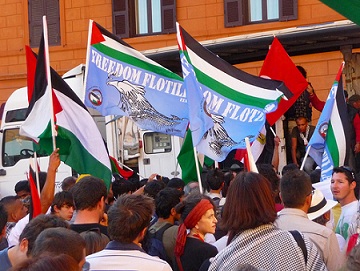 THE NATION– Amid the economic and social upheaval of Greece’s beleaguered capital city, where demonstrators have been protesting government-imposed austerity measures, forty activists from across the United States began training this week to nonviolently confront the Israeli military blockade of Gaza. The Americans are part of a flotilla of ten ships—from France, Ireland, Canada, Norway, Greece, Sweden and other countries—planning to set out for Gaza’s main seaport in the next week to relieve the siege.
  THINK PROGRESS
 ALTERNET
 GUARDIAN
 KURZWEILAI