MR Original – Afghanistan: Endless War for Resources

MEDIA ROOTS- This year marked the tenth anniversary of America’s invasion of Afghanistan, officially making it the longest war in US history. Now that Osama Bin Laden is finally confirmed dead, the federal government’s logic of continuing the occupation remains unclear.

Initially, the Bush administration irrationally insisted that any sovereign nation harboring terrorists was itself complicit in “terror” and therefore open for pre-emptive US military action. This rationale is absurd– just because one criminal might be living inside of a particular country doesn’t make that entire country guilty of the criminal’s crimes.

In 2002, Secretary of Defense Donald Rumsfeld was quick to tell CNN that US forces had successfully pushed the Taliban and Al Qaeda out of the region, and reports reveal that Osama Bin Laden hadn’t even been in Afghanistan since 2001. Additionally, a White House spokesperson recently admitted that there hasn’t been a terrorist threat in the country for the last eight years.

So what has the US been doing in Afghanistan for the last decade?

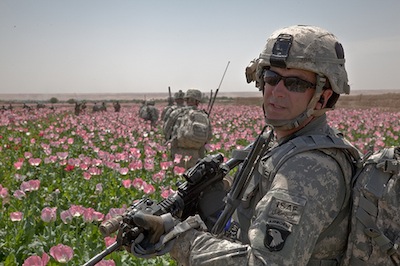
War has always been about two things: resources and control. Alongside the supposed surprise discovery of Afghanistan’s $1 trillion wealth of untapped minerals, it’s more than coincidental that before the US invasion, the Taliban along with the UN had successfully eradicated the opium crop in the Golden Crescent. Now 90% of the world’s heroin comes from Afghanistan.

As reported by Global Research:

Heroin is a multibillion dollar business supported by powerful interests, which requires a steady and secure commodity flow. One of the “hidden” objectives of the war was precisely to restore the CIA sponsored drug trade to its historical levels and exert direct control over the drug routes.

Immediately following the October 2001 invasion, opium markets were restored. Opium prices spiraled. By early 2002, the opium price (in dollars/kg) was almost 10 times higher than in 2000.

In 2001, under the Taliban opiate production stood at 185 tons, increasing  to 3400 tons in 2002 under the US sponsored puppet regime of President Hamid Karzai.

While highlighting Karzai’s patriotic struggle against the Taliban, the media fails to mention that Karzai collaborated with the Taliban. He had also been on the payroll of a major US oil company, UNOCAL. In fact, since the mid-1990s, Hamid Karzai had acted as a consultant and lobbyist for UNOCAL in negotiations with the Taliban.

In today’s globalized world, one can’t discount the role that multinational corporations play in US foreign policy decisions. Not only have oil companies and private military contractors made a killing off the Afghanistan occupation: big pharmaceutical companies, who collectively lobby over $250 million to Congress annually, need opium latex to manufacture drugs for this pill happy nation.

Another fact worth mentioning is that Karzai, a notable player in Afghanistan’s opium trade, has been receiving regular payments from the CIA since the invasion. Even more infuriating, the US government has been paying Taliban insurgents to protect supply routes and to “switch sides” in a poor attempt to neutralize the insurgency and buy loyalty from the fighters. The fundamental logic of funding both sides of the war to “win” is possibly the most incomprehensible concept to grasp. Clearly, this war is meant to be sustainednot won.

Fast forward to ten years later, and the turmoil within the country still looms heavy. Last Thursday, the Taliban claimed responsibility for a deadly attack that killed 27 US soldiers and wounded dozens more. Earlier this month marked the deadliest day for US troops since the war started when a rocket propelled grenade shot down a helicopter and killed 30 US soldiers.

In June of this year, Obama delivered a speech about drawing down in Afghanistan, which corporate media outlets touted as a major step to ending the war (Media Roots cut through the speech rhetoric). Yet, a glaringly under reported factor of the praised “drawdown” is the fact that even if the reductions are carried out as planned, the US will still have far more troops in Afghanistan than at any point during Bush’s administration. Furthermore, the US and Afghanistan are about to sign a strategic pact that will allow thousands of special forces troops to remain in Afghanistan until 2024.

Considering how the US is spending at least $6.7 billion a month in Afghanistan and over 55% of Americans think that the US should immediately withdrawal, this issue should be a constant hot topic in the public dialogue– especially amidst the debate of economic sacrifice. Yet in 2010, the corporate news only allotted a measly 4% of its coverage to the war in Afghanistan.

The unsustainability of America’s endless wars and imperialistic foreign policy is the elephant in the room that not enough people in the public arena seem to want to discuss. Sadly, because Americans are conditioned to not bring up politics and religion with others, many are confined to their own rigid perspective fed by biased corporate media outlets. We must begin to challenge this societal dogma if we ever want to progress our society and evolve our collective human consciousness.

Written by Abby Martin

Photo by flickr user DVIDSHUB
Corporate Profiteering in Palestinian Settlements

MEDIA ROOTS- Abby Martin from Media Roots reports the news for Project Censored’s KPFA morning show about the Verizon worker strikes and the role that multinational corporations have in Israel’s occupation of Palestine.

The segment features an interview with Dalit Baum, founder of “Who Profits from the Occupation”, an activist research initiative of the Coalition of Women for Peace in Israel that provides information about corporate complicity in the occupation of Palestine. She also directs Economic Activism for Palestine, which aims to support existing corporate accountability campaigns in the US.

Listen here or click to download below.

The Morning Mix with Project Censored – August 19, 2011 at 8:00am

Click to listen (or download)


For more information about companies involved in the occupation visit http://www.whoprofits.org/


Feral Capitalism Hits the Streets

MEDIA ROOTS- The London riots were mostly summarized as an animalistic decline of civil society by the corporate press, with too little analysis as to what societal, political and economic factors could cause such a backlash to occur. Since there was no apparent political motivation behind the rioting, it was easy to discard the actions as indiscriminate herd looting and burning by “feral teenagers.” Counterpunch writer David Harvey writes about how this breakdown is an inevitable outcome of living under a broken system of “feral capitalism,” where corruption and profiteering are rampant in almost every corporate and political sector.

Abby

***

COUNTERPUNCH– “Nihilistic and feral teenagers” the Daily Mail called them: the crazy youths from all walks of life who raced around the streets mindlessly and desperately hurling bricks, stones and bottles at the cops while looting here and setting bonfires there, leading the authorities on a merry chase of catch-as-catch-can as they tweeted their way from one strategic target to another.

The word “feral” pulled me up short. It reminded me of how the communards in Paris in 1871 were depicted as wild animals, as hyenas, that deserved to be (and often were) summarily executed in the name of the sanctity of private property, morality, religion, and the family. But then the word conjured up another association: Tony Blair attacking the “feral media,” having for so long been comfortably lodged in the left pocket of Rupert Murdoch only later to be substituted as Murdoch reached into his right pocket to pluck out David Cameron.

There will of course be the usual hysterical debate between those prone to view the riots as a matter of pure, unbridled and inexcusable criminality, and those anxious to contextualize events against a background of bad policing; continuing racism and unjustified persecution of youths and minorities; mass unemployment of the young; burgeoning social deprivation; and a mindless politics of austerity that has nothing to do with economics and everything to do with the perpetuation and consolidation of personal wealth and power. Some may even get around to condemning the meaningless and alienating qualities of so many jobs and so much of daily life in the midst of immense but unevenly distributed potentiality for human flourishing.

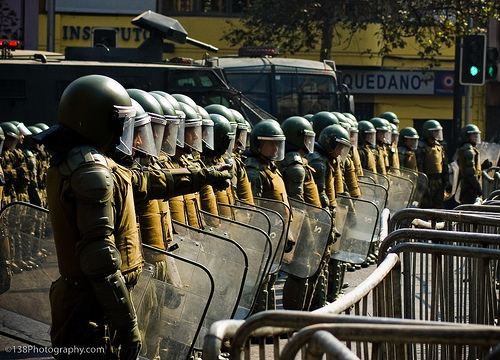
If we are lucky, we will have commissions and reports to say all over again what was said of Brixton and Toxteth in the Thatcher years. I say ‘lucky’ because the feral instincts of the current Prime Minister seem more attuned to turn on the water cannons, to call in the tear gas brigade and use the rubber bullets while pontificating unctuously about the loss of moral compass, the decline of civility and the sad deterioration of family values and discipline among errant youths.

But the problem is that we live in a society where capitalism itself has become rampantly feral. Feral politicians cheat on their expenses, feral bankers plunder the public purse for all its worth, CEOs, hedge fund operators and private equity geniuses loot the world of wealth, telephone and credit card companies load mysterious charges on everyone’s bills, shopkeepers price gouge, and, at the drop of a hat swindlers and scam artists get to practice three-card monte right up into the highest echelons of the corporate and political world.

Read the full article about Feral Capitalism Hits the Streets.

Written by David Harvey

© 2011 Counterpunch

Photo by Flickr user 138_photo

Hazare’s Anticorruption Supporters Picket Leaders

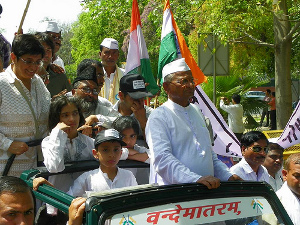
MEDIA ROOTS- Anna Hazare is a social activist who is leading the anticorruption movement in India by following Mahatma Gandhi’s  principles of nonviolence. He received worldwide attention with a four day hunger strike in early April that led to the Indian government conceding to his demand of enacting an anti-corruption law (based on the Lokpal Bill) for those holding public office.

On July 28, the Parliament approved a draft of the Lokpal Bill, which excluded the Prime Minister, judiciary and lower bureaucracy from the scope of proposed corruption. Hazare discounted the draft and announced that he would embark on an indefinite hunger strike starting August 16 until proper provisions were made to the legislation. After a brief arrest, Hazare started his strike a week ago and he is garnering support from millions across the country. Regardless of what the outcome of the strike may be, it is exciting to see a figure making corrupt politicians pay attention by practicing Gandhi’s satyagraha methods. Hopefully his method starts a ripple effect…

Abby

***

THE HINDU– Over 100 supporters of social activist Anna Hazare staged a dharna in front of the rented house of Prime Minister Manmohan Singh at Sarumotoria here on Monday. They beat drums, shouted slogans Anna Hazare zindabad and in support of the demand for tabling the Jan Lokpal Bill in Parliament.

The rented house of Dr. Singh, a Rajya Sabha member from this State, is owned by Hemoprova Saikia, former Assam Minister and wife of the former Chief Minister, Hiteswar Saikia.

Police arrived at the spot but Anna’s supporters dispersed peacefully after about half an hour. The protesters included Guwahati BJP MP Bijoya Chakravarty’s daughter and award-winning filmmaker Suman Haripriya and son Ranajit Chakravarty, a lawyer.

Security has been beefed up at Dr. Singh’s residence in the wake of the protests.

Anna’s supporters staged a dharna in front of the residence of the BJP MP also. However, there were no reports of demonstration in front of the houses of other MPs from Assam.

© 2011 The Hindu

Photo by Flickr user vm2827

Film: Fault Lines – The Top 1%

AL JAZEERA– The richest one per cent of Americans earn nearly a quarter of the country’s income and control an astonishing 40 per cent of its wealth.

Inequality in the US is more extreme than it has been in almost a century – and the gap between the super-rich and the poor and middle class people has widened drastically over the last 30 years.

Meanwhile, in Washington, a bitter partisan debate over how to cut deficit spending and reduce the US’ $14.3 trillion debt is underway. As low and middle class wages stagnate and unemployment remains above nine per cent, Republicans and Democrats are tussling over whether to slash funding for the medical and retirement programmes that are the backbone of the US’ social safety net, and whether to raise taxes – or to cut them further.

The budget debate and the economy are the battleground on which the 2012 presidential election race will be fought. And the US has never seemed so divided – both politically and economically.

How did the gap grow so wide, and so quickly? And how are the convictions, campaign contributions and charitable donations of the top one per cent impacting the other 99 per cent of Americans? Fault Lines investigates the gap between the rich and the rest.

Al Jazeera’s Fault Lines

Photo by flickr user J_D_R