
No Internet Privacy Due to CyberTerrorism Threat?


RT TV – The looming threat of cyberterrorism is being ramped up by the day–from government officials to mainstream media pundits–who say that cyberterror will soon outweigh terrorism as the number one security threat facing the United States.

It’s a threat that’s all too certain, as the federal government continues to make the claim stressing how it’s not a matter of if, but when a cyber attack will occur in this the US.  At a recent congressional hearing entitled “America is Under Cyber Attack: Why Urgent Action is Needed,” Subcommittee Chairman Michael McCaul exclaimed how “It’s not a matter of if, but when a cyber Pearl Harbor will occur.”

The rhetoric is so pervasive, that there is even an entire cyberterror exhibit called “Weapons of Mass Disruption” at the International Spy Museum in Washington, DC, a museum whose executive director spent 36 years at the CIA.  The room displays multiple disaster scenarios it claims are likely to happen when a cyber attack destroys the power grid and infrastructure of this country.

Mark Stout, historian at the International Spy Museum, explains that the room is not there to cause panic–it simply exists as a beacon of awareness about the issue.  He says that as technology advances along with our reliance on and integration with computer systems, it’s becoming more important to focus on cyberterrorism.  However, Stout does express the similar talking point of the likely possibility of this happening in the near future, warning that “there will come a time and it will be within our lifetime, probably relatively soon, that there will be a major cyber terrorist attack.” 

Also on display at the “Weapons of Mass Disruption” exhibit is a well produced graphic film reel of government officials and top military brass urging warnings about the threat.  “We know that there are half a dozen countries in the world that have developed cyber weapons,” states James A. Lewis, Director of Center for Strategic International Studies, in the film. 

However, the threat surpasses nation states.  The government is also pointing fingers at ubiquitous web entities such as Anonymous, the leaderless hacktivist group who has been shutting down highly secure government websites in addition to their repeated calls for mass civil unrest in the US.

Overall, the cyberterror hype seems to be working–a recent poll reveals that Americans are now more scared of cyberterrorism than actual terrorism. 

In response to the climate of fear, the federal government has already started to draft legislation to deal with the threat. The Cyber Intelligence Sharing and Protection Act, or CISPA, is a bill that would permit massive collusion between corporations and the government to gain access to private user data.  It has already passed the House, and is now awaiting a Senate vote.

Critics of the legislation warn that the bills proposed are too broad, and could pave the way for government abuse.  “When it comes to protecting our civil rights and civil liberties, we don’t usually give the government a blank check, and that’s what these bills have done in a lot of ways,” explains Matt Wood, Policy Director for Free Press.  He continues to describe how the government’s excessive response doesn’t match the threat, and that these laws could be used simply for corporations to capitalize off the elimination of privacy at the risk of impeding Net Neutrality.  “It could be a competitive threat, it doesn’t have to be something you and I define as a cyber security threat, just a threat to their current bottom line or business,” Wood states.

Whether or not CISPA passes the Senate, one thing remains clear.  The government will continue its constant attempts to control the Internet, and the blanket threat of cyberterrorism may be the perfect avenue to convince the people of this country into giving up their rights to privacy on the Internet once and for all.

Written by Abby Martin for RT TV

Photo by flickr user AdamSelwood
MMT: Why the USA Is Not Broke

EnablingStructuresNEPMEDIA ROOTS — If you’ve taken Economics 101, you may have had the same realisation I did when the course reached the part where the USA, for example, goes off the gold standard and the dollar becomes a purely fiat currency with no gold or anything tangible backing it.  When the issues of the business cycle arise, the inherent boom and bust cycles of our capitalist system, and the citizenry, economists, and legislators face the questions of what to do about those recurrent economic recessions, conventional economics says we must cut spending and raise taxes. 
And, of course, those actions will be undertaken on the backs of the working-class and in favour of the ruling-class with regressive taxes and budget cuts.  Yet, one common sense solution was obvious given the USA’s fiat (or sovereign) currency:  Why doesn’t government simply print (or issue) more money, so small businesses can operate, hospitals and schools can be well-funded and accessible to all, and so on?  But our academic and civic culture has been so indoctrinated by neoclassical economic dogma the immediate rebuttal, not open for debate, simply insists that would be inflationary.  Yet, commercial banks create credit currency all the time, but neoclassical economics doesn’t decry those commercial activities as inflationary.

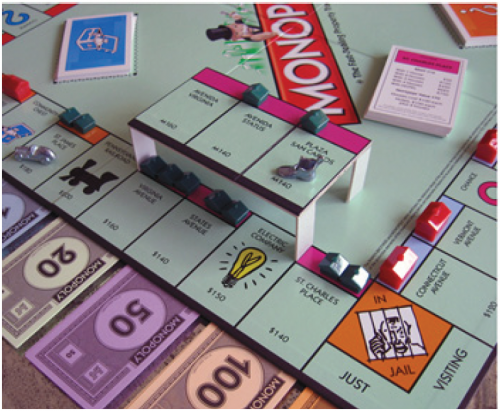
Thus, many of us have been impressed by the Modern Money Theory (MMT) school of political economics, which empirically confirms such common sense ideas as valid.  Media Roots featured Guns and Butter broadcasts of the recent MMT Summit in Rimini, Italy.  Particularly, Dr. Stephanie Kelton’s presentations explain what money actually is, how it works today, and how MMT presents viable alternatives to the fiscal austerity now being imposed on Europe and being proposed for the USA by the same banking and financial elites.  In a new article published at New Econonomic Perspectives, J.D. Alt uses the children’s game of Monopoly to help us rethink its objective as well as conventional notions of money, banking, and finance.  Alt helps us understand why the USA is not broke and fiscal austerity is not inevitable.

Messina

***

NEW ECONOMIC PERSPECTIVES — Why does it seem like there isn’t enough money to pay for the things we really need? The headlines are filled with stories about our nation’s “debt problem” and dire warnings about our impending “bankruptcy.” As an architect who fills his waking hours thinking up all kinds of wonderful things we could be building, I’m alarmed by the idea there isn’t enough money to pay for any of them. Before wasting more time dreaming, I had to find out: Is it really true? Are we reallytoo poor to put America back to work making and building the things we need to maintain a prosperous nation?

Searching for an answer, I discovered a small (but growing) group of economists (see here, here, here, here, here, here) who represent an emerging school of thought known as “modern monetary theory” (MMT). These men and women are valiantly trying to make us all understand a paradigm shift that occurred some forty years ago, when the world abandoned the gold standard. Their key insight shocked me: A sovereign government is never revenue constrained when it is the Monopoly issuer of its own pure fiat currency; it has all the money that’s needed to put its citizens to work building anything—and providing any service—that is desired by the public (provided the real resources are available). Even more remarkable, sovereign “deficits” in the fiat currency are just the accounting record of the surpluses that have been injected into the private economy. Eliminating the sovereign currency deficit by imposing austerity will not make the economy healthier; it will, in effect, bankrupt the citizens!

If this seems to defy logic, stay with me for just a few minutes. I’m going to propose a simple exercise that will help you “see” this reality for yourself. The exercise is simply that everyone join me in a familiar game of Monopoly. By the end of the game, I hope to convince you that MMT is correct and that we could be doing better, much better – for ourselves and future generations—if we just understood and took ad vantage of our modern monetary system.

Read more about Playing Monopolis Monopoly: An inquiry into why we are making ourselves so miserable.

***

Photo by flickr user Enabling Structures NPG

Posted in Uncategorized | 1 Reply

Jazz Composition – Occupy EP by Collin Shook Trio

MEDIA ROOTS – This is a beautiful jazz ensemble all recorded live with no cuts by the Collin Shook Trio.  Inspired by the Occupy Wall Street Movement, the jazz musicians decided to make an EP dedicated to OWS activism and the spirit of revolution.  It’s an amazing and especially inspiring EP considering the intent and the meaning behind each song.  Please take a listen and consider supporting musicians who choose to use their incredible talents to reflect the spirit of the time.
Abby

***

CS: This tune was born in November of 2011. I had written a 2 movement piece called #Occupy after perusing #OccupyTucson for a few days. Only then did I finally put this one down to paper. I named it Derivatives, partly because they are a major part of the economic recession which stemmed the #Occupy Movement.


CS: Prelude To Occupation is a tune we composed as a part of a 3-Piece Suite that expresses a sense of wandering, stirring energy.  With a repetitive theme, it explains the building energy of the same-old same-old things happening over and over again, just like the elite continually taking profits off the top of all commerce in the US and pocketing it, leaving the working class unable to stay ahead.


CS: #Occupy: Movement 1 is a ballad that embodies the lull and complacency that takes place before a public reaction. It’s the gathering energy and whispers in the dark that stir up the masses and spread information.  From the prelude to Movement 1, it shows the dissipation of action and is the quiet before the storm.


#Occupy: Movement 2 is the current embodiment of the uprising. The bass solo at the top of the song is in alignment with the slow start to the movement. Once the band drops in, the pushing 3 chord, break-beat feel creates momentum.

Each change to the bridge is riding the wave of little pockets of demonstrations springing up all over, then returning to the constant motion of the A section. Each B section gets more and more dissonant and finally ends with an unresolved tonality, expressing the unfinished motives of the #occupy Movement.


***

This is a live recording from Skybar in Tucson AZ on April 2nd, 2012. 

From #Occupy EP, released 12 April 2012
Collin Shook – Composer and Keyboards
Dylan DeRobertis – Bass
Matt Pirc – Drums
Recorded With 2 Mics and Reaper DAW

http://www.collinshookmusic.com/


Elvis Presley, Nixon And The Origins of The DEA

MEDIA ROOTS  October 3rd, 1970, Elvis Presley wrote the following letter to Richard Nixon:
“First, I would like to introduce myself. I am Elvis Presley and admire you and have great respect for your office. I talked to Vice President Agnew in Palm Springs three weeks ago and expressed my concern for our country. The drug culture, the hippie elements, the SDS, Black Panthers, etc. do NOT consider me as their enemy or as they call it The Establishment…

I will be here for as long as long as it takes to get the credentials of a Federal Agent. I have done an in-depth study of drug abuse and Communist brainwashing techniques and I am right in the middle of the whole thing where I can and will do the most good. I am Glad to help just so long as it is kept very Private.”

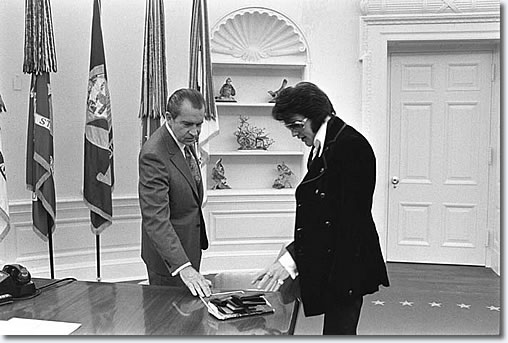
On December 21st, 1970, Elvis Presley was invited to the White House for a personal meeting with Richard Nixon and his advisors.  To pre-empt said meeting, Nixon was given a briefing that stated:

“PURPOSE:

To thank Elvis Presley for his offer to help in trying to stop the drug epidemic in the country, and ask him to work us in bringing a more positive attitude to young people through-out the country...

Suggestions for Presley activities: 

*Encourage fellow artists to develop a new rock musical theme, ‘Get High on Life'”

After this fruitful meeting between the two men, Nixon sent a letter in response to Elvis:
“It was a pleasure to meet with you in my office recently, and I want you to know once again how much I appreciate your thoughtfulness in giving me the commemorative World War II Colt 45 pistol, encased in the handsome wooden chest. You were particularly kind to remember me with this impressive gift.” 

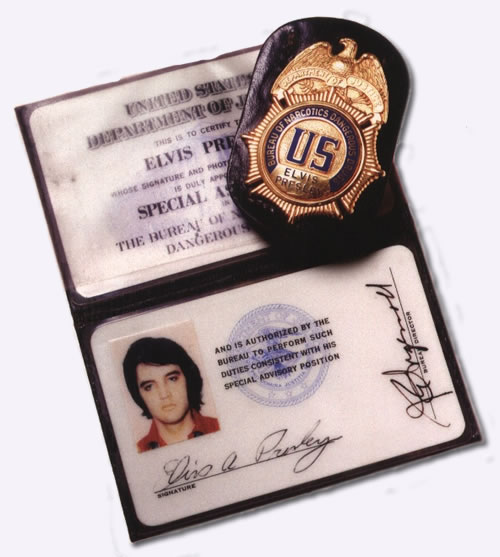
President Nixon had presented Elvis with an ‘honorary’ badge granting him superficial status as a drug enforcement agent, predating the formation of the DEA.  The seeds planted in this meeting and orchestrated PR campaign eventually lead to the formation of the Drug Enforcement Administration.  When Elvis received the badge, the Washington Post described the scene (via January 27th, 1972):

“By presidential dictum, Elvis Presley, the swivel-hipped singer, has been issued a federal narcotics badge. The Emotional Presley was so overwhelmed at getting his own genuine, gold-plated badge that tears sprang from his eyes, and he grabbed President Nixon in a Hollywood bear hug.”

Officially the agency known as the Drug Enforcement Administration, or DEA, was established on July 1st, 1973, with a signing order by President Richard Nixon.  The act effectively combined the Bureau of Narcotics and Dangerous Drugs (BNDD) and the Office of Drug Abuse Law Enforcement (ODALE) under one umbrella.  We will continue to write more about the origins of the DEA on Media Roots in the coming months, but for now enjoy this actual happening as surreal as it may seem. 


Robbie Martin for Media Roots

***

When Nixon Met Elvis


Photographs Public Domain

Read a PDF and Photographic Archive of When Elvis Met Nixon Here

***

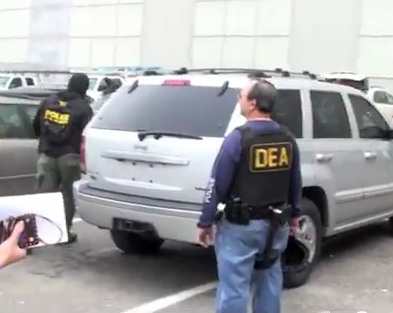
DEA ‘Forgets’ Prisoner in Cell for 5 Days


MEDIA ROOTS – You often hear the term Gulag and think of a secret prison in a third world dictatorship, where its purpose is to break you down, humiliate and torture you.  This style of imprisonment has been frequently used by members of the US military in Afghanistan, Gitmo and Iraq. 

Torture and ‘enhanced interrogation techniques’ fall outside of the realm of the Geneva Conventions since those imprisoned are deemed ‘enemy combatants’ instead of prisoners of war.  Labeling such prisoners as ‘enemy combatants’ is nothing more than a flimsy legal loop hole that gives the military carte blanch to treat them however they would like, without due process.  It’s hard to believe that someone would experience a similar fate on American soil.

Recently, in San Diego, California, a UCSD student named Daniel Chong was arrested during a 4/20 marijuana drug raid and left in a holding cell without charges for over five days.  He was without food, water, toilet, or human contact of any kind.  Chong eventually resorted to drinking his own urine and eating a bag of white powder he discovered in the cell, which turned out to be meth amphetamine–only exacerbating his psychotic state.  He described attempting to commit suicide with broken glass from his glasses and said that the he literally lost his mind and didn’t think he would survive. 

The DEA and San Diego police claim that this is a unique incident that rarely ever happens.  They chalk it all up to a “mistake,” stating that someone simply “forgot to go check on him.”  Whether or not the person [or people] accountable for driving Chong insane and leaving him to potentially meet his demise for the crime of smoking marijuana is yet to be seen.

Robbie Martin for Media Roots

***

HIGHLANDER NEWS – For nearly five days, Chong sat alone in a room with no food, no water and no toilet. Chong told CBS News that he kicked the door many times and screamed for help, but his cries were ignored. “I just couldn’t believe that this was legal,” Chong told the AP. “I’m thinking ‘no way.’”

He drank his urine three times due to dehydration and unknowingly consumed methamphetamine after finding the drugs in the cell; the DEA has yet to explain why the methamphetamine was found in the holding cell.

“The DEA’s protocol was so sloppy that somebody who was a previous prisoner secreted a small amount of meth in a plastic bag inside a blanket,” stated Chong’s attorney, Gene Iredale, in an article by the LA Times. It is unclear whether the hallucinations that Chong experienced were caused by the drugs or other severe ailments such as starvation.

Chong told the New York Times that on the fourth day, the lights shut off in his holding cell. Chong, contemplating suicide, chewed into his glasses and attempted to carve the words “Sorry mom” into his arm using a glass shard. “I pretty much lost my mind,” he told the Associated Press.

Agents found Chong on the afternoon of April 25, covered in his own feces but still conscious. “He is glad to be alive,” Iredale said of Chong. “He wants to make sure that what happened to him doesn’t happen to anyone else.”

Continue Reading UCSD student left in DEA cell for 5 days sues for 20 million.

Photo by Robbie Martin