


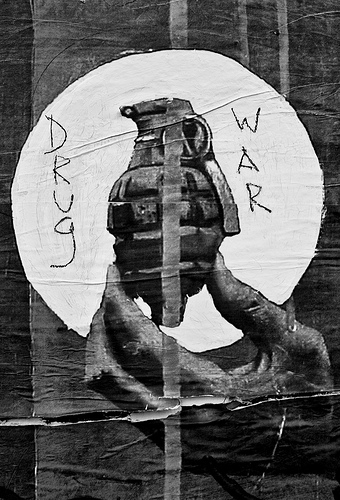
 MEDIA ROOTS — Pretext for ulterior motive is the standard operating procedure for US/NATO imperialism. Like the so-called War on Terror, the so-called War on Drugs is equally preposterous in its lack of credibility, serving only the function of justification for increasing police state control of our everyday lives, the enrichment of the ruling-class 1%, and totalitarianism. Media Roots contributor Christian Sorensen concludes part two of his two-part series on the global War on Drugs. In the first installment, Sorensen discussed how we got here; this installment discusses where we are now.
Messina
***
FEAR AND THREATS
Since Pentagon’s comportment in the War on Terror and the War on Drugs is nearly identical, Pentagon officials have abandoned any attempts at separating the two. Today, the Pentagon actively attempts to tie War on Terror and the War on Drugs together. Aligning well with scare tactics of powerful lobbies, the Pentagon is interested in using fear of terror in order to expand its military hegemony in Latin America. Secretary of Defense Panetta frames the situation; the threat of violent extremism is spreading throughout Latin America, according to Panetta. “We always have a concern about, in particular, the [Iranian Revolutionary Guard] and [their] efforts… to expand their influence, not only throughout the Middle East but also into this region… In my book, that relates to expanding terrorism.” Senior officials allege that “narcotics trafficking, transnational organized crime, and terrorist networks form a nexus that increasingly requires an interagency and coalition approach to combat effectively.”
General Fraser presents Iran’s “connections” with Hezbollah “terrorist groups” as a concern, even dedicating an entire section of his posture statement to Violent Extremist Organizations and Influence of Iran. According to Fraser, those organizations raise funds in Latin America, but are also “involved in illicit activity.” So we continue to watch “that connection between the illicit activity and the potential pathway into the United States.” General Dempsey spreads fear that terrorists could use the drug trade networks to smuggle themselves and weapons of mass destruction into the United States. Dempsey’s predecessor professes transnational drug crime “ties in very nicely with the support of terrorists.” One assistant Secretary of Defense asserts “criminals” and “insurgents” are “nearly indistinguishable.” Dempsey promises “the time to pressure this network is now, and we are.”
General Fraser is short on reasons to be fearful of “a number of violent extremist organizations” in Latin America, so he was forced to dig deeply. Fraser cited a bombing from 18 years ago as reason to be alarmed of radical clerics in Latin America. Scrounging for links, Fraser mentioned Jamaica’s Sheikh Abdullah al-Faisal as an example of efforts of “the radicalization of converts and other Muslims.” Fraser also referenced the “government’s successful detection and thwarting of the plot to assassinate the Saudi ambassador to the United States” as reinforcing “the importance of that monitoring and the effectiveness of U.S. countermeasures.” (This “plot” was widely panned by former U.S. intelligence and military officials as a potential false flag, including former-CIA case officer Robert Baer). The Deputy Assistant Secretary of Defense for Counternarcotics and Global Threats repeated the Saudi plot as proof that traffickers and terrorists are now “working together in ways that previously we hadn’t seen.”
Other Pentagon officials, like Michael Sheehan and William Wechsler, formally united the War on Terror with the War on Drugs. Since “terrorism, drug trafficking and other forms of transnational organized crime are increasingly intertwined,” Sheehan advises that the Pentagon must “leverage all of the elements of national power to protect citizens and U.S. national security interests and to enable our foreign partners to do the same.” According to Sheehan, terrorism and organized crime needs a response governed by complementary, mutually reinforcing, and increasingly related strategies. Wechsler, a bureaucrat with a background in entirely in corporate finance, ties Terror and Drugs together, noting: “Loose criminal networks… have diversified their illicit activities and also may have connections with other hostile actors, including terrorist groups, insurgencies and elements of rogue or hostile states.” Fear is the Pentagon’s substrate, nourished through unsubstantiated, inflated claims.
Exploitation isn’t limited to Latin America. The Pentagon now uses the War on Drugs to reinforce its military presence in Europe and Africa. Brigadier General Scraba explains that drug traffickers have allied with terror networks in Europe too, which results in “far more sophisticated criminal networks able to operate across national borders.” Admiral James Stavridis established the Joint Interagency Counter Trafficking Center (JICTC) in Stuttgart in order to confront this matter, which he described as “a major national security threat to the United States.” AFRICOM has a similar center known as Counternarcotics and Maritime Interagency Operations Center. Stavridis refers to these entities as “fusion organizations.” Realists refer to them as tools of military imperialism. Secretary Panetta calls them instruments for “promoting security” and “promoting peace.” Sadly, all of the Pentagon’s geographic Combatant Commands incorporate counter-narcotics programs into their theater campaign plans. No matter the location, the Pentagon uses fear to subdue self-determination, independent military action, or non-capitalist inclinations.
ARROGANCE and IGNORANCE
If the fear-mongering and corporate greed inherent to the military-industrial complex don’t scare Latin American leaders, then arrogance and ignorance might. For example, General Dempsey (Scalopus Pentagonus) is only able to view entire continents through the neo-colonial lens of military power. He finds South America and Africa “fascinating,” and calls these continents “theaters,” employing the imperial nomenclature of the Pentagon’s lexicon, which long ago divided the entire world into Areas of Responsibility. Despite economic, geographic, and cultural differences, Dempsey insists that “security issues… manifest themselves similarly” across all South American countries.
Defense Secretary Panetta’s ignorance is especially notable. Panetta claims “the United States and Chile are neighbors, we are friends, and we have built a longstanding defense relationship founded on mutual respect, shared values and the goal of advancing peace and stability in this hemisphere and beyond.” Certainly, Panetta recognizes the arrogance and deliberate misdirection inherent in his own words. He either never learned about USA’s support for General Augusto Pinochet or he slyly ignored it; Panetta is either ignorant about history or a cunning political operator. Neither bode well for Latin America.
Pentagon officials display more ignorance when viewing diplomacy as threatening. General Fraser points out Iranian President Ahmadinejad (the U.S. corporate media’s current demon of choice) had visited Latin America six times in six years. According to Fraser, Iran has also established dozens of Shi’a cultural centers across Latin America. Yet the General fails to mention that religious missionary work is inherent to all three Abrahamic religions. U.S. Christian missionaries, for example, have had far more success than Iran at establishing religious centers in Latin America.
Finally, Fraser spreads thick irony when affirming that USSOUTHCOM works with “other U.S. government agencies and international partners’ military and law enforcement agencies to track, capture and prosecute people who have made several countries in the Americas the most violent in the world.” USSOUTHCOM, the un-appointed police force of the Americas, is calling others “violent.” To repeat, a Unified Combatant Command in the world’s largest military is calling others violent. The Pentagon’s blindness is remarkable, especially since Fraser insists that the mission in Latin America “is one that stresses us, if you will, to think differently.” Despite Fraser’s words, the Pentagon continues expanding and throwing money and weaponry at social and economic issues.
DISSENT, LOUD AND CLEAR
The War on Drugs has failed, according to the Global Commission on Drug Policy, a high-level international panel comprised of many public policy experts and former heads of state from Greece, Poland, Colombia, Mexico, and Brazil. The Commission’s concludes:
“Vast expenditures on criminalization and repressive measures directed at producers, traffickers and consumers of illegal drugs have clearly failed to effectively curtail supply or consumption. Apparent victories in eliminating one source or trafficking organization are negated almost instantly by the emergence of other sources and traffickers. Repressive efforts directed at consumers impede public health measures to reduce HIV/AIDS, overdose fatalities and other harmful consequences of drug use. Government expenditures on futile supply reduction strategies and incarceration displace more cost-effective and evidence-based investments in demand and harm reduction.”
The Commission recommends: end the criminalization of non-violent drug users; encourage governmental experimentation with various legalization strategies; treat and rehabilitate those who require assistance; respect the human rights of all participants, including farmers and couriers; end prohibition; and re-schedule drugs in order to address blatant anomalies, like classifying marijuana and MDMA as Schedule 1 Controlled Substances.
Two passages from the Commission’s report are of particular importance:
“Replace drug policies and strategies driven by ideology and political convenience with fiscally responsible policies and strategies grounded in science, health, security and human rights – and adopt appropriate criteria for their evaluation… Ensure that the international conventions are interpreted and/or revised to accommodate robust experimentation with harm reduction, decriminalization and legal regulatory policies.”
“Arrest and incarceration has filled prisons and destroyed families without reducing the drug availability or weakening criminal organizations. Drug control resources are better directed elsewhere.”
In addition to the refreshing rationality of these recommendations, former presidents of Mexico, Colombia, and Brazil candidly affirm USA’s War on Drugs is a failure. In urging the U.S. to debate drug legalization, former Colombian President Cesar Gaviria accurately stated “society is spending $40 billion each year in fighting drugs… and has more than 500,000 people in jail. But they are spending that money in a way that is not efficient. The consumption is not being reduced.” At the recent Summit of the Americas, Guatemalan President Otto Perez Molina strongly promoted decriminalizing drugs as a means by which to tackle the drug problem. Former Mexican President, Vicente Fox, advocates the benefits of legalization: less violence. Embracing the language of diplomacy, incumbent Mexican President Felipe Calderon feels “misunderstood” in agreeing to the U.S. War on Drugs. As a partial result of its antiquated drug policies, USA was quite isolated at the most recent Summit of the Americas.
WAR SOLVES NOTHING
After decades of war against drugs, nothing is solved.
U.S. generals, politicians, and Senior Executive Service careerists throw weaponry, exercises, operations, and interagency collaborations at drugs, but none addresses U.S. demand. Pursuing the production and transportation of drugs, which is the primary focus of the War on Drugs, will never reduce U.S. demand. According to rudimentary economics, supply will always meet insatiable demand. We, the citizens of the United States of America, are the world’s biggest market for cocaine. (We also consume 80% of the world’s opiate pain-killers). According to the Congressional Research Service, the U.S. demand for drugs has actually “enhanced the power of Drug Trafficking Organizations, other allied gangs, and organized criminal groups.” Since “war” was declared, drug use in the United States has actually increased.
The costs associated with the Drug War are astounding. Billions are spent annually. USSOUTHCOM has spent $8 billion in Colombia alone in less than ten years. Billion dollar initiatives like Plan Colombia and Merida are failures. Over $1 trillion has been spent in total. According to Harvard Professor Jeffrey Miron, “current policy is not having an effect of reducing drug use, but it’s costing the public a fortune.” Other costs are equally exorbitant; untold amount of fuel, funding, manpower, and energy are sunk into the War on Drugs. The U.S. Navy, Air Force, DEA, ATF, ICE, CIA, State Department, CBP, NSA, AFISR, and FBI all grab a bureaucratic piece of the War on Drugs pie. Detection, monitoring, interdiction, and detention equipment are continually purchased, used, refurbished, and wasted. President Obama even declared organized, transnational crime a “national emergency,” allowing for the United States to summon more funding and resources to the “battle.”
Lives are also wasted. USSOUTHCOM General Fraser acknowledges 67,000 murders in Central America from 2007-2010. At least 45,000 have died in Mexico since 2006. Some place the figure at 47,515 deceased Mexican citizens since late 2006. Other estimates indicate 50,000 dead in Mexico over the same timeframe. Defense Secretary Panetta acknowledges 150,000 murders in Mexico in the War on Drugs in total. The body bags pile up daily. An untold number of men, women, and children have been disappeared. A human being is killed in Honduras every seventy-four minutes. In May 2012, DEA helped kill 4 civilians in Honduras. Unfortunately, there are no statistics that can enumerate injuries, grieving souls, lost potential, or sacrificed democracy.
Imagine the national-level impact if USA ceased its War on Drugs. USSOUTHCOM’s entire bureaucratic existence would crumble. The profits of “defense contractors” (e.g. Booz Allen Hamilton, CACI) would diminish. CBP might actually have to admit to the system’s racism. D.C. think tanks would fold. Retired generals, like Barry McCaffrey who profits from promoting conflict, would creep quietly into obscurity. South American Defense officials, who live in relative opulence and who benefit from syphoning from the Pentagon’s neural plug, would also shrink into the darkness. Leading U.S. bureaucrats would be forced into early retirement, including the Assistant Defense Secretary for Homeland Defense, the Deputy Commissioner for Customs and Border Protection, and the Chief of U.S. Border Patrol. Pentagon officials like Michael Sheehan, Garry Reid, William Wechsler, and USSOUTHCOM’s entire leadership would have to find other pretexts to justify military hegemony. These senior U.S. officials are the real criminals. Instead of helping their fellow global citizens, they kill thousands throughout the Americas, incarcerate millions domestically, and waste billions of taxpayer dollars. This simple exercise in imagination highlights how innumerable officials need the War on Drugs to justify their presences.
ALTERNATIVES
U.S. drug laws are unsustainable, specifically unjust marijuana laws. Unjust laws are legal codes, which a powerful group compels everyone to obey, but does not make the law applicable to their elite friends. For example, the rich men who compose a majority in U.S. Congress, have access to premiere legal teams, and carry white skin tones, are not prosecuted in similar proportion to African-American males on marijuana charges. African-Americans are “arrested for marijuana possession at twice, three times, or even four times the rate of whites in every major country of California… This seems especially unfair, because young blacks actually smoke marijuana less than young whites.” Moreover, the out-group is unable to enact new legislation or change the status quo in any meaningful way, since common voting power in the United States drowns beneath corporate lobbies’ overwhelming influence.
Instead of enduring war, the United States can embrace decriminalization or legalization. Under decriminalization, personal drug possession and usage are legally prohibited, but not punished as criminal violations. Under legalization, all drug use is legal; possession and distribution is not punishable by law. With legalization, U.S. adults are responsible for the welfare of their own bodies. Both systems are preferable to war, murder, corporate exploitation, militarization, incarceration, racism, and all the other debilitating trends accompanying the current War on Drugs.
In July 2001, Portugal decriminalized all drugs. Glenn Greenwald, a constitutional scholar and successful author, analyzed Portugal’s decriminalization. Evidentially, decriminalization of all drugs was a boon for Portuguese society. According to Greenwald, “judged by virtually every metric, the Portuguese decriminalization framework has been a resounding success” and “has had no adverse effect on drug use.” Many corollary benefits also occurred, including no increase in drug use among youth and dramatic reductions in sexually transmitted disease.
Greenwald concludes: “By freeing its citizens from the fear of prosecution and imprisonment, Portugal has dramatically improved its ability to encourage drug addicts to avail themselves of treatment. The resources that were previously devoted to prosecuting and imprisoning drug addicts are now available to provide treatment programs to addicts.” The model of decriminalization can certainly be applied to the United States, but it doesn’t necessarily address issues like drug trafficking, murder, and military excess.
There are numerous benefits to legalization. By definition, legally regulated and distributed drugs would displace and eventually replace illegal drug traffic from Latin America. Keeping drugs illegal places production and distribution in the hands of criminal elements. Hence, legalizing drugs allows licit business entrepreneurs to embrace new markets. Criminal elements are naturally excluded from the picture. According to a RAND study, if both Mexico and the United States were to legalize marijuana, “the economics of the trafficking cartels would take a serious hit.”
With legalization comes taxation. Profits from the hemisphere’s drug trade, which some officials place at roughly $400 billion per annum, can be mainstreamed and taxed. Benefits resound. For example, taxation of intrastate drug sales could provide California with sufficient funding for its public education system, which suffered cuts due to years of government irresponsibility. Furthermore, all funding that was once allocated to the pursuit, seizure, and destruction of illegal drugs, in addition to the incarceration and judicial prosecution of those who use drugs, could be spent more effectively on public educating and brightening the futures our children. Drug taxation is a tremendous asset for the U.S. government whose policymakers are always pressed to find more funding avenues. In addition to billions of dollars in state revenue, legalization would allow law enforcement and judicial professionals to turn their attention to the real bad guys: murderers, rapists, and thieves.
An excerpt from a New York Times article in 1970 sums up the ideal approach:
“It is possible to stop most drug addiction in the United States within a very short time. Simply make all drugs available and sell them at cost. Label each drug with a precise description of what effect – good and bad – the drug will have on the taker. This will require heroic honesty. Don’t say that marijuana is addictive or dangerous when it is neither, as millions of people know – unlike “speed,” which kills most unpleasantly, or heroin, which is addictive and difficult to kick.”
POLICY CORRECTIONS
Ultimately, some combination of decriminalization (for the hard drugs) and legalization (for marijuana) will likely take effect as the unsustainable War on Drugs collapses. When this occurs, several policy corrections are necessary. Firstly, treatment and rehabilitation, which are more cost effective than war and incarceration, can be favored for hard drug users. Instead of incarceration and punishment, those who suffer from addiction to hard drugs can recuperate through treatment and recovery, benefitting society in the process. Secondly, USA can learn from the Brazilian model and only deploy its military to countries that have a United Nations mandate. Social wars, whether on drugs or terror, can be entirely avoided. Thirdly, funding hitherto allocated to the Inter-American Development Bank (IADB), the International Narcotics Control and Law Enforcement (INCLE), and the Economic Support Fund (ESF) for use in the War on Drugs can now be used solely to boost economic development, reduce poverty, or enhance education throughout Latin America. Fourthly, U.S. Congress needs to be held accountable. Potential remediation includes imposing term limits on all representatives and senators, banning corporate personhood, and restricting lobbying in its current form.
Many traditionalists will opposed positive changes. Some gentle truths ease the mental block. Firstly, god, however defined, created all marijuana and coca plants. Secondly, George Washington grew marijuana; hemp’s industrial uses are manifold. Thirdly, men and women throughout Latin America turn to agriculture to provide for their families. None, especially coca farmers in Colombia, are terrorists in our War. They raise a crop, no different than raising fruit. Fourthly, the principle of states’ rights demands that the federal government cease raiding California marijuana dispensaries, which are legally incorporated under California law. (See HR 2306 for a resolution that would allow states to regulate respective strategies to deal with marijuana). Fifthly, a majority of U.S. citizens favor legalizing marijuana. Sixthly, it’s patriotic, just, and in complete concord with our Declaration of Independence and U.S. Constitution to question the Pentagon’s abuse of power. We would oppose the disgrace known as the War on Drugs if we were true heirs to the revolution of 1775. Finally, marijuana and coca have been around for thousands of years, and will outlast the DEA’s existence by thousands of years.
In the meantime, Latin American governments can push back. Currently, “enhancing security capacity” means submitting to U.S. military hegemony and corporate interests. If any Latin American country desires their “security” to be enhanced in that manner, then all parties must recognize that USA will use its “whole of government,” all of its interdiction capabilities, and its full spectrum of monitoring technologies in order to achieve its objectives. But you don’t have to take my word for it, as all aforementioned examples illustrate. To avoid hegemonic nightmares, every Latin American country can follow Ecuador’s lead and not renew leases for U.S. military bases. Instead of entertaining Washington’s imperial drive, all can just say no. Together, they can. Certainly, the U.S. government will try and maneuver to stay in Latin America by threatening to withdraw Foreign Military Financing and economic aid from assertive countries. This is not a problem. Governments can easily recoup that amount through agriculture profits, free from Pentagon oppression, and by decreasing defense spending. What was once spent on aiding and abetting USA’s drug war can now be spent on social services and education.
Rebellious pioneers motivate those who resist the Pentagon’s imperialism in the United States and throughout Latin America. The indefatigable Bob Marley rhetorically rallies our collective spirit: “How long shall they kill our prophets while we stand aside and look?” Percy Bysshe Shelley incites us to “rise like lions after slumber, in unvanquishable number” and shake our chains to earth like dew. For, we “are many, they are few.”
Written by Christian Sorensen for Media Roots
Additional labour by Messina
***
Photo by Flickr user Brandon Doran
 MEDIA ROOTS – Being held in a solitary cell with virtually no human contact for long periods of time is tantamount to torture. Human beings are social creatures that are supposed to move and interact with other humans–being cramped in a small box and denied human contact is proven to cause massive psychological damage as well as physical deterioration.
  MEDIA ROOTS — The ‘Fair Share of the Common Heritage’ is a philosophical economic principle that every sentient being—human and non-human—has a right to a fair share of the wealth derived from the earth’s natural resources and humankind’s accumulated cultural knowledge.