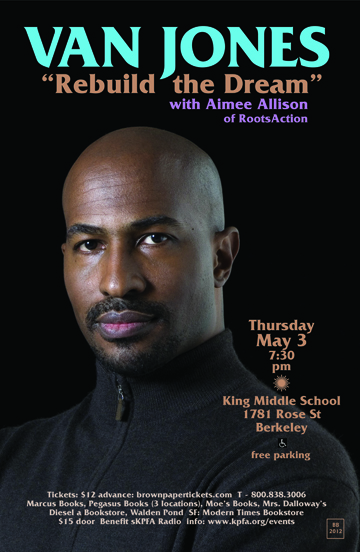
Van Jones Shills for Obama at Berkeley KPFA Benefit

VanJonesBerkeley050312MEDIA ROOTS The San Francisco Bay Area, particularly Berkeley, is known as one of the progressive or revolutionary regions of the USA, being the home of the 1946 Oakland General Strike, the Free Speech Movement, ‘60s counterculture, the Black Panthers, and the listener-sponsored free speech radio model popularised by Berkeley’s KPFA and its Pacifica Radio Network (later bastardised by PBS and NPR), to cite a few salient above-ground examples. 

And today, arguably, one of its most famous activists, Anthony Kapel “Van” Jones, is also one of its most influential.  After joining Obama’s Administration in March of 2009, ostensibly, to further Van Jones’ Green Jobs agenda (or to be co-opted), his fame has only increased.  Last week, VJ returned to the Bay Area for a KPFA fundraising event for the first time since his resignation from Obama’s White House, succumbing to pressure from right-wing pundits, such as Glenn Beck, and taking one for the team, as it were.

Van Jones began his speech (at least per KPFA’s Flashpoints broadcast of excerpts) with a walk down memory lane of his activism and community organising, with thanks to KPFA each step of the way.  VJ discussed criminalisation and mass incarceration of youth and his successes with the Oakland-based Ella Baker Center for Human Rights.  VJ went on to describe his realisation of the importance of jobs, labour issues, and political economy.  Although his work with Books Not Bars was reducing youth incarceration rates, he said, lack of jobs meant working-class youth largely ended up in the adult prison-industrial complex.  This led VJ to publishing his 2008 book The Green Collar Economy on green jobs, melding the working-class need for jobs with the need for an ecologically sustainable society.

Van Jones’ KPFA benefit speech, essentially on behalf of his reputation, also spoke to his retreat from the White House, but morphed his personal explication into Obama apologism and a get-out-the-vote entreaty toward Obama’s 2012 re-election campaign.  Essentially, VJ returned to Berkeley to preach to the choir, but with a shocking, maybe not so shocking, proposal: 

Progressives, activists, Leftists, anarchists, and liberals, all who are aware of the litany of crimes accumulated by Obama, must vote for Obama to give him another four years to continue US/NATO imperialism and the evisceration of the Constitution. 

Maybe Van Jones didn’t say that in so many words, but with his own special brand of charm and charisma, that was the essential thrust of his speech. 

With the electoral vacuum among progressives, activists, and the Occupy Movement—not to mention the anarchist rejection of democratic elections and the, perhaps, illusory goal of a stateless world—in general, Van Jones is poised to be Obama and the Democrat Party’s number-one salesman to the Left.  But the establishment knew that in 2009 and they know that very well in 2012.

But in understanding, Van Jones’ political outlook, we must clarify certain misperceptions.  For example, there’s a widespread false narrative, which Van Jones seems content to perpetuate, which holds Van Jones was “cast out of the Obama Administration,” as the Flashpoints broadcast introduction suggested.  But let’s be clear.  Van Jones wasn’t “cast out.”  He wasn’t fired.  Van Jones quit.  He quit on his past principles and he quit on those who believed in him and supported him.  VJ refused to stick it out as Green Jobs tsar under Obama because, as he put it on KPFA radio last year, he didn’t want to be a distraction away from Obama.  So, essentially, he bailed and, in doing so, protected Obama’s image (reminiscent of Elizabeth Warren’s saga), rather than exposing the progressive fraud the Obama Administration was and continues to be in 2012.  This fraud should be self-evident, particularly to KPFA/Pacifica radio listeners hearing Obama’s crimes day in and day out.  But seeing how the nation’s, perhaps, most radical radio network broadcast, arguably, one of the most famous and influential activists campaigning for Obama, VJ’s recent Berkeley speech deserves reflection.  And not necessarily because it was simply broadcast, which I am grateful for—because otherwise those of us unable to attend wouldn’t have the opportunity to listen to it, learn from it, and/or critique it—but because of the seemingly sycophantic and uncritical adulation and adoration the Berkeley audience, ostensibly among the most radical, showered the man with.

Van Jones began by praising KPFA and his Berkeley audience:

“It feels good to be home!  Especially, after spending a couple of years in Washington, D.C. where they think that Barack Obama is a socialist.

“Come with me to da Bay!  Where you will quickly discover Barack Obama is a Republican—out here in the Bay!  The Bay don’t play!”

Van Jones is a very clever Ivy League player.  And it’s unlikely he works without a sophisticated team of speechwriters and PR managers, not with so much political capital riding on his ability to deliver otherwise disaffected progressives back into the loving arms of Obama’s 2012 re-election campaign.  And, yet, Obama is the humanising face of the empire, the Commander-in-chief, the leader of the Democrat Party, the fount of virtually all of the ills progressives across the country have been protesting since he took office. 

At the same time Van Jones pandered at every turn to the most superficial aspects of Berkeley, the SF Bay Area, activism, and progressivism, he trivialised and ridiculed progressives and radicals and the inevitably inherent complexity and ideological dialectics therein:

“First of all, as you know, I was able to distinguish myself as a radical activist in the Bay Area. [Audience Laughs; Scattered Applause]  You gotta work hard!  You gotta get up early!  Work late, weekends, to be walkin’ down the street in Berkeley!  And people say:  That guy is radical!

Van Jones ridiculed coalition meetings and the activist culture.  He ridiculed the inability of some to be concise enough to speak for less than “30 minutes,” rather than applauding their passion and concern for socioeconomic justice.  (And, of course, VJ himself is always afforded VIP status and allowed to speak as long as he wants because he’s a celebrity.  It doesn’t matter he’s campaigning for Obama and by extension the continuation of the war machine, the surveillance state, repression of dissent, and on and on.)

“Now, I know we all fuss and fight and have twelve different factions about the KPFA [Audience Laughs].  And it’s the Bay Area, I understand it.  But there’s a reason we’re so passionate about the station.  And there’s a reason that the people in Pacifica need to listen to the voice of the people here.  And take your hands off this station.  And let the voice of the people be heard!  We can solve these problems here locally.”

Now, this was perhaps one of the most disgusting moments of many throughout his speech.  This was a nod to the pro-Democrat Party faction within KPFA, which he apparently now supports.  For those who don’t know about the internal politics of KPFA’s and Pacifica’s governance, it can basically be understood as an ideological struggle between pro-Democrat Party forces and pro-grassroots activism forces.  But what Van Jones didn’t say was that the people’s voice is heard and is reflected through democratic board elections, which have elected the Local Station Boards of KPFA and the other four sister stations across the country, which comprise the Pacifica National Board, which owns the Pacifica network.  This democratic governance of KPFA and Pacifica was hard-won after many mass demonstrations and litigation by KPFA listeners, but then VJ, a Democrat, knows this—he was there in ’99, I was there in ’99, tens of thousands were there in ’99—which makes his comment all the more bewildering or infuriating, depending on one’s predisposition, whether it was an anti-democratic statement or an uninformed one.

Van Jones claimed he went to “D.C. and tried to represent some of the best of the Bay.”  Yet, by then he had publicly distanced himself as far as possible from the 9/11 Truth Movement, from police state repression activism, and his radical origins.  He couldn’t even bring himself to say 9/11:  “You couldn’t talk about peace in 2003. You remember goin’ home for Thanksgivin’ after—[pause/gulp]—2001, 2002.”  Even fighting for his Green Jobs agenda wasn’t worth the trouble because all his critics had to do was call him names for him to fold.

Upon further reflection, even Van Jones’ entire Green Jobs agenda starts to look thin when we consider the Keynesian federal direct hiring programs of FDR’s New Deal, something, neither Obama, or Van Jones will mention.

Van Jones argued toward directing the unemployed toward a perceived private sector demand for solar panels.  Yet, by late 2007/early 2008, the economy was buckling.  At that point, with the economy tanking, homeowners just wanted to keep their mortgages above water and renters wanted to stay in their rentals.  While green jobs are all very well, we didn’t need to focus on solar panels or any high-tech industry; simply hiring the unemployed to work on the nation’s crumbling infrastructure would have sufficed.  But it’s not a lack of ideas, which prevents full employment; it’s the lack of political will within the de facto two-party system.

Consider Obama’s JOBS Act, for example, which he signed into law last month.  It is not the progressive legislation Democrats (or Republicans, for that matter) would have the citizenry believe with its erosions of important financial regulations resulting from the international race to the bottom dynamic where US financial regulators lower their standards to compete with foreign capital markets.  Here’s how expert white-collar criminologist William K. Black describes Obama’s bill:

“The JOBS Act is something only a financial scavenger could love. It will create a fraud-friendly and fraud-enhancing environment. It will add to the unprecedented level of financial fraud by our most elite CEOs that has devastated the U.S. and European economies and cost over 20 million people their jobs. Financial fraud is a prime jobs killer.  […]

“This bill will kill millions of jobs because financial frauds are weapons of mass financial destruction. It will start an international fraud-friendly deregulation race to the bottom and will become the basis for further criminogenic U.S. Congressional actions.”

Yet, Van Jones won’t mention that, either, instead dedicating his energies to selling the ostensible virtues of re-electing Obama and the Democrat Party in 2012.

Van Jones explained his retreat from the White House and said it was scary going in because he had earned the reputation of a radical.  Last year, he finessed Obama’s refusal to act on his campaign promises by blaming the victim, by blaming progressives and activists because they hadn’t marched on Washington, D.C. enough, as if people elect representatives only to then have to twist their arms to fulfil their campaign promises.  And, of course, VJ dares not mention the Occupy Movement, nor Obama’s federalised repression of the OM (at least not in the cut broadcast here). 

Instead of admitting Obama has been a total disaster, Van Jones says he was disappointed in the movement; he blames the dissident:

“But I also saw something, that was very disappointing.  It wasn’t in the building.  It was on the outside.  The movement stopped moving.”

Well, clearly, his disappointment pales by comparison to the disappointment Americans feel with Obama’s disgraceful policies, such as the refusal to prosecute any financial élites for fraud, the two-tiered justice system, granting Wall Street immunity, at the same time he’s positioning himself, as the champion of the 99%, and on and on. 

Anger is a gift…” —Zack de la Rocha

For anybody who ever felt indignation about the crumbling economy and infrastructure or US/NATO imperialism, Van Jones offered subtle disparagement—and most cleverly when self-directed against his own idealism bound for Obama’s White House: 

“So, I knew that I had been on the Left side of Pluto for most of my life and that that dudn’t really play well in Washington.”

Van Jones recalled further back, contrasting his early radical experiences in the Bay Area:  “And I remember what it was like to come to fly in SFO the first time, fifteen years earlier, just a, you know, angry kid with a Yale law degree.” 

Against his newfound White House wisdom:  “I got [to the White House] and, you know, very smart people, very good people.  But, you know, there’s something, that we have when you’re front lines fightin’, the kind of stuff you guys do, the kind of stuff we do.  You know when you’re this close to the problem, when you’ve gone to as many funerals of young people, as some of us have gone […] you have a seriousness, that sometimes the people who just have to climb that slippery pole in Washington, D.C. they develop other skills.  And I say that with all respect.”

VJ was suggesting:  The citizenry, particularly Bay Area progressives, simply do not understand what it’s like to be in the White House and, therefore, shouldn’t criticise him or Obama.

But for all of his apologetics of White House and D.C. culture, Van Jones offered little meaningful justification for the policies, which flow from it, against the working-class and toward US/NATO imperialism.  Van Jones, essentially, aimed at discrediting activists on the streets of being qualified political agents, as traumatised, unclear, not objective, incapable of assessing one’s own socioeconomic issues they confront, which “smart,” “good” people in Obama’s Administration can. 

One has to listen close, but a dismissive voice of judgment and recrimination is there.  Apparently, that accounts for all complaints against Obama’s first term in the White House.

Again, the subtext is you provincial radicals are just angry and insular and you don’t know what it’s like, so shut up and don’t criticise me for campaigning for Obama, however deceptively.  Don’t criticise me for not even entertaining any alternatives to corporate-funded campaigns and a de facto two-party dictatorship.

Van Jones suggests the angry people who are too close to the problem are somehow too traumatised by it, too serious to have a sense of humour to be effective, as he romanticises his ascension to the White House. 

They develop other skills, he says, of the same White House staffers he later contradicts himself with by describing as being trained to “look up” as career politicians in his attempts to apologise for the failures of Obama’s Administration. 

At the same time, Van Jones tried to simplify and reduce the complexity of ideological dialectics on the Left and among radicals and progressives, he tried to sell us the notion of complexity within the White House.  This was the most shameless Obama apologism we may have ever heard.  Speaking to the Berkeley audience, VJ attempted to garner sympathy for Obama’s atrocious and disastrous, if not outright sinister, policy decisions by counting the numbers of civilian and military employees against the number of White House staffers, as if the ratio is even relevant.  Granted there may be various factions within the Democrat Party, but D.C., seriously, can be boiled down to two factions at the end of the day—Democrats and Republicans.  And even those two factions become one blur when we consider they both take money from the same corporations.  They are both beholden to the same corporate, financial, and capital interests.  And neither of them cares about democracy or free and fair elections.

A democratic republic needs the competition of ideas, which demand free and fair elections.  Rule by secrecy and patronage breeds incompetency, waste, and tyranny.” —US Day of Rage

Well, it’s no grand achievement to ascend to the White House.  The grand achievements are the results accomplished once in the White House.  And if the culture is such corporate lobbying drowns out any principled politics then one must stick it out and fight and blow the whistle and expose the corruptions.

But Van Jones bailed, plain and simple.  Last year, in accounting for what exactly happened when his idealism went to D.C.  He talked about green technology being implemented to some extent, but that it needed to be scaled up and so forth, that it doesn’t happen overnight.  But how is that different from the age-old ameliorative approach the Democrat Party has always engaged in?

After reading years of headlines of Obama’s betrayal of those who voted for him (which I did not; I’ve voted third-party since 1996), how can we reconcile that with Van Jones’ more recent Obama electioneering?  What type of reform-the-Democrat-Party-from-within radical strategy can justify supporting the ethical bankruptcy of the bought and sold Democrat Party, at the expense of the competition of ideas, of a multi-party system, of free and fair elections?

Here is a fraction of Obama’s accomplishments, courtesy of St. Pete for Peace

“Signed the NDAA into law — assassinating US citizens w/o trial now legal
Waged war on Libya without congressional approval
Started a covert, drone war in Yemen
Escalated the proxy war in Somalia
Escalated the CIA drone war in Pakistan
Will maintain a presence in Iraq even after “ending” war
Secretly deployed US special forces to 75 countries
Sharply escalated the war in Afghanistan
Sold $30 billion of weapons to the dictatorship in Saudi Arabia
Signed an agreement for 7 military bases in Colombia
Touted nuclear power, even after the disaster in Japan
Opened up deepwater oil drilling, even after the BP disaster
Did a TV commercial promoting “clean coal”
Defended body scans and pat-downs at airports
Signed the Patriot Act extension into law
Continued Bush’s rendition program

In discussing the two-tiered justice system justice system in the USA, which enables much of the ills Van Jones describes, Glenn Greenwald has offered this summation:

“The thing is, if you look at what has happened in the last decade in the United States,” explains Greenwald, “think about the kind of crimes that we have seen by the most powerful people. 

“So, we’ve seen the construction of a worldwide torture regime, spying on American people without the warrants required by the criminal law, an aggressive attack on another country that killed at least a hundred thousand innocent people, multiple acts of obstruction of justice, systematic fraud on an enormous scale, that triggered a worldwide economic crisis, that destroyed the economic comfort and middle-class security of tens of millions of people, mortgage fraud where homes were taken without legal entitlements.  And every single one of these crimes has been completely protected.  None have been investigated meaningfully, let alone prosecuted.

“Then at the very same time that we’ve created this template of elite immunity we have created the world’s largest penal state, prison state, in the entire world.  

“So, people are extremely well aware of this vastly disparate treatment, that people who are powerful and in positions of privilege and prestige receive versus how ordinary Americans receive treatment before the bar of justice.  And we’re inculcated the idea we’re all supposed to be equal before the law.”

Despite all of this, Van Jones continues campaigning for Obama with the same tired Obama apologism, blame-the-victim trope, he’s been selling since at least 2011.  At this point, post Occupy Movement, this argument is utterly absurd and only buoyant due to people’s uncritical adulation.

Prior to Obama, Van Jones had an incredible record of social justice.  We don’t take issue with his excellent work pre-Obama.  But that was then, this is now.  People change.  And it is precisely because of VJ’s sparkling reputation and the belief his fans instil in him, which makes him all the more deserving of critique and questioning when he’s calling for progressives to re-elect Obama, who has only worsened every single issue, for which he once stood against.   

How can we reconcile all of this with Van Jones’ call for progressives to give Obama, a war criminal worse than Bush, another four years? 

Written by Felipe Messina for Media Roots [Updated 13 May 2012 08:55 PDT]

***

FLASHPOINTS — Today, on Flashpoints, Bay Area green activist and Obama outcast—or shall we say he was cast out by the Obama Administration? Maybe a little too radical?—Van Jones, here, in a recent benefit for free speech KPFA.  We’re gonna play that speech and do a little introduction.  Stay tuned.

Dennis Bernstein (c. 0:38):  “And we’re back.  You are listening to Flashpoints on Pacifica Radio.  I know that many of you know who Van Jones is, somebody who was, among other things, a Yale Law School graduate, the founder of the Ella Baker Center for Human Rights, Color of Change, and Green for All.  He was hired by the Obama Administration and then quickly gotten rid of. 

(c. 1:08) “Many of you might not remember that Van Jones played a key role when I had to, shall we say, sit down to stand up for free speech radio and prevent the corporate takeover of Pacifica.  Van Jones was the first one who showed up in the on-air studio making sure that I knew that the battle to save KPFA was on the front line.  And one of the most important media battles of our time for progressive institutions and I worked very closely with Van and others to save this radio network. 

“I’m gonna tell you a little bit more about what it was like when I was sitting there being threatened by a bunch of thugs hired by Pacifica [under Democrat Mary Frances Berry and then-Executive Director Lynn Chadwick] to have Van Jones show up.

“But we want to play for you now some excerpts from a speech he gave for a benefit for KPFA.  Listen to this.”

Van Jones (c. 2:06)“It feels good to be home! [Audience Cheers; Applauds]  Especially, after spending a couple of years in Washington, D.C. [Audience Laughs] where they think that Barack Obama is a socialist. [Van Jones Chuckles: Audience Whoops

Audience Member:  “[Unintelligible; Possibly:  Those are fighting words.]”

Van Jones:  “No, no, no. [Audience Laughs]  Come with me to da Bay! [Van Jones Laughs; Audience Whoops; Applauds]  Where you will quickly discover Barack Obama is a Republican [Audience Applauds]—out here in the Bay! [Audience Applauds]  The Bay don’t play!

“So, thank you KPFA. [Audience Applauds]  Thank you KPFA. [Audience Applauds]  

“I wanna talk to you about my book ‘cos, you know, it’s genius. [Audience Applauds]  It’s amazing! [Audience Whoops]  But before we even do that I wanna take some time ‘cos I’ve been gone for a while.  And I wanna thank KPFA.  We’re here for them.  And many of you, and we have grown up together.  Many of us in this room, I see a lot of friends.  It was KPFA in 1995 when [San Francisco’s] Marc Andaya, a notorious brutal police officer gunned, he didn’t gun down, he beat, stomped, and pepper-sprayed to death Aaron Williams in 1995.  Marc Andaya had already shot to death an unarmed Black man.  And he had 32 allegations of police brutality against him, five lawsuits, one of the worst police officers on the force, still there, still there in 1995.  And the only media outlet, that would take him on was KPFA. [Audience Applauds

“And at that time I was just a recent law school graduate.  I had little baby dreadlocks.  You remember.  I had a green turtle-neck and a green blazer. [Audience Laughs]  And that was a hundred percent of my wardrobe. [Audience Laughs]  And they let me get on the air with Aaron’s family in 1995.  And we built up one of the biggest police brutality campaigns in the history of the country.  Not only did we get rid of Marc Andaya, we got rid of the entire San Francisco Police Commission, that was protecting brutal officers, like Marc Andaya.  Thank you, KPFA. [Audience Applauds]  All the way back to ’95, ’96, ’97. [Audience Applauds]  

“I remember in 2000, coming out of that campaign, we had built up the Ella Baker Center for Human Rights, really, based on that campaign, that KPFA helped us to spearhead.  Again, I was just right out of law school.  And they invested in me.  They gave me that opportunity.  They gave me that microphone.  And we built up the Ella Baker Center. 

“And then it turned out that in Alameda County, they were going to build a super jail for children in Oakland.  And it was going to, not only be a super jail, it was going to be on the other side of the county from Oakland.  And the jail, that they were proposing to build was going to be bigger than the juvenile hall in Cook County, Chicago, which is, I think, five or six times bigger.  But the jail was gonna be even bigger than that.  They were just gonna suction Black, Brown, and poor kids out of Oakland and stick them in that monument to racism and brutality.  And nobody would do anything about it.  And it was KPFA, that let us get on the air.  And we started a campaign called Books Not Bars, that not only stopped—[Scattered Cheers; Applause]—yeah, ya’ll can clap for Books Not Bars. [Audience Applauds]  I just want you to remember what this community has done.  I’m just one activist.  You can have any activist in the Bay Area.  I just wanna tell y’all my story and my testimony and my thanks to KPFA because it was KPFA, that continued to let us get back on the air and back on the air and talk about it.  And not only did we stop the super jail, but Books Not Bars, as a part of the Ella Baker Center, has gone on in alliance with other groups to close four youth centers in this state, to cut the youth prison population in California’s prisons by 30%.  Thank you, KPFA. [Audience Applauds]  Thank you, KPFA for being there for people.

“I remember in 2005 when an American city drowned and the president was missing in action.  I remember Katrina.  I remember African-American grandmamas on rooftops.  I remember them flooding into that stadium and being in the richest country in the history of the world, that was moving troops and personnel all around the world, but couldn’t put a drop of water on the tongue of an infant right down there in New Orleans.  I remember the heartbreak.  And I remember there was one station, that continued to lift up the voices of the people who were suffering and insist on justice, and who helped us launch a little thing called ColorOfChange.org. [Scattered Cheers; Applause]  And when we launched that organisation, me and James Rucker—James Rucker, an African-American brutha had just left MoveOn.org—we had about 3,000 emails between us.  But we used that to try to get help for people.  And we got on KPFA.

“That little ColorOfChange.org organisation now has almost one million members.  It’s the biggest online African-American advocacy organisation in the world.  Thank you, KPFA. [Audience Applauds]  Thank you, KPFA for being there for people.

“And, by the way, there was this guy on this TV station; the station is named after a sneaky, furry mammal. [Audience Laughs]  I don’t wanna give him no free publicity. [Audience Laughs]  But it’s a sneaky, furry mammal.  Tell ya neighbourhood, if they ain’t figured it out.  [Audience Laughs]  Now, wouldn’t that be a subtle clue to you!? [Audience Laughs]  All yo’ news! Comes from a news outlet named after a sneaky, predatory, nasty little animal. [VJ Snickers; Audience Laughs]  Wouldn’t that be a subtle hint!?  It’s like:  It couldn’t possibly be false.  Anyway.

“So, there was this guy who was on this station.  And he was spreading lies about certain people.  Color of Change found out about it.  He ain’t on that station no mo’! [Audience Applauds]  He ain’t on that station no mo’!  I don’t wanna mention Glenn Beck’s name; it might give him some publicity.  But you can probably figure out who I’m talkin’ ‘bout. 

“And, also, that same organisation, ColorOfChange.org, found out that there was a group called ALEC. [Audience Groans]  Oh, don’t throw nothin’ up here!  I’m just the messenger.  [Audience Laughs]  Ya’ll were beautiful until just now! [VJ Chuckles]  I said ALEC; it’s like everybody—[VJ Strains; Audience Laughs]—everybody got constipated—[VJ Strains; Audience Laughs].  But it’s a terrible group, innit?

Audience:  “Yeah!”

Van Jones (c. 10:18)“This group, in case you missed an episode, or don’t listen to KPFA.  This is a terrible group.  And this is this pay to play, corporate cash-for-access, organisation.  And they let these corporate lobbyists meet behind closed doors with these state legislators and they just write despicable laws.  And the corporations write these evil laws.  And then the legislators take ‘em and pass ‘em.  And it’s just a pay to play thing, make Tom DeLay look like a girl scout. [Scattered Laughter

“And it would be bad enough, if it was just the usual despicable laws, that these people do, you know—hurt the workers, don’t pay no taxes, and rip off the country.  That would be bad enough. [Scattered Laughter]  But, you know, if you just let somethin’ in your refrigerator just sit in there [Scattered Laughter] for a long time. [Scattered Laughter]  At first, it’d just smell kinda bad.  Then it’d start to smell real bad.  And then it just starts to stank! [Scattered Laughter]  ALEC just started stankin’! [Scattered Laughter]  They started comin’ up with crazy laws, that had nothin’ to do with any, uh, you remember that thing in Arizona?  Anti-immigrant law?  ALEC.  You heard about all these voter disenfranchisement laws?  ALEC.  Trayvon Martin?  That so-called stand-your-ground, kill at will, law?  ALEC.

“So, Color of Change, a little local group, that got it’s first big boost from KPFA—nobody else would give us any attention, now with almost a million members—said enough is enough.  And they exposed ‘em and went after ‘em and all these big corporations that were behind the scenes.  Once you open up that refrigerator door [Scattered Laughter], they went—Pepsi and Coke—and they went scamperin’.  And I forget how much money that they lost.  ALEC is now promising that they’re not gonna put out any more of these nasty laws.  Of course, they’re lyin’.  But they’re forced to lie because of Color of Change.  Thank you, KPFA! [Audience Applause]  We have some power is what I’m sayin’.

“We have some power.  And the last thing I just wanna say is I remember back at the Ella Baker Center when I was there and Alli Starr [sp?] was there and a number of people who are here.  And we started thinkin’ about what we were gonna do with these young folks who were comin’ home from prison, comin’ home from jail.  See, the worst thing in the world isn’t to lose the campaign.  It’s to win a campaign and realise that your victory doesn’t get you what you wanted.  See?  We started winnin’ these campaigns.  We stopped the super jail.  We started closing some of these youth prisons.  And we saw the young people come home for about six weeks.  Turn right back around, headin’ off to the adult system.  Why?  No jobs.  No jobs.

“We started sayin’, yo, what can we do?  And, luckily, California had passed some laws to make the solar industry take off.  And we noticed that folks were wanting those solar panels on their houses in California.  And, so, there was consumer demand and the policies were there and entrepreneurs were there and the technology was there.  And there were no solar panels goin’ up because solar panels don’t put themselves up.  Nobody had thought to train the workers.  And, so, people would be orderin’ solar panels and it’d be three months, six months.  And we said:  Well, hold on a second. You got all this work, that needs to be done, solar industry. We got some young people in Oakland and other places who need some work. Can we take these people, who most need work and connect them to the work, that most needs to be done? Repowering America with clean energy and fight pollution and poverty at the same time, you see? [Scattered Applause

“And we came on KPFA and we started talkin’ about green jobs—Green Jobs, Not Jails.  I worked with Alli Starr [sp?].  We did this UN World Environment Day in 2005.  KPFA broadcast almost everything, that we did and got this tremendous momentum behind us.  In 2007, the Oakland City Council passed something called the Green Jobs Corp.  A guy named Ian Kim worked on that.  And it wound up, finally, connectin’ the dots.  We haven’t done all, that we wanted to do.  But the green jobs movement and its impact on the environmental movement and on racial justice started on the airwaves with KPFA.  So, thank you, KPFA. [Audience Applause]  I could go on and on, but thank you, KPFA, for being there for people. 

“You know, if we didn’t have this station—think about it now.  Now, I know we all fuss and fight and have twelve different factions about the KPFA [Audience Laughs]  And it’s the Bay Area, I understand it.  But there’s a reason we’re so passionate about the station.  And there’s a reason that the people in Pacifica need to listen to the voice of the people here.  And take your hands off this station.  And let the voice of the people be heard!  We can solve these problems here locally. 

“But it’s because the station’s been here for people.  And it’s been here for me.  And the last time I got a chance to stand in front of you guys, we had just put out a book called The Green Collar Economy.  Now, y’all remember that book.  They didn’t want to publish that book.  I had written this book—I’ve told this story before; I’m gon’ tell it again ‘cos it pisses me off [VJ Chuckles; Audience Laughs]  We had written this book, The Green Collar Economy about green jobs, and race and all this different stuff, and nobody wanted to publish it.  I went to every publishing house on the East Coast.  And they all met with me.  I mean they were happy to meet with me.  You ever have those meetings? 

“[VJ Caricatures Insincere Publishers] ‘This is just great! I’m so, just, this is just great to talk to you.’ [Audience Laughs] You just keep this up. [Audience Guffaws; Scattered Applause]  [Van Jones Adopts Nasal Tone Suggesting a Square Euroamerican AccentAnd you’re so articulate.’ [Audience Cacchinates/Whoops; Applauds]     

“That’s when you know you’re in trouble.  This is going down, down, down.  So, and then, of course, afterwards, rejection!  Rejection!  Rejection!  Rejection!  So, I said look, you know, I talked to my book agent.  And I said:

“‘Look, I’m a big kid.  I grew up in the South.  I can take it.  Can you please find out what’s going on with these publishers?  They meet with us.  They talk to us.  They’re all happy when I’m there.  And then they reject us.’

“And, so, she went.  She made some phone calls.  And she came back.  She said:  Let’s just move on.  I said:  No, I want to know! [VJ Pounds Dais; Audience LaughsI wanna know!  And she says:  You don’t.  I say:  I do want to know! [Audience LaughsThis is what they’re saying about your book, Van.  Black people do not read green books. [Audience Laughs Momentarily Before Catching Themselves In Apparent RegretAnd White people do not read Black books. [Audience LaughsTherefore, nobody is gon’ read yo’ book. [VJ Laughs; Audience Laughs, Applauds]  I said:  Oh, it stings!  It stings!

(c. 17:58)  “Luckily, there was a young person who was working at HarperOne.  And HarperOne is the West Coast little branch of HarperCollins and that person had heard me give a talk.  And that young person stuck up for me and that West Coast branch decided to publish the book, I’m happy to report.  The first place I came to debut the book was a KPFA fundraiser four years ago.  That book debuted number twelve on the New York Times and has been translated into six Asian languages and is a part of the curriculum in 100 universities. [Applause]  Take that East Coast! [Audience Cheers]

“So, I say that because we’ve been together for a long time.  And this feels like home.  KPFA feels like home to me.  I’m just so glad to be here.  I’m tryin’ not to get emotional ‘cos people make fun of me gettin’ up here cryin’ and gettin’ snot on the microphone.  I’m tryin’. [Audience Laughs]  Not to gross anybody out.  But it just means a lot to me to be here.  And to have gone to D.C. and tried to represent some of the best of the Bay.  That wuddn’t easy. 

“On a Friday, I was with Angela.  Where’s Angela?  Hey, Angela.  Hey, give Angela Sevin [sp?  Davis?], a round of applause, one of our great freedom fighters.  Stand up! [Audience Applauds; Cheers]  One of our great freedom fighters. ! [Audience Applauds; Cheers] Thank you, sistuh.  There’s so much good work now, but if I start callin’ out names somebody gon’ get mad at me.  I ain’t gon’ call all y’all. [Audience Laughs]  But Angela and I were down in San Quentin on a Friday and I knew I was goin’ to the White House.  Nobody knew.  But I was goin’ on that Monday.  And I just needed to be with my bruthas.  It was scary to me to even think about goin’.  First of all, as you know, I was able to distinguish myself as a radical activist in the Bay Area. [Audience Laughs; Scattered Applause]  You gotta work hard!  You gotta get up early!  Work late, weekends to be walkin’ down the street in Berkeley!  And people say:  That guy is radical. [Audience Laughs; ApplaudsThat guy is on the Left.   

“So, I knew that I had been on the Left side of Pluto for most of my life and that that dudn’t really play well in Washington.  But that wasn’t my main fear.  I’d ne’er been there.  You know?  When you’re here, you know who your friends are.  You know who your frenemies are. [Audience Snickers]  You know who’s gonna talk for thirty minutes at the coalition meeting. [Audience Laughs]  You know wha’ I mean?  They raise their hand; then you’re like:  Oh, good, bathroom break! [Audience Guffaws]  I get, I’ll be right back! [Audience Laughs] ‘Cos you gon’ talk for a while! [Audience Laughs]  You know!  Right?  I didn’t know.  And I wanted to just, kind of, get grounded with my brothers. 

“So, we went to San Quentin and had a big prayer meetin’.  And all the bruthas hugged me.  And they said:  Don’t forget about us up there.  Don’t forget about us up there.  Tell Obama hello.  That Sunday night, I got in the car.  A friend of mine picked me up—Mary Anne Mendelhoff [sp?]—and she drove me to SFO.  And it was a red-eye flight.  And I get out and she drives off.  I’m standin’ there.  And I remember what it was like to come to fly in SFO the first time, fifteen years earlier, just a, you know, angry kid with a Yale law degree.  They should not give angry Black kids Yale law degrees.  I’m gon’ tell you right now.  That would be my number one advice to the ruling-class:  Do not give Ivy League law degrees to angry Black kids.  And here it is, fifteen years later and I’m goin’ to the White House.  And I remember when the plane took off.  I said:  I don’t know what’s gonna happen to me.  You know you go from the jailhouse to the White House in 72 hours; that’s a lot! [Scattered Laughter

 “And I got there and, you know, very smart people, very good people.  But, you know, there’s something, that we have when you’re front lines fightin’, the kind of stuff you guys do, the kind of stuff we do.  You know when you’re this close to the problem, when you’ve gone to as many funerals of young people, as some of us have gone—I mean I think I still have gone to more funerals for young people than graduations—haven’t been here in the Bay, you have a seriousness, that sometimes the people who just have to climb that slippery pole in Washington, D.C. they develop other skills.  And I say that with all respect. 

“But I didn’t call them.  They called me to come.  They said they needed somebody to advise them on this stuff.  And I was the top person in the country.  And Time magazine had just said all this nice stuff about me and the whole deal.  And I’d written a book and all that.  But I’d never been there.  Okay, that’s not true. [Scattered Laughter]  I was there in—what was it, 2000, Alli? With the WTO?  No, no with the World Bank?—okay, so, I was there with the World Bank protest.  I got peppers-prayed.  But, other than that [Scattered Laughter].  […] 

“What I think what I learned when I was there was the lot of the lessons that you learned in the work, that we do is almost invaluable in that scenario.  First of all, you know, the federal government is a lot of people.  I mean it seems obvious, but once you get there, it’s like 1.6 million civilian employees, 1.4 million military.  So, the president has three million people, that work for him.  But in that building and on that campus, there’s only about 1,600 people.  And, so, I mean that’s like cooks and interns and security guards.  It’s not that many people on the White House grounds, in the White House complex.  And you gotta deal with three million people under you, 300 million people in the country, and almost 7 billion people, all who want your boss’s attention.  That is a trip. 

“I mean it becomes white noise.  Every single living human breathing has some opinion about your boss.  And they all want your boss to pay attention to them.  And, in fact, for about the first two years of the Obama Administration, about half of the Left had one critique of Obama:  If only he would read my blog [Intoning Richard Nixon-like Growl]. [Audience Laughs] What’s wrong with this guy? If only he would read my blog.  Gee, if it were that easy, folks, it would be a different game.  It’s tough.

“So, I wind up in this situation where I’m there, biggest economic catastrophe since the Great Depression, two wars, ecological crisis, and 1,600 people.  And, say what you want about this president, I mean, don’t forget the one before him, I mean this guy volunteers to be the captain of the Titanic after it’d hit the iceberg. [Audience Laughs]  And you know who drove it into the iceberg. 

“So, [Scattered Applause] […]

“And most people there though—and here’s the one advantage, that people like us have—most people there have trained themselves, the whole time we were in Washington, D.C., to look up.  They’re trying to get that next job, right.  The Chief of Staff is right ahead of them.  They want her job, right?  So, they’re only workin’ halfway to do what she’s sayin’.  Then half the time, they’re trying to figure out how to get rid of that one, so they can get to the next level.  And, so, this whole, everybody’s lookin’ up, tryin’ to climb that ladder.  Well, I’m not a politician.  I had not intention of going to Washington, D.C.  They asked me to go give advice.  I looked down from the White House.  I looked down.  And what I saw was a whole lot of people who were just like us.  Good people, hard-working people, honest people, people who believe in government, people who believe in the Constitution, who for eight years had had some other person—[Audience Laughs]—above them.  And who didn’t know if it was safe to go ahead and do right.  And you know what’s required when you have a whole bunch of people in any situation who need to be doin’ what’s right.  What’s needed is a community organiser. [Audience Laughs]  It turns out I know how to do that.

“And, so, I started goin’ around to departments and agencies.  And talkin’ to people and findin’ good folks.  And makin’ sure folks knew we were serious about tryin’ to move some of these things forward.  And if you just look at what happens in the news, you miss most of what’s goin’ on.  Way more good stuff was able to get done.

“But I also saw something, that was very disappointing.  It wasn’t in the building.  It was on the outside.  The movement stopped moving.  The movement, that got us there, stopped moving.  And it was the most bizarre feeling in the world to have been a part of our movement, having grown up in our movement, literally, having grown up in our movement, having been there in Seattle, having been there with Rodney King, how all of the different struggles, and remembering that the movement for hope and change didn’t start with Obama.  Gimme a break!  Obama didn’t invent no movement for hope and change.  It started with you.  It started with us. 

“The movement for hope and change started in 2003.  George W. Bush decided he was gonna start that illegitimate, illegal war on the people of Iraq, and you stood up and said no.  That’s when the movement started.  It was with ordinary people came out of our houses. We didn’t have any one leader.  We didn’t have any one superhero.  We didn’t have any one messiah.  We had each other and a little piece of technology called email. [Sparse Laughter]  We thought we were slick.  Remember that? [Scattered Laughter]  Move On!  [Intoning Sarcastic Voice] We’ve got email now. [Audience ChucklesI’m going to forward this to my friends. [Audience LaughsBush is in trouble. [Audience Laughs]  Remember that?!  And that was a big deal!  And there was no one leader.  Code Pink—remember that?!—came out, all the women’s voices came out. [Scattered Applause]  United for Peace and Justice, Kevin Danaher, Medea Benjamin, Global Exchange, all these different groups, not one group, not one leader.  And we had millions of people in the streets.  The New York Times called us the second super power—world public opinion—the only thing, that could stand up to George Bush.  And we were doing it here and around the world.  That’s the movement, that got started.  We got beat.  We poured it right over into the John Kerry campaign.  People can’t remember John Kerry’s name.  Why?  Because it wuddn’t about him.  It wasn’t about one leader.  It wasn’t about one person running for office.  It was about us.  And we came within a hundred thousand votes in Ohio of gettin’ rid of George W. Bush then.  Don’t forget that.  That wasn’t the Democrat Party; that was us, our movement.  The movement was much bigger than the Kerry Campaign in 2004.  And if we’d got a hundred thousand more votes in Ohio, Bush would’ve got kicked out then by you.  And the people that you were inspiring in 2004.  Karl Rove jumped out in 2004 and said:  The Republican Party is gonna run America for the next 20 years, the next 30 years. We’re the permanent majority.  Oh, really?  Interesting. 

“Katrina happens 2005.  We had one party authoritarian rule in this country—for six years—bankrupted the richest country in the world, started an illegitimate war in Iraq, wiped out civil liberties and human rights, did every despicable thing you could imagine in a six-year period.  There was no one superhero, that came and broke that momentum.  You did that.  We did that.  We the people, ordinary folk, regular folk created this incredible movement.  And it was in that environment, while you were mainstreamin’ peace.  You couldn’t talk about peace in 2003. You remember goin’ home for Thanksgivin’ after 2001, 2002.  You talk about peace, you couldn’t even, the whole, everybody look at you [Grunts]. [Scant Laughter

“You mainstreamed the movement for peace when it was hard.  You mainstreamed the movement for green solutions for climate when it was hard.  You mainstreamed the opposition to these secret prisons in Guantánamo when it was hard.  You didn’t have one leader do that for you.  You did it for the country, for humanity, for the Earth.  And it was because of your work and your genius and your courage that a young senator realised that there was an opportunity to do something.  He left Washington, D.C.  He came to try to sell his book.  Remember that?”

One Lone Audience Member:  “Yep.”

Van Jones:  “He was tryin’ to sell The Audacity of Hope and ran into you.  A tsunami of people demanding a new direction.  He said:  Now, wait a second. If I stand with these people and they stand with me. This thing is gonna be bigger than the Democrat Party, the Republican Party, the Giuliani brand, the McCain brand, the Clintons, and anybody else. This is, we, the people movin’ now.

“And the movement met the man.  And the man met the moment.  And the man met the movement.  And you had this supernova and it inspired the world.

“Now, I know we like to be critical and, and all that.  But just don’t forget what you did.”

Dennis Bernstein (c. 32:35):  “And Van Jones speaking recently in a very animated fashion on behalf of KPFA/Pacifica Radio and the power of this free speech institution.  Currently, Van Jones holds a joint appointment at Princeton University, as a Distinguished Visiting Fellow in, both, the Center for African American Studies and in the programme in Science, Technology, and Environmental Policy working with many other institutions. 

“We have to say he was run out of Washington, D.C., perhaps a little bit too forward thinking and radical for the folks.  But we always have to be on the cutting edge.  And we are always willing to give Van Jones a platform, as we have for some time.” 

Transcript by Felipe Messina for Media Roots and Flashpoints

***

Flashpoints – May 7, 2012 at 5:00pm

Click to listen (or download)

***

Freedom” © 1992 (Zack de la Rocha/Rage Against the Machine)

Rubber Ring” © 1985 (Marr/Morrissey)


Media Roots TV – May Day 2012, Oakland, CA

MEDIA ROOTS  Media Roots contributor Chris Musgrave documented and edited inspiring and moving footage in the Downtown and Fruitvale areas of Oakland to capture the festive and optimistic spirit of engaged citizenry petitioning their government for a redress of grievances on May Day, May 1, 2012, under the universal banner of the Occupy Movement and in solidarity with immigrant and non-immigrant workers—under-, unemployed, employed, organised, or otherwise—and their need for improved wages and working conditions.  The decision was, apparently, made by regional Occupy General Assemblies to stand in support with labour picket lines, rather than attempt to shut down the Golden Gate Bridge, reflecting an increasing working-class consciousness among the northern California Occupy Movement.

While the event was mostly peaceful, the isolated instances of property damage were magnified by most media outlets, including public media.  Also, standards of criminalising demonstrators seemed to be worsening, as even chalk writing, an activity children on my street engage in everyday, was being criminalised.  And, of course, once the sun set and many were unable to continue demonstrating, Oakland police, alongside multiple police agencies began firing tear gas and taking other repressive measures to stamp out remaining demonstrators.

Messina

***

***

UPDATE (4 MAY 2012 17:55 PDT):

KPFA/PACIFICA RADIO — “Again, May Day actions have begun around the world, around the nation, and in California [today May, 1, 2012].  And in a little bit we’ll be checking in to Los Angeles.  But, of course, all eyes were also, today, on San Francisco and what was gonna happen with the Golden Gate Bridge.  There were previous reports about trying to shut the bridge down over the weekend.  The unions said they did not want that to happen.  The union is in contract dispute and trying to get contract for their workers with the Golden Gate employers.  But they said, at the last moment, not to shut down the Bridge, but instead to hold a major picket.

(c. 12:31)  “Apparently, or reportedly, the Ferries have been shut down.  And we have this report from Pacifica correspondent John Hamilton from the San Francisco Ferry Building.”

“[Brass Liberation Orchestra plays] As the Brass Liberation Orchestra provided a soundtrack, about a hundred striking Golden Gate Ferry workers and their supporters picketed at San Francisco’s iconic Ferry Building this morning [May, 2012].  Notably, absent was the usual hustle and bustle at the Ferry terminal where boats operated by the Golden Gate Bridge Highway and Transportation District.

“[Sounds of Demonstrators’ Call and Response Chanting] Get back! (Get Back!)  Go away! (Go Away!)  Fight Back! (Fight Back!)”

(c. 13:10) “All service on the Ferries, which normally shuttle thousands of commuters and tourists from Larkspur and Sausalito to and from San Francisco, has been shut down until 2:15 this afternoon [May 1, 2012] in response to the strike.

Michael Villeggiante is President of ILWU Local 10, a sister union to The Inlandboatmen’s Union [IBU], which called today’s strike.”

Michael Villeggiante (c. 13:30):  “They’re on strike.  They’re trying to negotiate their healthcare plan.  And they’re not negotiating in good faith.  The deal that they have on the table is outrageously high for the working-class persons.  They’ve already given concessions.  And that they’re in the middle of trying to get what they need.  And this is just a show of solidarity with the workers that they need to come to the table and bargain and make the deal.” 

John Hamilton (c. 13:57):  “[Demonstrators and Picketers Chanting]  The Inlandboatmen’s Union is just one of several unions comprising the Golden Gate Labor Coalition, whose workers have gone since July without a contract.  The Golden Gate Bridge District wants to force workers to pay up to 8% of their salary to cover health benefits, which are now provided free of charge.  Robert Irminger is Strike Captain of today’s picket line in San Francisco.”

Robert Irminger (c. 14:23):  “The workers, that are on strike today are the terminal assistants who work in these terminals, they’re jobs are up for elimination.  The Bridge District last year eliminated Ticket Sellers, which has created mass confusion for, particularly, tourists trying to buy tickets from machines.  And now they’re trying to do the same with the people in the terminal, who help maintain the terminal and also answer the questions for the tourists.  So, that is the immediate reason we have a strike.  And, of course, when those brothers put up a picket line, the other bargaining units on the Ferry boats as well as the captains belong to the Marine Engineers’ Beneficial Association wouldn’t cross those picket lines.”

John Hamilton (c. 15:05):  “The IBU and its sister unions had initially planned an informational picket this May Day at the Golden Gate Bridge, but shifted the pickets to Ferry terminals with today’s strike.  The Golden Gate Labor Coalition convinced members of the Occupy Movement to call off plans to shut down the Golden Gate Bridge and to, instead, join picket lines.  Clarence Thomas is a Member and former Officer with ILWU Local 10, representing longshore and warehouse workers in the [S.F.] Bay Area.  He’s also active in the Occupy Oakland Movement.” 

Clarence Thomas (c. 15:34):  “It’s very, very important that we take these actions today, International Workers’ Day, because this is the day, that celebrates the struggle for the eight-hour workday in this country.  It’s also a day, that celebrates worker independence.  Workers need to be independent.  They need to be able to organise, mobilise in their own name.  And they need to be able to use direct action and general strike in order to gain victory.

John Hamilton (c. 16:00):  “Now, the Occupy Movement, which you’ve been a part of in the Bay Area, had initially called to shut down the Golden Gate Bridge today.  And then it changed its plans to join an informational picket when requested by the union coalition representing all the Golden Gate Bridge workers.  And then that call was since changed to here. 

“I do know that there was some frustration within the Occupy Movement that the large signature action was no longer going to occur today.  Your thoughts on that dynamic.”

Clarence Thomas (c. 16:25):  “Well, I’m like you.  I just found out that there was not going to be an action on the Golden Gate Bridge last night.  I don’t want to speculate, as to why that happened.  But I do want to say this:  The whole idea for reclaiming the history and tradition of May Day has not come from the labour bureaucracy.  It’s come from the rank and fileAnd I would imagine that the rank and file was really the segment of the union that was really interested in taking this direct action at the Golden Gate Bridge.  I would not imagine that the labour bureaucracy would have been in favour of that.  And I say that because historically there’s been a great deal of influence of the Democrat Party over labour.  And I believe that when we talk about taking this kind of action, this kind of direct action, it’s coming from the rank and file because the rank and file is getting pretty tired of what’s going on with labour. 

(c. 17:20) “Labour in the private sector is only represented by 7% of the workforce.  That’s the lowest since 1900.  So, the rank and file wants to see much more direct action.  The rank and file wants to see strikes when appropriate.  And, as a matter of fact, that is the reason the California Nurse’s Association are going out [to strike]—4,500 nurses at nine different Sutter hospitals are going out on strike.  And they will be out on strike for five days. 

“So, I think that sort of like gives you some indication of what’s going on in the labour movement, in my opinion.  I’m not speaking for the [ILWU] Local [10].  These are my own thoughts.”

John Hamilton (c. 18:03):  “Meanwhile, there are May Day actions across San Francisco today, including a 10am immigrants’ rights march underway in the Mission District and plans for a march to Occupy the Financial District and public sector workers, with SEIU Local 1021, plan a rally against downtown greed inside City Hall today until quote ‘they kick us out.’

“Reporting from Downtown San Francisco, I’m John Hamilton, Pacifica Radio, KPFA.”

Transcript by Felipe Messina for Media Roots and KPFA/Pacifica Radio

***

Photo by Abby Martin, Founder of Media Roots


Posted in Uncategorized | 1 Reply

MMT Summit: A Debate on How to Get Out of the Euro

MoneyPileFlickrepSos.deMEDIA ROOTS — The current Global Recession, which like the Hurricane Katrina disaster, is largely manmade due to poor planning and political will refusing to respond adequately.  Italians seem to be ahead of the curve with their response by convening a summit on political economics.  Despite a media blackout, over 2,000 Italians packed into a basketball stadium for the first annual grassroots Summit Modern Money Theory 2012 in Rimini, Italy in February.  Such a summit on MMT by the Occupy Movement would go far toward increasing our financial and political economics literacy, as a contribution to the various Occupy Movement teach-ins and workshops on political economy toward greater financial literacy, particularly on May DayGuns and Butter has been broadcasting weekly programmes, featuring highlights from the three-day long event.  At Media Roots, we’ve featured the entire series on the MMT Summit

Perhaps, your Econ 101 experience was like mine; as soon as I got any big ideas, my professor would start dissing ‘command‘ economies and start going on about ‘free market‘ economies.  Yet, Dr. Michael Hudson reminds us, “The important thing to realise is that every economy is planned.  The question is:  Who is going to do the planning?”  Dr. Hudson joins his colleagues Dr. Stephanie Kelton, Dr. William K. Black, and Marshall Auerback for the relevant discussion on ‘How to Get Out of the Euro.’  If the banks do the planning, there will be austerity and pain, the people will suffer and lose rights and dignity.  If “government, on behalf of Main Street” does the planning “to help long-term growth, to help employment,” then the people stand a fighting chance.  MMT explains how this can be done.  (Please see transcript below.)

Messina

***

GUNS AND BUTTER — “There is an alternative, even under the screwed up EU structure that exists now.  The European Central Bank, as the de facto issuer of currency, could act like a sovereign.  It could provide the funds to provide the recovery.  And the ECB knows that it has this capacity.  THEY DON’T WANT TO USE THE CAPACITY TO HELP THE PEOPLE OF EUROPE. 

“There is an alternative, even under their screwed up system; and they refuse to use it.  And [Mario] Graghi, in his Wall Street Journal interview, two days ago made this explicit where he said, ‘The European model is dead’—the social model.  And that he wanted the private sector, the banks, to discipline the governments.”

Bonnie Faulkner (c. 1:24)“I’m Bonnie Faulkner.  Today on Guns and Butter:  Marshall Auerback, Michael Hudson, William K. Black, and Stephanie Kelton from the first economic summit on Modern Money Theory in Rimini, Italy in February of 2012.  Today’s show:  ‘A Debate on How to Get Out of the Euro.’

“We begin with economist and portfolio strategist Marshall Auerback.  Marshall Auerback is currently a portfolio strategist with Madison Street partners, a Denver-based investment management group.  He is a fellow with the Economists for Peace and Security.  And a research associate for the Levy Institute.  He is a frequent contributor to New Economic Perspectives.”

Marshall Auerback (c. 2:12):  “I’ve been asked to say a few words on the possibility of Italy leaving the Eurozone.  I want to stress that this is not necessarily the first option.  I think, in fact, this is a last resort, that should be taken with great care and when all other options have been exhausted.  I say this because there are no easy options available to you.  And I don’t think we’d be honest if we sugar-coated this.  So, this is a political judgment, that you, the Italian people, will have to make.  It would be presumptuous of me, as a foreigner to advise you on what course of action to take.  So, I’m just going to give a very few specific options as to what would be entailed if Italy were to leave the euro.  I have a little paper called ‘Exiting the Euro.’ [Snickers

(c. 3:16)  “Okay, so this is what would have to happen, first of all.  To exit the euro for a nation to regain its currency sovereignty.  Here are the following changes, that would have to occur.  First of all, you would have to reintroduce a new currency or the old lira under monopoly issue.  Within this currency the national government could purchase anything that was for sale in that currency, including domestic unemployed labour at the same time the central bank, the bank of Italy, would receive a refund of the capital it had contributed to the European Central Bank and it would also recede back all of the foreign currency reserves that it had moved over to the EU system.  The nation’s central bank would then regain control of monetary policy, which means that it and not the bond market could set interest rates along the yield curve and add to banks reserves if necessary. 

(c. 4:28)  “Okay, now, here’s where it gets more complicated.  There is clearly some existing sovereign debt that is denominated in euros.  This is a short-term problem because the nation that wanted to exit Italy for example would now have to deal with a foreign currency debt problem.  Now, to some extent, some of the transfers back to the central banking system from the ECB would help to offset the euro exposure upon exit from the euro.  But I’m not going to lie to you; it would be part of a painful adjustment process.  And you may have to default.  You would, at that point, have to enter into a negotiated settlement, whereby the creditors accepted your local currency or nothing. 

(c. 5:26)  “Okay, so, this, I think, is the key issue:  Now, some say that the financial markets would make it very difficult to exit.  They talk about, for example, the dreaded rating agencies would mark you down in the event of a default and force higher rates on local debtMy response to that is that they’re doing that anyway. [Snickers]  What else is new? [Laughs] [Audience Applause]

“I would also add that we have been downgraded in the United States and our borrowing costs have actually gone lower since that time of that downgrade.  These are the same organisations, that were calling toxic subprime mortgages ‘AAA’ as recently as 2007. [Applause]  I think even Mr. Berlusconi has more credibility than the credit rating agencies.

(c. 6:30)  “Now, we would all stress that it’s very important to retain currency sovereignty.  But it doesn’t give you carte blanche to do whatever you want.  When we talk about the pursuit of public purpose, which we do a lot in MMT., we are discussing ways that the government will spend, so that it promotes employment.  At a very minimum, jobs in a public sector Job Guarantee programme for those, that are currently unemployed, so that we can generate real output growth.  The government has to use its newly found fiscal freedom to advance public purpose and not to waste public spending on unproductive pursuits.  So, what do I mean by unproductive pursuits?  Well, obviously, major handouts to zombie banks counts as an unproductive use of government money.  You want to give money, as we like to say in America, to Main Street, rather than Wall Street.

(c. 7:38)  “Now, there are clearly going to be practical issues involved in changing back to the lira.  First of all, you’d have to amend the computer codes.  But you’ve had some experience with that.  You all remember the Y2K bug.  A lot of hard work had to be done to insure that we did not have a meltdown in our computer system. 

“So, how do we support the new lira?  Well, the Italian government would have to announce that it will begin taxing exclusively in the new currency, in the new lira.  And it will also announce that it will make all payments, going forward, in the new lira, not in euros.  That’s the main thing.  The government can now provision itself and continue to function on a sustainable basis.  So, what will be the value of the new lira?  Well, that’s where the markets do come into play.  The new currency will be allowed to float.  The exchange will be determined between willing buyers and sellers at market prices.  Now, as I said about the existing euro debt, that will be a subject of negotiation.  But now the leverage rests with the government, not with the markets.  It can be a long process.  Argentina is still negotiating and litigating claims from the time when it depegged its currency in 2001.  That hasn’t stopped Argentina from growing or functioning as a real economy.  Same thing in Russia; the rouble collapsed in 1998 against the dollar.  The banking system was highly disrupted.  The capital markets did not function for a number of months, but today we still have a rouble.  We still have a Russian banking system.  Russia has survived. 

“And the other question is what to about euro bank deposits and euro bank deposit loans.  Well, for now they remain in place.  There is nothing to stop Italy, ordinary Italians from using euros or having euro deposits.  Just like there’s nothing stopping you from having dollar deposits or British pound deposits.  Panama has decided to dollarize.  Nothing that the United States has done prevents Panama from continuing to use the dollar.  Okay, so here is, I think, where the Job Guarantee programme, that Stephanie [Kelton] has discussed, is extremely important.  I think it’s absolutely essential this be one of the first programmes that’s introduced by the government because the first thing you want to do is to insure there is minimal unemployment. [Applause]

(c. 10:32)  “And for any given size government taxes should be adjusted to insure that the labour force, that works for that wage, be kept to a minimum.  So, as low taxes as possible.  Remember your taxes are no longer funding your spending; you have fiscal freedom.  Now, there is some talk about tax evasion.  How do you enforce a tax?  Personally, I think that this problem is overstated in Italy.  But I think you can maximise compliance by introducing a tax on land, a national real estate tax.  Obviously, it’s much more difficult to avoid.  You can’t move land around.  So, it seems to me that’s an effective way to collect taxes.  Compliance would be maximised because if the tax isn’t paid, then the state can simply sell the property at auction.  Everybody contributes, either, as an owner of the property or the renter, as the owner’s costs would ultimately be passed through to the renters. 

(c. 11:40)   “I might probably substantially reduce taxes, such as the VAT because that would penalise the ability to spend.  And it is a very regressive tax. [Applause

“Finally, I would say that all lira bank deposits would be fully insured by the government.  I would not insure euro deposits, but I would insure lira deposits.  Banks would be government regulated and supervised.  They would be prohibited from any secondary market activity, which means no derivatives, no credit default swaps [Applause], no trading against your clients. [ApplauseBankers are there to lend, provide capital for businesses and consumers, so that the economy could grow, not to bet against their consumers, as they do today. [Applause]  And I’d probably include substantial capital buffer requirements, around 15% to 20%.

“Those are just a few specific suggestions I have.  I know we’re going to discuss them in greater detail on the round table, but I thought I’d introduce these now, as there had been considerable demand for this sort of presentation yesterday during the question period.  So, thank you very much.”

Bonnie Faulkner (c. 13:08):  “You’ve been listening to economist and portfolio strategist Marshall Auerback.  We next hear from economist and historian Michael Hudson.  Michael Hudson is a Wall Street financial analyst and distinguished research professor of economics at the University of Missouri, Kansas City.  Today’s show:  ‘A Debate on How to Get Out of the Euro.’  I’m Bonnie Faulkner.  This is Guns and Butter.”

Dr. Michael Hudson“I will be talking about the small aspects.  But I want to talk about the political frame for this about Italy, the way in which it might leave the Eurozone.  I think you should ask why Italy wanted to join to begin with.  I think that it hoped that somehow joining Europe would solve its own domestic problems.  They hoped that Europe would be a civilising influence, helping it solve its political corruption, its tax corruption, its bad financial structure, and, especially, those of its own big banks.  But the fact is Europe is only able to impose financial and fiscal austerity.  No matter what happens, Italy is going to have to solve its own political and banking problems itself.  It’s going to have to deal with its large families and its oligarchy and its predatory finance by itself.  Europe is, obviously, not going to help you because the European Union is on the side of big banking and big finance against you. [Applause]

(c. 15:12)  “So, as you discuss the alternatives to remaining in the euro, I think you have to say that, if you leave, it’s not going to be out of weakness, not out of default, but because you’re living on a principled position.  And you’re leaving, not be leaving the euro, but by your saying, Europe has left the euro. Europe has been captured by the banks.  And you’re saying; here’s how Europe should work.  You, here, can outline a declaration of independence for how a good Europe should work and you will lead the way into Europe, the new Europe, not out of the old, bad Europe. [Applause

(c. 16:04)  “The important thing to realise is that every economy is planned.  The question is:  Who is going to do the planning?  Will it be, as Marshall said, by Main Street, by government on behalf of Main Street to help long-term growth, to help employment?  Or will it be planned by Wall Street or, even worse, by your bankers, which are even worse, even more predatory, even more enjoying evil than I have ever seen on Wall Street.  The bank planning is geared toward austerity, not towards economic advance.    

“Contrary to what the newspapers say, bank planning wants governments to run deficits; the neoliberals want larger deficits than have ever been run before.  And you have seen from Stephanie [Kelton’s] charts that the deficits in the last three years have been enormous into what she called the private sector.  But what was her private sector?  It wasn’t the labour markets.  It wasn’t into industry.  It was bailouts for the bankers.  The private sector, itself, is divided into the financial sector and the host economy of production and consumption.

“So, I think that if you’re issuing or thinking about issuing a declaration of economic independence and political independence and saying what you think Europe should be, the fiscal policy of the European Central Bank, which is the European government, should be replaced by parliament.

(c. 18:01)  “Today’s European Central Bank tells you:  We will tell you about your fiscal policy will be. We central bankers will say what the labour policy will be. We want unemployment. They will say what your central policy will be. That is, stop paying pensions, so that the employers can pay the banks.

What you want is a dependent central bank, a central bank run by government for the people, not for the commercial bankers, that are seeking to replace democracy with oligarchy. [Applause]  A real social democratic government would be a real socialist government.  As Stephanie explained, it would run deficits to reflate the economy.  Countercyclical spending to reflate the economy and restore employment is called hyperinflation by the neoliberals.  Employing Italian labour is called turning Italy into Zimbabwe.  You have to realise the Orwellian doublethink that is used here.  Your policy should be workplace reform, labour security.  And your fiscal policy should be untaxing labour by returning Italy’s tax system to real estate and to wealth off the value added tax, which is the most inefficient, the most costly, tax, onto property and wealth taxes. [Applause]

“And, finally, as to the government spending deficit, if Europe tells you to balance the budget, tell them:  Okay, we’re starting by withdrawing from NATO.  That will put the fear of gawd [Applause], that will put the fear of gawd into their politicians—namely the United States.  So, good luck on your declaration of independence. [Applause]”

Paolo Barnard (c. 20:20):  “What’s gonna happen to my bank account?  What’s gonna happen to my savings?  What’s gonna happen to my shop?  Please answer this, please.  People are asking.  You know?  These are the questions that I’m getting.”

Dr. William K. Black:  “What’s happening now?  What happens right now is that you’ve lost all power.  And they have you completely in their power because of two things and Stephanie [Kelton] has explained them.  You are not allowed to have any policy, that keeps people employed because the bond market will destroy you.  You are not allowed to have the government step in because of the Stability and Growth Pact.  But both of those points of leverage come entirely from the euro.  That’s the only reason they have any power.  If you have a sovereign currency that floats, the bond markets leave you alone and they go attack the people using the euro.  And there is no reason for a Stability and Growth Pact if you’re not on the euro.  That’s the only reason it exists.  It’s because of the euro.  So, it goes away as well.  You refuse to deal with it.

(c. 22:02)  “What Stephanie [Kelton] showed you, in terms of how your shop works, is the creation of There Is No Alternative where they have shrunk and shrunk and shrunk your policy space to take away every alternative.  So, what happens in your shop after you have created and gone back to the lira?  Well, that depends on what else you do, how well you adopt theories of Modern Monetary Theory and similar post-Keynesian thought and put people back to work.  If you put people back to work, then they have money, then they come to your shop and they buy things.  Then you hire workers.  That’s called an economic recovery.  That’s called a government, that actually works for the people and serves the interests of the people. 

“Does it produce inflation?  Well, look at the United States.  Look at Japan.  Japan has a debt-to-GDP ratio twice as large, basically.  It does not have inflation.  It can borrow money for virtually zero.  The United States, after the credit-rating agencies downgraded us can borrow money for very close to zero.  The United States, because it has not adopted austerity, is growing.  I don’t know if the joke will work in Italian; but we say of the Stability and Growth Pact, that it is an oxymoron produced by regular morons.  As Stephanie [Kelton] showed you, it does not produce stability.  It produces recurrent recessions.  And then when they respond to the recession, they make it worse through austerity.  And so it’s not growth, it’s Anti-Growth Pact.  It shrinks the economy instead of having it grow; and there is only one thing left in the policy space.  All of us, simultaneously, must compete for exports. 

“Now, first, that’s impossible because of the fallacy of composition.  But, second, the very effort is what they want.  This is what we’ve been explaining because the effort is—we call it—the road to Bangladesh.  Germans have not been the winners under the Hatz policy.  German workers’ real wages have fallen.  It is only the German bankers and large industrialists who are winners.  And the rest of Europe does not have the productivity levels close to Germany.  So, the only way to compete under this strategy is to have wages one-fourth the wages a German worker would have. 

(c. 25:35)  “So, when we were in Ireland the government strategy is to cut Irish wages, so they could outcompete Portugal.  But if you go to Portugal the strategy is to cut wages, so that you could outcompete Greeks.  And if you go to Greece, the strategy is to cut wages, so that you could outcompete Turkey.  And Turkey’s trying to outcompete China.  And China soon will be trying to outcompete Vietnam.  And, as I say, the bottom line of all of this is you are in Zimbabwe or Bangladesh, not because of hyperinflation, but because of hypercuts in workers’ wages.

(c. 26:26)  “So, to bring it back to your little shop.  If you get rid of the euro and follow the types of strategies that we’re talking about, you have a shop, that makes more money because it has more customers because you and everyone else are paying your workers enough they can actually live and buy things.  So, demand increases.  Employment increases.  Could you cause hyperinflation?  Of course, it is possible to cause hyperinflation.  You have to have intelligent policies.  But you need not have even serious inflation.  Although, frankly, small inflation would be a good thing right now. [Applause]”

Dr. Michael Hudson (c. 27:20)  “Bill talked about German industry running a surplus.  But what happens when Germany runs a surplus?  You get dollars in exchange.  And dollars, as he’s pointed out, are created as a fiat currency to reflate the American economy.  So, on a global scale, Europe is supporting Zimbabwe; it’s supporting the United States and any other country.  This government is creating its own money and running its own deficit.  So, you are plugged into a fiat money system.  But it’s a dollar system with whom you’re running a balance of payment surplus.  So, your austerity and your exports are designed to promote the United States, whose investors come out and buy Siemens.  Siemens is largely owned by U.S. investors now.  Siemens doesn’t pay any German taxes; and I could go right down the line with other German companies.  So, you have to look at this in a global scale:  Your pain is to benefit other countries.  And what you want is your own independence, so that your effots will support yourself. [Applause]”

Bonnie Faulkner (c. 28:49):  “You’ve been listening to lawyer and former bank regulator William K. Black and economist Michael Hudson.  William Black is associate professor of law and economics at the University of Missouri, Kansas City and the author of The Best Way to Rob a Bank is to Own One: How Corporate Executives and Politicians Looted the S&L Industry.

“We next hear from Stephanie Kelton.  Stephanie Kelton is associate professor of economics at the University of Missouri, Kansas City; research scholar at the Levy Economics Institute; and director of graduate student research at the Center for Full Employment and Price Stability.  Today’s show:  ‘A Debate On How to Get Out of the Euro.’  I’m Bonnie Faulkner.  This is Guns and Butter.”

Dr. Stephanie Kelton (c. 29:48):  “The difference with Argentina is that Argentina defaulted.  But it didn’t have to launch a new currency.  It devalued its existing currency.  Okay?  Things in Argentina had gotten very bad under IMF austerity.  And you ended up with a situation where there was, essentially, no electable party.  And that created the conditions, that made an Argentian default and devaluation possible.  What was unimaginable before became possible because things had gotten so dire.  Argentina was close to being a failed state.  But what worked in Argentina was not the default as much as the devaluation.  They devalued their currency by 65% on a trade-weighted average against the rest of the world.  If this happened in southern European countries, I would expect that the whole trade pattern would be a mess, perhaps collapse for a time.  Countries may come out better in the end, but they would come out better in the end with their own currency.  So, it seems to me that the best example is not Argentina for what we’re talking about and what Italy one day might decide to do.  But Slovenia because Slovenia withdrew and launched their own new currency. 

“So, when we were in Ireland, as Bill [Black] mentioned, many, many people asked us what you’re asking us now.  If it were easy, Greece probably would’ve done it by now.  Everybody wants to know how to get out.  Marshall talked about reprogramming the computers.  But there’s no undo button for the euro.  It’s not easy.  And none of us here have ever drafted a blueprint for a country to lay out the steps, that they need to take to withdraw from the currency union and launch their own currency.  So, I don’t know if any of us here can answer the detailed questions you so reasonably have.  But I know someone who can.  I know who drafted the blueprint in Slovenia.  So, why don’t we meet next week, we’ll invite him. [Applause]  I mean I’m joking, but [Applause] you need—for this level of expertise—you need someone other than the five that you’ve got here today I’m afraid.  But it does require a great deal of planning.  As I understand it, the gentleman who drafted the Slovenian withdrawal—Slovenia started planning six months ahead of time getting everything in place, accounts, transitions, decisions about when to convert, bank accounts, debt questions, all of the kinds of issues, that Paolo has raised and, that many of you have raised have been dealt with; and in the recent past.  And we can get answers to the kinds of questions, that you have.  But, unfortunately, I don’t know if any of us here can provide you with adequate answers today.”

Dr. William K. Black (c. 33:50):  “Well, a clarification first. [Applause]  It was not the default, that caused the crisis in Argentina.”

Dr. Stephanie Kelton:  “No, no.”

Dr. William K. Black:  “The economy collapsed because of the lack of default in some ways.”

Dr. Stephanie Kelton:  “No, no.  It was the IMF austerity.”

Dr. William K. Black:  “Right.  And it was the fact that Argentina pegged the peso to the dollar, so it effectively created a euro-like situation.”

Dr. Stephanie Kelton:  “And it ended up with a bailout from the IMF.”

Dr. William K. Black:  “And it ended up with a price because the dollar appreciated, that made it very difficult for Argentina to export.  And, so, Brazil basically destroyed them in terms of the export markets.  And Argentina went from a first-world nation to a third-world nation because of that crisis.  As Stephanie said, it’s then the default and the devaluation and the re-adoption of a sovereign currency, that allowed Argentina recover. 

“But key things:  They did default.  They still can’t borrow on conventional terms.  As Marshall [Auerback] said, they’re still in litigation, but they’ve averaged over 6% growth in for 15 years.  So, yes there are problems.  It’s not easy.  It’s not clean.  But it’s immensely successful.  Alright?

“Stephanie is absolutely right that there are an enormous number of technical steps to transition out of the euro back to a new lira.  Many of you are old enough to remember that there were months of preparation to convert from the lira to the euro.  Right?”

Dr. Stephanie Kelton:  “Years.”

Dr. William K. Black (c. 34:58):  “That money went out before to the banks, and there were educational programmes about how all of it would work, and there are reprogramming issues, and such.  I can tell you, though, that the fundamental question, however, is the one keyed up by Marshall [Auerback].  Italy—first, there’s no one size fits all—Italy is in a position, that if it regains its sovereignty, it can decide:  Do we wish to default or not?  You are not like Greece.  Greece will default.  Ireland will default, unless it continues to be insance.  Portugal will default, unless it continue to be insane.  Italy is a much richer country. 

“If you choose to default it gets messier.  And you have to have a different plan.  You also have to remember it’s a negotiation.  And I would guess most people in this room have negotiated.

“You have to be ready to default.  You don’t go around simply threatening to do it without the ability and the plan on what you’re going to do. [Applause]”

Marshall Auerback (c. 37:29):  “Let me start by saying that most of the things that I suggested this morning were largely based on Warren’s [Mosler’s] proposal.  And I’m not trying to suggest that what Warren and I have suggested wouldn’t really work.  But I would simply suggest that there would be some disruption.  It is operationally feasible, everything, that Warren has suggested.  All we are saying is its not the sort of thing that you could decide on the spur of the moment.  It doesn’t just happen over five minutes.  It does take a degree of planning.  There will be negotiations.  There will be litigation.  It’s very hard to convey that in a blog post.  So, it is doable.  But I think it would be dishonest of us to suggest that it could be done without any kind of adjustments or any kind of economic disruption.” [Applause]”

Dr. Stephanie Kelton (c. 38:31):  “I would also add [Applause]; I know that Marshall [Auerback] and I are both in communication with Warren [Mosler] several times a day.  We know him well.  And we know what his preferred solution to the ongoing solvency crisis is and has always been.  The piece, that Paolo [Barnard] is referring to is a piece, that Warren [Mosler] wrote in response to something that someone sent him saying:  Europeans are looking for a plan for default.  How do you exit the euro?  So, he wrote out his thoughts.  They wanted an exit plan.  And he produced something.  But his preferred plan and the one he continues to push is for the ECB to hold this thing together.

“You know the old joke?  Why did the man rob the bank?  Because that’s where the money is. 

“The solution for Warren [Mosler] has always been simple and painless, unlike a messy default.  Warren [Mosler] has always said the whole problem could be solved in five minutes, if the ECB would simply write the check.  You know why?  Because that’s where the money is.  They can’t come to you—and the Greeks and the Portuguese and the Irish—and impose austerity and crush your economies trying to extract euros from the people to transfer them to the bondholders because the effects are going to destroy the European Union.  The solution is to have the one who creates the money create the money and stop trying to come and get it from the users of the currency. 

“So, Warren’s [Mosler] proposal, Marshall [Auerback], I’ll just give it to you quickly, is for the European Central Bank on an annual basis to make a contribution equal to roughly 10% of the Eurozone’s GDP to give it to every member of the European Monetary Union [EMU].  The funds would be divided on a per capita basis, so that Germany would actually receive the largest payment.  It would, therefore, not be viewed as a bailout.  Everyone gets it, regardless of the size of their deficit or surplus.  And you get it on an annual basis.  It’s a revenue distribution.  It comes from the only entity in the EMU, that can create the euro, provide you with financial resources, that the government can use to run programmes, a Job Guarantee, whatever it is you need here. 

“The thing it deals with immediately is the solvency problem, which is what’s crushing you today.  It gets the bond markets off your back.  It brings interest rates down.  And as that happens, your debts become serviceable, sustainable, and it can be dealt with without a default.”

Bonnie Faulkner (c. 42:07):  “You’re listening to professor and economist Stephanie Kelton; economist and portfolio strategist Marshall Auerback; lawyer, author, and former bank regulator William K. Black; and Wall Street financial analyst and research professor of economics Michael Hudson.  Today’s show:  ‘A Debate On How to Get Out of the Euro.’  I’m Bonie Faulkner.  This is Guns and Butter.”

Dr. William K. Black:  “Warren’s [Mosler] idea is very interesting.  Warren [Mosler] points out that there is an alternative, even under the screwed up EU structure now.  The European Central bank, as the de facto issuer of currency, it could provide the funds to provide the recovery.  And the ECB knows that it has the capacity.  They don’t want to use the capacity to help the people of Europe. [Applause]  There is an alternative, even under their screwed up system, but they refuse to use it.  And [Mario] Draghi, in his Wall Street Journal interview, two days ago made this explicit where he said, ‘The European model is dead’—the social model.  And that he wanted the private sector, the banks, to discipline the governments.

“So, let me turn to Paolo’s [Barnard] question.  What do you do if—and it’s really a question of devaluation and they’re really two questions; one is the Latvian question, though it’s not unique to Latvia.  In Latvia, of course, you could have borrowed in your local currency or you could borrow in the euro.  And the interest rate on mortgages was much lower than the euro.  So, people borrowed in the euro and the local currency lost tremendous value and it was much harder to repay the mortgages.  It happened in Iceland as well. 

(c. 44:27)   “You have a general problem once you go to the lira, if the euro continues to operate as an alternative where you’re exposing your consumers to potential huge currency risk.  And that exposes the banks if it’s your local banks, that are making the loans denominated in euros to substantial credit risk.  So, going forward you might want to say, at least, that Italian banks must issue their mortgages in lira, as opposed to euros.  So, that’s the going-forward question.  And it’s a question for you.  And, again, this is our point.  There are many questions for you.  And Italy has to make its own decisions about how it wants to run its financial system.  There’s no one game plan, that tells you the right way. 

(c. 45:27)  “The second question is what do I do with my mortgage that’s already in euros if we develop a lira and if we decide a la Argentina that we want to devalue?  And Randy’s [Wray] point was:  If this produces massive problems in the ability to repay, then that is a place where the government should step in using the resources, that Modern Monetary Theory makes clear, and other theories make clear, are available to it, if it has a sovereign currency, and deal with the problem instead of letting millions of Italians go bankrupt.  And, yes, that’s very much something that I know we agree with and my guess is there’s a consensus.  And, now, someone who’s actually been in Latvia will probably tell me why I’m wrong about Latvia. 

Dr. Michael Hudson (c. 46:20):  “I was a research director of the Riga Graduate School of Law and senior consultant to the largest political coalition, the Harmony Centre Party there.  Latvia has not devalued its currency against the euro.  It has remained in the euro straightjacket.  The problem that it’s dealing with is exactly what Professor Black has explained.  What do you do if your mortgages are denominated in euros, or sterling, or dollars, and the currency goes down against it? 

“We have solicited the advice of international lawyers and the answer is quite simple.  First, Latvia redenominates all mortgages in its own domestic currency, then it lets the domestic currency float, or devalue.  Any sovereign government can do what President Roosevelt did in the United States in 1933.  Contracts in America had a gold clause, saying that the creditors had a right to collect the value in gold.  President Roosevelt simply said:  We’re America.  We can nullify the gold clause.  And he did it.  And John Maynard Keynes, in London, wrote an article saying President Roosevelt is magnificently right. 

“Latvia and Italy have the same option.  You can nullify the foreign currency clause in your mortgages and your personal loans and your commercial loans. You can simply redenominate all loans in your own currency.  Under international law this can be done.  So, follow the U.S. model and do it. [Applause]”

Dr. Stephanie Kelton (c. 48:16):  “Paolo [Barnard] just asked me to maybe say one more word about Randy’s [Wray] proposal about the mortgages.  It’s not something that we support just here.  It’s also something we support in the U.S.  We also suffer from a very, very serious problem in our mortgage markets where millions of Americans—we use the term under water in their homes; they owe more on the mortgage than the property is worth and I imagine you’re dealing with a very serious problem with that as well.  Marshall [Auerback] and I were looking at the rate of growth of private sector debt in Italy over the last ten years.  And we were comparing the rate of growth of public sector debt to the rate of growth in the private sector debt, looking at Italy from 2000 until 2010.  And what you find is that the public sector debt has actually increased only modestly over that period, while the private sector debt has absolutely exploded.  And, so, mortgage debt is part of that, but it’s not all of that. 

“And what you may need and likely need is what so many countries in the world need; the U.S., certainly, does.  And that is our own debt restructuring, a writedown.  We need a writedown of these debts, so that they become affordable to the people.  They aren’t affordable now.  So, if you were to leave the euro and launch your own currency, those debts would be redenominated; and they would be written down.  And it would be the Italian government’s decision to decide how much to write them down. 

“One of the proposals, that we here in the U.S., that some of the MMT economists have supported is that homes, that are currently underwater, could be purchased at a fair market price by the government and then leased back to the owner over time.  They wouldn’t lose the home.  They wouldn’t have to disrupt their families.  But they would be given an affordable payment.  And they would be allowed to stay in the home and, ultimately, regain ownership of the property, but on terms very different from the ones, that exist today. [Applause]” 

(c. 51:10)  “The only other thing I would point out is that even with the inflation, Argentina has been growing between 6% and 10% every year for the past decade.  That’s a huge difference from what it was doing under the IMF-sponsored programmes of the 1990s.  There is also a large component of commodities-related inflation and that’s in part related, I think, to the financialisation of the commodities complex because you now have Wall Street banks speculating in oil.  They speculate on food prices.  And these have played a major role in helping to create a significant cost-push inflation in the commodities sector.  And this is a question of, again, financial regulation.  It’s not something specific to Argentina. [Applause]

(c. 52:14)  “Marshall, you know, those high-growth rates, that Argentina managed to achieve were a result, in part, from the fact that Argentina defaulted in the context of a booming global economy.  And we sit, today, discussing the possibility of a default in the context of a global economy, that is teetering, I think, on the brink of another recession.  And, so, while the rest of the world helped to lift Argentina up, an exit today wouldn’t have that same benefit.  But with a sovereign currency and MMT and the ability to craft your own economic policies to create full employment at home, to sustain incomes for the Italian people, you can lift yourselves. [Applause]”

Bonnie Faulkner (c. 53:25):  “You’ve been listening to professor and research scholar Stephanie Kelton; economist and portfolio strategist Marshall Auerback; lawyer, author, and former bank regulator William K. Black; and Wall Street financial analyst and research professor of economics Michael Hudson.

“Today’s show has been:  ‘A Debate on How to Get Out of the Euro.’  This debate concluded the first Italian economic summit on Modern Money Theory in Rimini, Italy.  Please visit the University of Missouri, Kansas City, New Economic Perspectives blog at www.neweconomicperspectives.org.

“Guns and Butter is produced by Bonnie Faulkner and Yara Mako.  To leave comments or order copies of shows, email us at [email protected].  Visit our website at www.gunsandbutter.org.”

Transcript by Felipe Messina for Media Roots and Guns and Butter

***

Guns and Butter – April 25, 2012 at 1:00pm

Click to listen (or download)

Photo (synopsis) by Flickr user Kevin Dooley

Photo (above) by Flickr user epSos.de

MR Original – Wake Up

Unplug_the_signal_campaignMEDIA ROOTS — The written word still exists for those still interested in exploring our self-imposed boundaries of consciousness and reality and understanding of the universal collective oneness of humanity.  How much humanity do we allow ourselves?

Messina

***

[PROSE/MIXTAPE]


On the subject of false consciousness in his paper entitled “The State, Class and False Consciousness Within the American Working Class,” Dr. Jeremy Cloward recently cited Italian philosopher Antonio Gramsci from the 1930s:

“[Gramsci] contended that the working class is not simply subject to the political and economic ideology of the bourgeoisie that is imposed on them by that class but instead can help shape its own conscious mind through its own institutions (e.g., labor unions, workers literature, etc.). ”

But we have to do it, we have to shape our own consciousness, we have to debate these things, discuss these things, create our own institutions with real legal/political clout, not just supplication along pre-permitted routes and timeframes of controlled dissent sanctioned by the state.  Indeed, we must shape our own institutions, rank-and-file driven unions, grassroots political parties, to challenge the status quo through the rule of law and make manifest the will of the 99% in legal-political terms.  Perhaps, in our own little activist circles we think we’re all already on the same page.  We may think we’re all radicals, it’s nothing new for us.  Yeah, we know the system’s rotten.

But it seems we fetishise complaining and protesting.  We agree, we must exercise our First Amendment rights and engage in civic participation in the town square, the town hall, the agora.  Direct action is crucial.  But we must also act consistent with our own views and class position.  That means voting consistently with our class position (if we believe in democratic elections, or actively seeking to do away with them, if not).

I want to participate.  Do you want free and fair elections?

“Open up your eyes and look within
Are you satisfied (with the life you’re living)?”

Perhaps, the question of false consciousness, wherein Dr. Cloward notes that people don’t even realise how fucked they are, they don’t even realise how much better their daily lives could be without the tyranny of false democracy, without acquiescing through abstention in their own misery or voting for the false promise of the Democrat Party; perhaps this problem is a subjective one.  Perhaps, people have found happiness in slavery, as Trent Reznor sang

“Slave screams; he thinks he knows what he wants
Slave screams; he thinks he has something to say
Slave screams; he hears but doesn’t want to listen
Slave screams; he’s being beat into submission

“Don’t open your eyes; you won’t like what you see
The devils of truth steal the souls of the free
Don’t open your eyes; take it from me
I have found
You can find
Happiness in slavery

“Slave screams; he spends his life learning conformity
Slave screams; he claims he has his own identity
Slave screams; he’s going to cause the system to fall
Slave screams; but he’s glad to be chained to that wall”

Fuck that, you say.  I ain’t no slave.  Then we look around. 

Perhaps, it’s like The Matrix character Cypher, who didn’t want to be freed, who wanted to be returned to his happiness in slavery:

“You know, I know this steak doesn’t exist.  I know that when I put it in my mouth, the Matrix is telling my brain that it is juicy and delicious.  After nine years, you know what I realise? [Takes a bite of steak]  Ignorance is bliss.”

But, then, Cypher was given a choice.

What choices do we make?  To protest the ills of a de facto two-party dictatorship and then line up every few years to vote them back into power or acquiesce through abstention.

Cognitive dissonance.

A synaptic revolt

One may be reminded of 2 + 2 = 5 or Winston Smith.  Or Radiohead:

“Are you such a dreamer
To put the world to rights
I’ll stay home forever
Where two and two always makes a five”

“It’s the devil’s way now
There is no way out
You can scream and you can shout
It is too late now
Because you’re not there
Payin’ attention
Payin’ attention
Payin’ attention
Payin’ attention”

“The culture war is over.  Everyone lost.”

Is it too late?  It’s never too late for many of us.  That’s why we’re dreamers, isn’t it?  We want to wake up our neighbours who are sleeping or hypnotised.

Wake the folk up.

In two film roles Lawrence Fishburne played characters seeking to wake up his neighbours:  School Daze by Spike Lee and the Wachowski’s trilogy.

Wake up!!!!!!!

“Please, wake up.”


“Wake up, young man
It’s time to wake up
Your love affair has got to go, for ten long years
For ten long years, the leaves to rake up
Slow suicide’s no way to go”

In layman’s terms. 

In academic terms, we can debate the state, class, and false consciousness.  Fighting for free and fair democratic elections or advocating abstention a la anarcho primitivism or what have you.

May the best, most-life affirming and sustainable, ideas conducive to socioeconomic justice and equality win the debate.

But first we must be awake

To debate

From theory to Socratic discourse to policy in action.

Where you at?


***

“Exodus” © 1977 (Marley, Robert Nesta)

“Happiness In Slavery” © 1992 (Reznor, Trent)

The Matrix © 1999 Warner Bros.

“Good Riddance” © 1996 (Yow, David/Sims, David Wm./Denison, Duane/Kimball, Jim)

“2 + 2 = 5” © 2003 (Yorke, Thomas/Selway, Philip James/O’Brien, Edward John/Greenwood, Jonathan Richard Guy/ Greenwood, Colin Charles)

School Daze © 1988 40 Acres & A Mule Filmworks/Columbia Pictures Corporation

“Wake Up” © 1995 (Staley/McCready/Martin/Saunders)

MR Original – A Community of Cowards


ArmySunsetflickrUSArmyMEDIA ROOTS — Five years ago, Lieutenant Colonel Paul Yingling courageously asserted USA’s military generals were failing in their duty to provide policymakers with candid appraisals of war.  Unfortunately, generalship has only deteriorated since then.  Today, Pentagon leaders lie directly through euphemism, omission, and talk of progress.

Euphemism

Generals euphemize in order to shape public discourse in their favor and to mislead their listeners.  By employing euphemisms precisely, Pentagon officials corral listeners’ thought processes into the confines of a perspective, which portrays the generals as benevolent protectors.  For example, USA’s generals conduct military operations, while the opposing force conducts ambushes and acts of war.  Any locals, which resist the generals’ plans are deemed insurgents and militants, while those who resist, the generals’ enemies, are termed rebels.  Perceive the distinction.  The terms, insurgents and militants invoke imagery of unjustified revolt against a benign authority, while rebels stand up for justice despite overwhelming odds.  Meanwhile, the Pentagon refers to random citizens who are swept up in the obscenity of night raids (a.k.a. village stability operations) as insurgent facilitators.  These citizens are then placed in administrative detention, instead of solitary confinement.  Administrative detention recalls a process of paperwork, regulated justice, and accountability.  When USA’s generals employ this phrase, they deliberately place the listeners’ thought processes within the compassionate confines of supervision and order, while actively obviating any potential questions of human rights or public liability.

Nomenclature cushions the listeners’ ears.  When taken off the streets, the enemy experiences extraordinary rendition instead of a kidnapping.  Generals ordain mercenaries and kidnappers as military contractors and glorified agents, respectively.  Once in custody, an insurgent might experience an isolated case of abuse or sanctioned enhanced interrogation, certainly not torture.  Meanwhile USA’s generals implement a policy of targeted killings, otherwise known as terrorist atrocities when the brown-skinned Arab implements the same policy (Chomsky: 24).  When civilian casualties inevitably occur, generals euphemize their deaths as collateral damage, a term which is not recognized anywhere in humanitarian international law (Johnson: 25). 

To imply a kinder, transient military presence, the Pentagon traditionally employs euphemisms of outpost, facility, or station when referring to overseas military bases.  After ramping up the so-called War on Terror, generals conjured up new euphemisms like forward operating location, defense staging post, and contingency operating site, while clinging to classics like camp, which invoke imagery of an ephemeral hiker.  Generals describe any setbacks as operational pauses or indications of a desperate enemy.  Generals term regulating documents like status of forces agreements as visiting forces agreements, again implying that the generals’ troops are merely spending the night in your resource-rich land, which the generals refer to as a theater instead of a warzone.  When the Pentagon overstays its welcome, it leaves behind a residual training force instead of a continuing military occupation

When generals are unable to negotiate judicial immunity for their troops, they redeploy and re-posture them, instead of withdrawing.  Even the Pentagon’s weaponry is named with compassion, as the LGM-118 missile is known as the Peacekeeper!  When reforming military healthcare and retirement packages, all while claiming to care for their people, generals embrace terminology like flexibility vice cost-cutting and reforming vice gutting.  When defusing concern over costly projects like the F-22 Raptor, Pentagon officials use the term additional contract requirement instead of honestly discussing the waste associated with overpriced, underperforming weapons platforms.  And the Wheel of Euphemisms goes ‘round.  Mendacity through euphemism is a sly way to manipulate public opinion and deceive policymakers, and is one way that USA’s generals fail to perform their duties.

Omission

When not lying through euphemism, generals simply omit truths about civilian casualties, women’s rights, and war funding.  General Stanley McChrystal (ret.), who in uniform was once incapable of distinguishing between the Taliban and Al-Qaeda, omitted discussion of USA’s role in creating civilian casualties from Senate testimony.  Although he once privately admitted the harm of civilian casualties, McChrystal insisted publicly that the Pentagon’s strategy was working.  Even after being dismissed for insubordination, McChrystal maintained ties to the Pentagon and continued to omit truths.  Nine months after getting fired, McChrystal proposed that in order to defeat a fluid network like the Taliban, USA’s forces should become a flexible network themselves. (This concept was later repeated by General Martin Dempsey).  While finding room for corporate lingo like “robust communications connectivity” and “shared purpose,” McChrystal omitted any mention of civilian casualties from his “win” formula.  For the record, the United Nations estimates over 10,000 civilian fatalities in Afghanistan from 2006 through 2011.  The truth, which generals like McChrystal omit, is that USA “lost” in Afghanistan a long time ago, due in large part to civilian casualties.  Today, approaching two years removed from military service, McChrystal still insists that the Afghan population wants USA’s military: “They would like an American base somewhere” with enough “people on that base — say 15,000 — to show the world [they’ve] got… American power… right over [their] shoulder,” echoing delusional Pentagon rhetoric, which “the Afghan people desire [USA’s presence].”

By avoiding qualitative discussions of women’s rights, generals perpetuate the perception that “women continue to make progress in Afghanistan.”  In contrast to Pentagon omissions, domestic violence against women has increased in Afghanistan since USA’s 2001 invasion.  Cosmetic fixes, like female representation in parliament, belie a reality where misogyny reigns supreme.  As of 2011, ten years into the war, Afghanistan was ranked the most dangerous country for women in the world.

To sustain their flush coffers and interminable wars, generals avoid placing budgetary figures in perspective.  For example, the annual United States’ military budget has increased from roughly $261 billion to roughly $700 billion in just eleven years.  The United States spent more on war in Afghanistan in one year, adjusted for inflation, than it spent on the War of 1812, the Mexican-American War, the Civil War, the Revolutionary War, and the Spanish-American War combined.  One will not hear generals discuss spending roughly $1 million taxpayer dollars per year to sustain each service-member that they deploy to Afghanistan.  Lastly, generals rarely acknowledge that they spend roughly $10 billion taxpayer dollars per month in Afghanistan.  For a full accounting of expenditures, generals must also factor in payments to the Pakistani military, the Frontier Corps, and disbursements for access to regional air bases, all of which they rarely disclose.  Generals lie to policymakers through omission, as the cases of Stanley McChrystal, Afghan women, and war funding illustrate.

Talk of Progress

Admiral James Stavridis once unintentionally alluded to the way in which USA’s generals lie.  Despite tremendous obstacles, Stavridis didn’t “see any challenge… that we can’t overcome by training the Afghan security forces, protecting the people of Afghanistan, working closely with our friends and allies… and doing exactly what I’m doing right now – strategic communication [and] telling the story – because it will be a story of success over time in Afghanistan.”  Lying repeatedly—what Stavridis calls strategic communication—involves frequently asserting that progress is occurring in Afghanistan.

Upon taking the leadership reins in Afghanistan in July 2011, General John Allen set the bar by affirming that “together, we will prevail.”  Allen insists that considerable progress has been made in Afghanistan and that “security in many places… is near normal.”  Allen maintains that progress in Afghanistan is tangible and viable, and that the insurgency is “severely degraded.”  He claims that “the insurgents are on the defensive. They are losing territory. They are losing support.”  In this spirit, Allen encourages Congress to “stay the course” in Afghanistan during this time of optimism.  Allen insists that “we have a sound campaign plan” and that “we can accomplish our objectives, without question.”  To overcome any remaining skepticism, General Allen points to the numbers as justification for “progress” and “momentum,” boasting that in the past year, the Afghan security forces grew from 276,000 to 330,000 individuals.  Allen claims that these security forces are “doing a good job” and “better than we thought.”  In operational terms, he alleges that “42 percent [of operations] were Afghan-led” and that Afghanistan’s national police force and army has “passed the 320,000-member mark.”  The United States’ top general in Afghanistan lies well and lies often.

Others point to quantity over quality.  Lieutenant General William Caldwell, commander of the NATO Training Mission Afghanistan, lets his deputy boast about “growing to a force of 352,000 – 195,000 in the [Afghan] army and 157,000 in the police” by October 2012.  General Caldwell hails these forces as having made “tremendous” progress.  His deputy continues, proclaiming that “we have over 3,100 Afghans assigned to training instructor positions with a very deliberate, proven program of certification that takes place.”  Others assert that the National Army and Police have grown by more than 100,000 members since President Obama’s 2009 strategy realignment, with another 50,000 slated to join by the end of the summer of 2012.  With enough repetition, generals use numbers to justify imaginary progress.

Defense Secretary Leon Panetta leads the charge in asserting that significant progress has been made combatting Afghanistan’s insurgency.  He vows that “we need to keep the momentum up and we need to keep the enemy on its heels… We have to continue the pressure [sic] on the enemy.”  He states that “we are making progress in Afghanistan… violence is down [and] the insurgents have lost momentum.”  So now, according to Panetta, not only does America have the momentum, but the “insurgents” have lost theirs.  Panetta is very consistent. 

On 12 January, he asserted that “we see continued progress in Afghanistan. It remains challenging, but we have begun to enable a transition to the Afghan government.”  On 1 February, Panetta repeated: “We have weakened the Taliban. We’ve made good progress in going after them. The level of violence is down. It continues to be down.”  On 11 March, Panetta responded to SSgt Robert Bales’ killing spree by stating: “This terrible incident does not reflect our shared values or the progress we have made together.”  On 12 March, Panetta claimed to have made progress in terms of Afghanistan’s ability to govern, “control and secure itself,” stating “the level of violence is… down significantly over these last five years.”  On 15 March, Panetta claimed, “we have made good progress here in Afghanistan… Levels of violence are down. We’ve weakened the Taliban.”  Overall, Secretary Panetta reaffirms that “we’ve made good progress… in terms of security, particularly in the south and southwest,” emphasizing a “consensus that we are on the right path. We’ve made good progress, [and although] there are hard times ahead… we remain unified in the goal of achieving a stable Afghanistan that can govern and secure itself for the future.”  Not to be outdone, Secretary of State Clinton hit all of the key talking points when testifying to the House Foreign Affairs Committee: tremendous progress, momentum, pressure on the enemy, peace process, and building capacity.

US Admiral James Stavridis, NATO’s Supreme Allied Commander, “can see the progress,” affirming that he’s “confident we’re going to succeed.”  Stavridis reminisces: “[Looking] back on three years in command… is where I have seen the most progress.”  Stavridis concedes that “despite a very challenging couple of weeks,” [read: massacres, civilian casualties, Quran burnings, and green-on-blue deaths], he is “quite confident that our fundamental strategy remains sound.” 

Lieutenant General David Rodriguez, commander of US Army Forces Command, concurs that USA is making headway: “Last year saw the implementation of a plan that demanded focus and synchronization, and we saw that where we do that, we make steady progress.”  Irresponsibly embracing corporate jargon, Rodriguez swears that progress is occurring “through synchronizing efforts in time and space.” 

Lieutenant General Scaparrotti, deputy commander of US Forces in Afghanistan, has “personally seen” progress across Afghanistan, remarking that “we certainly have the momentum, and we’ve got the resolve to succeed.”

Pentagon Press Secretary George Little summarizes his superiors’ assessments: “We’re making progress. We have put the enemy on its heels in many parts of the country. Doesn’t mean that there isn’t work to be done — there is — but let’s not let the events of the past week steer us away from the reality that we have made significant progress throughout the country.”

Sometimes the lies are quite detailed.  General James Amos, Commandant of the Marine Corps, points to “substantial progress” in Afghanistan’s Helmand River Valley.  Amos remarks bluntly that “the Taliban have been driven out… those that wanted to stay have been killed, and those who didn’t want to stay have squirted out.”  General James Mattis adds the Taliban are “losing leadership, ground, logistics, and public support.”  Major General Richard Mills elaborates, stating “our intent is to simply overwhelm [the Taliban] with an increased operational tempo that he’ll be unable to match.”  Major General James Terry takes off where Mills left off, discussing his own regional leadership: “A lot has changed during our ten months out there on the ground… we have made progress… Most notable is that insurgent momentum has been put in check and we are increasing security in key districts.”

Meanwhile, the Pentagon shirks severe obstacles as minor bumps in the road.  Desertions from the Afghan army and police units are euphemized as attrition and described as “less than what the figures reflect” because Afghan personnel “who are taken off the rolls later return to their units.”  Violence and bold assassinations are “expected,” while officials emphasize “the many successes we’ve enjoyed over the Taliban in the past year.”  The spectacular nature and frequency of recent assassinations are explained away as the result of the Taliban’s inability to “mount a big military campaign.”  Army Major General Allyn supports this claim when professing that “ruthless, desperate, and inexplicable acts of insurgents” against civilians are the predictable side effects of the Afghan-NATO partnership.  Or, as Defense Secretary Panetta puts it, “these kinds of attacks – sporadic attacks and assassination attempts – are more a reflection of the fact that they are losing their ability to attack our forces on a broader scale.”  Even attacks against the U.S. Embassy in Kabul, an area previously thought to be immune to Taliban penetration, are spun as the actions of a desperate few.

Above all, generals lie perniciously to Congress and the USA’s public when arguing that USA occupies Afghanistan to prevent it from becoming a planning area for future attacks on USA.  As the attacks of 7-7 and 11-M illustrate, terrorist plots can originate from any country, regardless of location, political orientation, or level of democracy.  Therefore, no matter how long USA’s forces stay in Central Asia, future plots could originate from Afghanistan, Laos, Bolivia, the United States, Lithuania, or any other country.  Operating against this logic, NATO Joint Command states their intent “to be here to [2014] any beyond… [They are] determined to work toward [their] goal of ridding Afghanistan of these terrorist sanctuaries.”

USA’s generals codify their lies in the Pentagon’s bi-annual Report on Progress toward Security and Stability in Afghanistan, which is known informally as the Pentagon’s “congressionally-mandated report card.”  Critical minds ponder why the Pentagon is allowed to rate its own performance.  As it stands, nothing stops generals from giving themselves good marks on every Report.  True to form, the Pentagon uses the word “progress” over 100 times within its Report on Progress.

Exemption

Exceptions to this tradition of lying are granted to officials who ignore the biggest problems associated with the so-called Global War on Terror while profiting from criticism aimed at US intelligence.  Criticism from Major General Michael Flynn, the former top US intelligence officer in Afghanistan, is a great example.  Flynn writes:

“The vast intelligence apparatus is unable to answer fundamental questions about the environment in which U.S. and allied forces operate and the people they seek to persuade. Ignorant of local economics and landowners, hazy about who the powerbrokers are and how they might be influenced, incurious about the correlations between various development projects and the levels of cooperation among villagers, and disengaged from people in the best position to find answers.”

Since he didn’t stray outside the Pentagon’s ideological boundaries, Flynn is recognized as a discerning leader, a man of temerity, and is promoted to Lieutenant General.  Others gain by framing their criticism as simply institutional challenges.  Former Commander of U.S. Special Operations Command, Admiral Eric Olson (ret.), once criticized US intelligence in this light:

“We generally don’t speak their languages, we don’t understand their histories, we don’t know their families, we don’t know how work is done, we don’t know how money is made, we don’t know all the nuances, we don’t know the effects, truly, of climate, of terrain, of religion, of culture, in these regions.”

Olson’s brief sparkle of candor occurred en route to retirement.  Immediately after retiring from military service, Olson profited from his critique by working for corporations—like Iridium Communications and Mission Essential Personnel—which rectify the very flaws Olson had highlighted while in uniform a few months earlier.

If General Flynn or Admiral Olson were truly honest, they’d assess the big picture.  Former CIA official Antonio Mendez’s analysis of Vietnam, a catastrophe from which we still haven’t learned, provides today’s high-ranking officers with a strong critical foundation:

“America’s costly involvement in Vietnam was a tragic defeat. From the perspective of an intelligence war, we had failed to understand the fundamental nature of the enemy. Successive administrations and CIA leadership could only perceive the North Vietnamese through the lens of the Cold War, as surrogates of their Communist masters in Moscow and Beijing (Mendez: 121).”

Any general could switch up some names and create the following accuracy:

“America’s costly involvement in Afghanistan was a tragic defeat. From the perspective of an intelligence war, we had failed to understand the fundamental nature of the enemy. Successive administrations and Pentagon leadership could only perceive the Taliban through the lens of the Global War on Terror, as alleged allies of al-Qaeda.”

For various reasons, some of which were explored above, USA’s generals avoid criticizing the big picture, choosing instead to lie continuously.  The generals’ subordinates then choose to tread water on the battlefield and pursue deeply flawed strategic designs while generals wriggle from one pretext to the next: eliminating al-Qaeda, to fighting the Taliban, to nation-building, to conducting a counterinsurgency campaign, to training police and army forces.  Any excuse will do, as long as the Pentagon maintains a military presence in Central Asia.

Lessons Never Learned

USA’s generalship was poor when Lieutenant Colonel Paul Yingling composed his groundbreaking exposé in 2007.  Since then, the caliber of US generalship has declined dramatically.  USA deserves honesty from her senior defense officials.  Any candid general would acknowledge that the Pentagon has deployed forces against “low-level troublemakers”—Abu Sayyaf, Boko Haram, the Taliban, Lord’s Resistance Army, Al-Shabbab, Lashkar-e-Taiba, Haqqani, and FARC—that posed no threat to the United States of America.  Contrary to duty and courage, Pentagon officials instead lie continuously through euphemism, omission, and reference to ambiguities like progress.  Harry Pendel rings in USA’s ears, reminding us: “If it wasn’t a con, you wouldn’t go on saying it, would you, General?”

Written by Christian Sorensen 

And edited by Felipe Messina for Media Roots

***

Posted in Uncategorized | 1 Reply