MR Original – GMO Labeling

MEDIA ROOTS – With a healthy eating mentality on the rise, a lot of companies are attempting to cash in on the idea of providing natural and organic foods, which is great if the foods are truly natural and organic. However, labeling laws along with the FDA itself aren’t exactly on the thoughtful consumers side in all of this. Unfortunately, it’s not as simple as picking up a bag of Tostitos and reading the ingredients. Corn, oil, salt. Sounds natural, right? Not necessarily.

Genetically modified organisms. The name explains it all – scientifically created in a lab in an effort to feed more people faster and for a lot less money. GMO’s are definitely not natural. Government regulations on GMO’s define the process as “the altering of the genetic material in that organism in a way that does not occur naturally by mating or natural recombination or both.” Furthermore, companies can use genetically modified foods (most commonly corn and soy) without labeling them as such. Sometimes tricky labeling can even serve to dupe intelligent buyers.

Silk brand soymilk, for example, started out using organic soybeans but over time switched to using non-organic, GMO soy while changing the ‘organic’ labeling to ‘natural’. The company saved money and was able to keep its long-time consumers that most likely overlooked the new wording. Silk was eventually held accountable for its dishonesty and recently returned to using certified organic soybeans in its original soymilk.

New regulations require biotechnology companies to provide health safety data directly to the FDA prior to marketing a GMO product. However, ‘we the consumer’ still must do our own research before grocery shopping because foods containing GMO’s continue to remain unlabeled as such.

For your health, do just that – research.

If the food is processed, non-organic, and contains a crop that has a genetically modified variant (like tomatoes, potatoes, canola, corn and soy, do) then the chances are it is GMO. Reading the food labels and ingredient lists won’t mean much unless you first know what’s what. Learn what crops are genetically modified and what ingredients they are used to make. The non-GMO shopping guide by the NON-GMO Project is a great resource to start with.

The truth about what we eat should be in our control and it can be.

Visit the nonGMO project to find out what you can do to help the labeling process at http://www.nongmoproject.org/

Article by Erin Berton

© COPYRIGHT MEDIA ROOTS, 2011

Photograph by flickr user Tim Psych

One US Corporation’s Role in Egypt’s Brutal Crackdown

THE HUFFINGTON POST – The open Internet’s role in popular uprising is now undisputed. Look no further than Egypt, where the Mubarak regime today reportedly shut down Internet and cell phone communications — a troubling predictor of the fierce crackdown that has followed.

What’s even more troubling is news that one American company is aiding Egypt’s harsh response through sales of technology that makes this repression possible.

The power of open networks is clear. The Internet’s favorite offspring — Twitter, Facebook and YouTube — are now heralded on CNN, BBC and Fox News as flag-bearers for a new era of citizen journalism and activism. (More and more these same news organizations have abandoned their own, more traditional means of newsgathering to troll social media for breaking information.)

But the open Internet’s power cuts both ways: The tools that connect, organize and empower protesters can also be used to hunt them down.

Telecom Egypt, the nation’s dominant phone and Internet service provider, is a state-run enterprise, which made it easy on Friday morning for authorities to pull the plug and plunge much of the nation into digital darkness.

Moreover, Egypt also has the ability to spy on Internet and cell phone users, by opening their communication packets and reading their contents. Iran used similar methods during the 2009 unrest to track, imprison and in some cases, “disappear” truckloads of cyber-dissidents.

The companies that profit from sales of this technology need to be held to a higher standard. One in particular is an American firm, Narus of Sunnyvale, Calif., which has sold Telecom Egypt “real-time traffic intelligence” equipment.

Narus, now owned by Boeing, was founded in 1997 by Israeli security experts to create and sell mass surveillance systems for governments and large corporate clients.

The company is best known for creating NarusInsight, a supercomputer system which is allegedly used by the National Security Agency and other entities to perform mass surveillance and monitoring of public and corporate Internet communications in real time.

Narus provides Egypt Telecom with Deep Packet Inspection equipment (DPI), a content-filtering technology that allows network managers to inspect, track and target content from users of the Internet and mobile phones, as it passes through routers on the information superhighway.

Other Narus global customers include the national telecommunications authorities in Pakistan and Saudi Arabia — two countries that regularly register alongside Egypt near the bottom of Human Rights Watch’s world report.

Click to continue reading what Democrats and Republicans are saying about Narus’ role in Egypts brutal crackdown.

© COPYRIGHT HUFFINGTON POST, 2011

Written by Timothy Karr

As the Campaign Director for Free Press and SavetheInternet.com, Karr oversees campaigns on public broadcasting and noncommercial media, fake news and propaganda, journalism in crisis, and the future of the Internet. Before joining Free Press, Tim served as executive director of MediaChannel.org and vice president of Globalvision New Media and the Globalvision News Network.

Photograph by Flickr user: Samantha Celera

The Torture Career of Egypt’s New Vice President

COMMONDREAMS – In response to the mass protests of recent days, Egyptian President Hosni Mubarak has appointed his first Vice President in his over 30 years rule, intelligence chief Omar Suleiman. When Suleiman was first announced, Aljazeera commentators were describing him as a “distinguished” and “respected ” man. It turns out, however, that he is distinguished for, among other things, his central role in Egyptian torture and in the US rendition to torture program. Further, he is “respected” by US officials for his cooperation with their torture plans, among other initiatives.

Katherine Hawkins, an expert on the US’s rendition to torture program, in an email, has sent some critical texts where Suleiman pops up. Thus, Jane Mayer, in The Dark Side, pointed to Suleiman’s role in the rendition program:

Each rendition was authorized at the very top levels of both governments….The long-serving chief of the Egyptian central intelligence agency, Omar Suleiman,     negotiated directly with top Agency officials.  [Former U.S. Ambassador to Egypt] Walker described the Egyptian counterpart, Suleiman, as “very bright, very realistic,” adding that he was cognizant that there was a downside to “some of the negative things that the Egyptians engaged in, of torture and so on. But he was not squeamish, by the way” (pp. 113).

Stephen Grey, in Ghost Plane, his investigative work on the rendition program also points to Suleiman as central in the rendition program:

To negotiate these assurances [that the Egyptians wouldn’t “torture” the prisoner delivered for torture] the CIA dealt principally in Egypt through Omar Suleiman, the chief of the Egyptian general intelligence service (EGIS) since 1993. It was he who arranged the meetings with the Egyptian interior ministry…. Suleiman, who understood English well, was an urbane and sophisticated man. Others told me that for years Suleiman was America’s chief interlocutor with the Egyptian regime — the main channel to President Hosni Mubarak himself, even on matters far removed from intelligence and security.

Suleiman’s role, was also highlighted in a Wikileaks cable:

In the context of the close and sustained cooperation between the USG and GOE on counterterrorism, Post believes that the written GOE assurances regarding the return of three Egyptians detained at Guantanamo (reftel) represent the firm commitment of the GOE to adhere to the requested principles. These assurances were passed directly from Egyptian General Intelligence Service (EGIS) Chief Soliman through liaison channels — the most effective communication path on this issue. General Soliman’s word is the GOE’s guarantee, and the GOE’s track record of cooperation on CT issues lends further support to this assessment. End summary.

However, Suleiman wasn’t just the go-to bureaucrat for when the Americans wanted to arrange a little torture. This “urbane and sophisticated man” apparently enjoyed a little rough stuff himself.

Shortly after 9/11, Australian citizen Mamdouh Habib was captured by Pakistani security forces and, under US pressure, torture by Pakistanis. He was then rendered (with an Australian diplomats watching) by CIA operatives to Egypt, a not uncommon practice. In Egypt, Habib merited Suleiman’s personal attention. As related by Richard Neville, based on Habib’s memoir:

Habib was interrogated by the country’s Intelligence Director, General Omar Suleiman…. Suleiman took a personal interest in anyone suspected of links with Al Qaeda. As Habib had visited Afghanistan shortly before  9/11, he was under suspicion. Habib was repeatedly zapped with high-voltage electricity, immersed in water up to his nostrils, beaten, his fingers were broken and he was hung from metal hooks.

That treatment wasn’t enough for Suleiman, so:

To loosen Habib’s tongue, Suleiman ordered a guard to murder a gruesomely shackled Turkistan prisoner in front of Habib – and he did, with a vicious karate kick.

After Suleiman’s men extracted Habib’s confession, he was transferred back to US custody, where he eventually was imprisoned at Guantanamo. His “confession” was then used as evidence in his Guantanamo trial.

Click to continue reading the full article on Egypt’s new VP, Omar Suleiman.

Written by Stephen Soldz, psychoanalyst, psychologist, public health researcher, and faculty member at the Boston Graduate School of Psychoanalysis. He edits the Psyche, Science, and Society blog. Soldz is a founder of the Coalition for an Ethical Psychology, one of the organizations working to change American Psychological Association policy on participation in abusive interrogations; he served as a psychological consultant on several Gutanamo trials. Currently Soldz is President of Psychologists for Social Responsibility [PsySR] and a Consultant to Physicians for Human Rights.

© COPYRIGHT COMMONDREAMS, 2011

Photograph by hermmermferm

Pakistan Floods Crisis Is Far From Over, Says Oxfam

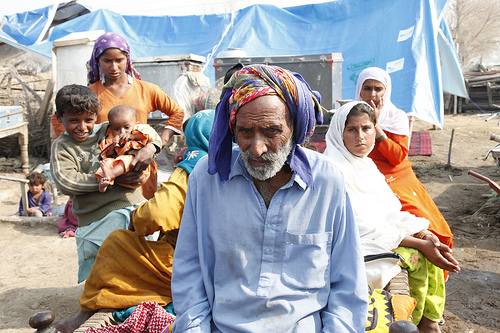
BBC – Six months after Pakistan’s worst monsoon floods in 80 years, Oxfam says the crisis is far from over and could even get worse. 

The UK-based agency says malnutrition levels in the south have soared, and the aid community has only “scratched the surface of human need”.

At least 170,000 people remain in relief camps and swathes of land are still under foul water in the south.

Pakistan’s government is to halt most emergency relief efforts this month.

The UN appeal for $2bn (£1.26bn) to rebuild Pakistan remains only 56% funded.

Click to continue reading about Pakistan’s flood crisis.

BBC © MMXI

Photograph by DFID – UK Department for International Development

MR Original – Let’s Talk Facebook.

MEDIA ROOTS – You there.  Let’s talk Facebook.

Had I not deactivated my Facebook account just last week I would soon celebrate 26 years as a human, a full 7 of which FB would have been a part of.  More than one-quarter of my earthly life. 

In the beginning I held out as long as I could, until the pressure of being the only kid in college without an account eventually drilled through my defenses.  At first it was not all bad.  Heck, I used it to meet a girl at my school whom I otherwise would have never known, and we fell ridiculously in love.  Amazingly, disgustingly in love.  She eventually left me for another young stud and moved to the east coast.  Life! But I digress.

I quit Facebook.  If you’ve ever clicked the “deactivate account” button, the ensuing screen guilt-trips you with photos of your friends who “will miss you” if you leave.  Then you are instructed to explain why are pulling the plug and, if you make it THAT far, Facebook insinuates that you are weak of character by keeping your old email and password information warm for you, should you decide to come crawling back.  As if we can’t function without it.

I’m here to tell you that you life goes on.  Only after letting go do you realize your individual level of dependency.  One thing I’ve asked myself in my newfound post-FB world is ‘how did being a part of this for so many years make me a stronger, better person?’

Suppose I spent just 10 minutes a day on Facebook every single day for 7 years, or 2,555 days. This comes out to something like 425 hours.  425 hours is more than 17 full days.  17 full days spent on the computer posting photos, poking people, and sending messages.  

Did I make a difference in my community in those 17 days? No.  Did I make a new best friend? No.  Did I find out something that changed my life? No.  Did I learn a valuable new skill? No.  

So, why…?

Facebook is an escape to a land of safety and relative predictability but it doesn’t really matter because everybody looks good and sometimes they entertain you.  It’s reality TV with your Facebook friends as the actors.  I knew when I logged on I could expect Jen to post yet another video of her dog, Brian to rant about the Chargers and their losing ways, and Terrance to complain about college.  My friends played their parts with no major deviation from the script.  And it was this total absence of anything vaguely resembling the exchange of critical, analytical thinking that wore me down.    

The news feed makes the absolute vast majority of my friends appear one-dimensional, self-absorbed, and shallow.  My buddy Terrance is actually a deep thinker, but he doesn’t share that side of himself on Facebook (after all, what is the incentive?). Thus, I am deprived of the true essence of his person on a daily basis. I have surrounded myself with a world of make-believe and dehumanization by extending this behavioral phenomenon to the hundreds of my other intelligent, capable friends and acquaintances who post junk on the news feed. 

Look, if Facebook works for you, stick with it.  Maybe you know how to fully harness its potential to enrich your life. But do understand that you can never be 1,000,000% certain that your privacy is secure online.  And try spending as much time on Facebook as you do actually picking up the phone and calling the people you care about or, better yet, seeing them in person.  There will never be a substitution for the real experiences in life.                         
            
Writing by Jerry Miller

Photograph by Rick Pickett   

Posted in Uncategorized | 1 Reply