Obama Making Plans to Use Executive Power

NY TIMES– With much of his legislative agenda stalled in Congress, President Obama and his team are preparing an array of actions using his executive power to advance energy, environmental, fiscal and other domestic policy priorities.

Mr. Obama has not given up hope of progress on Capitol Hill, aides said, and has scheduled a session with Republican leaders on health care later this month. But in the aftermath of a special election in Massachusetts that cost Democrats unilateral control of the Senate, the White House is getting ready to act on its own in the face of partisan gridlock heading into the midterm campaign.

“We are reviewing a list of presidential executive orders and directives to get the job done across a front of issues,” said Rahm Emanuel, the White House chief of staff.

Any president has vast authority to influence policy even without legislation, through executive orders, agency rule-making and administrative fiat. And Mr. Obama’s success this week in pressuring the Senate to confirm 27 nominations by threatening to use his recess appointment power demonstrated that executive authority can also be leveraged to force action by Congress.

Read full article about Obama Making Plans to Use Executive Power.

© 2010 NY TIMES
Jason de Caires Taylor -– Art Infiltrates Ocean

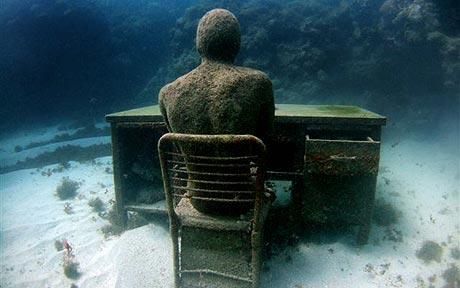
MEDIA ROOTS- It appears the sea has become an appropriate site for modern art, as Mexican artist Jason De Caires has inserted his sculptures into the ocean. The pieces are created on land, transported by boat and submerged into shallow water that can be viewed by snorkeling. Some of the larger figures are actually bolted to the floor of the ocean.

As an activist, I don’t know how I feel about this endeavor. The ocean floor is the last environmental bastion of non-human interference. I think the most beautiful thing about snorkeling or scuba diving is being immersed in a completely unadulterated environment.

On the other hand, I do appreciate the fact that the sculptural pieces are made of material that doesn’t destroy the ocean habitat in any way. The pieces are strengthened by the coral, algae, and marine life that grow on them. Under most circumstances, nature will destroy anything manmade over time, which is encouraging to think that this art will eventually be overtaken by coral and algae and serve as a foundation for new life.

As an artist, it irks me that this guy is gaining such notoriety for this. His sculptures are very generic and uninteresting. A bowl of fruit on a table? A guy sitting at a desk? Bolted to the bottom of the ocean floor?  The one that is the most unsettling to me is the guy at a desk. Do we really need this portrayal of present day working humans in an atmosphere that is totally unrelated to our modern world?

Anyone who tries to escape the human world will be forced to view his art. Instead of choosing to view his exhibit in a gallery of sorts, you are forced to be faced with it if you happen to be underwater in this part of the world. The only thing I know is that it would be the last thing I want to see underwater… hopefully this type of aquatic foray doesn’t spread to the rest of the art world.

Abby

Agency Planned Exercise on 9/11 Around Planes Crashing into Buildings

ASSOCIATED PRESS– In what the government describes as a bizarre coincidence, one U.S. intelligence agency was planning an exercise last Sept. 11 in which an errant aircraft would crash into one of its buildings. But the cause wasn’t terrorism — it was to be a simulated accident.

Officials at the Chantilly, Virginia-based National Reconnaissance Office had scheduled an exercise that morning in which a small corporate jet would crash into one of the four towers at the agency’s headquarters building after experiencing a mechanical failure.

The agency is about 4 miles (6 kilometers) from the runways of Washington Dulles International Airport.

Agency chiefs came up with the scenario to test employees’ ability to respond to a disaster, said spokesman Art Haubold. No actual plane was to be involved — to simulate the damage from the crash, some stairwells and exits were to be closed off, forcing employees to find other ways to evacuate the building.

“It was just an incredible coincidence that this happened to involve an aircraft crashing into our facility,” Haubold said. “As soon as the real world events began, we canceled the exercise.”

Continue reading about Agency Planned Exercise on 9/11 Around Planes Crashing into Buildings.

© 2002 AP

Photo by flickr user MGlasgow

No Relationship Between Fluoridation and Tooth Decay Rate

ICNR– Data collected by the National Institute of Dental Research (NIDR) of the United States Public Health Service (USPHS) produced the largest and most extensive database ever used to determine whether there is a relationship between fluoridation and tooth decay. Released on June 21, 1988, the $3,670,000 nationwide survey examined 39,207 U.S. school children aged 5-17 from 84 different geographical areas.

Of the 84 areas, 28 had been fluoridated for 17 years or more, 29 had never been fluoridated, and 27 had been only partially fluoridated or fluoridated for less than 17 years. Age-adjusted tooth decay rates for the permanent teeth of children were determined for each of the 84 areas which were then listed in the order of increasing tooth decay rates. The listing showed clearly that there was no relation between tooth decay rates and fluoridation. Ironically, the lowest tooth decay rate reported in the survey occurred in a nonfluoridated area.

tooth decayThe average number of decayed, missing, and filled permanent teeth (DMFT) per child was 2.0 in the fluoridated areas, 2.0 in the nonfluoridated areas, and 2.2 in the partially fluoridated areas. The percentage of decay-free children in the fluoridated, non fluoridated, and partially fluoridated areas was 34%, 35%, and 31%, respectively.

The foregoing results compiled from an analysis of the data gathered by NIDR were neither sought – nor reported in the NIDR release. At the Safe Water Foundation, we extracted these results from the data of the NIDR survey and submitted them to the journal, Comm. Dent. Oral Epidemiol., for publication. After reviewing the manuscript we submitted, Dr. Irwin Bross, the former Head of the Research, Design, and Analysis unit of the Sloan-Kettering Institute, former Director of Biostatistics of the Roswell Park Memorial Institute, and the current President of Biomedical Metatechnology, commented: “The material is clear and well presented. It provides a good demonstration of its main points: There is not much difference in tooth decay rates or in the percentages of decay-free children in the three fluoridation categories.”

Continue reading about Comprehensive Study Shows No Relationship Between Fluoridation and Tooth Decay Rate.

© ICNR

Photo by flickr user D.C.Atty 

Do Diet Sodas Make You Gain Weight?

weightABC NEWS– The growing problem of obesity in this country has led some experts to take a closer look at diet soft drinks. It turns out they may not be as helpful to weight loss as some people might think.

Ever since Tab hit the market in the swingin’ 60s, diet soda has become an American mainstay. In the era when thin-became-in thanks to mini-skirts – and the rail-thin model Twiggy – diet soda’s appeal was instant…

Save hundreds of calories a day, and stay skinny – right? The paradox is that American waistlines have been growing steadily.

Researcher Sharon Fowler, at the University of Texas Health Science Center, has been tracking soda drinkers for more than a decade. “People who were drinking diet soft drinks – two or more per day – had a 57 per cent chance of becoming overweight.”

Fowler says it may be that diet soda gives a false sense of security. “I can get the candy bar to go with the diet soft drink, and it’s just a little candy bar, I’m OK.”

However, Fowler and other experts suspect something else… That diet sodas can actually make you want to eat MORE!

Continue reading about Do Diet Sodas Make You Gain Weight?

© ABC News, 2007

Photo by flickr user keith011764