
Iraq War Vet- “We Were Told to Shoot People, Officers Would Take Care of Us”

TRUTHOUT– On Monday, April 5, Wikileaks.org posted video footage from Iraq, taken from a US military Apache helicopter in July 2007 as soldiers aboard it killed 12 people and wounded two children. The dead included two employees of the Reuters news agency: photographer Namir Noor-Eldeen and driver Saeed Chmagh.

The US military confirmed the authenticity of the video. The footage clearly shows an unprovoked slaughter, and is shocking to watch whilst listening to the casual conversation of the soldiers in the background.

As disturbing as the video is, this type of behavior by US soldiers in Iraq is not uncommon. Truthout has spoken with several soldiers who shared equally horrific stories of the slaughtering of innocent Iraqis by US occupation forces.

“I remember one woman walking by,” said Jason Washburn, a corporal in the US Marines who served three tours in Iraq. He told the audience at the Winter Soldier hearings that took place March 13-16, 2008, in Silver Spring, Maryland, “She was carrying a huge bag, and she looked like she was heading toward us, so we lit her up with the Mark 19, which is an automatic grenade launcher, and when the dust settled, we realized that the bag was full of groceries. She had been trying to bring us food and we blew her to pieces.”

The hearings provided a platform for veterans from Iraq and Afghanistan to share the reality of their occupation experiences with the media in the US. Washburn testified on a panel that discussed the rules of engagement (ROE) in Iraq, and how lax they were, to the point of being virtually nonexistent.

“During the course of my three tours, the rules of engagement changed a lot,” Washburn’s testimony continued, “The higher the threat the more viciously we were permitted and expected to respond. Something else we were encouraged to do, almost with a wink and nudge, was to carry ‘drop weapons’, or by my third tour, ‘drop shovels’. We would carry these weapons or shovels with us because if we accidentally shot a civilian, we could just toss the weapon on the body, and make them look like an insurgent.”

Hart Viges, a member of the 82nd Airborne Division of the Army who served one year in Iraq, told of taking orders over the radio.

“One time they said to ?re on all taxicabs because the enemy was using them for transportation…. One of the snipers replied back, ‘Excuse me? Did I hear that right? Fire on all taxicabs?’ The lieutenant colonel responded, ‘You heard me, trooper, ?re on all taxicabs.’ After that, the town lit up, with all the units ?ring on cars. This was my ?rst experience with war, and that kind of set the tone for the rest of the deployment.”

Vincent Emanuele, a Marine rifleman who spent a year in the al-Qaim area of Iraq near the Syrian border, told of emptying magazines of bullets into the city without identifying targets, running over corpses with Humvees and stopping to take “trophy” photos of bodies.

“An act that took place quite often in Iraq was taking pot shots at cars that drove by,” he said, “This was not an isolated incident, and it took place for most of our eight-month deployment.”

Kelly Dougherty – then executive director of Iraq Veterans Against the War – blamed the behavior of soldiers in Iraq on policies of the US government.

“The abuses committed in the occupations, far from being the result of a ‘few bad apples’ misbehaving, are the result of our government’s Middle East policy, which is crafted in the highest spheres of US power,” she said.

Michael Leduc, a corporal in the Marines who was part of the US attack on Fallujah in November 2004, said orders he received from his battalion JAG officer before entering the city were as follows: “You see an individual with a white ?ag and he does anything but approach you slowly and obey commands, assume it’s a trick and kill him.”

Bryan Casler, a corporal in the Marines, spoke of witnessing the prevalent dehumanizing outlook soldiers took toward Iraqis during the invasion of Iraq.

“… on these convoys, I saw Marines defecate into MRE bags or urinate in bottles and throw them at children on the side of the road,” he stated.

Scott Ewing, who served in Iraq from 2005-2006, admitted on one panel that units intentionally gave candy to Iraqi children for reasons other than “winning hearts and minds.

“There was also another motive,” Ewing said. “If the kids were around our vehicles, the bad guys wouldn’t attack. We used the kids as human shields.”

In response to the WikiLeaks video, the Pentagon, while not officially commenting on the video, announced that two Pentagon investigations cleared the air crew of any wrongdoing.

A statement from the two probes said the air crew had acted appropriately and followed the ROE.

Adam Kokesh served in Fallujah beginning in February 2004 for roughly one year.

Speaking on a panel at the aforementioned hearings about the ROE, he held up the ROE card soldiers are issued in Iraq and said, “This card says, ‘Nothing on this card prevents you from using deadly force to defend yourself’.”

Kokesh pointed out that “reasonable certainty” was the condition for using deadly force under the ROE, and this led to rampant civilian deaths. He discussed taking part in the April 2004 siege of Fallujah. During that attack, doctors at Fallujah General Hospital told Truthout there were 736 deaths, over 60 percent of which were civilians.

“We changed the ROE more often than we changed our underwear,” Kokesh said, “At one point, we imposed a curfew on the city, and were told to fire at anything that moved in the dark.”

Kokesh also testified that during two cease-fires in the midst of the siege, the military decided to let out as many women and children from the embattled city as possible, but this did not include most men.

“For males, they had to be under 14 years of age,” he said, “So I had to go over there and turn men back, who had just been separated from their women and children. We thought we were being gracious.”

Steve Casey served in Iraq for over a year starting in mid-2003.

“We were scheduled to go home in April 2004, but due to rising violence we stayed in with Operation Blackjack,” Casey said, “I watched soldiers firing into the radiators and windows of oncoming vehicles. Those who didn’t turn around were unfortunately neutralized one way or another – well over 20 times I personally witnessed this. There was a lot of collateral damage.”

Jason Hurd served in central Baghdad from November 2004 until November 2005. He told of how, after his unit took “stray rounds” from a nearby firefight, a machine gunner responded by firing over 200 rounds into a nearby building.

“We fired indiscriminately at this building,” he said. “Things like that happened every day in Iraq. We reacted out of fear for our lives, and we reacted with total destruction.”

Hurd said the situation deteriorated rapidly while he was in Iraq. “Over time, as the absurdity of war set in, individuals from my unit indiscriminately opened fire at vehicles driving down the wrong side of the road. People in my unit would later brag about it. I remember thinking how appalled I was that we were laughing at this, but that was the reality.”

Other soldiers Truthout has interviewed have often laughed when asked about their ROE in Iraq. Garret Reppenhagen served in Iraq from February 2004-2005 in the city of Baquba, 40 kilometers (about 25 miles) northeast of Baghdad. He said his first experience in Iraq was being on a patrol that killed two Iraqi farmers as they worked in their field at night.

“I was told they were out in the fields farming because their pumps only operated with electricity, which meant they had to go out in the dark when there was electricity,” he explained, “I asked the sergeant, if he knew this, why did he fire on the men. He told me because the men were out after curfew. I was never given another ROE during my time in Iraq.”

Emmanuel added: “We took fire while trying to blow up a bridge. Many of the attackers were part of the general population. This led to our squad shooting at everything and anything in order to push through the town. I remember myself emptying magazines into the town, never identifying a target.”

Emmanuel spoke of abusing prisoners he knew were innocent, adding, “We took it upon ourselves to harass them, and took them to the desert to throw them out of our Humvees, while kicking and punching them when we threw them out.”

Jason Wayne Lemue is a Marine who served three tours in Iraq.

“My commander told me, ‘Kill those who need to be killed, and save those who need to be saved'; that was our mission on our first tour,” he said of his first deployment during the invasion.

“After that the ROE changed, and carrying a shovel, or standing on a rooftop talking on a cell phone, or being out after curfew [meant those people] were to be killed. I can’t tell you how many people died because of this. By my third tour, we were told to just shoot people, and the officers would take care of us.”

When this Truthout reporter was in Baghdad in November 2004, my Iraqi interpreter was in the Abu Hanifa mosque that was raided by US and Iraqi soldiers during Friday prayers.

“Everyone was there for Friday prayers, when five Humvees and several trucks carrying [US soldiers and] Iraqi National Guards entered,” Abu Talat told Truthout on the phone from within the mosque while the raid was in progress. “Everyone starting yelling ‘Allahu Akbar’ (God is the greatest) because they were frightened. Then the soldiers started shooting the people praying!”

“They have just shot and killed at least four of the people praying,” he said in a panicked voice, “At least 10 other people are wounded now. We are on our bellies and in a very bad situation.”

Iraqi Red Crescent later confirmed to Truthout that at least four people were killed, and nine wounded. Truthout later witnessed pieces of brain splattered on one of the walls inside the mosque while large blood stains covered carpets at several places.

This type of indiscriminate killing has been typical from the initial invasion of Iraq. Truthout spoke with Iraq war veteran and former National Guard and Army Reserve member Jason Moon, who was there for the invasion.

“While on our initial convoy into Iraq in early June 2003, we were given a direct order that if any children or civilians got in front of the vehicles in our convoy, we were not to stop, we were not to slow down, we were to keep driving. In the event an insurgent attacked us from behind human shields, we were supposed to count. If there were thirty or less civilians we were allowed to fire into the area. If there were over thirty, we were supposed to take fire and send it up the chain of command. These were the rules of engagement. I don’t know about you, but if you are getting shot at from a crowd of people, how fast are you going to count, and how accurately?”

Moon brought back a video that shows his sergeant declaring, “The difference between an insurgent and an Iraqi civilian is whether they are dead or alive.”

Moon explains the thinking: “If you kill a civilian he becomes an insurgent because you retroactively make that person a threat.”

According to the Pentagon probes of the killings shown in the WikiLeaks video, the air crew had “reason to believe” the people seen in the video were fighters before opening fire.

Article 48 of the Geneva Conventions speaks to the “basic rule” regarding the protection of civilians:

“In order to ensure respect for and protection of the civilian population and civilian objects, the Parties to the conflict shall at all times distinguish between the civilian population and combatants and between civilian objects and military objectives and accordingly shall direct their operations only against military objectives.”

What is happening in Iraq seems to reflect what psychiatrist Robert Jay Lifton calls “atrocity-producing situations.” He used this term first in his book “The Nazi Doctors.” In 2004, he wrote an article for The Nation, applying his insights to the Iraq War and occupation.

“Atrocity-producing situations,” Lifton wrote, occur when a power structure sets up an environment where “ordinary people, men or women no better or worse than you or I, can regularly commit atrocities…. This kind of atrocity-producing situation … surely occurs to some degrees in all wars, including World War II, our last ‘good war.’ But a counterinsurgency war in a hostile setting, especially when driven by profound ideological distortions, is particularly prone to sustained atrocity – all the more so when it becomes an occupation.”

Cliff Hicks served in Iraq from October 2003 to August 2004.

“There was a tall apartment complex, the only spot from where people could see over our perimeter,” Hicks told Truthout, “There would be laundry hanging off the balconies, and people hanging out on the roof for fresh air. The place was full of kids and families. On rare occasions, a fighter would get atop the building and shoot at our passing vehicles. They never really hit anybody. We just knew to be careful when we were over by that part of the wall, and nobody did shit about it until one day a lieutenant colonel was driving down and they shot at his vehicle and he got scared. So he jumped through a bunch of hoops and cut through some red tape and got a C-130 to come out the next night and all but leveled the place. Earlier that evening when I was returning from a patrol the apartment had been packed full of people.” 

Creative Commons License
This work by Truthout is licensed under a Creative Commons Attribution-Noncommercial 3.0 United States License.
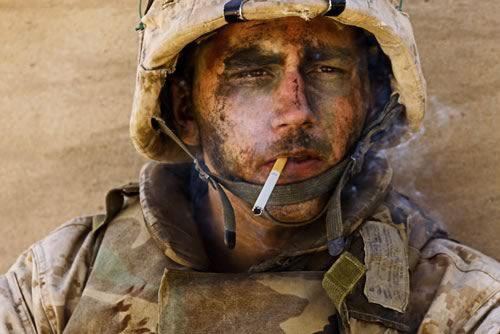
The Marlboro Marine’s Private War

GUARDIAN– The young marine lit a cigarette and let it dangle. White smoke wafted around his helmet. His face was smeared with war paint. Blood trickled from his right ear and the bridge of his nose. Momentarily deafened by cannon blasts, he didn’t know the shooting had stopped. He stared at the sunrise. His expression caught my eye. To me, it said terrified, exhausted and glad just to be alive. I recognised that look because that’s how I felt too. I raised my camera and snapped a few shots.

With the click of a shutter, Marine Lance Corporal James Blake Miller, a country boy from Kentucky, became an emblem of the war in Iraq. The image would change two lives – his and mine.
I was embedded with Charlie Company of the 1st Battalion, 8th Marine Regiment, as it entered Falluja, an insurgent stronghold in Iraq’s Sunni Triangle, on 8 November 2004. We encountered heavy fire almost immediately. We were pinned down all night at a traffic circle, where a six-inch kerb offered the only protection. I hunkered down in the gutter that endless night, praying for daylight, trying hard to make myself small. A cold rain came down. I cursed the Marines’ illumination flares that wafted slowly earthward, making us wait an eternity for darkness to return.

At dawn, the gunfire and explosions subsided. A white phosphorus artillery round burst overhead, showering blazing-hot tendrils. We came across three insurgents lying in the street, two of them dead, their blood mixing with rain. The third, a wiry Arab youth, tried to mouth a few words. All I could think was: ‘Buddy, you’re already dead.’

We rounded a corner and again came under heavy fire, forcing us to scramble for cover. I ran behind a Marine as we crossed the street, the bullets ricocheting at our feet. Gunfire poured down and it seemed incredible that no one was hit. A pair of tanks rumbled down the road to shield us. The Marines kicked open the door of a house and we all piled in.

Miller and other Marines took positions on the rooftop; I set up my satellite phone to transmit photos. But as I worked downstairs in the kitchen, a deep rumble almost blew the room apart. Two cannon rounds had slammed into a nearby house. Miller, the platoon’s radioman, had called in the tanks, pinpointed the targets and shouted: ‘Fire!’

I ran to the roof and saw smouldering ruins across a large vacant lot. Beneath a heap of bricks, men lay dead or dying. I sat down and collected my wits. Miller propped himself against a wall and lit his cigarette. I transmitted the picture that night. Power in Falluja had been cut in advance of the assault, forcing me to be judicious with my batteries. I considered not even sending Miller’s picture, thinking my editors would prefer images of fierce combat. The photo of Miller was the last of 11 that I sent that day.

On the second day of the battle, I called my wife by satellite phone to tell her that I was OK. She told me my photo had ended up on the front page of more than 150 newspapers. Dan Rather had gushed over it on the evening news. Friends and family had called her to say they had seen the photo – my photo.

Soon, my editors called and asked me to find the ‘Marlboro Marine’ for a follow-up story. Who was this brave young hero? Women wanted to marry him. Mothers wanted to know whether he was their son. I didn’t even know his name. Shellshocked and exhausted, I had simply identified Miller as ‘a Marine’ and clicked ‘send’.

I found Miller four days later in an auditorium in the city’s civic centre. Miller’s unit was taking a break, eating military rations. Clean-shaven and without war paint, Miller, 20, looked much younger than the battle-stressed warrior in the picture – young enough to be my son. He was co-operative, but embarrassed about the photo’s impact back home.

Once our story identified him, the national fascination grew stronger. People shipped care packages, making sure Miller had more than enough smokes. President Bush sent cigars, candy and memorabilia from the White House. Then Major General Richard F Natonski, head of the 1st Marine Division, made a special trip to see the Marlboro Marine. To talk to Miller, Natonski had to weave between earthen berms, run through bombed-out buildings and make a mad sprint across a street to avoid sniper fire before diving into a shattered store front. ‘Miller, get your ass up here,’ a first sergeant barked on the radio.

Miller had no idea what was going on as he ran through the rubble. He snapped to attention when he saw the general. Natonski shook Miller’s hand. Americans had ‘connected’ with his photo, the general said, and nobody wanted to see him wounded or dead. ‘We can have you home tomorrow,’ he said.

Miller hesitated, then shook his head. He did not want to leave his buddies behind. ‘It just wasn’t right,’ he told me later. ‘Your father raised one hell of a young man,’ the general said, looking Miller in the eye. They said goodbye and Natonski scrambled back to the command post.

For his loyalty, Miller was rewarded with horror. The assault on Falluja raged on, leaving nearly 100 Americans dead and 450 wounded. The bodies of some 1,200 insurgents littered the streets. As the fighting dragged on, the story fell off the front page. I joined the exodus of journalists going home or moving to the next story. More than a year and a half would pass before I saw Miller again.

Continue reading about the Marlboro Marine.

© GUARDIAN, 2007

China Tries to Sterilize 10,000 Parents Over One Child Rule

TIMES ONLINE– Doctors in southern China are working around the clock to fulfil a government goal to sterilise — by force if necessary — almost 10,000 men and women who have violated birth control policies. Family planning authorities are so determined to stop couples from producing more children than the regulations allow that they are detaining the relatives of those who resist.

About 1,300 people are being held in cramped conditions in towns across Puning county, in Guangdong Province, as officials try to put pressure on couples who have illegal children to come forward for sterilisation. The 20-day campaign, which was launched on April 7, aims to complete 9,559 sterilisations in Puning, which, with a population of 2.24 million, is the most populous county in the province.

A doctor in Daba village said that his team was working flat out, beginning sterilisations every day at 8am and working straight through until 4am the following day. Zhang Lizhao, 38, the father of two sons, aged 6 and 4, said that he rushed home late last night from buying loquats for his wholesale fruit business to undergo sterilisation after his elder brother was detained. His wife had already returned so that the brother would be freed.

Mr Zhang said: “This morning my wife called me and said they were forcing her to be sterilised today. She pleaded with the clinic to wait because she has her period. But they would not wait a single day. I called and begged them but they said no. So I have rushed back. I am satisfied because I have two sons.”

Thousands of others have refused to submit and officials are continuing to detain relatives, including elderly parents, to force them to submit to surgery. Those in detention are required to listen to lectures on the rules limiting the size of families.

On April 10 The Southern Countryside Daily reported on about 100 people, mostly elderly, packed into a damp 200sq m (2,150sq ft) room at a township family planning centre. The newspaper said: “There were some mats on the floor but the room was too small for all people to lie down and sleep, so the young ones had to stand or squat. Owing to the lack of quilts, many cuddled up to fight the cold.”

Among those being held was the 68-year-old father of Huang Ruifeng, who has three daughters. Mr Huang said: “Several days ago a village official called me and asked me or my wife to return for the surgery. Otherwise they would take away my father.” He said that he was too busy to go and did not have confidence in village medical techniques. In any case, he wanted his wife to give birth to a son first.

An official at the Puning Population and Family Planning Bureau, who declined to be identified, told The Global Times: “It’s not uncommon for family planning authorities to adopt some tough tactics.”

In Puning county couples with illegal children and their relatives who apply for permits to build a house are rejected. Illegal children are refused residency registration, a penalty that denies them access to healthcare and education. Authorities have discovered, however, that those methods have less success than rounding up relatives. One official said that an investigation would be launched to establish whether authorities in Puning had exceeded their remit.

A state-level regulation stipulates that couples who violate the family planning policy must not be punished without proper authorisation and family members may not be penalised to put pressure on couples. In the years after China launched its strict “one couple, one child” family planning policy in the late 1970s abuses such as forced late-term abortions, sterilisations and even the killing of newborn babies were widely reported. Such practices have diminished in recent years, as the policy has become more widely accepted and exceptions have been introduced.

Officials in Puning are under particular pressure, however: they risk failing in their bid for promotion to a second-tier county if they cannot meet all quotas. That includes keeping the number of births within government limits. The county is under criticism from Guangdong authorities, who want to slow a population growth that is reflecting badly on the entire province. One reason for Puning’s large population is that families in the mainly rural region often have up to three or four children.

Many of those with extra children have left to find factory jobs along the more developed coast, taking advantage of being away from local government surveillance to give birth outside the quotas. Rules in Puning, as throughout rural China, allow farmers to have a second child if the first is a daughter. After that couples must stop. By the morning of April 12 Puning officials said that they had achieved, in a mere five days, about half of their sterilisation goal after their “education” persuaded people to comply.

Family planning

• China is the world’s most populous country with about 1.3 billion people. By 2025 the population is expected to exceed 1.4 billion

• The birthrate is low at 14 births per 1,000 people every year but the infant mortality rate is also low, at 20.25 deaths per 1,000 live births

• The single-child policy, referred to by the Chinese Government as the family planning policy, was introduced in 1978 to ensure that China could feed all of its people

• The policy stipulates that couples living in cities can have one child, unless one or both are from an ethnic minority or they are both only children. In most rural areas a couple may have a second child after a break of several years

• Despite the policy, it is common to find couples in the countryside, where 80 per cent of the population live, with a large number of children

• Many couples get round the law by sending pregnant women to stay with relatives, then claiming that the baby was adopted or belongs to a friend or relative

• Critics say that the policy has led to the killing of female infants because of the traditional preference for boys

Sources: BBC; CIA World Factbook

© COPYRIGHT TIMES ONLINE, 2010

Photo by Flickr user Benoitflorencon

More Soldiers Have Committed Suicide than Have Died in Combat

GLOBAL RESEARCHHere is a shocking statistic that you won’t hear in most western news media: over the past nine years, more US military personnel have taken their own lives than have died in action in either the wars in Iraq or Afghanistan.

These are official figures from the US Department of Defence, yet somehow they have not been deemed newsworthy to report. Last year alone, more than 330 serving members of the US armed forces committed suicide – more than the 320 killed in Afghanistan and the 150 who fell in Iraq (see wsws.org).

Since 2001, when Washington launched its so-called war on terror, there has been a dramatic year-on-year increase in US military suicides, particularly in the army, which has borne the brunt of fighting abroad. Last year saw the highest total number since such records began in 1980. Prior to 2001, the suicide rate in the US military was lower than that for the general US population; now, it is nearly double the national average.

A growing number of these victims have been deployed in Iraq or Afghanistan. What these figures should tell us is that there is something fundamentally deranged about Washington’s “war on terror” – which is probably why western news media prefer to ignore the issue. How damning is it about such military campaigns that the number of US soldiers who take their own lives outnumber those killed by enemy combatants.

What is even more disturbing is that the official figures only count victims of suicide among serving personnel. Not included are the many more veterans – officially classed a civilians – who take their own lives.

Most likely, these deaths are reported in some small-town newspaper in “a brief” news item with no context or background as to what drove these individuals to take their own lives. It is estimated that the suicide rate among veterans demobbed from fighting in Afghanistan and Iraq is as high as four times the national average. The US Department of Veteran Affairs calculates that over 6,000 former service personnel commit suicide every year.

Many of these men have come home to a country they have fought for only to find no jobs, their homes repossessed by banks that have enjoyed trillion-dollar bailouts and broken relationships.

Meanwhile, President Obama – the erstwhile peace candidate – has taken on the role of Commander in Chief with gusto, telling his countrymen and women that they are fighting a “just war” to “defend American lives”. Only a year ago, he was campaigning for the presidency on a ticket to end such wars. Now, more than his predecessor, George W Bush, Obama is committing to wars without end. How soul-destroying is that for a grunt holed up in a bunker, with his young family back home probably telling him that they have just signed up for food stamps?

In their guts, these US soldiers must know – as many other ordinary people around the world do – that these wars are nothing but a desperate, pathological bid by a dying power to salvage its crumbling empire – an empire that enriches a tiny elite and impoverishes the majority. Is it any wonder that many of them simply lose the will to live?

Finian Cunningham is a frequent contributor to Global Research.  Global Research Articles by Finian Cunningham

© GLOBAL RESEARCH, 2010

Control of Public Media as a Social Justice Issue

TRUTHOUT– Media justice organizers at the Center for Media Justice (CMJ) and MAG-Net have recently produced a brilliant campaign plan (“The Campaign for universal broadband”) to win three policies crucial for just and democratic communication: network neutrality, universal broadband and universal service fund reform.

Considering the renewed struggle required to win these goals, and to protect them afterwards, two questions seem particularly important. First, to win media access rights, social justice movements need media access.

So, how do we get the kind of access that can allow us to succeed? Second, as net neutrality and universal broadband are not ends in themselves, but rather the means to enable a just and democratic media system, who should produce that system? Open access to a media system controlled by the status quo will not provide the necessary means for disadvantaged communities and social justice movements to change power relations.

To win and protect the three central policies of the MAG-Net plan, media justice movements must have allies at radio and TV stations – the leading sources of news for most people, especially those without the Internet (Pew Center for People and the Press). Mainstream commercial channels will not provide that access as they are also agents defending corporate power and driving social justice movements to the margins. So, what about public media?

The problem is that too often public broadcasting outlets have boards populated by elite and corporate representatives, who historically have used their power to filter out the very perspectives we seek to extend. However, a movement of active publics could restructure governance at public media and demand democratically elected boards. This change could enable representatives from diverse communities to make decisions about programming and provide new access for marginalized and oppressed social groups to shape and produce content, self-organize and build just social relationships.

So, like network neutrality and universal broadband, should social justice movements also consider control over public media to be a racial and economic justice issue? In the effort to constitute a just and a ubiquitous public media system, should a high priority be to demand direct, democratic community governance of publicly funded outlets, especially local NPR and PBS affiliates? Though flawed, badly funded and commercialized, CPB outlets are the material of an existing system that could – if under community control – be a new means for self-organization by diverse publics.

What do you think the priority is or should be for synergizing isolated community print, online, radio, PEG and other media producers into a new public system – creating a publicly controlled, radically reorganized, public media system that could enable social justice movements to change social conditions?

There are excellent reasons to conceive of network neutrality as a social justice issue. The Center for Media Justice made particularly important contributions to this understanding with their document “Network Neutrality, Universal Broadband, and Racial Justice,” as did CMJ’s Malkia Cyril and co-authors Joseph Torres and Chris Rabb with their statement, “The Internet Must Not Become a Segregated Community.” Both works powerfully clarify that the Internet system envisioned by corporate and state officials would create first- and second-class Netizens. As the net neutrality struggle continues to demonstrate, diverse publics must communicate and act on their own behalf to establish and preserve a policy for digital technology based on equal access.

However, marginalized communities must not hope that a neutral Internet will build a media system to meet their needs. It is time to give up any remaining illusions of technological determinism. There is no political orientation inherent in technology – not even a neutral digital network. Only the creative labor of our communities and our movements can produce the spaces we need to collaboratively create new understandings of ourselves and our purposes; to communicate, coordinate and act. Lacking creative action by our communities and movements, universal broadband would only enable widespread access to a system dominated by the same corporate and racist forces that dominate the current system. After all, war and injustice continue irrespective of Facebook, Twitter and Digg. Though perhaps it seems obvious, it is crucial to remember that it was primarily the culture of the producers – not the users – that shaped the Internet medium (Castells, The Internet Galaxy, 2003).

Historically marginalized communities now, at this crucial juncture, could wield power as producers to shape the Internet into a new media network to increase equity in media access and political participation. Movements for media justice could struggle to develop the Internet as a platform where marginalized communities can speak to themselves and to wider audiences.

As the CMJ’s statements on network neutrality and universal broadband remind us, social justice movements cannot simply trust professionals employed by either corporations or the state to decide which social groups get broadband access or what digital content we can access once online. That same critical logic applies to control over public media and public news production. Unfortunately, it is evident that professional journalists and their allies are organizing to create a revitalized public media system that they, state officials and corporate, elite, station trustees will largely control with little or no role for historically marginalized communities as decision makers or as content producers.

Professional news models of production are collapsing – or rather transforming. Professional journalists themselves are engaged in a desperate struggle to maintain their social position as elite interpreters of daily life through controlling access to the occupation of reporting. As professional journalists seek to reconstruct their gatekeeping authority over online news production, they are also rebuilding barriers to access that historically excluded people of color, the poor and working classes, political dissidents, LGBT communities, and other groups. In short, virtually every emerging model to “save journalism” presented by commercial – and public – media professionals (as well as some academics) reproduces old hierarchies that exclude disadvantaged communities from decision making.

For example, in December of 2009, the Federal Trade Commission (FTC) held a workshop deep within the beltway titled “How Will Journalism Survive the Internet Age?” These meetings attempted to make sure that journalism’s future will be market based. Of course, when market forces shape news production they inevitably shape the content and the political meaning of news. Renowned journalist Edward R. Murrow acknowledged as much when he warned, if “news is to be regarded as a commodity, only acceptable when saleable, then I don’t care what you call it – I say it isn’t news” (Speech to the Radio and Television News Directors Association (RTNDA) convention, Chicago, 10/15/1958). Murrow’s concern over corporate influence on news did not seem to be shared by the many FTC participants, who, instead, struggled to find ways that the government could help shore up the declining commodity value of news.

Even a workshop panel that explored noncommercial options, “Public- and Foundation-Funded Journalism,” (starts at about the 1:18:00 mark here; transcript starts at page 23 here) raised little criticism of corporate influence on news production. Perhaps unsurprisingly, the panel also displayed some of the same exclusions that media activists have critiqued for years, namely a lack of diversity: seven white men, two white women, and one male of color. This translates to 90 percent white, 80 percent male. Lacking representatives from disenfranchised communities, and entertaining no questions from the audience, there was almost no consideration of the issues important to historically marginalized social groups. It was almost as if the panelists had never read the Carnegie Commission report that founded public broadcasting and were unaware of the central role it defined for such groups. The Carnegie report called for a system that will “bring into the home” people’s “protests”; “provide a voice for groups in the community that may otherwise be unheard”; “increase our understanding of the world, of other nations and cultures, of the whole commonwealth of man”; and “help us to see America whole, in all its diversity.”

This is not to say that the word “diversity” was missing from their vocabularies, but that they used the word in restricted ways. The panelists did support a greater diversity of audiences and content. Panelists also advocated for “technological diversity” and the need for government money to fund it, as well as the need for new productive relationships with software developers. But never did they consider the possibility that the diverse communities they view as audiences also have a legitimate role to play making decisions about public media. Nor did panelists consider opening up new productive relationships – and, thus, career paths – to historically marginalized communities.

There was a little critical discussion about the influence of powerful commercial or state funders, but there was virtually no discussion about the difficulty of making journalism accountable to diverse publics. Instead, some of the most powerful representatives of journalism on the panel argued that the old system simply “worked,” and all that’s needed is more public money for journalists and technology. The best kind of accountability, they claimed, was for journalists to govern themselves using professional ethics and a strong “firewall” between the newsroom and funding.

To most of us, a firewall is that impenetrable metal barrier that protects the driver and passengers in a car from a conflagration in the engine compartment. There is no such physical divide when it comes to news production, as evidenced by decades of academic research, the work of groups such as Fairness and Accuracy in Reporting and common experience. Instead of the mythical firewall, a more honest depiction should acknowledge a historic and ongoing social struggle among publishers, journalists, designers, and powerful sources to shape the news to their own vision. Lacking power, disadvantaged communities are largely excluded from this struggle.

Panelist Jon McTaggart, the senior vice president & COO of American Public Media (producer of NPR’s MarketPlace), said, “I think that any serious news organization has a fire wall in place where organizational funding is certainly distinct from the activities of the journalists themselves.”

NPR President and CEO Vivian Schiller went farther and argued that firewalls truly do provide genuine accountability: “Advertising subsidizes the newspaper and all commercial media. You know, does that mean that newspapers have pulled their punches about those advertisers? Certainly not.” Astoundingly, she even claimed that there has never been “any instance in the history, at least, of NPR where a story has been slanted or, you know, favorable to a foundation funder.”

Eric Newton, vice president of the journalism program at the Knight Foundation, also argued that the old system successfully held commercial news media accountable. “It’s about professional ethics. And one of the great things about the commercial newspaper industry is how many hundreds of major newspapers have fantastic codes of ethics that they do hold each other accountable for and the professional organizations and journalism schools do hold them accountable.” He even made false and misleading claims that libraries and schools rely on professional ethics and self-governance to be accountable to their communities. Citizens in voting booths looking at their ballots may disagree. Publicly elected boards often govern public libraries and schools.

Even Josh Silver, executive director of Free Press, did little to challenge the clearly self-serving assertions raised by news producers and industry representatives, but, instead, reinforced their frames and ideas. For example, his statement, “we have to know that the firewall is rock-solid” accepts that firewalls could actually be “rock-solid,” that professional ethics and best practices could truly be a concrete substitute for public participation. Other statements he made further reinforced a conceptual division between expert professionals and the public, this time casting the FTC participants as legitimate decision makers over community needs: “[W]e need to figure out … what do communities really need” so that “we” can “really engage the public.” Who is this “we” that stands apart from the public, yet decides what that public truly needs?

As the only representative from a media activism movement on the panel, Silver should have defended public participation in the public media system. Instead, Silver’s only suggestions for “structural change” were for better ombudsmen, a different appointment process for CPB board members and an abandonment of the appropriations process. But as none of these ideas expose professionals or officials to any meaningful consequences from diverse publics, these ideas would in fact continue to structure public media as a domain of elite control. These changes would, he said, help to insulate public media from too much politics – and on this point he has it all upside down. After all, limiting decision making over public media to officials and insiders is to ensure that it is their political culture that will shape the medium. Should not media justice and democracy activists instead increasingly expose public media to the politics of economic and racial justice and democratic participation?

We need a media system that is partial to justice and the health of our communities. The media justice community and its allies need to critically analyze proposals to remake public media – most importantly those from the Knight Foundation and from Schudson and Downie. Despite the claims of media professionals, industry reps, and some academics, we cannot leave the development of public media to their expertise alone. Professional journalists, corporations, and state officials seem poised to produce a system that represents the relationships they need – not what marginalized communities and social justice movements need. They will give us a marketplace of their ideas and call it just.

(This article was published 4/12/10 as an op-ed at the Editor & Publisher web site.)

Article by Scott Owens and James Sanders

Creative Commons License
This work by Truthout is licensed under a Creative Commons Attribution-Noncommercial 3.0 United States License.