
Leaker of Wikileaks Massacre Video Arrested

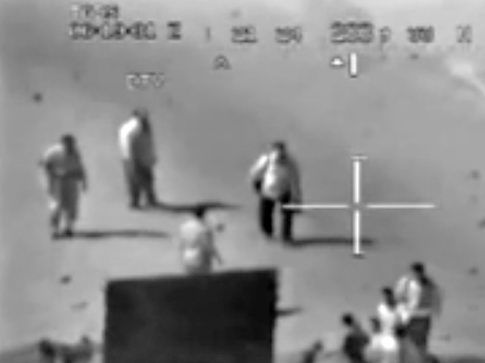
HUFFINGTON POST– According to Wired, federal officials have arrested 22-year-old SPC Bradley Manning, an intelligence analyst with the US Army, for allegedly leaking the “Collateral Murder” Wikileaks video. The controversial video, released in April 2010, shows a 2007 Apache helicopter attack that left several noncombatants dead, including two Reuters employees and three civilians.

Manning was reportedly arrested two weeks ago at Forward Operating Base Hammer near Baghdad, by the Army’s Criminal Investigation Division. “Manning was turned in late last month by a former computer hacker with whom he spoke online,” Wired divulges. The hacker, Adrian Lamo, who has also contributed to Wikileaks, notified the Army when Manning claimed “he leaked a quarter-million classified embassy cables.”

Wired reports:

Manning told Lamo that he enlisted in the Army in 2007 and held a Top Secret/SCI clearance, details confirmed by his friends and family members. He claimed to have been rummaging through classified military and government networks for more than a year and said that the networks contained “incredible things, awful things … that belonged in the public domain, and not on some server stored in a dark room in Washington DC.

“I wouldn’t have done this if lives weren’t in danger,” Lamo told Wired. “He was in a war zone and basically trying to vacuum up as much classified information as he could, and just throwing it up into the air.”

The US Army has called Wikileaks exposés “potentially actionable information” and the Pentagon labeled the organization a “national security threat.”

Read more at Wired.

© HUFFINGTON POST, 2010
Divers Find Oil Under Surface, BP Denies

VOA NEWS– The National Oceanic and Atmospheric Administration (NOAA) confirms that some of the oil escaping from that ruptured well in the Gulf of Mexico is staying beneath the surface, raising new environmental concerns about the disaster. BP says there is no significant oil staying underwater.

Scuba divers showed U.S. legislators video of the spill which they shot while 20 meters under the sea and 64 kilometers off the U.S. Gulf coast.  The oil is so thick below this depth that it blocks out almost all light. “Something I’ve never seen in diving, in my whole life out here,” said diver Al Walker.

Fellow diver Scott Porter says the substance feels like a mixture of clay and wax.  He had to scrape it off his hands.  Soap had no effect. “I don’t know of anything that would be able to live through that,” Porter said.

Yet on Wednesday, BP continued to deny any large amount of oil under the surface.

“No one has yet found any concentrations that measured higher than the parts per million,” said BP’s Doug Suttles.

Meantime, Congress conducted five oil spill hearings on Capitol Hill Wednesday.  Legislators want to know why risks weren’t studied when oil rigs drill 5,000 feet below the water.

“I’m just terribly bothered about the lack of foresight, both by our government and of BP and, of course, BP will pay a price for that,” said Congressman Vernon Ehlers. “Perhaps even a failure of the corporation at the rate it’s going.”

Read full article about Oil Being Under the Surface.

© COPYRIGHT VOA NEWS, 2010

Photo by NASAGoddardPhotoandVideo

Gaza Blockade Isn’t About Security

MCCLATCHY– As Israel ordered a slight easing of its blockade of the Gaza Strip Wednesday, McClatchy obtained an Israeli government document that describes the blockade not as a security measure but as “economic warfare” against the Islamist group Hamas, which rules the Palestinian territory.

Israel imposed severe restrictions on Gaza in June 2007, after Hamas won elections and took control of the coastal enclave after winning elections there the previous year, and the government has long said that the aim of the blockade is to stem the flow of weapons to militants in Gaza.

Last week, after Israeli commandos killed nine volunteers on a Turkish-organized Gaza aid flotilla, Israel again said its aim was to stop the flow of terrorist arms into Gaza.

However, in response to a lawsuit by Gisha, an Israeli human rights group, the Israeli government explained the blockade as an exercise of the right of economic warfare.

“A country has the right to decide that it chooses not to engage in economic relations or to give economic assistance to the other party to the conflict, or that it wishes to operate using ‘economic warfare,'” the government said.

McClatchy obtained the government’s written statement from Gisha, the Legal Center for Freedom of Movement, which sued the government for information about the blockade. The Israeli high court upheld the suit, and the government delivered its statement earlier this year.

Sari Bashi, the director of Gisha, said the documents prove that Israel isn’t imposing its blockade for its stated reasons, but rather as collective punishment for the Palestinian population of Gaza. Gisha focuses on Palestinian rights.

(A State Department spokesman, who wasn’t authorized to speak for the record, said he hadn’t seen the documents in question.)

The Israeli government took an additional step Wednesday and said the economic warfare is intended to achieve a political goal. A government spokesman, who couldn’t be named as a matter of policy, told McClatchy that authorities will continue to ease the blockade but “could not lift the embargo altogether as long as Hamas remains in control” of Gaza.

Read full article on the Gaza Blockade Not Being About Security.

Frenkel, a McClatchy special correspondent, reported from Jerusalem. Warren P. Strobel and Steven Thomma contributed to this article from Washington.

© COPYRIGHT MCCLATCHY, 2010

UN Approves New Iran Sanctions

AL JAZEERA– The United Nations Security Council has overwhelmingly agreed to a new package of economic sanctions against Iran. 

12 of the council’s 15 members voted on Wednesday to approve the sanctions resolution. Turkey and Brazil both voted against the resolution, while Lebanon abstained.

Barack Obama, the US president, called the resolution “the toughest sanctions ever faced” by the Iranian government.

“We recognize Iran’s rights. But with those rights come responsibilities. And time and again, the Iranian government has failed to meet those responsibilities,” Obama said at the White House.

Susan Rice, the United States ambassador to the UN, praised the vote as a “decisive” move against Iran’s nuclear programme, which she called a “grave threat to international security.”

Mahmoud Ahmadinejad, the Iranian president, was one of several high-ranking Iranian officials to quickly condemn the decision. Ahmadinejad said the sanctions would not have an impact on Iran.

“Sanctions are falling on us from the left and the right. For us they are the same as pesky flies,” Ahmadinejad said. “We have patience and we will endure throughout all of this.”

Alaeddin Boroujerdi, the head of the Iranian parliament’s national security committee, said lawmakers would review the level of Iran’s cooperation with the International Atomic Energy Agency. And Manouchehr Mottaki, the Iranian foreign minister, said the vote “damaged” the UN Security Council.

Several other European countries praised the sanctions resolution; the Chinese government endorsed it as well, while insisting that it still wants a diplomatic solution.

Continue reading about Iran’s New Sanctions.

Photo by Flickr User Daniella Zalcman

© COPYRIGHT AL JAZEERA, 2010