RT– Did you grow up hating Barbie, envious of the darling doll’s flawless features, palatial dream house, drop-top convertible and perfect (and plastic) boyfriend?
Now you have a whole new reason to abhor the iconic American effigy that has objectified women for half a century—she’s ruining the rainforest!
Activists at Greenpeace are launching an all-out war on the 11.5 inch-tall plaything, condemning the doll’s manufacturer, Mattel, for accelerating the deforestation of a South Asian haven for wildlife.
Greenpeace contests that Mattel Inc., the world’s largest toy company, packages Barbie and other children’s products in paper that has its root in Indonesian deforestation. Asia Pulp and Paper (APP), the company that provides the materials for Mattel packaging, has allegedly trashed the habitat for tigers, orangutans, tigers, leopards, elephants and other endangered species for two decades now. Now advocates are calling out the toy giant to change their ways.
The environmental activists are taking credit for a large banner that was unfurled over Mattel headquarters in El Segundo, California last week. The signage featured Barbie’s dapper boyfriend Ken projecting a frown and urging his gal pal: “Barbie: it’s over. I don’t date girls that are into deforestation.” A demonstration outside of the Mattel offices that day led to the arrest of ten protesters. A full-fledged attack on the manufacturer is now underway, as Greenpeace has taken to the Internet to blast the toy company.
MEDIA ROOTS- It reads like a science fiction novel: a multinational corporation, in control of a vast majority of the world’s food supply and chief promoters of genetically altered foods, is actively infiltrating the legislative authority to not only corner the world food market, but to make growing food in one’s own back yard illegal. Even more sinister, they’ve hired one of the most equipped private mercenary companies in the world to enforce their whims.
It’s an unnerving scenario, and an altogether realistic one. As the corporate era continues to expand its branches and authority in modern America, the modern farmer is facing challenges and dangers far more frightening than early frost or a pest infestation; they are now being forced to defend the very seeds they plant. Even worse: they’re up against one of the most powerful corporations in the world, whose genetically modified products many experts are warning could be detrimental to human health.
A quick lesson in GMOs, for the blissfully unaware: genetic engineering or modification of food involves the laboratory process of artificially inserting genes in the DNA of food crops or animals to add nutrients or traits such as resistance to insects or disease, according to the U.S. Department of Energy Genome Program’s Humane Genome Project. The result is called a genetically modified organism, or GMO.
The Monsanto corporation, the world’s leading producer of herbicides, is also a world leader in genetically modified seeds. The two go hand-in-hand, you see: one kills the bugs eating the plants, the other is able, through scientific tinkering, to resist the uber-toxic poisons used to kill the bugs. Theoretically, it’s a match made in heaven – until one factors in the impact of the potentially hazardous genetic manipulation, and the tactics by which the company owning the patent on these Frankenfoods assert their market domination.
cJust how big is the GMO issue? As Americans become more conscientious of what they put in their bodies, many will be surprised to learn that we’ve been consuming genetically engineered or genetically modified foods for the past 15 years. 70 percent of our nation’s corn farmland and 94 percent of soy farmland are planted with genetically engineered crops, designed to resist pests and herbicides and increase crop yields. New technologies promise a future where genetically modified apples that don’t turn brown, rice is infused with vitamin A and, as early as next year, you may be able to buy a GM super salmon that grows to maturity in just two years.
At the forefront of the GMO debate, the Monsanto corporation has long been viewed as the chief enemy among organic farmers and GMO skeptics, having been the most aggressive in their attempts to corner the world food market, often through large-scale legal battles against small-time farmers and considerable (and controversial) legislative influence that leans heavily in their favor.
What is the ultimate benefit to Monsanto’s methods? The company defends the usefulness of its GM seeds, saying, “Biotechnology crops have provided a wealth of benefits to farmers and the environment. It is well established that farmers growing biotech crops realize many benefits including increased yields and lower production costs, and the use of these crops have resulted in an increase in the adoption of conservation tillage practices that reduce soil erosion. These benefits are the reason why farmers have overwhelmingly and willingly chosen to use these technologies year after year.”
Evidence of the negative economic and health effects of GMO seeds, however, which organic-farming groups argue invalidates the legal requirement for “usefulness” under patent law, are plentiful. “None of Monsanto’s original promises regarding genetically modified seeds have come true after 15 years of wide adoption by commodity farmers,” said David Murphy, founder and Executive Director of Food Democracy Now! “Rather than increased yields or less chemical usage, farmers are facing more crop diseases, an onslaught of herbicide-resistant superweeds, and increased costs from additional herbicide application.”
Moreso, studies are cropping up with increasing regularity that the potential harm of GM seeds far exceeds the original indication. Andres Carrasco, a globally recognized scientist in the biotech world, found (along with his team from Argentina and Paraguay) that Monsanto’s Roundup weed killer causes birth defects in frogs and chickens. “The findings in the lab are compatible with malformations observed in humans exposed to glyphosate during pregnancy,” he told GMWatch. He has since reportedly suffered threats and attacks from local civilians as well as area police.
Many believe that the prevalence of GM corn and GM sugarbeets used as sweeteners in processed foods (such as the nearly-unavoidable high fructose corn syrup) is a leading contributing factor to the spike in diabetes, which has more than doubled since GM foods were quietly introduced to the market in 1996. GMO products have been found to exacerbate allergies, reduce digestive enzymes, cause liver problems and may, according to some findings, even lead to cancer.
Biochemist and nutritionist Arpad Pusztai first blew the whistle in 1998 on the hazards of GM crops, costing him his job at Rowett Research Institute in Scotland. Having studied biotechnology for 35 years, Pusztai had established himself as the world’s leading expert in the highly specialized field. In 1995, he won a three-year, $1.5 million contract from the UK government to establish a testing methodology for regulators when assessing the safety of genetically modified crops. The results of his findings, which are as remarkable as they are alarming, can be found in his book Seeds of Destruction: The Hidden Agenda of Genetic Manipulation.
In his book, Pusztai contends that agribusiness giants plan world domination by patenting life forms to gain worldwide control of our food supply, with innumerable references to studies and experiments to support his claims. The book’s findings lend added ominous tones to Henry Kissinger’s 1970 quote: “Control oil and you control nations; control food and you control the people.”
Despite these findings, which are increasing in regularity far beyond Pusztai’s work, large-scale efforts are underway to not only silence these damning revelations but to actually redefine personal farming, with the clear intention of world food-market domination. In 2009, two pieces of legislation were introduced (HR875 and S425) that would, through deceptively loose terminology, which would put private farming at risk and effectively criminalize organic farming. It is perhaps quite telling that the sponsor of the bill is Connecticut Congresswoman Rosa Delauro, who is married to Stan Greenburg, a political strategist for Monsanto. She is, quite literally, in bed with the enemy, in the eyes of farmers at risk.
The H.R. 875 bill, also known as the Food Safety Modernization Act, would establish a “Food Safety Administration” within the Department of Health and Human Services, specifically “to protect the public health by preventing food-borne illness, ensuring the safety of food, improving research on contaminants leading to food-borne illness, and improving security of food from intentional contamination, and for other purposes.”
Section 3 of H.R. 875 defines what type of establishments would be subject to the regulations in this legislation. It that section, a “food production facility” is defined this way: “any farm, ranch, orchard, vineyard, aquaculture facility, or confined animal-feeding operation.” To clarify, that would include all small farms, all organic farms, and even small family gardens if you sell any produce to your neighbor. It would, in effect, preclude the public’s right to grow, own, trade, transport, share and feed naturally grown food and agricultural products.
The law was signed into effect in January.
Such conflicts of interest exist on the U.S. Supreme Court as well, with judge Clarence Thomas, a former Monsanto attorney, writing the high court decision allowing biotech companies to patent GM seeds. Thomas also refused to recuse himself from last year’s Monsanto v Geertson Seed case, which allowed the USDA to impose a partial deregulation of GM alfalfa last June. This January, the USDA completely deregulated GM alfalfa, even removing the requirement for buffer zones, which helped prevent the wind-generated spread of seeds.
The Monsanto corporation has taken a very aggressive stance in its business tactics, suing literally hundreds of farmers whose fields have been contaminated with the company’s genetically modified seeds. In 2001, Monsanto sued a 70-year-old farmer from Saskatchewan, Canada, named Percy Schmeiser, for violating its patent on an herbicide-resistant GMO canola seed. They alleged that Schmeiser had intentionally planted some of Monsanto’s patented “Roundup Ready” seed, which has been genetically modified to withstand the company’s Roundup brand weed killer. Schmeister countered that the patented seed had blown onto his fields unbeknownst to him – a sentiment shared by many frustrated farmers around the world. Monsanto won the case, as well as two subsequent appeals, the last at the Canadian Supreme Court in 2004.
According to the company’s website, between 1997 and April of 2010, Monsanto filed 144 lawsuits over alleged patent violations in the U.S. Nine of those cases have gone to trial, with the company winning every case. And according to Digital Journal, Monsanto has also admitted to hiring Blackwater, a notoriously aggressive security firm which hires Green Berets and CIA officers, not only to keep watch for the safety of personnel overseas, but to monitor blogs of people raising issue with their tactics.
Even worse, Monsanto has modified its Technology Stewardship Agreement to shift all damage liability arising from transgenic crops onto farmers who plant their seeds, in the event that any health effects occur.
There is no overstating the risks small farmers face if their fields are accidentally contaminated with GMOs. In March, the Public Patent Foundation, a nonprofit legal services organization based at New York’s Cardozo Law School, filed a federal lawsuit against Monsanto on behalf of about 60 U.S. and Canadian organic farmers, family farmers, seed businesses and agricultural groups. The suit denies accusations of infringing upon biotech corporation Monsanto’s patented plant germs, and contends that the proliferation of genetically modified seeds put organic growers at particular risk—both of their crops being contaminated by modified seeds, and of legal challenges from the corporation if the seed inadvertently ends up in their fields.
“This case asks whether Monsanto has the right to sue organic farmers for patent infringement if Monsanto’s transgenic seed should land on their property,” Dan Ravicher, executive director of the Public Patent Foundation and lead attorney in the case, said in announcing the suit. “It seems quite perverse that an organic farmer contaminated by transgenic seed could be accused of patent infringement, but Monsanto has made such accusations before and is notorious for having sued hundreds of farmers for patent infringement, so we had to act to protect the interests of our clients.”
The prosecution denies using Monsanto property and claims the company’s genetically modified seeds have an invasive presence. Despite the prosecution’s claims, a press release from Monsanto said farmers’ accusations are nothing more than a “publicity stunt.”
Genetically modified seed, the plaintiffs argue, can destroy organic versions of the same crop; after Monsanto introduced its GM canola seed, for instance, organic canola “became virtually extinct as a result of contamination.”
GeneWatch UK and Greenpeace have documented over 300 contaminations through July 2010 alone.
“Some say transgenic seed can coexist with organic seed, but history tells us that’s not possible, and it’s actually in Monsanto’s financial interest to eliminate organic seed so that they can have a total monopoly over our food supply,” Ravicher said.
We all deserve to know what’s in our food. We all deserve the right to grow our own food, if we desire. But above all, we deserve access to healthy food.
Stay informed. Enlighten others. Act now.
Johnny Firecloud is actively
helping to build new horizons of personal activism and sociopolitical progress
in Los Angeles, where he runs Antiquiet.com and is a senior writer/editor at
CraveOnline.
Photo by flickr user Adobe of Chaos, alicia, Melvyn20CalderonGreenpeace
Related: Want to work on an organic farm? www.wwoof.org
MEDIA ROOTS- Despite the incessant commercialization of electronic music and increasing accessibility to beat making software, my brother Robbie Martin, AKA Fluorescent Grey, continues to push his musical limits while staying true to his art.
Every album he’s released has been the product of innovative conceptualizations, whether it be constructing songs from sampling the elements of fire and water or combining hertz frequencies to cancel out sounds. His music falls loosely into the genre of IDM (Intelligent Dance Music) akin to the likes of Aphex Twin and Squarepusher, but his versatility and constant exploration into new territory makes him difficult to box into a particular category.
Fluorescent Grey studied audio engineering at Expressions for New Media College in Emeryville where he mastered his technique and production skills. In an effort to remain as independent from the mainstream as possible and not have to cater toward other labels, he then pioneered the creation of Record Label Records, a bay area based record label that now represents a variety of artists worldwide.
Robbie’s non conformity has also led to his involvement with several hoaxes that have caused quite a stir in the musical and political world, including tricking Autechre fans into thinking his album was a leaked copy of Autechre’s Untilted, creating a bogus Myspace page for Aphex Twin’s side project The Tuss, and releasing a fake terrorist beheading video that got him attention from media outlets worldwide as well as a visit from the FBI.
Now, Robbie co-hosts and produces Media Roots Radio, where he incorporates unique vintage electronic music into every broadcast. My brother’s creativity has hugely inspired me in life, and he’s taught me everything I know about music, so it was a great honor to have been able to sit down with him for an in depth interview about his inspiration, his discography, his label, his thoughts on politics and on the future of electronic music.
***
MR: You have been passionate about music ever since you were
young, and you’ve always had a taste for the bizarre. Where
do you think that stems from?
FG: Probably listening to Weird Al Yankovic as a
kid. I remember getting old tapes of his Michael Jackson parodies, one song in
particular that really inspired me was his Devo parody “Dare to be Stupid.” At
the time, I didn’t know it was a parody, it just seemed like a really creative
and weird song. It was him saying all these non sequitur things over really
fast techno music, and I liked the aesthetic combination of that.
Another
song of his was a love ballad done in a 50’s-Doo Wop style, and the lyrics were
about him mutilating himself to get this girl. “I’ll jump in a pool of
razorblades for ya baby” and stuff like that. “Christmas at Ground Zero” was a
gleeful theme of post-apocalyptic nuclear fallout, and “Mr. Frump and the Iron
Lung” was a song where Mr. Frump talks to Weird Al through a disturbing iron
lung sound effect.
Weird Al Yankovic’s “Mr. Frump and the Iron Lung”
FG: Our neighbor gave me
a tape when I was eight that had the songs “Shoehorn with Teeth” by They Might
Be Giants and “Punk Rock Girl” by the Dead Milkmen, and they were both kind of
in a similar vein to Weird Al Yankovic. Those were all awesome, weird songs
that stuck with me as a kid. I remember thinking Shoehorn with teeth in
particular had some kind of double entendre sexual meaning, of course now that
I’m older I know it doesn’t (laughs). Those
songs carried a certain creative energy
to them.
MR: Who are some of your other musical influences early on
and now?
FG: A lot of older hip hop. Slick Rick’s
“La Di Dah” and “Square Dance Rap” by Sir Mix-A-Lot were two songs that were in
a higher echelon of rap music. They went beyond the genre of rap and were just
insanely infectious songs.
Later on, when
I really got into more avant-garde stuff, the main acts that influenced me were
Coil, Zoviet France and Aphex Twin. Aphex Twin was a huge inspiration for me,
but Coil and Zoviet France were more interesting to me at the time because they
were more unpredictable. Especially Coil. Some of their stuff has vocals,
some is just noise, some is totally melodic, and some is classical.
MR: In high school I remember you getting into some really
crazy experimental music where you were playing radio frequency and static
noises that were pretty unbearable to listen to. When did you venture into such
extreme territory?
FG: I think the
turning point for me is when I started making my own music. I wanted to play
guitar in a band, but I was never really good at guitar and could never get
enough friends together with the same musical tastes to form a band. The only
friends that I knew who were good at instruments, well let’s just say their
favorite bands were MxPx, Blink 182 and the Mr. T Experience.
My first exposure to
industrial music was when I heard Nine Inch Nails as a kid, and I was really
inspired by the combination of weird sounds with emotion. I remember hearing “Down In It” on the radio
and then just listening to the Pretty Hate Machine tape all the time. When
NIN’s Downward Spiral came out, I had started doing a lot of music research on
the internet. I think it was around 1994, and there were a lot of resources
online to discuss music with people in different groups.
I found the AOL
usenet section and then the rec.music.industrial news group. The people in it said that Nine Inch
Nails wasn’t real industrial music and they just rip off all these other
bands. They listed other bands like Ministry, Skinny Puppy and Throbbing
Gristle and at the time, it was a really important resource for me because I
didn’t know anyone else who wanted to explore further than NIN.
There was a record store in
Pleasanton of all places called City Records that had an industrial section,
and they let you listen to cds before buying them. I sat on the floor of
City Records and listened to almost the whole duration of Skinny Puppy’s Too Park Park for the first time, it was mesmerizing. Even though I was a little thrown off by Ogre’s
voice at first, I went with it and bought all the Skinny Puppy I could find, eventually landing on Bites and Last Rights as my
two favorites.
The first album that I heard from that
springboard was Zoviet France’s Garista. I remember hearing about Zoviet France
because they (Mark Spbyby specifically) were working with Download and I got
into Download via Skinny Puppy. I bought Garista not knowing it was Zoviet
France’s first CD, and it just sounded like people in a garage banging shit
together, just the most tribal and pure form of music. There were no rules.
There was no studio production or anything, it just sounded like anybody could
do it if they wanted to.
Zoviet France’s “Side B”
FG: It was a really
weird experience for me, because I didn’t understand that someone could just
put something like this out there and people would listen to it. It didn’t fit
into my mental vocabulary. It became really inspiring for me, because I
realized that I don’t have to play the guitar, the drums or be learned in music
theory to make stuff people will enjoy listening to.
MR: Did you start making music by sampling and experimenting
with different sounds that you found around you at the time?
FG: Yeah, it started
with just things I had around the house. One of the first songs I ever made was
with Mike Dunkley, a guy who later came on board as a contributing artist with
Record Label Records. We made a song together when were in middle school that
involved a snoring Santa robot toy. It was Santa in bed snoring, and when you
held his stomach down, it messed up and kept repeating the same sound over and
over. We made a song where we put the snoring through all these computer
effects. Back then we couldn’t afford guitar pedals or effects processors, so
we used the Sound Blaster 16 programs that came with Windows to add echoes and
stuff.
MR: That’s awesome, I remember that toy! I have always
really liked your artist name and have always wanted to know how the hell you
came up with it.
FG: It was a concept
I used to think about a lot as a child- colors that you try to imagine in your
mind that don’t exist. I would get into these weird mind fuck loops as a kid
where I would lie in bed at night wondering if are colors out there can’t see
and don’t exist… what would those look like? It’s just one of those things you
think about as a kid. When highlighter markers hit the market it seemed like
this exciting new technology. I was only five years old or something, but it
was almost magical to me how they were so bright.
MR: We did grow up in the 80s, and there seemed to be a
big fluorescent tone throughout the culture.
FG: Yeah, the
fluorescent tone was definitely a big inspiration. It goes along with the weird
mental fuck loop I would put myself in with the concept of fluorescent colors,
and imagining a color that couldn’t possibly be fluorescent, like fluorescent
grey.
MR:
What was the first official Fluorescent Grey release?
FG:
When I released the first album under the name Fluorescent Grey, I was spelling
Fluorescent F-L-O-R-E-S-C-E-N-T,
which actually means flowery. The first release under that name was called Dirk Furgonson’s Orchestral Rollercoaster of Fun & Challenge and it was a
recording of Aaron Epperson and I jamming in our garage with random shit we had
at the time. We stacked all this stuff into the mic input of a karaoke stereo
system using adapters, splitters and headphones. We didn’t even have a mixer or
anything, just spaghetti cables coming out of a mic jack. The session was
recorded on a 120 minute cassette tape as a limited edition of one.
Amoeba
Records in Berkeley used to allow experimental noise musicians to sell tapes,
so we put ours in the store, but an Amoeba employee bought it before it even
had a chance to sell on the shelves. I think the guy thought it was cool that
some 16-year-old kid was selling their own noise music to the store. Phil
Blankenship aka Lefthanddecision was the guy curating the noise section who
bought the tape. The
next album was called Swiveling Lawn Chairs, and we made it by syncing up
different Fischer Price style turntables with scotch tape patterns so they
would make a repeated rhythm every time the record rotated.
Next,
I tried my hand at doing a minimalist tone album called Twenty to Twenty
Thousand Hertz, influenced by people like Pansonic and Jean-Claude Risset. The
concept was a four CD set with each CD being a 74 minute test tone from 20
hertz to 20,000 hertz over the course of 74 minutes. One of the discs was 20 to
20,000, one was 20,000 to 20 and another was 20,000 to 20 in one channel and 20
to 20,000 in the other channel combined, so at one point in the middle of it
would actually be silent because it was face canceling itself out.
Molten
Ghost was my next release, and is probably my favorite album from this period
of time. It was a culmination of my experimentation on older Windows computer
programs like Cool Edit Pro, Vaz, Audio Mulch, Rebirth- some of it sounds like
modern Mego Records stuff, and I’m pretty proud of it (download or stream Molten Ghost).
Later
on around 2001 I was going to Expressions College for audio, I was listening
Venetian Snares’s Cats, Squarepusher’s Go Plastic and Autechre’s Confield
and Draft. But I never had felt like I was skilled enough in making beats or
programming songs to match the caliber of those artists. It wasn’t until 2002
that I felt like I had learned enough and was ready to take a stab at doing
something more elaborate than what I had been doing, production wise.
That’s
how Lying on the Floor,
Mingling with God in a Tijuana Motel Roomcame about. At
first, it was going to be a rushed album of songs I was working on at the time.
Then I realized I could use the opportunity to embark on a lot of ideas that
I’ve had for years for songs to put on the album. For example, the song made
only from water sounds was a concept I had always wanted to do.
I also wanted
to do a song based entirely around Kabuki theater sounds and a song using
spectral morphing synthesis to morph from one sound to the other. I used sounds that were personal to me too,
like the sound of me hitting the aluminum walls of a work shed with a baseball
bat. The tracks on Lying on the Floor also incorporate a lot of fast, IDM
glitchery sequencing techniques, because I’m interested in the technical
quality of beats that are too fast to play but that your brain can still follow
and process.
My
next release, Gaseous Opal Orbs,
fit as a great follow up to Lying on the Floor. It was the first album that I
started using Physical Modeling Synthesis on, which is the recreation of acoustic instrument sounds by using
only computers, equations and pure synthesis. There are absolutely no samples,
recordings, or real instruments. You simply input the mathematical dimensions
of what you want to create. For example you can make a virtual horn that is a
hundred feet long, or make the sound of a violin being strummed forever.
It’s
fascinating, because it brings you to a state of mind where your brain can’t
tell the difference between real sounds or sounds made with a synthesizer. Even
if I make the sound myself, I like to fire up an automator that will randomly
automate the parameters of the sound so that over time it evolves into an
unrecognizable texture and takes on the strange quality of a dying organism or
screaming creature. I have gotten some really strange, guttural vocal sounds by
using physical Modeling synthesis that by the end of this real time
manipulation I barely recognize as mine, they take on a life of their own.
The
way music production has evolved is almost like a magic trick. Hollywood sound
design will stack together a ton of different samples just to make the sound of
someone tearing open a bag of potato chips or something. They won’t even use
the sound of someone opening a bag of chips, instead they will layer together
sounds like crunching leaves or rubbing straws together.
That’s
the kind of artistic liberty you can take with sound that you can’t do with
visual arts. It’s much harder to trick someone visually. Brian Eno has a great
quote about this where he said imagine the impact on visual art if visual
artists and painters didn’t even have access to 50% of the color spectrum until
the year 1950. On a side note i’m a big admirer of Brian Eno the writer, but
not so much the musician.
The
same thing has happened with music. When synthesis and other music making
techniques were invented, it was similar to having all these new colors,
timbres and textures that were brand new to the human ear. It was an entirely
new set of tools that opened up new ways to make sound. The technology is still
in its infancy. We’ve only known how to create them for the last 70 years,
which is not long in the course of human history. Computer DSP technologies
have taken us a long way too.
MR: Talk about your album that you
said you made all in one continuous session.
FG: Improvised
Electronic Musiccomes from the idea of making something
with a static, rigid beat structure to it. It started as something in the 171
BPM tempo. I wanted to make really fast electronic music that started with an
empty pattern and built on top of it from scratch. Instead of going back and
erasing anything, I kept everything and forced myself to move forward while
recording the entire process.
Out of 20
hours of recording time of me on my sequencer, I got about one hour of usable
music. I didn’t re-arrange any of the music that I improvised, I only
compressed the time and delete portions in between. The overall structure and
the flow was the same, and since it was all at 171 BPM it ended up sounding
like a continuous dance mix at the same tempo with no lapse in the beat (download or stream Improvised Electronic Music Parts 1-3).
MR: That’s a really cool concept to
challenge yourself with.
FG: It was liberating to be able to make music
according to a different set of rules than what I was used to entirely. The
newest album that I just put out is through UK label Acroplane Records, called Antique Electronic Synthesizer Greats, 1955 to 1984 Part 1 (download in full Antique Electronic Synthesizer Greats).
The
album is my love letter to old electronic music- before rave, before synth pop,
before industrial, and before electronic music was set into this pattern and
absorbed into more rigid formulas. If you make electronic music now, people
will ask: Is it drum and bass? Is it dub step? I’m talking about back when it was
just music made with synthesizers or by creating tones with sped up tape loops,
and you couldn’t label it like that.
I
wanted to make new songs using all these different loops and layers from old
music I had collected over the years. Some of them have recognizable melodies
that will remind people of old songs which is the fun part of it. Another
reason I made the album was that I wanted to flesh out some of those songs and
kind of show how they were responsible for things that came later on. When I listen
to music like old Ptose, Cluster, or Harold Grosskopf, it reminds me how that,
you know, a lot of these artists that make electronic music now are referencing
either intentionally or just through the ether, these older artists and are
echoing ideas that were formed a long time ago.
Then there are artists like Justice who actually
take these old songs- like Goblin- and remix them into really hard hitting
modern dance sounding songs. It’s really cutting production, like really vacuum
sucking bass drums. It’s really pleasurable sounding, but I was trying to avoid
that with this. I wanted to just showcase the sounds as they were. The
compression I used in some tracks I wouldn’t use for effects. I just layered a
lot of these old sounds on top of each other to thicken them out, like the bass
drum from Kraftwerk’s “Radio-Activity” with
a baseline put over it from a Tangerine Dream track.
Fluorescent Grey’s “Chicken Hypnotism”
MR: You are also the founder of Oakland based
independent record label, Record Label Records (RLR), what prompted you to
start the label?
FG: I started RLR because we needed a vehicle to
launch my friend and my Great White Hype Coil parody rap album off of. Instead
of just self-releasing it, we wanted to come up with an umbrella label for it.
But at the time there wasn’t much of a plan to keep it going farther than just
releasing rap parody releases.
MR: How did it evolve into something more? When did you
start pulling other musicians onto the label?
FG: I started
getting more serious about my own music, and I knew that I didn’t want to
compromise what I wanted to do by trying to get on someone else’s label. So I
started working hard to put out my own music on my own label. Kush Arora, one
of the artists on RLR, is a longtime friend who is into similar musical styles,
so it was natural to put him on the label. RLR released his debut album
Underwater Jihad.
MR: A lot of the artists on RLR have also been your
friends growing up. It’s cool that so many of your friends just happen to be
extremely musically gifted as well, and amazing that you have given them an
outlet with RLR to put out their music.
FG: Yeah, but
that’s just a weird coincidence for me, I wouldn’t sign my friends just because
they are my friends. Like I had no idea Mike Dunkley had continued making music
from high school. Then one day I saw him in the halls of Expressions College
and found out he was taking their visual arts program. He showed me some of his
music and I was surprised because it was really good. In a way, it was really
similar to mine. We were both obsessed with a lot of the IDM music banking
techniques and sound design, and we were both huge Autechre fans.
MR: A lot of labels release only certain genres and
don’t branch out to incorporate different sounds. But RLR takes a different
approach, by hosting artists like Kush Arora and Sote, who both have completely
different sounds.
FG: RLR is a
mostly experimental label that caters to people with weird taste. I think too
many labels have the tendency to put out genres of music people are already
comfortable with, like Dubstep or garage music. I don’t want to plug RLR
into any particular genre. Genres come and go- for me it’s more about picking
music that I not only find fun to listen to, but that is also groundbreaking in
some way.
MR: So you aren’t closed off to any sound?
FG: Well I haven’t
put out anything with pop music and vocals, but nobody has sent me any demos in
that vein that i’ve loved. If someone sent me a great demo of something
like that, I would put it out. Brian E is probably the poppiest thing I
have put out. Some people might try to lump his music in with other ’80s
revival music right now, but I think it stands apart from most of that stuff.
It’s referencing all the best aspects of 70s prog, things that most retro
revivalist musicians find too difficult to even attempt. It hits a perfect
stride to me, only a few artists I think have successfully done this as of late
one of them is Dam Funk.
Fluorescent Grey’s Ice Cap Zone 2 Michael Jackson Mashup
MR: What other independent labels do you respect and follow?
FG: The top one that
comes to mind is Pthalo Records. They’ve put out a lot of music that I
happen to be obsessed with like Wobbly and OST and Terminal 11. They were probably
the first label that put out a lot of that really crazy but more specifically
unhinged experimental electronic music post digital age. Also Mego Records’s
influence is pretty huge. Another label that I think is underrated is Childisc
Records, which is Nobukazu Takemura’s label.
MR: The most notoriety you have gotten in the press
isn’t from RLR (yet), but from numerous musical hoaxes you have pulled on the
internet instead. Talk about the Autechre and The Tuss hoaxes you did.
FG: The
Autechre hoax happened when Soulseek was at its peak, now it’s dying off
because people download most of their mp3s on torrent sites or mediafire,
filestube things like that. But when Autechre was about to drop their ninth
album Untilted, I had their album name in my search terms so it would show up
once its leaked. Keep in mind that I was and still am a huge Autechre fan boy,
so usually I wouldn’t sit on the internet literally waiting for a leak to show
up in real-time.
When the first result popped up, I downloaded it and I wasn’t
sure if it was real because it sounded a lot different than I expected. It
suddenly came to me that even if it was Autechre, it sounded more stripped down
and different enough from their previous styles that someone could make
something that sounded similar and people would believe it’s real. So I put
about 50% of Lying on the Floor, an album of mine I had been sitting on for a
year, on SoulSeek with the same Autechre album song titles.
Within hours there
were 300 downloads of the album..just from my account, to know how many others
shared it and had downloads from their computers is incalculable, and it kind
of spread like wildfire across the net. Tons of people listened to it, believed
it, and really liked it. Some people even said they liked my album better than
the real Autechre album they ended up hearing. To be fair, a lot of people
didn’t like it either. Some of the comments I saw said “where did all the synths
go?” and “Autechre would never use tabla” (laughs).
MR: What equipment do you normally play with and use to make
music?
FG: Recently
I’ve been working with a lot of synthesizers and effects processors. I’ve been
moving away from the computer a bit more just to get out of my comfort zone,
but I’m moving back onto it now.
MR: When I saw you play at the Kava Lounge in San
Diego, you blew everyone away. You built up
all your beats and the sound had so many layers. When you do shows that are
interactive like that, are they done extemporaneously or do you
have a good idea of how you are going to build your songs beforehand?
FG: When I do
live shows, I like to have parts that allow me to improvise. When you’re using
a drum machine, you could just play a whole show by playing back patterns that
you’ve already made on the machine and it wouldn’t really be live. It would
just be you switching to the next pre-recorded pattern. But there are
people who make a really good show out of combining different loops and
patterns- like Daedelus. He’s really good at performing with a bunch of loops
that he manipulates and mixes together on the fly.
But to play a show
like the San Diego show, sometimes I wear a headphone to hear the beat as it’s
coming in. I’ll listen to the music in one headphone as I cue up the drum machine
and manually sync it in, most of the time I dont use headphones so I will have
to cue it in perfectly on beat and risk being off. I always start with a bass
drum, because it’s safe and easily on sync with the tempo. But I’ll usually
bring it in with a mostly blank pattern where it’s just an empty grid of 16
steps using either a drum machine or a Korg Electribe.
As the music is
going, I’ll usually make up a beat on the fly. It’s an exciting process
because you’re generating something that is unpredictable. It could either suck
or be really good. Sometimes I’ve taken people out of the moment by making too
crazy of a beat or something. But then there are other times I’m really
surprised that one base drum here and one snare drum there works and people enjoy
it.
MR: You just got a ridiculously awesome old school
synthesizer.
FG: The ARP
2600. It’s basically the world’s greatest analog synthesizer ever
made.
MR: As someone who has been into the more underground IDM
electronic scene for a while, what do you think about the fact that IDM seems
to be influencing a lot of more mainstream music? Bands like Animal Collective
and Deerhoof seem to be incorporating a lot of weird sounds and styles. And
just in general you see a lot more Warp artists headlining indie music
festivals and stuff. Do you think it’s a good thing that the mainstream is
becoming more accepting of other types of electronic music beyond just house
and techno?
FG: I think
there are good and bad aspects of it. Just like anything else that catches on
with the mainstream, it can get distilled and whitewashed. It infects
everything, like now you hear Aphex Twin production techniques on Britney
Spears songs and car commercials use glitching stuttering effects. It’s all over the place now, which makes it
boring. But in a sense that’s also a good thing because it makes people who
want to be on the tip of the spear and cutting edge move beyond those old
techniques.
Before they got
appropriated by the mainstream, people didn’t really know how to do them. They
were kind of like these secret magic tricks you’d do in a computer, but there
weren’t workarounds and tools to do those things for you. Now there are, and
everybody has access to them.
MR: The accessibility pushes the envelope for people to keep
reinventing music.
FG: It pushes
people beyond the idea that technology shouldn’t define music. The things
you’re able to do in the computer shouldn’t define the music itself. If
music is good it will move beyond those technological trappings. Just because
those techniques can be done by everyone now, doesn’t mean that people
shouldn’t be creative anymore.
MR: Agreed, I think it’s a really exciting time for
electronic music, precisely because of what you just said.
FG: I’ve also
realized that the term electronic music is becoming, or should I say is an outdated term, because technology
doesn’t define electronic music like it used to when electronic music meant
literally made by electronic equipment, like synthesizers and
samplers. Now everyone uses electronics and sampling. Take jazz- I’m sure
there are some bad jazz producers out there who take the best sounding drum
loop or snare drum sound from the whole song and replace every drum sound in
the song with that one sample.
My friends and I
have described most modern commercial rock music as cybernetic music because
it’s half-electronic / half-real, and you can’t tell the two apart. It’s been
edited heavily on protools, subtly autotuned and squashed so much dynamically
that it looses all character. So the
term “electronic music” doesn’t really apply anymore to the genre. Also, the
internet culture has sped up things so fast that more and more music fans and
hipsters are looking for the newest and weirdest type of music to be
into. That has pushed the experimental and avant-garde music into the
mainstream- it’s the last bastion of what people haven’t discovered yet.
Now, there is so
much technology available and so many ways to achieve a certain sound. You can
fake an old 1930s record now using modern technology to record tricks and make
it sound old, you know? To me, electronic music just means anything that uses
those illusions to convince people they’re hearing something that they
aren’t.
MR: Can you tell when something that isn’t supposed to be
ie: pop punk music is a sampled or edited beat just by listening?
FG: Some of the time
yeah, because it’s not very well done. But more often than not it’s hard
to tell. There are really good producers that have been able to trick people
for years. Pretty much the last 15 years of rock music on the radio has been
totally edited to the point where they might as well be using a sampling
library like the BFD series.
MR: Like auto tune- it seems to be in every pop song
out in the last two years. Shifting gears here, as a highly politically
opinionated person, how do politics fit into your music making?
FG: I’ve tried to
keep my political beliefs and my art separate, and don’t plan to inject too
many politics into Fluorescent Grey- but there’s an underlying political belief
that Record Label Records is founded on.
MR: It seems like it is the artistic integrity of
maintaining a small indie label and not selling out to multinational
corporations. RLR provides an important platform for other independent artists
to put their work out there.
FG: I try to
maintain that. I also try to maintain autonomy from the dance music culture,
which is the primary way people make money in the electronic music scene. I am
not trying to make money by compromising what I want to do. With Record Label
Records, I want to have a home for artists who are kind of making music that’s
really personal to them, and it doesn’t have to fit into any particular niche.
MR: But Record Label Records did endorse Cynthia McKinney and
Ralph Nader for the 2008 Presidential elections.
FG: Yea, I got
irritated that everyone I knew in the electronic music scene was an Obama
lover. I would go on websites like Accelerator and they would be talking about
him. So that’s why I publically endorsed Nader and McKinney. I think I’ve made
a lot of people angry by utilizing some hoaxing techniques too, things that I
learned from the beheading hoax I did.
MR: What are you working on right now, and what’s in store
for Record Label Records?
FG: Record
Label Records just released a compilation series this year of Record Label Record
artists, part one of the compilation is called Drinking the Goat’s Blood and
the second one is called Electric Carpets. Drinking the Goat’s Blood is
more of an experimental album, while the second disc shows a more poppy side of
Record Label Records.
With this
compilation we brought in a lot of new players into the RLR family. Some of the
people I have been a fan of for a long time and others are people who have sent
me demos over the years. Wobbly, who has another appearance on the RLR compilation Ghostbusters 3, but I’m really excited to have two exclusive tracks from him
on this compilation. He just came out with an amazing split album with Jay
Lesser and Matmos off Important Records that I recommend everyone to check
out.
Not Breathing is
also appearing on Electric Carpets, who makes amazing stuff. Koyxen, AKA
Kouhei, a Japanese artist is on a collaboration with hip-hop artist Sensational
and is putting an exclusive track on. Contagious Orgasm has a track on it
too.
Then there’s a track by Senryl, AKA Gunnar
Cubbins, another artist who I’m really excited to have on board. The way I
discovered him was by total random chance. A friend of mine gave me a tape of
amazing electronic music made between 1982 and 1986, and it was incredibly weird
sounding, experimental TR606 music. Senryl had made all of their music in santa
cruz, most of it at Cabrillo Junior College , and back then there weren’t a lot
of people in Santa Cruz doing EMU modular systems. In fact, some of the music
he worked on was some of the only music ever made on an EMU modular
system. EMU only put out a couple of
modulars, and one of them was at UC Santa Cruz which he had access to due to
him wooing the staff with his self made recordings.
I
also am about to release a Fluorescent Grey album called Ambiente, which was
a split release between Record Label Records and UK based Catalyst Records.
I’ve been working on this album longer than probably anything else i’ve
released. Some of the tracks on it date back to 2005, it’s going to be 2 cds
long each one 80 minutes. The second disc, titled Uncanny Valley, will
be a seamless mix of brand new ambient music, whereas the more older stuff will be featured on the first disc.
Fluorescent Grey’s Ambiente Sampler
Mike Dunkley and
Lucas, AKA Kossak, are both coming out with their first full length albums this
year. Steven Frenda AKA Scuzi is coming
out with his first full-length album too. Some more things to look
out for the future: Tomoroh Hidari’s double album is going to be
released, which will be the first double vinyl release by RLR. The Record
Label Records website now has a station player where you can upload every
single track of any release we have done and listen to it in full.
MR: And I, Abby Martin, am happy to announce that I
will be doing a special series of eight limited edition original paintings as
covers for a limited edition Ambiente release.
FG: Yes, and for Ambiente, only
one of the discs is going to be available in a digital format. The two-disc set
is also going to be a limited edition run of 50 copies or so. Besides Ambiente, I’m putting out what is supposed to be a third disc in an
unofficial trilogy that was meant to go along with Lying on The Floor and Gaseous Opal Orbs. The third disc in the trilogy should come at the very end
of 2011.
After that, I am
going to put out an album called Plunderphonics 5.1, the theme for which is
all stolen material from modern DVD recordings. Modern DVD meaning 5.1 surround
sound. It’s going to be a collage album based off of stealing weird surround
sound background tracks from different movies. Another album in the works will be a limited run and it will come with a vest- where
you can experience music tactilely, with a speaker that goes on your chest and no
headphones. It’s going to be an album that you can only feel with your stomach.
MEDIA ROOTS- Despite the incessant commercialization of electronic music and increasing accessibility to beat making software, my brother Robbie Martin, AKA Fluorescent Grey, continues to push his musical limits while staying true to his art.
Every album he’s released has been the product of innovative conceptualizations, whether it be constructing songs from sampling the elements of fire and water or combining hertz frequencies to cancel out sounds. His music falls loosely into the genre of IDM (Intelligent Dance Music) akin to the likes of Aphex Twin and Squarepusher, but his versatility and constant exploration into new territory makes him difficult to box into a particular category.
Fluorescent Grey studied audio engineering where he mastered his technique and production skills. In an effort to remain as independent from the mainstream as possible and not have to cater toward other labels, he then pioneered the creation of Record Label Records, a bay area based record label that now represents a variety of artists worldwide.
Robbie’s non conformity has also led to his involvement with several hoaxes that have caused quite a stir in the musical and political world, including tricking Autechre fans into thinking his album was a leaked copy of Autechre’s Untilted, creating a bogus Myspace page for Aphex Twin’s side project The Tuss, and releasing a fake terrorist beheading video that got him attention from media outlets worldwide as well as a visit from the FBI.
Now, Robbie co-hosts and produces Media Roots Radio, where he incorporates unique vintage electronic music into every broadcast. My brother’s creativity has hugely inspired me in life, and he’s taught me everything I know about music, so it was a great honor to have been able to sit down with him for an in depth interview about his inspiration, his discography, his label, his thoughts on politics and on the future of electronic music.
***
MR: You have been passionate about music ever since you were young, and you’ve always had a taste for the bizarre. Where do you think that stems from?
FG: Probably listening to Weird Al Yankovic as a kid. I remember getting old tapes of his Michael Jackson parodies, one song in particular that really inspired me was his Devo parody “Dare to be Stupid.” At the time, I didn’t know it was a parody, it just seemed like a really creative and weird song. It was him saying all these non sequitur things over really fast techno music, and I liked the aesthetic combination of that.
Another song of his was a love ballad done in a 50’s-Doo Wop style, and the lyrics were about him mutilating himself to get this girl. “I’ll jump in a pool of razorblades for ya baby” and stuff like that. “Christmas at Ground Zero” was a gleeful theme of post-apocalyptic nuclear fallout, and “Mr. Frump and the Iron Lung” was a song where Mr. Frump talks to Weird Al through a disturbing iron lung sound effect.
Weird Al Yankovic’s “Mr. Frump and the Iron Lung”
FG: Our neighbor gave me a tape when I was eight that had the songs “Shoehorn with Teeth” by They Might Be Giants and “Punk Rock Girl” by the Dead Milkmen, and they were both kind of in a similar vein to Weird Al Yankovic. Those were all awesome, weird songs that stuck with me as a kid. I remember thinking Shoehorn with teeth in particular had some kind of double entendre sexual meaning, of course now that I’m older I know it doesn’t (laughs). Those songs carried a certain creative energy to them.
MR: Who are some of your other musical influences early on and now?
FG: A lot of older hip hop. Slick Rick’s “La Di Dah” and “Square Dance Rap” by Sir Mix-A-Lot were two songs that were in a higher echelon of rap music. They went beyond the genre of rap and were just insanely infectious songs.
Later on, when I really got into more avant-garde stuff, the main acts that influenced me were Coil, Zoviet France and Aphex Twin. Aphex Twin was a huge inspiration for me, but Coil and Zoviet France were more interesting to me at the time because they were more unpredictable. Especially Coil. Some of their stuff has vocals, some is just noise, some is totally melodic, and some is classical.
MR: In high school I remember you getting into some really crazy experimental music where you were playing radio frequency and static noises that were pretty unbearable to listen to. What made you start venturing into such extreme territory?
FG: I think the turning point for me is when I started making my own music. I wanted to play guitar in a band, but I was never really good at guitar and could never get enough friends together with the same musical tastes to form a band. The only friends that I knew who were good at instruments, well let’s just say their favorite bands were MxPx, Blink 182 and the Mr. T Experience.
My first exposure to industrial music was when I heard Nine Inch Nails as a kid, and I was really inspired by the combination of weird sounds with emotion. I remember hearing “Down In It” on the radio and then just listening to the Pretty Hate Machine tape all the time. When NIN’s Downward Spiral came out, I had started doing a lot of music research on the internet. I think it was around 1994, and there were a lot of resources online to discuss music with people in different groups.
I found the AOL usenet section and then the rec.music.industrial news group. The people in it said that Nine Inch Nails wasn’t real industrial music and they just rip off all these other bands. They listed other bands like Ministry, Skinny Puppy and Throbbing Gristle and at the time, it was a really important resource for me because I didn’t know anyone else who wanted to explore further than NIN.
There was a record store in Pleasanton of all places called City Records that had an industrial section, and they let you listen to cds before buying them. I sat on the floor of City Records and listened to almost the whole duration of Skinny Puppy’s Too Park Park for the first time, it was mesmerizing. Even though I was a little thrown off by Ogre’s voice at first, I went with it and bought all the Skinny Puppy I could find, eventually landing on Bites and Last Rights as my two favorites.
The first album that I heard from that springboard was Zoviet France’s Garista. I remember hearing about Zoviet France because they (Mark Spbyby specifically) were working with Download and I got into Download via Skinny Puppy. I bought Garista not knowing it was Zoviet France’s first CD, and it just sounded like people in a garage banging shit together, just the most tribal and pure form of music. There were no rules. There was no studio production or anything, it just sounded like anybody could do it if they wanted to.
Zoviet France’s “Side B”
FG: It was a really weird experience for me, because I didn’t understand that someone could just put something like this out there and people would listen to it. It didn’t fit into my mental vocabulary. It became really inspiring for me, because I realized that I don’t have to play the guitar, the drums or be learned in music theory to make stuff people will enjoy listening to.
MR: Did you start making music by sampling and experimenting with different sounds that you found around you at the time?
FG: Yeah, it started with just things I had around the house. One of the first songs I ever made was with Mike Dunkley, a guy who later came on board as a contributing artist with Record Label Records. We made a song together when were in middle school that involved a snoring Santa robot toy. It was Santa in bed snoring, and when you held his stomach down, it messed up and kept repeating the same sound over and over. We made a song where we put the snoring through all these computer effects. Back then we couldn’t afford guitar pedals or effects processors, so we used the Sound Blaster 16 programs that came with Windows to add echoes and stuff.
MR: That’s awesome, I remember that toy! I have always really liked your artist name and have always wanted to know how the hell you came up with it.
FG: It was a concept I used to think about a lot as a child- colors that you try to imagine in your mind that don’t exist. I would get into these weird mind fuck loops as a kid where I would lie in bed at night wondering if are colors out there can’t see and don’t exist… what would those look like? It’s just one of those things you think about as a kid. When highlighter markers hit the market it seemed like this exciting new technology. I was only five years old or something, but it was almost magical to me how they were so bright.
MR: We did grow up in the 80s, and there seemed to be a big fluorescent tone throughout the culture.
FG: Yeah, the fluorescent tone was definitely a big inspiration. It goes along with the weird mental fuck loop I would put myself in with the concept of fluorescent colors, and imagining a color that couldn’t possibly be fluorescent, like fluorescent grey.
MR: What was the first official Fluorescent Grey release?
FG: When I released the first album under the name Fluorescent Grey, I was spelling Fluorescent F-L-O-R-E-S-C-E-N-T, which actually means flowery. The first release under that name was called Dirk Furgonson’s Orchestral Rollercoaster of Fun & Challenge and it was a recording of Aaron Epperson and I jamming in our garage with random shit we had at the time. We stacked all this stuff into the mic input of a karaoke stereo system using adapters, splitters and headphones. We didn’t even have a mixer or anything, just spaghetti cables coming out of a mic jack. The session was recorded on a 120 minute cassette tape as a limited edition of one.
Amoeba Records in Berkeley used to allow experimental noise musicians to sell tapes, so we put ours in the store, but an Amoeba employee bought it before it even had a chance to sell on the shelves. I think the guy thought it was cool that some 16-year-old kid was selling their own noise music to the store. Phil Blankenship aka Lefthanddecision was the guy curating the noise section who bought the tape. The next album was called Swiveling Lawn Chairs, and we made it by syncing up different Fischer Price style turntables with scotch tape patterns so they would make a repeated rhythm every time the record rotated.
Next, I tried my hand at doing a minimalist tone album called Twenty to Twenty Thousand Hertz, influenced by people like Pansonic and Jean-Claude Risset. The concept was a four CD set with each CD being a 74 minute test tone from 20 hertz to 20,000 hertz over the course of 74 minutes. One of the discs was 20 to 20,000, one was 20,000 to 20 and another was 20,000 to 20 in one channel and 20 to 20,000 in the other channel combined, so at one point in the middle of it would actually be silent because it was phase canceling itself out.
Molten Ghost was my next release, and is probably my favorite album from this period of time. It was a culmination of my experimentation on older Windows computer programs like Cool Edit Pro, Vaz, Audio Mulch, Rebirth- some of it sounds like modern Mego Records stuff, and I’m pretty proud of it (download or stream Molten Ghost).
Later on around 2001 I was going to Expressions College for audio, I was listening Venetian Snares’s Cats, Squarepusher’s Go Plastic and Autechre’s Confield and Draft. But I never had felt like I was skilled enough in making beats or programming songs to match the caliber of those artists. It wasn’t until 2002 that I felt like I had learned enough and was ready to take a stab at doing something more elaborate than what I had been doing, production wise.
That’s how Lying on the Floor, Mingling with God in a Tijuana Motel Roomcame about. At first, it was going to be a rushed album of songs I was working on at the time. Then I realized I could use the opportunity to embark on a lot of ideas that I’ve had for years for songs to put on the album. For example, the song made only from water sounds was a concept I had always wanted to do.
I also wanted to do a song based entirely around Kabuki theater sounds and a song using spectral morphing synthesis to morph from one sound to the other. I used sounds that were personal to me too, like the sound of me hitting the aluminum walls of a work shed with a baseball bat. The tracks on Lying on the Floor also incorporate a lot of fast, IDM glitchery sequencing techniques, because I’m interested in the technical quality of beats that are too fast to play but that your brain can still follow and process.
My next release, Gaseous Opal Orbs, fit as a great follow up to Lying on the Floor. It was the first album that I started using Physical Modeling Synthesis on, which is the recreation of acoustic instrument sounds by using only computers, equations and pure synthesis. There are absolutely no samples, recordings, or real instruments. You simply input the mathematical dimensions of what you want to create. For example you can make a virtual horn that is a hundred feet long, or make the sound of a violin being strummed forever.
It’s fascinating, because it brings you to a state of mind where your brain can’t tell the difference between real sounds or sounds made with a synthesizer. Even if I make the sound myself, I like to fire up an automator that will randomly automate the parameters of the sound so that over time it evolves into an unrecognizable texture and takes on the strange quality of a dying organism or screaming creature. I have gotten some really strange, guttural vocal sounds by using physical Modeling synthesis that by the end of this real time manipulation I barely recognize as mine, they take on a life of their own.
The way music production has evolved is almost like a magic trick. Hollywood sound design will stack together a ton of different samples just to make the sound of someone tearing open a bag of potato chips or something. They won’t even use the sound of someone opening a bag of chips, instead they will layer together sounds like crunching leaves or rubbing straws together.
That’s the kind of artistic liberty you can take with sound that you can’t do with visual arts. It’s much harder to trick someone visually. Brian Eno has a great quote about this where he said imagine the impact on visual art if visual artists and painters didn’t even have access to 50% of the color spectrum until the year 1950. (On a side note i’m a big admirer of Brian Eno the writer, but not so much the musician.)
So, the same thing has happened with music. When synthesis and other music making techniques were invented, it was similar to having all these new colors, timbres and textures that were brand new to the human ear. It was an entirely new set of tools that opened up new ways to make sound. The technology is still in its infancy. We’ve only known how to create them for the last 70 years, which is not long in the course of human history. Computer DSP technologies have taken us a long way too.
MR: Talk about your album that you said you made all in one continuous session.
FG: Improvised Electronic Musiccomes from the idea of making something with a static, rigid beat structure to it. It started as something in the 171 BPM tempo. I wanted to make really fast electronic music that started with an empty pattern and built on top of it from scratch. Instead of going back and erasing anything, I kept everything and forced myself to move forward while recording the entire process.
Out of 20 hours of recording time of me on my sequencer, I got about one hour of usable music. I didn’t re-arrange any of the music that I improvised, I only compressed the time and delete portions in between. The overall structure and the flow was the same, and since it was all at 171 BPM it ended up sounding like a continuous dance mix at the same tempo with no lapse in the beat (download or stream Improvised Electronic Music Parts 1-3).
MR: That’s a really cool concept to challenge yourself with.
FG: It was liberating to be able to make music according to a different set of rules than what I was used to entirely. The newest album that I just put out is through UK label Acroplane Records, called Antique Electronic Synthesizer Greats, 1955 to 1984 Part 1 (download in full Antique Electronic Synthesizer Greats).
The album is my love letter to old electronic music- before rave, before synth pop, before industrial, and before electronic music was set into this pattern and absorbed into more rigid formulas. If you make electronic music now, people will ask: Is it drum and bass? Is it dub step? I’m talking about back when it was just music made with synthesizers or by creating tones with sped up tape loops, and you couldn’t label it like that.
I wanted to make new songs using all these different loops and layers from old music I had collected over the years. Some of them have recognizable melodies that will remind people of old songs which is the fun part of it. Another reason I made the album was that I wanted to flesh out some of those songs and kind of show how they were responsible for things that came later on. When I listen to music like old Ptose, Cluster, or Harold Grosskopf, it reminds me how that, you know, a lot of these artists that make electronic music now are referencing either intentionally or just through the ether, these older artists and are echoing ideas that were formed a long time ago.
Then there are artists like Justice who actually take these old songs- like Goblin- and remix them into really hard hitting modern dance sounding songs. It’s really cutting production, like really vacuum sucking bass drums. It’s really pleasurable sounding, but I was trying to avoid that with this. I wanted to just showcase the sounds as they were. The compression I used in some tracks I wouldn’t use for effects. I just layered a lot of these old sounds on top of each other to thicken them out, like the bass drum from Kraftwerk’s “Radio-Activity” with a baseline put over it from a Tangerine Dream track.
Fluorescent Grey’s “Chicken Hypnotism”
MR: You are also the founder of Oakland based independent record label, Record Label Records (RLR), what prompted you to start the label?
FG: I started RLR because we needed a vehicle to launch my friend and my Great White Hype Coil parody rap album off of. Instead of just self-releasing it, we wanted to come up with an umbrella label for it. But at the time there wasn’t much of a plan to keep it going farther than just releasing rap parody releases.
MR: How did it evolve into something more? When did you start pulling other musicians onto the label?
FG: I started getting more serious about my own music, and I knew that I didn’t want to compromise what I wanted to do by trying to get on someone else’s label. So I started working hard to put out my own music on my own label. Kush Arora, one of the artists on RLR, is a longtime friend who is into similar musical styles, so it was natural to put him on the label. RLR released his debut album Underwater Jihad.
MR: A lot of the artists on RLR have also been your friends growing up. It’s cool that so many of your friends just happen to be extremely musically gifted as well, and amazing that you have given them an outlet with RLR to put out their music.
FG: Yeah, but that’s just a weird coincidence for me, I wouldn’t sign my friends just because they are my friends. Like I had no idea Mike Dunkley had continued making music from high school. Then one day I saw him in the halls of Expressions College and found out he was taking their visual arts program. He showed me some of his music and I was surprised because it was really good. In a way, it was really similar to mine. We were both obsessed with a lot of the IDM music banking techniques and sound design, and we were both huge Autechre fans.
MR: A lot of labels release only certain genres and don’t branch out to incorporate different sounds. But RLR takes a different approach, by hosting artists like Kush Arora and Sote, who both have completely different sounds.
FG: RLR is a mostly experimental label that caters to people with weird taste. I think too many labels have the tendency to put out genres of music people are already comfortable with, like Dubstep or garage music. I don’t want to plug RLR into any particular genre. Genres come and go- for me it’s more about picking music that I not only find fun to listen to, but that is also groundbreaking in some way.
MR: So you aren’t closed off to any sound?
FG: Well I haven’t put out anything with pop music and vocals, but nobody has sent me any demos in that vein that i’ve loved. If someone sent me a great demo of something like that, I would put it out. Brian E is probably the poppiest thing I have put out. Some people might try to lump his music in with other ’80s revival music right now, but I think it stands apart from most of that stuff. It’s referencing all the best aspects of 70s prog, things that most retro revivalist musicians find too difficult to even attempt. It hits a perfect stride to me, only a few artists I think have successfully done this as of late one of them is Dam Funk.
Fluorescent Grey’s Ice Cap Zone 2 Michael Jackson Mashup
MR: What other independent labels do you respect and follow?
FG: The top one that comes to mind is Pthalo Records. They’ve put out a lot of music that I happen to be obsessed with like Wobbly and OST and Terminal 11. They were probably the first label that put out a lot of that really crazy but more specifically unhinged experimental electronic music post digital age. Also Mego Records’s influence is pretty huge. Another label that I think is underrated is Childisc Records, which is Nobukazu Takemura’s label.
MR: The most notoriety you have gotten in the press isn’t from RLR (yet), but from numerous musical hoaxes you have pulled on the internet instead. Talk about the Autechre and The Tuss hoaxes you did.
FG: The Autechre hoax happened when Soulseek was at its peak, now it’s dying off because people download most of their mp3s on torrent sites or mediafire, filestube things like that. But when Autechre was about to drop their ninth album Untilted, I had their album name in my search terms so it would show up once its leaked. Keep in mind that I was and still am a huge Autechre fan boy, so usually I would sit on the internet literally waiting for a leak to show up in real-time.
When the first result popped up, I downloaded it and I wasn’t sure if it was real because it sounded a lot different than I expected. It suddenly came to me that even if it was Autechre, it sounded more stripped down and different enough from their previous styles that someone could make something that sounded similar and people would believe it’s real. So I put about 50% of Lying on the Floor, an album of mine I had been sitting on for a year, on SoulSeek with the same Autechre album song titles.
Within hours there were 300 downloads of the album..just from my account, to know how many others shared it and had downloads from their computers is incalculable, and it kind of spread like wildfire across the net. Tons of people listened to it, believed it, and really liked it. Some people even said they liked my album better than the real Autechre album they ended up hearing. To be fair, a lot of people didn’t like it either. Some of the comments I saw said “where did all the synths go?” and “Autechre would never use tabla” (laughs).
MR: What equipment do you normally play with and use to make music?
FG: Recently I’ve been working with a lot of synthesizers and effects processors. I’ve been moving away from the computer a bit more just to get out of my comfort zone, but I’m moving back onto it now.
MR: When I saw you play at the Kava Lounge in San Diego, you blew everyone away. You built up all your beats and the sound had so many layers. When you do shows that are interactive like that, are they done extemporaneously or do you have a good idea of how you are going to build your songs beforehand?
FG: When I do live shows, I like to have parts that allow me to improvise. When you’re using a drum machine, you could just play a whole show by playing back patterns that you’ve already made on the machine and it wouldn’t really be live. It would just be you switching to the next pre-recorded pattern. But there are people who make a really good show out of combining different loops and patterns- like Daedelus. He’s really good at performing with a bunch of loops that he manipulates and mixes together on the fly.
But to play a show like the San Diego show, sometimes I wear a headphone to hear the beat as it’s coming in. I’ll listen to the music in one headphone as I cue up the drum machine and manually sync it in, most of the time I dont use headphones so I will have to cue it in perfectly on beat and risk being off. I always start with a bass drum, because it’s safe and easily on sync with the tempo. But I’ll usually bring it in with a mostly blank pattern where it’s just an empty grid of 16 steps using either a drum machine or a Korg Electribe.
As the music is going, I’ll usually make up a beat on the fly. It’s an exciting process because you’re generating something that is unpredictable. It could either suck or be really good. Sometimes I’ve taken people out of the moment by making too crazy of a beat or something. But then there are other times I’m really surprised that one base drum here and one snare drum there works and people enjoy it.
MR: You just got a ridiculously awesome old school synthesizer.
FG: The ARP 2600. It’s basically the world’s greatest analog synthesizer ever made.
MR: As someone who has been into the more underground IDM electronic scene for a while, what do you think about the fact that IDM seems to be influencing a lot of more mainstream music? Bands like Animal Collective and Deerhoof seem to be incorporating a lot of weird sounds and styles. And just in general you see a lot more Warp artists headlining indie music festivals and stuff. Do you think it’s a good thing that the mainstream is becoming more accepting of other types of electronic music beyond just house and techno?
FG: I think there are good and bad aspects of it. Just like anything else that catches on with the mainstream, it can get distilled and whitewashed. It infects everything, like now you hear Aphex Twin production techniques on Britney Spears songs and car commercials use glitching stuttering effects. It’s all over the place now, which makes it boring. But in a sense that’s also a good thing because it makes people who want to be on the tip of the spear and cutting edge move beyond those old techniques.
Before they got appropriated by the mainstream, people didn’t really know how to do them. They were kind of like these secret magic tricks you’d do in a computer, but there weren’t workarounds and tools to do those things for you. Now there are, and everybody has access to them.
MR: The accessibility pushes the envelope for people to keep reinventing music.
FG: It pushes people beyond the idea that technology shouldn’t define music. The things you’re able to do in the computer shouldn’t define the music itself. If music is good it will move beyond those technological trappings. Just because those techniques can be done by everyone now, doesn’t mean that people shouldn’t be creative anymore.
MR: Agreed, I think it’s a really exciting time for electronic music, precisely because of what you just said.
FG: I’ve also realized that the term electronic music is becoming, or should I say is an outdated term, because technology doesn’t define electronic music like it used to when electronic music meant literally made by electronic equipment, like synthesizers and samplers. Now everyone uses electronics and sampling. Take jazz- I’m sure there are some bad jazz producers out there who take the best sounding drum loop or snare drum sound from the whole song and replace every drum sound in the song with that one sample.
My friends and I have described most modern commercial rock music as cybernetic music because it’s half-electronic / half-real, and you can’t tell the two apart. It’s been edited heavily on protools, subtly autotuned and squashed so much dynamically that it looses all character. So the term “electronic music” doesn’t really apply anymore to the genre. Also, the internet culture has sped up things so fast that more and more music fans and hipsters are looking for the newest and weirdest type of music to be into. That has pushed the experimental and avant-garde music into the mainstream- it’s the last bastion of what people haven’t discovered yet.
Now, there is so much technology available and so many ways to achieve a certain sound. You can fake an old 1930s record now using modern technology to record tricks and make it sound old, you know? To me, electronic music just means anything that uses those illusions to convince people they’re hearing something that they aren’t.
MR: Can you tell when something that isn’t supposed to be just be listening ie: when pop punk music is a sampled or edited?
FG: Some of the time yeah, because it’s not very well done. But more often than not it’s hard to tell. There are really good producers that have been able to trick people for years. Pretty much the last 15 years of rock music on the radio has been totally edited to the point where they might as well be using a sampling library like the BFD series.
MR: Like auto tune- it seems to be in every pop song out in the last two years. Shifting gears here, as a highly politically opinionated person, how do politics fit into your music making?
FG: I’ve tried to keep my political beliefs and my art separate, and don’t plan to inject too many politics into Fluorescent Grey- but there’s an underlying political belief that Record Label Records is founded on.
MR: It seems like it is the artistic integrity of maintaining a small indie label and not selling out to multinational corporations. RLR provides an important platform for other independent artists to put their work out there.
FG: I try to maintain that. I also try to maintain autonomy from the dance music culture, which is the primary way people make money in the electronic music scene. I am not trying to make money by compromising what I want to do. With Record Label Records, I want to have a home for artists who are kind of making music that’s really personal to them, and it doesn’t have to fit into any particular niche.
MR: But Record Label Records did endorse Cynthia McKinney and Ralph Nader for the 2008 Presidential elections.
FG: Yea, I got irritated that everyone I knew in the electronic music scene was an Obama lover. I would go on websites like XLR8R and they would be talking about him. So that’s why I publically endorsed Nader and McKinney. I think I’ve made a lot of people angry by utilizing some hoaxing techniques too, things that I learned from the beheading hoax I did.
MR: What are you working on right now, and what’s in store for Record Label Records?
FG: Record Label Records just released a compilation series this year of Record Label Record artists, part one of the compilation is called Drinking the Goat’s Blood and the second one is called Electric Carpets. Drinking the Goat’s Blood is more of an experimental album, while the second disc shows a more poppy side of Record Label Records.
With this compilation we brought in a lot of new players into the RLR family. Some of the people I have been a fan of for a long time and others are people who have sent me demos over the years. Wobbly, who has another appearance on the RLR compilation Ghostbusters 3, but I’m really excited to have two exclusive tracks from him on this compilation. He just came out with an amazing split album with Jay Lesser and Matmos off Important Records that I recommend everyone to check out.
Not Breathing is also appearing on Electric Carpets, who makes amazing stuff. Koyxen, AKA Kouhei, a Japanese artist is on a collaboration with hip-hop artist Sensational and is putting an exclusive track on. Contagious Orgasm has a track on it too.
Then there’s a track by Senryl, AKA Gunnar Cubbins, another artist who I’m really excited to have on board. The way I discovered him was by total random chance. A friend of mine gave me a tape of amazing electronic music made between 1982 and 1986, and it was incredibly weird sounding, experimental TR606 music. Senryl had made all of their music in santa cruz, most of it at Cabrillo Junior College , and back then there weren’t a lot of people in Santa Cruz doing EMU modular systems. In fact, some of the music he worked on was some of the only music ever made on an EMU modular system. EMU only put out a couple of modulars, and one of them was at UC Santa Cruz which he had access to due to him wooing the staff with his self made recordings.
I also am about to release a Fluorescent Grey album called Ambiente, which was a split release between Record Label Records and UK based Catalyst Records. I’ve been working on this album longer than probably anything else i’ve released. Some of the tracks on it date back to 2005, it’s going to be 2 cds long each one 80 minutes. The second disc, titled Uncanny Valley, will be a seamless mix of brand new ambient music, whereas the more older stuff will be featured on the first disc.
Fluorescent Grey’s Ambiente Sampler
Mike Dunkley and Lucas, AKA Kossak, are both coming out with their first full length albums this year. Steven Frenda AKA Scuzi is coming out with his first full-length album too. Some more things to look out for the future: Tomoroh Hidari’s double album is going to be released, which will be the first double vinyl release by RLR. The Record Label Records website now has a station player where you can upload every single track of any release we have done and listen to it in full.
MR: And I, Abby Martin, am happy to announce that I will be doing a special series of eight limited edition original paintings as covers for a limited edition Ambiente release.
FG: Yes, and for Ambiente, only one of the discs is going to be available in a digital format. The two-disc set is also going to be a limited edition run of 50 copies or so. Besides Ambiente, I’m putting out what is supposed to be a third disc in an unofficial trilogy that was meant to go along with Lying on The Floor and Gaseous Opal Orbs. The third disc in the trilogy should come at the very end of 2011.
After that, I am going to put out an album called Plunderphonics 5.1, the theme for which is all stolen material from modern DVD recordings. Modern DVD meaning 5.1 surround sound. It’s going to be a collage album based off of stealing weird surround sound background tracks from different movies. Another album in the works will be a limited run and it will come with a vest- where you can experience music tactilely, with a speaker that goes on your chest and no headphones. It’s going to be an album that you can only feel with your stomach.
ROLLING STONE– Close your eyes, take a deep breath, and, as you consider the career and future presidential prospects of an incredible American phenomenon named Michele Bachmann, do one more thing. Don’t laugh.
It may be the hardest thing you ever do, for Michele Bachmann is almost certainly the funniest thing that has ever happened to American presidential politics. Fans of obscure 1970s television may remember a short-lived children’s show called Far Out Space Nuts, in which a pair of dimwitted NASA repairmen, one of whom is played by Bob (Gilligan) Denver, accidentally send themselves into space by pressing “launch” instead of “lunch” inside a capsule they were fixing at Cape Canaveral. This plot device roughly approximates the political and cultural mechanism that is sending Michele Bachmann hurtling in the direction of the Oval Office.
Bachmann is a religious zealot whose brain is a raging electrical storm of divine visions and paranoid delusions. She believes that the Chinese are plotting to replace the dollar bill, that light bulbs are killing our dogs and cats, and that God personally chose her to become both an IRS attorney who would spend years hounding taxpayers and a raging anti-tax Tea Party crusader against big government. She kicked off her unofficial presidential campaign in New Hampshire, by mistakenly declaring it the birthplace of the American Revolution. “It’s your state that fired the shot that was heard around the world!” she gushed. “You are the state of Lexington and Concord, you started the battle for liberty right here in your backyard.”



 RT– Did you grow up hating Barbie, envious of the darling doll’s flawless features, palatial dream house, drop-top convertible and perfect (and plastic) boyfriend?
 MEDIA ROOTS- It reads like a science fiction novel: a multinational corporation, in control of a vast majority of the world’s food supply and chief promoters of genetically altered foods, is actively infiltrating the legislative authority to not only corner the world food market, but to make growing food in one’s own back yard illegal. Even more sinister, they’ve hired one of the most equipped
  cJust how big is the GMO issue? As Americans become more conscientious of what they put in their bodies, many will be surprised to learn that we’ve been consuming genetically engineered or genetically modified foods for the past 15 years.
  Such conflicts of interest exist on the U.S. Supreme Court as well, with judge Clarence Thomas, a former Monsanto attorney, writing the high court decision allowing biotech companies to patent GM seeds. Thomas also refused to recuse himself from last year’s Monsanto v Geertson Seed case, which allowed the USDA to impose a partial deregulation of GM alfalfa last June. This January, the USDA completely deregulated GM alfalfa, even removing the requirement for buffer zones, which helped prevent the wind-generated spread of seeds.
  MEDIA ROOTS- Despite the incessant commercialization of electronic music and increasing accessibility to beat making software, my brother Robbie Martin, AKA Fluorescent Grey, continues to push his musical limits while staying true to his art.
 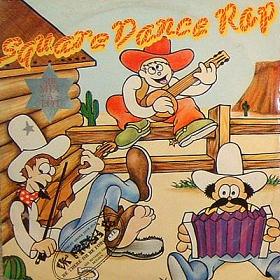 FG: A lot of older hip hop. Slick Rick’s
“La Di Dah” and “Square Dance Rap” by Sir Mix-A-Lot were two songs that were in
a higher echelon of rap music. They went beyond the genre of rap and were just
insanely infectious songs.
FG: A lot of older hip hop. Slick Rick’s
“La Di Dah” and “Square Dance Rap” by Sir Mix-A-Lot were two songs that were in
a higher echelon of rap music. They went beyond the genre of rap and were just
insanely infectious songs. FG: It was a concept
I used to think about a lot as a child- colors that you try to imagine in your
mind that don’t exist. I would get into these weird mind fuck loops as a kid
where I would lie in bed at night wondering if are colors out there can’t see
and don’t exist… what would those look like? It’s just one of those things you
think about as a kid. When highlighter markers hit the market it seemed like
this exciting new technology. I was only five years old or something, but it
was almost magical to me how they were so bright.
FG: It was a concept
I used to think about a lot as a child- colors that you try to imagine in your
mind that don’t exist. I would get into these weird mind fuck loops as a kid
where I would lie in bed at night wondering if are colors out there can’t see
and don’t exist… what would those look like? It’s just one of those things you
think about as a kid. When highlighter markers hit the market it seemed like
this exciting new technology. I was only five years old or something, but it
was almost magical to me how they were so bright. 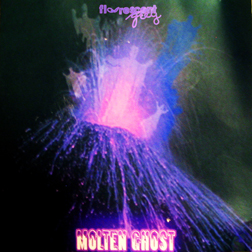 Molten
Ghost was my next release, and is probably my favorite album from this period
of time. It was a culmination of my experimentation on older Windows computer
programs like Cool Edit Pro, Vaz, Audio Mulch, Rebirth- some of it sounds like
modern Mego Records stuff, and I’m pretty proud of it (
Molten
Ghost was my next release, and is probably my favorite album from this period
of time. It was a culmination of my experimentation on older Windows computer
programs like Cool Edit Pro, Vaz, Audio Mulch, Rebirth- some of it sounds like
modern Mego Records stuff, and I’m pretty proud of it ( That’s
how
That’s
how  My
next release,
My
next release, 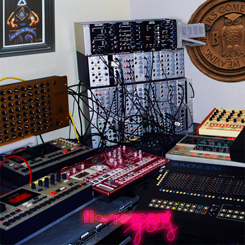 FG:
FG:  MR: A lot of the artists on RLR have also been your
friends growing up. It’s cool that so many of your friends just happen to be
extremely musically gifted as well, and amazing that you have given them an
outlet with RLR to put out their music.
MR: A lot of the artists on RLR have also been your
friends growing up. It’s cool that so many of your friends just happen to be
extremely musically gifted as well, and amazing that you have given them an
outlet with RLR to put out their music. 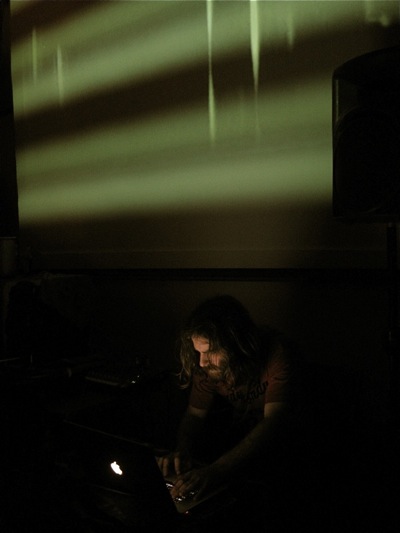 MR: When I saw you play at the Kava Lounge in San
Diego, you blew everyone away. You built up
all your beats and the sound had so many layers. When you do shows that are
interactive like that, are they done extemporaneously or do you
have a good idea of how you are going to build your songs beforehand?
MR: When I saw you play at the Kava Lounge in San
Diego, you blew everyone away. You built up
all your beats and the sound had so many layers. When you do shows that are
interactive like that, are they done extemporaneously or do you
have a good idea of how you are going to build your songs beforehand? MR: Agreed, I think it’s a really exciting time for
electronic music, precisely because of what you just said.
MR: Agreed, I think it’s a really exciting time for
electronic music, precisely because of what you just said.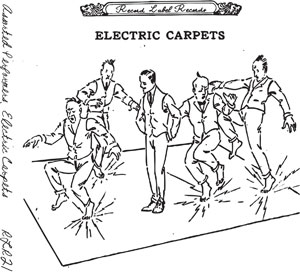 FG: Record
Label Records just released a compilation series this year of Record Label Record
artists, part one of the compilation is called Drinking the Goat’s Blood and
the second one is called Electric Carpets. Drinking the Goat’s Blood is
more of an experimental album, while the second disc shows a more poppy side of
Record Label Records.
FG: Record
Label Records just released a compilation series this year of Record Label Record
artists, part one of the compilation is called Drinking the Goat’s Blood and
the second one is called Electric Carpets. Drinking the Goat’s Blood is
more of an experimental album, while the second disc shows a more poppy side of
Record Label Records.  ROLLING STONE