 MEDIA ROOTS- Several research studies have studied job discrimination by sending out
resumes with different identifying features and tracking the response
rates. For instance, one study conducted by researchers at MIT and
University of Chicago sent out thousands of resumes that were identical
except for the name of the applicant: in one version, the applicants
name was stereotypically “Black” (e.g., Rasheed, Aisha) and another
version had stereotypically “White” names (e.g., Greg, Emily). Even
though the resumes were identical in terms of qualifications, those
researchers found that the “White” resumes had a 30 percent greater
chance of getting responses than the “Black” resumes.
MEDIA ROOTS- Several research studies have studied job discrimination by sending out
resumes with different identifying features and tracking the response
rates. For instance, one study conducted by researchers at MIT and
University of Chicago sent out thousands of resumes that were identical
except for the name of the applicant: in one version, the applicants
name was stereotypically “Black” (e.g., Rasheed, Aisha) and another
version had stereotypically “White” names (e.g., Greg, Emily). Even
though the resumes were identical in terms of qualifications, those
researchers found that the “White” resumes had a 30 percent greater
chance of getting responses than the “Black” resumes.
A
new study published this week in the American Journal of Sociology has
used this method to test whether gay men face similar job
discrimination. Identical resumes were sent out, with a key difference
being membership in a college club: either the applicant reported
membership in an LGBT organization, or a socialist organization. The
results were striking: “gay” resumes were significantly less likely to
lead to interview requests than “socialist” resumes. The socialist group
was used as the comparison to rule out the possibility that any
discrimination was due to an “anti-liberal” bias, and this makes the
results even more striking: being openly gay is more of a liability on
the job market than being openly socialist.
Perhaps
even more concerning is that a huge scientific literature now shows
that these types of discrimination are not necessarily due to overt,
conscious prejudice – these differences tend to emerge from subtle,
unconscious preferences that guide our judgments and decision making
even when we’re not aware of it.
Steven Frenda for MR
***
EUREKALERT– A new study suggests that openly gay men face substantial job discrimination in certain parts of the U.S. The study, which is the largest of its kind to look at job
discrimination against gay men, found that employers in the South and
Midwest were much less likely to offer an interview if an applicant’s
resume indicates that he is openly gay. Overall, the study found that
gay applicants were 40 percent less likely to be granted an interview
than their heterosexual counterparts.
“The results indicate that gay men encounter significant barriers in
the hiring process because, at the initial point of contact, employers
more readily disqualify openly gay applicants than equally qualified
heterosexual applicants,” writes the study’s author, András Tilcsik of
Harvard University.
For the study, Tilcsik sent two fictitious but realistic resumes to
more than 1,700 entry-level, white collar job openings — positions such
as managers, business and financial analysts, sales representatives,
customer service representatives, and administrative assistants. The two
resumes were very similar in terms of the applicant’s qualifications,
but one resume for each opening mentioned that the applicant had been
part of a gay organization in college.
“I chose an experience in a gay community organization that could
not be easily dismissed as irrelevant to a job application,” Tilcsik
writes. “Thus, instead of being just a member of a gay or lesbian campus
organization, the applicant served as the elected treasurer for several
semesters, managing the organization’s financial operations.”
The second resume Tilcsik sent listed experience in the “Progressive
and Socialist Alliance” in place of the gay organization. Since
employers are likely to associate both groups with left-leaning
political views, Tilcsik could separate any “gay penalty” from the
effects of political discrimination.
The results showed that applicants without the gay signal had an
11.5 percent chance of being called for an interview. However, gay
applicants had only a 7.2 percent chance. That difference amounts to a
40 percent higher chance of the heterosexual applicant getting a call.
The callback gap varied widely according to the location of the job,
Tilcsik found. In fact, most of the overall gap detected in the study
was driven by the Southern and Midwestern states in the sample — Texas,
Florida, and Ohio. The Western and Northeastern states in the sample
(California, Nevada, Pennsylvania, and New York) had only small and
statistically insignificant callback gaps.
“This doesn’t necessarily mean that there is no discrimination in
those states, just that the callback gaps were small in the case of the
jobs to which I sent applications,” Tilcsik explained. “I think it’s
very plausible that, even in those states, there might be a large
callback gap in some other jobs, industries, or counties. What this does
show is that discrimination in white-collar employment is substantially
stronger for the Southern and Midwestern states in the sample.”
The research also found that employers seeking stereotypically
heterosexual male traits were more likely to discriminate gay men. Gay
applicants had lower callback rates when the employer described the
ideal candidate for the job as “assertive,” “aggressive,” or “decisive.
“It seems, therefore, that the discrimination documented in this
study is partly rooted in specific stereotypes and cannot be completely
reduced to a general antipathy against gay employees,” Tilcsik writes.
The technique Tilcsik used, known as audit study, has been used in
the past to expose hiring prejudice based on race and on sex. This is
the first major audit study to test the receptiveness of employers to
gay male job applicants.
Understanding the ways in which these biases might operate at the
interview stage of the employment process, or how they might apply to
lesbian job seekers in the U.S., requires additional research, Tilcsik
says.
###
András Tilcsik, “Pride and Prejudice: Employment Discrimination against Openly Gay Men in the United States.” American Journal of Sociology 117:2 (September 2011).
Established in 1895 as the first U.S. scholarly journal in its field, the American Journal of Sociology remains a leading voice for analysis and research in the social sciences.
Photo by Flickr user bpsusf



 MEDIA ROOTS- Several research studies have studied job discrimination by sending out
resumes with different identifying features and tracking the response
rates. For instance,
MEDIA ROOTS- Several research studies have studied job discrimination by sending out
resumes with different identifying features and tracking the response
rates. For instance,  MEDIA ROOTS- Who are these Occupy Wall Street people? What is this “99%”? The question is being asked many times over around the nation, even now as you’re reading this. Perhaps in providing answers, it’s best we start with the One Percent and work our way up.
 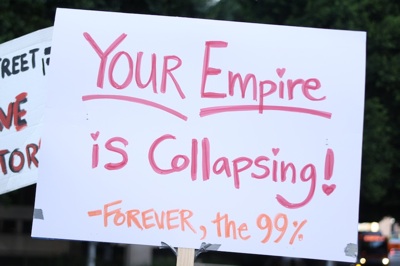 We are those who feel that the elected leaders of America have forgotten us among the ranting political rhetoric and opposition demonization by politicians who longer represent us at all.
 Teachers and nurses associations are aligning themselves as well. Neighbors are stopping by with food and supplies. Just yesterday afternoon at City Hall in Los Angeles, dozens of pizzas and various other food and drink as well as medical and clothing supplies were being distributed freely by the people. For the people. I’m hardly a religious man, but the collective thousands at OccupyLA caring for one another without parasitic motive was the closest thing to truly Christ-like behavior among a large mass of people that I’ve seen in my 33 years.
 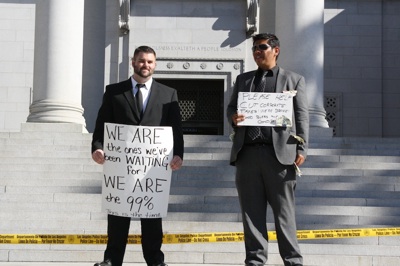 Yet despite constant evidence to the contrary, we trust that politicians – who truly no longer represent the people – will turn away from the staggering amounts of money that corporations offer for favorable legislation and the power-wealth’s demands.
  For just about every vocal movement throughout history, there has been a countermeasure, an opposition that speaks with equal passion and dissent from the idea. Yet with the Occupy movement, the only opposing assailants are the champagne-toasting core of the problem sneering down at protestors on Wall St., and the likes of Ann Coulter and Alex Jones who are feebly trying to “expose” the movement as a veiled operation for the Democratic party (which it most assuredly is not). Where are the picketers defending the multi-millionaires and the multinational corporations?