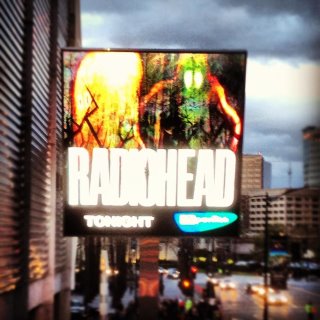
Radiohead King of Limbs at San Jose HP Pavilion

RadioheadHPP11APR2012MEDIA ROOTS — Despite reticent airplay from corporate rock stations around the S.F. Bay Area, radio stations which tend to stick to the band’s older hits squeezed into their ultra-commercial agenda, modern rock band Radiohead continues to maintain its popularity for decades, playing a sold-out show yesterday in San Jose’s Shark Tank, or Corporation A Pavilion, in support of its newest album “The King of Limbs.”  (See complete set list below.)

In fact, the band is more popular than ever, despite lacklustre support from the corporate broadcasters controlling modern rock radio. Virtually, the entire “King of Limbs” Tour around the world is completely sold out.  Radiohead will next travel south down California to Santa Barbara before playing Coachella, then Mexico, then Coachella again, before continuing on its world tour.

The opening band from Stillwater, Oklahoma, Other Lives, opened promptly at 7:30 pm, Wednesday night, April 11, 2012, kicking off the concert with ambitious and cinematic music, which clearly paid deep homage to the headlining band, reflecting some influence.  I should probably know who the band was, but I haven’t been listening to an excessive amount of new music lately, I’ll admit.  At first, I wondered if they were not foreign by their musical style of modern rock.  Some people I spoke with at the concession stands noted, yeah, this does kind of sound like Radiohead.  But this band, new to me, seemed to possess an interesting character of its own. Other Lives has been recording for years and has been featured on TV show soundtracks and will join Radiohead in playing this year’s Coachella music festival.

When Radiohead took to the stage after a 45-minute intermission (plenty of time for the captive audience to consume calories, pints of ale, or Radiohead KOL Tour swag), opening with “Bloom,” the packed stadium was fully primed for the rhythmic meditations—absolutely brilliant and intense, cathartic.  From our vantage point, quite close to the lower edge of the balcony seats, billows of herbal smoke dotted the stadium audience, as the band tore it up.  Unfortunately, for our section, our nearest usher was determined to uphold all security codes and came up to where we were seated to scold a girl behind us firing up some ganja.  As the opening King of Limbs track, “Bloom” was an appropriate opener for the “King of Limbs” concert.

Later, frontman Thom Yorke would offer the receptive audience some honest observations in between numbers.  It’s always nice to see such humanity.  At one point, after tearing through “The National Anthem,” Thom Yorke prefaced the next song, helping Radiohead students poring over their lyrics, by commenting on the economic “bullshit” and “…all the people’s money and investigate all that bullshit. And all that Silicon Valley bullshit.”  Thom Yorke continued, “And then you forgot about it. And then they called us up at rehearsal and we decided that we should do this song. So, help me out.

Radiohead then shuffled into a B-side to “Pyramid Song,” released in May of 2001 and which notably foreshadows the future economic calamity of banks’ collapse/looting, “The Amazing Sounds of Orgy“:

I want to see you smile again,
Like diamonds in the dust,
The amazing sound of the killing hordes,

The day the banks collapse on us,

Cease this endless chattering,
Like everything is fine,

When sorry is not good enough,

Sit in the back while no one drives,

I’m so glad you’re mine.”

Taking the audience through In Rainbows space, the second number of the night had the audience fully enthralled.  “15 Step” with its instantly recognisable a capella opening and bare drum ryhthms reinforced the vibe we’d cultivated en route to the show.  And it reminded the audience of the band’s recent material. The first two numbers were the first tracks off of their last two albums.  And the night was young.

But seeing Radiohead is truly a luxury, no less for a working-class observer, such as myself, often unable to traverse space and time to bridge the gulf between the San Joaquin Valley and Silicon Valley.  When you’re broke and underemployed forever, you rarely leave the block, much less travel to the heart of Silicon Valley to catch Radiohead’s Bay Area stop on their “King of Limbs” world tour and congregate with the Bay Area’s petit bourgeois, with the Lefties and the Liberals, with the engaged and the disengaged.  But there we were, driving westbound through verdant hills and wine country.  My brother played M. Ward on the stereo—”Post-War.”  He was exhausted from working hard labour all day and I don’t mind tying one on now and then.  After all, anything worth doing is worth doing right.

We listened to King of Limbs, too, on the road.  It’s quite a tranquil album.  The first few tracks connected me to their past work in their own original way, but reflecting some continuity, very tranquil, reaching graceful dimensions of musical expression of emotion.  It’s a rather hypnagogic album.  A plane ascended overhead, as we approached the San Jose exit off of 280.  A scene not unlike the cover of Radiohead’s classic OK Computer, or any metropolitan setting of modern bustle.

Parking was $20 bucks, so that sucked.  But what are you gonna do?  We could’ve parked on the street and walked for miles, but then you miss the tail-gate parties.  Indeed, as we pulled up our neighbours enjoyed themselves at their tail-gate, as security guards chatted down yonder unconcerned.  “The security guards aren’t sweatin’ you guys?” my brother asked.  “We’re about to find out,” said our Euroamerican neighbours.  My brother wasn’t feeling quite as entitled.  “Let’s get out of here, man.”  We did, after a few rounds to save on the Shark Tank bar tab.

In logical succession, the third number was “Morning Mr. Magpie,” track two from The King of Limbs.  This track sounds simple, but is anything but, with its complex layering of agile rhythms, sublime drumming, and muted and delayed guitar playing and sporadic bursts of bass playing.  If there is anything worth fighting for, or dying for, or living for, Radiohead’s musicianship and lyricism were articulating it last night.

You stole it all,  

Give it back

The Shark Tank stage almost seemed like an optical illusion, with its two drum kits on stage with identically head-shaven drummers emanating layered drum rhythms and syncopation.  Bloody hell, I thought.  Is that really two drummers?  Or mirrors and shit?  Indeed.  I was not seeing double.  Not yet, anyway.  This was only the third number.  The band seemed to enjoy the same configuration from every time I’ve seen them live, except for the addition of a second drummer, with Ed O’Brien playing guitar to the audience’s left and Jonny Greenwood with his musical arsenal on the right.  And Colin Greenwood unassumingly layin’ back on bass.  

“Thank you,” said Thom Yorke, going into the fourth track.  They say in journo school, one is to report the story, not be the story.  But I’ve always been thankful some, such as Hunter S. Thompson, never gave a shit.  How much humanity is allowed in public human expression or communication?  I gave my best howl, during one of those opportunistic moments when the venue quiets and one’s howl can travel the furthest:  “Fucken Thom!!!”  Thom Yorke seemed to respond, “Wow!”  But my brother insists we were way too far for it to have been audible.  My vox was shot for days afterward.

No matter.  The warmth of electronic tones then enveloped us into “Kid A.”  The band have previously described their love of Warp Records and such around the period when Kid A was released.  Thom Yorke pulled out some sick ass synth thing and started to rock out with it and synthesised vocalisations. 

Then more obscure track “Staircase” was followed by “The Gloaming (Softly Open Our Mouths in the Cold).”

When I see a band, like Radiohead, like one of my favourite living recording artists, like Morrissey, like Andre Nickatina, like Bjork, like KRS-ONE, like Shellac, like Scratch Acid, like Dinosaur, Jr., I am thankful.  Other favourites, like The Jesus Lizard or Amy Winehouse or Nirvana or The Doors or Big Black weren’t meant to last.  The artistic entity that is the soft animal centre of any worthwhile musical project is something that doesn’t always enjoy longevity.  But some do; and here we have the beauty of Radiohead still going strong.

Radiohead’s music often helped me, and, doubtless, others, reflect on the themes of freedom and humanity and suffering and the human condition—and human triumph.  The ripping opening chords and vocal wails to “The Bends,” were one such musical moment.  

I wish it was the ’60s,
I wish we could be happy,
I wish that something would happen…”

Such angst and eagerness for progressive change in humanity in our society was heard in popular music in the ’90s.  Rock and roll has often been the stomping grounds of rebels, except when the musical form has been coopted and cloned by corporations eager to promote sterilised radio-friendly unit shifters.  Two decades later, the struggle continues.  For someone aging from the generation of Radiohead itself, I knew, of course, The Bends wasn’t going to be the focal point of this show.  Radiohead’s 2008 DVD, “In Rainbows From The Basement” and The King of Limbs were our reference points for last night’s “King of Limbs” set-list.

The National Anthem” was almost too familiar and almost seemed too easy as an audience-pleaser, as if the song, having been given sufficient time, had been fully embraced by the audience.  Radiohead’s music definitely takes some time for people to catch up with.  But then, “The National Anthem” did elicit an almost identically enthusiastic appreciation when they performed it at the Shoreline Amphitheatre (in Mountain View, CA) years before.

After Thom Yorke commented on the 1% making money, as economic “bullshit” goes down, and they played “The Amazing Sounds of Orgy,” Thom Yorke cheekily announced the “intermission“:  The epic “Climbing Up the Walls” from OK Computer sounded in during a foray into their classic album.  “Karma Police” followed, with Jonny Greenwood on piano, Thom Yorke on the mic with acoustic guitar, and Ed O’Brien on electric guitar and back-up vocals.  This was an extremely, basic, if dutiful, rendition.  But the tune is just such an effective number, one can hardly help singing along at full tilt.  I was in the piano practice rooms of the local community college just the other day trying to sort out the precise voicing to the C-D-G-F# chord sequence to the tune’s pre-chorus.  Some may argue Radiohead songs like these are played out.  But it would be one’s own fault to try and play out such remarkable work.  For me, and evidently last night’s audience, it’s a timeless tune.  I’ll never forget seeing the condescending slap on Thom Yorke’s shoulder from David Letterman when the band played the song on his TV show, “You alright?” asked the smug host, almost offended by the song’s sincerity.  Some people feel popular music is not meant to be so meaningful.  More recently, David Letterman pulled the same thing on Julian Casablancas when they performed their brilliant number “Taken For A Fool.”

“It’s gonna rain,” said Thom Yorke. “This is freely available on YouTube, as are many things.”  Then Radiohead played the new song “Identikit,” which seems to have lifted its title from the 1974 film

Next, “Lotus Flowergyrated swiftly through the air in an amped up delivery, yet meditative like much of the vibe of The King of Limbs and In Rainbows, incredibly emotive.  By various accounts, this is one of the standout tracks so far off of King of Limbs.

The musical progression between the recent sounds on King of Limbs and In Rainbows was connected in last night’s set to the earlier more rock guitar-laden sounds of OK Computer by sounds from Hail to the Thief, from which came the next track—”There There.”

In pitch dark I go walking in your landscape,
Broken branches trip me as I speak,

Just ‘cos you feel it doesn’t mean it’s there…”

The set-list was a smart blend of more recent material and select tracks from earlier albums.  “Feral” is a particurly tasty track with its oscillating synth sounds and snaking basslines.

“This song is called ‘Little By Little,’ announced Thom Yorke, introducing the third track from King of Limbs.  It was another of the various songs last night, which would utilise the full complexity of interplay involving two drummers.  And my brother noted Andre Nickatina having sampled this track.

Reckoner,” with its incredibly emotional tapestries of introspection and global meditations closed out the set, Thom Yorke’s haunting falsetto wailing and whispering.  

Thank you, San Jose,” said Thom Yorke, returning to the stage.  I was feasting on some concession stand calories, as my brother went for a smoke break and Radiohead returned to the stage for an encore with “Separator.”  This is the closing track from King of Limbs.  But the night was not complete without a Radiohead classic or two.  

During the band’s first encore, it launched into the pre-9/11 era classic from 2001’s Amnesiac, “I Might Be Wrong,” before a reinvigorated audience.  At this point, the epic human communion was undeniable.

The frenetic frenzy of “Myxomatosis” next kicked into gear.  If the ending wasn’t big enough with “Everything In Its Right Place,” we were all blessed with a second encore.  And the backbone of what really makes Radiohead such a strong band—stripped down brilliant songwriting at the core—shone through the building with “The Daily Mail“:

The Moonies are up on the mountain
The lunatics have taken over the asylum
Waitin’ on the rapture

Singing, ‘We’re here to keep your prices down,
We’ll feed you to the hounds,
To the Daily Mail, together, together

You made a pig’s ear, you made a mistake
Paid off security and got through the gate
You got away with it but we lie in wait

Where’s the truth? What’s the use?
I’m hanging around lost and found
And when you’re here, innocent
Fat chance, no plan
No regard for human life

You’ll keep time, you’ve no right
You’re fast and loose, you will lose
You jumped the queue, you’re back again

President for life, lord of all
The flies in the sky, the beasts of the earth
The fish in the sea

You’ve lost command

The penultimate song of the evening was a real crowd-pleaser, “Planet Telex,” from Radiohead’s second album, the ’90s-era classic, The Bends.  “Planet Telex” sounded, as if the tempo was considerably slowed from its studio/album recording.  But then that may have only been in contrast to the much more uptempo compositions Radiohead has recorded more recently for In Rainbows and King of Limbs.  And it’s often the case when bands play older material, as with “Karma Police,” the tunes may sound a bit rough, as the musical vibe, is likely in a different aesthetic space.   And, in this case, last night was apparently the first time Radiohead has played “Planet Telex” this tour and the first time it’s even played it live since 2009.  But audiences, who’ve formed such strong bonds with those songs, are invariably audibly appreciative.

Rolling Stone has ranked The Bends #110 within their 500 Greatest Albums of All Time.  I would probably place the album much higher in my personal list of greatest albums of all time, but then my music print, one’s personal collective memory of music, which shapes our musical tastes, was indelibly shaped during the ’90s when, at least for me, popular music seemed to convey some sense of rebellion and subversion.  As for the ’90s, which for me was an incredibly rich musical decade, and for popular music was certainly dominated by post-punk bands, such as Nirvana, Radiohead ably filled the musical void left by the sudden demise of the post-punk legend of Nirvana. 

And when so many bands like Silverchair and Bush were eagerly aping Nirvana’s aesthetics, Radiohead was able to celebrate the sound of heavily-distorted rock guitar sounds and the quiet-loud-quiet dynamics Nirvana, and The Pixies before them, had championed, but do it with originality and with prescient lyricism.  Of the post-Nirvana mid-’90s, it’s hard for me to think of a song, which better captured the zeitgeist than “The Bends.”

Where do we go from here?
The words are coming out all weird
Where are you now when I need you?
Alone on an aeroplane
Falling asleep against the windowpane
My blood will thicken

I need to wash myself again
To hide all the dirt and pain
‘Cos I’d be scared that there’s nothing underneath
And who are my real friends?
Have they all got the bends?
Am I really sinking, this low?

My baby’s got the bends, oh no
We don’t have any real friends; no, no, no

I’m just lying in a bar with my drip feed on
Talking to my girlfiend
Waiting for something to happen
And I wish it was the ‘60s
I wish we could be happy
I wish, I wish, I wish
That something would happen

Where do we go from here
Tha planet is all gummed up in a sea of fear
And where are you?

They’ve brought in the C.I.A.
The tanks and the whole Marines to blow me away
To blow me sky high

My baby’s got the bends, oh no
We don’t have any real friends; no, no, no

I want to live and breathe
I want to be a part of the human race
I want to live and breathe
I want to be a part of the human race, race, race

Where do we go from here?
The words are coming out all weird
Where are you now when I need you?

SET LIST — RADIOHEAD @ SAN JOSE HP PAVILION, 11 APR 2012

1. Bloom

2. 15 Step

3. Morning Mr. Magpie

4. Kid A

5. Staircase

6. The Gloaming (Softly Open Our Mouths in the Cold)

7. The National Anthem

8. The Amazing Sounds of Orgy

9. Climbing Up the Walls

10. Karma Police 

11. Identikit

12. Lotus Flower

13. There There

14. Feral

15. Little by Little

16. Reckoner

Encore

17. Separator

18. I Might Be Wrong [tour debut]

19. Myxamatosis

20. Everything In Its Right Place

Final Encore

21. The Daily Mail

22. Planet Telex [tour debut, first performance since 2009]

23. Idioteque


Written by Felipe Messina for Media Roots

Photo by Ramon David Messina

“The Amazing Sounds of Orgy” © 2001 Radiohead

“Morning Mr. Magpie” © 2011 Radiohead

“There There” © 2003 Radiohead

“The Daily Mail” © 2011 Radiohead

“Planet Telex” © 1995 Radiohead

***
MR Journalist Jailed For Videotaping Park Police

MEDIA ROOTS — Independent journalists have a passion to get information out to individuals who might not otherwise receive it and most often require supplementary sources of income to survive.  Here at Media Roots, life’s no different.
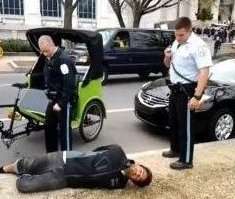
My second line of work is operating a pedicab, a three-wheeler that helps shuttle tourists to various monuments, memorials, and museums in the nation’s capital.  Pedicabs have been in operation here for over five years and boast a perfect safety record and a near-perfect customer satisfaction record.  And while 38 police departments now claim jurisdiction within the District, only the U.S. Park Police find issue with the hard-working and generally light-hearted independents operating on the National Mall.

Most pedicabbers have other lines of work, like indy journalists, and are typically rather articulate and rational.  The majority have never had previous issue with the law and are not looking to create any unnecessary trouble for law enforcement.  But after only a few hours at the third-most popular tourist attraction in the United States, anyone can witness how the aggressors wear an official costume, while the pacifists cruise around accepting gratuities.

While peddling on Sunday, March 25, I found myself pulling up to the Smithsonian Natural History Museum at approximately 3:00 pm.  Another pedicab appeared to have been abandoned in front of the museum.  And nearby was a Park Police cruiser.  In order to prevent the missing operator from having to pay the $195 to recover the cab from the impound lot, I briefly attempted to cart the empty cab back to our shop downtown.

Almost immediately, Officer Blake of the U.S. Park Police, the same officer whom had issued me a previous citation just weeks before (only to be dismissed by DC adjudication services), appeared and ordered me to not take the human-powered vehicle.  I immediately complied and moved approximately 20 feet from the scene.  Blake would follow me and continued to instruct me I couldn’t stop where I had – in front of a parked tour bus.

“Where would you like me to go?” I asked.

“Off the Mall,” he would reply with an unlawful attempt to exile me from over 300 acres of public property.

Unsure how to respond, I steered my pedicab to what appeared to be a legal parking spot a motor vehicle had just vacated.  Again, the officer was hot on my trail.

Give me your ID. You’re getting a ticket.”  I complied with no hesitation.  In order to maintain a level of accountability, I also pulled out my video camera to capture the scene.

“Put your camera away,” he continued.

“I don’t have to put my camera away.”  After all, I am the organizer for DC CopBlock and quite familiar with the First Amendment.

“Put your hands behind your back.”

I had officially been placed under arrest, despite the fact that two other pedicabbers were seemingly ignored by officer Blake.  I was in utter disbelief that not only was I getting arrested again (the first arrest in November, also a charge for resisting arrest, was eventually dismissed by federal prosecutors), but I was now getting arrested for a Constitutionally-protected act.

As the handcuffs were aggressively placed on my already-sore wrists, I became dizzy and uncertain about the officers’ intentions.  They screamed orders at me, even though I was not talking back nor were there any loud noises nearby.  A tourist and his son a few feet away were visibly traumatized by the incident with the younger crying and his father yelling at the police for their blatant display of excessive force.

“Stop resisting,” Officer Hiatt continued to yell at me, even though he was close enough to kiss me.

“I’m not resisting,” I calmly replied, uncertain what else to say.

The officer then slammed me down to the gravel.  Because I was already cuffed, I couldn’t break my fall and ended up landing face-first.  The fall knocked me out for a minute and the trauma to my shoulder is still present to this day.  But the emotional damage of a tyrannical police force, operating without regard to the law or morality might take years to recover from.

Oskar Mosco is a regular contributor for Media Roots

***

TBD — Two Park Police officers bend down to look at another groaning black-haired pedicab operator, his face against the grass and lying on his stomach on the National Mall. They talk into their radio. On the street is a little green pedicab, abandoned. One officer fastens handcuffs on the young man, a manager at National Pedicabs.

This pedicab operator calls himself Oskar Mosco and is the same one who was arrested last fall and formed the D.C. Pedicab Operators’ Association to advocate for operators amid the evolving regulations and allegations of harassment that have come up in the last year.  He was last arrested in November, but the case was dismissed earlier this year.  The National Park Service controls the pedicab territory of the National Mall, and Park Police enforce the rules.  Yet the NPS is still developing its formal pedicab regulations, which will apparently mirror those the District Department of Transportation released last year.  The Park Police note that D.C. traffic regulations apply, however, and regularly write tickets to the region’s pedicabbers.

Mosco attempts to ask what orders he disobeyed.

“We are no longer discussing this,” the Park Police officer tells him. “You are under arrest.”

The two officers pull Mosco to his feet and escort him to a police car, in which a second pedicab operator sits, as Mosco shouts that he was arrested for videotaping the police. “You should not get arrested for videotaping a police officer!” Mosco yelled to onlookers in front of the Natural History Museum. “This is a free country, not a police state!”

Pedicabs are a human-powered transportation option that fill a unique demand in an increasingly petroleum-dependent society. They have proven to be safe and fun in areas that demand a variety of transportation options. The very survival of America’s emerging pedicab industry depend on a population that is informed, and concerned, with the what else can be possible. Those interested in following the development of American pedicab culture can follow the page Everything Pedicab.

Read more about Two D.C. pedicab operators were arrested on the National Mall.

© 2012 TBD

***

Photo provided by Daniel Blackwell. 

Academic Dr. William Black: How to Become a Billionaire


HoovervillesFlickrTony_Fischer_PhotographyMEDIA ROOTS — Pacifica Radio’s Guns and Butter have faithfully broadcast another potent weekly instalment of compelling discussions from the radical economics summit in Rimini, Italy produced by journalist Paolo Barnard:  Summit Modern Money Theory 2012.  Media Roots previously transcribed and featured the first, second, third, and fourth consecutive Guns and Butter broadcasts on the MMT Summit.  Here we present the most recent coverage of this important and inspiring international economic summit featuring academic Dr. William K. Black, author of The Best Way to Rob a Bank Is to Own One.

It’s essential to understand, at least, the basics of how the ruling-class widens inequality.  It’s equally important to understand our role in perpetuating that widening inequality by supporting their corrupt political parties, the Democrat and Republican parties, and their counterparts abroad, for which no amount of token reformers, such as Dennis Kucinich or Paul Wellstone or Barbara Lee or you name it, could compensate because corporate funding isn’t intended to benefit the working-class.  Dr. Black discusses many economics taboos never mentioned.  Similarly, we must acknowledge political taboos never mentioned, such as our rigged two-party system.  The days of New Deal Democrats are long gone.  It’s high time for expanding beyond U.S.A.’s monopolised two-party dictatorship, which undergirds the vast fraud Dr. Black discusses, as well as virtually every other single-issue, which atomised activists toil against.  As U.S.A. faces the masochistic prospect of electing another pro-1% Republican or re-electing the pro-1% Democrat Obama, we bear in mind the role of political parties and their principles, or lack thereof, and our atrophied votes for the least worst, rather than the best possible.  (Transcript below.) 

Messina

***

GUNS AND BUTTER — “And here’s the key question:  How many of you are bankers?  Not many, right?  How much brains does it take to make a bad loan?  I think we could all do that.  So, all the mediocre bankers have no way to make money with honest competition.  But they have a sure thing, if they’re willing to follow the fraud recipe.” —William K. Black

“I’m Bonnie Faulkner.  Today on Guns and Butter:  William K. Black.  Today’s show:  ‘Formula For Fraud.’  William Black is Associate Professor of Law and Economics at the University of Missouri, Kansas City.  He is a lawyer, academic, and former bank regulator and author of The Best Way to Rob a Bank is to Own One: How Corporate Executives and Politicians Looted the S&L Industry.  

“According to William Black, the current crisis is 70 times larger than the Collapse of the Savings and Loan Industry in the late 1980s.  Today’s programme includes two of Bill Black’s presentations on Saturday, February 25th, [2012] in Rimini, Italy at the first Italian grassroots economic Summit on Modern Money Theory produced by Italian journalist Paolo Barnard, which featured speakers Stephanie Kelton, William Black, Marshall Auerback, Michael Hudson, and Alain Parguez.

“In today’s show, Black deconstructs the elements, that constitute the recipe for fraud.”

Dr. William K. Black (c. 2:05):  “It’s difficult to follow such a raging optimist. [Applause]  But I can assure you, it’s actually far worse than they say.  First, there are no ‘technocrats,’ especially the ‘genius’ technocrats.  I suggest a new rule of thumb for judging a ‘genius technocrat.’  They have to be right at least two out of ten times.  And there’s not a single economist in Europe, who calls himself a technocrat, that could do the equivalent of making two penalty kicks out of ten.  So, I’m going to pick up on some of the things, that Michael [Hudson] has talked about.  He quoted Balzac’s famous phrase that behind every fortune lies a great scandal.  And I’m going to explain how that works.  So, you will now learn how to steal €10 billion euros. [Applause]  The purpose of this is not so that you will steal €10 billion euros.  The purpose is so that you can be an intelligent lion because they feed on sheep. 

(c. 3:40) “We’ve been asked to do our talks in four parts.  So, unlike Gaul, my speech is divided in four parts.  This talk will be about why we suffer recurrent, intensifying, financial crises.  Then, I’ll explain how theoclassical economic dogma produces these disastersThe third part will be to explain why our response to the crisis has made it worse.  And I, actually, will end on an optimistic note.  The fourth part is how we have succeeded in some places at some times and why you can do the same.

(c. 4:29) “Part one sounds like one question:  Why do we have recurrent, intensifying, financial crises?  But it’s really two questions.  The first one asks:  What is the cause of these crises?  The second one says:  Well, wait a minute. We keep on suffering crises. Why don’t we learn the right lessons from these crises?  So, part one will focus on what caused the crises.

(c. 5:05) “Part two will focus on why ideology prevents us from learning the right lessons.  

Santayana’s famous phrase, of course, is that those that forget the mistakes of the past are condemned to repeat them.  But, even if we remember the mistakes we’ve made, the new policy we pick could be another mistake.  So, part three discusses that, in part.  

“But part four says the real tragedy is when you forget the successes of the past, when you have something that you know works and that you refuse to use.  Because, as Michael [Hudson] said, there’s not an economics textbook in the world, that warns you that elite CEOs often become wealthy through fraud.  And there is a primitive, tribal, taboo in economics in English against using the five-letter eff-word—fraud.  When I go and talk to groups of economists, who are traditional, I start out the meeting by asking them each to say out loud the word fraudYou can’t believe how difficult it is for them, even, to utter the word.

(c. 6:42) “So, as I said, the lessons of success, it’s a real tragedy to forget them.  And I’m going to quote from George Akerlof and Paul Romer’s famous article, or, at least, an article, that should be famous where the title says it all:  ‘Looting: The Economic Underworld of Bankruptcy for Profit.’  So, the bank fails or, in the modern era, is ‘bailed‘ out, but the CEO walks away wealthy.  And this is what Akerlof and Romer wrote about 20 years ago:

“‘Neither the public, nor economists foresaw that savings and loan deregulation was bound to produce looting, nor, unaware of the concept, could they have known how serious it would be. Thus, the regulators in the field who understood what was happening from the beginning found lukewarm support, at best, for their cause. Now, we know better. If we learn from experience, history need not repeat itself.’

(c. 8:22) “George Akerlof was awarded the Nobel Prize in Economics in 2001.  So, you might think economists would pay attention.  You might think, since this article was written nearly 20 years ago, that the textbooks would mention fraud and looting.  They don’t just ignore everyone here.  They ignore Nobel Prize winners in Economics.

“So, what, again, was this lesson?  It was the regulators in the field, the little people, not the fancy people, who understood from the beginning that deregulation would lead to massive lootingAnd it was the economists, that ignored them.  And after we had proven that it was fraud, after we had sent over a thousand elite bankers and their cronies to prison, after a Nobel Prize winner warned about it, after all those things, they ignored it and produced crisis after crisis, including the one we experience now.

(c. 9:59) “So, what did we know out of that savings and loan crisis, that was widely described at the time as the worst financial scandal in U.S. history?  And we have a history rich in scandal.  Here is what the national commission, that investigated the causes of the crisis reported:

“‘The typical large failure [grew] at an extremely rapid rate, achieving high concentrations of assets in risky ventures… [E]very accounting trick available was used… Evidence of fraud was invariably present, as was the ability of the operators to ‘milk’ the organisation.’ 

(c. 11:04) “That means to loot the organisation.  But, speaking of milk, [Applause] the frauds I’m describing are in no way limited to the Unites States; they exist in every country.  And they are common enough to explain, and they are old enough to explain, what Balzac was saying because many of the wealthy become rich through precisely the scandals, the fraud, I will describe.

“In criminology, we call them financial super predators when we’re being lyrical.  When we’re writing journals, we call them ‘control frauds,’ which is boring.  Control fraud occurs when the person who controls a seemingly legitimate entity, like Parmalat, uses it as a weapon to defraud.  And they can often use this weapon with impunity.  In finance, accounting is the weapon of choice.  And these accounting frauds cause greater losses than all other property crimes combined; yet, economics, again, never talks about it.  Worse, when many of these frauds occur in the same area, they hyperinflate financial bubbles, which is what causes financial crises and mass unemployment.  It makes the CEOs wealthy, produces Balzac scandals, and destroys democracy.

(c. 13:10) “In criminology, we talk about criminogenic environments, long words, simple concept.  When the incentives are extremely perverse, you will get widespread fraud.  So, what makes for perverse incentives?  The ability to steal a lot of money and not go to prison and not having to live in disgrace.  In practice, that means, in English, the three Ds:  deregulation, desupervision, and de facto decriminalisation.  Deregulation: You get rid of the rules.  Desupervision: Any rules, that remain, you don’t enforce.  Decriminalisation: Even if you sometimes sue them and get a fine, you don’t put them in prison.  So, that’s the first area—deregulation

(c. 14:20) “The second area is executive compensation.  And what is ideal for accounting fraud?  Really high pay based on short-term-reported income with no way to claw it back, even when it proves to be a lie.  Those are the most important, but it’s also good, if your assets don’t have a readily verifiable market-value ‘cos then it’s easy to inflate the asset prices and it’s easy to hide the real losses.  And, if you want a true epidemic of fraud, if entry into the industry is very easy, then you’ll get much more fraud.”

Bonnie Faulkner (c. 15:15):  “You’re listening to lawyer, academic, author, and former bank regulator William K. Black.  Today’s show:  ‘Formula for Fraud.’  I’m Bonnie Faulkner.  This is Guns and Butter.”

Dr. William K. Black:  “So, this is what you were waiting for, at least from me.  This is the recipe, only four ingredients, that bankers in many parts of the world use to become billionaires.  And, again, it’s one that Akerlof and Romer agreed with.  So, first ingredient: grow massivelyTwo: by making really, really crappy loans, but at a higher interest rate.  Third ingredient: extreme leverage—that just means a lot of corporate debt.  Fourth ingredient: set aside virtually no loss reserves for the massive losses that will be coming.  By the way, in Europe, this last ingredient is mandated by international accounting rules, which are incredibly fraud-friendly.  And everybody knows that—in accounting—and nobody has changed it.  If you do these four things, you are mathematically guaranteed to report record short-term income.  This is why Akerlof and Romer referred to it as a sure thing—it’s guaranteed. 

(c. 17:10) “There are actually three sure things.  The bank will report record profits.  The profits, of course, are fictional.  The CEO will promptly become wealthy and, down the road, the bank will suffer catastrophic losses.  Again, if many banks do this, you will hyperinflate a bubble.  This recipe helps explain why bankers hate markets, why bankers hate capitalism, why they hate anything like an effective market.

So here’s a thought exercise:  What if you were a CEO of a bank and you wanted to grow exceptionally rapidly?  The first ingredient to the fraud recipe, that means 50% a year.  And that’s realistic; that’s what the banks in Iceland, that’s what many of the banks in Europe—continental Europe—and the US also did.  How would you do that if you were honest? You’re in a market that’s competitive.  The only way to grow that rapidly is to charge far less money—a lower interest rate—for your loans.  But if they’re a real market what would your competitors do?  They would match your price reduction.  You wouldn’t end up making any more loans; and all the banks would be loaning at a lower interest rate.  So, here’s the question?  Is that a good way to make money as a bank?  It’s a terrible thing for a bank, right?  So, all the bankers would lose.  And that’s why they hate markets.  And that’s why banks are the biggest proponents of crony capitalism and the leaders worldwide in crony capitalism

(c. 19:26) “And that leads us to a discussion of why bad loans are so perfect for bank fraud; you can charge a much higher rate to people who can’t get loans because they can’t repay the loans.  And there are millions, tens of millions, of such people.  So, you can grow very rapidly.  You can charge a higher interest rate.  If your competitors do the same thing, it’s actually ‘good’ for you because it hyperinflates the bubble.  And the bad loans, you just refinance them and you hide the losses for many more years. 

(c. 20:22) “So, the CEO takes no risk; all of this is a sure thing.  And here’s the key question:  How many of you are bankers?  Not many, right?  How much brains does it take to make a bad loan?  I think we could all do that.  So, all the mediocre bankers have no way to make money with honest competition.  But they have a sure thing, if they’re willing to follow the fraud recipe.  I’m now gonna quote from the person, the economist [James Pierce, NCFIRRE’s Executive Director], who led the national investigation of the savings and loan crisis.  And he called this dynamic I’ve just explained, ‘the ultimate perverse incentive.’  So, this is what he said:

(c. 21:28) “‘Accounting abuses also provided the ultimate perverse incentive:  it paid to seek out bad loans because only those who had no intention of repaying would be willing to offer the high loan fees and interest required for the best looting.  It was rational for operators’—that’s CEOs—‘to drive their banks ever deeper into insolvency, as they looted them.’  

(c. 22:12) “That is how crazy a world that theoclassical economics has built, where the best way, the surest way, to become wealthy, as a bank CEO, is to make the worst possible loans.  And to make so many bad loans, they have to gut the underwriting process.  Underwriting is what an honest bank does to make sure that it’s going to get repaid.  But, if you want to make bad loans, you have to get rid of your effective underwriting.  So, this is the key, if you get rid of underwriting.  We already established you’re not bankers. 

“So, imagine all of you run Competent Honest Bank and you do underwriting.  And you can tell can tell high-risk and low-risk borrowers.  Low risk borrowers you charge 10%.   High-risk borrowers you charge 20%.  I run Bill’s Incompetent Bank, I can’t tell risk.  So, I charge everybody 15%.  Which borrowers come to me?  Only the absolute worst borrowers.  No good borrower would come because they could borrow at your bank at 10%.  So, this is not like a usual risk.  In economics, we call this adverse selection.  And it means that a bank, that makes loans this way must lose vast amounts of money.  No honest banker would operate this way.  And the banks, that engage in these frauds, also create criminogenic environments, themselves, to recruit fraud allies.  For example, the people, that value homes. If they won’t inflate the value, the dishonest banks won’t use them.  Do they need to corrupt every person that values homes?  No.  5% of the profession would be fine.  They just send all their business to the corrupt—we call them—appraisers in America.  And this is called a Gresham’s Dynamic; and it means that cheaters prosper and bad ethics drives good ethics out of the marketplace.  

(c. 25:18) “Well, what about compensation?  In [the United States of] America, the largest corporations, the largest 100, created a group to lobby, called the Business Roundtable.  And you remember our Enron-era frauds, early 2000s?  Well, they got embarrassed.  And, so, they appointed a task force to look at the frauds.  And they named a particular CEO as head of their task force; and he was asked by Business Week, why do we have all these frauds?  This is the answer he gave:

“‘Don’t just say: ‘If you hit this revenue number, your bonus is going to be this. It sets up an incentive that’s overwhelming. You wave enough money in front of people; and good people will do bad things.’

(c. 26:28) “And that was Franklin Raines, the head of Fannie Mae, which is now insolvent by about $500 billion dollars.  How did Frank Raines know about this perverse incentive?  Because he used it at Fannie Mae to produce the frauds, that made him wealthy.

“How about Ireland?  This is a report by a Scandinavian banker hired to do an investigation, not a real investigation, of course.  He reported:

“‘Bonus targets, that were intended to be demanding through the pursuit of sound policies and prudent spread of risk were easily achieved through volume lending to the property sector.’

(c. 27:25) “Now, that requires a translation, not because it’s written in English, but because it’s written to be not understood.  So, what is he really saying?  The bank CEO sets a target for income, that is huge—three times the current income.  How can you triple income safely?  Wow, if somebody could really do that safely, we’d be happy to pay them a very big bonus, right?  But what does he say?  

“You don’t have to do it safely.  And it isn’t hard.  You just follow the fraud formula, the recipe, and it’s a sure thing.  It’s easily achieved.

“What’s wrong with his sentence, though?  

“He says the targets were intended to be difficult, demanding.  And they were intended to be met through prudent lending.

(c. 28:34) “Seriously, you think that?  The CEO is deciding how much money he is going to make.  Do you think he intended a demanding target or a target that was easily achieved and would make him wealthy?

“So, I will end on this.  We need a coast guard for our banks.  We can no longer allow CEOs to desert their posts after running their banks aground and causing such great destruction.  The cruise ship’s captain’s career is over.  But the elite bank CEOs, that destroyed the global economy remain wealthy, powerful, and famous because they looted.  They were ‘bailed’ out.  They did not leave in a lifeboat in the dark of night.  They left in their yachts, yachts that the governments paid for.  And no official anywhere in the world has demanded of those bank CEOs who deserted their vessels […] [Applause]  Grazie.”

Bonnie Faulkner (c.30:30):  “You’re listening to lawyer, academic, author, and former bank regulator William K. Black.  Today’s show:  ‘Formula for Fraud.’  I’m Bonnie Faulkner.  This is Guns and Butter.”

Dr. William K. Black:  “Someone called on the Black Plague?  I’m here. [Laughter, Applause]

In this part two, I’m going to talk about why we have recurrent, intensifying crises, why we don’t learn the right lessons from our past crises.  And then we’re going to discover something that, of course, you’ve been hearing.  The dominant economists are truly terrible at one thing.  They are terrible at economics.  But occasionally they go beyond economics and they are abysmal on ethics.  And they are the leading opponents and dangers to democracy throughout the EU, in particular, but in America as well.

(c. 31:40) “Economists tell us they want to be judged on their predictive ability.  We welcome their admission because their record in prediction is pitiful.  But, of course, it is precisely the fact that they’ve been wrong about everything important for three decades, that makes them unwilling to admit their error and evermore insistent on continuing their worst policy advice.

(c. 32:12) “As I said economics is particularly awful when it gets into the concept of morality.  In my first talk, I read you a quotation from the economist who conducted the study of the savings and loan crisis.  And he pointed out that it was ‘rational’ for looters to make bad loans.  Well, here is the reaction of one economist, Greg Mankiw, to hearing the work of that national commission and of that Nobel Prize winner-to-be, George Akerlof.  He listened to their story and he said—and this is not an off-hand comment; he was the official discussant; he had the paper a week in advance; he thought about these remarks—he said:

“‘[…] it would be irrational for savings and loans [CEOs] not to loot.’

“So, note that he goes from simply a statement about how you maximise fraud by making bad loans to the ethical proposition that if it would be rational action, it must be the appropriate action, even though the rational action is to defraud.  

(c. 33:40) “Now, there’s a very interesting book called Moral Markets, that had the unfortunate timing to come out in 2008 because it is a triumphal book about capitalism and about how capitalism makes markets more moral.  But even it contains this statement:

“‘Homo economicus is a sociopath. Homo economicus is what happens if people behave the way economists predict that they will behave.’  

And these scholars, who love capitalism, said: if you do that, you will create a nation of sociopaths.  

“Greg Mankiw was not a random economist.  [Then-]President Bush made him Chairman of the President’s Council of Economic Advisers, the most prominent economic position in America, after he had said these things.  

(c. 34:48) “The next two gentlemen are the leading law and economics scholars on corporate law.  And I’m quoting from their treatise in 1991; so, an entire generation of US lawyers have been taught this next phrase:

“‘A rule against fraud is not an essential or […] an important ingredient of securities markets.’

The key economist there—who is not really an economist, he’s a lawyer—is Daniel Fischel.  He worked for three of the worst control frauds, including the absolute worst savings and loan ‘control fraud,’ praised them as the best firms in America, and then wrote this two years later without ever admitting in his book that he had tried his theories in the real world and they had led him to praise the worst frauds.  So, this is rank academic dishonesty on top of getting everything wrong.  And what happened to Fischel after he got everything wrong?  He was made Dean of the University of Chicago Law School, one of the most prominent academic positions in America.

(c. 36:15) “Alan Greenspan also worked for the worst fraud in the savings and loan crisis.  Charles Keating’s Lincoln Savings.  And he personally recruited, as a lobbyist for this worst fraud, the five [bipartisan] US Senators who would intervene with us to try and prevent us from taking enforcement action against the largest violation in the history of our agency because that violation was by Charles Keating and Lincoln Savings.  And those five senators became known and ridiculed as the Keating Five.  By the way, [Republican Senator] John McCain was one of those senators who met with us.  [The other four were Democrats.]

Alan Greenspan then wrote a letter saying we should allow Lincoln Savings to do these terrible investments because ‘they posed no foreseeable risk of loss to the federal insurance fund.’  Lincoln Savings proved to be the largest cost to the insurance fund.  After he had gotten it as wrong, as it is possible to get something wrong, we made him Chairman of the Federal Reserve.  So, here you have a record of we promote and honour, in economics, the people who get it spectacularly wrong, as long as they get it wrong for powerful banks, that are frauds.

(c. 37:59) “So, what did they predict?  This is the short list.  Neoclassical economists predicted, that because markets were efficient they were self-correcting, fraud was automatically excluded, and financial bubbles could not occur

“They assured us that because of bankers’ interest in their reputations and auditors and appraisers, that they would never commit a fraud and never assist a fraud

“They predicted that massive financial derivatives would stabilise the economic system

“They told us, even when the bubble had reached proportions larger than any in the history of the world, that there was no housing bubble in the United States, that there was no housing bubble in Ireland, that there was no housing bubble in Japan, that there was no housing bubble in Spain

“They told us that if we paid CEOs massive amounts of money based on short-term performance, that was fictional, it would align the interests of the CEO with the shareholders and the public and be the best possible thing.  

(c. 39:30) “Every one of these predictions proved utterly false.  Actually, every single one of these predictions had been falsified before the economists ever said them; and they did not change. 

“What did they do back in the day?  They looked at Europe.  This is Cato, named, of course, after a famous Roman—a very conservative anti-think tank in the United States.  Cato, in 2007, as Iceland was collapsing in massive fraud, said these words:

“‘Iceland’s economic renaissance is an impressive story. Supply-side reforms’—that means tax cuts—‘along with policies, such as privatisation and deregulation, have yielded predictable results.’

“Remember, we’re making predictions. 

“‘Incomes are rising, unemployment is almost non-existent, and the government is collecting more revenue from a larger tax base.’ 

“So, they cut taxes, but overall tax revenue grows because the country is growing at a massive rate.  Why?  Because the big three banks in Iceland are all accounting control frauds.  They are growing at an average rate of 50% every year.  And by the time they collapse in 2008, they are ten times the GDP of Iceland.  And they suffer 60% losses on their assets.  That was their prediction of proof-positive that deregulation, low taxes, privatisation produce economic booms.

(c. 41:36) “They said something very similar about Ireland in an article entitled ‘It’s Not Luck‘:

Ireland […] boasts the fourth highest gross domestic product per capita in the world. In the mid-1980s, Ireland was a backwater with an average income level 30% below that of the European Union. Today, Irish incomes are 40% above the EU average.

“‘Was this dramatic change the luck of the Irish?  Not at all.  It resulted from a series of hard-headed decisions that shifted Ireland from big government stagnation to free market growth.’ 

And they wrote this in 2007, a year after the Irish bubble had popped and Ireland was going into freefall.  And what are we being told now is the answer?  Hard-headed decisions, that shift the governments from big government stagnation to free market growth.  They have learned absolutely nothing from their past failed ‘predictions.’  In fact, Trichet came to Ireland in 2004 and said Ireland should be the model for nations joining the European Union.”

Bonnie Faulkner (c. 43:20):  “You’re listening to lawyer, academic, author, and former bank regulator William K. Black.  Today’s show:  ‘Formula for Fraud.’  I’m Bonnie Faulkner.  This is Guns and Butter.”

Dr. William K. Black:  “But we have seen this movie many times before in many countries.  We had seen it in the Savings and Loan Crisis.  But then came the Enron-era Crisis and WorldCom.  And I’ll focus on just one aspect.  Again, we had accounting control fraud, that drove an immense crisis.  But what people forget is that most of the world’s largest banks eagerly aided and abetted Enron’s frauds.  They knew Enron was engaged in fraud; and they thought that was a good thing because they would get more deal flow, as we say, more volume.  These frauds were documented extensively by investigations, hundreds of pages about it.  Not a single one of the large conventional bankers were prosecuted.  There was a prosecution about Merrill Lynch, which the courts obstructed.  Indeed, the U.S. Supreme Court ruled that only the government could bring civil suits—against an enforcement action, of course—against banks, that aided and abetted fraud.  Think of that!  You could have indisputable proof that the bank had aided Enron, knowingly done so, caused you billions in losses, and you could not sue the bank.  That’s how bad the law has become in the United States. 

(c. 45:27) “So, that left us with, Will the government sue?  Well, the Federal Reserve, we now know from recent testimony in front of the national commission, that investigated this current crisis, the leadership actively resisted bringing any action against the banks, even what we call a slap on the wrist.  And it was only when the Securities and Exchange Commission took a slap on the wrist that the Federal Reserve was embarrassed into taking any action. 

“We also know, from this extraordinary testimony by the long-time head of supervision at the Federal Reserve, that he was deeply disturbed by the fact that most of the largest banks in the world had aided Enron’s fraud.  So, he put together a comprehensive briefing for the leadership of the Federal Reserve.  At that meeting, the senior officials of the Federal Reserve and the senior economists of the Federal Reserve did not criticise Enron and they did not criticise the banks that aided Enron’s frauds.  They were enraged at the supervisor.  How dare he criticise banks?  And this was the era—and continues, in the United States, to be the era—of reinventing government, which is a neoclassical, neoliberal, be soft on bankers

And I witnessed, personally, when our Washington staff came at a training conference and instructed us that we were to refer to banks as our clients.  We were the regulators.  And we were, not only, supposed to refer to them as clients, we were supposed to treat them as clients.  Being a quiet type, I stood up and began protesting; and they simply shouted us down. [Applause]”

(c. 47:59) “So, this is occurring in 2001, 2002, 2003, 2004.  At that point, Italy enters the picture.  And Italy enters the picture because of Parmalat.  And it enters the picture because, again, you have a massive accounting control fraud where the CEO is looting Parmalat and taking the money out of Italy to tax havens where he can hide it in a wave of special complex corporate forms designed to hide the fraud. 

“And what does the Federal Reserve say about all of this?  Well, first they brag about their ‘enforcement’ action.  Note that they won’t name the large institutions

“‘In these enforcement actions, certain large institutions were required to revise their risk management practices where examiners found failures by these institutions to identify those transactions, that presented heightened legal and reputational risk, particularly, in cases where transactions were used to facilitate a customer’s accounting or tax objective, that resulted in misrepresenting the company’s true financial condition to the public and regulators.’ 

(c. 49:42) “So, this is another passage that requires translation, not because it’s in English, but because it’s in gobbledygook.  So, what are they really saying?  First, they are bragging about an enforcement action, that they tried very hard not to bring and which was utterly useless.  Second, note what their concern is.  Their concern is “heightened legal and reputational risk.”  They’re worried that when the bank aids Enron or Parmalat’s frauds they’ll get caught and then their reputation will suffer.  They’re not worried about Enron’s shareholders.  They’re not worried about the 12,000 Enron employees who lose their jobs.  They’re not worried about Parma’s economy.  None of that matters.  They don’t even discuss it.  And they’re not worried about morality.  Call me old school, but I thought, when I was a regulator, if the banks I was regulating were engaged in fraud, first, my job was to stop it. Second, my job was to remove the CEO from office.  Third, my job was to help prosecute him and put him in prison.  And, fourth, my job was to sue him, so that he walked away with not a lira or a euro or a dollar.  But all of that is gone. [Applause]

(c. 51:25) “But you know this because you have probably seen a gem of a film.  And you know, probably, what Citicorp called this special vehicle it created to facilitate the looting of Parmalat.  Somehow, I think this means black hole; that’s what they called it.  And this is so wonderful.  Citicorp eventually said it regretted one thing, calling it bucanero.  The only thing it was honest about is the only thing it regretted.  What it did to Italy in Parma, not so much.

(c. 52:15) “So, what did people find in this crisis?  This is the National Commission Report on our crisis

“‘We conclude widespread failures in financial regulation and supervision proved devastating to the stability of the nation’s financial markets.  The sentries were not at their posts […] due to the widely-accepted faith in the self-correcting nature of the markets and the ability of financial institutions to effectively police themselves.’ 

“It specifically blames Greenspan and his deregulatory ideology.  That could have helped to avoid a catastrophe.  

(c. 53:05) “But those are words.  Here is an image.  The person—yes, this man—he is ‘Chainsaw Gilleran.’  That translates very well into Italian, I see.  He was the head of the agency I used to work for.  He is standing next to the three leading bank lobbyists in America and the guy who will be his successor.  They are poised and posed over a pile of federal regulations.  And, if that’s too subtle, they are tied up in red tape.  And the message is:  We will work with our clients, the banks, to destroy all regulation. And the reason we bring a chainsaw is to make clear that everything will be destroyed. 

(c. 54:00) “Well, what about Europe?  There was a conservative dissent to the conclusions I’ve just read.  They claimed that deregulation could not have been a major cause of the crisis in America because the crisis also occurred in Europe.  That’s all they said.  They implicitly assumed that Europe must have been tough on bank regulation.  

I will conclude with these words from the report on the Irish Crisis.  There were generic weaknesses in EU regulation and supervision.‘  So, the dissent has it exactly wrong.  They’re right; it’s important to look at Europe and the same causal mechanismderegulation, desupervision, and this absurd executive compensation—swept Europe and America.  And the economists got what they wanted and predicted it would be wonderful.  It produced a catastrophe. [Applause]”

Bonnie Faulkner (c. 55:30):  “You’ve been listening to William K. Black.  Today’s show has been ‘Formula for Fraud.’  William Black is Associate Professor of Law and Economics at the University of Missouri, Kansas City.  He is a lawyer, academic, and former bank regulator and the author of The Best Way to Rob a Bank is to Own One: How Corporate Executives and Politicians Looted the S&L Industry.  

“Please visit the University of Missouri, Kansas City New Economic Perspectives blog at www.NewEconomicPerspectives.org.  Visit the website for the first Italian Summit on Modern Money Theory at www.DemocraziaMMT.info.

Transcript by Felipe Messina for Media Roots and Guns and Butter

fm: Updated 27 MAR 2013 18:51 CST

***

Guns and Butter – April 4, 2012 at 1:00pm

Click to listen (or download)

MR Original — Network Awesome Interview


MEDIA ROOTS
Jason Forrest‘s name used to be synonymous with the electronic music genre breakcore and with expert remixing and plunderphonics under his own name as well as the alias, “Donna Summer” (possibly to confuse unsuspecting Donna Summer fans in record stores).  For the last decade, Forrest has run his own record label ‘Cock Rock Disco.’  He now resides in Germany and has founded, and now maintains, with the help of many volunteer workers, the net’s best curated internet video repository, Network Awesome

***

Media Roots:  “What is Network Awesome?” 

Jason Forrest:  “Network Awesome is a website that broadcasts six video programs a day.  These programs can be collections of music based on a theme, or whole movies, or documentaries, or anything else.  All the shows then go into an archive that’s organized by theme, type, style, etcetera.  Or, in other words, we’re like a TV station, but online, free, and damn good.”

MR:  “I heard of you in the form of ‘Donna Summer’ when I first visited New York.  I asked the store clerk at Kim’s Video if they carried any really good local electronic music and she handed me a copy of your CD—”This Needs To Be Your Style.”

Jason Forrest:  “Wow!  That’s so cool to hear!  I don’t think I ever really got any love from those guys before, so that feels nice!”

MR:  “Since then you’ve been running a record label, Cock Rock Disco, and continuing with your own musical projects.

“Most recently, I have been seeing a lot about Network Awesome and watching it myself, without realizing it was ran by none other than Jason Forrest.

“How did Network Awesome start?  Was it a gradual build or was there a lot of pre-planning involved?”

Jason Forrest:  “I started thinking about what was to become Network Awesome back in the summer of 2010.  After doing a lot of research on both broadcast TV Networks and also investigating a lot of online video sites (especially what works and what doesn’t work), I reached out to a friend, Greg Sadetsky, to develop the idea.  Then, in a mad flurry, we built the basic version of the site in about five weeks and launched it on January 1st, 2011.  For the first few months we were both doing a lot of other stuff, but around May of last year we started to really focus on the site.  And since then it’s been one exciting thing after another!”

MR:  “At first glance Network Awesome seems like a really sophisticated Youtube playlist; what makes it different than a playlist?”

Jason Forrest:  “It’s more like a library filled with books and each book is made of lists.  We currently have over 4,200 shows that extend in pretty much all areas of culture and entertainment.”

MR:  “Was your history as a crate-digger/sample-sleuth valuable for scouring the internet for obscure content?”

Jason Forrest:  “Great question, it actually didn’t dawn on me until a few months into the project that Network Awesome acts very much in the same way that my previous music did.  But while we do play a lot of lesser-known media, I know that it is not our agenda at Network Awesome to be obscure.”

MR:  “You have great video categories like ‘jazz drumming’ and even entire playlists for mostly unheard of sketch comedy shows like ‘The Dana Carvey Show.’  Were these your ideas originally?”

Jason Forrest:  “Some were, like the Awesome Drummers show.  But Network Awesome actually has something like 148 volunteers who work on the site.  So, there’s so many ideas flying around that I can’t claim them all!  Haha!”

MR:  “You just answered one of my next questions.  I imagine if you would do it yourself it would be a full-time job to find constant content.  Any obstacles when having that much content coming in?”

Jason Forrest:  “Network Awesome is getting to the point where we have so much great content that it’s become a problem to organize and present it efficiently to the viewer.  We just made a major design update, which has made the site so much better to stumble upon great stuff, but it’s possible to improve still.”

MR:  “With the introduction of high end consumer multimedia, Blueray and other media players and Apple TV that have access to Netflix, Vudu, Amazon, do you think there is a place for Network Awesome in this arena?  A lot of these players come with Youtube built in, but the navigation to different videos is cumbersome.”

Jason Forrest:  “‘Cumbersome‘ – haha! I think of Youtube as an unbelievable public database, and while their search functions are very good, it’s not an enjoyable experience.  I think Network Awesome can be both compatible and competition to the sites you mentioned.  And, if we continue to grow at this rate, we’ll also become a force for a better quality of content as well.”

MR:  “By cumbersome, I was referring to the way wireless network-capable TVs and DVD players now commonly have a Youtube feature that requires a numerical remote control to search through it. 

“It feels ‘half-hearted’ because it’s far easier to just search for a video on your computer with a alphabetical keyboard.  If someone just simply had a ‘Network Awesome‘ button on this interface it would make the experience 100 times more enjoyable.  

“Do you ever ponder the idea that Network Awesome is such a good concept, a big company may base a commercial product off of it?”

Jason Forrest:  “That’s what we’re actively working towards, but we also have the belief that it’s possible to make a profitable company that also supports interesting content.  I think the idea that advertisers are only interested in the broadest definition of the mass market is not really true anymore.  We’re already starting to produce original content in collaboration with sponsors, so we feel there’s a lot of potential there!”

MR:  “Network Awesome caused me to have a paradigm shift where I first saw the ideal use of  ‘on demand’ content; in the right hands, it can be an extremely powerful cultural tool.  Do you agree that Network Awesome, even though it doesn’t host new mainstream reality TV episodes (why would it), is one of the best curated and most complete ‘niche’ streaming video databases on the entire internet?

If you are too humble about the word ‘best,’ how would you describe it yourself?”

Jason Forrest:  “It’s funny; even though I started Network Awesome, I don’t see it as an extension of my ego.  So, I’m happy to tell people how great we are!  Haha!  If you take a look at the quality of what we show every day – and you compare it to the absolutely horrible state of much of broadcast TV and the many sites that focus exclusively on viral videos, then you might say we’re the best thing on the internet.  I mean, I like it.  Haha.”

Go to Network Awesome and check out the six new programs they curate daily.

Interview Conducted By Robbie Martin of Media Roots

***

Photo of Jason Forrest from Network Awesome

Third-Party Challenge to Unconstitutional Prop 14

VoteThirdPartyFlickr_ryenskiMEDIA ROOTS — On Monday, KPFA Radio’s The Morning Mix spoke with representatives from California’s third-parties about their legal challenge to Proposition 14, Rubin v. Bowen, which created the new statewide ‘Top Two’ electoral system.  Under this system, the rigged de facto two-party system has now been virtually codified in California.  Given the obscene amounts of corporate funding expended by the pro-1% Democrat and Republican parties, third-party voters are now, essentially, disenfranchised under this clearly unconstitutional legislation.

“After two months of delays,” wrote RestoreVoterChoice.org prior to the hearing, “a lawsuit challenging the constitutionality of California’s new ‘Top Two’ election scheme will be heard in Alameda County Superior Court on Tuesday, 10 April [2012].

“The plaintiffs encourage supporters in the [S.F.] Bay Area to attend this important court hearing.

“The hearing is scheduled for 9:00am on April 10 in Department 16 of the court, located at 1221 Oak Street in Oakland, before Judge Lawrence John Appel. If there are last minute changes in the schedule, they will be posted here.”

Messina

***

THE MORNING MIX — “Today, we are talking to California’s third-parties about their challenge to Proposition 14.  This is the proposition that created the new statewide ‘Top Two’ electoral system.  People as different on the political spectrum as Ralph Nader and Meg Whitman oppose this system.  And we’ll be telling you why. 

“We’re also going to tackle something most of us don’t think about until we, literally, have no choice—end of life issues.  Long-time hospice nurse Elaine McGee will be in and taking your calls. 

“And, last week, the Center for Biological Diversity challenged the Obama Administration to save the oceans before it’s too late.  We’ll talk to wildlife biologist and attorney Emily Jeffers about why the Center believes this crisis demands immediate attention and the international strategy that could lead us back from the brink. 

“But we begin with the third-party challenge to California’s ‘Top Two’ law.

Adrienne Lauby (c. 9:07):  “Now, our [2012 California] Primary Election will be held on June 5th, less than two months from now.  And this year’s election will be very different than in the previous years.  Owing to Proposition 14, a ballot measure that was passed two years ago, California is scheduled to deploy a new system where all candidates for a given office will appear on one ballot.  However, representatives from several third-parties are going to court to challenge the law.”

Anthony Fest“Under the new system, instead of a separate primary ballot for each party, all candidates for state and congressional office will be listed on the same ballot and every voter can choose from among all those candidates.  The top two finishers in the June election, regardless of their party affiliation will then appear on the November General Election ballot, essentially, making November a run-off election.  This is due to Prop 14, the measure that passed in June of 2010.  It’s informally called the ‘Top Two’ law.

“The Green, Peace and Freedom, and Libertarian parties say the measure is unconstitutional.  Last November, they filed a suit to block it and there will be a hearing on the case tomorrow morning in Alameda County Superior Court, 1221 Oak Street in Oakland.  Joining us this morning to discuss the ‘Top Two’ law and the challenges to it are representatives of the three parties that filed suit. 

Marsha Feinland is with the Peace and Freedom Party.  She’s run for the U.S. Senate, representing Peace and Freedom and plans to do so again.  Welcome, Marsha.”

Marsha Feinland (c. 10:32):  “Good morning.”

Anthony Fest“Mike Rubin is with the Green Party.  And, along with Marsha, he’s also an individual plaintiff in the lawsuit.  Thanks for joining us, Mike.”

Michael Rubin:  “Thank you for having me.”

Anthony Fest“And with us on the phone is Richard Winger.  Richard is with the Libertarian Party.  He’s also the editor of the website Ballot Access News.  Good to have you with us, Richard.”

Richard Winger:  “Thank you very much.”

Anthony Fest“Now, let’s begin with Marsha.  Tell us, in nutshell, why you’re challenging this measure and what legal grounds.”

Marsha Feinland (c. 10:56):  “Well, this measure is very anti-democratic.  And we feel it doesn’t give voters a real choice.  Now, the open primary ‘Top Two’ initiative was put forward as being something that gives voters more choices.  But, actually, in November when most people vote, they’ll have very little choice because only the top-two vote getters in the primary will be able to make the ballot.  And those top two vote-getters might not be even from two different parties; they might be very, very similar.

“It’s also possible that neither of the top two vote-getters get anywhere close to a majority.  So, it’s not even both of them put together.  For instance, in the coming [California] Senate race there are 24 candidates.  So, it’s very possible for each of the top two to get a very low percentage, although that’s very doubtful, since Dianne Feinstein is one of them.  But if we’re going to have a challenge to the powers that be, we’ve got to be able to make real choices.  And we can’t do that with this election.”

Anthony Fest (c. 12:08)“So, whether or not it’s good policy, on what grounds do you say it’s unconstitutional?”

Marsha Feinland:  “It’s unconstitutional because the parties do not get to pick their candidates.  And it’s not just the parties; it’s the voters in the parties that don’t get to pick their candidates.  In fact, we’re forced into a position in which the parties pick their candidates.  The parties are able to make endorsements in the primary instead of leaving it up to the voters.  There are supposed to be primaries in which the voters in the parties pick their candidates; those candidates go to the election.  That’s not what’s happening.

Anthony Fest“Okay, let’s turn now to Mike Rubin with the Green Party.  Now, Prop 14 passed two years ago with just under 54% statewide, not an overwhelming mandate, but a majority.  And it also won a majority in all but three of the state’s 58 counties.  So, why contest the decision of the voters?  And do you think the court might be reluctant to set aside something, which the voters passed?”

Michael Rubin (c. 13:07):  “Well, it’s possible that the courts might be reluctant.  But I will tell you that the people, Proposition 14 passed because people are disgusted with the legislature, particularly the [California] State legislature.  And, unfortunately, the remedy that was proposed by Proposition 14 for the problems of the state legislature are not responsive to the actual problems in the [two-party monopolised] state legislature, which is that the state legislature is responsive to the 1% and not the 99%.

“So, Proposition 14 was presented as a false solution to the two-partisan gridlock and all that kind of stuff.  But the reality is that it’s going to do nothing about the problems in the legislature.”

Anthony Fest“Let’s turn now to Richard Winger.  As a Libertarian, Richard, do you concur with Marsha’s and Mike’s points or is your reasoning somewhat different?”

Richard Winger (c. 14:00):  “It’s the same.  And you asked about constitutionality.  The U.S. Supreme Court said in 1986 in a case called Munro vs. Socialist Workers Party, that was from Washington State, that there is no Constitutional distinction between a petition method to show a modicum of support worthy of getting a candidate on the November ballot versus a prior vote test.  Now, the U.S. Supreme Court had already said that petition requirements for a candidate to get on the General Election ballot cannot exceed 5%.  Applying the logic of that decision, this system is unconstitutional because it requires a candidate who wants to get on the [California] Election Ballot itself, which is November, a showing of approximately 30%.  Typically, if you look back at primaries in California and many states where all the voters could choose from all the candidates, the second-place person typically gets 30%.  That’s what you need to be in the top two, on the average.  So, that’s the basis for the claim. 

“It’s about voting rights.  The Supreme Court has said every voter has a right to vote for the candidate he or she desires.”

Anthony Fest (c. 15:32)“So, you’ll be citing that case when you make your arguments before the Superior Court down the road.”

Richard Winger:  “Yes.  And I gotta say when this topic was introduced just now the introducer mentioned the [California] November Election as a run-off.  That is not accurate.  It sounds pedantic, but it’s important.  Since the 19th century, Congress has told the states to have their Congressional and Presidential elections in November.  And, if they want to insure that the winner got 50%, they have to hold a run-off after that.  There’s two states that do that:  Georgia and Louisiana, they have it in December.

“So, by federal law, whatever California does in June is not the election because that would be illegal.”

Anthony Fest (c. 16:22)“Now, as well as being active in the Libertarian Party you’re also Editor of Ballot Access News.  So, tell us, as someone who follows voting laws around the U.S., are their counterparts to Prop 14 in effect elsewhere in the U.S.?  And what’s the outcome then from those?”

Richard Winger:  “That’s a very good question.  Louisiana has used the system for 35 years.  And Washington State has used it for four years.

“There was just a study that came out in the California Journal of Politics and Policy called ‘The Top Two Primary: What Can California Learn From Washington?’  And the author was the witness for the State of Washington, in fact, in court in a Washington state case.  He was on the state side.  But he was a political scientist.  He wrote a fair report.  The abstract says:  ‘The partisan structure of Washington’s legislature appears unaltered by the new primary system.’ 

“In other words, the whole reason this thing was sold to us is that, supposedly, it would make the [California] legislature behave better.  And this study says after four years it hasn’t worked.  It says:  ‘The aggregate of all this did not add up to a legislature that looked different or functioned differently from the legislature elected under a partisan primary.’  He’s not the only political scientist that said that.  Boris Shor and Seth Masket looked at partisanship and polarisation in state legislatures and they agreed California had the most polarised legislature, but—and the study goes back 15 years—they said Washington State had the second-most polarised legislature.  And, during most of those 15 years, Washington had, either, a ‘Top Two’ primary, or a blanket primary.”

Adrienne Lauby (c. 18:22):  “So, Marsha—this is Adrienne Lauby—when I’m up in the North Bay, which is pretty Democrat[-dominated], what I’ve seen over and over again is in the general election we’ve got a Democrat who’s gonna win and a Republican who doesn’t have a chance.  So, to me, this sounded pretty good.  You’re gonna have two Democrats who have different points of view; one may be more to the Left than the other.  And I’ll get a chance to maybe put my guy or my gal in.  What’s wrong with this thinking?”

Marsha Feinland:  “Well, you’re making the assumption that the two Democrats might have two different points of view.  In fact, if you’d looked at the primary results in the last Presidential Election, if we had had the ‘Top Two’ primary, we would’ve had Hillary Clinton and Barack Obama.  And we are now finding out that they don’t have two different points of view.  So, therefore, the voters have no choice at all.  I think it’s really important to open the debate and open the process to people who can really pose an alternative. 

“And when Richard said that this Proposition was sold to us I wanna emphasise sold.  The elections are pretty much sold.  They’re not really chosen.  There’s so much advertising; and there’s so much money in the elections.  And what happens with Proposition 14 and this type of primary is that there is even more money required because people need to raise the money, both, for the primary and for the general election. 

“So, the appearance might be sold to you that you have two different candidates.  But, actually, you may end up with two very-the-same candidates.”

Anthony Fest (c. 19:54)“It’s 8:20am on The KPFA Morning Mix.  We’re talking about Proposition 14, the ‘Top Two’ primary law and the upcoming court challenge to it.  I’m Anthony Fest with Adrienne Lauby.

“Let’s turn to Mike Rubin now, as we begin to wrap up this segment.  By the way, Prop 14 applies to [California] statewide office and the U.S. House and Senate seats.  It does not apply to the presidential race.  But, Mike Rubin from the Green Party, let’s go back and take a look at the history of Prop 14.  It was placed on the ballot, not by the voter petition process, but by a vote of the legislature.  The bill, that placed it on the ballot, was written by Republican [State] Senator Abel Maldonado.  It passed both houses by a better than two-to-one margin and also had the support of [then-]Governor Arnold Schwarzenegger

“For a measure that was promoted as taking power away from the party apparatus, it had wide support from Democrat and Republican politicians.  But what’s the motivation, do you think?  If it was all about excluding third-parties, third-parties haven’t really made much of a dent in state politics anyway, as far as winning office.  So, what’s going on behind this?”

Michael Rubin (c. 21:01):  “Well, I think there’s a couple of things to say.  One is that the fact that the [California] Legislature passed this was a pay-off to Abel Maldonado for his vote on the budget.  It was his price to pass the budget.  They needed a few Republican votes for the budget and his price was Proposition 14.  That’s the first thing to say.

“The second thing is that the purpose of Proposition 14 was not really to harm third-parties.  I don’t know that.  That’s not the primary thing.  The primary thing was, it was sold as a way of getting more quote ‘more moderate’ candidates.  That was the so-called selling point.  And it goes back to this thing about partisanship and gridlock and all that stuff.  And I think that the problem that we have in California is that we have too many moderate’ candidates, not enough ‘moderate’ candidates.”

Anthony Fest (c. 22:01)“And that should be the decision of the voters not the politicians already in office.”

Michael Rubin:  “Absolutely.”

Anthony Fest“Okay,  Marsha Feinland, with the Peace and Freedom Party;  Mike Rubin, with the Green Party; Richard Winger, with the Libertarian Party, thanks for joining us.

“And, Marsha, you have an announcement?” 

Marsha Feinland:  “Yeah.  I think it’s really important for people to go to the court tomorrow morning at 9am at 1221 Oak Street.  But, also, the case has been continued twice.  So, it’s very important to go to the website to make sure that it’s still on schedule.  The website is RestoreVoterChoice.org.”

Anthony Fest“Thanks for joining us this morning.”

Michael Rubin:  “Thank you for having us.”

Richard Winger:  “Thank you.”

Marsha Feinland:  “Okay.”

AUDIO OF THE SIMPSONS VIDEO CLIP

Homer Simpson:  “America, take a good look at your beloved candidates.  They are nothing but hideous space reptiles!”

Crowd:  “[Gasps] Ahh!!  [Shrieks]”

Two-Party Candidate A:  “It’s true.  We are aliens!  But what are you going to do about it?  It’s a two-party system.  You have to vote for one of us!”

Passive Voters:  “He’s right.  It’s a two-party system.”

Assertive Voter:  “Well, I believe I’ll vote for a third-party candidate.”

Two-Party Candidate B:  “Go ahead.  Throw your vote away!”

Two-Party Candidates A and B:  “Ha-ha-ha, ha-ha!!”

Transcript by Felipe Messina for Media Roots

Image by Flickr user ryenski (above) and Flickr user bkrealtist (feature)

***

***

Posted in Uncategorized | 1 Reply