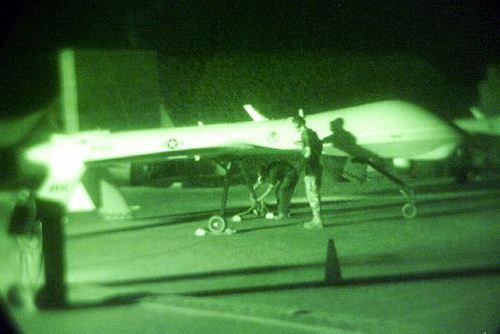
Pakistani Scholar Disputes US Drone Death Tallies

AOL NEWS– When it comes to measuring casualties and death rates, Pakistani computer scientist Zeeshan-ul-hassan Usmani is a world-class expert. His Ph.D. thesis looked at complex simulations calculating blast waves from suicide bombings, with an eye toward preventing mass casualties from such attacks.

Now Usmani, an assistant professor at Ghulam Ishaq Khan Institute in Pakistan’s North-West Frontier Province who recently completed five years as a Fulbright scholar in the U.S., is applying that expertise to the contentious debate over drone strikes. And his website, Pakistan Body Count, draws a striking conclusion about the unacknowledged CIA drone strikes in Pakistan: More than 90 percent of the reported casualties are civilians.

Pakistani youngsters sit beside the bloodstain wall of a house after a suspected U.S. drone missile strike in Mohammadkhel, a village in the Pakistani north Waziristan region along Afghan border, 2008.

Since the beginning of the drone attacks, Usmani estimates that over 1,200 civilians have been killed by the strikes, compared to only 30 members of al-Qaida.

Usmani brings a unique background to the work. His work on blast simulations has looked at the details of a terrorist attack that may determine who lives and who dies. He and his colleagues found, for example, that circular crowds suffer the worst in terrorist attacks (more than a 50 percent death rate), while people arranged in rows, such as at prayer in a mosque, had only a 20 percent death rate.

Read the full article about Pakistani Scholar Disputes US Drone Death Tallies.

© 2011 AOL News

Photo by Flickr user sdasmarchives

Experiments Suggest Life Not One-Time Deal

HUFFINGTON POST– We think we die and rot into the ground, and thus must squeeze everything in before it’s too late. If life — yours, mine — is a just a one-time deal, then we’re as likely to be screwed as pampered. But experiments suggest this view of the world may be wrong.

The results of quantum physics confirm that observations can’t be predicted absolutely. Instead, there’s a range of possible observations each with a different probability. One mainstream explanation, the “many-worlds” interpretation, states that there are an infinite number of universes (the “multiverse”). Everything that can possibly happen occurs in some universe. The old mechanical — “we’re just a bunch of atoms” −- view of life loses its grip in these scenarios.

Biocentrism extends this idea, suggesting that life is a flowering and adventure that transcends our ordinary linear way of thinking. Although our individual bodies are destined to self-destruct, the “me” feeling is just energy operating in the brain. But this energy doesn’t go away at death. One of the surest principles of science is that energy never dies; it can neither be created nor destroyed. When we die, we do so not in the random billiard ball matrix but in the inescapable life matrix. Life has a non-linear dimensionality −- it’s like a perennial flower that returns to bloom in the multiverse.

A series of landmark experiments show that measurements an observer makes can influence events that have already happened in the past. One experiment (Science 315, 966, 2007) confirmed that flipping a switch could retroactively change a result that had happened before the switch was flipped. Regardless of the choice you, the observer, make, it’ll be you who will experience the outcomes −- the universes −- that will result.

Read more about Do You Only Live Once? Experiments Suggest Life Not One-Time Deal.

© 2011 Huffington Post

Photo by Flickr user Smithsonian

‘Gaddafi Has Suicide Plan for Tripoli’

PRESS TV– A Russian official says that Libya’s ruler Muammar Gaddafi plans to blow up the capital Tripoli with missiles if revolutionaries seize the city.  In his latest televised speech on Thursday, Gaddafi said that he will not surrender to NATO forces.

“The Libyan Premier [Baghdadi al-Mahmudi] told me: if the rebels seize the city, we will cover it with missiles and blow it up,” Russia’s special envoy to Libya Mikhail Margelov told Russian newspaper Izvestia on Thursday.

“I imagine that the Gaddafi regime does have such a suicidal plan,” Margelov added.
He said that Gaddafi still had plentiful supplies of missiles and ammunition.

The Russian envoy met with the Libyan prime minister on June 16 in Tripoli after holding talks in Benghazi earlier the same month.

Read more about ‘Gaddafi Has Suicide Plan for Tripoli’.

© 2011 PressTV

Photo by Flickr user EuanSlorach