Cell Phone Radiation Listed as Cancer Risk

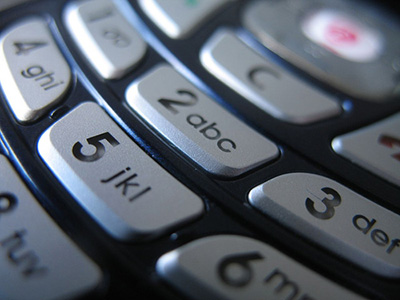
RAW STORY– A new report from the World Health Organization (WHO) classifies cell phones as a possible carcinogen in the same category as lead, engine exhaust and chloroform.

A team of 31 scientists from 14 countries in the International Agency for Research on Cancer, the cancer arm of the World Health Organization, made the determination that cell phone exposure was “possibly carcinogenic to humans.” The team, which included scientists from the U.S., reached their conclusion after reviewing dozens of studies.

“The biggest problem we have is that we know most environmental factors take several decades of exposure before we really see the consequences,” Dr. Keith Black, chairman of neurology at Cedars-Sinai Medical Center in Los Angeles, told CNN.

“What microwave radiation does in most simplistic terms is similar to what happens to food in microwaves, essentially cooking the brain. So in addition to leading to a development of cancer and tumors, there could be a whole host of other effects like cognitive memory function, since the memory temporal lobes are where we hold our cell phones,” he added.

Read the full article about Cell Phone Radiation Officially Listed a Potential Cancer Risk.

© 2011 RAW STORY

Photo by Flickr user jonjon_2k8

Theft of Funds – $6.6 Billion Missing in Iraq

RAW STORY– Approximately $6.6 billion in cash was likely stolen after being flown to Iraq during the months that followed the U.S.-led invasion, Pentagon officials said recently.

Stuart Bowen, the U.S. Special Inspector General for Iraq Reconstruction, told The Los Angeles Times that the sum just might be “the largest theft of funds in national history.”

The cash was part of a series of shipments totaling more than $12 billion, taken largely from the U.N. “oil-for-food” program and the sales of Iraqi oil. Officials in the Bush administration had hoped the massive pallets of cash would help calm Iraq’s civilian population following the chaotic and violent invasion and toppling of Saddam.

The funds — which were separate from a $53 billion appropriation Congress approved for Iraqi reconstruction efforts — were cobbled together by the Federal Reserve Bank of New York before being flown to Baghdad and distributed to interim Iraqi ministers, who U.S. officials see as the most likely culprits in the theft: an allegation that’s not officially been leveled.

Read the full article about Billions Missing in Iraq May Be ‘Largest Theft of Funds in National History’.

© 2011 Raw Story

Photo by Flickr user

McDonald’s Could Account for Half of May’s Job Growth

THE ATLANTIC WIRE– We were joking when we wrote that McDonalds was singlehandedly reviving the U.S. economy by hiring 62,000 employees in a single day in April. At the time, it didn’t feel like the recovery hinged on the creation of low-paying, temporary McJobs. Well, on the heels of today’s pessimistic report saying that just 54,000 jobs were added in May, the fast food chain’s effect on the economy is looking impressive to MarketWatch:

McDonald’s ran a big hiring day on April 19 — after the Labor Department’s April survey for the payrolls report was conducted — in which 62,000 jobs were added. That’s not a net number, of course, and seasonal adjustment will reduce the Hamburglar impact on payrolls. (In simpler terms — restaurants always staff up for the summer; the Labor Department makes allowance for this effect.) Morgan Stanley estimates McDonald’s hiring will boost the overall number by 25,000 to 30,000. The Labor Department won’t detail an exact McDonald’s figure — they won’t identify any company they survey — but there will be data in the report to give a rough estimate.

Read more about McDonald’s Could Account for Half of May’s Job Growth.

© 2011 The Atlantic Wire

Photo by Flickr user thms

WikiLeaks Haiti: Let Them Live on $3 a Day

THE NATION– Contractors for Fruit of the Loom, Hanes and Levi’s worked in close concert with the US Embassy when they aggressively moved to block a minimum wage increase for Haitian assembly zone workers, the lowest-paid in the hemisphere, according to secret State Department cables.

The factory owners told the Haitian Parliament that they were willing to give workers a 9-cents-per-hour pay increase to 31 cents per hour to make T-shirts, bras and underwear for US clothing giants like Dockers and Nautica.

But the factory owners refused to pay 62 cents per hour, or $5 per day, as a measure unanimously passed by the Haitian Parliament in June 2009 would have mandated. And they had the vigorous backing of the US Agency for International Development and the US Embassy when they took that stand.

To resolve the impasse between the factory owners and Parliament, the State Department urged quick intervention by then Haitian President René Préval.

“A more visible and active engagement by Préval may be critical to resolving the issue of the minimum wage and its protest ‘spin-off’—or risk the political environment spiraling out of control,” argued US Ambassador Janet Sanderson in a June 10, 2009, cable back to Washington.

Two months later Préval negotiated a deal with Parliament to create a two-tiered minimum wage increase—one for the textile industry at about $3 per day and one for all other industrial and commercial sectors at about $5 per day.

Still the US Embassy wasn’t pleased. A deputy chief of mission, David E. Lindwall, said the $5 per day minimum “did not take economic reality into account” but was a populist measure aimed at appealing to “the unemployed and underpaid masses.”

Haitian advocates of the minimum wage argued that it was necessary to keep pace with inflation and alleviate the rising cost of living. As it is, Haiti is the poorest country in the hemisphere and the World Food Program estimates that as many as 3.3 million people in Haiti, a third of the population, are food insecure. In April 2008 Haiti was rocked by the so-called Clorox food riots, named after hunger so painful that it felt like bleach in your stomach.

According to a 2008 Worker Rights Consortium study, a family of one working member and two dependents needed at least 550 Haitian gourdes, or $12.50, per day to meet normal living expenses.

Read the full article about WikiLeaks Haiti: Let Them Live on $3 a Day.

© 2011 The Nation

Photo by Flickr user Okinawa Soba

Fears of a Corporate Police State

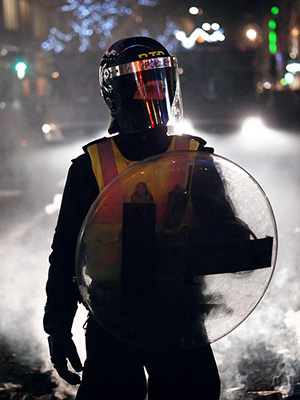
SALON– “Corporate Police State,” it’s a fraught — some might even say, overwrought — term. But in its purest, apolitical form, it simply describes the periodic commingling of state and corporate power to protect private interests.

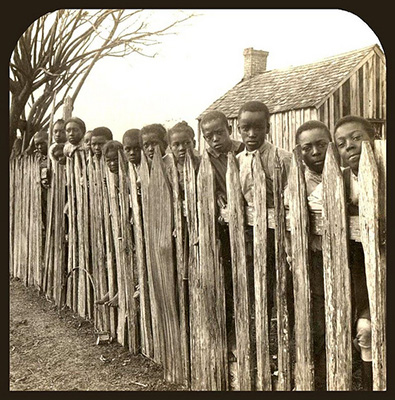
In the American psyche, any discussion of that phenomenon typically brings one of three images to mind. There’s the Old Corporate Police State — the sepia-toned America of decades long past, a place where state militias murder striking mine workers on behalf of Gilded Age barons and Congress empowers the government to forcibly ban work stoppages that defy corporate executives’ wishes. There’s the Fictional Future Corporate Police State — that smoldering bombed-out world depicted in “Robocop,” “Fortress” and every other dystopian flick in Hollywood’s post-apocalyptic catalog. And there’s the Foreign Corporate Police State — think Dubai, Singapore, Monaco and every other lavish enclave defined by lots of rich people, lots of corporate headquarters, lots of heavily armed cops — and almost no civil liberties.

By imagining the Corporate Police State primarily as a historical, fictional or foreign monster, these snapshots encourage us to believe that this monster poses no threat to us in the here and now. They encourage us, in other words, to ignore the monster’s creeping advances in present-day America.

In just the last few years, the Corporate Police State has reared its head at every level of government.

Read the full article about Fears of a Corporate Police State.

©2011 Salon

Photo by Flickr user hozinja