MEDIA ROOTS — The 2012 GOP primary debates have given
people many things to make fun of—and worry about. Bill Maher, along with other comics, has poked
fun at GOP candidates’ risky remarks regarding foreign policy. Abby Martin, of Media Roots, joins RT in their DC studio to
discuss what this means for the U.S. people.
MEDIA
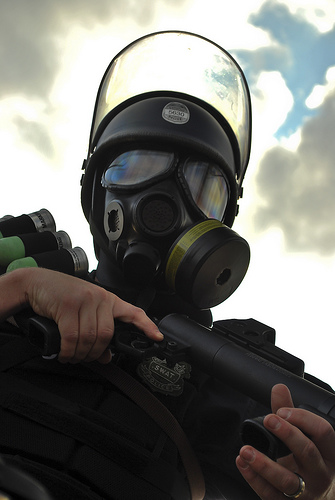
ROOTS — In apparent small-scale warfare waged by Oakland
police against First Amendment activity, hundreds of
people were kettled, brutalised with batons, tear gas, flash-bang grenades, and
arrested during Occupy Oakland (OO) demonstrations on Saturday, January 28,
2012, in the first major action by OO since the Oakland Port shutdown.
Participants have charged they weren’t given clear
dispersal orders by police, preventing many from avoiding arrest, as well as kettling people and using the hammer and anvil police formation. According to Oakland Police Chief Howard Jordan, almost 400 hundred people
were arrested during Saturday’s OO demonstrations.
“Many people who have medical needs were
unable to prevent themselves from being arrested, or to retrieve their
medication, because the police did not give a dispersal order—they just
kettled.”
This tactic of kettlingis a consistent tactic used by police against the Occupy Movement to
corral all demonstrators, even passersby and journalists. This is apparently intended to discourage participation by those
unable to risk arrest or those interested in witnessing the demonstrations as neutral observers or independent journalists (corporate press often rely solely on police accounts, rather than direct observation). OO has noted the tactic is illegal; indeed, it amounts to entrapment when people are ordered to disperse and, yet, not allowed to do so. U.K. courts have found the tactic to be clearly illegal.
The activities on Saturday were intended to
kick off “a weekendlong festival,” according
to OO, starting with “the takeover of an empty building where
it will host workshops, panels, a film festival, live music, assemblies and more”—“including
former Black Panther Party leader Elaine Brown, anarchist anthropologist and
member of Occupy Wall Street David Graeber, feminist, revolutionary & historian
Roxanne Dunbar-Ortiz…”
Pacifica Radio’s Northern California sister-station, KPFA, also covered
OO demonstrations.
“The Morning Mix” aired a
special broadcast with Dennis Bernstein this morning. It was reported that many demonstrators were badly beaten, at least one was
hit with a stun gun, another had teeth knocked out by a police baton, another was thrown through a plate glass window, people were thrown down the stairs, and another was
hospitalised for internal bleeding as a result of rioting cops swinging their
batons at people, in violation of their own policies.
Franklin Sterling “was out there in Oakland where the
police deployed hundreds of officers in riot gear over the weekend, so as to
prevent OO from putting a vacant building, which has sat vacant for six years,”
and for which the City of Oakland has no current plans.
Dennis Bernstein also invited various guests to discuss OO “and why the violent
Oakland Mayor” Jean Quan “feels so much camaraderie with the Oakland Police,”
which have been working overtime to undermine the First Amendment rights of the
people, as she turns “her back on the people who elected her.”
“Letters and Politics”
was also on the scene Saturday capturing audio for today’s broadcast.
Note: Pam Drake, the conflicted OO
member interviewed by LAP this morning who wrote an article about breaking up with the Occupy Movement,
claimed OO didn’t ratify the Move-In Day occupation of an empty building. Yet, Occupy Oakland indicates,
the “Occupy Oakland GA passed a proposal calling for the [vacant building]
space to be turned into a social center, convergence center and headquarters of
the Occupy Oakland movement.” In
conclusion, Drake, a ‘SaveKPFA’
faction-aligned KPFA Local Station Board Member said she still considered
herself a member of OO, oddly rendering her entire position moot.
Although, there have been reports of OO demonstrators breaking into
Oakland’s City Hall and causing damage, even by the ostensibly radical KPFA
News (aligned with the less radical KPFA faction above), audio reports from LAP today describe how the doors were left open,
people were hesitant to go inside, with only a few entering.
What is not disputed are the flag burnings that took place after U.S. and
California flags were taken from Oakland City Hall and burned by demonstrators in a Constitutionally-protected act of free speech, albeit with appropriated City Hall property.
Ultimately, OO was
prevented by police in riot gear from occupying the building, which has been vacant for six years now, and which OO decided to
convert into a community centre and new home for the OO Movement. Mass actions in solidarity with the police state repression against OO have been planned in dozens of cities across the nation.
MR
***
Occupy Oakland demonstrations, January 28, 2012
***
ANOTHER OCCUPY OAKLAND MARCH ATTACKED BY POLICE
Oakland, CA–Saturday, January 28, 2012, Sheila and I joined about 1,500 members of Occupy massed at 14th
and Broadway in downtown Oakland. Occupy Oakland’s announced intention
was to march to and occupy a long vacant building “somewhere” in the
city to re-create a living, working, and coordinating center for this
young “politics on the fly” movement for the rights of the 99%. As you
probably know, previous occupations of public space from coast to coast
have been destroyed and precluded by Government ordered police actions,
making community development, collaboration and participatory mass
democracy yet more difficult.
The atmosphere was festive and
gay, resembling what the counter culture of the 60s used to call a
“be-in.” People of all ages, got up in all kinds of costumes, wheeling
large platform dollies with furniture, mattresses, sleeping bags,
grills, electronics, crates of canned foods, loaves of fresh bread and
almost anything you can think of you might need in your new home,
through the streets of the city. A drumming corp and a brass band
separately did their thing. Within the march itself, music also blared
from a powerful high quality sound system on a flatbed truck draped with
young people. A famous recycled and refurbished AC Transit “Occupy”
bus was ambushed out of the demo and occupied by the police. When one of
the marchers’ platform dollies lost a wheel in a BART grating dozens of
people came to the rescue, each picking up something from the load of
materiale and carrying the stuff along the march. Sheila grabbed a box
weighing about 15 pounds, which may have contained large plastic bags
(at least according to its original printed label). We saw an old
friend, Helen, in the drum group, pounding out a pulsing beat on a large
drum strung from her waist. Young people smiled, swayed and danced
their way snakelike through downtown until the march reached Laney
College. There were also bicyclists, children in carriages pushed by
parents, people of various ethnicities often in small social groups, and
the always present minority of young anarchists with shields and masks.
Slowly the police began to mass around the march perimeters.
At Laney the march was blocked by a police line to the left and had to
enter the campus; and when it tried to exit we found most of the ways
off campus barred by battle ready police lines. Exiting at the
Southeast edge of campus the march tried to track back toward downtown,
only to be fenced in and blocked by chain link fencing and police lines.
With nowhere to go the march stalled for a short while until, without
provocation, Oakland’s finest began lobbing numerous (probably about 10)
smoke/flash grenades into the dense crowd. People scattered briefly
without any panicking and then reassembled. About 10 minutes after the
smoke cleared, the police from a cruiser speaker declared an unlawful
assembly and issued a disperse order. We left the demonstration,
backtracking our way out at that point to avoid arrest or being beaten.
However, the police apparently did not attack the full demonstration at
that time (from what we later learned) and you’ll have to find out what
then transpired from some other intrepid reporter. One of those, still
among the crowd when we left was Mitch Jeserich (in his wheelchair),
undaunted and apparently recording for his KPFA Letters and Politics
program (Mondays-Fridays 10 a.m. at 94.1 FM the SF Bay Area).
A 5
p.m. local newscast on Channel 7 (ABC) stated that police were forced
to use grenades and teargas because an unruly crowd attacked them. If
this happened it wasn’t while we were there. Although we were right in
the middle of the crowd, we saw no attacks against the police, only the
smoke grenade attack by the cops, although a few young men pushed down
parts of the chain-link fences in a couple of places. From the way the
crowd was blocked an uninvolved observer might well conclude that any
confrontations were in response to the police decision to trap the
march. The police and the ABC media coverage suggest that the aim of
the 1%’s armed and responsive police was to create just enough chaos to:
1) prevent the Occupiers from reaching their objective location, 2) to
justify some arrests, 3) provoke some skirmishes that would allow
demonization of the 99% movement via the 1%’s wholly owned corporate
capitalist media. We’ve all seen these tactics used against the Black
and Latino communities and against immigrants.
In a perhaps
unrelated provocation a couple of counter pickets held a huge printed
sign at the start of the march with the slogan: Occupy attacks Workers
Rights. No one paid them any attention. Later I overheard one marcher
tell another: “The media and politicians always claim we are costing the
city all this money for the police. But why are they calling out
hundreds of cops? We aren’t destroying anything or hurting anyone. We
don’t want them spending public funds on cops to attack us and prevent
public discourse either. They do it to protect the monopoly of power of
the 1%.”
Written by Marc Sapir
[Marc sent this via email to a mutual KPFA friend (whilst sending it to the Berkeley Daily Planet). This is taken from that email.]
MEDIA ROOTS — Graffiti Philosophy is a video collage illustrating sociopolitical commentary in the renegade art form of graffiti. It traverses class warfare, suffering, consumerism and mass media indoctrination, industrial civilization’s oil addiction, exploitation by Empire, environmental consequences of fossil fuels, and the fate of humanity.
“An artist’s duty is to reflect the times.” – Singer, poet and civil rights activist Nina Simone
MR
***
Graffiti
Philosophy
***
I love how much art can illustrate about
society and the world around us. Graffiti
art is especially interesting to me because of the
clarity it conveys in such a succinct fashion.
Also, political graffiti holds a lot of power to move
people to action. It
was reported that graffiti helped spark and encourage
the revolution in Syria, as well as Egypt and countries in South Asia.
“Graffiti Philosophy” is my attempt at
illustrating the state of the world
in which we currently live: one where an oligarchic-corporate empire has corrupted and
usurped governments, destroyed worker’s rights and wages, subverted the Fourth
Estate, indoctrinated the population into a mindless and superficial consumer
culture, built and instituted a police/surveillance state side-by-side with the
military industrial complex, and hastened the environmental destruction of the
planet.
People across the world are suffering
immensely, with their livelihoods in constant jeopardy. The well-being of communities and families is
in perpetual danger and under constant threat, and the officials we continue to elect from the same corrupt two-party system, beholden to Wall Street interests, only pay lip service to their campaign promises.
From the moment in which we wake until we fall asleep, we are
inundated with corporate media spin and propaganda. It’s near
impossible for the average citizen on the street to discern the truth without taking
a proactive approach in searching for independent, impartial news
sources.
However, the facade seems to be breaking as more people come to the realization that their so-called democracy is only an illusion, especially in North America. They
call it virtual politics in
Eastern Europe. The truth has become a fungible commodity – replaceable
and changeable for whatever purpose suits the moneyed elite.
How can civilization survive when the truth is buried and
the decisions for society are based upon the delusional, self-serving beliefs of the American ruling-class? With the continued advancement of modern technology and man’s ability to
destroy humanity multiple times over, this question becomes ever more pressing.
MEDIA
ROOTS — On a recent KPFA radio broadcast, Project Censored discussed the ten-year mark of the U.S. Guantánamo Bay gulag and its implications for the Rule of Law. One of Project Censored’s featured guests, Dr. Almerindo Ojeda, delivered an Occupy UC Davis –Dissent Lecture on December 1, 2011 at the University of California at Davis. We present that address here, entitled Guantánamospeak and the Manufacture of Consent. Dr. Ojeda is a professor of Linguistics and the Principal Investigator in the Guantánamo Testimonials Projectof the Center for the Study of Human Rights in
the Americas at UC Davis, for which Dr. Ojeda serves as Director.
If prisoners at Guantánamo were the canaries-in-the-goldmine, then the U.S. people have not heeded the warning of the decade, a testament to the efficacy of U.S. state propaganda and social control. The Bush era policies of imperialism and domestic repression have only escalated during the Obama Administration–with Obama’s recent signing of the NDAA (S.1867), any one of us may arbitrarily face the same fate as those languishing at Guantánamo.
MR
***
GUANTÁNAMOSPEAK AND THE MANUFACTURE OF CONSENT
For those who
stubbornly seek freedom around the world, there can be no more urgent task than
to come to understand the mechanisms and practices of indoctrination […]
Propaganda is to democracy what violence is to totalitarianism.
Noam
Chomsky
Much
has been made about prisoner abuse at Guantánamo. And rightly so: Guantánamo is
an ongoing crime against humanity. If you don’t believe me, take a look at the Guantánamo Testimonials Project we have
been carrying out at this campus. But even though a lot has been said, there and
elsewhere, about prisoner abuse at Guantánamo,
relatively little has been said about language
abuse at the Cuban airbase. Yet, there has
been a lot of it. And we need to talk about it, if only because prisoner abuse
is enabled by language abuse.
Abusing
a human being is not easy to do; consenting to do it is not something that
comes naturally. As a matter of fact, the consent to abuse a fellow human being
is something that needs to be manufactured.
It needs to be built. Like a house. Brick by brick and room by room.
How
was this consent to abuse manufactured
at Guantánamo? First, you instill fear. You say that Guantánamo holds vicious
criminals that would not hesitate to chew on hydraulic tubes to bring an
airplane down. Then you cultivate hatred. You say that each and every one of
the individuals detained at the base was personally responsible for 9/11. Then
you abuse language; you engage in what Orwell would call Guantánamospeak. It is this third step that I want to focus on
today.
The
abuse of language at Guantánamo began by coining the term war on terror. A war is something that threatens the very survival
of a nation. Consequently, no citizen of that nation can be against it. Except
for the ‘traitors’ who seek the
destruction of their own nation. But is terrorism something that threatens the
survival of our nation? It can lead to massive loss of life (as 9/11 did). And
it can be a crime against humanity (as 9/11 was). But threaten the survival of a nation? Wars are events that have only
two natural outcomes: victory or defeat. Consequently, if you do not root for
victory, you are rooting for defeat. Only a traitor can root for defeat.
But
casting our response to 9/11 in terms of a war creates a linguistic problem.
How would you call someone you capture in that war? Prisoner of war? This would be extremely problematic, as prisoners
of war have rights under the Geneva Conventions, one of them being the right to
be free from coercive interrogation. But interrogate coercively is something
our government very much wanted to do with these captives. So we called them detainees instead of prisoners. This has an added rhetorical
advantage: it makes imprisonment at Guantánamo sound like a minor inconvenience
(like being detained by traffic). So we
should consent to that.
By
the way, the verb capture is already
loaded. Being captured is what happens to fugitives, possibly of justice, and
hence to criminals. Never mind that some of the individuals held at Guantánamo were
captured in their homes with their
families. Or fleeing carpet bombing. Or coming out of a courthouse that had
just cleared them from charges of terrorism. Or were handed to us by local
militias in exchange for bounties (a practice that might be called
human trafficking in legal circles).
Alternatively,
Guantánamo prisoners may be called enemy
combatants. This reinforces the context of war, and hence the survival of
the nation. But mention of war again
brings about the term of prisoner of war.
So we should clarify the term enemy
combatant and speak of unprivilegedenemycombatants. Adding
the adjective unprivileged manages to
turn the rights of the Geneva
Conventions into privileges.
Privileges are things which are granted by the grace of a legitimate authority.
Rights are something you have regardless of the generosity of the powers that
be. Rights are something powers can no more grant than they can withhold.
And just for the record:
Guantánamo prisoners have rights
under the Geneva Conventions. Everyone held in an armed conflict is protected
by these conventions. The fact that some captives did not wear uniforms only
means that they do not have the rights Geneva grants to combatants. They would
still have the rights granted to civilians. For civilians are protected by the Geneva Conventions as well as combatants. I
should add that thinking that the Guantánamo prisoners are in fact protected
by the Geneva Conventions is not my interpretation; it is the interpretation
of the International Committee of the Red Cross, which is the accepted arbiter
for the implementation of the Geneva Conventions. It is the organization the
signatories of the Convention, the US included, have agreed to abide by.
But
we digress. Let’s return to Guantánamospeak.
Guantánamo
prisoners are being coercively interrogated. This, of course, is not called
this way. That may enable dissent. In Guantánamo, when you are taken from your
cell in order to be interrogated, you are said to be making good on a reservation. Or to be going for an interview. So, being interrogated is
like going to a restaurant. Or applying for a job. Nothing to dissent about
there.
Interestingly,
language does not always take the abuse lying down; sometimes, it fights back. Guantánamo personnel may say, for example, that so-and-so is going to reservation, a phrase which we
would never use for making good on a reservation made at a restaurant (and
betrays the attempt to veil the reference to interrogations, which are
something one would ‘go to’).
As
has been thoroughly reported, interrogations at Guantánamo can be brutal. They
may involve beatings, sleep deprivation, solitary confinement, exposure to temperature
extremes, blaring noise, painful binding, and threats of death or harm to self
or to others. Such practices are what independent observers call torture. But they cannot be called that
in Guantánamo. That would sow the seeds of dissent. There, these practices are
collectively referred to as procedures of enhanced
interrogation instead. Interrogation is acceptable in a criminal setting (given
legal protections). So, what is wrong with enhancing an acceptable procedure? We
should consent to it.
Each
one of the aforementioned forms of torture has its own special entry in the
dictionary of Guantánamospeak. Food
deprivation is called dietary
manipulation—a lapse, perhaps, as manipulation often refers to
less-than-legitimate doings (language fights back again). Sleep deprivation is
called sleep management (nothing
wrong with managing sleep, is there? After all, you do not want to be a
slouch). Under one of the modalities of sleep
management, a prisoner can be moved, almost continuously from one cell to
another for weeks. This involves full bodily searches, gatherings of
belongings, three-chain shackling, marching from one cell to another, and
unshackling. This is done around the clock for weeks, as a consequence of which
the prisoner is unable to sleep for more than one hour at a time. This form of
sleep deprivation is referred to as thefrequent flyerprogram (so the movement from cell to cell is to be thought of as
the benefits program one gets from an airline by traveling a lot with it). This
is supposed to be funny. The program is also called Operation Sandman, thus making a perverse reference to the nursery
rhyme used to put children to sleep (and acknowledging, via sarcasm, the real
purpose of the exercise).
The
most common form of beating in Guantánamo comes in the context of forced cell
removals. Suppose a non-compliant prisoner refuses to go to interrogation (or
to make good on a reservation he never made). An Immediate Reaction Force is
called in. An Immediate Reaction Force is a team of six guards in full riot
gear that march into a cell, pepper-spray the prisoner (some of you may know
about this first-hand)… In any event, they pepper-spray the prisoner, charge on
him, slam him onto the ground, beat him up badly, hog-tie him, and take him
wherever he needs to be—which, at that point, is usually the infirmary.
Interestingly, these events are called irfs
(based on the acronym for Immediate
Reaction Force), and the action itself is called an irfing. Irf is a new word
of American English. But we didn’t need it. We already had a term for that. It
would be aggravated battery. But this
term, of course, would sow dissent, and cannot be used.
Beyond
aggravated battery, bearing three-chain shackling (on wrists, ankles, and waist)
is referred to as wearing a three-piece
suit (thus making light of excessive binding by reference to an elegant
suit of clothes). To soften up a hardenedterrorist in reservation, the prisoner is made to squat on the
floor about a metal eye-ring where he is painfully chained from his wrists and
ankles. This is called a stress position
(stress being an unavoidable feature of modern life). Independent observers
might call that binding torture
instead. Then, if all else fails, a prisoner is threatened with being taken to
a country where he can be physically abused (beaten, electroshocked, cut,
suffocated, or burned). A practice of torture
by proxy from which we can remove ourselves linguistically by appealing to
the aseptic term extraordinary rendition.
Language is used here to conceal
reality rather than to reveal it. But
the most common form of torture associated with the war on terror is, by far, waterboarding. Being a widespread form of torture,
waterboarding goes under myriad names the world over. It is not certain that
waterboarding actually happened at Guantánamo. But other forms of controlled
suffocation (dryboarding) have been
proposed as explanations for the first three deaths in custody at the base. The
one pertinent testimony we have about actual waterboarding has reached us
anonymously, allegedly from a guard, who said the practice happened all the time at Guantánamo, where it was
not called waterboarding but drown-proofing. As if prisoners were
being protected from drowning—which I guess is true. Except that it is us that
are causing the drowning. And the protection is only from the natural outcome
of drowning (death). And only to prolong the agony of the victim.
Incidentally,
waterboarding is sometimes described as simulated
drowning. Or as a procedure that induces the misperception of drowning. This is inaccurate and misleading. It
is inaccurate because waterboarding is not simulated drowning; it is actual
drowning. Only that it is controlled so as to prevent death and thus prolong
the agony. Controlled drowning would
therefore be closer to the mark. Describing waterboarding as simulated drowning is also misleading,
as it suggests that the problem with waterboarding is deception—which would be no problem at all; deception is a
perfectly legal interrogation tactic.
In
2004, the Supreme Court dealt the first of three blows to Guantánamo. It ruled
that prisoners had to be given a semblance of their day in court. What they got
was significantly less than a semblance. They got a farce. They were subjected
to so-called Combatant Status Review
Tribunals (CSRTs). They were called tribunals
in order to say that the ruling of
the Supreme Court was followed. But they were nothing like a real American
tribunal. First, the prisoners were not allowed a lawyer; only a personal representative. And that
representative was a member of the military. Consequently, he had the same employer
as the prosecution. The tribunal took place before a panel of three judges.
They too were members of the military. As was the “court of appeals”
that could overturn the decisions of these tribunals. As
if this were not enough, the prisoner could be tried on secret evidence. So,
there was no way he could defend himself properly. Hearsay was admitted into
the record as well. And the evidence brought about by the prosecution could not
be questioned. It had to be taken as fact. This asymmetry between the claims of
the prosecution and those of the defense can be traced linguistically in the
transcripts of the CSRTs. The allegations of the prisoner are described as such
by appealing to verbs of saying (what are known in the trade as verba dicendi). Verba dicendi are verbs like says,
alleges, claims. Crucially, however, the charges of the prosecution are
mentioned straight up without such verbs. The impression you therefore get is
not one of a conflict between charges and refutations, but one of a clash
between facts and counterclaims. The former breeds dissent; the latter,
consent.
The
outcomes of the CSRTs were also interesting specimens of Guantánamospeak. The verdicts of these tribunals were not, as one
may expect, innocence or guilt. No; they were still an enemy combatant or no longer an enemy combatant. For,
finding that a prisoner was not an enemy combatant would question the original
evidence supporting his capture. It
would also raise the possibility that he was imprisoned without cause in the
first place. But that would detract from the consent being manufactured.
Amazingly,
in remarkably few cases, and in spite of having the cards stacked squarely
against him, a prisoner could be ruled to be no longer an enemy combatant. At which point, the “court of
appeals” which, as we said, was also employed by the military, convened a
new tribunal to review the results. Such revised tribunals invariably reversed
the ruling of the first tribunals, and found the prisoners to be correctly designated as enemy combatants
after all. Interestingly, these new tribunals were called reconvened tribunals. As if the original tribunal had just taken a
break for lunch and “reconvened” afterwards. Never mind that the new
tribunal had an entirely different panel of judges, was allegedly handed new
evidence, and reached the opposite verdict than the old one.
One
of the constant fears in Guantánamo is that the prisoners would commit suicide
(prison suicides reflect poorly on prisoner treatment). So, suicides are linguistically impossible in Guantánamo.
According to the prison manuals that have been made public, what we have there can
only be described as self-harm gestures—like
slapping your forehead or biting your fingernails, I suppose.
Hunger
strikes are linguistically impossible in Guantánamo as well. Like prison
suicides, prison hunger strikes are signs of poor conditions at the prison.
Thus, what the Guantánamo manuals prescribe is the use, not of hunger strikes, but only of total voluntary fasts. This contorted
Orwellian idiom removes hunger strikes from the realm of protest and transfers
them into the realm of religious beliefs (the prisoners are religious fanatics
anyway). And into the realm of free, voluntary activity, the existence of
which would actually reflect well on the prison.
Incidentally,
I mentioned that some Guantánamo manuals have been made public (thanks to the
transparency organization WikiLeaks). This is no small matter, given the amount
of censorship that clouds the base. Once again, censorship (which is unbecoming
of a democracy) is called secrecy (an
admissible practice in wartime). It is also called redaction when it is applied to a document. But to redact a document means to write it (or used to mean as much before
the War on Terror). By coopting the term redaction,
censorship vanishes into the very creation of the document; it becomes
inevitable (and hence acceptable).
More
than 600 of the 779 individuals that have been imprisoned at Guantánamo at one
time or another have been released. A few of them went on to engage in
hostilities against the United States or their interests (exactly how few is in
dispute). This has been described as recidivism.
Or as returning to the battlefield.
Even if their captors never claimed that the so-called battlefield returnees had ever been in a battlefield in the first
place. The possibility that these individuals were actually retaliating for the
torture they endured at Guantánamo is seldom raised. For that would suggest
that some of the violence we endure is the result of the violence we
inflict.
Consenting to abuse a fellow human being is not something that happens naturally; it is something that needs to be manufactured.
Almerindo Ojeda, Principal Investigator
The Guantánamo Testimonials Project
Center for the Study of Human Rights in the Americas
University of California at Davis
Author’s Note:The term manufacture of consent was coined in 1921 by Walter Lippman in his
book Public Opinion (see Chapter XV).
According to Lippman, the manufacture of consent was a form of propaganda that
the élite had to unleash on the
unenlightened masses of a modern democracy.
The term was subsequently used by Chomsky and Herman in the title to a book they
published in 1988. In that book they revealed the way in which profit
motive corrupts the mainstream media into manufacturing consent. The term Guantánamospeak is based on the term Newspeak Orwell coined in his book 1984. The epigraph to this paper was
taken from “Propaganda, American style,” an article which is
available online at zpub.com/un/chomsky.
MEDIA ROOTS — As the Occupy Movement coalesced globally, tents
and bodies were brutalized by the state and press credentials were swept aside with sweeping arrests of journalists, we may have taken comfort in the thought that they couldn’t jail an idea—the idea of
the 99% resisting the tyranny of the 1%.
Yet, under Obama, powers that be are
trying to do just that—imprison
ideas, as key books of the Chicano literary cannon have been, essentially, arrested
and taken into indefinite detention at some Book Depository. Not only are scores of innocent immigrants
profiled and held arbitrarily to bolster a bogus war on imaginary enemies, but
books, too, are imprisoned in the info wars of propaganda for corporate
imperialism and tyranny, what Dr. Carlos Muñoz calls the colonisation of the mind.
Dr. Muñoz spoke with Flashpoints earlier this week about this blatant
display of racism and state repression in Arizona as well as the historical
underpinnings of the Brown and Black struggle for equality in the U.S.
Messina
***
FLASHPOINTS — [17 Jan 2012] “Today on
Flashpoints, the Tucson School District bans key books by Chicano and Native
American authors. That’s right. That’s what I said. Bans
the books. They box them up, ban them,
and put them in the Book Depository. We
ain’t gonna see ‘em.”
***
FLASHPOINTS — [18 Jan 2012] “You’re
listening to Flashpoints on Pacifica Radio.
My name is Dennis Bernstein. The
outrage and disgust continues over the decision by the Tucson School system to
ban books by Chicano and Native American authors, such as Leslie Marmon Silko, Buffy
Sainte-Marie, and Winona LaDuke. The decisions to ban the books followed a 4
to 1 vote on Tuesday by the Tucson Unified School District, the Board, to succumb to the State of Arizona and
forbid Mexican American Studies,rather
than fight the State decision.
“Students said the
banned books were seized from their classrooms and out of their hands after the
vote came. And they are troubled. They are saying that it’s sort of like Nazi
Germany. And they were unable to sleep after
it happened. Some of the books also
include Suzan Shown Harjo We Have No Reason
to Celebrate and many others.
“Joining us to talk
about this very important and troubling situation is Dr. Carlos Muñoz. He’s one of the key pioneers in ethnic
studies and Chicano studies in the country.
Dr. Muñoz was the founding Chair of the first Chicano Studies Department
in the nation in 1968 at the California State University at Los Angeles and the
founding Chair of National Association of Chicana/o Studies. He is a pioneer in the creation of
undergraduate and graduate curricula in the disciplines of ethnic studies. He’s the author of numerous pioneering works
on the Mexican-American political experience and on African-American and Latino
political coalitions. His book Youth, Identity, Power: The Chicano Movement
won the Gustavus Myers Book Award for outstanding scholarship in the study of
human rights in the United States.
“Dr. Carlos Muñoz,
welcome back to Flashpoints.”
Dr. Carlos Muñoz (c. 2:59): “Thank you for inviting me.”
Dennis Bernstein (c. 3:01): “Well, it’s good to have you with us, although it’s a terrible
situation. And this thing, believe it or
not, started to unfold on Martin Luther King’s birthday celebrations. Let me get your initial response to what
happened here. What were you
thinking? What went through your mind?”
Dr. Carlos Muñoz (c. 3:17): “Well, you know, I don’t have the words to express my anger at what’s
taking place in Tucson, Arizona. It’s
just simply unbelievable. I mean never
did I expect, at this point in time in history, after 40 years of scholarship
that has been generated and published and being taught in universities around
the country, specifically on the Chicano experience in the United States. For scholars of Mexican-American background
and other people of colour, scholars of colour have collectively made a
profound contribution to the body of knowledge of people of colour in this
country and have rectified and documented a history that speaks the truth of
what this country has been historically as an empire, a promoter of imperialism
throughout the world, as a racist, White-supremacist
nation, as witnessed by the so-called founding
fathers, who were, for the exception of one, all slave owners.
“This kind of truth
doesn’t speak well to what’s going on in Arizona because I think that the people
that are there responsible for this particular tragedy in public education are,
either, ignorant and never attended the university, never were educated, and/or
are members of the Tea Party or some other extreme racist organisations that
are promoting anti-Mexican, racist, hysteria.
“So, I think what we
see here, as I see it anyway, a situation where right-wingers have collectively
organised and made this an issue because it’s a manifestation of the perceived threat
of, what I call the, quote ‘Brown Invasion,’
as has been encapsulated by a lot of the right-wing politicians in this
country. Increasing what are called
demographic [] that we are witnessing right now has become a threat to many
people in power and, of course, especially in Arizona, as you know. That [either] once they [started] this whole
process of criminalizing Mexican undocumented workers and have set the tone for
other states to follow that are under the tutelage of right-wing political
folks. So, I think, it’s something that
needs to be protested, people have to take to the streets and say [don’t end]
in Tucson. It’s an issue that has become
very, very critical and deserves the support of all Americans, regardless of race or ethnic background. It’s just ridiculous.”
Dennis Bernstein (c. 6:10): “One of the things that people who work within the system, we were
speaking with teachers and students, is that it was an incredibly effective
programme, in which students were succeeding, students who were dropping out
before were staying in school, going on to higher education.
“Could you talk about
how that happens, why it was so important for these students—and the school
system there is 61% Mexican-American—why it’s so important? Say a little bit more about that.”
Dr. Carlos Muñoz (c. 6:45): “Well, you know, in any places of education, if you’re a student and you
don’t hear about people like yourself in the making of history in this nation,
you’re bound to feel somewhat inferior.
You know what I mean? I’ve gone
through that when I was a kid. I mean,
my god, all this White history. You
know? And all the heroes were
White. And you never hear about the good
things that were done by folks of colour in this society and during the
building of this nation.
“And, so, it’s
been. Before, prior to the emergence of
ethnic studies and Chicano studies in universities, there were no books about
the Chicano experience. And the
consequence of that, as I witnessed it, as I experienced it, was an inferiority complex.
“You know, my god, all
we hear about Mexicans, for example: they’re criminals, they’re drunkards, their
women are whores, they. There come
all these racist, negative stereotypes that are promoted in the movies and
television, newspapers. So, the
consequence of that was, historically, what I call the colonisation of the mind where the young people of Mexican descent
were pushed into thinking that they were inferior, that their culture was inferior.
“Now, what’s happened
in Tucson has been a remarkable, remarkable process of [deep
colonisation]. You know? Where the issues that have been presented
there in public schooling have been taken on by teachers, by staff members in
the school district, who have had the courage to develop a programme of
Mexican-American studies, the first, by the way, and the only one in the whole
country at the public school level, a remarkable feat that ought to be
celebrated and be set up, you might say, as an example of what other public
school systems, including those of us here in California, those systems here,
ought to pursue.
“And the consequence
has been remarkable, as you mentioned.
In fact, that particular Tucson Mexican-American Studies programme has
resulted in the radical turnabout in terms of many people taking pride,
becoming proud of the fact that they learn that they come from ancestors who
have made contributions, profound contributions to civilisations throughout the
Americas—that fact alone is incredible, a tangible contribution to boosting the
feeling of being worthy as human beings.
And that kind of feeling is very, very important to have in order for
young people to succeed in life beyond public school.
“So, I think what has
been done in Arizona by these White politicians has been an effort to return to
the days of the 1950s, previous to the Chicano Movement and other Civil Rights
Movements in this country. They try to ‘Americanise,’ quote-unquote, and ‘re-colonise’ the minds of young people in
the State of Arizona.”
Dennis Bernstein (c. 9:56): “You’re listening to Flashpoints on Pacifica Radio. My name is Dennis Bernstein. We are speaking with Dr. Carlos Muñoz.
“You know, banning
this programme in Tucson is almost like banning the speaking of Spanish in
Mexico. Anybody who has spent time in
Tucson or Nogales, Arizona understands how prevalent—”
Dr. Carlos Muñoz: “Right.”
Dennis Bernstein (c. 10:14): “—I mean it’s Mexico, but it’s called the United States. Now, they did this in front of the
students. The decision was made for the
teachers to be boxing the books up in front of the students, shipping them out
for storage.”
Dr. Carlos Muñoz: “Right.”
Dennis Bernstein (c. 10:29): “Kids were crying. I remember
when I was down there in Tucson and we were broadcasting from there. One young student told me that she was really
thinking about suicide and had actually tried to take her own life once until
she got into a programme like this and began to feel alive.
“Could you comment on
that?”
Dr. Carlos Muñoz (c. 10:50): “Right. Well, this is an example of what I was
referring to is when young people are awakened by educators to who they really
are and where they come from and why it’s a source of pride, or should be a
source of pride, I mean it’s incredible.
You cannot put the value on that
kind of intellectual discovery and awakening of a young mind. It makes a world of difference to a young
person to find meaning in their lives that carries them forth toward a positive
direction in society to become good citizens and critical-thinking people that
are going to make contributions to the betterment of the society as a
whole.”
Dennis Bernstein (c. 11:45): “You know, one has to believe or gets the strong feeling that they
really don’t want the students to succeed because the programme was so
successful, the amount, the percentage of students who ended up going to
college as a result of this kind of study was overwhelming. And one has think that this is an attempt to
cripple, undermine, and keep these kids down, rather than to cheerlead the fact
that they’re getting better, things are getting better, and they’re really
succeeding.
“It’s racism at the
core, wouldn’t you say?”
Dr. Carlos Muñoz (c. 12:25): “I agree. I wholeheartedly agree. And I think, to add to that, what I see here
is that with regard to the demographic is becoming more Mexican than ever. They envision that out of all these young
people developing a critical thinking capacity and proud identity that they are
going to become the future politicians of Arizona. And that is a scary thing; that is a scary
thing for these guys. They say, ‘my god, we’re not just going to have
undocumented workers who are poor and are a cheap labour source. We’re gonna
have people now getting into powerful positions in this country that are going
to take away from what belongs to us,’ unquote.
“And, so, I think that’s
the bottom line here that they want to put a stop to this process of producing
young leaders that are going to be speaking truth to power and that are going
to make a difference in the future of in terms of turning the tide against
racism and other things that are negative out there in Arizona for Mexican
people as a whole.”
Dennis Bernstein (c. 13:43): “Some of the people who have been banned are labelling this, sort of, an
inquisition. We thought, maybe, that was an
overstatement. But maybe now I’m
thinking it’s an understatement. I’m
thinking about books that were banned.
Can you imagine The Pedagogy of
the Oppressed by Paolo Freire, Occupy
America: A History of Chicanos by Rodolfo Acuña, a good friend of
yours. We actually had the both of you
on the show not too long ago.
“Talk about what the
White people might be afraid of that’s inside these beautiful books.”
Dr. Carlos Muñoz (c. 14:20): “You know, they’re afraid of the truth.
You know? The truth hurts.
“And I think that as I
said earlier, the fact that the scholarship [] Acuña [] really incredible,
back-breaking book. It was the first one
to put out a history, a true history of America, in the sense that he
documents, beyond a shadow of a doubt, the nature of our society and how, in
fact, Mexican-Americans, in particular, have struggled for social justice
throughout the history here in this country.
“And it’s just
remarkable that all this knowledge that Occupied America represents, they don’t
want to acknowledge it. They have problems
with it because Rudy Acuña speaks the truth, as do all scholars.
“And Shakespeare
speaks the truth. You know? Talk about this gets really absurd when even
people like Shakespeare, an English White guy, you know, who had the audacity,
for his time, to speak truth to power, of the British Empire and put out the
issue of colonisation and oppression in that regard. Even there, they can’t tolerate that
particular scholarship.
“So, basically, it’s
an ideological struggle. It’s a cultural
war that is what’s happening in Arizona between those who espouse the racist
framework of analysis that WhiteEurocentric thought should be
predominant in public education and those of us who have struggled against that
and have created, and have been teaching now, a more truthful history of our
society. And who had gone out of their
way collectively to put forth a more, you might say, visionary process of
education that is inclusive of not just Mexican-Americans, but all people. We don’t do what we are accused of doing, of
being divisive, un-American. On the contrary, we have been most American in the context of
continuing the process of creativity and intellectual thought that our
ancestors started here in the Americas long before the White man arrived to conquer and engage in conquest.
“We have ancestors
that generated civilisation way back when and are people as a whole have
continued that process. And I think that
we are remarkable in the context of what we represent as a people, not just
being indigenous people, but also inclusive of all the other dimensions of the
reality that we represent, as a multiracial, multiethnic people in our
society. And this is what is not acknowledged by these people. They don’t want to acknowledge that. It’s scary to them. And rightly so. It should be scary to them. And, so, that’s the whole issue now.”
Dennis Bernstein (c. 18:03): “We are speaking with Dr. Carlos Muñoz, one of the key pioneers in
ethnic studies and Chicano studies in this country.
“I’m wondering, Dr.
Muñoz, I don’t see your book on the list yet [] Power: The Chicano
Movement. But I guess it’s gonna become
sort of a diploma that you put on the wall alongside all the other ones that
you have.”
Dr. Carlos Muñoz: “Yeah.”
Dennis Bernstein: “I was banned in Tucson and I’m proud of it.”
Dr. Carlos Muñoz: “Well, you know, this is the thing that I tell people that all these
people, all these banned books represent quite an honourable group of
people. It’s incredible. I feel kind of bad; I want that honour of
being identified by this right-wing. I
hope I do get that honour down the road.
“But in the meantime,
I’m very proud of Acuña and Rodriguez and all these folks down there who have
gone and supported in defence of ethnic studies in Tucson.”
Dennis Bernstein (c. 19:08): “And it is troubling that this comes in the context of, really, what is
the new Civil Rights Movement, which is the rights of migrant workers,
immigrant workers, the workers who do the hardest work in this country, that we
all depend on, it’s a way to sort of build the borders higher, even those who
are citizens in this country, it’s building walls around their lives, and
condemning their kids of a life less than they deserve.”
Dr. Carlos Muñoz (c. 19:41): “Yeah. No, I agree. I think what’s happening is this effort to
get the put down of Mexican-Americans
in Arizona, to criminalise them, to put them as social outcasts and not worthy
of being ‘American,’ in quotes. Unless, of course, they take the path of
assimilation into the dominant culture, which by the way won’t be so dominant
pretty soon down the road. I made
reference to this earlier. The demographic revolution is a reality, whether
some White people like it or not. We are
going to be the majority in this country.”
Dennis Bernstein (c. 20:18): “Well, here in California, Whites are already the minority, right?”
Dr. Carlos Muñoz (c. 20:22): “Exactly. Right. In Hawai’i and here. And, so, it’s happening. Now, mind you, we don’t want to romanticise
this fact because I always provide my critical analysis of the demographic
revolution in the context that unfortunately that is not gonna be cause the
consequence of profound change. And I
cite President Obama as an example; big deal, we have a Black President. But where are we? We’re worse off than we were during the Bush
Presidency.
“So, the point here is
not so much to romanticise that people of colour are going to ‘take power,’ in quotes. It’s a question of looking at the reality
that indeed there is that potential that out of this diversity there will come
about a more humanistic society that is going to place its emphasis on social
justice and peace and not war and violence throughout the world.”
Dennis Bernstein (c. 21:26): “And, finally, I want to get back to the revenge aspect of this action that we’re taking in Tucson, what it
looks like, what may need to happen in terms of fight-back.”
Dr. Carlos Muñoz (c. 21:00): “Right.”
Dennis Bernstein (c. 21:00): “We understand that White politicians took this action starting with the
fact that Dolores Huerta was in Tucson and talked about how White people hate Brown people. And White politicians there hate Brown people. And those politicians never forgot it. They are in positions of power now and they
are punishing the people. Now, that’s
horrible.
“Respond to the
fight-back that you’d like to see. What
should it look like?”
Dr. Carlos Muñoz (c. 22:11): “Well, I think there should be a revolution. I mean this is the time for the revolution to
really emerge in the context of Dr. King’s call for a revolution of
values. I’m not talking here about a
Hollywood version of a revolution or whatever with violence and all that, but
rather a non-violent revolution as Dr. King called for that’s going to
transform the value system that we have now in our society, away from the
process of individualisation or what’s best for the individual or what’s best
for the 1%, but rather what is best
for the 99% of our society, that
includes the majority of people of Colour and poor Whites and, even, the White
middle class. Right? ‘Cos we know.
I think this is what I’d like to see happening there.
“And I think also we
have to definitely make clear that it’s not all White politicians there are
some good allies. But it’s a kind of
White politician that we need to address this issue toward. And that is the right-wing, Tea Party, White
politician type of person that is out there that’s doing the evil deeds that
are taking place in Tucson, Arizona.”
Dennis Bernstein (c. 23:44): “Alright, we have been speaking with Dr. Carlos Muñoz. He is one of the key pioneers in ethnic
studies in this country. Dr. Muñoz was
the founding Chair of the first Chicano Studies Department in the nation in
1968 at the California State University at Los Angeles. And he is the founding Chair of the National
Association of Chicana/o Studies.
“We thank you very
much, sir, for taking the time out, very informative, and we’d love to talk to
you again some time soon.”
Dr. Carlos Muñoz (c. 24:11): “You’re welcome and have a nice day.”
Dennis Bernstein (c. 24:13): “Thank you so much, bye-bye, now.”



 MEDIA
ROOTS — In apparent small-scale warfare waged by Oakland
police against First Amendment activity, hundreds of
people were kettled, brutalised with batons, tear gas, flash-bang grenades, and
arrested during Occupy Oakland (OO) demonstrations on Saturday, January 28,
2012, in the first major action by OO since the Oakland Port shutdown.
MEDIA
ROOTS — In apparent small-scale warfare waged by Oakland
police against First Amendment activity, hundreds of
people were kettled, brutalised with batons, tear gas, flash-bang grenades, and
arrested during Occupy Oakland (OO) demonstrations on Saturday, January 28,
2012, in the first major action by OO since the Oakland Port shutdown. 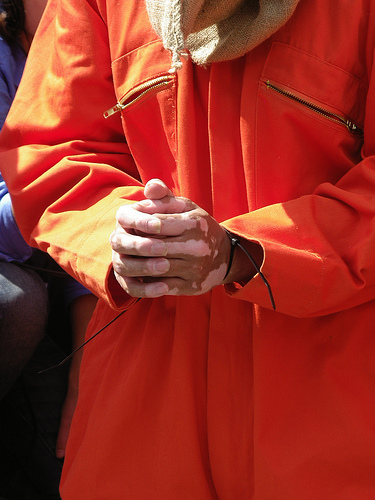 MEDIA
ROOTS — On a recent
MEDIA
ROOTS — On a recent 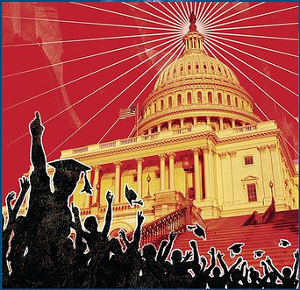 MEDIA ROOTS — As the Occupy Movement coalesced globally, tents
and bodies were brutalized by the state and press credentials were swept aside with sweeping arrests of journalists, we may have taken comfort in the thought that they couldn’t jail an idea—the idea of
the 99% resisting the tyranny of the 1%.
MEDIA ROOTS — As the Occupy Movement coalesced globally, tents
and bodies were brutalized by the state and press credentials were swept aside with sweeping arrests of journalists, we may have taken comfort in the thought that they couldn’t jail an idea—the idea of
the 99% resisting the tyranny of the 1%.