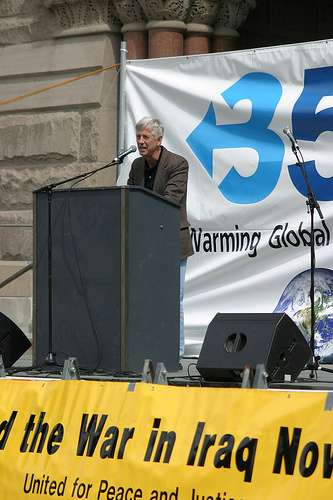
MEDIA ROOTS — Has the U.S. two-party dictatorship completely saturated Election 2012 media
coverage? Can you recall when you last heard news coverage of any
alternative party candidates?
At least one third-party candidate
is resisting this year’s media blockade against alternative Presidential
candidates who are not partisans of the Wall Street Democrats and
Republicans. (No, it’s not Ralph Nader, who has done more than his fair
share of working for electoral justice. And, no, it’s not the Green Party, which sold out to the Democrat Party by 2004.)
Considered one of the greenest U.S. mayors, recovering
Democrat Rocky Anderson, now with the Justice Party, recently stopped by KPFA (Berkeley,
CA) to discuss with Project Censored his 2012 campaign for U.S. President, the
collusion between Democrats and Republicans to further parallel plutocratic
goals, his history of resistance to U.S. imperialism, and more.
“[The U.S.] Constitution has been eviscerated while Democrats have stood by
with nary a whimper. It is a gutless, unprincipled party, bought and paid for
by the same interests that buy and pay for the Republican Party.” —Rocky
Anderson
Messina
***
PROJECT CENSORED — “This morning, the theme is Criminalizing Dissent: Updates on the Animal
Enterprise Terrorism Act.
“Before we get to our
first guest today, we have a surprise and drop-in guest. And we are very pleased to introduce to you;
we have live in our studio Rocky Anderson, the former mayor of Salt Lake City,
Utah, who courageously stood up in the Bush years from Utah, one of the reddest
states in the Union to call for the impeachment of then-President George W.
Bush. Rocky Anderson is in the [S.F.]
Bay Area all weekend doing several events.
And he is running on the Justice Party for President of the United
States. Rocky Anderson, thanks for
joining us.”
Rocky Anderson (c. 10:15):
“Thank you, Mickey. And [it’s]
great to see you and Andy here today.”
Mickey Huff (c. 10:18): “So, we just have a few moments here in the
beginning. Can you tell us a little bit? Remind people about what you were doing in
the impeachment phases when you were pushing for this against George W. Bush
and then segue a little bit into what you’re doing now.”
Rocky Anderson (c. 10:31):
“Well, I had huge concerns, of course, even before the invasion of Iraq,
given the run-up to the invasion and occupation. I never call it a war because it really
wasn’t a war. It was completely illegal,
[an] aggressive war, if you can even
use that term war. We knew from the U.N.
inspectors that the representations of President [G.W.] Bush were a complete
lie. He wasn’t disclosing to us the huge
disagreement within the intelligence community with what he was telling us,
with what he was telling Congress. And,
so, I was urging everyone that had any leadership position in this country to
push back against that run-up to ‘war.’ And then when it became even clearer, not
only the lies but the human rights violations, the massive death and
destruction in Iraq and the tremendous hatred and resentment throughout the
Muslim world, I felt like it was all of
our responsibilities.
“And the really
frightening thing is those who would say, as mayors did from around the country,
they didn’t want toget involved, itwasn’t their job, it was too controversial. What I saw was this narrowing of people’s
lives and leadership to exactly what they saw their role was. And, all of a sudden, there were no leaders
standing up. It was a dismal eight
years; and I was wondering, okay, if it’s not gonna be the leaders, if it’s not
gonna be people in elected office, at least the people need to rise up. We need to be closing down cities. We need to be out in the streets. We need to be doing everything we can to
stand up against the gross abuses and the whole notion of war of aggression and
empire building. And, yet, this nation,
in large part, remained so quiet and complacent—and I must say even the artist
community. We weren’t hearing the
mainstream music and the lyrics that drove so much of what we did in the ‘60s
and ‘70s, and even during the ‘80s with the disaster in Central America and
United States policy there.
“So, I think it’s
really heartening now to see the Occupy Movement, to see people becoming more
aware, taking action, understanding that our destiny really is in our
hands. And, for more of that, I really
urge people to go to our website, VoteRocky.org, and see why it is that the Justice Party was
formed. This isn’t just about moving
people around within this perverse game that people play utilising these roles
that the Democrat and Republican parties have made up and from which they’re
thriving. We need to get together,
organise in every way, do it in a sustained way, not just during an election,
but all of us hanging in there to push for major changes in what has become a
plutocracy, government by the wealthy, when all of our interests are getting absolutely
shafted.”
Andy Roth (c. 13:47): “This is Andy Roth from Project Censored; and
we’re here with Rocky Anderson, Presidential Candidate for the Justice
Party. Rocky, as mayor of Salt Lake City
from 2000 to 2008, you’re record on the environment was especially strong. You certainly weren’t quiet or
complacent. You stood up for the issues.
“Our theme later in
the hour, today, is the Animal Enterprise Terrorism Act. I just wanted to ask you, very quickly, in
the moment or two we have left now. Do
you think it’s right to use terms like terrorist
and terrorism to describe members and
actions of the environmental movement in the United States?”
Rocky Anderson (c. 14:24):
“Absolutely not. It is such a
perversion of our language. And these
people are brilliant at the way they frame things. It’s like calling what we’re doing around the
world a‘war on terrorism’ when, in fact, what we’re doing is terrorising
the lives of millions of people and really creating so many obstacles to real
security, probably for generations.
“But, you know, you
hear war on terror, war on drugs. George Lakoff points out in his excellent book Don’t Think of an Elephant; he talks
about how the Right is so successful in framing issues by the use of these
kinds of terms. Think about it. And one of the examples he uses is tax relief. Well, right there it connotes that taxes are
a bad thing and something we should be relieved from. And
what happens on the Democrat side?
They end up using the same terms.
They’ll use the same vocabulary.
And it’s not just a matter of timidity.
It’s a matter of collusion
between the two parties.”
Mickey Huff (c. 15:31): “Well, that’s the voice of Rocky Anderson,
running for [U.S.] President on the Justice Party. Rocky, could you give the website one more
time?”
Rocky Anderson (c. 15:37):
“Yes, it’s VoteRocky.org.”
Mickey Huff (c. 15:40): “Okay, so that’s the voice of Rocky
Anderson. He’ll be at 10am at Provo
Park [in Berkeley, CA] rallying with fired steelworkers. This evening, I believe, you’ll be at the
Occupy the Truth: Whistleblowers Conference at UC Berkeley. I’ll make announcements for that. I don’t believe you’re on the programme, but
I believe you’ll be there, if people want to meet and talk with you.”
Rocky Anderson (c. 15:54):
“No. But there will be great friends
of mine on the panel.”
Rocky Anderson (c. 16:02):
“And these are messages that need to get out to all the American people because
what we’re seeing under this [Obama] Administration is a more aggressive
campaign against those who are responsible for getting the truth out to the
American people and people around the world and, yet, all of the illegal
conduct, including cold-blooded murder that’s being disclosed by these people,
nobody’s doing anything about that. The
real perpetrators, again, under our two-tiered system of injustice in this country are not being held accountable.”
Mickey Huff (c. 16:35): “That’s Rocky Anderson. Thanks so much for dropping in.”
Rocky Anderson (c. 16:37):
“It’s great to see you. Thank you
so much.”
Mickey Huff (c. 16:38): “Again, this is the Project Censored show,
free speech radio, KPFA. We’ll be right
back with the Animal Enterprise Terrorism Act, Will Potter, and Odette Wilkens.
Please stay with us.”
MEDIA ROOTS — Judi Bari was an
activist, a person of conscience, who exercised her First Amendment rights toward socioeconomic justice for much of her life.
She was one of the leading organisers to popularise environmental
activism with Earth First!, which influenced the environmental activism
contributing to the historic 1999 WTO resistance in Seattle, as well
as the more recent Occupy Movement. On
May 24, 1990, a motion-triggered car bomb exploded under Judi’s car seat, as she
and Darryl Cherney drove through Oakland en route to Santa Cruz during the Redwood Summer organising
tour.
Judi Bari’s story, one of solidarity and collective action, has
been documented in an important new film by Mary Liz Thomson (Director/Editor) and Darryl Cherney (Producer)
entitled “Who Bombed Judi Bari?” The
documentary film will have its world premiere next week at the 2nd
Annual San Francisco Green Film Festival taking place March 1-7. The world premiere
screening will be on Friday, March 2, at 5pm (1746 Post Street, SF). With the full production team in the house, this
screening will likely be filled to capacity.
So, advance tickets are recommended
for those interested in attending.
This is an important film for all because it speaks directly to our human
rights in the face of state belligerence.
If we don’t care to question culpability when our neighbours are
attacked, particularly where the state has motive to repress, we are unlikely
to encourage future generations to take principled stands for socioeconomic justice. From JFK, X, Ché,
MLK,
Fred
Hampton, and countless others to 9/11,
as the state obfuscates and destroys evidence outright, lack of curiosity
becomes erosive to our humanity.
Perhaps, we are learning. In the case
of the 1990 attempt on Judi Bari’s life, the FBI was thwarted in
its plans to destroy all of the evidence.
“A U.S. federal judge in California has ordered the FBI to preserve evidence in a 1990 car bombing that nearly killed two members of the environmental group Earth First! The FBI
was planning to destroy all evidence in the case, even though agents
had never determined who carried out the attempted assassination of
environmental activists Judi Bari and Darryl Cherney. The FBI initially arrested the activists for building the bombs themselves, but the pair later sued the FBI and won more than $4 million in damages.”
Messina
***
“Who Bombed Judi Bari?” trailer
***
SFGFF — This is a raw, personal and at times abrupt film, with a protagonist and
story vitally important to American justice and the struggle for the
environment. Judi Bari was an environmental and social justice activist
who popularized protests against clear-cutting (e.g. at Headwater
Forests) together with the organization EarthFirst! in the 1980s and
’90s. At times, she (and others) proceeded despite threats of death and
violence. Then, on May 24th, 1990 in Oakland, CA, a bomb explodes in
Judi’s car and she suffers debilitating injuries along with confidant,
and the film’s producer, Darryl Cherney. In the aftermath FBI and local
police accuse the team of bombing themselves. It chronicles the rise of a
powerful movement as well as the circuitous court cases that followed
the blast. Chock full of archival news footage, interviews and
statements by Bari, viewers follow a path from non-violent eco protests
to an ostensible assassination attempt on Judi’s life with an associated
cover-up – ending with a surprising resolution.
***
“Redwood Summer: Where the 90s Begin,” by Mary Liz Thomson, et al. (1990)
MEDIA ROOTS — Jonathan Turley, a professor of law at George Washington University Law School, discussed on C-SPAN his Washington Postarticle, “Are You Being Watched? It’s Your Fault,” “looking at the issues of surveillance and privacy and U.S. citizens’ loss of privacy protections,” as well as their own complicity in this crisis and related implications, such as the intergenerational erosion of privacy expectations.
One may be reminded of the U.S. public’s similar enculturation to a two-party system, for which they perpetually vote, but doesn’t represent their interests; instead, Democrats and Republicans collude to further corporate consolidation of power. But because of the intergenerational downward spiral of eroding public expectations, as in the loss of privacy protections, the public perpetually give up their rights.
Messina
***
Jonathan Turley on C-SPAN (19 December 2011)
***
WASHINGTON JOURNAL — “Jonathan Turley is law professor at George Washington University Law School. Thank you for being here.”
Jonathan Turley: “Thank you.”
“Also has the blog JonathanTurley.org, a legal blog, that goes over lots of issues, that are in the public eye, what’s going on in the legal world and their implications.
“You had a piece in the Washington Post recently called, ‘Are You Being Watched? It’s Your Fault.’ What does that mean?”
Jonathan Turley: “Well, what is often neglected in today’s, particularly presidential debate, but in all the overall debate in the country is that we have something of a crisis with regard to privacy. This country used to be distinguished, used to be defined by privacy. We have an innate sense of privacy, that you haven’t seen expressed in other countries to the same extent. Even close allies, like England, really don’t have the historic commitment to individual privacy the United States has had.
“But what has happened in a very short time is the erosion of privacy in this country, to the point of a crisis. I mean we’re fast becoming a fish-bowl society. I mean when you came here this morning, when you left your home, you were filmed on the roads, driving to the highways, on the highway, itself. If you stopped for coffee, you were filmed in the parking lot and in the 7-11. And then you got back in and you were surveilled inside your building. Most people’s businesses now have a hundred, video cameras, that run continuously. And you work in that environment. And then you turn around and you repeat that trip.
“And Americans are now used to being under surveillance all the time. I teach privacy at George Washington Law School. There’s a big sign in all of the classes, that says you are under surveillance.’ And I teach privacy with that sign right above my head.
“So, the question is: What’s happening to our society? What type of citizens are we producing when they grow up learning to expect, even be comforted by, continual surveillance?”
Libby Casey: “I wanted to read the last paragraph of this piece you wrote. It says:
“‘…the problem is not with the government, but with us. We are evolving into the perfect cellophane citizens for a new transparent society. We have grown accustomed to living under observation, even reassured by it. So much so that few are likely to notice, let alone mourn privacy’s passing.”
Jonathan Turley (c. 2:23): “That’s right. My students have a fraction of the privacy expectations that I had. And their children are likely to have even less. What we are not really discussing is what happens to a society where we expect, even want, to be under surveillance. That’s a completely different paradigm from what the framers [of the Constitution] believed was essential. What I think people miss is that the Constitution does protect privacy to a small extent, but not very much. What really protected privacy in the United States was the inability of the government to actually engage in surveillance for a lot of times. It would be a technological limitation. Those technological limitations are now gone. Government actually can engage in surveillance that the framers would never have imagined. And it’s coming at a time when people are no longer focusing on the loss of privacy because they are not used to having much privacy in this society.”
Libby Casey (c. 3:23): “You dig into the case Jones vs. the United States for the Supreme Court, which involves GPS tracking and putting a GPS tracking device in the vehicle of a suspect. Take us through your concerns about this case and what you think the implications are.”
Jonathan Turley (c. 3:37): “That’s perfectly Orwellian. In fact, that’s what Justice Kennedy said during oral arguments. He basically said, ‘Let me get this straight, you’re saying’—and this is the Obama administration is saying—‘that we should be able to put GPS devices on any citizen without a warrant, so, that we could follow them 100% of the time, know exactly where they’re going?’ And Justice Kennedy said, ‘Isn’t that pretty Orwellian that you would be able to do that?’ And the Obama administration’s argument is, basically, citizens have no expectations in terms of their travelling in public, even with a device, that shows every turn, every second, that they make. And that’s the reality.
“See? It’s strange, but we a cycle, like a 40-year cycle, where our privacy doctrines break down and we need a correction. The best example of that was in 1928, in a case called Olmstead. The Court created a truly ridiculous doctrine called the Trespass Doctrine. And that doctrine said that the government only needed a warrant if they physically trespassed on your property. Well, that, of course, is bloody ridiculous ‘cos what it did—it was actually one of the few cases where the Supreme Court actually forced technological changes. And, so, the market of surveillance immediately went to non-trespassory surveillance devices. And, so, the Supreme Court actually pushed the industry into developing ways to engage in surveillance, that didn’t involve trespassing, things like laser window pickups and parabolic mics.
“Well, the Trespass Doctrine was a huge failure. The government engaged in massive amounts of surveillance. Then, in 1967, the Supreme Court handed down Katz, which is a very elegant decision. And Katz was the decision, that said famously that the Fourth Amendment protects people not places. And that’s really great. I mean it really captured the moment. The test they created—”
Libby Casey: “Now, why is that important? Break that down for us.”
Jonathan Turley (c. 5:29): “Because the Trespass Doctrine treated your home, the physical outline of your home as what’s being protected. Well, that was ridiculous. What was really being protected is what the home represents, what’s within it, privacy.
“And, so, the Katz court handed down a test, that was really a major step forward for privacy. But it had within its seeds for its own destruction because what the Katz test said is that the government would now require a warrant to engage in surveillance whenever you have a reasonable expectation of privacy. Well, here’s the problem. It is that means that as your reasonable expectations of privacy fall, the government’s ability to engage in surveillance increases. And, as it increases, your expectations fall. And you have this downward spiral, which we’re in today.
“Most of my students today have very little expectation of privacy outside their immediate home or apartment. And that means the government have much more ability.”
Libby Casey (c. 6:27): “Do you think that the case, that’s now before the Supreme Court, Jones vs. The United States could be as significant in these privacy issues, as Katz was, as the earlier law was?”
Jonathan Turley: “It could. It’s coming around at the right time. We’re on the 40-year mark again. And the Court could correct its past problems. The problem, that we have, is that this is not the Court to do it. This is a very conservative court. There’s not a lot of privacy advocates on this court. It is the problem, that many Libertarians have with the conservative movement, that is many of the justices are conservative; they are not libertarian, in the sense that they tend to vote for the government on police and surveillance programmes. And they tend not to vote on individual rights and things like privacy.”
Libby Casey (c. 7:09): “Jonathan Turley is a law professor at George Washington University Law School.
“Here’s how you can join the conversation: Republicans can call 202.737-0002. Democrats: 202.737-0001. And independent callers: 202.628-0205.
“Let’s go to Nashua, New Hampshire. Hula is on our Independent line. Good morning.”
Hula from Nashua, New Hampshire: “Good morning, Mr. Turley. Actually, I have, both, sort of a question and a comment. I’ve heard a news that said now that we are no longer fighting a war, the drones, which were used in the war will be used to just fly over and see what’s happening. And, basically, then if they see any crime, they can go and get the warrant and, basically—speaking of Orwellian—this is really scary because this is an additional layer of erosion. And I would like your comments on that.”
Jonathan Turley (c. 8:05): “Well, it’s a very good question. And I’m afraid you’re absolutely right. We’re running out of wars abroad. And we’re bringing all that back to have a war in this country. And that war is going to be on privacy. And Congress, as usual, is not very protective. Congress has more often been the threat to privacy than its champion.
“And you are seeing drones being used now. We just saw a drone used in a minor case in Texas, where it was used involving what would have been a low felony. But they used a drone over this guy’s ranch. You’re gonna see a lot more of that.
“And I have to say I’m very critical of both sides. You know I wrote a column in the L.A. Times not long ago talking about how Barack Obama may have killed the civil liberties movement in the United States ‘cos he divided the movement. Some people just cannot break from Obama. But civil libertarians tend to be very angry with Obama.
“And the question you raised goes to that issue. It’s not just the drones. For example, President Obama is going to be signing this new law, that allows for citizens to be held indefinitely without trial, without access to courts. Civil libertarians oppose that. And then President Obama said he would veto it and then broke that promise.
“But we’re now seeing this shift, where many of the things, that were being done abroad—and citizens were always told, ‘Look, we do this to other people. We do this outside our country. Many citizens thought that was comforting.
“Well, now it’s coming home. And they’re bringing the technology and the practices back to the United States. And it’s a little bit late to get that cat to walk backwards when it comes to civil liberties.”
Libby Casey (c. 9:40): “Here’s that L.A. Times op-ed piece: Obama: A disaster for civil liberties, written by our guest, Jonathan Turley. And you write:
“‘Perhaps, the biggest threat to civil liberties is what President Obama has done to the movement itself. It has quieted to a whisper, muted by the power of Obama’s personality and his symbolic importance as the first Black president, as well as the liberal who replaced Bush. Indeed, only a few days after he took office, the Nobel Committee awarded him the Nobel Peace Prize without having a single accomplishment to his credit beyond being elected. Many times, Democrats were, and remain, enraptured.’
“Do you think there’s a feeling among liberals and privacy advocates and others that—as you mentioned the pendulum has swung from President George W. Bush and this is sort of the best, that can be done in this moment?”
Jonathan Turley (c. 10:27): “Well, that’s a big debate. That’s a debate we have on our blog almost every day. I mean at the blog, it’s a big civil liberties blog, and there are many people, that have said I can’t support President Obama. For one thing, many civil libertarians said that when Obama, basic-, well, he went to the CIA and said, ‘I will not allow you to be investigated or prosecuted for torture.’ He told that to the CIA employees, which had violated treaty obligations, that we had.
“And, so, for civil libertarians, many of them, simply cannot vote for Obama. In fact, the irony is the only guy talking about civil liberties today is Ron Paul. I mean it’s bizarre because Obama has taken most of the Bush policies and actually expanded them, didn’t even just maintain them.
“And, so, the result is that you have this division in the civil liberties community. Some civil libertarians say, ‘I just can’t ethically support Obama after what he’s done. Then others, I have to say, are caught up in this cult of personality. They can’t get themselves to vote against him. The Democrats are playing the same argument that, ‘Oh, yeah, he’s really bad, but those guys are worse.’ And that’s the type of bargain. It’s a Faustian bargain, that guarantees that you’re going to get someone bad. And many people are just saying, ‘I don’t want to do it anymore.’
Libby Casey (c. 11:42): “But the interesting thing about the Democrats is you have this Stockholm Syndrome for civil libertarians where they’re embracing Obama, even though he’s pretty much destroyed the civil liberties movement in the United States.
“A comment on Twitter: James writes, ‘I believe we have desensitized ourselves thru smartphone picture taking; youtube-facebook posts; and traffic/online security cams.’
“Well, that’s exactly right. And that’s the problem with Katz. That is—”
Libby Casey: “The case.”
Jonathan Turley: “—yes, the case—it’s that when you say that you’re desensitised, it means you don’t have as much of a reasonable expectation of privacy. And that become a self-fulfilling, you know, fact for Katz test.
“But the amazing thing is when you look at these children—I remember many years ago I was called by the head of a school district, of one of the largest school districts in the country, and he said, ‘I just wanted to ask your opinion about us putting videocameras on school buses.’ And I said, ‘Really!? Because that would mean you’d have thousands of tapes!’ This is back in the age of tapes, before digital. And he says, ‘Oh, no, no, no. We’re only gonna put a tape in one of the cameras. But the kids won’t know, which one.’ And I sort of fell back in my chair and thought, ‘That’s the chilling effect.’ That is the framers and Supreme Court have talked about the chilling effect, that what the Constitution is trying to prevent is not as much their surveillance of you, directly, but the chilling effect if you fear you may be under surveillance. And it’s the chilling effect, which changes who we are.
(c. 13:08) “Every year, I ask my students to do an exercise at George Washington around this time when they go home for the holidays. And I tell them to put a tape recorder on a table when they’re having breakfast with their relatives or out with their friends. And they have to say, ‘Look, this is for Turley. It’s an assignment from his class. No one’s gonna listen to this, but me. Can I just put this on? Pretend to put it on. It doesn’t even have tape in it. And watch what happens.
“Suddenly, your friends will start talking in complete sentences. They’ll be incredibly coherent and erudite. They’ll no longer talk about who’s fat or who’s sleeping with who. They’re gonna be talking about, you know, the future of the euro. There’s an immediate change.”
Libby Casey: “Is that so wrong?”
Jonathan Turley: “It is wrong, in the sense that the point is that even the fact that this person that you’re gonna talk to is the only person that’s gonna listen to it, it changes the way that we relate. That’s the chilling effect.
“And we’re becoming, not just a cellophane people, we’re becoming an inhibited people because we are cellophane citizens.”
“Let’s hear from Dom, a Democratic caller from South Carolina.”
Dom from South Carolina: “Hi, Libby.”
Libby Casey: “Hi.”
Dom from South Carolina: “Mr. Turley.”
Jonathan Turley: “Yes.”
Dom from South Carolina: “Uh, the chilling effect. I would tell you that the new generation, even some people in my—I’m a 55-year old guy—is kinda goin’ away because people display their lives on the social networks like it’s nothing. They tell all their dirty laundry. I’m amazed at the things they post on Facebook. And it seems that the only way to deal with the privacy is to specifically state what expectation of privacy means.
“Otherwise, the technology and the attitude of, especially, like, my kids and everything is doing away with, like you said, the goal post keeps slipping.
“Also, one question about the president’s expanded powers. I mean what, can’t the Supreme Court, can’t they enter in? I can’t believe that the president can come, pull me out of my house in the dark of the night, and whisk me away, and I have no action that I can take. I mean, what is that? Why isn’t the Supreme Court, uh, weighing in on this?! This is really, I’m a strong Democrat who backs Obama. But I’m thinking about not backing him because of this. And I’d really like to hear your opinion. I’ve enjoyed you over the many, many years, that I’ve seen you on TV.”
Jonathan Turley: “Thank you very much.
“First of all, let’s start with your second point. It’s actually worse than their coming in to your house. I hate to ruin your day, but President Obama just stated that he is going to maintain a policy that he can have any American citizen killed without any charge, without any review, except his own. If he is satisfied that you are a terrorist, he says that he can kill you anywhere in the world, including in the United States. Two of his aides were just at a panel a couple of weeks ago and they reaffirmed they believe U.S. citizens can be killed on the order of the president anywhere in the United States.
“That has left civil libertarians’, you know, head exploding because what’s amazing is that you’ve got a president who now says that he can kill you on his own discretion, he can jail you indefinitely on his own discretion, and the response of the American people is one big collective shrug and yawn. And I don’t think the framers would have ever anticipated that. They truly believed that citizens would hold their liberties close. And that they wouldn’t relax those fingers. But they are.
“And, now, the point that you had made about the question about privacy and the new generation, we’re not gonna get any help from Congress. Congress has never had a good record on privacy or Constitutional issues. But the only positive thing—and I wanna give you something positive, as you head to work this morning—that is the polls, we’ve had three polls in the last year and they all show the same thing. The American people say that they are more afraid of the government than they are of outside forces, like terrorists.
“So, there’s this disconnect. The majority of Americans are actually very concerned about the loss of rights, but Congress—both Democrats and Republicans—can’t move harder against privacy. They—and this is part of the cynical calculation—I think that President Obama made this calculation early on decided that no one would be to the right of him on terrorism and national security. And he has taken the Democratic Party with him on that.
“So, you have this remarkable disconnect where the majority of citizens are going, ‘We’re really concerned about this. We are fearful of our own government.’ And, yet, it’s just not translating on the Hill.”
Libby Casey: “Jon Turley writes in a recent op-ed piece called Are You Being Watched? It’s Your Fault. He talks about Congress. And you write:
“‘Congress has historically been indifferent, if not hostile, to individual rights. Few members are willing to pass laws to protect privacy over security demands, [leaving many arguing for small government while ignoring Big Brother that dwells within it].’
“And then you also talk about—jumping earlier in the piece—how privacy is under assault from private companies.”
Jonathan Turley: “Right. That’s something that a lot of people often don’t think about, is that the Fourth Amendment protects you against the government. And that creates this huge gap.
“The surveillance industry today is a multibillion dollar a year industry. Most of that is going to private companies. And they have become, really, exponential in terms of their growth, in terms of the surveillance they have of their employees with the support of Congress.
“So, most surveillance, that people are under is not by the United States government. Now, that’s dangerous because what happens is that the U.S. government, usually can get that surveillance. But the standard is non-existent. See, where the government needs a warrant, these private companies do not, in terms of much of the surveillance that they do.
“And you see that in England. England has become a true fish-bowl society, truly Orwellian. They’ve got ten of thousands of CCTV cameras, many of those are private. The government takes from those private feeds as well.
“Chicago—my hometown—just has about 10,000 cameras now, which is ironic. I wrote another column recently about citizens filming police officers in public. And one of the things I mention in that column is that the Chicago District Attorney, or the State’s Attorney, has actually gone to court to fight the right of citizens to film officers in public while the city, itself, has 10,000 cameras filming citizens every minute they’re on the street. So, the government loves to do surveillance, but they really don’t like citizens filming them.”
Mike from Mojave, Arizona: “Good morning, Mr. Turley. And good morning to you.”
Jonathan Turley: “Good morning.”
Mike from Mojave, Arizona: “Yes, I’d like to focus the attack away from the President and Congress for a second and just talk about whether the Supreme Court, itself, has made some rulings on what I call topically flawed warrants. For instance, a warrant, that is misaddressed, though the entry is made and some contraband is found, that being a mistake can, under certain circumstances, be a valid warrant where otherwise if the police fake a probable cause to gain entry into an establishment and it’s determined that it’s illegal. That’s found to be not good.
“Now, to me contradictory here is that the good warrant, that is done by mistake is allowed to be a good warrant, though that’s only statistically effective, where the illegal warrant, that’s made by police, ‘I’m going to enter an establishment,’ unless they think there’s something there. But [if] they don’t have enough probable cause, they’ll just make it. All those entries, more, are gonna be successful if they get away with it.”
Libby Casey: “Mike, let’s get a response from our guest.”
Jonathan Turley: “Well, you’re right. The Fourth Amendment area is a mess. When I’ve taught Constitutional Criminal Procedure, I feel like I’ve had to apologise to my students because they constantly are trying to say, ‘How are these consistent?’ You have to say, ‘They’re not.’
“The Supreme Court has, actually, done some pretty lousy work when it comes to Fourth Amendment. And even some of the justices have indicated that this is a field, that is inherently in conflict.
“Part of the problem for civil libertarians is that the Fourth Amendment is a beautifully written thing. It’s very, very clear. It’s to protect your person, your things, your homes. And it requires warrants. But what the Supreme Court did years ago is they decoupled two clauses. There’s the reference to warrants. And then there’s the reference to the term reasonable or unreasonable searches and seizures. They decoupled it. And that means that you can do reasonable searches and seizures without a warrant. And they started to create exceptions to the warrant clause. And those exceptions have now swallowed the rule. Vastly more surveillance today is conducted without a warrant than with a warrant. So, most surveillance today by the government is done without a warrant, without anybody looking at it. And the thing to remember with probable cause: The standard is incredibly low. The vast majority of warrants are granted. If a warrant is not granted, I gotta tell you, there is a serious problem. And the problem is probable cause does not require a lot to get a warrant. But most surveillance today is done without a warrant because of the slew of exceptions the Supreme Court has created.”
Libby Casey (c. 23:01): “Let’s got to our independent line, where Tom joins us from New Milford, Connecticut. Good morning.”
Tom in New Milford: “Good morning. Thanks for the discussion. I wanted to make a couple of points.
“Number one: The president [Obama] was a fairly low level law lecturer at the University of Chicago. So, I’m not sure he’s really even qualified on legal issues.
“Number two: I’m a part-time certified coin dealer. There have been a lot of coin dealers robbed this year. The surveillance equipment was substandard. And the police have nothing to go on. I think the police do need the tools do their job. And there’s a lot of tax evasion with the IRS needs better tools to do their job.
“How would you respond to those concerns?”
Jonathan Turley: “Well, they’re legitimate concerns, but I have to tell you the police have a lot of tools today. I stopped teaching the constitutional criminal law just because it went down where I could teach it from a pamphlet because every right seemed to be created with an exception or reduced.
“And, right now, we have a fraction of the protections in terms of citizens, that we had a decade ago. And they have a lot of these types of protections.
“The problem, that privacy advocates have, is we’re trying to sell an abstraction. One, that people hear the word privacy and they like it, but it’s still an abstraction where a politician will come forward and say, ‘Do you wanna nail the guy, that stole your coins?’ or ‘Do you wanna stop terrorists from a terrorist attack?’ That’s a very concrete thing. People can think of themselves in that circumstance.
“So, it’s always a false trade off. Privacy always loses. And that’s why we’re seeing a radical diminishment of privacy in our society, that’s changing who we are. And the question is: Can we really get that back?
“And what I’m trying to say is that it’s very easy to lose privacy; it’s much, much harder to get it back, that it’s one of those things in your life, that, once it’s gone, you have a hard time finding where you left it and an even harder time finding someone willing to give it back to you.”
Libby Casey (c. 25:16): “Jonathan Turley, a law professor at George Washington University Law School.
“Jody writes to us on Twitter: ‘Today’s youth want the opposite of privacy. In time, they will learn.”
Jonathan Turley: “Unfortunately, they will learn. That’s very insightful. And that’s the tragedy, that once you’ve lost it to such a degree that you’re left with, ‘who am I?’ Or who are we as citizens?
“There has become this detachment, this passivity. That’s why a talk about a collective yawn, that privacy is one of the most important rights to you, that you really enjoy. But you don’t associate those things with privacy. But once it’s gone and you find yourself living in a fishbowl society, as we increasingly do, then you realise—a bit too late—that it’s gone. And that requires us to educate people and to really prevail upon Congress. These people in Congress will do anything to keep their jobs. That, I think, we all agree on. If the public makes clear that they can mess around with a lot of things—they can ruin the economy; they can do anything they darn want—but they have to leave privacy alone, they’ll respond. But it’s gonna take us to save it.
Libby Casey (c. 26:31): “Tying in to this, one of our viewers writes an email and asks this question:
“‘In law, what’s the difference between ‘privacy’ and ‘anonymity’? As a young person, I can concede I don’t have the same privacy concerns as some of the older generations. It seems to me that when I get into discussions about this topic, many want to have the ability to do things anonymously versus privately. When I pick up a prescription, I have an expectation that my transaction remains private, but by no means anonymous. However, many people seem to squawk online that they can’t maintain their privacy when what they’re really trying to protect is their anonymity.’
Our viewer writes: ‘Anonymity can be dangerous, but privacy is essential.’”
Jonathan Turley (c. 27:09): “Well, first of all, it’s an incredibly insightful question. I’ve actually written on this, the difference between privacy and anonymity, and I take a rather dim view of this distinction because, first of all, it’s absolutely correct that people now more often talk about anonymity, rather than privacy. And the reason is really sad. As privacy has diminished in our society, people are grabbing on to anonymity, as the only way of retaining a small aspect or privacy.
“That’s why I take a rather dim view of it, because this is another Faustian bargain. That is: A society in a fishbowl, the only way to retain privacy is to pretend you’re a different fish. And that’s what people are doing. And, so, on the internet—like on my blog we have a complete anonymity rule. And some of my guest editors really question whether we should really have that because people abuse it. People become vicious when they are allowed to have anonymity.
“But anonymity has become the last recourse for people, that have no privacy, that are transparent to society. That is really sad. That’s basically saying, ‘When I go into society I’m going to wear a disguise because otherwise everyone will know what I’m doing what I’m saying and who I am.’ Think how that changes you.
“Think about schools, by the way, who now go through metal detectors, have cameras filming them all the time. What type of citizens are we creating? Where we’re actually raised in that fish bowl? They don’t even have an inkling to feel what it was like to feel like you could walk in the street or say something and not have it recorded or played back to you.”
Libby Casey (c. 28:59): “Jonathan Turley is a law professor at George Washington University. His legal blog is JonathanTurley.org. You can find guest commentators there and discussions about legal issues and their implications on society.
“Candidate [for U.S. President] Newt Gingrich has come out in the last couple of days talking a lot about the role of the judiciary. And this is a story from National Review. His comments over the weekend suggested that he would abolish whole courts to get rid of judges, whose decisions, he feels, are out of step with the country, that Congress has the power to dispatch the Capitol police or U.S. Marshalls to apprehend a federal judge who renders a decision broadly opposed.
“This topic came up yesterday when Michele Bachmann was doing a Sunday talk show circuit on NBC’s Meet the Press. Let’s hear how Michele Bachmann, a candidate for President, weighed in on judges.”
Michele Bachmann Clip: “The Constitution is set up how it should be. The problem is the Supreme Court, or other members of the court, have passed decisions, that aren’t in conformity with our constitution. That’s what we take issue with. That’s why it’s important that the people have representatives be able to pass laws, as the president would sign in conformity with their will. What’s wrong is when judges make laws in conformity with their own opinion. They can’t make laws. It’s the congress and the president, that make laws.”
Libby Casey (c. 30:24): “Michele Bachmann on Meet the Press. What do you make of this discussion right now about the power of the judiciary and whether or not it should be pulled back a little bit.”
Jonathan Turley: “Well, it’s the perfect storm, isn’t it? I mean we just talked about how the president’s acquiring unilateral authority to kill citizens without trial. We have a presidential campaign where people seem to have a race to the bottom of who can really devour more parts of our constitution. They seem to be running against the Constitution.
“You know, I’m a Madisonian scholar, so I’ll admit James Madison is like Elvis to me. But none of these people are James Madison. He was one of the most brilliant human beings this country has ever produced. And the necessity of an independent judiciary for a country like ours has proven itself over and over again.
“And, so, what I would encourage people to think about is where we would be if we didn’t have an independent judiciary. Everyone disagrees with opinions. I’ve had courts rule against me, that I thought were insane. But we all, as citizens, share a certain covenant of faith. That’s what the Madisonian system is. It’s a covenant of faith. And we make a commitment to each other. We may disagree with each other. We may even hate each other. But it’s a leap of faith. You have to trust the system. And what Gingrich and Bachmann are talking about is the height of demagoguery. And I don’t want to challenge them, personally. But they need to look at what they’re saying about this country and what we would be left with if an independent judiciary was replaced by the whim and will of Congress.
Libby Casey (c. 32:02): “Let’s hear from Fort Wayne, Indiana. Chris, Democrat’s line, welcome.”
Chris in Fort Wayne: “Yeah. He’s on the right track. But I wish he would put the blame for this where it belongs. And that’s with the conservatives on the Supreme Court. They’re the activist judges. For 30 years, they’ve eroded rights and given ‘em to the government and given ‘em to private business.
“Now, I just went through this stupid drug testing stuff. And I just cannot believe that private companies are allowed to get into my private business of what I do off the hours of work! In order to bring forward—in the Supreme Court, the Republicans on the Supreme Court have eroded the rights. Now, just because they’ve tied it to something else, kind of forced the [Democrat] President [Obama] to sign it, now you put all the blame on the president.
“Now, what scares me is the conservatives, if one gets in there, will actually use this power.”
Jonathan Turley (c. 32:59): “Well, first of all, I certainly agree with the Supreme Court’s fault in this. But I have to say that, if people are going to deal with the crisis we’re in, we have to be even-handed. And we can’t make excuses. There is no excuse for President Obama. If he signs a law, that says they can indefinitely imprison citizens, then he’s made an incredibly bad decision. There is no law. It doesn’t matter what it’s attached to. His decision to tell CIA employees that they would never be investigated or prosecuted for torture, that was an incredibly bad decision. It violated treaties. We can’t make excuses. The Democrats are equally at fault. You know we found out a few years ago that the Democratic leaders knew about the torture programme. They knew about the unlawful surveillance programme; the [Democrat] leadership knew about it.
“There is no red or blueissue here. It’s something of a chimera. We’ve gotten into this blue state/red state paradigm. We’ve bought it.And we’ve become a nation of chumps. They’re all lying to us. And, yet, when elections come around we put on our blue or our red scarves and go running off to support them. And what’s being lost is not just good government. We’re beginning to see our rights being lost.
“And, unfortunately, the system, the system, that Madison created—this is what, really, Benjamin Franklin said. You know, when a woman came up to him and said what have you created, in Philadelphia? And he said, ‘A republic, madam, if you can keep it.’ It’s pretty chilling words because if you’re a nation of chumps, you’ll lose the republic they created. And that’s what’s happening.
Cal in Ogden (c. 34:48): “Yeah, good morning, guys. Hey, Mr. Turley, I just wanna thank you for being one of the few law professors out there, I think, that actually believes in individual rights and freedoms and the privacy thing.
“And one of the things, that’s really disturbing to me is this latest National Defense Authorization Act allows for the detention of U.S. citizens on U.S. soil without due process. I, personally, called all of my representatives from Utah found out what their voting record was on it and congratulated the ones, that voted against it, and told the ones, that voted for it that I was going to personally campaign against them. And, you know, this thing about the president being able to decide who gets eliminated or not eliminated—and this coming from a guy, that would probably fight against the death penalty of people who have been tried and who have been found guilty of heinous crimes.
“But the thing you hit on about the collective shrug from the populace, I think the problem there is the American people are never ever told the truth. The mainstream media is so biased towards one side that they are not telling the truth. I wish with all my heart that—remember the movie with Jim Carrey, Liar Liar, about how he couldn’t lie for a period of time? If, for the next year, the mainstream media and all of our politicians could not lie and had to tell the truth, you would see a dramatic shift in this country like nothing that no one’s ever experienced before because the people, if they’re told the truth—and our ‘Founding Fathers’ knew this, too, that they could rely on the people, if the people had the truth. But they’re not getting the truth. Thanks, Mr. Turley.”
Jonathan Turley (c. 36:44): “Well, if that happened the silence would be deafening on The Hill if they had that condition. I would love to see that.
“You know, I just got back from Utah a couple of days ago. And one of the interesting things, that I found in speaking to groups from Utah to Massachusetts, is that there is this shared view. The citizens are out there. There is not a big difference between folks in Utah and folks in Massachusetts about their fear of the government, their resistance to all of the powers, that have been accumulated by the government. And you have this disconnect where the two [monopolistic] parties are advancing an interest, that is starkly opposed to them.
“And I think part of the [collective] shrug and part of that [collective] yawn is a sense of detachment, of helplessness, that people don’t feel that they count anymore, that they really have the ability to influence anyone. And, so, we have this blue state/red state, you know, thing, that people are buying, on one hand. But the majority of citizens look at that and say, ‘I don’t matter anymore.’ That’s the scariest thing of all because the framers really did believe that citizens mattered. And they believed that citizens could change the outcome in a representative democracy. I think that, perhaps, is the greatest crisis of all.”
Libby Casey (c. 38:03): “Tying in to that, Stella writes on Twitter, in her opinion, ‘we are a nation of suckers, as we’ve allowed this invasion of privacy. Now, what can we do to stop this?’
Jonathan Turley: “It’s gonna take a lot. I mean it may take a third party, quite frankly. I mean we have a political system, that is brain dead. I mean the EKG on this thing is flat. And everyone seems to agree on it. Congress is now about as popular as ebola. And, yet, most of those people are going to be returned and they know it. And these are people, that, by the way, it doesn’t bother them. It doesn’t really bother them that everyone thinks they’re clowns, as long as they get back.
“And, so, we have to do fundamental reforms. One would be, possibly, a third party. I wrote a piece about a year ago about how we could change our system. And part of it is to break the control of the [electoral] monopoly.
“I’ll give you an example. Many areas—let’s say Utah—are not likely, outside Salt Lake City, to elect a Democrat. But they sure would like to find someone other than their incumbent. But the way that these states run primaries is the incumbent always wins first party. And then the citizens feel they don’t have a choice. One approach, sometime’s called the Minnesota rule, is they have the top two vote getters from the primary, regardless of party, to run in the general. So, if this is a heavily reddistrict, then two Republicans will run against each other. It could break the hold of the incumbents.
“So, there are a lot of things we could do like that. What we have to do is rally the American people and say this is not what it’s supposed to be. That is, you’re not supposed to have the majority of citizens feel that they are detached and powerless in a representative democracy. And they have to get mad enough to demand serious [electoral] reforms. And they’ve gotta come up with it for themselves because we are not going to get them from the people in the building over to my left.”
Libby Casey (c. 39:55): “One last call from Valencia, California. Gary, independent line: Can you keep it brief, Gary?”
Gary in Valencia: “Well, I had a lot.”
Libby Casey: “Sorry.”
Gary in Valencia: “We don’t have a representative republic. In fact, in 1911 they capped the [lower] House of Representatives at 435. We now have more federal judges than we do representatives. And when people speak out against this they get punished. Professor Turley spoke about [this] in an article in an article about the Unites States v. Elena Ruth Sassower, who runs the Center for Judicial Accountability. She tried to hold the judges accountable. More important than an impartial/independent judiciary is an accountable judiciary. And we don’t have one because they are never impeached. Misconduct complaints against federal judges are dismissed to the tune of 100%. And there’s the doctrine of absolute judicial immunity, that judges have, that covers them for corrupt and malicious acts.”
Libby Casey (c. 40:55): “Let’s get a response from our guest.”
Jonathan Turley: “Well, I do think that judges—I have written, as you’ve noted—that judges can be imperial. And there should be more review of their conduct. I’ve been very disturbed by judges, who have been holding people in contempt for statements made in public about them, where lawyers have criticised judges and found themselves charged through the bar or through the court. And that’s a worrisome trend.
“But what I think we can agree on is that there’s something fundamentally wrong in our system now. And if you really believe in a patriotic purpose as a citizen, you have to stop listening to these people, these politicians, and organise, as a citizenry, to save the country, to return it. And I know that sounds pretty stark. But the crisis we’re in is a crisis of faith. People have lost faith in this country.And when people lose faith, it’s an invitation for strongmen, for authoritarian power. And that’s what’s happening. As citizens pull back, power is filling the void. And it’s very dangerous.”
Libby Casey: “Jonathan Turley, law professor at George Washington University. He also is the founder and executive director of the project for older prisoners. And he has a legal blog, JonathanTurley.org. Thank you.
Transcript by Felipe Messina for Media Roots and Jonathan Turley
MEDIA ROOTS — With governments,
citizens, and activists worldwide increasingly relying on the internet, the environment the
internet fosters is a hotly contested issue.
Last summer, the United Nations declared that disconnecting people from
the internet was a human
rights violation and against international law. Considering internet access as a human right
and witnessing the vital contribution it has played in the Arab Spring and Occupy Movements,
the sanctity of preserving a free and open internet, or net neutrality, can’t
be understated. Even the U.S. military
recently acknowledged the critical role of cyberspace by including the digital
domain in its latest concept of “full spectrum dominance.”
As humanity’s relationship with the
burgeoning information age matures, threats to a free and open internet
continue to proliferate. Indeed, when the
printed press, radio, TV, and every other technological innovation, which have promised
to revolutionize public access to a diversity of information, were developed, they’ve
faced consolidation, monopolization, and the resultant transferences of power
and control into few hands. Now, potential
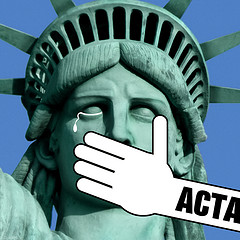
predators stalk the digital realm; and they have been revealed as SOPA, PIPA
and ACTA.
SOPA, PIPA and
ACTA all generally share the same goals which are to ostensibly protect
trademarks and intellectual property, while fending off counterfeiting and
pirating. SOPA and PIPA are U.S. pieces
of legislation, while ACTA is a transnational agreement. After recent public outcries, internet users
defeated an attempt to pass SOPA and PIPA on Capitol Hill. However, SOPA will be resurrected soon. Meanwhile, countries around the world
vigorously protest the enactment of ACTA.
What’s the significance of these acronyms on our digital routines? Let’s break each one down individually and
have a closer look.
PIPA: Protect IP Act – Preventing
Real Online Threats to Economic Creativity and Theft of Intellectual Property
PIPA’s stated
goal would have given the U.S. government and copyright holders additional
capabilities to restrict access to websites involved in copyright infringement
and the distribution of counterfeit goods.
Senator Patrick Leahy (D-VT) originally introduced Senate Bill 968 on May
12, 2011, but the motion to proceed with the legislation was withdrawn January
23, 2011.
The most controversial
aspect of the bill would have enabled Domain Name System (DNS) blocking and
redirection. DNS serves as the virtual
yellow pages of the internet. By
blocking and redirecting DNS, this essentially tears entire pages out of the
phone book, creating an incomplete version, no longer compatible with the rest
of the world. In this scenario, a simple
search for a site would yield a message stating the site no longer exists.
SOPA: Stop Online Piracy
Act
SOPA (H.R. 3261) is the
sister bill to PIPA in the House of Representatives. SOPA was introduced by U.S. Representative
Lamar Smith (R-TX). Its legal aim was to
provide law enforcement agencies greater online jurisdiction to prevent
violation of copyrighted intellectual property and the creation of counterfeit
goods.
“This bill would
establish a system for taking down websites that the Justice Department
[DoJ] determines to be dedicated to copyright infringement. The DoJ or the copyright
owner would be able to commence a legal action against any site they deem to
have ‘only limited purpose or use other than infringement,’ and the DoJ would
be allowed to demand that search engines, social networking sites and domain
name services block access to the targeted site. It would also make
unauthorized web streaming of copyrighted content a felony with a possible penalty
up to five years in prison.”
The bill’s
inherent dangers would have allowed the U.S. government and private companies to
arbitrarily incapacitate websites, thus threatening freedom of speech. Furthermore, thousands of websites would have
been jeopardized based on their user-generated content, which in turn,
frequently relies on copyrighted material.
Following the SOPA Blackout Day on January 18th, Senate
Majority Leader Harry Reid (D-NV) rescinded
H.R. 3261’s vote on January 24, 2012.
This brief video offers a concise explanation of SOPA.
The battle for
online freedom plows ahead, in light of a new bill
originating in the Senate Homeland Security and Government Affairs
Committee. Senator Joe Lieberman (I-CT),
who chairs the Committee, is engineering the latest attempt to widely expand
authority by Executive Branch departments over the internet. The debut of this new cybersecurity bill is
expected today, February 16, 2012.
Details of the cybersecurity bill have not been revealed, a result of
the legislation’s crafters meeting behind closed doors. Theories
abound that the bill, which has benefited
from bipartisan support, would grant the Department of Homeland Security
expansive new powers to regulate and stake out the internet under the pretext
of cybersecurity. However, the
persistent attempts to pass such legislation adversely impacting free speech and
the flow of information must be questioned.
Large amounts of financial contributions to politicians, as well as dubious connections, may indicate that a broader agenda is at work.
Supporters of
SOPA and PIPA will likely vigorously lobby for the new cybersecurity bill to be
passed. Backers of this type of
legislation read like a who’s who
list of Hollywood industry bosses. From
the MPAA (Motion Picture Association of America) to the RIAA (Recording Industry
Association of America), major Hollywood power brokers angle to protect their
interests. A total of 161
entities have stumped for the passage of
SOPA and PIPA. Besides the MPAA and
RIAA, they include the AFL-CIO, the International Brotherhood of Teamsters,
Comcast, Disney, and Sony. Based on some
of the groups in favor, the entire matter appears to be a pet project of the
Democrat Party. This comes as no
surprise when considering who the vanguard of Hollywood intellectual property has historically been.
Chris Dodd has made it his mission to crusade in Washington D.C. on
behalf of Hollywood under the pretext of copyright protection legislation. Dodd is the perfect bridge between Hollywood
and the Beltway. On March 1, 2011, Dodd
was chosen as chairman
of the MPAA. On the side, he also lobbies for an
organization called Creative America.
“…everyone in
the community recognizes what a grave threat content theft poses to our
livelihood and creativity – that thieves are making millions of dollars
trafficking in stolen film and television while our jobs, pensions and
residuals continue to decline.”
Some of the
groups involved with Creative America
include the CBS Corporation, NBC Universal, the Screen Actors Guild, Twentieth
Century Fox, Viacom, and Warner Bros. Entertainment. A simple search into Dodd’s previous career
uncovers much cozier ties to D.C.
Dodd has enjoyed
over three decades as a senator and has the distinction of being Connecticut’s
longest serving senate member. He’s one of the
most recognizable Democratic senators of years past, with posts on the Committee
on Foreign Relations, the Committee on Banking, Housing and Urban Affairs, and
the Committee on Health, Education, Labor and Pensions. However, his post-political career has proven
quite lucrative. According to sources,
Dodd rakes in a $1.5 million salary as chairman of the MPAA. The appointment of Dodd to head the MPAA
might be the biggest coup Hollywood has had in years.
Further evidence
from Dodd himself reinforces this as he
threatened to cut off financial contributions from Hollywood to politicians who
did not support SOPA and PIPA. The
pipeline of sizeable contributions from Hollywood going to politicians is a
healthy one most on Capitol Hill would prefer to preserve.
Democrat Senator Harry
Reid has also asserted himself a champion of SOPA and PIPA legislation. He has brought various versions of the bill
to the Senate floor and may be bound to three and half million vested interests
to pass the legislation; Reid was the beneficiary
of $3.5 million from SOPA and PIPA
advocates during the last campaign cycle. Although donations to Reid stand out by far,
other elected officials supporting the legislation have received contributions,
too: Democrat Chuck Schumer ($2.6 million), Democrat Kirsten
Gillibrand ($2 million), Democrat Barbara Boxer ($1.4 million), and Republican Michael Bennet ($1
million). Clearly, millions of reasons
jeopardize maintaining a free and open internet. One of those reasons is another piece of
little known legislation, called ACTA.
ACTA:
Anti-Counterfeiting Trade Agreement
ACTA protests
have flashed across Europe over recent weeks.
Anti-ACTAvists have sprung up
from the Netherlands to Germany to Poland and many other countries throughout
Europe. The contentious nature of ACTA attempts
to normalize an international legal framework that enforces intellectual
property rights, but also endeavors to target counterfeit goods and even generic
medications. On October 1st,
2011, Australia, Japan, Canada, Morocco, New Zealand, Singapore, South Korea,
and the United States signed the agreement.
At the start of 2012, the European Union and 22 of its member states
ratified ACTA, bringing the total signatories to 31.
Battle lines
have been drawn and two organizations are standing toe to toe—the MPAA and the Electronic
Frontier Foundation (EFF). According to
the EFF, “[…] copyright industry rightsholder groups have sought stronger
powers to enforce their intellectual property rights […] to preserve their
business models.” This sentiment
essentially drives to the heart of the debate, one which also includes SOPA and
PIPA. Those opposed to restricting the
internet view these efforts as a veiled and desperate attempt at trying to
preserve an atrophying business model, being rendered obsolete by the age of digital
file sharing. This sentiment has
galvanized many who sense that the true reason the public digital domain is under
siege is in attempts to undermine free speech and democracy. Due to what’s at stake, emotions have run
high. U.S. Rep. Darrell Issa (R-CA) has called it
“more dangerous than SOPA.” Popular
opinion likely agrees with Issa, but is the truth harder to discern?
A lot of misinformation
swirls around ACTA. The hacktivist group Anonymous shares some
of the blame. A popular video
produced by the amorphous, hacktivist collective shines light on ACTA’s
pitfalls. But is the hit piece video
accurate? According to ArsTechnica.com,
there are four dubious claims that Anonymous makes: ISPs will monitor all your data packets, ACTA
obliges its member countries to assent to the worst features of SOPA and PIPA, generic
drugs will be banned and seeds will be controlled via patents, and ISPs will be
constantly required to scour their servers for even the smallest bits of
copyrighted material. The Anonymous
video, which includes a qualifying disclaimer at the outset, has been widely
embedded in articles online and reached nearly one million views. Anonymous noted, “This video may not reflect
the recent changes within the ACTA text.
However, it will give you an idea of what ACTA is about and why the
internet should fight it.” And, of
course, after sorting any conflicting claims, ACTA still deserves a thumbs-down
verdict. We also bear in mind internet
censorship, freedom of speech restrictions, loss of net neutrality, domestic
surveillance, and civil rights erosions and police state repression have already
been ongoing issues plaguing the U.S. ACTA
would simply codify existing repressive policies for people in the U.S. under
the pretext of opposing counterfeiting.
ACTA is a poorly
crafted agreement and simply bad. ACTA’s
basic criticisms are threefold: the agreement’s designers are not
democratically elected nor accountable, the ACTA negotiations were held in secret, and there was no discussion held in a public forum. ReadWrite
Enterprise does a fine job laying
out ten reasons why ACTA fails.
Furthermore, even though ACTA probably won’t change U.S. law, it would
lock us into a constrictive legal space in an area of law that changes
rapidly. Much like activists around the
world can now respond more quickly to police brutality and government tactics
of repression thanks to the internet, file sharing enthusiasts are finding new ways to
circumvent internet censorship just as quickly.
The Internet Can’t Be
Bound and Gagged
Already the hive
mind of the internet has developed a solution to undercut potential censorship
attempts. Many people are unaware the
internet exists similarly to an iceberg; only a small portion of it is visible
to the average user. A significant
amount of the internet lies hidden in an area called the deep web. The deep web lies
obfuscated to the armchair web surfer due to an inability to access it by simply
typing it into a search engine and accessing it.
For example, the deep web does not employ the use of meta tags or DNS
and blocks search engines, among other characteristics, making navigation there
challenging. In this secretive
environment, hackers have been diligently working on a new protocol calledTribler.
Tribler
works in a similar fashion to other BitTorrent clients except that when search
results are produced, they aren’t procured from a central index, rather they
are directly produced from other peers.
According to TorrentFreak,
“Downloading a
torrent is also totally decentralized. When a user clicks on one of the search
results, the meta-data is pulled in from another peer and the download starts
immediately. Tribler is based on the standard BitTorrent protocol and uses
regular BitTorrent trackers to communicate with other peers. But, it can also
continue downloading when a central tracker goes down.”
This type of
decentralized structure would allow users to create ‘channels’ amongst
themselves and make Tribler an
indomitable force, making neutralization by censors extremely difficult. Tribler
will make it “impossible
to shut down unless the whole Internet goes down with it.” This will come as excellent news to millions
of people witnessing attempts to stifle internet freedom with ACTA, SOPA, PIPA,
and ongoing attacks on net neutrality.
The race to control
the internet rages on, but developments like this beg the question: Does the
internet adapt and evolve too quickly for elected officials to harness it? This brings to mind Wile E. Coyote and the Roadrunner. Some things can just never be
caught. However, U.S. voters continue
to support the two-party system, which continually abandons them whilst
representing corporate interests. Time
will tell.
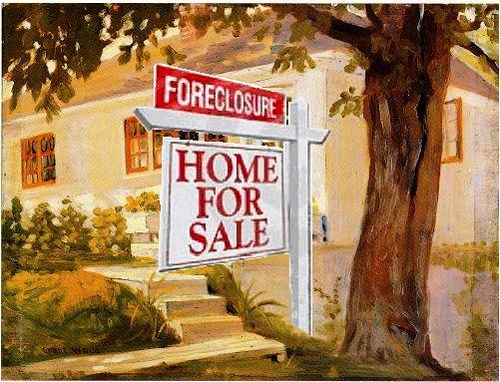
MEDIA
ROOTS — Freddie Mac, aka the Federal
Home Loan Mortgage Corporation, is one of America’s largest mortgage-insurance
companies, chartered in 1970 by the federal government “to provide liquidity,
stability and affordability to the U.S. housing market.” However, the mortgage giant recently invested
$5 billion in complex securities that pay when mortgage holders are unable to
refinance and take advantage of the current record-low interest rates,
effectively betting against U.S. homeowners.
If Freddie Mac’s declared corporate
mission is to make it “easier for consumers to afford a decent house or
apartment,” then why is the company profiting from U.S. homeowners’ inability
to refinance and reduce interest rates on their mortgages? These investments constitute a clear conflict
of interest, particularly since Freddie Mac also determines which homeowners are
eligible to refinance. Freddie Mac is
essentially betting that homeowners will not be approved to refinance at lower
interest rates, and meanwhile, creating new regulations, restrictions, and fees
to limit eligibility, which a Federal Reserve paper qualified as “difficult
to justify.”
Following the subprime mortgage crisis and a
taxpayer-funded government bailout of over $200 billion, Freddie Mac, along
with fellow GSEFannie Mae (aka the Federal
Home Loan Mortgage Corporation), were taken over by the U.S. Government and placed into
conservatorship under the Federal Housing Finance Agency (FHFA) in September
2008, an agency created under Bush. The
FHFA is, therefore, responsible for overseeing and regulating the lenders’
business practices. However, recent
reports of these unsavory transactions by NPR and nonprofit newsroom ProPublica
raised the question of whether the FHFA’s interest is to help U.S. homeowners,
or simply to ensure the companies’ financial success.
Indeed, Catherine Austin-Fitts, former
Assistant Secretary of Housing and Federal Housing Commissioner, has described
collateral fraud in the housing market contributing to the 2007 housing
bubble collapse and economic meltdown of 2008:
“It’s funny how few people need to be
involved [to enable this level of fraud], particularly when you’re hiding
behind the Federal credit. So, if you’ve
got control in the right places at Fannie, Freddie, and FHA, particularly,
through the systems. It’s a surprisingly
few people. What you do need is for
everybody in 3,100 [U.S.] Counties involved in real estate to just shut
up. So, for example, you saw appraisers
who knew that the appraisals were just, you know, going out of control and made
no sense. And if you had an appraiser
who wouldn’t play ball, he’d kind of be dealt with. So, you had this sort of five to ten percent
who objected to the corruption and would try and do something and would be
dealt with in a variety of ways. But
what you needed was for everybody to just play along and not ask questions.”
Today, some in Congress are asking a few questions
about Fannie and Freddie, but will that be enough to protect the public
interest? Republican Senator, Johnny
Isakson, of Georgia said, “We have a situation that’s obviously, at best,
unsavory and, at worst, immoral.”
Democrat Senator Barbara Boxer argued, “They’re actually, in my view, turning
against their mission. And I truly blame
the regulator here, Mr. DeMarco, because he had to approve this instrument.” Notably, both stop short of questioning legality.
In response to allegations of conflict of
interest, FHFA Director Edward DeMarco responded
that the investments, known as inverse
floaters, were “in the class of normal business transactions” and he is
“completely puzzled at the notion that something immoral went on here.” FHFA regulators maintain that a “firewall”
separates the investment portion of Freddie Mac from the regulatory branch,
which creates rules that make it difficult for homeowners to refinance. The Inspector General of the FHFA is
conducting an “open
evaluation on capital markets, which encompasses this issue.” The investments have drawn some scrutiny from
members of Congress. And the Senate is holding
a hearing today on Capitol Hill to question Freddie Mac’s investment practices.
The current situation with Freddie Mac’s dubious
investments in inverse floaters brings to mind the housing crisis caused by the
breakdown of credit default swaps and the mortgage-backed securities they
insured, which caused millions in the U.S. to lose their homes through foreclosure,
often with rushed robo-signing, through
threats and intimidation, particularly in immigrant communities, and without
being able to provide appropriate documentation. For example, Wells Fargo, which profits from
private prisons housing entire immigrant families, has been linked with also
targeting immigrant families to force them out of their homes and expedite
foreclosures.
Ultimately, mortgage companies like Freddie
Mac and Fannie Mae essentially granted bad loans, often predatory loans, and
bet that borrowers would default. Now
that mortgage interest rates have dropped, Freddie Mac, a government-controlled,
taxpayer-owned company, has chosen to deny homeowners lower interest rates,
once again putting profits before people, and betting against U.S.
homeowners. If the American Dream is in
fact dead, then it’s corporate greed enabled by political corruption that
killed it.
Written by Noelle
Giambalvo Bortolai for Media Roots



 MEDIA ROOTS — Has the U.S. two-party dictatorship completely saturated Election 2012 media
coverage? Can you recall when you last heard news coverage of any
alternative party candidates?
MEDIA ROOTS — Has the U.S. two-party dictatorship completely saturated Election 2012 media
coverage? Can you recall when you last heard news coverage of any
alternative party candidates? 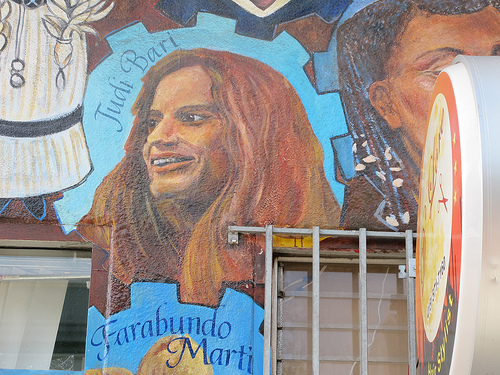 MEDIA ROOTS —
  MEDIA ROOTS — With governments,
citizens, and activists worldwide increasingly relying on the internet, the environment the
internet fosters is a hotly contested issue.
Last summer, the United Nations declared that disconnecting people from
the internet was a
MEDIA ROOTS — With governments,
citizens, and activists worldwide increasingly relying on the internet, the environment the
internet fosters is a hotly contested issue.
Last summer, the United Nations declared that disconnecting people from
the internet was a