MEDIA ROOTS — Earlier this week, Pacifica Radio’s Flashpoints spoke with long-time activist Kathy Kelly about U.S./NATO Imperialism and Afghanistan:
“But what the United States wants is an agreement that U.S. troops can remain in Afghanistan until 2024 and beyond. So, the idea of the troops being withdrawn in 2013 and 2014 is good for electoral strategies on the part of the Obama Administration, but it’s not reflective of the truth.”
The “U.S. [under Obama] wants roadways and bases to protect the poppy pipeline—the Turkmenistan, Afghanistan, Pakistan, India pipeline—and what [Democrat] Hillary Clinton refers to as the new Silk Road, conduits through which they can extract precious resources, natural gas, fossil fuels, out of Afghanistan and have control over resources that China may have designs on, possibly Russia. And, of course, they want forward operating bases, in order to be a relevant threat to Iran, and to Russia and China.”
Messina
***
FLASHPOINTS — “Today, on Flashpoints we continue our drumbeat coverage of the endless war in Afghanistan. We’ll be joined by Kathy Kelly, of Voices for Creative Non-Violence, just back from the region. Also, we’ll be joined by Iraq War Vet Scott Olsen, who was shot in the head by local Oakland police after the Oakland Mayor Jean Quan gave the go-ahead to crush Occupy Oakland. Mickey Huff of Project Censored will join us to talk about the latest mainstream news nightmare. And workers at the San Pablo California Casino demand better pay, better treatment, and better working conditions. I’m Dennis Bernstein. All this, straight ahead, on Flashpoints. Stay tuned.”
Dennis Bernstein: “You’re listening to Flashpoints on Pacifica Radio. My name is Dennis Bernstein. This is your daily investigative news magazine.
“Kathy Kelly says, “In the recent past Afghan civilians have been appalled and agitated by the news of U.S. soldiers that went on killing sprees, cutting off body parts of victims to save as war trophies. They’ve been repulsed by photos of U.S. soldiers urinating on the corpses of Afghans who have been killed, the burning of the Quran; it goes on. We’re gonna talk about this so-called latest rogue operation that left, I don’t know, Kathy Kelly, what’s the figure now? How many kids? How many people were murdered in this latest killing spree?”
Kathy Kelly (c. 1:58): “Well, as I understand it’s nine children and then sixteen. Although, I’ve heard an Al Jazeera report that it was 17 people who’ve been killed. And eleven of them were all from one family, four from another family, and one man in his home.”
Dennis Bernstein: “Nine children? Were they sleeping? This was the middle of the night, right?”
Kathy Kelly: “In Panjwayi, there was a man; his name is Hakan Abdul Samad[sp?] and he had moved his large family away from Panjwayi because he wanted to be safer. And while he was gone NATO forces obliterated his home, bombed it. So, he built another home. I imagine it was a pretty simple dwelling. And the District governance encouraged all the people who had moved away to move back. They said, American soldiers, U.S. soldiers will protect you.
“So, the irony is so, so sad and tragic. They moved back and this was a forward operating base for special operations forces and the 38-year old soldier, who allegedly committed the crime, was a sniper who had been assigned to the base. He wasn’t a special operations force soldier, but he was a sniper. And, of course, as I think you’ve mentioned before, he had already done three tours of duty in Iraq and had suffered brain injury from an automobile accident. And he was sent over to Afghanistan.”
Dennis Bernstein (c. 3:24): “We heard, and have been hearing ever since this latest slaughter, that this was a lone gun, that this has nothing to do with U.S. policy. It sets back U.S. policy there to help local people get on their feet and fight the Taliban. What’s wrong with that story?”
Kathy Kelly: “Well, I think that there has been a steady stream of attacks against Afghan civilians, which were without provocation, without cause.
“We can think about shepherds on a mountainside who were slaughtered on February 8th; eight teenagers were killed by a helicopter gunship.
“We can think about three students in the Nemati family who had come back to celebrate Ramadan with their family; and, in a night raid, they were mistaken for insurgents. They were killed, as they slept.
“We can think about young Milof, who was sleeping on her cot in her courtyard. And at a night raid, a grenade was thrown over a courtyard wall; and she was killed instantly.
“We can talk about the March 1st, 2011 killing of youngsters on a mountainside in Kunar, who were collecting firewood and it goes on and on and on.
“So, it’s very woeful. To act as if this is so exceptional and the United States would never tolerate the killing of innocent civilians. And it’s a smoke screen and it’s a, well, it’s a lie. And that’s the way to continue gaining the indifference on the part of the U.S. public that’s needed for the United States to continue its work there. You have to convince people that, by and large, our wars are humanitarian wars, and that we don’t do bad things.
“But you can go back to the Haditha Massacre, which is only just now being resolved. And as it turns out only one person is blamed for that crime. You can take a look at the killing spree that resulted in somebody going to jail for a long time, really. But it was out of this same base, the Lewis-McChord base, that this soldier had been trained and sent over to Afghanistan—the base where the killing spree soldiers had been stationed.”
Dennis Bernstein (c. 5:40): “Now, there’s an election coming up. And the president is suggesting to his advisors that his will, his desire is to get out of Afghanistan by 2014. But there’s also this thing called the Strategic Protection Agreement that, well, tell us about that.”
Kathy Kelly: “Yeah. The Strategic Partnership Agreement is something that the United States wants signed before the NATO Summit that will be in Chicago May 20th, 21st. And, so, they have pressured Hamid Karzai to sign this and he’s been holding out. He’s said, No, I want to get a guarantee there won’t be anymore night raids. And he wants a guarantee that all the prisons will be turned over to Afghan authorities.
“But what the United States wants is an agreement that U.S. troops can remain in Afghanistan until 2024 and beyond. So, the idea of the troops being withdrawn in 2013 and 2014 is good for electoral strategies on the part of the Obama Administration, but it’s not reflective of the truth. The United States wants to have special operations forces combined with drone remote-controlled attack capacities.
“And don’t think that it’s going to mean that the military budget will be less. The military budget will still grow. And the money spent in Afghanistan will continue into maintaining a presence, which the Taliban are simply—clear as a bell—they won’t accept. And, so, the United States will perpetuate warfare. And why? The best reason I can discern from trying to understand the designs of the United States geopolitically and in their view of strategic national interest of the United States, it’s that the U.S. wants roadways and bases to protect the poppy pipeline—the Turkmenistan, Afghanistan, Pakistan, India pipeline—and what Hillary Clinton refers to as the new Silk Road, conduits through which they can extract precious resources, natural gas, fossil fuels, out of Afghanistan and have control over resources that China may have designs on, possibly Russia. And, of course, they want forward operating bases, in order to be a relevant threat to Iran, and to Russia and China.”
Dennis Bernstein (c. 8:00): “So, this is one more; this appears to be one more geopolitical slaughter in the name of the controlling of key resources and to make sure that the United States can maintain, or somehow restrain China. That’s what it looks like to you?”
Kathy Kelly: “That’s what it looks like to me. And in World War II they often used the word quisling when a political leader was really subservient to the Nazis. And I think that Karzai is in a very unenviable position of being a quisling to U.S. authorities. I don’t think he wants to go along with everything that the United States is asking. And it’s interesting.
“And the parallel in the case of Iraq and after WikiLeaks and Bradley Manning and some of the revelations of what had happened in, for instance, the Haditha Massacre came out. Then that actually gave the Iraqi Parliament more bargaining position with what they called the SOFA Agreement, the Status of Forces Agreement. And the United States didn’t get everything that they wanted. They didn’t get immunity for United States soldiers in Iraq that commit crimes. So, it could be that the Afghan political leadership will have some kind of negotiation with the United States. But, right now, this Strategic Partnership Agreement hasn’t even been presented to the Afghan Parliament. It’s just something they keep pressuring on Hamid Karzai to sign.”
Dennis Bernstein (c. 9:37): “Amazing. You’re listening to Flashpoints on Pacifica Radio. We don’t have a ton of time left, Kathy, but you have been coming and going. You’ve been working with young people in Afghanistan. You have a much better sense of what the people are feeling on the ground there. And we didn’t see the kind of publicity like with the burning of the Quran. But we also saw that there was a restriction and a warning to the so-called free press in Afghanistan not to, if you will, blow this out of proportion. But what can you asses in terms of what’s happening on the ground, another slaughter, another massacre in the context of all these other atrocities.”
Kathy Kelly (c. 10:20): “Well, Dennis, it’s so perceptive of you to pick up on that order from the Ministry of Information. That’s a very frightening group, the NDS, the National Directorate of Security. And people who go up against that Ministry of Information find themselves jailed, tortured, killed. So, you can bet that no one is going to want to rock the boat, if the Ministry of Information has put out a clear order for restraint. It was very brave of the youngsters in Jalalabad to go out and demonstrate.
“The Afghani people volunteers also, I think, have been so brave. What they have been doing is, they’ve been going in between various cities. They’ve gone to Karan. They’ve gone to Jalalabad. And they meet with the young people who are their counterparts. And they are trying to link together. 65% of Afghan’s population are under 18. So, these are young people trying to say, we have a better stake for the future that would make it possible for us to live, and possibly thrive, in this country, if we’re not fighting against each other and picking up guns and going to war with each other.
“Meanwhile, the United States has pressed to arm and train the Afghan local police groups, even though human rights watch put out a scathing report on what the Afghan local police have done in many locales. So, we have our job here too. We, I think, can clamour and insist that the United States not pressure for a Strategic Partnership Agreement. I don’t think many people in the U.S. Congress or Senate ever heard of this Agreement. But it should be something that is up for discussion in this country, as well.”
Dennis Bernstein (c. 12:06): “And I just mention that in terms of the press and the coverage because NPR, and all the other mainstream press, made a big deal suggesting that, ‘See, there wasn’t as much coverage; people probably care a lot more about the Quran than they do about these nine shredded children.’
“And, really, it was troubling. People did care about the Quran. But this incident and we know it’s simmering under the surface, so thank you for pointing that out, for sharing that information about what’s happening in terms of the control of information there. Not surprising.
“Kathy Kelly, as always, it’s a pleasure to have you on with us. It’s not a pleasure to be talking about these things, but the battle goes on. You work with Voices for Creative Non-Violence. How can people follow what you’re doing and what the group is doing?”
Kathy Kelly (c. 13:03): “Well, we welcome people to go to our website: http://vcnv.org/ And we keep a, it’s a grim record that we do keep an Afghan atrocities update. And, so, it’s good to stay aware of some of the sad and dreadful truths. And, also, we’re very eager to support the Afghani’s peace volunteers and the long-distance planning they want to have—two million friends for peace join in a candle-lighting internationally that will be in solidarity with their commemoration on International Human Rights Day, December 10th. So, plan for that. We know that there’ll be lots of candles lit in your area.”
Dennis Bernstein: “Kathy Kelly, thanks for being with us on Flashpoints again.”
Kathy Kelly: “Thanks, Dennis. Bye, now.”
Rush Transcript by Felipe Messina for Media Roots and Flashpoints
MEDIA ROOTS — Recently, Max Keiser discussed, on RT, the MF Global pillaging scandal, the USA’s eighth largest bankruptcy, and how the Occupy Movement has remained largely silent on the potential rallying-call issue due to a lack of financial literacy. Fortunately, Max Keiser, Dr. Michael Hudson, Dr. Richard Wolff, and others have been speaking at Occupy Movement convergences. Perhaps, in the USA, we may learn to head off the banker fascism austerity now looming over the Eurozone. Media Roots considers the benefits of our increased collective interest in the dynamics of political economy and international relations, impacting our global regions. In this spirit, we present the second broadcast from Pacifica Radio’s Guns and Butter, featuring excerpts of the introductory remarks from radical economist Dr. Alain Parquez at the recent Italian Modern Monetary Theory Summit in Rimini, Italy, February 2012.
Messina
***
GUNS AND BUTTER —“Real wages will collapse. And what we have in mind is a total collapse of the share of labour income in the French society and how to get that by the Treaty of Maastricht and the creation of the euro system.” —Dr. Alain Parquez
“I’m Bonnie Faulkner. Today on Guns and Butter: Alain Parquez. Today’s show: The Birth of the European Central Bank: Its Real Agenda. Alain Parquez is Emeritus Professor of Economics, Ist Class, Université de Franche-Comte at Besancon, France; Faculty of Law, Economics and Political Science. He has written extensively on monetary policy, crisis theory, and economic policy, including articles and books on the impact of austerity measures, which he believes are the cause of the world crisis. He is currently writing a book on the general theory of the monetary circuit and its economic policy implications.
“Today’s show features introductory remarks by Alain Parquez at the first Italian grassroots economic Summit on Modern Money Theory in Rimini, Italy, February 2012, produced by Italian journalist Paolo Barnard. The five speakers were Stephanie Kelton, William Black, Alain Parquez, Michael Hudson, and Marshall Auerback.”
Dr. Alain Parquez (c. 2:00): “Yes, when I look at this audience, I am ashamed to be French because such an event would be impossible in my own country for two reasons. The government would have tried to forbid it. And the economy and society is in such a stateof total disaster that people, even young people, are completely despaired. So, again, Italians are the sole hope of Europe. [Applause]
“Contrary to what happens in France, you try to fight the total coup d’état which has been planned a very long time ago, and enshrined into the European monetary union. I shall try to explain that the so-called ‘sovereign crisis’ of sovereign debt is a lie. [Applause] But it has been carefully planned by those who build the European system. What they had in mind was the creation of a new totalitarian social order destroying democracy, all kind of social legislation. And now the new treaty imposed by our French president, who makes Berlusconi a saint, deprived the states of any kind of sovereignty, imposed permanent deflation. So, yes, my colleague was right [reaching over to UMKC Professor W.K. Black, seated to his left]. You are what the European ruling-class is afraid of—mobilisation of the people. They want to rule by fear and ignorance. And, at least, thanks to Paolo and thanks to you, there is hope that fear and ignorance will defeat what should be deemed techno-fascism, which is the existing tradition of the European monetary union. So, thank you and hail Italy. [Applause]
(c. 6:23) “Well, I am here to speak of a very dark and tragic story. You already understood that the euro is a monster, contradicting all the rules of both modern money, modern economy. So, the problem is why is such an absurd system exists at all. I was told that in your country, like in mine, some people believe that if we get rid of the euro, Italy or France should be back to the state of the poorest part of Africa—Zimbabwe. But the real economy in the Eurozone is already in the state of Zimbabwe. For instance, some short data on France because the French invented and imposed the Eurosystem a very long time ago. In France, the true amount of unemployment is around 60% of the active people, which is obviously enormous. And we have a true rate of inflation of 7% or 8%. So, we don’t have full employment and we don’t have price stability. It means that all official data in Europe are lies.
(c. 9:38) “So, I shall start my true speech by a quotation from the Chief Executive of the French Ministry of Finance—by the way, is a monk of the Order of Santo Benedict and the Chief of the French Opus Dei; and by the way the European Commission is entirely controlled, like the French government, by the Opus Dei. So, I try to discuss with him. He told me, ‘Yes! The French economy is dead, but not enough.’ He told me, ‘Professor, you should understand why the European system exists. What we want is to destroy, forever, the people. We want, forever, to create a new kind of European people, accepting sufferance, poverty, which couldaccept wages lower than in China.And it will be the core of my intervention.’
(c. 11:50) “The Eurosystem was never planned to be a monetary union. It was not even planned as a neoliberal agenda. The neoliberal economics, American style, was and is still completely ignored by the ruling European elite. What you think that even for the leader of the French Socialist Party, President Obama is a Marxist.
“So, what is the euro? A new totalitariansocial order, which was planned a long time ago in the interwar period and completed by the regime of François Mitterrand. In the new order, there will be no more sovereign state. The state has to vanish, at least the state rooted into democracy, parliament, republic. In the new order, power should be entirely transferred to those who deserve it, which means some elite capitalist class technocrats enjoying absolute power of control.”
Bonnie Faulkner(c. 14:49): “You’re listening to economics professor and author Alain Parguez at the Summit on Modern Money Theory in Rimini, Italy. Today’s show: The Birth of the European Central Bank: Its Real Agenda. I’m Bonnie Faulkner. This is Guns and Butter.”
Dr. Alain Parquez: “And, in the first part of my interventions, I shall try briefly to explain the story of the planning of the European monetary union. It started in the interwar period in the most reactionary, traditionalist, part of the French ruling-class with some support from an Italian philosopher, Julius Evola, the very one who accused Mussolini of being too soft to the people and who accused Adolf Hitler of being too soft on poor people.
“In a second part, I shall try to explain that the so-called sovereign debt crisis is obviously an event who never happened in history. But such a crisis has been carefully planned by the architects of the European system. What they had in mind was to privatise the state. And since they believed that the state, at least the state with democracy was always wasting real wealth. It’s obvious that the state being forced to borrow money, the state debt should be looked at as bad debts and, thereby, the state should be completely enslaved to the so-called bonds market, which is exactly what is happening now.
(c. 18:37) “In [the] last part, I shall try to prove that there is not the least way of amending the system because as a social order it has its logic. And those who control the system will never accept any kind of change, especially, any kind of intervention of the European Central Bank. Only, indeed, if those interventions aim at increasing the banks’ wealth. So, the sole possibility of saving the European society is to get rid of that system. The private sector, capitalist sector, in Europe is now dead. To quote Michael Hudson, ‘[few public] leaders of the capitalist sector are no more interested into the real economy. They are rentiers.’ So, European capitalism is dying. [Gross Domestic Product] is for five or six years, in France, minus 3% or 4% a year.
(c. 21:12) “As for the euro, it’s as I wrote, thanks to an invitation by my colleague Stephanie Kelton, a long time ago, on false money, Iwrote an article ‘False Money Against the Real Economy.’ And, indeed, it destroyed the real economy. But first let us, briefly, explain the origin of such an absurd system. There are two stages into the planning of the Eurosystem. The first in the interwar period and during 1940-1943. And the second stage, the achievement of the system was, I must say, the masterwork of the regime of François Mitterrand. So, we start in the mid-‘30s with people like Schuman, Jean Monnet. Schuman wrote that in 1927 we need to create Europe as a new order rooted into tradition saving Europe from decadence. Decadence for the poor Europeans means socialism, revolution, Protestants, Jews, Marxism, free access to health and education, abortions, homosexuality, etcetera, etcetera.
(c. 24:19) “And which is extremely interesting, for the early poor Europeans, what they wished was a system completely opposed to the United States society they hated. And the European elite was more hating the United States society of consumption, shopping malls, than they hated USSR. And now it is exactly the same. So, what was required to build Europe, to abolish the state, to force a permanent deflation by squeezing and squeezing public expenditures. It could help to transfer the power to a super-class of technocrats on a supranational scale. But for those early Europeans, what meaned Europe? It mean a condominium between France/Germany and a colonial empire, including Southern Europe and Eastern Europe. They were absolutely explicit on this problem.
“But how could we suppress the state? By depriving the State of any power on money. All of them were fanatical followers of Friedrich Hayek, the most right-wing Austrian economist of that time. So, Europe should rely on a supranational currency, entirely controlled by a sovereign central bank enjoying absolute power to ration the state. Indeed, there, finally, what they wished was to impose a future European currency, as a super-gold standard—”
Bonnie Faulkner (c. 28:35): “You’re listening to economics professor and author Alain Parguez at the Summit on Modern Money Theory in Rimini, Italy. Today’s show: The Birth of the European Central Bank: Its Real Agenda. I’m Bonnie Faulkner. This is Guns and Butter.”
Dr. Alain Parquez: “—of the Treaty of Maastricht, was written by a French economist François Perroux in 1943 with the full support of a treaty passed between the [white] government and the French [Ponant] regime of that time. And the new treaty, which has been decided by President Sarkozy and Madame Merkel, is exactly the blueprint of François Perroux 1943.
“Those people were against the traditional gold standard because they believed that the gold standard had not allowed a total abolition of the power of the state to spend. So, Europe should be a super-gold standard. So, it was a first stage. But, for some time, the European project was maybe in the backwards because all of his supporters were more Hitlerian than Adolf Hitler himself.
“So, we had to wait. The regime of Francois Mitterrand, I could speak on this question because I had been conscripted by the Chief Advisor of Francois Mitterrand, who by the way was a fanatical right-winger hating the modern world, hating the United States, a monarchist, who said, ‘I hate the poor.’ So, Jacques Attali was, de facto, the Prime Minister of France. And Attali was in charge with a lot of former Marxists, turned to supporters of the new regime, of drafting a more sustainable version of the Eurosystem. But they had in mind the same vision: We must destroy shopping malls, consumption. Shopping malls were, for them, a pure infamy. People should accept to be poor.
(c. 33:18) “I remember debates at the secret commission who was in charge of the campaign of Mitterrand. Mitterrand had to win the support of the then-Parti Communiste. France had a communist party; now, no more. So, I was charged to write some modest [condition]; I would say modern money programme. But Attali was asked by those who funded [the] Mitterrand campaign. And who [were] the major funders? The Chase Manhattan Bank and two other American banks. But we never gave you money to get a programme of full employment. Attali said, I have the commitment of our dear future president, as soon as we could, we will destroy, we will cut, we will deflate the economy.Real wages will collapse. And what we have in mind is a total collapse of the share of labour income in the French society. And how to get that? By the Treaty of Maastricht and the creation of the Eurosystem.
“I shall end this intervention by emphasising, first, the lies. It happened that I was quiet close to Francois Mitterrand. He was some long time ago, some boyfriend of my mother before the war. My mother told me, Francois lies so well that he could believe that he is for the people. So, Francois Mitterrand during the sole debate on the Treaty of Maastrichtdared to say, answering a question from a student, I can swear there is not the least independent central bank in the Treaty of Maastricht.
(c. 37:28) “The second point. The core principle of the European treaties was the privatisation of the state, was to oblige the state to borrow money by selling bonds to private banks. So, the state, like any corporation, but a corporation with a very pure reputation had to beg money to banks at the rates of interest decreed by banks. So, finally, the Treaty of Maastricht and the following Growth and Stability Pact, a very weird name. The true name should have been Destruction and InstabilityPact. So, the true world they had in mind was that, finally, the State will be completely enslaved to private banks. And, so, will be obliged to cut and cut and cut expenditures. And it is exactly what happened. And, finally, lies continue. To be brief, the share of state debt in the assets of major French/German banks is below 5%. Banks are losing money, not because of state debt, but because of the total collapse of the real economy.
(c. 40:50) “And, second point, I am horrified when people say, Oh, poor banks. The Greek government lied. But it is absurd; everybody was aware of the true state of the Greek economy. 90% of the Greek debt is held, like the Italian, by French and German banks. So, everybody knew. And, by the way, what is happening now sought to the new treaty is—if it is, indeed, finally endorsed—a total abdication of states, of fiscal policy, and any kind of social policy. And, indeed, the dream of the new order will be achieved.
“So, now, the problem of rulers of the system is how to maintain the control of society; of this, they are afraid because there is no debate. Official economists in Germany, France, most European countries, are completely corrupt. If I dare say, they are official prostitutes financed by grants of institutions; so, they never debate the infamy and collapse of European system. Thank you. [Applause]”
Bonnie Faulkner (c. 43:47): “You’re listening to Economics Professor and author Alain Parguez at the Summit on Modern Money Theory in Rimini, Italy. Today’s show: The Birth of the European Central Bank: Its Real Agenda. I’m Bonnie Faulkner. This is Guns and Butter.”
Dr. Alain Parquez (c. 44:08): “You see, let me allow, for a while, [to differentiate] the European Central Bank and banks because, ultimately, who has created the ECB? Who is imposing the European Central Bank policy? The states themselves. Even if the European Central Bank decided to finance state expenditures, the French Government and the German Government will say no. They absolutely are rejecting any kind of policy of saving the economy. Everybody knows that.
(c. 45:14) “First, the European Central Bank is a weak oligarchy of 17 central banks de facto ruled by the French Central Bank and by the German Central Bank. But everybody also knows that the central banks of France and Germany never do anything without the full advice, consent, and support of the new axis ruling in Europe—Paris/Berlin. Thereby, it is exactly the same for banks; governments from France and Germany imposed policies of detritions all over Europe. And now the economy is in such a state of disaster that we need an enormous increase in expenditures. So, it is much more than a job guarantee programme when the majority of the population is forever unemployed. So, my solution is let us support any movement to get rid of the euro. There is no other way. Give back full monetary sovereignty to the states. [Applause]
(c. 47:25) “I was told that this event is for the Chair of European Commission, an abomination; and your prime minister was asked to prevent it. At least, the luck for Italy is that you have a weak state, whereas in France we have a very strong state.
“Second point, I do think that what is at stake is to impose a change of politics, people accepting—as learned audience—are living in a world of lies. And you are absolutely right; the share of labour income, including pensions in France/Germany is at its lowest level since the interwar period or the Nazi period. In France, in the span of 20 years, the share of labour income collapsed by at least 30% or 40% percent.And, yes, more and more people are committing suicide in France because of labour conditions. People who are still employed are living in firms who are more and more acting as some kind of Soviet forced-labour concentration [camp]. Never have people been so productive. The productivity in France/Germany [and] is in Italy, one of the highest in the world. But, at the same time, real wages collapsed and people are not aware of this scandal.
“But now, in most parts of France, the shopping malls are empty. A large part of the country is going back to some kind of middle age, an [item] for Germany. And this is a scandal, [of which] we must try to make the people know the truth, to oblige the media to reveal the true situation. Everybody knows that the euro is grossly over-and-over-valued. The euro rate of exchange is maintained by a lot of artefacts, including permanent swaps with the Federal Reserve System.
(c. 51:49) “And now, some thought of France and Germany to get an inflow of dollars from Saudi Arabia and even China. So, the real value of the euro is absolutely nothing. After all, Italy, like France, always survived and prospered in a global environment. Without the euro, Italy was a highly competitive country, as Marshall [Auerback] said. And, so, if I could assure you that Stephanie [Kelton] was right, the euro can’t survive, only if Italy decides to remain in the system. All major banks in France and Germany are already trying to compute the effect of the end of the euro system. It is a dying system. So, the effect could be a benefit for Italy if it retains its monetary sovereignty, reconstruct the economy.
(c. 54:08) “The very option of the United States of Europe had been rejected since the start because those who intended to abolish the state at the national level did not intend to create a state at the European level. We’ve reached a state of the society where the sole option is to leave the system. And, by the way, banks do not want to be reimbursed. It is a point I should address more. The French and the Germans created a system, installing some kind of eternal debt for European people. What banks want is income. And if Italy decided to leave the Euro, the system would collapse. The real value of the euro is nothing. And it is a fact that France and Germany, and mainly the French, are afraid of this point.”
Bonnie Faulkner (c. 55:55): “You’ve been listening to Economics Professor and author Alain Parquez. Today’s show has been: The Birth of the European Central Bank: Its Real Agenda. Alain Parquez is Emeritus Professor of Economics Ist Class, Université de Franche-Comté at Besancon (France); Faculty of Law, Economics and Political Science. His main academic title is that of Docteur d’Etat Es Sciences Economiques, Université de Paris 1. He is a member of the Eastern Economic Association in the United States. Courses he has taught during the last eight years include, Principles of Macroeconomics, Theory of Economic Policy, Financial Economy, International Economic Relations, and Theory of Distribution. Visit his website at www.neties.com. Or google: Alain Parquez. Visit the website for the first Italian Summit on Modern Money Theory at www.DemocraziaMMT.info.
“Guns & Butter is produced by Bonnie Faulkner and Yara Mako. To leave comments or order copies of shows, email us at [email protected]. Visit our website at www.gunsandbutter.org.”
Transcript by Felipe Messina for Media Roots and Pacifica Radio’s Guns and Butter
MEDIA ROOTS —With the reverberating excitement around the recent Italian Modern Monetary Theory Summit 2012, which is shattering
orthodox and right-wing economic
dogma in the Eurozone with common sense and offering the post-Shock Doctrine Occupy Movement intellectual tools to strengthen its activism, Media Roots takes a look at the work of one of the
grassroots Summit’s featured speakers, particularly for younger readers and others. This may be old news for some; yet, younger generations benefit when elders convey, celebrate, and affirm important works of radical thought in the public domain.
In 1972,
Dr. Michael Hudson published, what Terence McCarthy called, “The most important
work on imperialism since Lenin.” As
Bonnie Faulkner, host of Pacifica Radio’s Guns and Butter, indicates regularly
when she airs Dr. Hudson, “His
1972 book, Super
Imperialism: The Economic Strategy of American Empire is a critique of
how the United States exploited foreign economies through the IMF and World
Bank.”
Indeed; encapsulating the book’s analysis, the publisher writes:
“Never before has a bankrupt nation dared insist that its bankruptcy become
the foundation of world economic policy; that, because of its bankruptcy, all
the nations what their economies transferring its bankruptcy to themselves,
stultifying their industries, and paying tribute to the beggar.”
“Effectively speaking, the United States has compelled the older nations of
the West to pay for the overseas costs of the US war in Asia. Whatever they may
desire, the central banks of Europe had no choice but to continue to except the
paper dollar equivalents annually created as the domestic and overseas deficit
of the United States increase. Otherwise, the whole of shaky structure of the
world monetary system will collapse into rubble. America has succeeded in
forcing other nations to pay for its wars on a systematic basis, something
never before accomplished by any nation in history .”
Messina
***
MICHAEL
HUDSON — In 1949
the United States held three-Quarters of the world’s gold; by 1960 it had
become a debtor nation. And yet, the United States has built history’s most
powerful and affluent empire. Its techniques for world domination remained, at
first, the conventional devices of the economic superstate. In recent years,
however, the United States has sophisticated its strategy to the point here,
although fallen into serious debt, it has retained and even expanded its
dominance. The United States has pioneered a new form of imperialism in which
the assets of its competitors have been employed for American ends. The or now
calls the tune for the creditor.
Terence McCarthy, in his Introduction, calls Hudson’s analysis of the Debtor
superstate “one of the most important books of this century. It is the first
work to synthesize the new and different form which capitalist imperialism has
assumed since Lenin wrote.”
Michael Hudson teaches international and monetary economics at The New
School for Social Research, Graduate Faculty. He has published articles in
Ramparts, the Journal of International Affairs, Commonweal, Cross Currents and
the Review of Social Economy, in addition to specialized monographs on
balance-of-payments theory and accounting. He has worked as a
Balance-of-Payments analyst for the Chase Manhatten Bank and for the accounting
firm of Arthur Andersen, and as a senior economist for the Continental Oil Com.
In addition, he has lectured at the Institute for Policy Studies in
Washington, D.C, before the National Association of Business Economists in New
York, and elsewhere throughout the United States. He is currently writing a
history of international trade and investment theory, and a study of the
economic origins of the American Civil War.
GLOBAL RESEARCH — First
written in 1972, it was updated in a 2003 edition that’s every bit as relevant
now – thus this review focusing on Hudson’s new preface, introduction, and
detailed account of the book’s theme.
He revisited it in his 2008-09 Project Censored award- winning article
titled: “Economic Meltdown – The ‘Dollar Glut’ is What Finances America’s
Global Military Build-up” in which he explains the following – the
“inter-related dynamics” of:
— “surplus (US) dollars pouring into the rest of the world for yet further
financial speculation and corporate takeovers;”
— global central banks “recyl(ing) these dollar inflows (into) US
Treasury bonds to finance the federal US budget deficit; and most important
(but most suppressed in the US media),”
— “the military character of the US payments deficit and the domestic
federal budget deficit.”
In other words, the global “dollar glut” finances US corporate
takeovers, speculative excesses creating bubbles and global economic crises,
America’s reckless spending, foreign wars, hundreds of bases worldwide,
“military build-up,” and culture of militarism and belligerence
overall at the expense of democratic freedoms, beneficial social change, and
human and civil rights.
MEDIA ROOTS — Abby and Robbie Martin grew up in Pleasanton, CA, a city located ten miles from the Lawrence Livermore National Laboratory (LLNL), a secret nuclear weapons production facility. They initially set out to explore the psychological impacts of taking nuclear testing into virtual space. But as their investigation unfolded, they found that the LLNL—in conjunction with Site 300—has built an impressive greenwashing PR campaign cloaking a sinister reality.
Despite a moratorium on nuclear testing, the nuclear arms race continues unabated at very high costs. In addition to the startling cases of LLNL’s mismanagement of dangerous materials and ‘accidental‘ releases, the facilities are still testing every radioactive component of a nuclear bomb in open air, according to sources.
Malignant melanoma (skin cancer) rates are six times higher among children born in Livermore; melanoma has been linked to radiation exposure. And the amount of radiation which has been expelled from the lab since its
inception is equivalent to that released from the bombing of Hiroshima.
Most disturbingly, the Livermore community is largely unaware of what the lab
is actually doing and what its potential impacts are on its health and the
environment.
Written by Abby Martin
***
The Continuing Nuclear Arms Race & The Lawrence Livermore National Lab:
Mismanagement, Dangers & Effects
Produced/Filmed/Directed/Edited by Abby & Robbie Martin
***
Abby Martin: “The United
States has the biggest weapons arsenal in the world and is the only country who
has ever used nuclear bombs during war.
All of the nuclear weapons stockpile management and nuclear weapon technology
come from two locations in the United States:
Los Alamos Laboratory in New Mexico, which is surrounded by a giant plot
of desert, and Lawrence Livermore Laboratory, a square-mile facility located
right next to a city of 90,000 people.
If a large-scale disaster or nuclear accident happened here, it would
affect the entire Bay Area—comprised of San Francisco/Oakland—with seven
million people living in it. This blue
well behind me is used to measure radioactive runoff from the Lawrence
Livermore Lab.”
Abby Martin Narration (c. 0:36): “The United
States used to blow up full-scale nuclear weapons in open air until the 1963 Limited Test Ban Treaty, which permitted the continuation
of nuclear testing underground. In 1992,
Congress passed the Nuclear Testing Moratorium Act, which banned all nuclear
testing. However, the treaty is not yet
ratified. And the U.S. still has over
5,000 nuclear weapons, 2,000 of which are on readiness alert at all times. To compensate for the loss of full-scale
underground nuclear testing, the Department of Energy created the Stockpile
Stewardship Program, which built new facilities that test different components
of a nuclear weapons explosion, using super computers to put them all together.
“Most of
the PR surrounding the Lawrence Livermore Lab gives the impression that it’s a
technology innovator, working to harvest
the energy of the sun to create clean
energy for the world. As it turns out, out
of the Lawrence Livermore Lab’s $1.5 billion dollar annual budget, less than 1%
is alternative energy; the rest is defence and nuclear weapons development.
“Another,
more elusive, site buried in the hills behind the Lawrence Livermore Lab is called
Site 300, a live-fire explosives test range where they blow up highly
radioactive compounds used to simulate many of the nuclear systems designed at
the lab. Site 300 is mountainous with
many watersheds and canyons making contamination easy to spread and clean-up
extremely difficult. At Site 300, we
found that they are testing depleted uranium and tritium, the radioactive
hydrogen in the hydrogen bomb, in open air tests. Site 300 happens to be located in a very
high-velocity wind area.
“We took a
closer look at Lawrence Livermore Lab and Site 300 and found out if the
Livermore community is aware of its impact on their health and the environment
and the potential danger it poses to the entire San Francisco Bay Area.”
Abby Martin (c. 2:25): “Do you know about the Lawrence Livermore
Lab?”
Livermore Man:
“Yes.”
Livermore Woman: “I mean it’s common knowledge to grow up in Livermore—”
Livermore Man B: “Oh, here we go.”
Abby Martin:
“What?”
Livermore Woman B: “I’m aware of it, yeah.”
Abby Martin:
“What is it
that you think they do there?”
Livermore Woman C: “At the Lab? Oh, it’s a
government [Shrugs], testing on all kinds
of different things?”
Livermore Man B: “I’m not really educated to what exactly, what they do. You gonna tell me?”
Livermore Woman C: “I know they do a lot of research and they have, like, the top
scientists from all over the world that work there.”
Livermore Woman B: “They used to do, like, nuclear devices.
But to my knowledge they don’t really do that anymore.”
Livermore Man C: “Well, what I think they do there is research and development.”
Abby Martin:
“What do you
think it is they do there?”
Livermore Man:
“I worked
there for nearly 30 years.”
Abby Martin:
“So, what
did you do there?
Livermore Woman B: “I don’t know. My dad works in a
machine shop there. [Laughs] I don’t know what he does, though. [Laughs]”
Marylia Kelley (Tri-Valley CAREs): “In many ways, Livermore is a community that’s in denial. It is also a community that I would call
disempowered because you have a super-secret nuclear weapons laboratory and a
community around it that’s supposed to not
ask questions.”
Abby Martin Narration (c. 3:39): “We went to the lab in Site 300 to try to
find out more.”
Site 300 Armed Military Gatekeeper: “Can you just turn that off please? [Leaving
Gate Booth]”
Abby Martin:
“Isn’t this publicly-funded
property?”
Site 300 Armed Military Gatekeeper: “The Federal, um, could you turn it off just to make? I gotta make, I gotta call my captain.”
Site 300 Armed Military Captain: “Um, could you go ahead and turn the camera off?” [Camera Cuts Out]”
Abby Martin:
“I don’t know;
I’ve read somewhere that they were testing depleted uranium. I was, like, that can’t be true. [Inside a Reception Area]”
Receptionist Woman: “No, nothing nuclear.”
Scott Yundt (Tri-Valley CAREs): “What we’ve been able to place together from FOIA requests and from public documents is that they’ve released over a million curies of radiation from the lab
since 1953 when they opened. That’s
about the same amount of radiation that was released in the bombing of Hiroshima.”
“The study
also found that, for one decade, there was a threefold increase in brain
cancer in Livermore children.”
Abby Martin (c. 4:47): “Do you think that there’s any sort of
impacts on the environment or to the health of the community with the testing
that they’re doing there? [Outside in
Downtown Livermore]”
Livermore Man:
“Probably
very little over what most all of us do everyday. [Shrugs]”
Livermore Woman B: “None that haven’t been around since I was a kid. [Shrugs] So, I don’t know. [Laughs]
I mean I survived. [Young Woman
Laughs and Shrugs]”
Livermore Woman C: “Yeah, ‘cos they’ve had some problems with the, you know, ground w-,
releases of some of the poisons and—”
Livermore Man D: “I know that there was plutonium
in a park near my house when I was growing up.”
Abby Martin Narration (c. 5:16): “During the ‘70s and ‘80s, the Lawrence
Livermore Lab was flushing radioactive materials, including plutonium down the
drain. And it was recycled by the City
of Livermore’s sanitation department as compost. The City then gave away the toxic compost as
landscaping.
“Local residents
around the lab have even coined a neighbourhood park, plutonium park, which is located adjacent to a school.
Marylia Kelley (Tri-Valley CAREs): “They kept a log book, you know, a guest register. So, people signed it, but one day the lab
showed up and took it with them. And it’s
never been seen again. So, there’s no
way to track who has this plutonium-contaminated sludge or if the particular bit of
sludge they took home has plutonium contamination in it or not.
“And, in
the midst of all this, Livermore Lab went and got some of this sludge because
they were interested in looking at the uptake of plants after a nuclear war.”
Livermore Man D: “Obviously, most cities don’t dump plutonium into their sewage treatment
plants. So, that’s a unique experience
to our area.”
Abby Martin Narration (c. 6:26): “One of the most impressive PR campaigns
coming from the lab is the National
Ignition Facility (or the NIF).”
Scott Yundt (Tri-Valley CAREs): “It’s a mega-laser that they love to talk about how it’s gonna save the
world through creating nuclear fusion energy.
Most of what the National Ignition Facility is for is ‘stockpile management.’ And it’s really a way for them to test
nuclear weapon components because it creates an environment—in that chamber—that is similar to the environment created by a nuclear weapons explosion.”
Abby Martin Narration (c. 7:01): “Just like many war technologies that the
U.S. government rebrands as peace through force, the ‘Stockpile Stewardship’ program is nothing more than a cloak on the
continued and unabated nuclear arms race.”
Scott Yundt (Tri-Valley CAREs): “We have a nuclear-weapons-complex that is still stuck in the Cold War era.”
Marylia Kelley (Tri-Valley CAREs): “80% of the American population tell pollsters that they would feel
safer if no county, including the United States, had nuclear weapons.”
Abby Martin Narration: “Despite the moratorium, we continue to find a way to test nuclear
weapons. But by testing each component
of a nuclear bomb separately with Site 300, the NIF, and super computers, they’re
able to pacify the public. However, in
the back of our minds, we all know that at any moment—by mistake, by
miscalculation, or by madness—life, as we know it, could end on this planet.
“How is the
looming threat of nuclear annihalation affecting our daily lives?”
MEDIA ROOTS —Carl Dix, Revolutionary Communist Party, is back in the S.F. Bay Area and will deliver an address to UC Berkeley this evening entitled “Mass Incarceration + Silence =
Genocide.” The last time Mr. Dix visited
northern California, Media Roots featured
his KPFA radio broadcast and UC Berkeley event with Dr. Cornel West. Today, we present a new interview with Carl Dix.
Messina
***
THE MORNING MIX WITH DAVEY D — “Good morning, everybody. Welcome to another edition of The Morning
Mix. It is at the top of the hour. Davey D hangin’ out wit’ you and we’ve got a
good, good, show for you. We have a
special guest in the building, Mr. Carl Dix of the Communist Party. He is here to talk about mass incarceration, silence, and genocide, also about his big speech coming up tomorrow [29 Feb 2012] at UC
Berkeley. So, you don’t want to miss
that, all that and more, coming up after the morning headlines.”
Carl Dix, Revolutionary Communist Party:
“Now, some people will say, well,
look, I knew Obama wasn’t gon’ be able to do much anyway and maybe he didn’t
even want to, but that’s not the point Brother Dix. Think of the inspiration that Black youth
will get from seeing a Black man in the White House, from seeing a Black First
Family. Think about what that will mean
and how that will spur them to greater heights of achievement.
“So, let’s talk about
that. See? And youth are getting charged up around
it. But what direction do they go when
they get charged up? I’ve had youth tell
me, ‘I wouldn’t fight for George Bush.
But, now, that Obama guy, he’s smart. If he says I gotta go fight, maybe I
should do it.’ That’s where some of that
inspiration has taken them.
“But even as they take
that inspiration out and try to achieve more in this society, and try to move
on up and do better than they had done before, what will they run into? They will run into the reality of the continuing
White Supremacy that’s built into the very fabric of this country. They will run into the male supremacy that’s
out there. They will run into
capitalist, imperialist America.
“So, what will happen
to those dreams? Will they be crushed to
the Earth? Will they dry up like a
raisin in the sun? Because I will tell you,
sisters and brothers, the doors that are open for our youth are not the doors
to higher education. They’re not the
doors to meaningful jobs, contributing to the development of society because it
is still the case that the educational systems in the inner-city schools where
most Black and Latino youth are are underfunded. They are not geared toward success. And most
of the youth in there are being tracked towards failure by the time they reach
the third and fourth grade.
“It is still the case
that jobs are being sucked out of ghettos and barrios. And drugs have been poured in there. That’s still what the youth are up
against.
“The doors that are
being opened to our youth are the doors to the courthouse, where they get
treated unequally by the criminal justice system in this country, and the doors
to the jailhouse, where Black people are being warehoused at horrific
numbers. 900,000 of the almost two and a
half million people who are in prison are Black. That’s a door that’s open for Black youth.
“And then there is the
door to the recruiting station to join the military to go halfway around the
world and kill people for this system, become a mindless killer for it. Those are the doors that are being
opened. This is what’s being offered to
our youth.”
Davey D (c. 10:52): “So, there you have it. That’s our guest, Carl Dix. He’s in the building with us, long-time
revolutionary. He is also one of the co-founders of the October 22 Coalition to Stop Police Brutality. He is also a founding member of the
Revolutionary Communist Party here in the U.S.
And, more recently, we know Carl for being an outspoken force against
the New York City Police Department for their infamous Stop and Frisk
situation. In fact, him and Cornel West
were up here at UC Berkeley not too long ago speaking truth to power around
that situation.
“And, man, we could go
down. You have a long list of
things. You don’t shy away from any of
the controversies, from Katrina on down to the police to definitely railing
against the system, as you were doing there and the response to Barack Obama’s
NAACP address where you very skilfully pointed out some of the challenges that
we would still have no matter who’s in the White House. You haven’t changed your mind on that, eh?”
Carl Dix (c. 12:02): “No, I haven’t changed my mind. See, the thing is, I’ve been at this for
awhile because this system has been at what it does to people here in this
country and around the world. And, from
one end, my grandmamma told me, you,
stubborn, boy. But as long as you on the right thing, then you should be
stubborn about it. And then, from
another end, I have not lost my hope in the possibility of bringing a totally
different and far better world into being through revolution.”
Davey D (c. 12:34): “Do you think that can happen? In this lifetime? Or is it something that you resigned yourself
to seeing in a distant future somewhere when you might not be here, me and
you.”
Carl Dix (c. 12:46): “Okay.
Well, just on that thing of might
not be here, you know, I could step out on the street and get hit by a bus,
so I’m not going at it like I definitely have to be here for it. But it is necessary, including in relation to
the topic I’m gon’ be speakin’ at tomorrow in Berkeley, Mass Incarceration, to
really end that and all of its consequences.
You gotta make a revolution and get this system off the face of the
Earth. And that’s what I’m working for;
and the potential for that is there.
It’s real. You can’t make
revolution with people and conditions the way they are now, but conditions are
changing. And people can change, as they
try to deal with those conditions. And
that’s something I’m working on, contributing to. Can’t say exactly when that might happen, but
I will not let somebody say it can’t
happen because you could even see in just a few months of Occupy, people have begun to question things that
had been accepted as, well, that’s just
the way it is, capitalism is being talked about.
“Even revolution has come up, although people mean a lot
of different things by revolution. And
that’s two discussions, capitalism and revolution, that I enjoy engaging in.
Davey D (c. 14:02): “They’re not necessarily the same thing?”
Carl Dix: “No, they’re not necessarily the same
conversation, but I enjoy engaging in both.”
Davey D: “You know I was very specific and deliberate
by playing that speech that you gave; I think it was 2009, if I’m correct.”
Carl Dix: “Yes.
Davey D: “And I wanted to play it, and people might
be, why did you play that one? You know?
Since 2009, there’s been increased conversation in many circles around
the incarceration rate of Black and Brown youth, in particular, as you pointed
out, Black youth. Michelle Alexander, of
course with her groundbreaking book, talking about the new Jim Crow, another word for slavery;
we’re now seeing that come up. Dr. Joy
DeGruy talks a lot about what is happening with this increased prison situation. And on top of all that we know have lots of
conversations of domestic spying, people being labelled ‘terrorists,’ all these types of things. And for many of us, including myself, we
didn’t think we would see that sort of direction take place under this
President [Obama].
“First of all, are you surprised that we moved in this
direction at the rate that we have? Or
is this something unique in the air that has made this accelerate or, at least,
made the conversation be something that is more pointed now?”
Carl Dix (c. 15:29): “Well, I think there are a few things. One is that this has been a direction over
four decades ‘cos, [if] you go back to the Attica Prison rebellion,
there were less than 300,000 people in prison back in 1971. Today, it’s more than 2.4 million, a more
than eightfold increase, which is rooted in the very operation of this
capitalist setup and conscious policies that the rulers adopted to deal with ‘how do we head off another 1960s-type
situation?’ I mean, they consciously
laid that out. Richard Nixon is quoted,
the President back then in the late ‘60s/early 70s, he’s quoted by members of
his cabinet, as having said at a cabinet meeting, ‘The problem is the Blacks.
And we have to devise a solution that does not acknowledge that’s what we’re
dealing with.’
“And they came up with wars on drugs, wars on crime.”
Davey D (c. 16:30):
“Well, Nixon started off with a war
on youth.”
Carl Dix: “Yeah.”
Davey D: “If I remember correctly.”
Carl Dix: “See, all of this was supposedly not about ‘race,’ but was carried out in
oppressed communities, Black communities, then, increasingly, in Latino
communities. And this is what led us to
the more than eightfold increase. But
part of what brought this together in this period, ironically, Obama’s election
in the way that people got off into it, thinking they had fundamentally changed
the direction of American society. And I
said, at the time, that hope that was being generated, there’s a real question
of where will it go? Will it be crushed
to the Earth? Will it dry up like a raisin in the sun?
Or will it explode?And
that I’m out here working, so that people will come to understand that their
hopes in Obama were misplaced, but they don’t [have to] become demoralised or
passive because of that.
“And I’m not saying that it’s due to my work. It’s just how things came together that as
people became disappointed and let down in Obama, things have moved somewhere
else. And it’s not just Black people
because I’ve had a lot of young White people tell me back in 2009, we made our revolution, we got our first
Black president. Now, they are
seeing that the thrust has continued because we are dealing with a capitalist,
imperialist, system. And what it was doing was putting in place the
person that it felt was best able to lead things, in relation to its interests,
which are diametrically opposed to the interests of the overwhelming majority
of people not only in this country, but also in the world.
“And people are beginning to see that and taking stands
around it. That’s why we you’re seeing Occupy.
That’s why you’re seeing Michelle Alexander’s book and people taking it
up and reading it, doing study groups around it.”
Davey D (c. 18:28): “If you’re just tuning in, we have Mr. Carl
Dix in the building with us. He will be
speaking tomorrow night at UC Berkeley.
I’m gonna get the exact address.
It’s gonna be at the Maude Fife room in Wheeler Hall and that will be
starting tomorrow [29 Feb 2012] at 6:30pm.
And the topic: Mass
Incarceration: Its Source, the Need to Resist Where Things Are Headed, and the
Revolution We Need.
“Two questions:
You had mentioned a game plan initiated by President Nixon and carried
on, as you said, for the past three or four decades to really oppress and
repress numerous communities that are marginalized. Was this because there was a fear in terms of
the direction this country might go or did they discover early on that this is
a money-making operation? And if I’m
looking at the prison-industrial-complex and, especially, I’m sure you know,
when you go down south and people are literally paying for their incarceration. There’s all these side-industries that start
to make lots of money: prison unions,
private prisons, cheap labour, all these things. Now, we have an economic incentive to fill
these prisons up with bodies. And why
not go to communities that are voiceless in the mainstream sphere? How are
you seeing this? Was it a political fear
or was it a money-making venture?”
Carl Dix (c. 20:01): “Okay, that’s a very good question. And while the money-making part is a part of it and it’s become
increasingly more of it, what it is has been at the start, and continues to be,
a fear factor, as you were putting it and, frankly, a counterinsurgency,
including a counterinsurgency before there was the insurgency has begun because
they looked at the 1960s. They
remembered how their system was rocked back on its heels. Henry Kissinger talks about how they felt
under siege in the White House. They
also looked at how did that develop? And the way that it developed was off of the
inspiration of Black people standing up against what was being done to them in
the South first and then throughout the country. And that’s also where the revolutionary edge
of it came from because you had groups like SNCC,
the Student Nonviolent Coordinating Committee, the Black Panther Party, that
began to question the system, not saying Black people need to get into the
system, but begin to question the character and the nature of the system
itself. And that’s where the
revolutionary thrust of that period came from.
And they are saying we’re not
gonna let that go down again. That’s
what Nixon’s quote was all about: We’re gonna go after this section of society
and not give it a chance to play that role again.
Davey D (c. 21:23): “Oftentimes, when we look back at the ‘60s
and that turbulent period, the focus does go to the Black freedom struggle, the
Civil Rights era, but we would be wrong to dismiss the activities that were
taking place in other communities, the Chicano Movement, American Indian
Movement, Puerto Rican—”
Davey D: “Women’s Movement. There was a lot of questioning of the
system. Of course, White students with
the Free Speech
and Antiwar. I bring this up to ask a couple of
questions: One, the concern of having
these various groups now start to recognise that they have a common oppressor
and that they start to act in coalition with one another, was that a main
concern? And I’m asking that now looking
at the type of tactics that have been swift and very decisive around movements like
the Occupy where you see this
potential to all of a sudden get on the same page and start really going full
force. So, I guess what I’m asking is does this power structure fear us coming
together across racial lines, ethnic lines, class lines, or is there something
else at work?”
Carl Dix (c. 22:48): “No, if definitely does fear that and is
moving to try to make sure that doesn’t happen.
But, again, we have to look to history and all of those movements did
take off in this country. There was also
a worldwide thing going on. You know,
1968 there were landscape things in France. There was a war going on in Vietnam that was
a liberation struggle on the part of the Vietnamese people. There was a Great Proletarian
Cultural Revolution in China, so it was a worldwide phenomenon and it was
broadly taken up here.
“But there is a way that the struggle of Black people was
kind of on the cutting edge of that. And
a lot of the White youth who got involved in the Free Speech Movement, in the
Antiwar Movement, and, increasingly, became more militant, radical, and, even,
revolutionary. A key thing for them was
the relationship to the struggles of Black people. So, that’s why I talked about the
inspirational aspect of that, not that Black people were doing it by
themselves. But that it helped to spark
off broader developments. It helped to
get a sharper edge to that. And [the
establishment] saw that and they don’t want to see it again. So, they’re moving to cut that off and part
of that is keeping people separate as well as crushing anything that comes up
with the appearance of a threat to the [state] set-up. And Occupy
became that in the Fall [of 2011] when it spread like wildfire across the
country, started posing big questions about the role of the banks, the big
corporations, getting towards this question of capitalism.
“They held that coordinated phone conversation
from the mayors of different cities across the country with the federal
government. And what came out of that
were things like what you saw here in Oakland where they launched a military
assault on Occupy, nearly killed a young man in that.”
Davey D (c. 24:48): “Right.
You mention about things going on around the world in 1968 and we see
that happening in the form of the Arab Spring.
Just this morning we were hearing of unrest. Well, we knew there was unrest in the Ivory
Coast. Now, we’re seeing a lot of
questions come down in Senegal and other places. Is this separate? Or is this part of a larger reaction to the
same forces? If I’m framing the question
well.”
Carl Dix (c. 25:18): “I think you’re framing the question
well. And it is a reaction to a larger
force, that force being capitalism and imperialism and the way that it is
weighing down on people around the world. Because when the young man in Tunisia killed
himself that sparked things there and then Egypt came up in relation to that,
in both cases you were talking about governments that were backed up by
international imperialist forces. And in
Egypt you were talking about a government backed up and propped up by the
U.S. And then people there standing up
began to spread, not only in the Muslim/Arab parts of the world, but people
around the world, including right here were looking at that. And, so, that
played a very important initiating role, to tie this back to my points around
mass incarceration, which I’m gonna get into.
And the title of my talk is ‘Mass Incarceration plus Silence Equals
Genocide.’
“You have a lot of people around the world who are seeing
that this system is not offering them anything in terms of future. And in some cases, it’s people who used to
think they had a future and are beginning to see they don’t and in other cases
it’s people who’ve never had a future or haven’t had one, or appeared to have
one, in decades. That’s the thing with
Black people and Latinos and the way in which this system offers them nothing
for the future like I was talking about in that speech that you played. You know, jailhouse, courthouse, into the
military to be killed or to kill someone else.
That’s what they offer large sections of our youth today. And people don’t like that, in some cases,
never liked it, but didn’t see an opening to do anything about it. But things are coming together right now with
the Arab Spring, with it being taken up in other parts of the world, that
people are beginning to see an opening.”
Davey D (c. 27:23): “Is that a few people or do you think the
masses have become very comfortable? I
mean I know we may travel in circles where we’re gonna see people who are gonna
constantly question, they may challenge, etcetera, etcetera. But at the same time, you know, in the middle
of the biggest demonstrations you still have people rushing home to watch Real
Housewives of Atlanta and lose themselves into those things. You have folks that won’t show up for an
Oscar Grant or a Sean Bell rally, but will be up at four in the morning,
literally, setting off a riot, to get the new, you know, Air Jordans that
wasn’t even advertised.
“And, so, we have a lot of these things going on and then
you have people that will tell you, You
know, Carl, I’m just tryin’ to put food on my table, feed my kids; I’m not
trying to get involved with all this.
“So, the day to day life of just making sure that they
can sustain themselves, even if it’s very marginal, is a front and centre
thought and dictates action. So, how
detached from that routine and oftentimes a very limited type of space are we,
versus moving in a direction where we can actually kick up dust?”
Carl Dix (c. 28:39): “Okay.
Well, look, I’ve been in New York over the past period. See, I’m not just talking with you about the
people who come out to rallies and what they think.”
Davey D: “Right.”
Carl Dix: “We’ve been out in Harlem, talking about Stop
and Frisk. And before we did the first
action what we would hear, often from the same person, is I hate Stop and Frisk. They did this to me. They did this to my son.
They did this to—even sometimes—they
did this to my sister, or my daughter. You know, because they’re doing this to women
as well.
“But then the next point is: But you
can’t do anything about it. And
that’s why we decided we have to do something about it. And we launched this campaign to stop Stop
and Frisk, which is a policy under which the police can just step to you, stop
you, make you turn out your pockets, or search you themselves. And then often bust you for nothing.”
Davey D (c. 29:00): “Right.
I don’t think people really clearly understand here [in the S.F. Bay
Area] ‘cos we don’t see it as much. But
in New York that is a huge problem that you could be walkin’ with a tuxedo on
with your wife and kids and they pull you over and say, empty out your pockets, to make sure you don’t have a gun.”
Carl Dix (c. 29:46): “Yeah.
And how big is it? They stopped
and frisked almost 700,00 people; it was 684-thousand-plus last year alone in
New York City: 85% of them Black or
Latino, more than 90% of them they let you go after they’ve harassed you and
humiliated you, but then even some of that 10% that they don’t let go, some of
them were doing nothing wrong because when we did the action in Queens, they
held us overnight. So, we were in there
with a bunch of other people and people were telling us, Oh, they stopped me under Stop and Frisk. I didn’t have my driver’s
licence. I didn’t have an ID, so they ran me in the prison.So,
it’s like, did I wake up in Johannesburg, South Africa, 30 years ago when there
were past laws? Because what’s the crime
in not having an ID?”
Davey D (c. 30:39): “Right.
And that’s why I ask the question because it is so massive. We just had, you know, we did a show about a
brother who was killed over Stop and Frisk. He had a little bit of weed. The cops came by. He decided to walk, you know, into his
building—I’m sure you remember this.”
Carl Dix (c. 31:01): “Yeah.
I’ve seen the video of it.”
Davey D: “He just walked into his building—he wasn’t
under arrest or anything—they ran up into his apartment, kicked down the door,
and shot him in front of his grandma.
There was no gun, no nothing. But
there was a couple of joints that he was trying to get rid of, but this becomes
the justification that is often used. Well, they should’ve just listened to the
authorities. Or, they shouldn’t run. Or, you
shouldn’t, if you don’t have anything to hide, then there won’t be any problem. But it’s those types of encounters that we
see over and over again where people are like, the police are here, they’re gonna find something. I don’t want to deal
with this. And oftentimes it’s a
fatal situation.
“When you have these types of scenarios, Amadou Diallo,
another victim of Stop and Frisk, all he had was a wallet, shot 41 times. How
did we go from the Panthers and Dr.
King and Malcolm X to allowing ourselves—or did we allow
ourselves?—to be in such a situation
right now where it’s not even talked about inthemainstream, even amongst our pundits? You
know?
“I mean, you do it.
Cornel does it. But if I tune on
and I see our own folks sitting up there, they’re not really making this a
front and centre issue. You know? They’ll talk about LeBron James and what team
he’s gonna choose before they’re talking about the absurdity of 700,000 people
being stopped in one year.”
Carl Dix (c. 32:24): “Okay, two things. The first thing is we’re acting to change
that. And tomorrow night, when I talk,
I’m gonna talk about a proposal for a
national day of resistance to mass incarceration. That’s the first thing, but to get back to
your question: How did we go from the days of the Panthers to this kind of situation?
“And a couple things came together. One is that they came at the Panthers with
their fangs bared. I mean they murdered
Fred Hampton and Mark Clark,
leaders of the Chicago Panthers, as they slept in their beds. And they knew they were gonna be asleep
because they had had—”
Davey D (c. 33:03): “An informant.”
Carl Dix: “—an informant drugged them, to make sure
they’d be asleep. And then they busted
in and shot the place up, including consciously murdering these brothers. They had a diagram of who would be sleeping
where. And they went straight to Fred
Hampton’s bedroom and shot him, as he lay there asleep. So, that happened.
“And the question of how to make a revolution and what
kind of organisation and leadership you had for that, well, it was a gap there
because the Panthers had been the leading force on that.
“They came at the people, the communities that had been
supportive of the Panthers with police acting like occupying armies in a
conquered country, unleashed all kinds of—they even passed laws directed at
trapping up our youth in prison, the 100-to-1 crack-to-powder cocaine disparity [policies], consciously aimed at
Black and Latino communities. They did
all of that.
“And that’s what got us there. And there wasn’t the leadership for what to
do about it. And then people got put in
a situation where this just becomes the routine. Right now, for large sections of Black and
Latino youth in the inner-cities, going in and out of prison is a rite of
passage. It isn’t like for many youth, Am I gonna go that route or am I not gonna
go that route? It’s just; This is what happens to everybody in my
neighbourhood. You know? And you see that in the cultures and the
styles and all like that.
“But what needs to happen is we need to bring to
people—and that’s something that we, in the Revolutionary Communist Party are
working on—things don’t have to be this way.”
Davey D (c. 33:48): “Right.”
Carl Dix: “It’s this way because of this system and how
it operates, what it operates based on.
But we can make revolution. And
then you get into a whole lot of questions about revolution because most people
have heard, Well, that was tried and it
failed. And we say, Okay, revolution was tried and where, it
succeeded, it accomplished many positive and powerful changes.
Davey D (c. 35:03): “Right.
I want you to hold that thought for a second.”
Carl Dix: “Okay.”
Davey D: “I want to take a break. It’s 8:34 AM, if you’re just tuning in. We have—I was gonna say doctor—Carl Dix. Well, I’m
‘a call you doctor, anyway, ‘cos you
have solutions.
“Carl Dix will be speaking at UC Berkeley tomorrow
Wednesday [29 Feb 2012] at Maude Fife Room, Wheeler Hall.
And his topic is, [as] we were talking about, Mass Incarceration plus
Silence Equals Genocide.
“I wanna take a break and come back. And I wanna ask you to define revolution because many people have very
different opinions as to what that means.
And then, I think, many people are asking, do we have to overhaul the system?
Because you’ve been like, get rid
of the system. But can it be
reformed? I mean if we get the right
people in there and, you know, put all the right tools into place, can the
system be reformed and saved and made to do what it’s supposed to ideally
do?
“So, let’s take those questions. Maybe we’ll take a couple of phone
calls. If you wanna holler at Carl Dix,
you can call us at 510.848-4425. Once
again, 510.848-4425. And let’s check
this out and we’ll be right back.”
[Musical intermission:
Curtis Mayfield and Carl Dix mashup]
Audio of Carl Dix
speech (c. 36:21): “See, and let’s get real particular
about what happens to our youth. Let’s
talk about Sean Bell. See? And I want to tell you; and I’ll tell Obama,
I know William Bell, Sean Bell’s father.
I know Valerie Bell. These were
not parents who were not involved in Sean’s life. The problem wasn’t that they didn’t turn on
the TV and make sure that he did his homework.
The problem wasn’t that Sean had his pants down too low, or that he was
into gangs and drugs. The problem was some trigger-happy cops
happened on him the day of his wedding and blew him away in a hail of 50
bullets. That’s what happened to
that Black youth.
“This is what our youth are up against. See?
And we gotta talk about the fact that it wasn’t just Sean Bell. And I could give you all kinds of statistics,
but I’m not gonna do that. I’m just
gonna remind you of something because we were out organising youth to protest
when they let those cops go. The slogan
that the youth really got into and really took up was one that said, We Are All Sean Bell. The Whole Damn System
Is Guilty.
“Youth were wearing stickers. Youth carried signs. Youth made t-shirts that said that. See, now, what’s the significance of
that? Why were the youth saying We Are All Sean Bell? Because they all felt that, just like Sean,
they could be blown away by trigger-happy cops, too. And the cops could get away with it. They knew in a certain intuitive sense that
they were living their lives under a death sentence, a death sentence that may
or may not be carried out, but was real just the same.
“See, now, this should break your heart to hear about
this and to know about that. It should
make you angry. But then you’ve got to
move from being angry. You’ve got to go
forward. And going forward is a
question, like I read in that quote, of sweeping this system off the face of
the Earth because that, just that, would be enough to do it. But that ain’t the only thing; there’s the
wars for empire. There’s the
torture. There’s the indefinite
detention. There is a way in which women
are treated, as breeders of children, not as full human beings, subjected to
rape and domestic violence. There’s the
way the environment is being spoiled.
You know, the very planet we are living on is being ripped apart in the
chase after profit by this imperialist system.
There’s the disease and the starvation and the misery that this system
inflicts on people. There’s all kinds of
reasons to want to get rid of this system.
“See, and in that context, it is especially criminal to get sucked back into this system because
there’s a Black person presiding over the crimes that it’s carrying out. ‘Cos look, here is the deal: Obama’s
problem is that this system is deep in trouble.
And his mission is to save that system.Our
problem is this system. We don’t need to see it saved. In fact, we need to see it ended through
revolution.”
Davey D (c. 39:52): “So, I guess you might have answered my
question. And that is the voice of Carl
Dix. I’m playing a little excerpt of a
speech he did a couple of years ago. He’s
in the building with us. And we are
talking to him about changing the system.
Or can it be reformed, Carl? If I
put you and people like you into office, this would be a better place, right?”
Carl Dix (c. 40:13): “No.
Actually, it wouldn’t. And,
frankly, if you put me into office, there would probably be a contract put out
on me by the real—”
Davey D: “But I said, people like you.”
Carl Dix: “—by the real gangsters—”
Davey D: “Okay.”
Carl Dix: “—in this world, the people that run this
system. Because you pose, like, can we get the right people in there? Can we get some new mechanism, some new
policies, so it would work like it’s supposed to?
“Well, the question behind that is what is it supposed to
do? And from the very beginning—‘cos
people talk about, well, we gotta get
back to what the Founding Fathers were about.”
Davey D (c. 40:47): “Right.”
Carl Dix: “The Founding
Fathers were about slavery. They were about stealing the land from the
Native inhabitants. And—”
Davey D: “Right.
But they stole a lot of the ideals.
You know? In terms of the
separation of powers and this whole thing of democracy where one man, one vote
was the ideal. Now, they didn’t practice
it, I would argue. But can we get to
that idea?”
Carl Dix (c. 41:12): “Okay.
But see? Look. Again, people need to check out Thomas
Jefferson.”
Davey D: “Okay.”
Carl Dix: “Because he was probably one of the foremost proponents
of American Democracy. And Thomas Jefferson talked about the common
man; he meant the common White man,
but we’ll leave that part of his limitations aside for the moment. But, see, on top of saying, we gotta get the common man involved, he
said the common man needs people like us to lead him. And you saw that in practice when some
farmers up in Massachusetts, all White, were being abused by this system, being
ripped off, and rose up around that. And
the Founding Fathers, this was like a
couple years after the founding of the American
Republic, the founding fathers brutally crushed that rebellion. You know?
“So, from the beginning, this set-up was about how to maintain
and protect the interests of the handful of people who had wealth and power and
monopolised that power. And, at that
point, they were split between developing capitalists and outright
slave-owners.
“But the system has been geared from the beginning to
protect those interests and to keep those interests in play. And, frankly, the best way to do that is to
give the majority of people the feeling that they have a stake in this.”
Davey D (c. 42:38): “Okay.”
Carl Dix: “You know?
And that’s what this thing has worked on. And
that’s why I say we need a revolution, because this stuff is built into the
fabric of this system. I mean, we talk
about mass incarceration. One side of it
is the way this system has sucked the legitimate means of employment out of the
inner-cities, takin’ it half-way around the world because they could make a lot
more money by exploiting people. They
are paying them much less than they’d
have to pay somebody here and working them in more dangerous conditions.
“But, then, that leaves them with the people in the
inner-city. And then that’s where the
criminalisation of our youth come from because those 2.4 million people are in
jail because they have been criminalized.”
Davey D (c. 43:18): “What
do we replace the system with?”
Carl Dix: “We have to replace it. And, let me bring in the point about what is revolution.”
Davey D: “Okay.”
Carl Dix: “Revolution comes down to—‘cos if you pose a
challenge to this system, they’re gon’ try to violently suppress you; we’ve
seen that, not only in the past, but I’m talkin’ about a few months ago with
the Occupy, they even violently
suppressed that. So, you have to meet
and defeat the attempts at violent suppression of this system. And I mean actually defeat them and dismantle
the repressive apparatus, dismantle the way in which the economy is dominated
by a handful of capitalists, and replace it with different institutions that
work on a different basis, that aren’t aimed at how do we keep these large
corporations and the people who own them in effect ‘cos it will no longer be a
thing of individuals owning factories, large farms, mines, all that, everything
to create wealth. We’re talking about a
socialist system here.”
Davey D (c. 44:21): “Right.”
Carl Dix: “But a socialist system that is in transition
to a point where exploitation and oppression is ended, once and for all. And that’s what communism comes down to.”
Davey D: “Right.
Now, let me ask you this—and we’re gonna take your calls in just a
second; we have a number of people on hold at 510.848-4425. Our guest:
Carl Dix.
“This sounds good.
You know?”
Carl Dix: “M-hm.”
Davey D: “I hear what you’re sayin’. But my mindset is like, you know, I’m gonna be a predator no matter what you do. You can put me
in the most serene, utopian-type place, but I’m still gonna be lookin’ like I
want everything you have and then some. I’m addicted to power or trying to
attain it. How do we change the
mindset of people that are like that?
That are just gonna act a fool, even in the best of scenarios, because
we’ve been conditioned that way?”
Carl Dix (c. 45:13): “Okay.
That’s what I meant by, you can’t
make revolution with people and conditions as they are now. But that can change because, look, let’s look
back in the 1960s and what people did back then. What did Black people do in the South? They put their lives on the line. They went to lunch counters and knew they
were gonna get their behind kicked for doing it.”
Davey D: “Right.”
Carl Dix: “For integration. The Freedom Riders got on the bus, knowing
that they—they made their wills out before they did it—so, they weren’t looking
at it like, I’m doin’ this to get mine.”
Davey D: “Right.”
Carl Dix: “They thought they were doing this to make
revolution, to change society, to end injustice. But it was through the process of looking at
the problems, deciding what to do about it, doing some stuff. That’s how their mindsets changed.”
Davey D (c. 46:03): “Okay.”
Carl Dix: “And, in the 1960s, I mean this whole thing
of brother and sister. You’re walking down
the street, you see another Black person, that’s your brother or your sister. That actually became the way people looked at
each other to a large degree—”
Davey D: “Well, it planted seeds of consciousness.”
Carl Dix: “—because of the struggle, even if you
weren’t right in the middle of that struggle, you were influenced by that. See?
“So, that’s what we’re looking at. It’s not human nature. If you
are in a predatory situation, you gon’ have to pick up predatory instincts and
aspects in order to survive in it.”
Davey D (c. 46:36): “Right.”
Carl Dix: “But
we have to unleash a collective struggle to get rid of that. And, through the course of that collective struggle,
people are going to change their mindsets, change their instincts, develop new
aspects. And that’s how we’re gonna deal
with that.
“And, then, after we make revolution, because that’s what
we’re aiming to do, get rid of this system through revolution, then we have to
have a set-up where—‘cos people will have been born and grown up in the old
society, so we’re gonna have to deal with that.
And, see, we’ve learned a lot from how they dealt with it in China and
the revolution there. Bob Avakian has
led in looking at that, both, its strengths, but also its shortcomings.
“And one thing is they unleashed people. You know?
They’d have a situation where a man felt like his wife was his property;
he beat her up, he’d do this, he’d do that.
They’d have a delegation of his neighbours, especially, women
neighbours. But also men neighbours will
sit the brother down and say, we got to
talk about this because it was like that in the old society, but this is a new
society. We can’t have this. And
then, if the brother persisted, they would come back and with a heavier form of
communication, including sometimes they would whip the brother down and say, okay, now, we did that to you because you
refuse to stop doing that to your wife, who is actually your partner, not your
property.”
Davey D: “So, in other words, bad habits are gonna
have to be broken.”
Carl Dix (c. 47:55): “Yes.
Bad habits have to be broken, mainly through persuasion. But, you know, like sometimes—what do the
Jamaicans say? I’ve got to bring heavier manners to it.”
Davey D (c. 48:04): “Okay.
Let’s take some calls. We have,
it looks like we have, Mary out of Sacramento.
I hope you’re still there. Thanks
for holding.”
Mary in Sacramento: “Yeah. Hi.”
Davey D: “How you doing?
Mary in Sacramento: “Yes, hello. And thank you for taking my call. My name is Mary Trudel. I’m an author of A Voice of Reason
and also a founder of a non-profit called A Voice of Reason. And the reason I’m calling, first of all, is
my, I’m from Elmira,
New York, which is in the Iroquois Nation and,
actually, it’s, Elmira is one of the oldest prisons in America.
“Where I grew up there’s two major maximum-facility
prisons and five ghettos. And I grew up
watching this socially-engineered economic restraint where I noticed that all
the people of colour in my city were basically the target of these prison
systems. Namely, the prisons would allow
these kingpins to come out and the D.A. would give drugs to the kingpin who
would set him up in, say, a corner apartment.
And then the next thing you know everybody’s over there. And he’s gettin’ everybody in the
neighbourhood hooked. Then next thing
you know there’s these sting ops and then—boom!—the whole netful of people gone
to prison.
“And, since the 1850s, the Irish have been, kind of,
captains of industry as far as authority over there and have been mainly the
police. I’m not saying it’s that way
today. It’s a little bit better.
“But I really believe this is a socially-economic setting—”
Davey D (c. 49:33): “Okay.”
Mary in Sacramento: “—to, basically, keep
coloured people down. And I witnessed it
all my life.”
Davey D: “Well, we appreciate that, Mary. And I think a lot of people would agree with
you. I’m gonna hold your comment for a
second [Carl]. I want to get another
call ‘cos we have a lot of people on. Let’s
go to, I believe it is Barbara from Berkeley.
Barbara what’s happening?”
Barbara in Berkeley (c. 49:59):
“Hey, Davey D and brilliant guest.
I want to go back to the Occupy Oakland situation. And, you know, Jean Quan has plausible
deniability based on her being in the air going to Washington, D.C. to secure
funds for Oakland, federal funds. And,
yet, two weeks prior to that those federal funds provided an Israeli commando
force to come and train the Oakland police on so-called crowd control.
“And this is what I’m trying to get at, they pick out,
the police pick out, one person that they will kill or harm to the point that
it brings such fear to other people that were considering coming out into the
streets. And it’s just really a
terrible, terrible thing. You know?
“Oakland is living
in a police state right now.”
“And I don’t feel very good that the federal police are
gonna come in and take over the police force in Oakland because it’s not gonna
be the answer to this. Ands, so, I just wanted
to get my two cents in on the fact that we’re all being so controlled by fear
that we can’t go out and peacefully demonstrate without loss of life.”
Davey D (c. 51:37): “Okay.
Well, I appreciate that. And I
think there are a number of people that are concerned if it becomes a federal takeover,
maybe federal tactics and rules may suddenly be used.
“Let’s go to Antonio out of Castro Valley, how you doing,
Antonio?”
Antonio in Castro
Valley (c. 51:53): “Good morning. Yes. Mr. Dix, I’m a Marxist. And you say you are a Communist, but what you
preach here has nothing to do with Marxism.
We, the Marxists, are not for the minorities. We are for the majority, the working-class.
“And what matters to us is class, not ‘race.’‘Race’ doesn’t matter to us.
To us, what matters is class!
“And about the working-class, Marx says that the
working-class has to transition from being a class, in itself, to a class for itself, not for anybody else, for itself.
So, lumpen elements
are not our allies! Lumpen elements are the most threat to—”
Davey D: “Okay.
Antonio, you have different points of view. But this is not a shouting match and this is
not something to just, you know, get off on, so thank you.
“I’m gonna give you a chance to respond to a few of the
comments [Carl]—”
Carl Dix: “Okay.
Davey D: “—and we may have time for a couple other
calls.”
Carl Dix (c. 52:54): “Alright.
Let me start with the last one. I’m
not talkin’ about the lumpen. Who
are the people in the inner-cities who have had the jobs ripped from them? Because people talk about, well, these kids are into drugs, they’re
into this, they’re into that.
“Well, I did some work in the projects in Watts after the
1992 L.A.
Rebellion. And one thing that I ran into—because
I got to know a lot of people, including some of the people higher up in the
drug thing—and somebody who was fairly high up complained to me one day that
when they opened up a new supermarket, he lost all of his runners and
distributors of his product because they all ran down there to try to get the
few jobs that had opened up.”
“These people are
not something separate from the working-class. They’re that section of the working-class
that can’t find employment.”
Davey D (c. 53:49): “Right.”
Carl Dix: “That’s what they are. And they still look at themselves that
way. And that is an indication of that,
that if they get a regular job, they would drop all of this stuff. You know?
So, that’s still where they’re coming from. They’re
just lower and deeper in the working-class, not by their choice, but by the
workings of capitalism.
“So, you know, classdoes matter. But it’s not
that class
matters and not ‘race’ because race
is also a reality. And, see, that’s
actually where Marx was coming from. He
was coming from reality. So, you have to
look at how reality is developed. That’s
on that.
“On the first two people—because, largely, I’m with them
on that, you know? They’re getting
different parts of this. Because if
people think the federal government coming in and taking over is going to deal
with the problems in the relations between the police in Oakland and the
communities, they haven’t been paying close enough attention because that
assault on the Occupy Movement was part of a coordinated national assault that
the federal government pulled together and pulled off. So, that’s what you’re talking about, if you
say that.
“And the sister is right on this question of the prisons,
the fact that this is an engineered thing, that jobs were taken out. And drugs were pumped in. Go back to the Oliver North/Contras in
Nicaragua situationwhere they would run weapons down to
the Contras and then load up with drugs and bring the drugs back to the United
States. And when you looked into the
funding for that project, it was these two brothers that were heavy into the
cocaine thing in Central America, that were funding the whole project, both,
the weapons side and the drugs on the back end.
“That’s what was going on. That’s what’s been happening. And that’s what’s got our youth trapped up in
the criminal justice system. And, see,
from the perspective of making revolution, you have to say that that’s a
section of society that would most need revolution and, many of whom, would
welcome it. And that’s why they want to trap them up in the
criminal justice system.”
Davey D (c. 54:24): “Right.”
Carl Dix: “And that’s why we should want to not see that happen and build resistance
to that.”
Davey D (c. 56:08): “Let me see if we could just get one more
[caller] in here. It looks like we have Philip
from Oakland.”
Harry in Oakland: “Hello.”
Davey D: “You’ve got maybe thirty seconds.”
Harry in Oakland
(c. 56:22): “Yes, I’m Harry. I would like to ask your guest, what does he
actually mean about his comment about Jamaicans? Does he mean violence or torture? What exactly does he mean? Can he spell it out please?”
Davey D: “He’s talkin’ about when—”
Carl Dix: “Okay.”
Davey D: “—do the Jamaicans come with heavier force.”
Carl Dix (c. 56:40): “I’m from New York. And I go to some shows, including reggae and
dancehall-type shows and what they always put on the flyer is expect heavy manners. I have never seen exactly what that means
because the shows have all been copasetic.
So, I get the sense that what they’re basically saying to you is—”
Davey D (c. 57:05): “Violence—”
Carl Dix: “—don’t
start none, won’t be none, is where it’s coming from.”
Davey D: “You know, we have run out of time. And we have so many people that wanted to
talk to you. First, we’ll remind them
that tomorrow night [29 Feb 2012] you’ll be at Wheeler Hall at the Maude Fife
Room. That will be Carl Dix speaking on
mass incarceration, silence, and genocide.
They will be talking about its source, the need to resist where things
are headed, and the revolution that we need.
“So, Carl, I appreciate that. Is there a way that people can get a hold of
you?”
Carl Dix (c. 57:42): “You can hit me via email: carldix@hotmail. You could also go to the website for
Revolution Newspaper, where a lot of my writings are, that’s www.revcom.us.
And [if] you want to talk to me, come on out tomorrow
night. You know? ‘Cos we gon’ have an extended question and
answer discussion period. We gon’ mingle
afterwards. If you think I’m goin’ too
far by calling it a genocide, come on out ‘cos I’m gonna break down why I call it a genocide and what that
means.”
Davey D (c. 58:20): “Carl Dix, thank you. We’re gonna make way for Democracy Now! We’re out, folks.”
Transcript by Felipe Messina for Media Roots
***
Video streaming by UstreamUpdated 3 Mar 2012: “Mass Incarceration + Silence = Genocide,” Carl Dix, UC Berkeley, 29 Feb 2012
***
Further Reflections on the Work of Carl Dix
Carl Dix is, perhaps, one of
the more important thinkers of our time, speaking to the common sense nuts-and-bolts mechanics of the state repression grinding the lives of countless millions of working-class people in
the U.S, shunning the false hopes of the Democrat Party. One may be reminded of the oratorical courage of a Malcolm X or Martin Luther King. Carl Dix is one
of the few advocates who speaks out plainly about the viciousness of the state against the working-class and its attempts toward
liberation and socioeconomic justice. It
seems we have arrived at a point in U.S. history where the obvious truths about
our nation have become sacrilegious truths, truths we dare not speak, truths
which may provoke the rabid state to brand us with any number of labels
designed to dehumanise and derail people of conscience with watch lists and arbitrary and indefinite
detention. Activists and journalists must conform to the establishment or get canned. The persistent ones, the independent ones, are
being secretly surveilled, obstructed, detained, harrassed, and killed—anyone with the slightest shred of curiosity in
anything other than banal entertainment and distraction becomes an enemy of the state.
Carl Dix speaks about
the state’s counterinsurgency before there was even an insurgency. This point cannot be understated. Dix describes the state’s motivation to avoid a repeat of the 1960s liberation and countercultural movements. He characterises elected officials, such as Nixon, bemoaning
how the problem, from the view of the state, “is the Blacks.” Indeed, if
any group within the U.S. during the 20th century had the potential
to galvanise the U.S. people against the succession of repressive governments
they’ve endured in their lifetimes, it was Afroamericans, Blacks. Indeed, self-educating oneself about Black
nationalists, Pan-Africans, Civil Rights organisers, and so forth, gave this
author an education as a youth on the very real brutality and savagery of the state, behind the Disney veneer.
The mighty U.S. ship
of state, may not be a monolithic entity, but it is predicated upon certain
basic institutions and assumptions. Some
of those key assumptions are elitism, class division, a two-tiered justice
system, racism, male chauvinism, and electoral complacency. One key assumption is that people will shed
their concern for others and play ball, U.S. style, which is to say, ignore
injustice and go for self-enrichment. Another
key assumption is that U.S. voters, stubbornly clinging to egalitarian
tendencies, will continue to fall for the false left/right paradigm, that they
will continue to place their blind trust in the Democrat Party for Congress and
the Executive. Perhaps, Obama’s
continuation and worsening of Bush policies will disabuse many progressives of
such a notion. To this end, Carl Dix is
one of the few people who will speak plainly and truthfully.
***
“So, there you have it, just a little bit of
the sights and sounds that went down yesterday, Indigenous People’s Day at
Oscar Grant Plaza on 14th & Broadway, Occupy Oakland.
“As I said, folks, and
I think, one of the people there that we interview laid it out:
“Life as we know it here in the United States is done. It’s a wrap. You
now have a situation where those who are in the 1% are gonna be trying to take
everything and anything and go all out to try and oppress the rest of us. And
now is the time that we better pick a side. And we better figure out how we’re
going to struggle to overturn that situation. And, more importantly, what are
we gonna do to make sure we recognise and uplift the humanity in each of us?
“So, that’s definitely
something to think about.” —Davey D, The Morning Mix with Davey D, 11 Oct 2011
***
Indeed. As many of our friends and neighbours are
going to support or ignore Obama’s campaign for reelection, enabling the
continuation of U.S. imperialism and domestic repression, some are working to
put the brakes on this madness. Our nation is being
gutted and we seldom hear truly indignant voices of righteous rage. But it
seems the public no longer has the stomach for fiery or towering critique, or even question the monopolised two-party system, as
may have been heard during 20th century struggles. We seem to be coerced into having such polite
manners these days. The good news is it’s in our hands to choose.
***
The Morning Mix with Davey D – February 28, 2012 at 8:00am



 MEDIA ROOTS — Earlier this week, Pacifica Radio’s Flashpoints spoke with long-time activist Kathy Kelly about U.S./NATO Imperialism and Afghanistan:
 MEDIA ROOTS — With the reverberating excitement around the recent
  MEDIA ROOTS — Abby and Robbie Martin grew up in
 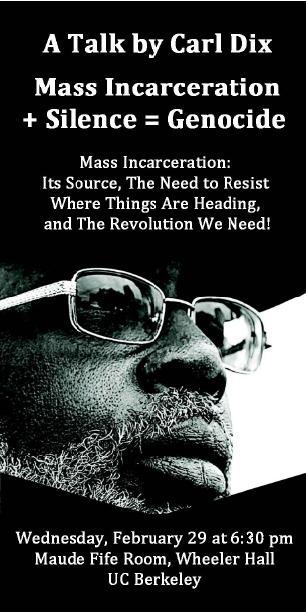 MEDIA ROOTS — Carl Dix, Revolutionary Communist Party, is back in the S.F. Bay Area and will deliver an address to UC Berkeley this evening entitled “Mass Incarceration + Silence =
Genocide.” The last time Mr. Dix visited
northern California, Media Roots
MEDIA ROOTS — Carl Dix, Revolutionary Communist Party, is back in the S.F. Bay Area and will deliver an address to UC Berkeley this evening entitled “Mass Incarceration + Silence =
Genocide.” The last time Mr. Dix visited
northern California, Media Roots