 MEDIA ROOTS — On Friday, December 2, 2011, at 7pm, at the Pauley
Ballroom on the UC Berkeley campus, a dialogue will take place between Cornel
West and Carl Dix. This upcoming event
open to the public free of charge is being organised by the University of California, Center for Race &
Gender, which notes:
MEDIA ROOTS — On Friday, December 2, 2011, at 7pm, at the Pauley
Ballroom on the UC Berkeley campus, a dialogue will take place between Cornel
West and Carl Dix. This upcoming event
open to the public free of charge is being organised by the University of California, Center for Race &
Gender, which notes:
“Carl Dix is a longtime revolutionary and a founding
member of the Revolutionary Communist Party, USA. In 1970 Carl was one of the
Fort Lewis 6, six GIs who refused orders to go to Vietnam. He served 2 years in
Leavenworth Military Penitentiary for his stand. In 1985 Carl initiated the
Draw The Line statement, a powerful condemnation of the bombing of the MOVE house in Philadelphia. In
1996, Carl was a founder of the October 22nd Coalition to Stop Police
Brutality. Carl coordinated the Katrina hearings of the 2006 Bush Crimes
Commission.”
Yesterday, Davey D broadcast an
interview with longtime activist Carl Dix on The Morning Mix out of KPFA radio in Berkeley, CA.
Some will take issue with the Revolutionary Communist Party,
yet acclimate to extremes on the Right. Some will stay open-minded and employ critical thinking. Others
take issue with the RCP’s reclusive figurehead, Bob Avakian. Yet, it’s hard to dismiss RCP spokesperson
Carl Dix’s cogent, radical analysis of U.S. imperialism, hegemony, and domestic
repression, which, following Obama’s nationwide militarised assaults against
peaceful Occupy Movement encampments, is timely and logical.
And, whatever one may hold against Cornel West, such as
his support for Obama in 2008, one must appreciate his dogged celebration of
the Socratic Method, as he welcomes dialogue with thinkers from diverse schools of thought,
even those of the RCP taxon. And Carl
Dix is certainly a worthy dialectician.
Among the sundry topics Carl Dix discusses in
conversation with Davey D (below) is the role of Obama as the Commander in
chief of the U.S. global empire; police state repression and its dimensions of
White supremacy, as manifested through racist policies like Stop and Frisk and
racial profiling; apathy among the masses and how we can wake the folk up; the pretext of national security to stifle dissent, S.1867 (passed by the two-party
Senate today) granting the Executive the use of the Military and arbitrary
indefinite detention against U.S. citizens, or anyone, in today’s U.S. global
empire, and the titanic lurch toward fascism in the wake of coordinated
Federalised assaults against the Occupy Movement; police brutality and
repression; mass incarceration and the prisoner hunger strikes; the 1% versus
the 99%; and what we can do about all of this.
The absurdity of militarised platoons of riot cops
brutalising and repressing peaceful demonstrators, First Amendment activity,
and even journalists covering it all makes this a timely discussion.
Messina
***
THE
MORNING MIX WITH DAVEY D
Davey D (7:10): “Listenin’ to a little James Brown right here
on The Morning Mix, Davey D hangin’ out wit’ you. And there is big doings in the City of
Berkeley in the [S.F.] Bay Area, come this Friday. Pauley Ballroom, my old stomping ground, is
going to feature an incredible dialogue
between Cornel West and Mr. Carl Dix.
Carl Dix, of course,
one of the founders of the Revolutionary
Communist Party here in the U.S. He
is also the founder of the October 22nd
Coalition Against Police Brutality.
And there are so many other things that we could talk to Carl about. But he’s outspoken. He’s an activist, a freedom fighter. And he’s on the phone lines wit’ us this
morning. Carl, how you doin’?”
Carl Dix (7:52): “I’m doing good, Davey. How you doin’?”
Davey D (7:55): “Good.
So, you and Cornel [West] have been kicking up a lot of dust. That’s what we’re hearing. And you’re bringin’ a lot of heat to some
issues that many like to sweep under the carpet, in particular, police terror,
incarceration, no jobs, miseducation, all in the age of Obama. Let me start off with my first question. Are you surprised that these issues are as
problematic as they are with our first Black President?”
Carl Dix (8:21): “No, it didn’t surprise me at all. Because I peeped that when Obama was running
for President, he was basically applying for the job of Commander in chief of
the U.S. global empire and he was basically sayin’ I’m the best guy to meet the
needs of the empire at this point. And
if you gon’ meet the needs of the U.S.’s global empire, that does not include
getting jobs for the youth, ending police terror, correcting the way the
education system works because all of that is built into the fabric of U.S.
capitalism, historically and currently.
“We’ve been doing this campaign to stop ‘Stop
and Frisk’ here in New York City, which is a policy of the New York Police
Department, under which they stop more than 700,000 people. That’s the pace they’re on this year. That’s 1,900 people each and every day. And five out six of those people stopped are
Black or Latino. And over 92% of them
are doing nothing wrong. But this ain’t
a mistake or an error in judgment. This
is a system based upon exploitation that has no future for the youth. So, rather than allow them to get roused up
and rise up the way that youth did in the 1960s, they have criminalized them
and tried to lock ‘em down. And whatever
colour the President is, he’s going to preside over that and see that that’s
carried out.”
Davey D (10:04): “Let me ask you. When you just mentioned that figure of the
‘Stop and Frisk,’ 700,000 people being stopped, mostly Black and Brown folks in
New York City. How does this happen with
8 million people in a city and we just sit back and there’s no outrage. We don’t see people, you know, bat an eye and
say, ‘This is wrong. Let’s stop this.’
Have we been dumbed down that much?”
Carl Dix (10:32): “There is some growing outrage. But, on the other side, yes, most people buy
into this. And they’re told that this is
done in order to protect them from crime and there’s a certain ignorance of the
reality because, if it’s about crime, why is that 92-plus-percent of the people
that the police stop, they can’t find the reason to even write ‘em a
ticket? And of the seven-plus-percent
who do get violations or arrested, some of them weren’t doing anything
wrong. They just looked the wrong way at
a cop, gave ‘em a little too much lip or were carrying a non-criminal amount of
marijuana in their pockets. But they
were told by the cop to empty their pockets and when they took the marijuana
out a cop arrested them for displaying marijuana in public. Because in New York state it is not a
criminal offence to have less than 25 grams of marijuana as long as you don’t
display it.”
Davey D (11:33): “Wow.”
Carl Dix (11:34): “But then there’s a certain trick-bag for
Black or Latino youth where the cop will tell you to empty your pockets. If you refuse they arrest you for violating
his order. If you comply with his order
they arrest you if you have that non-criminal amount of marijuana because it
then becomes public. That’s kinda how
they go at this and how they go at criminalizing our youth. But people accept it because they’re told it
has to do with safety against crime. And
the police chief even goes to Black and Latino churches and talks about how he
does what he does to protect their communities against criminals when,
actually, they’re criminalizing the youth of that community. And, you
know, Cornel and I wanna bring that to light, including that he and I
collaborated on launching a campaign of non-violent civil disobedience aimed at
bringing mass resistance [and] opposition to stop ‘Stop and Frisk.’”
Davey D (12:33): “You know, a lot of people listening would
probably say this doesn’t apply to me because it’s in New York City. And others will say this doesn’t apply to me
because the old adage, ‘If they have nothing to hide then they should just go
along with the programme and expose themselves,’ you know. ‘We’re in extraordinary times and this
requires extraordinary measures in order to protect our population.’ I bring this up because yesterday [11/28/11]
in the Senate they started debating a
bill that was drawn in secret, the National Defense Authorization Act,
which would give the President as well as the Military great powers in terms of
stopping people and holding them as ‘detainees’ for an indefinite amount of
time. And to me, this is brought up by
John McCain as well as Democrat Carl Levin, I wanna see if you can connect the
dots between the two in terms of, you know, we let the kids get stopped and
frisked in New York and now it could apply to anybody on a national level and
we don’t seem to be outraged. We were
all eating turkey and enjoying the football games, myself included, and not
really having our attention focused on these types of bills that are going
through the House and Senate.”
Carl Dix (13:52): “Yeah, all of this does come together because
‘Stop and Frisk’ is a policy that’s applied in New York City and a couple of
other cities across the country. But
most cities don’t have that explicit policy.
But there is probably no city across the country where the racial
profiling that underlay ‘Stop and Frisk’ doesn’t get applied and isn’t spoken
of, perhaps not explicitly, but as the way you go at crime. What’s really happened is that Black and Latino
youth have been made a criminalized group of society. And they basically treat ‘em all like
criminals, guilty until proven innocent, if they can survive their encounter
with police to prove their innocence.
And we have to bring that into the picture because we remember Oscar
Grant and the many other young Black and Latino people who did not survive
those encounters.
“But it also goes to this national security point because
they have expanded that racial profiling.
I mean, we’ve talked about driving
while Black or Latino, but we also gotta talk about flying while Muslim or Arab because that is also something that has
become criminal. And now with a bill
like this, they are granting the Executive the power to determine for whatever
reason that someone could be arrested, held, interrogated, treated as a
national security threat, and not have to give them the ability to challenge
that to have it heard in open court and to say, ‘Show and prove.’ Now, when Bush talked about grabbing that
kind of power there was a lot of opposition.
But Obama came in as the anti-Bush and he has actually consecrated some
of the things that were controversial under Bush because you look at the fact
that they explicitly executed a U.S. citizen with a drone strike in North-East
Africa and there wasn’t a [huge outcry] about that, similar to this [S.1867]
bill that you’re talking about. And
people need to deal with that.
“This dialogue that Cornel
and I are having is happening in a different situation because you’ve got this
spreading Occupy Movement. And that’s a
very good development. But we also have
to deal with the fact that there were coordinated
national assaults on the Occupy Movement.
You know, there were conference calls that the Mayor of Oakland was on
with 15 to 18 other mayors and there was participation in that conference call
from the Department of Homeland Security.
Now, people need to deal with the fact that protesting has become
something that there will be national military security conference calls and
coordinated assaults on. And the assault
that happened in Oakland was nothing short, on the Occupy Movement, was nothing
short of a military assault. I mean, we
just gotta call it what it is. When they
start throwing flash-bang grenades and comin’ in the way that they came in,
that was a military assault on people who were protesting. Or the UC Davis thing where students sitting
down with their arms linked were hit with pepper spray. And we gotta deal with the pepper spray that
the police routinely use is actually banned in warfare according to
international law. That’s what that came
down to. And you watch that cop very
calmly spray those students and then shake his can, so he could spray ‘em some
more. They’re actually telling us
something about what future they have in store for us. And we need to be talking about how we’re
gonna seize a different future because the future that they have is: ‘If you go with the programme and don’t rock
the boat, you can be a functionary in their oppressive, exploitative worldwide
system. If you rock the boat or if you don’t fit into that, which is the case
for huge numbers of Black and Latino youth, then they got a different
future.’ They got prisons. They got police. You know?
They got all of this or being in their Military and going around the
world and killing people for ‘em.”
Davey D (18:24): “Right.
If you’re just tuning in, we have Carl Dix on the phone line wit’
us. Carl Dix, well-known freedom
fighter, activist, founder of the October 22nd Coalition Against
Police Brutality, member of the Revolutionary Communist Party USA, founding
member of that. Let me ask you this,
Carl. You and Cornel are having this conversation
Friday, UC Berkeley, Pauley Ballroom.
We’re gonna hear all this information, you know; some of the stuff
you’re saying is gettin’ people riled up.
But now, at that point, what do we do to change that and can we have a
change that, you know, or at least start to see change that’s immediate,
understanding that ‘I don’t wanna wait
seven generations; I’m not trying to get involved with something where we have
to wait for, you know, my great-great-grandkids to receive the benefits. I
wanna hear, now, some sort of solution that I can see.’ What’s the prescription at this point?”
Carl Dix (19:21): “Well, the prescription, and this is going to
be a dialogue, so we’ll have two people who’ll come at it with some unity and
with some differences. You know? And I really respect and love my brother
Cornel. And we work together a lot. Like I said, we started this campaign to stop
Stop and Frisk together in addition to having these dialogues. But I’m gonna come from the revolutionary
communist perspective and I’m gonna put two things to people. One is building a movement for revolution,
which we gotta do right now. Okay? And I’m gonna develop that, bring out what
that revolution would be like, what it aims to do, why it could bring a whole
different and far better world into being.
And I’m also gonna say to people, ‘Whether or not you’re with that,
that’s something that I want people to dig into and check out.’ And I’m gonna bring source material that I
can encourage people to get into on that front.
I’m also gonna say, ‘We have to stop things like mass incarceration, 2.4
million people in jail in prisons all across the country, many of them held in
torture-like conditions; policies like Stop and Frisk and racial profiling that
serve as a pipeline to prison; the way in which prisoners are treated like
less-than-human when they get out, denied access to government loans, public
housing, even denied the right to vote.’
We have to actually build a fight around that right now and beat back
some of this. That’s what we’re engaged
in doing in New York around Stop and Frisk.
“The prisoners, themselves, in California stood up; and
people need to relate to that struggle, support it, things like the hunger strikes that
the prisoners in the California Special Housing Units waged, as well as
other forms to, both, bring to light these horrors, but also to fight, now, to
change them because they’re moving in a way that they wanna have us so locked
down that there’s nothing we could do about it.
And, at the same time, I’m gonna engage some of the questions that are posed
by the Occupy Movement because it has accomplished quite a bit. It has moved people to resist the outrageous
inequality in society, to stand up and fight back, but also to question why it
is like this and what could be done about it.
And, like I said, I’m gonna engage why it’s like this because it’s like
this because of capitalism in its very nature, what it functions based on. And we need revolution to get rid of it. And I’m gonna bring to them the kind of
revolution that we need and the work that Bob Avakian, the leader of
the Revolutionary Communist Party has done on that revolution, how to make it,
what kind of world we could bring into being and how we could go farther and do
better than the previous revolutions that have occurred.”
Davey D (22:27): “Okay.
You know, let me just see if we can just get a couple of calls in with
you—”
Carl Dix (22:32): “Okay.”
Davey D (22:32): “—before we let you go. The phone number here, we’re talking with Carl
Dix, he will be speaking with Cornel West this Friday at Pauley Ballroom, UC
Berkeley Campus, in the age of Obama.
Him and Cornel [West] will have a conversation about police terror,
incarceration, no jobs, and miseducation.
The subtitle: ‘What Is the Future for Our Youth?’ He’s on the phone line wit’ us and you could
give us a call. 510.848-4425. Once again, 510.848-4425. Carl, while we wait for some of those calls,
when you say ‘revolution,’ two
questions come to mind. Under the
P.A.T.R.I.O.T. Act and the proposed new laws that they’re trying to push
through and all that, that, kind of, makes you an enemy. Are you concerned that all of a sudden before,
you know, when you’re talking about this and you’re using words like ‘revolution’ and you are a member of the
Communist Party, that all of a sudden you won’t find yourself locked up? You know, because we have to, you know, you
might be deemed a quote-unquote ‘terrorist’
in this day and age. And, also, when
we’re talking about ‘revolution,’ are
we talking about, you know, goin’ to the rifle range and gettin’ a gun? Or is there another approach towards this?”
Carl Dix (23:45): “Okay.”
Davey D (23:45): “I mean can we have a ‘revolution’ at the voting booth?”
Carl Dix (23:48): “Alright.
Let me start with the second question and then move to the first
question. When we talk about ‘revolution,’ we’re talking about meeting
and defeating the violent attempts at suppression that this governmental
structure will undoubtedly launch at a revolutionary people. Now, it is not yet time for the all-out move
to revolution. The society is not yet
deep enough in crisis. There’s not yet
the revolutionary people numbering in the millions who are ready to put
everything on the line and don’t wanna live another day under this system. So, it would be in very much different conditions. That’s what ‘revolution’ means. And it’s
about dismantling the repressive apparatus that keeps capitalism and its
exploitative relations in effect here in this country and around the world and
putting in its place a whole different society with a different economic
programme that’s not based on exploitation, a socialist economic programme,
that would be in transition to an end to exploitation and oppression once and
for all. That’s what ‘revolution’ is about. That’s what we’re talking about. And that’s what it would take to pull it
off.
“Now, when I talk about building a movement for ‘revolution,’ I’m talkin’ about a couple
things. One is bringing to people that
things don’t have to be this way, that it isn’t like this is the best possible
of all societies. Revolution has been
made. It could be done again and we
could go farther and we could do much better.
I’m also talking about an approach that we call fighting the power and
transforming the people for revolution because we know people ain’t ready for
revolution right now. But they do need
to resist these attacks and through the course of the resistance we try to
bring out: Where do these attacks come
from? Why do they continually come down? And where do we need to go to end them?”
Davey D (25:45): “Okay.”
Carl Dix (25:45): “So, that’s what I mean when I talk about ‘revolution.’ And as far as this thing of, ‘Am I on some enemies list?’ I wouldn’t be surprised if I were. I mean, I do know that at the time of the
first Gulf War there were debates at the highest level of Government, as to
whether people who were saying what I was saying should be arrested for
it. And this was like the early 1990s,
we’re talkin’ about, because they were like, people who were criticising this
move towards war before it happened were maybe ‘treasonous’ and should be gone
after. They decided not to do it at that
point. But I don’t hold back on what I
say and say, ‘Well, I can’t say that because They may not like it and They
may criminalize it.’ I have to say what
I think is true because while the truth won’t set you free, in and of itself,
if you ain’t basin’ yourself on truth, you ain’t gon’ get free. If you’ based on a lie, you ain’t gon’ get
free and humanity’s not gon’ get free.
Davey D (26:44): “That’s real.”
Carl Dix (26:44): “So, that’s how we go at it. And we try to expose to people the ways in
which all of this repressive apparatus is geared not towards their safety, but
towards keeping the current status quo in effect.”
Davey D (27:00): “Okay.”
Carl Dix (27:00): “You know, and if you like this set-up with
1%, actually less than 1%, owning and controlling and dominating everything
then go with it. But if you’re against
that then you have to talk about the mechanisms that they have that keep that
in effect.”
KPFA FREE SPEECH PHONE LINES OPEN
Davey D (27:15): “That’s the voice of Carl Dix. It is 8:27 in the morning on The Morning Mix
and we’re gonna take a couple of calls.
We’re gonna kick it off with Sharif in El Sobrante. You’re on the Morning Mix. How are you doing, Sharif?”
Sharif in El
Sobrante (27:25): “Alright. As-Salamu `Alaykum.”
Davey D (27:27): “Good.
What’s happenin’?
Sharif in El
Sobrante (27:28): “Alright. Listen, I love this. I’ve never heard of this brotha befo’, but he
is well-spoken. And he can certainly
explain to me what the heck he’s talkin’ about.
I can dig it. I also, are you
there?”
Davey D (27:41): “Yeah.
We’re listenin’.”
Sharif in El
Sobrante (27:42): “Okay. Well, I would tend more towards socialism,
which means a society of men or a group of men with one common cause. Have him to deal with that, would you,
please?”
Davey D (27:52): “Okay.
Let me, before you hit that, Carl, let me just get another call in and
then I’ll let you hit ‘em both—”
Carl Dix (27:57): “Okay.”
Davey D (27:57): “—at the same time. Alright, so he asked a question about
socialism. Let’s go to Ayana in
Oakland.”
Ayana in Oakland
(28:02): “Hello.”
Davey D (28:04): “Hey, Ayana, you’re on the air. What’s your question or comment?”
Ayana in Oakland
(28:06): “Hi, yeah, question, kind
of comment, maybe both. Um, White Skin Privilege,
White Supremacy: During this Occupy Movement it just seemed
like folks love having conversations about class and economy absent of
that. And I feel like that very basis is
what has a lot of the structures be the way that they are today, just in terms
of how they affect people of colour.
And, so, I’m just wondering where do you stand on that just in terms of
[basic] conversation in terms of race constructed in that way—”
Davey D (28:46): “Okay.”
Ayana in Oakland (28:47): “—because that’s, essentially, what it is
that we’re dealing with.”
Davey D (28:49): “Okay.
We appreciate that. So, Sharif
wanted to know, you know, ‘socialism’—”
Carl Dix (28:52): “Okay.
Socialism and White supremacy.
Davey D (28:54): “Yes.”
Carl Dix (28:55): “Okay.
Let me start with the second question first. And those are both very good questions and,
both, things I’m gonna get into more this Friday when I dialogue with
Cornel. And I really encourage people to
come out. I believe it’s
going to be at seven o’clock. I
mean, on this question of ‘White supremacy,’ that is something that was built
into the fabric of U.S. society from the very beginning, from when they dragged
the first African here in slave chains and carried out genocide against the
Native inhabitants. And, literally,
every bit of wealth in this country is based on that foundation. And that is something that you ain’t supposed
to talk about. And, in fact, given that
I’m gon’ be in California, one of the things that we got to address is the
banning of affirmative action in the UC system.
It’s kind of like, ‘Oh, well, a couple of decades ago we ended Jim Crow
segregation. So, of course, there’s no reason for any remediative action to be
taken about the centuries of oppression that Black people, in particular,
suffered. So, that is a very important
point. Now, how do you go at it at this
point?
“And one of the things I’m gonna get into is the way we
went at the struggle to build, bring dramatic mass resistance around ‘Stop and
Frisk’ here in New York City. And one of
the things that we decided to do is we had to go down to Occupy Wall
Street. And we had some discussion and
even some argument over whether that would be a wise thing to do, since this
was mostly White young people who did not experience Stop and Frisk and the
viewpoint that went out was, ‘Okay, they don’t experience Stop and Frisk, but
if they’re talking about the 99% and they really mean that then they need to
know what happens to part of that 99%, which is part of what is used to keep
all of us down. So, we went down there
and we started telling people. We did
mic checks and started doing speak-outs around Stop and Frisk. And, initially, only a few people responded,
but as it developed, so far, each time that we have done, we’ve done three
civil disobedience actions, each time a good section of the people who went and
got arrested to stop Stop and Frisk were activists from Occupy Wall
Street. And they were people, they
included a few Black or Latino people, but mostly they were White people, who
were like, ‘I did not know this happened, but I can’t stand by and let it
happen, you know, so-called, in my name. I have to register my opposition.’ And see that’s the kind of struggle we gotta
take to people. Be real about this thing
about 99% ‘cos the 99% does not just suffer economic inequality across the
board. There is oppression aimed at
whole groupings of people based on race or nationality within that 99%. There’s oppression aimed at women within that
99%. And a movement that’s really about
addressing that has to be about addressing all of that. And I would bring to that a view that it will
take revolution to end all of that.
“That’s what I bring to that, which brings me to the so
the socialism question. That’s why I
wanted to go at it this way. Socialism
is an economic way to run a society. It
is also a political approach. And for
us, it’s a transition to a full classless communist world and that all of that
needs to be in the mix because when you talk about meeting revolution one part
of that is that you have to go up against a repressive structure that is aiming
to keep capitalism in effect. And you
see that in the attacks on Occupy because even though people were merely
protesting and raising questions about the nature of society, the people that
the run the show decided that was a danger to them and needed to be
repressed. So, that’s part of it, but
then even after you make the revolution, you have to deal with the fact that
there are a lot of differences that are left over from capitalism ‘cos you
can’t deal with all instantly right away.
One we’ve talked about, the oppression that’s aimed at Black people and
Latino people, the White supremacy that’s in society. You can take big steps on that, but the ideas
that people have taken on behind that are something that you gotta work to get
people out of. And you gotta figure out
the ways to do that, the same on the oppression of women, also, the fact that
some people do mental work while other people do back-breaking labour. You have to work to end all of those
differences.”
Davey D (34:00): “Right.”
Carl Dix (34:01): “And doing that actually requires a
transitional period. And that’s why for
us socialism is a transition to that full classless communist [world] where
exploitation has been ended once and for all.
And Bob Avakian, the leader of the Revolutionary Communist Party, has
done a lot of work on that. And I’m
gonna address some of it and I’ll also tell people about some of the sources
like the recent book
Basics, quotations and short
essays from his work that get more deeply into that.”
Davey D (34:31): “Okay.
You know, let me see if I can squeeze one more call in—”
Carl Dix (34:34): “Okay.”
Davey D (34:34): “—before we get to our other guest who’s here
on The Morning Mix. I believe we have
Beverly out of Petaluma. How you doing? You’re on The Morning Mix, Beverly.”
Beverly in
Petaluma (34:43): “Good morning. I found this a very interesting dialogue. But I had a thought, which is that the word ‘revolution,’ in itself, is like a red
flag to a lot of people. And I was
thinking that what about using the term evolution, which doesn’t have the same
threatening connotations, and focusing more, rather than on how we can’t stand the
way things are, on really creating a vision for how we would like things to be
and doing that in a way that inspires people because simply fighting against
something that’s wrong is not necessarily gonna lead to something that’s
right.”
Davey D (35:35): “Okay.”
Beverly in
Petaluma (35:36): “So, I wanted to suggest
some way to inspire people so that the wrongness becomes intolerable, but they
have a good feeling about the direction they’re moving in and making sure that
happens.”
Davey D (35:56): “Okay.
Let me let him get to that. Carl: evolution versus revolution.”
Carl Dix (35:58): “Again, a very good question, a very good
point. And the way that we go at this,
we feel, we have to lay bare what’s wrong about this set-up. But at the same time we bring forward what
the world could be like. And, in fact,
the Revolutionary Communist Party produced a draft Constitution for a future
socialist republic in North America. We
produced that because we wanted to give people an idea of the kind of society
that we are aiming to bring into being, how the government would work in that
society, where elections would fit in, how education would be handled, how the
rights of the people would be respected, how we would deal with international
relations, how the economy would be run.
And we wanted people to know that, one, because we thought it would
inspire people, but also we wanted people to be able to say, ‘This is what
you’re supposed to be going for; now let’s look at how you’re going at it,
whether it’s in line with what you’ve laid out there.
“Now, on this question about revolution and the
connotations that go with it, we’re actually aware of the connotations. The reason we feel like we need to use that
term is that it actually describes the kind of transformation that’s
needed. You know? And I know there are a lot of views of, ‘Can
we just organise at a distance from the state and its repressive apparatus?’ We think that that is not a winning
approach. And you even see something
like the Occupy Movement, which on one level was not directly challenging the
state, but was protesting inequality and all that and the state violently came
at it because it saw even people protesting and questioning as dangerous. And I mean that’s what we’re up against. That’s what we gotta deal with. And we do need the kind of transformation
that revolution represents, so that’s why we take that approach. And I can further go into that when Cornel
[West] and I talk this Friday up at the Pauley Ballroom at seven o’clock on UC
Berkeley’s campus. I also wanted to give
people a phone number and a way to get programme information if they’re
interested in more information.”
Davey D (38:22): “Sure, what’s the number?”
Carl Dix (38:24): “The number is 510.848-1196; I believe that’s
the number for Revolution Books. But also get programme information by going
to the Center for Race and Gender at UC Berkeley’s website. I believe that’s CRG.Berkeley.edu.”
Davey D (38:58): “Well, the Center for Race and Gender, they
can find out if they Google.”
Carl Dix (39:02): “They can Google it.”
Davey D (39:04): “Okay.
And, again, the number 510.848-1196.
Carl, we’re gonna have to wrap up.
We appreciate it. We look forward
to seeing you on Friday at Pauley Ballroom and so thank you for hangin’ out.”
Carl Dix (39:12): “Yeah, I look forward to getting out to the
[S.F.] Bay Area.”
Davey D (39:15): “Thank you for hangin’ out with us this
mornin’.”
Carl Dix (39:17): “Thank you.”
Transcript by
Felipe Messina
***



 MEDIA ROOTS — The private, unaccountable, Federal Reserve operates
above the law, as it dictates monetary policy. That’s enough to spur Ron Paul followers into
calling for an end to the Fed. Now, if you
shared in the justified rage of thousands of Occupy encampments across the
nation, protesting, ‘Banks got bailed
out, We got sold out,’ at the thought of hundreds of billions going to Wall
Street in the name of trickle-down economics salvation, then imagine the rage at the news
Bloomberg recently released. Bloomberg
has obtained thousands of pages of Federal Reserve documents under a Freedom
of Information Act request revealing the Fed quietly funnelled trillions to
Wall Street back in 2008 as Congress debated awarding banks those begrudged billions
in bailouts.
MEDIA ROOTS — The private, unaccountable, Federal Reserve operates
above the law, as it dictates monetary policy. That’s enough to spur Ron Paul followers into
calling for an end to the Fed. Now, if you
shared in the justified rage of thousands of Occupy encampments across the
nation, protesting, ‘Banks got bailed
out, We got sold out,’ at the thought of hundreds of billions going to Wall
Street in the name of trickle-down economics salvation, then imagine the rage at the news
Bloomberg recently released. Bloomberg
has obtained thousands of pages of Federal Reserve documents under a Freedom
of Information Act request revealing the Fed quietly funnelled trillions to
Wall Street back in 2008 as Congress debated awarding banks those begrudged billions
in bailouts. MEDIA ROOTS — Yesterday, Michael Ratner, President of the Center for
Constitutional Rights, discussed on Letters and Politics the
Federal involvement in the coordinated nationwide repression of the Occupy
Movement, evictions of OM encampments and the U.S. history of police state repression
of dissent and First Amendment activities. He also talks about the recent disturbing
provision, sponsored by Democrat Carl Levin, to the National Defense
Authorization Act Bill S.1867, granting the Executive authority to order the
Military to detain indefinitely U.S. citizens without charge.
MEDIA ROOTS — Yesterday, Michael Ratner, President of the Center for
Constitutional Rights, discussed on Letters and Politics the
Federal involvement in the coordinated nationwide repression of the Occupy
Movement, evictions of OM encampments and the U.S. history of police state repression
of dissent and First Amendment activities. He also talks about the recent disturbing
provision, sponsored by Democrat Carl Levin, to the National Defense
Authorization Act Bill S.1867, granting the Executive authority to order the
Military to detain indefinitely U.S. citizens without charge. MEDIA ROOTS — On Friday, December 2, 2011, at 7pm, at the Pauley
Ballroom on the UC Berkeley campus, a dialogue will take place between Cornel
West and Carl Dix. This upcoming event
open to the public free of charge is being organised by the
MEDIA ROOTS — On Friday, December 2, 2011, at 7pm, at the Pauley
Ballroom on the UC Berkeley campus, a dialogue will take place between Cornel
West and Carl Dix. This upcoming event
open to the public free of charge is being organised by the 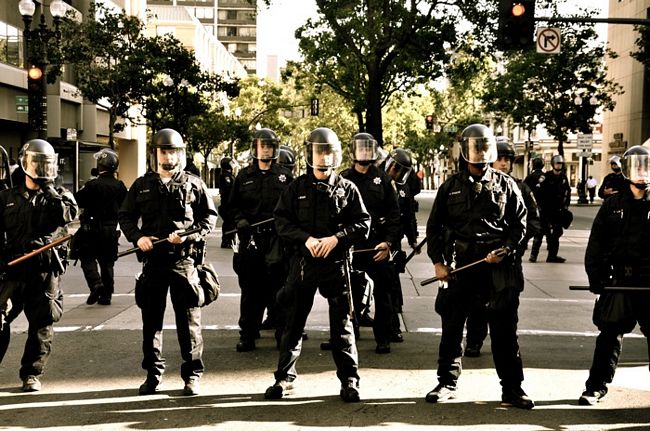 MEDIA ROOTS — Apparently,
militarised platoons of riot cops repressing peaceful protesters with police
brutality and intimidation wasn’t enough.
MEDIA ROOTS — Apparently,
militarised platoons of riot cops repressing peaceful protesters with police
brutality and intimidation wasn’t enough.