THE INDEPENDENT/UK – Soldiers, soldiers everywhere. In the valleys, on
the mountains, in the streets of Beirut. I have never seen so many
soldiers. Are they going to “liberate” Jerusalem? Or are they going to
destroy all the Arab dictatorships?
They are supposed to stop the country of Lebanon from sliding into a civil
war, I suppose. Hezbollah, we are told, has destroyed the government – which
is true up to a point. For on Monday, so we are told, the Hague tribunal of
the United Nations will tell us that members of Hezbollah killed the former
prime minister, Rafiq Hariri.
 America demands that the tribunal name the guilty men. So does France. And so,
of course, does Britain. Which is strange, because in 2005, when Mr Hariri
was killed 366 metres from me on the Beirut Corniche, we all believed that
the Syrians had killed him. Not the President, mind you. Not Bashar Assad,
but the security services of the Syrian Baath party. That’s what I believed
then. That’s what I still believe. But we are told now that it will be
Hezbollah, Syria’s friend and Iran’s militia (albeit Lebanese) in Lebanon.
And now America and Britain are beating the drum of litigation.
America demands that the tribunal name the guilty men. So does France. And so,
of course, does Britain. Which is strange, because in 2005, when Mr Hariri
was killed 366 metres from me on the Beirut Corniche, we all believed that
the Syrians had killed him. Not the President, mind you. Not Bashar Assad,
but the security services of the Syrian Baath party. That’s what I believed
then. That’s what I still believe. But we are told now that it will be
Hezbollah, Syria’s friend and Iran’s militia (albeit Lebanese) in Lebanon.
And now America and Britain are beating the drum of litigation.
Hezbollah must be blamed and of course, the Prime Minister – or, to be
correct, the former prime minister of Lebanon Saad Hariri, son of Rafiq –
has just lost his job.
There are many who believe that Lebanon will now descend into a civil war,
similar to the fratricidal conflict which it endured from 1976 to 1980. I
doubt it. A new generation of Lebanese, educated abroad – in Paris, in
London, in America – have returned to their country and, I suspect, will not
tolerate the bloodshed of their fathers and grandfathers.
In theory, Lebanon no longer has a government, and the elections which were
fairly held and which gave Saad Hariri his cabinet are no more. President
Michel Suleiman will begin formal talks on Monday to try to create a new
government.
But what does Hezbollah want? Is it so fearful of the Hague tribunal that it
needs to destroy this country? The problem with Lebanon is perfectly simple,
even if the Western powers prefer to ignore it. It is a confessional state.
It was created by the French, the French mandate after the First World War.
The problem is that to become a modern state it must de-confessionalise. But
Lebanon cannot do so. Its identity is sectarianism and that is its tragedy.
And it has, President Sarkozy please note, a French beginning point.
The Shias of Lebanon, of which Hezbollah is the leading party, are perhaps 40
per cent of the population. The Christians are a minority. If Lebanon has a
future, it will be in due course be a Shia Muslim country. We may not like
this; the West may not like this. But that is the truth. Yet Hezbollah does
not want to run Lebanon. Over and over again, it has said it does not want
an Islamic republic. And most Lebanese accept this.
But Hezbollah has made many mistakes. Its leader, Hassan Nasrallah, talks on
television as if he is the President. He would like another war with Israel,
ending in the “divine victory” which he claims his last war, in
2006, ended in. I fear the Israelis would like another war too. The Lebanese
would prefer not to have one. But they are being pushed further and further
into another war which Lebanon’s supposed Western friends seem to want. The
Americans and the British would like to hurt Iran. And that is why they
would like Hezbollah to be blamed for Mr Hariri’s murder – and for the
downfall of the Lebanese government.
And it is perfectly true that Hezbollah does want this government to fall. By
getting rid of this government, getting rid of this cabinet, it has broken
the rules of the Doha agreement, which stated that the government and
security services of Lebanon should not be harmed.
It is effectively wiping out the Arab “solution” to the Lebanese
sectarian conundrum, and what – with the help of its Christian allies – is
turning Lebanon into a frightened state. No wonder there were no drivers on
the roads yesterday. No wonder the Lebanese were so frightened to go out and
enjoy the Mediterranean sun. We are all frightened.
But I think the Lebanese state has grown up. I noticed, yesterday, that the
Christian leader of the Lebanese Forces, one of the Christian militias,
Samir Geagea, had a new photograph on the front of his party offices in a
mountain town. But he was wearing civilian clothes. He was wearing a suit
and tie. Not the militia costume he use to wear. That was a good sign.
No civil war in Lebanon.
Click to read the full article, Lebanon in Limbo: A Nation Haunted by the Murder of Rafiq Hariri.
© 2011 The Independent
Robert
Fisk is Middle East correspondent for The Independent newspaper. He is
the author of many books on the region, including The Great War for Civilisation: The Conquest of the Middle East.
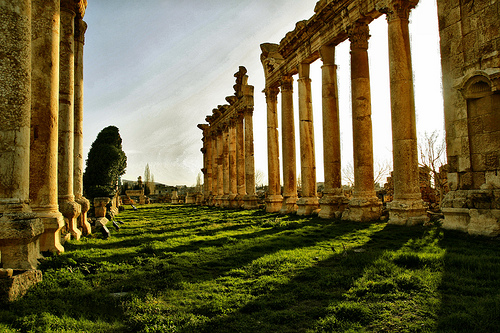
Photograph by Flickr user conjure1



 CHRISTOPHER ALEXANDER
 HUFFINGTON POST
 America demands that the tribunal name the guilty men. So does France. And so,
of course, does Britain. Which is strange, because in 2005, when Mr Hariri
was killed 366 metres from me on the Beirut Corniche, we all believed that
the Syrians had killed him. Not the President, mind you. Not Bashar Assad,
but the security services of the Syrian Baath party. That’s what I believed
then. That’s what I still believe. But we are told now that it will be
Hezbollah, Syria’s friend and Iran’s militia (albeit Lebanese) in Lebanon.
And now America and Britain are beating the drum of litigation.
America demands that the tribunal name the guilty men. So does France. And so,
of course, does Britain. Which is strange, because in 2005, when Mr Hariri
was killed 366 metres from me on the Beirut Corniche, we all believed that
the Syrians had killed him. Not the President, mind you. Not Bashar Assad,
but the security services of the Syrian Baath party. That’s what I believed
then. That’s what I still believe. But we are told now that it will be
Hezbollah, Syria’s friend and Iran’s militia (albeit Lebanese) in Lebanon.
And now America and Britain are beating the drum of litigation.