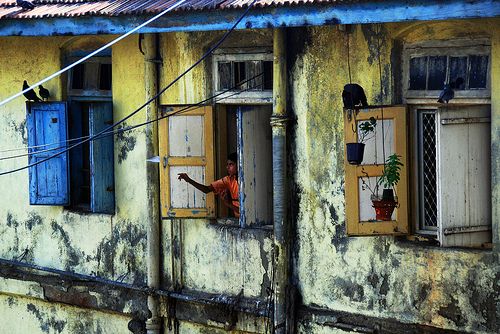
 Beyond these facts, there seems to be little
awareness about the reality of slums in the popular imagination. Thanks to the
tireless work of many activists and non-governmental organisations over many
decades, the issue of global poverty is now high on the international policy
radar – but the issue of slums, which forms a major component of poverty in
urbanising cities, still fails to register in most people’s concerns. Much may
be written about informal settlements in academic books and journals, but the
depiction of slums in popular movies and literature also serves to reinforce a
number of long-held prejudices against the urban poor. The complacent
indifference expressed by many governments and middle-class citizens to the
struggles faced by the millions of people living in slums can also lead to
other forms of discrimination or ‘myths’ about the solutions to inadequate
housing.
Beyond these facts, there seems to be little
awareness about the reality of slums in the popular imagination. Thanks to the
tireless work of many activists and non-governmental organisations over many
decades, the issue of global poverty is now high on the international policy
radar – but the issue of slums, which forms a major component of poverty in
urbanising cities, still fails to register in most people’s concerns. Much may
be written about informal settlements in academic books and journals, but the
depiction of slums in popular movies and literature also serves to reinforce a
number of long-held prejudices against the urban poor. The complacent
indifference expressed by many governments and middle-class citizens to the
struggles faced by the millions of people living in slums can also lead to
other forms of discrimination or ‘myths’ about the solutions to inadequate
housing.
As popularised by many publications in recent
decades that highlight the common misconceptions about global poverty,
conventional thinking on development issues in the West is often characterised
by many assumptions, clichés and rationalisations about the very poor who live
in distant countries. In challenging some of these core myths, we are able to
move beyond a response to poverty motivated by guilt or fear, and instead focus
on the structural causes of powerlessness that result in insecurity and
deprivation. The following ‘myths’ about slums aim to give a general
perspective on a range of key issues related to human settlements – including
the impact of economic globalisation, the role of national governments, the
significance of the informal sector of employment, the question of
international aid, and the (little mentioned) controversy surrounding global
slum data and development targets.
Myth 1: There are too many people
It
is easy to believe that urban slums are a consequence of too many people living
in cities, or too many poor people migrating from rural to urban areas for
governments to contend with the strain on housing. But the real problem is
rooted in outdated institutional structures, inappropriate legal systems,
incompetent national and local governance, and short-sighted urban development
policies. From a wider perspective, the resurgence of a non-interventionist
ideology in recent decades has weakened the role of national governments, and
de-prioritised the importance of the state in planning for a more equitable
distribution of resources in cities. Crippled by debt, forced to prioritise
loan repayments over basic services such as healthcare, and held in thrall to
the so-called Washington Consensus policies that demanded a withdrawal of
government from almost every sphere of public life, it has been impossible for
initiatives by the state or international agencies to keep pace with the rate
of urban slum formation since the 1980s. In the simplest terms, the existence
of slums is not an inevitable consequence of overpopulation, but a result of
the failure of policy at all levels – global, national and local – and the
adoption of an international development paradigm that fails to prioritise the
basic needs of the poor.
Myth 2: The poor are to blame
Many
people continue to blame the poor for their conditions of poverty. According to
this deep-seated myth, the people who live in slums are antisocial, uneducated
and unwilling to work, or else they would not be living in such conditions of
squalor. In contrast to such popular prejudices, however, anthropologists and
development practitioners have long observed that the poor are not a burden
upon the urbanising city, but are often its most dynamic resource. While
achieving considerable feats of inventiveness in self-help housing on an
individual basis, the collective power of urban poor groups has produced exceptional results in building new homes and
upgrading existing slum housing – as reflected in official development
literature which recommends “participatory slum improvement” as the best
practice for housing interventions in developing countries. Yet for every
example of a successful community-led upgrading scheme, there are as many
examples of slum clearance operations and forced evictions. This constitutes
one of the most crucial questions in the fight against urban poverty: will
governments together recognise and support the ability of the poor to organise
and help develop an inclusive city, or will they continue to view slum-dwellers
as being ‘anti-progress’ and a threat to established institutions?
Myth 3: Slums are places of crime,
violence and social degradation
A
long-standing prejudice against the urban poor is the widespread view of slums
as places of social degradation and despair, and of slum-dwellers as
perpetrators of violence and crime. Although high levels of crime may occur in
many informal settlements in developing countries, the popular depiction of
life in slums often fails to acknowledge the deeper causes of insecurity and
violence – including the links between levels of crime and incidences of
poverty, inequality, social exclusion, and youth unemployment. These causal
factors (and most importantly, the responsibilities and failures of state
institutions) often go unacknowledged in films and media reports about slums.
Many squatter settlements in the South also exhibit a communal solidarity that
contradicts these negative stereotypes, along with innumerable examples of
self-sacrifice, altruism and community service that serve as a laudable example
for mainstream society. This is not to glorify or sentimentalise the urban poor
and their self-help housing, as many slums can be equally characterised by the opposite
qualities of ruthless individualism and petty-exploitation. But too often the
stereotypical view of squatters as something ‘other’ – whether it be criminals,
idlers, parasites, usurpers, prostitutes, the diseased, drunks or drug addicts
– is the most common and misguided response to those who live in poor urban
communities.
Myth 4: Slums are an inevitable
stage of development
There
is an underlying assumption to much of the debate surrounding slums and urban
poverty: that the poor will get to our standard of living eventually, just so
long as they follow our prescribed free market approach to development. Yet the
policies for industrial growth followed by developed countries were not based
on a laissez-faire ideology of free
trade and state non-intervention, but instead used protectionist strategies for
key industries in the earlier phases of development – which calls into question
the neoliberal policy recommendations made to developing countries since the
1970s. The mainstream ‘science’ of economics is also based on the assumption
that perpetual growth is the foundation of progress, even if common experience
raises doubts about the environmental and social side-effects of unfettered
capitalism. Furthermore, we can ask if it is acceptable to consider the
appalling conditions and human abuses that defined cities all over Europe
during the nineteenth century as an inevitable, even if disagreeable, part of progress
in a rapidly industrialising city like Mumbai or Chang Hai. If not, our only
choice is to consider alternative goals and more holistic models of development
that prioritise social objectives ahead of the profit imperative and GDP, with
a more equitable distribution of resources on the national and global level.
Myth 5: The free market can end
slums
Many
proponents of economic globalisation maintain a rigid faith in the power of
market forces to end slums. Get the inefficient government out of the way,
remains the assumption, and the beneficent power of the market mechanism and
private capital will act as the levers of economic growth and widespread
affluence. But after several decades of relying on the market as a cure-all for
the ills of the twenty-first century, the increasing number of urban residents living
in slums is sufficient evidence that the
‘growth-first’ strategy for development isn’t sustainable. Employing market
forces as the arbiter of resource distribution is socially exclusive, not
inclusive, and it does not function when there is a need to produce certain
types of goods or services such as housing for the poor or welfare services for
low-income groups. The deregulation and privatisation of public services also serves
to directly undermine social welfare provision, and further compromises the
ability of public agencies to meet the needs of those who cannot afford the
market price for housing, healthcare, education and sanitation. In short, the
efficiency-oriented, growth-led and internationally competitive strategies of
the ‘world class city’ have failed to combat the problem of slums, and are more
likely to exacerbate urban poverty than act as a solution in the future.
Myth 6: International aid is the
answer
There
may be more aid projects for improving the living conditions of the urban poor
than ever before, but the current system of donor assistance has clearly failed
to stem the tide of growing slum formation. The first problem is simply one of
scale; urban poverty reduction is one of the lowest priorities for aid
donations from most multilateral agencies and wealthy countries. A greater
problem is the difference between the kind of assistance that is needed to
ameliorate slums and the forms of action that are currently provided by
international aid institutions. In particular, most official development
assistance agencies have failed to develop relationships with slum residents
and their representative organisations, and rarely assign any role to urban
poor groups in the design and implementation of aid programmes. The priorities
of aid agencies and development banks are also unlikely to favour the kind of redistributive
policies that are central for giving the poor local control over the housing
process. Although additional financial resources are imperative for upgrading
slums in developing countries, it is doubtful that aid can successfully address
the crisis in urban housing unless there is a transformation of the goals and
priorities of the major donor countries and the institutions that govern the
global economy.
Myth 7: There will always be slums
Few
writers on urban development issues imagine a ‘world without slums’ in the
future. In the polarised debates on urban poverty, both the ‘slums of hope’ and
‘slums of despair’ viewpoints tacitly accept the continued existence of slums.
Part of the problem is one of semantics, as it is difficult to conceive of an
end to ‘slums’ when the language used to describe them is limited and
generalised. The UN’s Millennium Development Goal on slums – to “significantly
improve the lives of 100 million slum-dwellers by 2020” – also implicitly
accepts the existence of slums as an enduring reality, as achieving this
(unacceptably low) target would hardly result in cities without slums. If
urbanisation trends and cities are to become socially inclusive and
sustainable, the development model that sustains them must be wholly reformed
and reimagined. In the widest sense, a
world without slums and urban poverty cannot be realised without a
transformation of our existing political, economic and social structures. A
first step lies in recognising the possibility of achieving a new vision of
human progress based upon a fundamental reordering of global priorities –
beginning with the immediate securing of universal basic needs. Only then can
the twin goals enshrined in the Habitat Agenda of 1996 be translated into a
concrete programme of action: “adequate shelter for all” and “sustainable human
settlements development in an urbanising world”. The hope not only rests with the mobilisation of sufficient power through
political organisation in the South, but also with the willingness of those in
affluent societies to join voices with the poor, to sense the urgency for
justice and participation, and to strengthen the global movement for a fairer
distribution of the world’s resources.



 THE PROGRESSIVE
  Beyond these facts, there seems to be little
awareness about the reality of slums in the popular imagination. Thanks to the
tireless work of many activists and non-governmental organisations over many
decades, the issue of global poverty is now high on the international policy
radar – but the issue of slums, which forms a major component of poverty in
urbanising cities, still fails to register in most people’s concerns. Much may
be written about informal settlements in academic books and journals, but the
depiction of slums in popular movies and literature also serves to reinforce a
number of long-held prejudices against the urban poor. The complacent
indifference expressed by many governments and middle-class citizens to the
struggles faced by the millions of people living in slums can also lead to
other forms of discrimination or ‘myths’ about the solutions to inadequate
housing.
Beyond these facts, there seems to be little
awareness about the reality of slums in the popular imagination. Thanks to the
tireless work of many activists and non-governmental organisations over many
decades, the issue of global poverty is now high on the international policy
radar – but the issue of slums, which forms a major component of poverty in
urbanising cities, still fails to register in most people’s concerns. Much may
be written about informal settlements in academic books and journals, but the
depiction of slums in popular movies and literature also serves to reinforce a
number of long-held prejudices against the urban poor. The complacent
indifference expressed by many governments and middle-class citizens to the
struggles faced by the millions of people living in slums can also lead to
other forms of discrimination or ‘myths’ about the solutions to inadequate
housing.
 AL JAZEERA