How Words Absolve Pillaging and Mass Murder

WordsFlickrKool_SkatkatObama’s election marked a new dawn for hundreds of millions of people, who were looking to an eloquent, constitutional lawyer for “Hope” and “Change” in America. However, it quickly became apparent that Obama had little substance beyond the slogans branded by his campaign.

With a little more than a year left in his presidency, his milquetoast legacy has been embodied by his greatest skill: wordcraft. Obama’s team has continued, if not exacerbated, most Bush era policies, simply rebranding them in order to appease and confuse the public into compliance.

One of the first things his administration did was declare an end to the “War on Terror” that the Bush sociopaths launched worldwide. Turns out, all they wanted to do was stop calling it a “War on Terror,” making clear that any further military involvement abroad would simply be called “Overseas Contingency Operations.”

Six years later, and the Nobel Peace Prize winning president has bombing campaigns in seven different countries under his belt. And the casualties of the empire’s plunders? Collateral damage.

There are also new terms for war. When US and NATO bombed the hell out of Libya resulting in the failed state we see today, it wasn’t a war. No, it was merely a “Kinetic Military Action,” according to government officials.

Torture is now “enhanced interrogation techniques”, and the act of kidnapping and exporting torture is simply called “extraordinary rendition”.

Whenever the administration sends predator drones to bomb people around the world, they’re just “surgical strikes” targeting “militants”. However, simply being military aged male constitutes someone as a militant, and according to the Bureau of Investigative Journalism, less than four percent of drone victims in Pakistan are officially listed as al Qaeda.

When Obama’s cabinet dropped the term “enemy combatant”, it was a purely symbolic move to distance itself away from the Bush Guantanamo era. Unfortunately, over 140 men still remain rotting away in the notorious prison despite what they’re now called on paper. And when these prisoners go on a hunger strike, it’s now called a “long term non-religious fast”.

As journalist Glenn Greenwald reminds us, altering the names of policies doesn’t change the fact that they’re still happening:

“The Obama administration…makes only the most cosmetic and inconsequential changes – designed to generate headlines misleadingly depicting a significant reversal – while, in fact, retaining the crux of Bush’s extremist detention theory.”

Obviously this rebranding tactic wasn’t invented by Obama’s PR team. 

Propaganda was propelled with the advent of PR genius Edward Bernays and later Nazi mastermind Joseph Goebbels, whose powerful techniques have been perfected and employed for decades by governments worldwide. Disturbing Newspeak phrases that absolve their pillaging and mass murder have permeated society and warped our interpretation of reality.


How Words Absolve Mass Murder

The term “Mowing the Lawn” is what governments say to allude to the literal mowing down of civilians. Shockingly, the callous term has been used not only by Israeli military commanders in reference to the recent bloodbath of Palestinians, but it’s also been used by Obama’s counter-terrorism adviser Bruce Riedel who said this about drone strikes:

“You’ve got to mow the lawn all the time. The minute you stop mowing, the grass is going to grow back.”

If you think that’s bad, officials also use the cute phrase “Shake ‘n Bake” to refer to using banned white phosphorus before blowing up people with high grade explosives. Administrators also think so lowly of the people they’re killing with flying robots that they brutishly call them “bug splats”.

Beyond war, in today’s cut throat capitalist world overrun by neoliberal doctrine, there’s a language of dehumanization employed towards everything, spoken among the elite class and policy heads in order to keep things running efficiently.

As the Guardian points out, the term “cleansing the stock” is actually used to describe excess human beings by parliamentarians. After all, you can’t afford to actually feel emotion, empathy or sorrow for the paupers at the bottom of the totem pole.

Unsurprisingly, when it comes to the natural world, the language is even more crude.

According to journalist George Monbiot,

“Nature is “natural capital”. Ecological processes are ecosystem services, because their only purpose is to serve us. Hills, forests and rivers are described in government reports as green infrastructure. Wildlife and habitats are asset classes in an ecosystems market. Fish populations are invariably described as stocks, as if they exist only as moveable assets from which wealth can be extracted – like disabled recipients of social security.”

All of these devaluing terms have seeped into mainstream consciousness, dutifully repeated by media figures and then, by us.

Words hold tremendous power, and if we don’t reclaim our language and start seeing people instead of “militants”, drone victims instead of “bug splats”, or natural splendor instead of “green infrastructure”, then the voiceless are destined to be silenced forever.

Follow me at @AbbyMartin

BP: Scandal, Lies and Another Massive Oil Spill Cover-Up

BP Thierry EhrmannForget Stephen King. If you want scary, read U.S. District Judge Carl Barbier’s 150-page Findings of Fact released recently in the Deepwater Horizon case.

Although the judge found BP liable for “gross negligence,” some U.S. media failed to mention that Barbier let BP off the hook on punitive damages. And that stuns me, given that the record seems to identify enough smoking guns to roast a sizable pig.

Every rig operator knows that, before a rig can unhook from a drill pipe, the operator has to run a “negative pressure test” to make sure the cement has properly sealed the drill pipe.

If the pipe is safely plugged, the pressure gauge will read zero. The amount of pressure BP measured at 5 p.m. on April 20, 2010, the day of the explosion? 1400 psi (see the findings, pages 62-65).

1400 psi is not zero. Stick a balloon in your mouth with zero pressure and nothing happens except that you look silly. Replace the balloon with a hose delivering a 1400 psi blast and it’ll blow your skull apart.

So, how could the company record zero? Answer: BP’s crew re-ran the test measuring the pressure in something called the “kill line,” which is definitely not the drill pipe.

By reporting that the pipe had no pressure and all was safe, BP could begin to unhook the Deepwater Horizon from the pipe—and sail away. Why would BP do that? In my view, there were three motives: money, money and money. It costs BP a good half million dollars each extra day the rig stays on top of the drill hole. It seems it wanted the rig gone, and quickly.

Instead of halting the disconnection process, BP appears to have lied and recorded the pressure reading as “zero.” The rig’s owner, Transocean of Switzerland, went along with BP’s actions.

So how did BP get away with mere “gross negligence” as opposed to the more serious claim of fraud? Because the court found that the blowout, explosion, fire and oil spill were caused by “misinterpretation of the negative pressure test.”

Misinterpretation? If a woman says “thanks” when you say she’s dressed nicely and you think she wants a kiss, that’s “misinterpretation.” But on the Deepwater Horizon, the drill pipe gauge read 1400 psi and BP picked a different pipe that gave the company the magic zero. That’s not, I contend, “misinterpretation.”

Maybe the judge thought he was pretty tough by calling out BP for “gross” negligence (rather than plain-vanilla negligence, the finding against Transocean and contractor Halliburton). But, in fact, it seems Barbier fell for the Three Stooges defense.

Throughout the 150-page decision, the judge cites one instance after another of bone-headed, buffoonish, slapstick decisions, and plenty of pratfalls and banana-peel slips by BP, Transocean and Halliburton. You have to wonder how these schmucks even found their drill hole. It was a corporate Larry-Moe-and-Curly-Joe routine that would provide a lot of belly laughs if 11 men hadn’t died as a result.

I’ve seen the Three Stooges defense before in federal court. In 1988, the corporate owner and the builder of the Shoreham nuclear plant were on trial on accusations they bilked their New York customers out of $1.8 billion. In court, they pleaded stupidity and incompetence as a defense against deliberate deception. As the government’s investigator, I didn’t buy it—billion-dollar corporations can’t be that stupid—and neither did the jury. (The racketeering charges were settled after trial for $400 million.)

And here is a new set of Stooges: BP plays Larry, Transocean puts on Moe’s wig and Halliburton makes “Nyuk! Nyuk! Nyuk!” sounds like Curly Joe. Halliburton, the judge found, failed to test the final cement mix and BP bitched about it—“[Halliburton engineer Jesse Gagliano] isn’t cutting it any more,” reads an email between two BP managers on the rig—but BP went ahead and used the bad cement anyway (Findings, paragraphs 227-228)

When the pressure in the drill pipe read 1400 psi, BP and Transocean managers should have stopped the rig departure immediately. They didn’t. Nevertheless, other systems should have prevented a blowout. According to Barbier, other safety systems were jacked with to save a penny here, a penny there (or, a million here, a million there). Example: BP used leftover cement (Findings, paragraphs 209-211) that contained chemicals that destroyed the integrity of the new cement, because using the old stuff saved some serious cash.

Barbier had the power to levy a fine big enough to make BP plc, BP America’s London-based parent corporation—a company with revenue of a quarter of a trillion dollars a year—go “ouch.” But to slam BP with a fine that would hurt, the judge needed to hear from the Justice Department about corporate-wide perfidy. He pointed out that the case would have to be made against BP plc, the international parent, if he were to level a fine that would punish the corporation.

Against BP there is evidence aplenty. For years BP plc has played fast and loose with safety—from Asia to Alaska.

Chasing BP across five continents, I’ve found that “gross negligence” could be BP’s corporate motto. In 2010, I was arrested in Azerbaijan hunting down evidence of another BP/Transocean offshore blowout that occurred 17 months before the Deepwater Horizon explosion. The cause of the Caspian blowout was the same as in the Gulf disaster: mishandling of “foamed” cement. Had BP not covered up the prior blowout off the coast of Azerbaijan, the deaths and destruction in the Gulf, I’m certain, would have been avoided.

More on the Caspian Sea blowout and BP ruling on Breaking the Set with Abby Martin:


What?! Another Massive BP Oil Spill Coverup?

**

The ugly truth is that the U.S. State Department knew of the Caspian disaster and kept its lips sealed. Furthermore, the U.S. government can’t tag BP as an endemically rogue, dangerous operator without casting doubt on the administration’s recent grant to the corporation of new deep tracts to drill in the Gulf of Mexico.

So maybe it was not the judge but the public that was blinded by the government and media crowing about a possible $18 billion fine for gross negligence. Eighteen billion dollars may sound like a lot to us mere mortals, but to a trillion-dollar behemoth like BP, it is not a punishment, but a reasonably priced permit for plunder.

Greg Palast is award winning author and journalist.

This article was originally published in Truthdig. Photo by flickr user Thierry Ehrmann

Watch Breaking the Set’s exclusive follow-up on the 2010 BP Oil Spill from the Gulf.

Prisoner Abuse: Indefinite Detention in Mississippi & Collective Punishment in North Carolina

prison by les hainesWhen you hear the words indefinite detention, Guantanamo Bay prison probably comes to mind.

But perhaps it’s time to add Scott County, Mississippi to the list.

Recently, the ACLU filed a class action lawsuit against the county on behalf of 50 prisoners who have been detained for months on end without being charged nor provided a lawyer.

One man named Joshua Basset, for example, has spent the last eight months in prison and has yet to speak to a lawyer. Another man who can’t afford bail, Octavious Burks, was arrested in November of 2013 and has not been charged nor appointed counsel.

The men are caught in a vicious catch-22, where no one will pay attention to their cases unless they have legal representation, yet they can’t receive a lawyer until they’re formally indicted by a grand jury. Grand juries only convene in Scott County three times a year, and if a prosecutor isn’t ready to present a case, several more months can pass before an inmate get can due process.

Despite several Supreme Court cases that ensure legal representation and the right to a speedy trial, the backwards judicial system in Mississippi has gone virtually unchallenged. What’s more disturbing is that Scott County isn’t unique – a full seven states don’t have to file charges against a defendant for up to six months after an arrest.

There are countless prisoners in a state of legal limbo, proving further why the prison industrial complex must be dismantled.

Breaking the Set

**

MINT PRESS NEWS – Approximately 600 prisoners have been under intermittent lockdown since late December at North Carolina’s Scotland Correctional Institution, according to Keith Acree, the communications officer at North Carolina’s Department of Public Safety. Prisoners have responded to the heavy-handed measures by writing to a prison advocacy website and legal advocates in the state to describe the conditions.

Lockdown involves confining prisoners to their cells for 22 to 24 hours a day and restricting privileges, such as outdoor recreation time and access to visitors.

In a letter to Solitary Watch, a website dedicated to advocating on behalf of prisoners under solitary confinement conditions, one of the inmates at Scotland described the current situation:

“While on lockdown, we’ve been through different stages. Stage one, we were on lockdown for 24 a day hours without being allowed to shower. It was like this for a month. Then the officers started taking us to the shower one day out of the week with handcuffs on so tight that it made it difficult for us to wash. Stage two, they let 12 of us out of our cells to rec in the dayroom for one hour. Next, they let 24 of us out for two hours. We haven’t had any outside rec since December 28, 2013, and our skin and health is showing that.”

Acree told MintPress News that the prison has “tried several times over the months to step that lockdown down.” The lockdown has continued, he said, because “every time we’ve stepped down we’ve had more incidents of disturbances and fights.”

In a follow-up email to MintPress after he was interviewed for this story, Acree wrote:

“At this point, the lockdown for close custody regular population (RPOP) has stepped down to a point that we call ‘managed observation.’ Close custody RPOP inmates are now allowed about 4 hours of out-of-cell time daily (compared to about 8 hours before the Dec. 28 fights that began the lockdown).”

He also noted that other privileges, such as visitation, outdoor recreation time and telephone use, have resumed, but he did not specify when. He added that, “Religious services have not yet resumed.”

One inmate at the prison wrote that the incident which started the massive lockdown in December consisted of two fights. “No one was stabbed or cut, and no staff was hurt.”

Another said in a letter to Solitary Watch, “We’ve been asking why they are punishing 600 inmates for something four people were involved in. Those inmates were put in segregation, found guilty of their charges and punished for them.”

The Laurinburg Exchange, which covered the incident in January, quoted Acree as saying that the lockdown started because of a “series of fights between inmates and minor assaults on staff members.” Indeed, Acree told MintPress the same thing over the phone.

However, the Laurinburg Exchange quoted him as saying that the incident was “nothing serious,” which does raise questions about why 600 inmates have been kept under such harsh conditions for so long.

Torturous Conditions & Loopholes in Punitive Law

“The idea that there were some incidents between guards and prisoners and that they’ve got everybody locked down from December to September is pretty remarkable,” exclaimed John Boston, director of the Prisoner’s Rights Project of the New York City Legal Aide Society at the American Civil Liberties Union, while speaking with MintPress.

He said it sounds like everybody in the unit was being subjected to “punitive segregation” without trial. When an individual is accused — even in prison — of doing something unlawful, he or she would normally have the right to due process before spending nine months in segregation (solitary confinement).

The prisoners at Scotland, however, have not been sent to segregation and, thus, do not have a right to due process. Instead, they’ve been locked in their cells alone in solitary confinement-like conditions and had their access to normal amenities restricted — presumably, all at the whims of the superintendent of the prison — a position held by Sorrell Saunders until he retired in August, and Katy Poole is now the acting administrator.

Approximately 80,000 prisoners in the U.S. are held in solitary confinement-like conditions, as of 2012. “The conditions of confinement are far too severe to serve any kind of penological purpose,” according to Craig Haney, a professor in the psychology department at the University of California, Santa Cruz.

Haney has investigated the psychological effects of solitary confinement on prisoners for years, visiting penitentiaries throughout the U.S. and interviewing staff and inmates. He concludes that the practice causes “grave risk of psychological harm.”

At a Senate Juiciary Subcommittee hearing on the Constitution, Civil Rights and Human Rights in 2012, Haney testified that “for some prisoners … solitary confinement precipitates a descent into madness.” The American Psychological Association, which reported on the hearing, said that prisoners in solitary often “experience panic attacks, depression and paranoia, and some suffer hallucinations.”

Five Omar Mualimm-ak, a prison reform activist who spent 12 years in a New York state prison, including 2,054 days in isolated conditions, claims that solitary confinement is torture. He wrote in The Guardian, “After only a short time in solitary, I felt all of my senses begin to diminish.”

“Everyone knows that prison is supposed to take away your freedom. But solitary doesn’t just confine your body; it kills your soul,” he continued.

The United Nations Human Rights Council’s Special Rapporteur on Torture, Juan E. Méndez, called for a global ban on prolonged solitary confinement because it violates the U.N.’s Convention against Torture. He told the U.N. General Assembly in 2011 that, “Segregation, isolation, separation, cellular, lockdown, Supermax, the hole, Secure Housing Unit… whatever the name, solitary confinement should be banned by States as a punishment or extortion technique.”

The practice is “contrary to rehabilitation, the aim of the penitentiary system,” he said. The U.N. News Centre also reported that he explained that holding someone in solitary confinement conditions for more than 15 days should be absolutely prohibited because studies have concluded that “lasting mental damage is caused after a few days of social isolation.”

The ACLU states that long-term “solitary confinement is cruel, expensive and ineffective.” It says that solitary confinement exacerbates prisoner mental illness and jeopardizes public safety when inmates are reintroduced into society. The organization released a report on youth in solitary confinement in the U.S. in 2012, asserting that the practice “can cause serious pain and suffering and can violate international human rights and U.S. constitutional law.”

The state of Maine has made great improvements in regards to solitary confinement. It has cut isolation time in half and improved the treatment of prisoners, according to a case study by the ACLU titled, “Change is Possible.” The report says that “through a combination of will, skill, and luck, reforms [in the state] began to take hold,” and touts the state as an example for other prisons that want to reform.

Instead of using solitary confinement as a punitive technique, the report says, staff have been given “new training and skill-building opportunities for managing difficult prisoners and challenging situations.” They have been trained to de-escalate situations and “removed incentives for supervisors to send difficult (but not dangerous) prisoners to the SMU [special management units a.k.a. solitary confinement].”

It remains to be seen whether other states might follow suit.

Budget Cuts and State Resources

“I wonder… if there’s a lack of resources there?” inquired Mary Pollard, executive director of North Carolina Prisoner Legal Services, while speaking with MintPress about the ongoing lockdown at the Scotland facility.

Her organization, which provides legal assistance to inmates in the state, had its budget cut by about 30 percent from last year. As a result, prisoners in North Carolina have no resources to advocate on their own behalf. She told MintPress, “When we had more funding we did more on conditions work. Folks would write in on negligent use of force or inability to protect themselves from other inmates, or inadequate medical care, deprivation of their religious liberty, the sorts of things we still hear from inmates [even at Scotland], we just don’t have the resources to really address it at the moment.”

She speculated that the Scotland facility must have a resource issue “because if they’re having to lockdown 600 people because of the actions of presumably many fewer than that,” and doing so for such an extensive period of time, it means they lack the resources needed for staff to properly do their jobs.

She explained that funding has been cut in many departments throughout the state and many facilities are contending with limited financial resources. Similar testimony was given by one of the inmates in the Solitary Watch letters: “They tell our families that they are understaffed, but that isn’t our problem. We are imprisoned inside a prison. . . We have been on lockdown since December 28, 2013, and enough is enough.”

When asked whether the prison has any budget, policy or staffing problems, Acree, of the Department of Public Safety, said he was “not aware of any issues like that.”

Scotland Correctional Institution currently holds 1,663 inmates. The approximately 600 prisoners currently under lockdown are located in the close-custody restriction unit of the prison, which means they are classified as having the highest public safety risk.

Written by Sean Nevins, photo by flickr user Les Haines

**

Another recent ACLU report details the shockingly high number of people serving life sentences without parole for non-violent crimes. Breaking the Set explains why mandatory sentencing laws are corrupt and criminal, while calling out state laws that leave judges without other options.

Life in Prison for Shoplifting Under Three Strikes Law

**

 Follow me @AbbyMartin

Posted in Uncategorized | 1 Reply

9/11: Warnings Ignored, US Ally Funding, Bush Admin Lies & Redacted Truths

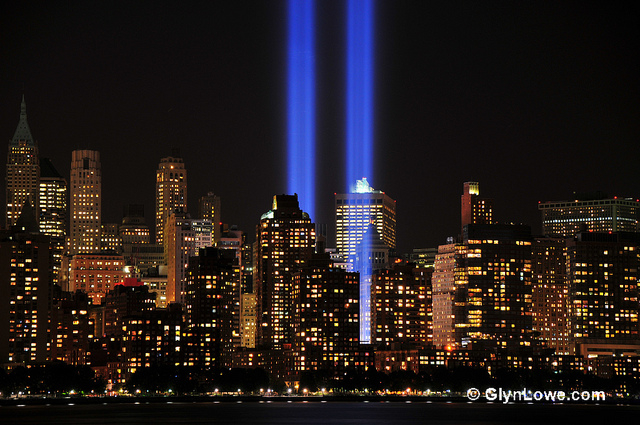
911memorialFlickrGlynLoweThe 9/11 attacks gave the US a huge opportunity to embark on a new era of global unity and partnership.
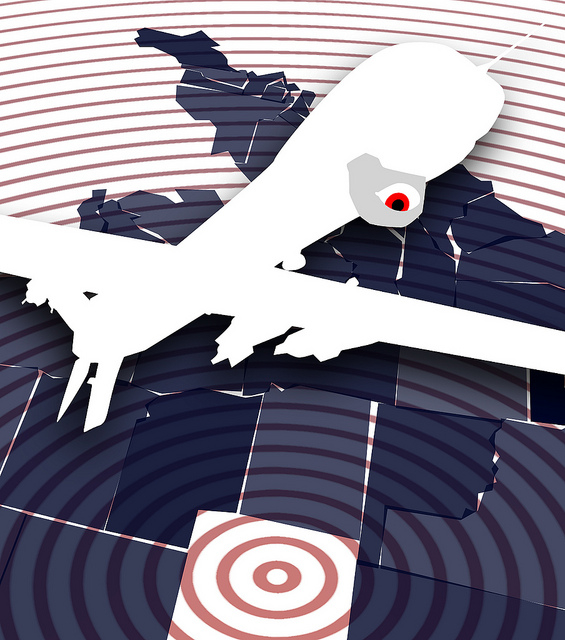
Instead, the tragedy was exploited – not only to erode Americans’ civil liberties, but to engage in endless militarism based on imperial bloodlust.

The US government tortured, bombed, invaded, occupied and destabilized entire nations that had nothing to do with 9/11 and posed no threat to this country. Incredibly, the countries that most likely did play an operational role remain the US’ strongest allies in the Middle East.

The Bush administration claimed the attacks were simply a failure of imagination, when in fact hijacking planes and crashing them into government buildings was a known tactic of terror.

Officials also turned a blind eye to an innumerable amount of warnings. From Morocco to Russia, dozens of foreign intelligence agencies warned the US of an imminent terrorist attack in the months prior to 9/11. The infamous August 6th Presidential Daily Briefing, in which Bush was warned of a 9/11 style plot, was just the tip of the iceberg. According to The New York Times, even more ‘shocking’ classified briefs were delivered to the highest echelons of the intelligence community.

Other lingering questions include why Pakistani ISI’s General Mahmoud Ahmed was having breakfast with lawmakers in DC on the morning of 9/11 after ordering Omar Sheik to wire transfer $100,000 to Mohammed Atta, the lead 9/11 hijacker. This, along with evidence of Saudi royal backing, calls into question why the 9/11 Commission Report concluded that the source of funding for the attacks is “of little practical significance.”

Despite the group’s casual disregard to investigate foreign governments that helped finance the operation, a document that could expose the subject is called The Joint Inquiry into Intelligence Community Activities Before and After The Terrorist Attacks of 9/11 – except 28 pages of it, entitled ‘Potential Sources of Foreign Support for the September 11 Hijackers,’ were redacted by the Bush administration and remain classified to this day.

Amazingly, simply bringing up any of these inconsistencies paints you as a lunatic in the mainstream media, which lumps any and all questions about 9/11 as baseless conspiracy theories. No matter how out there some of those theories indeed are, they shouldn’t delegitimize the facts.

Based on the historical record, here’s the best case scenario: Hundreds of warnings were ignored, no one was fired because of it and countless have died as a result.

**

Warnings Ignored, US Ally Funding, Bush Admin Lies & Redacted Truths

Coverage includes an exclusive interview with Brian McGlinchey, spokesperson for 28pages.org, former FBI agent and whistleblower Coleen Rowley about the agency being blocked from investigating Zacharias Moussaoui, AKA the ’20th Hijacker,’ RT’s Alexey Yaroshevsky at Ground Zero’s crass 9/11 gift shop.

**

I also went on Off the Grid with Jesse Ventura to talk about being ostracized for questioning the official 9/11 narrative as well as my trip to Guantanamo Bay.

Abby Martin Goes Off the Grid with Jesse Ventura

**

Follow me @AbbyMartin

Photo by flickr user Glyn Lowe

How Non-Violent Activists Can Land on the Drone King’s Kill List

obama droneSince 2008, the year of the worst financial crisis since the Great Depression of the 1930s, the U.S. Department of Defense has funded a multimillion dollar university research program to probe the complex dynamics of mass social and political movements, anticipate global trends, and ultimately augment the intelligence community’s preparations for civil unrest and insurgencies both abroad and at home.

Part of that has involved developing advanced new data mining and analysis tools for the U.S. military intelligence community to pinpoint imminent and potential threats from individuals and groups.

Among its many areas of focus are ongoing projects at Arizona State University (ASU) designed to enhance and automate the algorithms used by intelligence agencies like the NSA to analyze “open source” information from social media in order to track the potential threat-level to U.S. interests. Formal organizations and broad social networks as well as individuals could be identified and closely monitored with such tools to an unprecedented degree of precision.

Loosely defined concepts of political “radicalism,” violence and nonviolence, as well as questionable research methodologies, open the way for widespread suspicion of even peaceful activist groups and their members, and the equation of them with potential terrorists. Civil society organizations in the U.K., including both Muslim religious groups and non-religious anti-war networks, have been prioritized for study to test and improve the effectiveness of these data-mining tools.

Increasingly, though, the automation of threat-detection and terrorism-classification has been accompanied by the automation of killing, in the form of the generation of “kill lists” of terrorism suspects to be targeted via extrajudicial assassination by drone strikes. As President Obama, encouraged by powerful lobbies in the defense industries, has paved the way for the systematic integration of drones into domestic law-enforcement and homeland security operations, the prospect of extrajudicial assassinations occurring on U.S. soil are no longer merely hypothetical.

Now, new but little-known Pentagon directives authorize the use of armed drones against American citizens in the homeland in the context of domestic emergencies.

**

Flawed DoD Algorithms Determine Extrajudicial Assassinations

**

Algorithms of Death

“The algorithms being developed at ASU remind me of the algorithms used as the basis for signature strikes with drones,” said Thomas Drake, a former senior National Security Agency executive who leaked information about the NSA’s data-mining project Trailblazer to the press in 2006.

Drake agreed that the algorithms linked to “LookingGlass,” a new Pentagon-sponsored visual intelligence platform, could in fact be applied to fine-tuning the generation of the CIA’s notorious “kill lists.”

“Having the U.S. government and Department of Defense fund this kind of research at the university level will bias the results by default. This is a fall-out of big data research of this type, using algorithms to detect patterns when the patterns themselves are an effect – and mixing up correlation with causality. Under this flawed approach, many false positives are possible and these results can create an ends of profiling justifying the means of data-mining.”

It is now increasingly recognized that U.S. drone strikes against foreign terrorism targets have systematically killed large numbers of civilians, with a 2012 joint Stanford and New York University report suggesting that as few as 2% of casualties are “high-level” targets – an analysis cohering with counterinsurgency expert David Kilcullen’s 2009 estimate showing a “kill ratio” of 50 civilians to one militant, or, in other words, 98% civilian casualties.

“My colleagues in Special Forces tell me that the men on the front line are furious with the lack of accuracy and integrity at the national level, and no longer trust the targeting data,” said former veteran CIA case officer Robert Steele, who previously served as a Marine Corps infantry officer.

“They have seen for themselves how wrong the system is when they look their man in the eyes. Technical surveillance is the most expensive, least useful, and least accurate form of surveillance. Technology is not a substitute for thinking. We must become deeply and broadly expert at the human factor.”

Drones Come Home

U.S. administration officials including Obama himself have repeatedly refused to confirm whether the alleged legal power to conduct extrajudicial assassinations via drone strikes extends to the U.S. homeland. Last year, prior to becoming CIA director, John Brennan told the Senate Intelligence Committee: “…we do not view our authority to use military force against al-Qaeda and associated forces as being limited to ‘hot’ battlefields like Afghanistan.” He referred to Attorney General Eric Holder’s statement that “neither Congress nor our federal courts has limited the geographic scope of our ability to use force to the current conflict in Afghanistan.”

In February 2012, Obama signed in a law directing the Federal Aviation Administration (FAA) to throw American airspace wide open to drones by as early as September 2015. U.S. Customs and Border Protection (CBP) already deploys Predator drones to spot smugglers and illegal immigrants crossing into U.S. territory, and two dozen U.S. police departments have successfully applied for FAA permits for drones. As National Geographic observes, “all 18,000 law enforcement agencies in the U.S. are potential customers.” By 2020, it is estimated that some 30,000 drones would be active across the U.S. homeland.

Documents obtained under Freedom of Information by the Electronic Frontier Foundation (EFF) show that police plan to use drones essentially for surveillance. In Seattle and Miami, drones are already being used during criminal investigations and in “hot pursuit” of suspects, and could be used during natural disasters along with “specific situations with the direct authorization of the Assistant Chief of the Homeland Security Bureau.” Hundreds of “domestic drone missions” have been flown by CBP on behalf of other state and local agencies.

Last year, government documents revealed that Department of Homeland Security had customized its Predator B drones, built originally for foreign military operations, for domestic surveillance tasks and to “respond to emergency missions across the country,” including “identifying civilians carrying guns and tracking their cell phones.”

These drones are now being used on U.S. soil by the FBI, Secret Service, Texas Rangers and some local police forces. The DHS had also proposed to arm its domestic fleet of border patrol drones with “non-lethal weapons designed to immobilize TOIs [targets of interest]” – an option also being pursued by local police agencies that want to arm drones with rubber bullets, tear gas and other riot control weapons.

According to an unclassified U.S. Air Force document, the deployment of military drones in U.S. airspace will be controlled by the Pentagon and will be able to monitor unidentified groups, as well as “specifically identified” individuals with the Secretary of Defense’s approval. Military drones “are allowed to fly drones in public areas and record information on domestic situations,” noted Jennifer Lynch of the Electronic Frontier Foundation.

Executive Decisions

In February 2013, an extraordinary Pentagon directive authorized the deployment of U.S. military resources and personnel to respond to domestic emergencies, quell civil unrest and support civilian law enforcement in a domestic terrorism incident. The new directive builds on an earlier 2010/2012 DoD directive specifically authorizing the use of military surveillance drones on U.S. soil under Pentagon authority.

Although that directive prohibited the use of “armed” drones for “DSCA [Domestic Support to Civil Authorities] operations,” the new 2013 directive for Domestic Support to Civil Law-Enforcement Agencies goes further. It broadly asserts that “the Secretary of Defense may authorize the use of DoD personnel in support of civilian law enforcement officials during a domestic terrorism incident.”

Unlike the older directive, it stipulates that U.S. military commanders, including those at USNORTHCOM, USPACOM, and USSOCOM, would receive blanket authority over “operations, including the employment of armed Federal military forces at the scene of any domestic terrorist incident.” No limit is specified on what kind of “armed military forces” the Pentagon can conceivably deploy.

The “hypothetical” but nevertheless real extension of powers here was confirmed when Republican Senator Rand Paul asked Attorney General Holder to confirm the Obama administration’s position on conducting armed drone strikes on U.S. soil.

Holder wrote back that “the president could conceivably have no choice but to authorize the military to use such force if necessary to protect the homeland in the circumstances like a catastrophic attack.”

While denying any specific “intention” to do so, Holder conceded “it is possible, I suppose, to imagine an extraordinary circumstance, in which it would be necessary and appropriate under the constitution and applicable laws of the United States for the president to authorize the military to use lethal force within the territory of the United States.”

Although Holder’s comments were widely publicized last year, their pseudo-legal parallel in the form of the Pentagon’s 2013 directive was not. The latter demonstrates that Holder’s consideration of the U.S. military’s legal authority to execute drone strikes on U.S. soil is far from “hypothetical.” On the contrary, the U.S. military was determined to ensure that this extraordinary authority was formally adopted.

I asked the U.S. Department of Defense whether it could confirm that the Minerva-funded data-mining research would not be used to support the U.S. intelligence community’s analytical tools to identify terrorism suspects, in particular to identify targets for extrajudicial assassination. I did not receive a direct answer to this question.

“Research in these areas will improve strategic and operational responses to insurgencies,” said Dr. Erin Fizgerald, chief of the Minerva program. “Perhaps more importantly, these efforts will help analysts faced with a particular political environment that seems ripe for mass mobilization – or a particular movement that appears to be turning violent or destabilizing a government – know where to look to understand a particular movement and its implications for society.”

Global Instability

Prof. Mark Woodward, an anthropologist who leads the ASU projects funded by the DoD’s Minerva Research Initiative, is also affiliated to the CIA-funded Political Instability Task Force (PITF), originally formed in 1994 by appointment of the U.S. government. Although the PITF boasts of developing a predictive model with a “two-year lead time and over 80% accuracy” based purely on modelling “political institutions, and not economic conditions, demography, or geography,” in practice U.S. intelligence was unable to anticipate the unprecedented wave of instability that has swept across the Middle East and North Africa since 2011.

The Pentagon Minerva program addresses this gap in attempting to account for a complex range of interconnected factors beyond political institutions, including the impacts of environmental, energy and economic crises.

As I reported last year, the NSA’s surveillance programs are linked to extensive Pentagon planning for civil unrest in the context of escalating risks from climate, oil, food and economic shocks. Official documents over the last decade confirm that the intelligence community anticipates a heightened threat of instability, including “domestic insurgencies,” due to social and political collapse triggered by such shocks.

As episodes like the recent conflagration in Ferguson demonstrate, the Pentagon’s fears of a future of imminent domestic civil unrest are already being borne out.

Dr. Nafeez Ahmed is a bestselling author, international security scholar, investigative journalist and regular Guardian contributor on the geopolitics of interconnected environmental, energy and economic crises. This article was originally published on Occupy.com and is the fourth and last part of an investigation published. The first part can be read here, the second part here and the third part here.

Photo by Truthout on flickr