May 2008
 VANITY FAIR– Gary Rinehart clearly remembers the summer
day in 2002 when the stranger walked in and issued his threat. Rinehart
was behind the counter of the Square Deal, his “old-time country store,”
as he calls it, on the fading town square of Eagleville, Missouri, a
tiny farm community 100 miles north of Kansas City.
VANITY FAIR– Gary Rinehart clearly remembers the summer
day in 2002 when the stranger walked in and issued his threat. Rinehart
was behind the counter of the Square Deal, his “old-time country store,”
as he calls it, on the fading town square of Eagleville, Missouri, a
tiny farm community 100 miles north of Kansas City.
The Square Deal is a fixture in Eagleville, a place where farmers and
townspeople can go for lightbulbs, greeting cards, hunting gear, ice
cream, aspirin, and dozens of other small items without having to drive
to a big-box store in Bethany, the county seat, 15 miles down Interstate
35.
Everyone knows Rinehart, who was born and raised in the area and runs
one of Eagleville’s few surviving businesses. The stranger came up to
the counter and asked for him by name.
“Well, that’s me,” said Rinehart.
As Rinehart would recall, the man began verbally attacking him,
saying he had proof that Rinehart had planted Monsanto’s genetically
modified (G.M.) soybeans in violation of the company’s patent. Better
come clean and settle with Monsanto, Rinehart says the man told him—or
face the consequences.
Rinehart was incredulous, listening to the words as puzzled customers
and employees looked on. Like many others in rural America, Rinehart
knew of Monsanto’s fierce reputation for enforcing its patents and suing
anyone who allegedly violated them. But Rinehart wasn’t a farmer. He
wasn’t a seed dealer. He hadn’t planted any seeds or sold any seeds. He
owned a small—a really small—country store in a town of 350
people. He was angry that somebody could just barge into the store and
embarrass him in front of everyone. “It made me and my business look
bad,” he says. Rinehart says he told the intruder, “You got the wrong
guy.”
When the stranger persisted, Rinehart showed him the door. On the way
out the man kept making threats. Rinehart says he can’t remember the
exact words, but they were to the effect of: “Monsanto is big. You can’t
win. We will get you. You will pay.”
Scenes like this are playing out in many parts of rural America these
days as Monsanto goes after farmers, farmers’ co-ops, seed
dealers—anyone it suspects may have infringed its patents of genetically
modified seeds. As interviews and reams of court documents reveal,
Monsanto relies on a shadowy army of private investigators and agents in
the American heartland to strike fear into farm country. They fan out
into fields and farm towns, where they secretly videotape and photograph
farmers, store owners, and co-ops; infiltrate community meetings; and
gather information from informants about farming activities. Farmers say
that some Monsanto agents pretend to be surveyors. Others confront
farmers on their land and try to pressure them to sign papers giving
Monsanto access to their private records. Farmers call them the “seed
police” and use words such as “Gestapo” and “Mafia” to describe their
tactics.
When asked about these practices, Monsanto declined to comment
specifically, other than to say that the company is simply protecting
its patents. “Monsanto spends more than $2 million a day in research to
identify, test, develop and bring to market innovative new seeds and
technologies that benefit farmers,” Monsanto spokesman Darren Wallis
wrote in an e-mailed letter to Vanity Fair. “One tool in
protecting this investment is patenting our discoveries and, if
necessary, legally defending those patents against those who might
choose to infringe upon them.” Wallis said that, while the vast majority
of farmers and seed dealers follow the licensing agreements, “a tiny
fraction” do not, and that Monsanto is obligated to those who do abide
by its rules to enforce its patent rights on those who “reap the
benefits of the technology without paying for its use.” He said only a
small number of cases ever go to trial.
Some compare Monsanto’s hard-line approach to Microsoft’s zealous
efforts to protect its software from pirates. At least with Microsoft
the buyer of a program can use it over and over again. But farmers who
buy Monsanto’s seeds can’t even do that.
Continue reading about Monsanto’s Harvest of Fear.
Donald L. Barlett and James B. Steele
are Vanity Fair contributing editors.
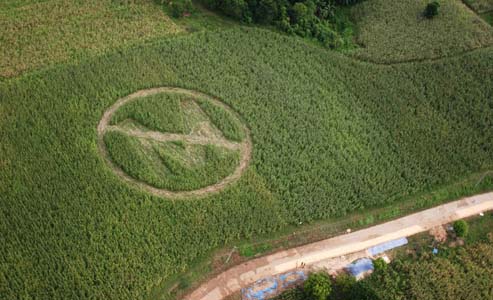
Photo by Melvyn Calderon/Greenpeace HO/A.P. Images.
© COPYRIGHT VANITY FAIR, 2008



 ALL BUSINESS
 VANITY FAIR
 GUARDIAN