Obama Advisers Say No Charges Against Those Who Authorized Torture

TRUTHOUT– Barack Obama’s incoming administration is unlikely to bring criminal charges against government officials who authorized or engaged in harsh interrogations of suspected terrorists during the George W. Bush presidency. Obama, who has criticized the use of torture, is being urged by some constitutional scholars and human rights groups to investigate possible war crimes by the Bush administration.

Two Obama advisers said there’s little – if any – chance that the incoming president’s Justice Department will go after anyone involved in authorizing or carrying out interrogations that provoked worldwide outrage.

The advisers spoke on condition of anonymity because the plans are still tentative. A spokesman for Obama’s transition team did not respond to requests for comment Monday.

Additionally, the question of whether to prosecute may never become an issue if Bush issues pre-emptive pardons to protect those involved.

Obama has committed to reviewing interrogations on al-Qaida and other terror suspects. After he takes office in January, Obama is expected to create a panel modeled after the 9/11 Commission to study interrogations, including those using waterboarding and other tactics that critics call torture. The panel’s findings would be used to ensure that future interrogations are undisputedly legal.

“I have said repeatedly that America doesn’t torture, and I’m going to make sure that we don’t torture,” Obama said Sunday on CBS’ “60 Minutes.” “Those are part and parcel of an effort to regain America’s moral stature in the world.”

Obama’s most ardent supporters are split on whether he should prosecute Bush officials.

Asked this weekend during a Vermont Public Radio interview if Bush administration officials would face war crimes, Senate Judiciary Chairman Patrick Leahy flatly said, “In the United States, no.”

“These things are not going to happen,” said Leahy, D-Vt.

Robert Litt, a former top Clinton administration Justice Department prosecutor, said Obama should focus on moving forward with anti-torture policy instead of looking back.

“Both for policy and political reasons, it would not be beneficial to spend a lot of time hauling people up before Congress or before grand juries and going over what went on,” Litt said at a Brookings Institution discussion about Obama’s legal policy. “To as great of an extent we can say, the last eight years are over, now we can move forward – that would be beneficial both to the country and the president, politically.”

But Michael Ratner, a professor at Columbia Law School and president of the Center for Constitutional Rights, said prosecuting Bush officials is necessary to set future anti-torture policy.

“The only way to prevent this from happening again is to make sure that those who were responsible for the torture program pay the price for it,” Ratner said. “I don’t see how we regain our moral stature by allowing those who were intimately involved in the torture programs to simply walk off the stage and lead lives where they are not held accountable.”

In the years after the Sept. 11, 2001, terror attacks, the White House authorized U.S. interrogators to use harsh tactics on captured al-Qaida and Taliban suspects. Bush officials relied on a 2002 Justice Department legal memo to assert that its interrogations did not amount to torture – and therefore did not violate U.S. or international laws. That memo has since been rescinded.

At least three top al-Qaida operatives – including 9/11 mastermind Khalid Sheik Mohammed – were waterboarded in 2002 and 2003 because of intelligence officials’ belief that more attacks were imminent. Waterboarding creates the sensation of drowning, and has been traced back hundreds of years and is condemned by nations worldwide.

Bush could take the issue of criminal charges off the table with one stroke of his pardons pen. Whether Bush will protect his top aides and interrogators with a pre-emptive pardon – before they are ever charged – has become a hot topic of discussion in legal and political circles in the administration’s waning days. White House deputy press secretary Tony Fratto declined to comment on the issue.

Under the Constitution, the president’s power to issue pardons is absolute and cannot be overruled.

Pre-emptive pardons would be highly controversial, but former White House counsel Arthur B. Culvahouse Jr. said it would protect those who were following orders or otherwise trying to protect the nation.

“I know of no one who acted in reckless disregard of U.S. law or international law,” said Culvahouse, who served under President Ronald Reagan. “It’s just not good for the intelligence community and the defense community to have people in the field, under exigent circumstances, being told these are the rules, to be exposed months and years after the fact to criminal prosecution.”

The Federalist Papers discourage presidents from pardoning themselves. It took former President Gerald Ford to clear former President Richard Nixon of wrongdoing in the 1972 Watergate break-in.

All republished content that appears on Truthout has been obtained by permission or license.

© TRUTHOUT 2008
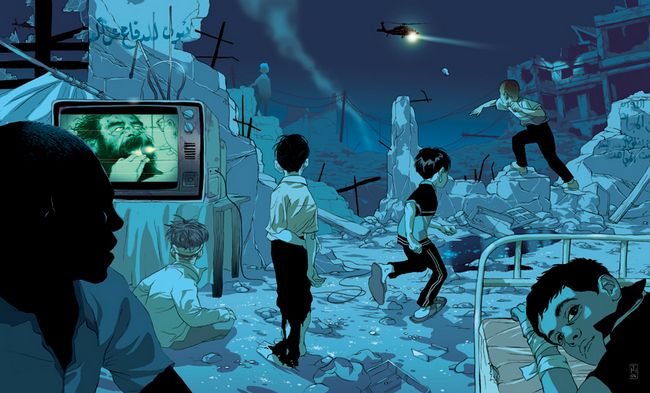
Tomer Hanuka – Graphic Illustrator

Night Probe


Sunset


Cholera


BIO– Tomer Hanuka is an illustrator and a cartoonist based in New York City. He works on a range of projects for magazines, book publishers, ad agencies and film studios. His Clients include The New Yorker, D.C comics, Nike and Microsoft. He has won multiple gold medals from the Society of Illustrators and the Society of Publication designers, and was showcased in Print magazine and American Illustration. In 2008 a book cover he created won the British Desgin Museum award as part of the Penguin Classics Deluxe Editions. Waltz With Bashir, an animated documentary for which Tomer contributed art, was nominated for an Oscar in 2009, and won the Golden Globe that same year. Currently he teaches at the School of Visual Arts and is working on a graphic novel with his twin brother Asaf.

To see more of Tomer’s work go to http://www.thanuka.com/

Posted in Uncategorized | 1 Reply

How California Decreed You Drink Fluoride in Your Water

water fluorideEL DORADO HILLS TELEGRAPH– Ignoring the democratic process and discouraging a healthy dialogue, the California Dental Association worked secretly and quickly to pass the 1995 California fluoridation law, forcing most California communities to add fluoride chemicals into the public water supplies, whether Californians want it or not, according to “The Fluoride Victory,” published in the Journal of the California Dental Association. It’s supposed to stop tooth decay in tap water drinkers, but research has proven otherwise.

California Assemblywoman Jackie Speier, working with the California Dental Association (CDA), sponsored the fluoridation bill that was signed into law in 1995, forcing all California water companies with 10,000 service connections to add nonessential fluoride chemicals into the drinking water without constituent or local governing body approval, discussion or referendum.

“To make the most of the element of surprise, it was decided that Speier would wait until the last possible moment to introduce her fluoridation bill,” writes author Joanne Boyd.

“’We pretty much knew we’d catch (the anti-fluoridation faction) by surprise because it wasn’t well known outside of the dental community what was going on,’ said Liz Snow, assistant director of CDA’s Government Relations (lobbying) Office. ‘But we didn’t want to give the other side any more time to mobilize than absolutely necessary,’” writes Boyd.

Continue reading about How California Decreed You Drink Fluoride in Your Water.

© El Dorado Hills Telegraph, 2008

Photo by flick user Gary Riegler Photography

Comcast Blocks Internet Traffic

MSNBC– Comcast Corp. actively interferes with attempts by some of its high-speed Internet subscribers to share files online, a move that runs counter to the tradition of treating all types of Net traffic equally.

The interference, which The Associated Press confirmed through nationwide tests, is the most drastic example yet of data discrimination by a U.S. Internet service provider. It involves company computers masquerading as those of its users.

If widely applied by other ISPs, the technology Comcast is using would be a crippling blow to the BitTorrent, eDonkey and Gnutella file-sharing networks. While these are mainly known as sources of copyright music, software and movies, BitTorrent in particular is emerging as a legitimate tool for quickly disseminating legal content.

The principle of equal treatment of traffic, called “Net Neutrality” by proponents, is not enshrined in law but supported by some regulations. Most of the debate around the issue has centered on tentative plans, now postponed, by large Internet carriers to offer preferential treatment of traffic from certain content providers for a fee.

Comcast’s interference, on the other hand, appears to be an aggressive way of managing its network to keep file-sharing traffic from swallowing too much bandwidth and affecting the Internet speeds of other subscribers.

Continue reading about Comcast Blocking Internet Traffic.

© COPYRIGHT Associated Press, 2007

Internet Providers Want to Meter Usage

MSNBC– If Internet service providers’ current experiments succeed, subscribers may end up paying for high-speed Internet based on how much material they download. Trials with such metered access, rather than the traditional monthly flat fee for unlimited connection time, offer enough bandwidth that they won’t affect many consumers — yet.

But as more people use the Internet to watch TV and stream movies, they could bump up against the metered rates’ caps, paying expensive over-use fees. Watching a movie may then require paying two fees: one for the movie, another to the cable company.

More and more television programming and movies are available online, through sites including Hulu, Netflix Watch Instantly, YouTube and Amazon.com’s Video on Demand.

“If you wanted to watch TV over the Internet in 2000, you had to be willing to take much less content than cable,” said Bobby Tulsiani, a senior analyst with Forrester Research in New York. “Now you get much, much more. Of course, you’re still watching on your PC, not your TV, so there are tradeoffs, but they are tradeoffs many people are willing to make.”

Most consumers probably don’t realize how much bandwidth their Internet usage consumes, because they’ve never had to care. Time Warner, the nation’s third-largest Internet service provider, in its five experimental markets is offering 5 gigabytes of downloaded Internet content for $29.95 per month. That translates to 15 hours of viewing standard-definition video, or 350,000 e-mails, or 170 hours of online gaming, or some combination of those activities, according to the company. A high-definition movie consumes about 7GB of bandwidth.

In addition to compelling consumers to monitor their Internet usage, metering could have broad societal effects, including disenfranchising the poor, retarding network growth and discouraging innovation, some experts say.

Continue reading about ISPs Metering Usage.

© COPYRIGHT MSNBC, 2009