How to Get Our Democracy Back

NATION– We should remember what it felt like one year ago, as the ability to recall it emotionally will pass and it is an emotional memory as much as anything else. It was a moment rare in a democracy’s history. The feeling was palpable–to supporters and opponents alike–that something important had happened. America had elected, the young candidate promised, a transformational president. And wrapped in a campaign that had produced the biggest influx of new voters and small-dollar contributions in a generation, the claim seemed credible, almost intoxicating, and just in time.

Yet a year into the presidency of Barack Obama, it is already clear that this administration is an opportunity missed. Not because it is too conservative. Not because it is too liberal. But because it is too conventional. Obama has given up the rhetoric of his early campaign–a campaign that promised to “challenge the broken system in Washington” and to “fundamentally change the way Washington works.” Indeed, “fundamental change” is no longer even a hint.

Instead, we are now seeing the consequences of a decision made at the most vulnerable point of Obama’s campaign–just when it seemed that he might really have beaten the party’s presumed nominee. For at that moment, Obama handed the architecture of his new administration over to a team that thought what America needed most was another Bill Clinton. A team chosen by the brother of one of DC’s most powerful lobbyists, and a White House headed by the quintessential DC politician. A team that could envision nothing more than the ordinary politics of Washington–the kind of politics Obama had called “small.” A team whose imagination–politically–is tiny.

These tiny minds–brilliant though they may be in the conventional game of DC–have given up what distinguished Obama’s extraordinary campaign. Not the promise of healthcare reform or global warming legislation–Hillary Clinton had embraced both of those ideas, and every other substantive proposal that Obama advanced. Instead, the passion that Obama inspired grew from the recognition that something fundamental had gone wrong in the way our government functions, and his commitment to reform it.

For Obama once spoke for the anger that has now boiled over in even the blue state Massachusetts–that our government is corrupt; that fundamental change is needed. As he told us, both parties had allowed “lobbyists and campaign contributions to rig the system.” And “unless we’re willing to challenge [that] broken system…nothing else is going to change.” “The reason” Obama said he was “running for president [was] to challenge that system.” For “if we’re not willing to take up that fight, then real change–change that will make a lasting difference in the lives of ordinary Americans–will keep getting blocked by the defenders of the status quo.”

This administration has not “taken up that fight.” Instead, it has stepped down from the high ground the president occupied on January 20, 2009, and played a political game no different from the one George W. Bush played, or Bill Clinton before him. Obama has accepted the power of the “defenders of the status quo” and simply negotiated with them. “Audacity” fits nothing on the list of last year’s activity, save the suggestion that this is the administration the candidate had promised.

Read more about How to Get Our Democracy Back.

Editors’ Note: We encourage readers moved by this essay to sign the Change Congress petition, a drive to enact solutions proposed in this article. Click here to sign. A video commentary by Professor Lessig can be viewed here.

© THE NATION 2010

Democracy in America a Useful Fiction

TRUTHDIG– Corporate forces, long before the Supreme Court’s decision in Citizens United v. Federal Election Commission, carried out a coup d’état in slow motion. The coup is over. We lost. The ruling is one more judicial effort to streamline mechanisms for corporate control. It exposes the myth of a functioning democracy and the triumph of corporate power. But it does not significantly alter the political landscape. The corporate state is firmly cemented in place.

The fiction of democracy remains useful, not only for corporations, but for our bankrupt liberal class. If the fiction is seriously challenged, liberals will be forced to consider actual resistance, which will be neither pleasant nor easy. As long as a democratic facade exists, liberals can engage in an empty moral posturing that requires little sacrifice or commitment. They can be the self-appointed scolds of the Democratic Party, acting as if they are part of the debate and feel vindicated by their cries of protest.

Much of the outrage expressed about the court’s ruling is the outrage of those who prefer this choreographed charade. As long as the charade is played, they do not have to consider how to combat what the political philosopher Sheldon Wolin calls our system of “inverted totalitarianism.”

Inverted totalitarianism represents “the political coming of age of corporate power and the political demobilization of the citizenry,” Wolin writes in “Democracy Incorporated.” Inverted totalitarianism differs from classical forms of totalitarianism, which revolve around a demagogue or charismatic leader, and finds its expression in the anonymity of the corporate state. The corporate forces behind inverted totalitarianism do not, as classical totalitarian movements do, boast of replacing decaying structures with a new, revolutionary structure. They purport to honor electoral politics, freedom and the Constitution. But they so corrupt and manipulate the levers of power as to make democracy impossible.

Inverted totalitarianism is not conceptualized as an ideology or objectified in public policy. It is furthered by “power-holders and citizens who often seem unaware of the deeper consequences of their actions or inactions,” Wolin writes. But it is as dangerous as classical forms of totalitarianism. In a system of inverted totalitarianism, as this court ruling illustrates, it is not necessary to rewrite the Constitution, as fascist and communist regimes do. It is enough to exploit legitimate power by means of judicial and legislative interpretation.

This exploitation ensures that huge corporate campaign contributions are protected speech under the First Amendment. It ensures that heavily financed and organized lobbying by large corporations is interpreted as an application of the people’s right to petition the government. The court again ratified the concept that corporations are persons, except in those cases where the “persons” agree to a “settlement.” Those within corporations who commit crimes can avoid going to prison by paying large sums of money to the government while, according to this twisted judicial reasoning, not “admitting any wrongdoing.” There is a word for this. It is called corruption.

Corporations have 35,000 lobbyists in Washington and thousands more in state capitals that dole out corporate money to shape and write legislation. They use their political action committees to solicit employees and shareholders for donations to fund pliable candidates. The financial sector, for example, spent more than $5 billion on political campaigns, influence peddling and lobbying during the past decade, which resulted in sweeping deregulation, the gouging of consumers, our global financial meltdown and the subsequent looting of the U.S. Treasury.

The Pharmaceutical Research and Manufacturers of America spent $26 million last year and drug companies such as Pfizer, Amgen and Eli Lilly kicked in tens of millions more to buy off the two parties. These corporations have made sure our so-called health reform bill will force us to buy their predatory and defective products. The oil and gas industry, the coal industry, defense contractors and telecommunications companies have thwarted the drive for sustainable energy and orchestrated the steady erosion of civil liberties. Politicians do corporate bidding and stage hollow acts of political theater to keep the fiction of the democratic state alive.

There is no national institution left that can accurately be described as democratic. Citizens, rather than participate in power, are allowed to have virtual opinions to preordained questions, a kind of participatory fascism as meaningless as voting on “American Idol.” Mass emotions are directed toward the raging culture wars. This allows us to take emotional stands on issues that are inconsequential to the power elite.

Our transformation into an empire, as happened in ancient Athens and Rome, has seen the tyranny we practice abroad become the tyranny we practice at home. We, like all empires, have been eviscerated by our own expansionism. We utilize weapons of horrific destructive power, subsidize their development with billions in taxpayer dollars, and are the world’s largest arms dealer. And the Constitution, as Wolin notes, is “conscripted to serve as power’s apprentice rather than its conscience.”

“Inverted totalitarianism reverses things,” Wolin writes. “It is politics all of the time but a politics largely untempered by the political. Party squabbles are occasionally on public display, and there is a frantic and continuous politics among factions of the party, interest groups, competing corporate powers, and rival media concerns. And there is, of course, the culminating moment of national elections when the attention of the nation is required to make a choice of personalities rather than a choice between alternatives. What is absent is the political, the commitment to finding where the common good lies amidst the welter of well-financed, highly organized, single-minded interests rabidly seeking governmental favors and overwhelming the practices of representative government and public administration by a sea of cash.” 

Hollywood, the news industry and television, all corporate controlled, have become instruments of inverted totalitarianism. They censor or ridicule those who critique or challenge corporate structures and assumptions. They saturate the airwaves with manufactured controversy, whether it is Tiger Woods or the dispute between Jay Leno and Conan O’Brien. They manipulate images to make us confuse how we are made to feel with knowledge, which is how Barack Obama became president. And the draconian internal control employed by the Department of Homeland Security, the military and the police over any form of popular dissent, coupled with the corporate media’s censorship, does for inverted totalitarianism what thugs and bonfires of books do in classical totalitarian regimes.

“It seems a replay of historical experience that the bias displayed by today’s media should be aimed consistently at the shredded remains of liberalism,” Wolin writes. “Recall that an element common to most 20th century totalitarianism, whether Fascist or Stalinist, was hostility towards the left. In the United States, the left is assumed to consist solely of liberals, occasionally of ‘the left wing of the Democratic Party,’ never of democrats.”

Liberals, socialists, trade unionists, independent journalists and intellectuals, many of whom were once important voices in our society, have been silenced or targeted for elimination within corporate-controlled academia, the media and government. Wolin, who taught at Berkeley and later at Princeton, is arguably the country’s foremost political philosopher. And yet his book was virtually ignored. This is also why Ralph Nader, Dennis Kucinich and Cynthia McKinney, along with intellectuals like Noam Chomsky, are not given a part in our national discourse.

The uniformity of opinion is reinforced by the skillfully orchestrated mass emotions of nationalism and patriotism, which paints all dissidents as “soft” or “unpatriotic.” The “patriotic” citizen, plagued by fear of job losses and possible terrorist attacks, unfailingly supports widespread surveillance and the militarized state. This means no questioning of the $1 trillion in defense-related spending. It means that the military and intelligence agencies are held above government, as if somehow they are not part of government. The most powerful instruments of state power and control are effectively removed from public discussion. We, as imperial citizens, are taught to be contemptuous of government bureaucracy, yet we stand like sheep before Homeland Security agents in airports and are mute when Congress permits our private correspondence and conversations to be monitored and archived. We endure more state control than at any time in American history. 

The civic, patriotic and political language we use to describe ourselves remains unchanged. We pay fealty to the same national symbols and iconography. We find our collective identity in the same national myths. We continue to deify the Founding Fathers. But the America we celebrate is an illusion. It does not exist. Our government and judiciary have no real sovereignty. Our press provides diversion, not information. Our organs of security and power keep us as domesticated and as fearful as most Iraqis. Capitalism, as Karl Marx understood, when it emasculates government, becomes a revolutionary force. And this revolutionary force, best described as inverted totalitarianism, is plunging us into a state of neo-feudalism, perpetual war and severe repression. The Supreme Court decision is part of our transformation by the corporate state from citizens to prisoners.

Chris Hedges writes a regular column for Truthdig.com. Hedges graduated from Harvard Divinity School and was for nearly two decades a foreign correspondent for The New York Times. He is the author of many books, including: War Is A Force That Gives Us Meaning, What Every Person Should Know About War, and American Fascists: The Christian Right and the War on America.  His most recent book is Empire of Illusion: The End of Literacy and the Triumph of Spectacle

© 2010 TruthDig

Shrimp’s Dirty Secrets

shrimpALTERNET– Americans love their shrimp. It’s the most popular seafood in the country, but unfortunately much of the shrimp we eat are a cocktail of chemicals, harvested at the expense of one of the world’s productive ecosystems. Worse, guidelines for finding some kind of “sustainable shrimp” are so far nonexistent.

In his book, Bottomfeeder: How to Eat Ethically in a World of Vanishing Seafood, Taras Grescoe paints a repulsive picture of how shrimp are farmed in one region of India. The shrimp pond preparation begins with urea, superphosphate, and diesel, then progresses to the use of piscicides (fish-killing chemicals like chlorine and rotenone), pesticides and antibiotics (including some that are banned in the U.S.), and ends by treating the shrimp with sodium tripolyphosphate (a suspected neurotoxicant), Borax, and occasionally caustic soda.

Upon arrival in the U.S., few if any, are inspected by the FDA, and when researchers have examined imported ready-to-eat shrimp, they found 162 separate species of bacteria with resistance to 10 different antibiotics. And yet, as of 2008, Americans are eating 4.1 pounds of shrimp apiece each year — significantly more than the 2.8 pounds per year we each ate of the second most popular seafood, canned tuna. But what are we actually eating without knowing it? And is it worth the price — both to our health and the environment?

Continue reading about Shrimp’s Dirty Secrets

© 2010 Independent Media Institute

Photo by flickr user adactio

The Secret Downing Street Memo

TIMES ONLINESECRET AND STRICTLY PERSONAL – UK EYES ONLY

DAVID MANNING
From: Matthew Rycroft
Date: 23 July 2002
S 195 02

cc: Defence Secretary, Foreign Secretary, Attorney-General, Sir Richard Wilson, John Scarlett, Francis Richards, CDS, C, Jonathan Powell, Sally Morgan, Alastair Campbell

IRAQ: PRIME MINISTER’S MEETING, 23 JULY

Copy addressees and you met the Prime Minister on 23 July to discuss Iraq.

This record is extremely sensitive. No further copies should be made. It should be shown only to those with a genuine need to know its contents.

John Scarlett summarised the intelligence and latest JIC assessment. Saddam’s regime was tough and based on extreme fear. The only way to overthrow it was likely to be by massive military action. Saddam was worried and expected an attack, probably by air and land, but he was not convinced that it would be immediate or overwhelming. His regime expected their neighbours to line up with the US. Saddam knew that regular army morale was poor. Real support for Saddam among the public was probably narrowly based.

C reported on his recent talks in Washington. There was a perceptible shift in attitude. Military action was now seen as inevitable. Bush wanted to remove Saddam, through military action, justified by the conjunction of terrorism and WMD. But the intelligence and facts were being fixed around the policy. The NSC had no patience with the UN route, and no enthusiasm for publishing material on the Iraqi regime’s record. There was little discussion in Washington of the aftermath after military action.

CDS said that military planners would brief CENTCOM on 1-2 August, Rumsfeld on 3 August and Bush on 4 August.

The two broad US options were:

(a) Generated Start. A slow build-up of 250,000 US troops, a short (72 hour) air campaign, then a move up to Baghdad from the south. Lead time of 90 days (30 days preparation plus 60 days deployment to Kuwait).

(b) Running Start. Use forces already in theatre (3 x 6,000), continuous air campaign, initiated by an Iraqi casus belli. Total lead time of 60 days with the air campaign beginning even earlier. A hazardous option.

The US saw the UK (and Kuwait) as essential, with basing in Diego Garcia and Cyprus critical for either option. Turkey and other Gulf states were also important, but less vital. The three main options for UK involvement were:

(i) Basing in Diego Garcia and Cyprus, plus three SF squadrons.

(ii) As above, with maritime and air assets in addition.

(iii) As above, plus a land contribution of up to 40,000, perhaps with a discrete role in Northern Iraq entering from Turkey, tying down two Iraqi divisions.

The Defence Secretary said that the US had already begun “spikes of activity” to put pressure on the regime. No decisions had been taken, but he thought the most likely timing in US minds for military action to begin was January, with the timeline beginning 30 days before the US Congressional elections.

The Foreign Secretary said he would discuss this with Colin Powell this week. It seemed clear that Bush had made up his mind to take military action, even if the timing was not yet decided. But the case was thin. Saddam was not threatening his neighbours, and his WMD capability was less than that of Libya, North Korea or Iran. We should work up a plan for an ultimatum to Saddam to allow back in the UN weapons inspectors. This would also help with the legal justification for the use of force.

The Attorney-General said that the desire for regime change was not a legal base for military action. There were three possible legal bases: self-defence, humanitarian intervention, or UNSC authorisation. The first and second could not be the base in this case. Relying on UNSCR 1205 of three years ago would be difficult. The situation might of course change.

The Prime Minister said that it would make a big difference politically and legally if Saddam refused to allow in the UN inspectors. Regime change and WMD were linked in the sense that it was the regime that was producing the WMD. There were different strategies for dealing with Libya and Iran. If the political context were right, people would support regime change. The two key issues were whether the military plan worked and whether we had the political strategy to give the military plan the space to work.

On the first, CDS said that we did not know yet if the US battleplan was workable. The military were continuing to ask lots of questions.

For instance, what were the consequences, if Saddam used WMD on day one, or if Baghdad did not collapse and urban warfighting began? You said that Saddam could also use his WMD on Kuwait. Or on Israel, added the Defence Secretary.

The Foreign Secretary thought the US would not go ahead with a military plan unless convinced that it was a winning strategy. On this, US and UK interests converged. But on the political strategy, there could be US/UK differences. Despite US resistance, we should explore discreetly the ultimatum. Saddam would continue to play hard-ball with the UN.

John Scarlett assessed that Saddam would allow the inspectors back in only when he thought the threat of military action was real.

The Defence Secretary said that if the Prime Minister wanted UK military involvement, he would need to decide this early. He cautioned that many in the US did not think it worth going down the ultimatum route. It would be important for the Prime Minister to set out the political context to Bush.

Conclusions:

(a) We should work on the assumption that the UK would take part in any military action. But we needed a fuller picture of US planning before we could take any firm decisions. CDS should tell the US military that we were considering a range of options.

(b) The Prime Minister would revert on the question of whether funds could be spent in preparation for this operation.

(c) CDS would send the Prime Minister full details of the proposed military campaign and possible UK contributions by the end of the week.

(d) The Foreign Secretary would send the Prime Minister the background on the UN inspectors, and discreetly work up the ultimatum to Saddam.

He would also send the Prime Minister advice on the positions of countries in the region especially Turkey, and of the key EU member states.

(e) John Scarlett would send the Prime Minister a full intelligence update.

(f) We must not ignore the legal issues: the Attorney-General would consider legal advice with FCO/MOD legal advisers.

(I have written separately to commission this follow-up work.)

MATTHEW RYCROFT

(Rycroft was a Downing Street foreign policy aide)

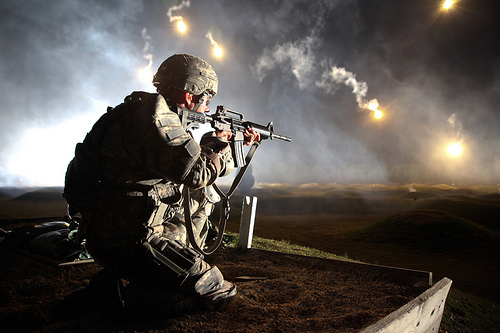
Bush Began Invasion Before Authorized by Congress

DEMOCRACY NOW– Writing in The Nation magazine, Democracy Now! correspondent Jeremy Scahill reports on Washington’s undeclared air war against Iraq in 2002:

“It was a huge air assault: Approximately 100 US and British planes flew from Kuwait into Iraqi airspace. At least seven types of aircraft were part of this massive operation, including US F-15 Strike Eagles and Royal Air Force Tornado ground-attack planes. They dropped precision-guided munitions on Saddam Hussein’s major western air-defense facility, clearing the path for Special Forces helicopters that lay in wait in Jordan. Earlier attacks had been carried out against Iraqi command and control centers, radar detection systems, Revolutionary Guard units, communication centers and mobile air-defense systems. The Pentagon’s goal was clear: Destroy Iraq’s ability to resist. This was war.

“But there was a catch: The war hadn’t started yet, at least not officially. This was September 2002–a month before Congress had voted to give President Bush the authority he used to invade Iraq, two months before the United Nations brought the matter to a vote and more than six months before “shock and awe” officially began.”

AMY GOODMAN: Here to talk about this all with us is Jeremy Scahill, producer and correspondent for Democracy Now!, has an article at The Nation magazine’s website, called “The Other Bomb Drops: How Bush Began the Iraq Invasion Before He Went to Congress or the U.N.” We are also joined on the telephone by Hans Von Sponeck, former Assistant Secretary General of the United Nations. And we are joined by John Bonifaz, who has just begun a website that deals with this issue. He is author of Warrior King: The Case for Impeaching George W. Bush. The website is called, AfterDowningStreet.org, a coalition of various groups urging Congress to begin a formal investigation to whether Bush has committed impeachable offenses in connection with the invasion of Iraq. Let’s begin, Jeremy, with you. Welcome to Democracy Now!, on this side of the mic.

JEREMY SCAHILL: Thank you, Amy. It’s good to be here.

AMY GOODMAN: Talk about what you found.

JEREMY SCAHILL: I think for many people who have been following the politics of the invasion and occupation of Iraq, it comes as no surprise to learn that the Bush administration intentionally misled the U.S. public and the world and operated with tremendous bad faith when it said it was trying to do everything it could to avoid war. And what we have here is really solid documentation that backs that up. What the British Times of London published last weekend was statistics from the British defense ministry that showed that in the second half of 2002—let’s remember that the invasion of Iraq officially began in March of 2003—that from May 2002 until the end of 2002, that the United States and Britain doubled the amount of attacks that—the number of attacks that they were carrying out against Iraq, from the whole of 2001. So, what you saw was the Bush administration ordering attacks, offensive attacks on Iraq, that were intended to take out communications infrastructure in the country, the ability of commanders in the Iraqi military to communicate with one another, pretty much defensive mechanics for the country, and these attacks were happening with the justification that they were protecting the so-called no-fly zones in Iraq.

The real scandal here is that the Bush administration, like the Clinton administration before it, oversaw the longest sustained bombing campaign since Vietnam. We reported on this show for years consistently that the United States was bombing Iraq once every three days. This bombing began—you could say that the preparations for this invasion began the moment that the so-called Gulf War ended and that Clinton laid the groundwork for this in his regular bombings of Iraq. We saw a spike in activity in these so-called no-fly zone attacks which had no U.N. mandate whatsoever, which were not approved by the international community.

AMY GOODMAN: Which are often mistakenly called the U.N. no-fly zones.

JEREMY SCAHILL: Right. And it was only the United States and Britain. France pulled out almost immediately after the United States began this program. So you had the United States and Britain, and then with the approval and support of some of the puppet regimes in the region that were for whatever reason in bed with the United States. After the passage of the Iraq Liberation Act in 1998, you saw an escalation in the so-called no-fly zones. The Clinton administration was using them to try to provoke Saddam Hussein’s regime into attacking the United States to justify further attacks. And you remember there was the heavy bombing known as “Operation Desert Fox” in December of 1998. So the Clinton administration is not innocent here. It carried out illegal bombings against Iraq consistently throughout the presidency of Clinton.

What we saw that sort of changed here under Bush is that the Bush administration dropped all of the rhetoric about the no-fly zones having something to do with defending Shiites or Kurds and actually were quite public about what they were using these no-fly zones for. They were using them to systematically and preemptively degrade Iraq’s ability to defend itself, not from an uprising of Shiites or Kurds, but from the invasion of a foreign army.

AMY GOODMAN: And then, can you locate the Downing Street memo, talk about its significance, and what happened with the bombing then? This Downing Street memo, what, July 23rd, 2002.

JEREMY SCAHILL: Yes. It reports on a meeting that senior British officials had had with members of the Bush administration, and what it is is a reflection of what the British understood to be the United States’ policy at the moment. And what’s clear from reading this—it’s actually not a memo, it’s minutes, but it’s called the Downing Street memo. It’s minutes of this meeting with Tony Blair and some of his most senior defense advisers. And the picture that is painted from this memo is that the United States already was not just planning and preparing for war, but was actively carrying out air strikes in support of this war. The invasion had begun already when the British had this meeting. And we find that in the form of remarks attributed to Geoff Hoon within these minutes, where he is talking about the Americans already spiking up activity against Saddam Hussein, and what he’s referring to is the increasing use of these so-called no-fly zones to degrade Iraq’s ability to defend against a U.S. invasion and to prepare the route for U.S. Special Forces to enter into the country. In September of 2002—now this is months before the actual invasion officially began, and a few months before Bush went to the Congress or the United Nations—100 aircraft violate Iraqi airspace, British and American aircraft. They go in and they carry out a systematic campaign of air strikes in the west of Iraq and basically destroy the west of Iraq’s ability to defend against an invasion. And that was one of the main places where U.S. Special Forces troops came in from Jordan into the west of Iraq. That happened in September of 2002. We’re talking about months before the actual invasion began.

AMY GOODMAN: We are talking to Democracy Now! correspondent, Jeremy Scahill, has a piece in The Nation online called “The Other Bomb Drops.” When we come back, we’ll also be joined by attorney John Bonifaz and the former U.N. Assistant Secretary General, Hans Von Sponeck..

Photo by Flickr user US Army