Sweetener Linked to Leukemias

aspartame sodasBBC– Aspartame is 200 times sweeter than sugar and is used throughout the world in low-calorie drinks and foods. Regulators say existing studies show it is safe, but will look at the European Journal of Clinical Oncology study.
But they said it was unlikely that the sweetener was harmful to humans to the same extent as in rats. Concerns have been raised about the aspartame in the past, but an analysis of 500 papers by UK regulators in 2002 concluded there was no threat to consumers.

The Food Standards Agency said: “The European Food Safety Authority intends to undertake an urgent assessment of this study to establish whether there are any implications for human health.

“We will study EFSA’s opinion carefully and consider what, if any, action may be required.”

Dr Elaine Vickers, cancer information officer at Cancer Research UK, said: “If a risk to humans does exist, it will almost certainly be very small.

“However, we welcome the news that the EFSA will undertake an urgent assessment of this work.”

Continue reading about Sweetener Linked to Leukemias

© BBC, 2005

Photo by flickr user Lee Coursey

Top Bush Advisers Approved Enhanced Interrogation Techniques

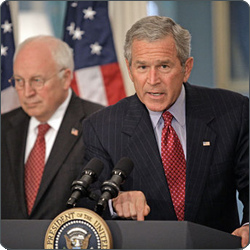
ABC NEWS– In dozens of top-secret talks and meetings in the White House, the most senior Bush administration officials discussed and approved specific details of how high-value al Qaeda suspects would be interrogated by the Central Intelligence Agency, sources tell ABC News.

The so-called Principals who participated in the meetings also approved the use of “combined” interrogation techniques — using different techniques during interrogations, instead of using one method at a time — on terrorist suspects who proved difficult to break, sources said.

Highly placed sources said a handful of top advisers signed off on how the CIA would interrogate top al Qaeda suspects — whether they would be slapped, pushed, deprived of sleep or subjected to simulated drowning, called waterboarding.

The high-level discussions about these “enhanced interrogation techniques” were so detailed, these sources said, some of the interrogation sessions were almost choreographed — down to the number of times CIA agents could use a specific tactic.

The advisers were members of the National Security Council’s Principals Committee, a select group of senior officials who met frequently to advise President Bush on issues of national security policy.

At the time, the Principals Committee included Vice President Cheney, former National Security Advisor Condoleezza Rice, Defense Secretary Donald Rumsfeld and Secretary of State Colin Powell, as well as CIA Director George Tenet and Attorney General John Ashcroft.

As the national security adviser, Rice chaired the meetings, which took place in the White House Situation Room and were typically attended by most of the principals or their deputies.

Contacted by ABC News today, spokesmen for Tenet, Rumsfeld and Powell declined to comment about the interrogation program or their private discussions in Principals Meetings. Powell said through an assistant there were “hundreds of [Principals] meetings” on a wide variety of topics and that he was “not at liberty to discuss private meetings.”

The White House also declined comment on behalf of Rice and Cheney. Ashcroft could not be reached for comment today. 

Critics at home and abroad have harshly criticized the interrogation program, which pushed the limits of international law and, they say, condoned torture. Bush and his top aides have consistently defended the program. They say it is legal and did not constitute torture.

Continue reading about Top Bush Advisors Approving Enhanced Interrogation Techniques.

Photo by flickr user Blatant News

© ABC, 2008

Bush-era Interrogations: From Waterboarding to Forced Nudity

MCCLATCHY– The long-awaited release Thursday of four Bush-era memos lays out in clinical detail many of the controversial interrogation methods secretly authorized by the Bush administration — from waterboarding to trapping prisoners in boxes with insects — while former President George W. Bush was publicly condemning the use of torture.

The memos were made public by the Justice Department with assurances from President Barack Obama that the intelligence officials who followed their guidance won’t be prosecuted. However, the president’s assurances don’t apply to the former administration officials who crafted the legal justification for the interrogation program.

The newly released memos offer the public the most unvarnished and explicit look yet at once-top secret efforts to psychologically break high-level terrorism suspects.

Despite the graphic description of the techniques, the memos at the time concluded that the tactics didn’t constitute “cruel, inhuman or degrading treatment,” even as Congress was moving to ban such treatment.

The memos reveal that by May 2005 various “enhanced” techniques were used on 28 detainees. Three high-level al Qaida operatives — Khalid Sheik Mohammed, Abu Zubaydah and Abd al Rahim al Nashiri — were subject to waterboarding, a procedure that simulates drowning and is widely regarded as torture. 

Obama said Thursday that the U.S. won’t prosecute CIA officials who used the techniques and ordered the memos rescinded. The CIA interrogators, some of whom were contractors, weren’t identified in the partially censored documents.

Continue reading about Bush Era Interrogations From Waterboarding to Forced Nudity.

© MCCLATCHY, 2009

From a Rapt Audience, a Call to Cool the Hype

NEW YORK TIMES– Hollywood has a thing for Al Gore and his three-alarm film on global warming, “An Inconvenient Truth,” which won an Academy Award for best documentary. So do many environmentalists, who praise him as a visionary, and many scientists, who laud him for raising public awareness of climate change.

But part of his scientific audience is uneasy. In talks, articles and blog entries that have appeared since his film and accompanying book came out last year, these scientists argue that some of Mr. Gore’s central points are exaggerated and erroneous. They are alarmed, some say, at what they call his alarmism.

“I don’t want to pick on Al Gore,” Don J. Easterbrook, an emeritus professor of geology at Western Washington University, told hundreds of experts at the annual meeting of the Geological Society of America. “But there are a lot of inaccuracies in the statements we are seeing, and we have to temper that with real data.”

Mr. Gore, in an e-mail exchange about the critics, said his work made “the most important and salient points” about climate change, if not “some nuances and distinctions” scientists might want. “The degree of scientific consensus on global warming has never been stronger,” he said, adding, “I am trying to communicate the essence of it in the lay language that I understand.”

Although Mr. Gore is not a scientist, he does rely heavily on the authority of science in “An Inconvenient Truth,” which is why scientists are sensitive to its details and claims.

Criticisms of Mr. Gore have come not only from conservative groups and prominent skeptics of catastrophic warming, but also from rank-and-file scientists like Dr. Easterbook, who told his peers that he had no political ax to grind. A few see natural variation as more central to global warming than heat-trapping gases. Many appear to occupy a middle ground in the climate debate, seeing human activity as a serious threat but challenging what they call the extremism of both skeptics and zealots.

Read full article about From a Rapt Audience, a Call to Cool the Hype.

© 2007 NY TIMES

Our Nazi Allies

SALON– Dieter Maier, an amateur investigator working from his home on the outskirts of Frankfurt, Germany, has uncanny luck finding out about U.S. ties to the Nazis.

For the past 20 years, Maier has been filing a steady stream of requests for information to a variety of U.S. government agencies, largely for the existential pleasure of historical inquiry, and also out of a fear of a rebirth of Nazism, fascism and racism in Germany. The more he knows about the past, he says, the better prepared he is to deal with the future and present.

What is most startling about Maier’s success, however, is that he appears to have had an easier time finding information on U.S. collaboration with Nazis after World War II than a committee appointed by Congress to extract the same controversial data.

Maier, through Freedom of Information Act requests, has unearthed new information on characters like Karl Heinz-Priester, one of the most prominent postwar neo-Nazi leaders. According to “The Biographical Dictionary of the Extreme Right,” Priester, a former Waffen SS liaison officer, helped found the National Democratic Reich Party in 1949. After being expelled for his dictatorial tendencies, Priester set up the equally virulent German Social Movement and became a leading player in the international fascist movement.

Maier received files from U.S. Army Intelligence that show that Priester was on the U.S. payroll as an informant, a fact never before reported. Priester was terminated as a U.S. spy in 1959 when it was deemed that his usefulness was falling off, or as it was put on his file card: “Subject’s services no longer needed. Production and performance poor.” (The FOIA is, unfortunately, a hit-and-miss proposition. I also filed a request on Priester, and was sent, among other things, the identical file card — with the notations identifying Priester as a U.S. agent blacked out.)

That U.S. officials collaborated with Nazis after World War II is, of course, well known. Just one day after Germany’s surrender, on May 10, 1945, the Joint Chiefs of Staff ordered Gen. Dwight Eisenhower to arrest all suspected war criminals, though advising him “to make such exceptions as you deem advisable for intelligence and other military reasons.” In other words, cut deals with war criminals who could be usefully employed by U.S. intelligence. Over the years, the United States found a spot on the payroll for thousands of former Nazis, especially as part of intelligence gathering operations aimed at the Soviet Union, our wartime ally but soon-to-be mortal foe.

Not much has been learned about these programs since, with successes such as Maier’s rare. But that was supposed to change in the fall of 1998, when Congress passed the little-noticed Nazi War Crimes Disclosure Act. It requires government agencies to turn over to the National Archives all files relating to Nazi looting and war crimes, including documents that detail American ties to Nazi war criminals.

Read full article about Our Nazi Allies.


© SALON, 2000