Monsanto Hid Decades of Pollution

WASHINGTON POST– On the west side of Anniston, the poor side of Anniston, the people ate dirt. They called it “Alabama clay” and cooked it for extra flavor. They also grew berries in their gardens, raised hogs in their back yards, caught bass in the murky streams where their children swam and played and were baptized. They didn’t know their dirt and yards and bass and kids — along with the acrid air they breathed — were all contaminated with chemicals. They didn’t know they lived in one of the most polluted patches of America.

Now they know. They also know that for nearly 40 years, while producing the now-banned industrial coolants known as PCBs at a local factory, Monsanto Co. routinely discharged toxic waste into a west Anniston creek and dumped millions of pounds of PCBs into oozing open-pit landfills. And thousands of pages of Monsanto documents — many emblazoned with warnings such as “CONFIDENTIAL: Read and Destroy” — show that for decades, the corporate giant concealed what it did and what it knew.

In 1966, Monsanto managers discovered that fish submerged in that creek turned belly-up within 10 seconds, spurting blood and shedding skin as if dunked into boiling water. They told no one. In 1969, they found fish in another creek with 7,500 times the legal PCB levels. They decided “there is little object in going to expensive extremes in limiting discharges.” In 1975, a company study found that PCBs caused tumors in rats. They ordered its conclusion changed from “slightly tumorigenic” to “does not appear to be carcinogenic.”

Monsanto enjoyed a lucrative four-decade monopoly on PCB production in the United States, and battled to protect that monopoly long after PCBs were confirmed as a global pollutant. “We can’t afford to lose one dollar of business,” one internal memo concluded.

Lastmonth, the Environmental Protection Agency ordered General Electric Co. to spend $460 million to dredge PCBs it had dumped into the Hudson River in the past, perhaps the Bush administration’s boldest environmental action to date. The decision was bitterly opposed by the company, but hailed by national conservation groups and many prominent and prosperous residents of the picturesque Hudson River Valley.

In Anniston, far from the national spotlight, the sins of the past are being addressed in a very different way. Here, Monsanto and its corporate successors have avoided a regulatory crackdown, spending just $40 million on cleanup efforts so far. But they have spent $80 million more on legal settlements, and another lawsuit by 3,600 plaintiffs — one of every nine city residents — is scheduled for trial next Monday. David Carpenter, an environmental health professor at the State University of New York at Albany, has been a leading advocate of the EPA’s plan to dredge the Hudson, but he says the PCB problems in Anniston are much worse.

“I’m looking out my window at the Hudson right now, but the reality is that the people who live around the Monsanto plant have higher PCB levels than any residential population I’ve ever seen,” said Carpenter, an expert witness for the plaintiffs in Anniston. “They’re 10 times higher than the people around the Hudson.”

The Anniston lawsuits have uncovered a voluminous paper trail, revealing an unusually detailed story of secret corporate machinations in the era before strict environmental regulations and right-to-know laws. The documents — obtained by The Washington Post from plaintiffs’ attorneys and the Environmental Working Group, a chemical industry watchdog — date as far back as the 1930s, but they expose actions with consequences that are still unfolding today.

Officials at Solutia Inc., the name given to Monsanto’s chemical operations after they were spun off into a separate company in 1997, acknowledge that Monsanto made mistakes. But they also said that for years, PCBs were hailed for preventing fires and explosions in electrical equipment. Monsanto did stop making PCBs in 1977, two years before a nationwide ban took effect. And the current scientific consensus that PCBs are harmful, especially to the environment, masks serious disputes over just how harmful they are to people.

Today, the old plant off Monsanto Road here makes a chemical used in Tylenol. It has not reported a toxic release in four years. Robert Kaley, the environmental affairs director for Solutia who also serves as the PCB expert for the American Chemistry Council, said it is unfair to judge the company’s behavior from the 1930s through 1970s by modern standards.

“Did we do some things we wouldn’t do today? Of course. But that’s a little piece of a big story,” he said. “If you put it all in context, I think we’ve got nothing to be ashamed of.”

But Monsanto’s uncertain legacy is as embedded in west Anniston’s psyche as it is in the town’s dirt. The EPA and the World Health Organization classify PCBs as “probable carcinogens,” and while no one has determined whether the people in Anniston are sicker than average, Solutia has opposed proposals for comprehensive health studies as unnecessary. And it has not apologized for any of its contamination or deception.

In the absence of data, local residents seem to believe the worst. The stories linger: The cancer cluster up the hill. The guy who burned the soles off his boots while walking on Monsanto’s landfill. The dog that died after a sip from Snow Creek, the long-abused drainage ditch that runs from the Monsanto plant through the heart of west Anniston’s cinder-block cottages and shotgun houses. Sylvester Harris, 63, an undertaker who lived across the street from the plant, said he always thought he was burying too many young children.

“I knew something was wrong around here,” he said.

Opal Scruggs, 65, has spent her entire life in west Anniston, the last few decades in a cottage in back of a Waffle House behind the plant. But in recent years, Monsanto has bought and demolished about 100 PCB-tainted homes and mom-and-pop businesses nearby, turning her neighborhood into a virtual ghost town. Now she has elevated PCB levels in her blood — along with Harris and many of their neighbors — and she believes she’s a “walking time bomb.”

“Monsanto did a job on this city,” she said. “They thought we were stupid and illiterate people, so nobody would notice what happens to us.”

Continue reading about Monsanto Hiding Decades of Pollution.

© 2002 The Washington Post Company

Photo by flickr user A6U571N
BP Enjoys Lobbying Strength as Investigation Looms

COMMON DREAMS– On Thursday, oil giant BP asked for U.S. government assistance in cleaning up massive amounts of crude oil ominously approaching the coast of Louisiana — the messy results of a recent oil rig explosion 40 miles off-shore.

In response, the Obama administration promised support in both clean up and containment of the environmental crisis. The president also sent clear signals indicating a potential federal investigation to determine cause and responsibility for the accident.

If BP faces heavy federal scrutiny, it’s well-positioned to fight back: The London-based company has consistently spent top dollar to influence legislative and regulatory activity in Washington, D.C., the Center for Responsive Politics finds.

During the 2008 election cycle, individuals and political action committees associated with BP — a Center for Responsive Politics’ “heavy hitter” — contributed half a million dollars to federal candidates. About 40 percent of these donations went to Democrats. The top recipient of BP-related donations during the 2008 cycle was President Barack Obama himself, who collected $71,000.

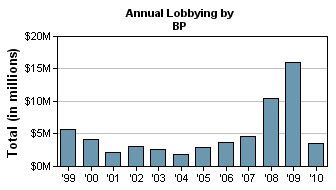
BP regularly lobbies on Capitol Hill, as well. In 2009, the company spent a massive $16 million to influence legislation. During the first quarter of 2010, it spent $3.53 million on federal lobbying efforts, ranking it second (behind ConocoPhillips) among all oil and gas industry interests.

Its registered lobbyists include a number of former federal government and high-ranking political campaign officials, including longtime political operative Tony Podesta, former congressional chief of staff Bob Brooks, former congressional legislative director David Pore and vice presidential aide Michael S. Berman, the Center’s research shows. 

The oil and gas industry, of which BP is a member, reported $169 million in 2009 lobbying expenditures.

Comparatively, the entire environmental industry spent $22 million on lobbying in 2009 — not much more than BP alone spent for the year. The most active member of the environmental industry, the Nature Conservancy, reported $2.2 million in 2009 expenditures. Last year, BP was active lobbying on the American Clean Energy Leadership Act of 2009, which allows increased oil and gas leasing in the Gulf of Mexico, in areas closer to shore than current law allows.

The bill also calls for additional research and inventory of oil and gas reserves in the U.S. Outer Continental Shelf. The bill is sponsored by Sen. Jeff Bingaman (D-N.M.), who has received $14,000 in campaign donations during the past two decades from those associated with BP, the Center finds.

In 2009, BP also lobbied on the Oil Spill Prevention Act of 2009 and the Clean Water Restoration Act.

The oil spill, which has yet to be remedied, was caused by an explosion on a BP-leased oil rig on April 20.

A state of emergency has since been enacted in Louisiana, and the White House has designated it an event of “national significance.” The oil well is reportedly leaking between 1,000 and 5,000 barrels a day, and rescue crews are trying to eliminate  the oil by setting it on fire, breaking it up with chemicals and skimming it off the surface of the ocean. Already, questions are being asked about cause and responsibility.

Upon hearing the cry for help in the Gulf of Mexico, Rep. Henry A. Waxman (D-Cal.), chairman of the House Energy and Commerce Committee, called for a “full blown investigation.”

In 2009, individuals and political action committees associated with BP donated $16,000 to members of the House Energy and Commerce Committee.

In addition, five of the all-time top 10 recipients of BP money in the House of Representatives sit on the House Energy Committee: John D. Dingell (D-Mich.) Joe Barton (R-Tex.), Ralph M. Hall (R-Tex.), Roy Blunt (R-Mo.) and Fred Upton, (R-Mich.).

All have received upward of $13,000 from BP-related individuals and political action committees during the past two decades. Dingell, the second most favored recipient of BP money in the House, has received $31,000.

Written by Cassandra LaRussa

© COPYRIGHT COMMON DREAMS, 2010

Sudan Hunger Crisis, Families Struggle to Survive

HUFFINGTON POST– Three-day-old Odong Obong lay in the hospital bed, his pencil-thin arms almost motionless and his shriveled, gaunt face resembling that of an elderly man.

Emaciated babies and young children throughout the ward bore the signs of hunger: exposed ribs and distended stomachs. Outside, old villagers reclined motionless in the shade, too frail to walk.

The U.N. calls this the “hungriest place on Earth” after years of drought and conflict, with aid agencies already feeding 80,000 people here. A doctor says the worst is yet to come.

Two years of failed rains and tribal clashes have laid the foundation for Africa’s newest humanitarian crisis. The World Food Program quadrupled its assistance levels from January to March in the Akobo region of southeastern Sudan.

International aid agencies are bracing for the worst. Even if spring rains materialize this year, the harvest won’t come in until fall.

“And if there is no rain, it will get worse,” said Dr. Galiek Galou, one of three doctors at the hospital in this town on the border with Ethiopia.

“If you stay here for a week you’ll have problems, even if you have money,” he said. “There is nothing to buy.”

Southern Sudan lies in a drought-prone belt of Africa, but the situation has been exacerbated by rising intertribal violence that claimed more than 2,000 lives in 2009. Because of the global financial meltdown, the government has fewer available resources.

The food crisis is also a legacy of a devastating north-south civil war of more than 21 years that left 2 million people dead and many more displaced. That conflict is separate from the war in the western Sudanese region of Darfur, which began in 2003 and has killed 300,000.

Continue reading about Sudan’s Hunger Crisis.

Medair: http://www.medair.org/

Save The Children: http://www.savethechildren.org.uk

© COPYRIGHT HUFFINGTON POST, 2010

Darfur Mediator and Sudanese Negotiator Resume Peace Talks

SUDAN TRIBUNE– Darfur’s peace chief mediator discussed today with the Sudanese officials the resumption of Doha talks to end the seven year conflict in Western Sudan.

Djibril Bassole, met Thursday in Khartoum with Amin Hassan Omer, government top negotiator and General Issmat Abdelrahman head of security arrangement sub-committee for the peace process.

The two sides discussed the ongoing preparations to resume the peace talks in Doha after its suspension last month for the general elections.

Amin informed Bassole that the Sudanese delegation would return to the Qatari capital on May 15 in order to continue peace talks with the rebel groups. Previously Sudan said the talks would restart after the swearing-in of the President elect Omer Al-Bashir on May 27.

The rebel Justice and Equality Movement (JEM) suspended its participation in the Doha process accusing Khartoum of violating a truce they agreed last February. Ahmed Hussein Adam, JEM spokesperson told Sudan Tribune yesterday they had informed the mediation of their readiness to sign a ceasefire before the departure of the government delegation to Khartoum but the Sudanese officials preferred to leave without to sign it.

He accused Khartoum of seeking to weaken his group militarily saying they were ready to repel any attack. The government and another rebel group, Liberation and Justice Movement (LJM) are expected to resume the negotiations after the arrival of the government delegation.

Sudanese President Omer Al-Bashir pledged this week to achieve peace in Darfur where some 300,000 people were killed and over 2.7 million are displaced since 2003.

© COPYRIGHT SUDAN TRIBUNE, 2010

Drug War Violence Sweeps Mexican Border

RAW STORY– Mexico’s bloody drug wars saw a new spasm of killings late Saturday into Sunday, with 25 people fatally shot in the northern state of Chihuahua bordering the United States. Seven of the deaths occurred in violence-plagued Ciudad Juarez, Mexico’s murder capital, bringing to 62 the number of people killed in the city over the past week.

The 18 other slayings overnight included four people fatally shot by automatic weapons fire in a bar in the town of Camargo, near the state capital Chihuahua City, and two women whose bodies were found stuffed in the trunk of an abandoned car in the same town, prosecutors said.

So far this year, more than 850 people have been killed in Ciudad Juarez, a city of 1.3 million, while more than 2,660 were killed there in 2009, according to official figures.

Mexican President Felipe Calderon visited Ciudad Juarez in February and apologized to numerous grieving families who lost loved ones in a January massacre that claimed the lives of 15 children and teens. The president admitted that his three-year crackdown on crime with more than 50,000 troops spread across the country “is not enough,” and vowed to redesign a new strategy against crime and violence with community cooperation.

To the east in the northern Mexican city of Monterrey early Sunday, three men and two women were trampled to death when some 10,000 people at an outdoor concert stampeded after three shots were fired, presumably in the air, by somebody at the fairground, local officials said.

Another 30 people were treated for injuries from the jostling, they added. Moments before the gunshots, the crowd appears to have been primed for panic when shouts “hit the ground” and “gunfight” were heard, witnesses told the Mexican newspaper Reforma. Monterrey, in Nuevo Laredo state that also borders the United States, has seen a spike in gang violence pitting the Guf of Mexico and Los Zetas drug cartels, officials said.

Read full article about Drug War Violence Sweeps Mexican Border.

© RAW STORY, 2010