No Right for Press to Protect Sources, Canadian Supreme Court Says

GLOBE & MAIL– The Supreme Court of Canada slammed the door shut Friday on a concerted attempt by the press to broaden its rights to protect confidential sources.

In an 8-1 ruling, the court said that in an age of blogging, Twittering and long-range microphones, the media are too amorphous to enjoy such a right and too ungovernable to exercise it properly.

“The bottom line is that no journalist can give a source a total assurance of confidentially,” the majority said. “All such arrangements necessarily carry an element of risk that the source’s identity will eventually be revealed.”

Mr. Justice Ian Binnie said it was a “simplistic proposition” to suggest that a journalist should be able to decide on his or her own whether to grant blanket immunity to a source.

To grant a right to administer blanket immunity to a trade that has no professional regulation and vastly differing ethical standards, “would blow a giant hole in law enforcement and other constitutionally recognized values such as privacy,” the majority said.

“Journalistic privilege is very context specific,” it added. “The public interest in free expression will always weigh heavily in the balance.”

The ruling means that the National Post and reporter Andrew McIntosh may now have to hand over an envelope sent by a confidential source, assuming police still wish to learn the source’s identity.

While Friday’s decision dealt primarily with physical evidence – such as letters or notebooks – its implications extend to information journalists obtain verbally from confidential sources.

The court recognized that many vital public issues have been enhanced by investigative reporting and that confidential sources in these sort of cases will very possibly win court approval in future for confidentiality arrangements.

But it said that confidentiality would be routinely requested and granted if it were made too easy to obtain.

“The public interest in freedom of expression is of immense importance but it is not absolute and, in circumstances such as the present, it must be balanced against other important interests – including the investigation and suppression of crime,” Judge Binnie said.

Continue reading about the Canadian Supreme Court Saying there is No Right for Press to Protect Sources.

© COPYRIGHT GLOBE & MAIL, 2010

Private Corporations Profit From Occupation of Palestine

PROJECT CENSORED– Israeli and international corporations are directly involved in the occupation of Palestine. Along with various political, religious and national interests, the Israeli occupation of the West Bank, Gaza, and the Golan Heights is fueled by corporate interests.

These occupying companies and corporations lead real estate deals, develop the Israeli colonies and infrastructure, and contribute to the construction and operation of an ethnic separation system, including checkpoints, walls and roads. They also design and supply equipment and tools used in the control and repression of the civilian population under occupation.

An extensive, on-going grassroots investigation, which exposes hundreds of international companies and corporations involved in the occupation, is being conducted and posted online at http://www.whoprofits.org by the Israeli group Coalition of Women for Peace.

The project currently focuses on three main areas of corporate involvement in the occupation: the settlement industry, economic exploitation, and control of the population. At this stage they are not investigating the vast industry of military production and arms trade (see story # 9).

The ongoing business of construction in the occupied territories of the West Bank and Golan Heights includes housing developments as well as extensive infrastructure projects such as roads and water systems for the exclusive use of Israeli settlers, on lands confiscated from Palestinians. The construction industry includes real estate dealers, contractors, planners, suppliers of materials, as well as security, surveillance, and maintenance services.

While the US government has on numerous occasions affirmed the illegality of Israeli settlements on Palestinian land, it encourages American support by providing tax deductions for donations to these settlements, which have nearly doubled within a year and are rapidly accelerating. An audit conducted by Reuters of American tax records found that thirteen tax exempt groups linked explicitly to settlements managed to collect more than $35 million in the past five years alone.  Secretary of State Condoleeza Rice defended the tax incentives as “humanitarian,” and rejected any comparison to Palestinian charities facing US sanctions for suspected links with Islamic parties, such as Hamas.

Israeli industrial zones within the occupied territories hold hundreds of companies, ranging from small businesses serving the local Israeli settlers to large factories that export their products worldwide. Settlement production benefits from low rents, special tax incentives, lax enforcement of environmental and labor protection laws, and other governmental supports. Palestinians employed in these industrial zones work under severe restrictions on movement, on organization, and with almost no government protections. These “advantages” often result in the exploitation of Palestinian labor, Palestinian natural resources, and the Palestinian consumer market.

All Palestinian imports and exports are controlled, restricting competition with Israeli producers, and making Palestinian consumers a captive market for Israeli goods. Restrictions are imposed on the development of Palestinian businesses, and all utilities and basic services are routed through Israeli firms.

Severe restrictions on movement of Palestinian labor and products inside the occupied territories and to neighboring areas have further increased the dependency of the Palestinian economy on Israeli companies as employers and retailers. The growing network of checkpoints and walls has all but destroyed Palestinian local production and the Palestinian labor bargaining power.

Eighteen months ago, outraged when the Palestinians of Gaza voted for the leadership of Hamas in democratic elections, Israel imposed a total lockdown on the entire population of Gaza. The Palestinians, determined to continue to resist occupation, found a way to circumvent total starvation. Author Sara Flounders notes, “The Israeli blockade led to a new economic structure, an underground economy. The besieged Palestinians have dug more than 1,000 tunnels under the totally sealed border. Many thousands of Palestinians are now employed in digging, smuggling or transporting, and reselling essential goods.” Smuggling constitutes approximately 90 percent of economic activity in Gaza, according to Gazan economist Omar Shaban.

The tunnels connect the Egyptian town of Rafah with the Palestinian refugee camp of the same name inside Gaza. They have become a fantastic, life-sustaining network of corridors dug through sandy soil. Tunnels are typically three-tenths of a mile long, approximately forty-five to fifty feet deep. They cost from $50,000 to $90,000 and require several months of intense labor to dig.

Food is towed through on plastic sleighs. Livestock are herded through larger tunnels. Flour, milk, cheese, cigarettes, cooking oil, toothpaste, small generators, computers, and kerosene heaters come through the tunnels. Every day 300 to 400 gas canisters for cooking come through the lines. On the Egyptian side, the trade sustains the ruptured economy, while corrupt or sympathetic guards and officers look the other way.

The Israeli siege of Gaza, followed by twenty-three days of systematic bombing and invasion, has created massive destruction and scarcity. Food processing plants, chicken farms, grain warehouses, UN food stocks, almost all of the remaining infrastructure, and 230 small factories were destroyed. At the time of this printing, hundreds of trucks packed with essential supplies from international and humanitarian agencies sit outside the strip, refused entry to Gaza by Israeli guards.

As soon as the Israeli bombing ended, work on the tunnels resumed.

However, Ann Wright, retired US Army colonel, former State Department official, and current peace activists, asks, “How do you rebuild 5,000 homes, businesses and government buildings when the only way supplies come into the prison called Gaza is through tunnels?  Will the steel I-beams for roofs bend 90 degrees to go through the tunnels from Egypt?  Will the tons of cement, lumber, roofing materials, nails, drywall, and paint be hauled by hand, load after load, seventy feet underground, through a tunnel 500 to 900 feet long, and then pulled up a seventy-foot hole and put into waiting truck in Gaza?”

For the people of Gaza, rebuilding their homes, businesses, and factories is on hold.  Over 5,000 homes and apartment buildings were destroyed and hundreds of government buildings, including the Parliament building, were smashed. Two cement factories in northern Gaza were completely destroyed by Israeli bombs.

Building supplies, cement, wood, nails, glass will have to be brought in from outside Gaza. Israel controls 90 percent of the land borders to Gaza, including the northern and eastern borders and 100 percent of the ocean on the west side of Gaza.  Egypt controls the southern border with Gaza.

Wright concludes, “The Israelis who bombed Gaza will be the primary financial beneficiaries of the rebuilding of Gaza. They bombed it and now will sell construction materials to rebuild what they have bombed, exactly like the United States has done in Iraq.”

Update by Sara Flounders
Much has been written about the suffering of the Palestinians, and most of it is true. What gives the history of Palestine its special potency is not the suffering, however, but the indomitable will of the people to continue fighting, even when it seems impossible. This part of the story—suffering and determination—has continued in the six months since the massive Israeli bombing of Gaza ended last January.
The Israeli invasion laid waste to much of the Gaza’s fragile infrastructure. The siege of Gaza continues, reducing the entire strip to a prison economy with all the desperation that implies. Every effort is being made to increase the isolation. The Israelis have forbidden the entry of even the most basic building materials that are essential to reconstruct the thousands of homes that Israeli bombs destroyed during the December/January assault on Gaza’s population.

Tens of millions of dollars of medical, food, clothing and other everyday aid has been collected from people from all around the world to send to the 1.5 million Palestinians living in Gaza, the largest open-air prison of the world. The great bulk of this aid is stalled at the border crossing points, prevented by the Israeli occupation authorities from entering.

My article, “The Tunnels of Gaza,” written last February, was about the 1,000 tunnels that the Palestinians courageously dug and maintained to bring material in from Egypt. These tunnels built during the months of siege and reopened after the invasion continue to be an important lifeline for Gaza’s population and a symbol of continued resistance. Now, they have even become a source of desperately needed building materials.

Some Gazans have turned to making dried mud bricks, a homebuilding material from an ancient age, to rebuild their bombed homes. And the best mud comes from the tunnels themselves, as an article in Bloomberg on June 3 pointed out. Again, a source of possible despair has become a story to inspire confidence in ultimate victory.

But it is important that the rest of the world refuse to allow the systematic isolation and total destruction of Gaza. One way to do this is to join in the work of Viva Palestina, one of several Gaza Solidarity Campaigns determined to bring in a small portion of supplies needed by the Gazans, and what is perhaps even more important, to keep world attention upon the continuing Israeli siege.

An MP in Britain, George Galloway, organized the first Viva Palestina caravan that took off from London and in twenty-three days crossed North Africa to deliver to Gaza 107 vehicles—including ambulances and a fire engine—255 people, and $2 million of aid last March. Now Galloway and Vietnam anti-war veteran Ron Kovic are organizing a similar caravan starting from the United States that aims to bring 500 vehicles and $10 million in aid—and to impact US political policy toward Palestine and Gaza (see vivapalestina-us.org).

The International Action Center is helping the Viva Palestina effort, and hopes that more and more people and organizations from all over the world will join to help lift the siege of Gaza and show solidarity with the Palestinian people, who once again are showing that they won’t give up.

Sources:
WhoProfits.org
Title: “Who Profits? Exposing the Israeli Occupation Industry”
Authors: The Coalition of Women for Peace

Palestine News Network, August 26, 2008
Title: “US Tax Breaks Support Israeli Settlers”

Workers World Newspaper, February 9, 2009, and Global Research, February 11, 2009
Title: “The Tunnels of Gaza, An underground economy and resistance symbol”
Author: Sara Flounders

CommonDreams.org, February 24, 2009
“Can Gaza Be Rebuilt Through Tunnels? The Blockade Continues-No Supplies, No Rebuilding”
Author: Ann Wright

Student Researchers: April Rudolph, Natalie Dale, and Kerry Headley
Faculty Evaluator: Jeff Baldwin, PhD
Sonoma State University

Photo flickr user frecklebaum

Obama’s Trilateral Commission Team

PROJECT CENSORED– Barack Obama appointed eleven members of the Trilateral Commission to top-level and key positions in his administration within his first ten days in office. This represents a very narrow source of international leadership inside the Obama administration, with a core agenda that is not necessarily in support of working people in the United States.

Obama was groomed for the presidency by key members of the Trilateral Commission. Most notably, Zbigniew Brzezinski, co-founder of the Trilateral Commission with David Rockefeller in 1973, has been Obama’s principal foreign policy advisor.

According to official Trilateral Commission membership lists, there are only eighty-seven members from the United States (the other 337 members are from other countries). Thus, within two weeks of his inauguration, Obama’s appointments encompassed more than 12 percent of Commission’s entire US membership.

Trilateral appointees include:

* Secretary of Treasury, Tim Geithner
* Ambassador to the United Nations, Susan Rice
* National Security Advisor, Gen. James L. Jones
* Deputy National Security Advisor, Thomas Donilon
* Chairman, Economic Recovery Committee, Paul Volker
* Director of National Intelligence, Admiral Dennis C. Blair
* Assistant Secretary of State, Asia & Pacific, Kurt M. Campbell
* Deputy Secretary of State, James Steinberg
* State Department, Special Envoy, Richard Haass
* State Department, Special Envoy, Dennis Ross
* State Department, Special Envoy, Richard Holbrooke

There are many other links in the Obama administration to the Trilateral Commission. For instance, Secretary of State Hillary Clinton is married to Commission member William Jefferson Clinton. Secretary of Treasury Tim Geithner’s informal group of advisors include E. Gerald Corrigan, Paul Volker, Alan Greenspan, and Peter G. Peterson, all members. Geithner’s first job after college was with Trilateralist Henry Kissinger at Kissinger Associates.

Trilateralist Brent Scowcroft has been an unofficial advisor to Obama and was mentor to Defense Secretary Robert Gates. And Robert Zoelick, current president of the World Bank appointed during the G.W. Bush administration, is a member.

According to the Trilateral Commissions’ website, the Commission was formed in 1973 by private citizens of Japan, Europe (European Union countries), and North America (United States and Canada) to foster closer cooperation among these core democratic industrialized areas of the world with shared leadership responsibilities in the wider international system. The website says, “The membership of the Trilateral Commission is composed of about 400 distinguished leaders in business, media, academia, public service (excluding current national Cabinet Ministers), labor unions, and other non-governmental organizations from the three regions. The regional chairmen, deputy chairmen, and directors constitute the leadership of the Trilateral Commission, along with an Executive Committee including about 40 other members.”

Since 1973, the Trilateral Commission has met regularly in plenary sessions to discuss policy position papers developed by its members. Policies are debated in order to achieve consensuses. Respective members return to their own countries to implement policies consistent with those consensuses. The original stated purpose of the Trilateral Commission was to create a “New International Economic Order.” Its current statement has morphed into fostering a “closer cooperation among these core democratic industrialized areas of the world with shared leadership responsibilities in the wider international system.”

Since the Carter administration, Trilateralists have held these very influential positions: Six of the last eight World Bank Presidents; Presidents and Vice-Presidents of the United States (except for Obama and Biden); over half of all US Secretaries of State; and three quarters of the Secretaries of Defense.

Two strong convictions guide the Commission’s agenda for the 2009-2012 triennium. First, the Trilateral Commission is to remain as important as ever in maintaining wealthy countries’ shared leadership in the wider international system. Second, the Commission will “widen its framework to reflect broader changes in the world.” Thus, the Japan Group has become a Pacific Asian Group, which includes Chinese and Indian members, and Mexican members have been added to the North American Group. The European Group continues to widen in line with the enlargement of the EU.

Update by Patrick Wood

The concept of “undue influence” comes to mind when considering the number of Trilateral Commission members in the Obama administration. They control the areas of our most urgent national needs: financial and economic crisis, national security, and foreign policy.

The conflict of interest is glaring. With 75 percent of the Trilateral membership consisting of non-US individuals, what influence does this super-majority have on the remaining 25 percent?

For example, when Chrysler entered bankruptcy under the oversight and control of the Obama administration, it was quickly decided that the Italian carmaker Fiat would take over Chrysler. The deal’s point man, Treasury Secretary Timothy Geithner, is a member of the Trilateral Commission. Would you be surprised to know that the chairman of Fiat, Luca di Montezemolo, is also a fellow member?
Congress should have halted this deal the moment it was suggested.

Many European members of the Trilateral Commission are also top leaders of the European Union. What political and economic sway do they have through their American counterparts?

If asked, the vast majority of Americans would say that America’s business is its own, and should be closed to foreign meddlers with non-American agendas.

But, the vast majority of Americans have no idea who or what the Trilateral Commission is, much less the power they have usurped since 1976, when Jimmy Carter became the first Trilateral member to be elected president (Project Censored Story #1, 1976).

In light of today’s unprecedented financial crisis, they would be abhorred if they actually read Zbigniew Brzezinski’s (co-founder of the Commission with David Rockefeller) statement from his 1971 book, Between Two Ages: America’s Role in the Technetronic Era, which states that, “The nation-state as a fundamental unit of man’s organized life has ceased to be the principal creative force: International banks and multinational corporations are acting and planning in terms that are far in advance of the political concepts of the nation-state.”

Yet, this is exactly what is happening. The global banks and corporations are running circles around the nation state, including the United States. They have no regard for due process, Congress, or the will of the people.

Why have the American people been kept in the dark about a subject so great that it shakes our country to its very core?
The answer is simple: The top leadership of the media is also saturated with members of the Trilateral Commission who are able to selectively suppress the stories that are covered. They include:

• David Bradley, Chairman, Atlantic Media Company
• Karen Elliot House, former Senior Vice President, Dow Jones & Company, and Publisher, the Wall Street Journal
• Richard Plepler, Co-president, HBO
• Charlie Rose, PBS
• Fareed Zakaria, Editor, Newsweek
• Mortimer Zuckerman, Chairman, US News & World Reports

There are many other top-level media connections due to corporate directorships and stock ownership.

For more information, this writer’s original 1978 book, Trilaterals Over Washington, is available in electronic form at no charge at http://www.AugustReview.com. This site also has many papers analyzing various aspects of the Trilateral Commission’s hegemony in the United States and elsewhere, since it’s founding in 1973.

© PROJECT CENSORED, 2009

US Drug War Has Met None of its Goals

AP– After 40 years, the United States’ war on drugs has cost $1 trillion and hundreds of thousands of lives, and for what? Drug use is rampant and violence even more brutal and widespread.

Even U.S. drug czar Gil Kerlikowske concedes the strategy hasn’t worked.

“In the grand scheme, it has not been successful,” Kerlikowske told The Associated Press. “Forty years later, the concern about drugs and drug problems is, if anything, magnified, intensified.”

This week President Obama promised to “reduce drug use and the great damage it causes” with a new national policy that he said treats drug use more as a public health issue and focuses on prevention and treatment.

Nevertheless, his administration has increased spending on interdiction and law enforcement to record levels both in dollars and in percentage terms; this year, they account for $10 billion of his $15.5 billion drug-control budget.

Kerlikowske, who coordinates all federal anti-drug policies, says it will take time for the spending to match the rhetoric.

“Nothing happens overnight,” he said. “We’ve never worked the drug problem holistically. We’ll arrest the drug dealer, but we leave the addiction.”

His predecessor, John P. Walters, takes issue with that.

Walters insists society would be far worse today if there had been no War on Drugs. Drug abuse peaked nationally in 1979 and, despite fluctuations, remains below those levels, he says. Judging the drug war is complicated: Records indicate marijuana and prescription drug abuse are climbing, while cocaine use is way down. Seizures are up, but so is availability.

“To say that all the things that have been done in the war on drugs haven’t made any difference is ridiculous,” Walters said. “It destroys everything we’ve done. It’s saying all the people involved in law enforcment, treatment and prevention have been wasting their time. It’s saying all these people’s work is misguided.”

___

In 1970, hippies were smoking pot and dropping acid. Soldiers were coming home from Vietnam hooked on heroin. Embattled President Richard M. Nixon seized on a new war he thought he could win.

“This nation faces a major crisis in terms of the increasing use of drugs, particularly among our young people,” Nixon said as he signed the Comprehensive Drug Abuse Prevention and Control Act. The following year, he said: “Public enemy No. 1 in the United States is drug abuse. In order to fight and defeat this enemy, it is necessary to wage a new, all-out offensive.”

His first drug-fighting budget was $100 million. Now it’s $15.1 billion, 31 times Nixon’s amount even when adjusted for inflation.

Using Freedom of Information Act requests, archival records, federal budgets and dozens of interviews with leaders and analysts, the AP tracked where that money went, and found that the United States repeatedly increased budgets for programs that did little to stop the flow of drugs. In 40 years, taxpayers spent more than:

-$20 billion to fight the drug gangs in their home countries. In Colombia, for example, the United States spent more than $6 billion, while coca cultivation increased and trafficking moved to Mexico — and the violence along with it.

-$33 billion in marketing “Just Say No”-style messages to America’s youth and other prevention programs. High school students report the same rates of illegal drug use as they did in 1970, and the Centers for Disease Control and Prevention says drug overdoses have “risen steadily” since the early 1970s to more than 20,000 last year.

-$49 billion for law enforcement along America’s borders to cut off the flow of illegal drugs. This year, 25 million Americans will snort, swallow, inject and smoke illicit drugs, about 10 million more than in 1970, with the bulk of those drugs imported from Mexico.

-$121 billion to arrest more than 37 million nonviolent drug offenders, about 10 million of them for possession of marijuana. Studies show that jail time tends to increase drug abuse.

-$450 billion to lock those people up in federal prisons alone. Last year, half of all federal prisoners in the U.S. were serving sentences for drug offenses.

At the same time, drug abuse is costing the nation in other ways. The Justice Department estimates the consequences of drug abuse — “an overburdened justice system, a strained health care system, lost productivity, and environmental destruction” — cost the United States $215 billion a year.

Harvard University economist Jeffrey Miron says the only sure thing taxpayers get for more spending on police and soldiers is more homicides.

“Current policy is not having an effect of reducing drug use,” Miron said, “but it’s costing the public a fortune.”

Continue reading about the US Drug War Has Met None of its Goals.

Copyright © 2010 The Associated Press

Photo by flickr user Andronicusmax

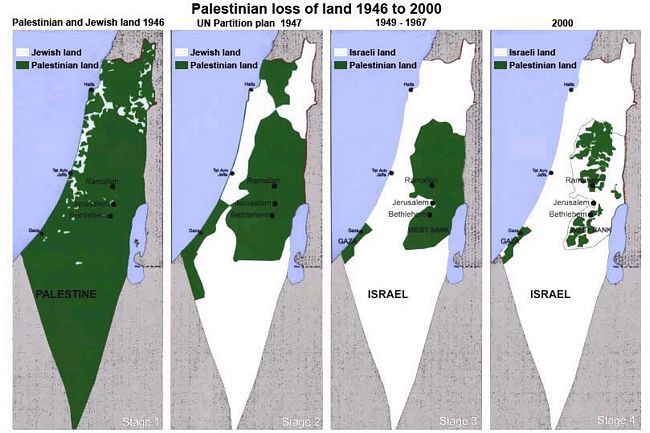
Map of Israel’s Progressive Takeover of Palestine

THE ATLANTIC– Joe Biden was kicked in the balls as he came to Israel with a simultaneous “fuck you” by the Israeli government announcing new settlements – 1600 houses – in East Jerusalem. The immediate spin was that Netanyahu was blindsided by the actions of his Interior Department and was embarrassed. But Haaretz reports today that these 1600 are just the beginning:

Some 50,000 new housing units in Jerusalem neighborhoods beyond the Green Line are in various stages of planning and approval, planning officials told Haaretz. They said Jerusalem’s construction plans for the next few years, even decades, are expected to focus on East Jerusalem.

Most of the housing units will be built in predominantly Jewish neighborhoods beyond the Green Line, while a smaller number of them will be built in Arab neighborhoods. The plans for some 20,000 of the apartments are already in advanced stages of approval and implementation, while plans for the remainder have yet to be submitted to the planning committees.

But Laura Rozen, always worth reading, sees skepticism in Israel:

Many observers were skeptical that Netanyahu was as in the dark about the plan as he claimed to Biden.

“Either one believes Netanyahu and his friends in government (saying it is all misunderstanding and bad timing),” wrote Jerusalem Post blogger Shmuel Rosner. “In such case, one should be concerned by Israel’s chaotic decision-making process on delicate matters.”

“Or, one might choose not to believe,” Rosner continued. “One might think Netanyahu isn’t telling the truth, or that [Interior Minister] Yishai is bluffing. If it’s the former, one will conclude that Netanyahu has no intention of seriously exploring the just-announced peace negotiations. If it’s the latter one will realize that Shas and Yishai are strong enough to toy with Netanyahu as much as they want – as much as embarrassing the American [Vice President]! – without paying a price. Not an encouraging thought.”

I cannot read Netanyahu’s mind. But I can observe Israel’s actions. They intend to occupy and colonize the entire West Bank forever.  They may allow some parceled enclaves for Palestinians, but they will maintain a big military presence on the Eastern border of West Bank, and they will sustain this with raw military power and force. I certainly cannot see any other rationale for their actions these past few years that makes any sense at all. Many Israeli politicians now use the term “apartheid” for this future. 

Map via Juan Cole

© THE ATLANTIC, 2010

Posted in Uncategorized | 1 Reply