Arizona Bans Ethnic Studies in Public School

ALTERNET– Hispanic students fill nearly half the seats in Arizona’s public school classrooms, but a new law signed by Governor Jan Brewer Tuesday makes it illegal for these students to learn about their heritage in school. HB 2281 prohibits schools from offering courses at any grade level that advocate ethnic solidarity, promote overthrow of the US government, or cater to specific ethnic groups—regulations which will dismantle the state’s popular Mexican-American studies programs.

Much like Arizona’s new immigration law, this ethnic studies ban is political interest dressed up to look like education reform. The bill was passed largely because of State Superintendent of Public Instruction Tom Horne’s personal distaste for the Tuscon Unified School District’s Chicano studies program, in which 3 percent of the district’s 55,000 students participate. He has been hell-bent on squashing the program ever since learning several years ago that Hispanic civil rights activist Dolores Huerta told Tucson High School students that “Republicans hate Latinos,” the Associated Press reports.

“Traditionally, the American public school system has brought together students from different backgrounds and taught them to be Americans and to treat each other as individuals, and not on the basis of their ethnic backgrounds,”…

Continue reading about Arizona Banning Ethnic Studies in School.

© COPYRIGHT ALTERNET, 2010

Photo by Esparta

More Troops Hospitalized for Mental Health than Any Other Reason

RAW STORY– More U.S. troops were hospitalized for mental health disorders than any other reason in 2009. Mental health hospitalizations throughout the military topped injuries, battle wounds and even pregnancy and childbirth for the first time in 15 years of tracking by the Pentagon’s Medical Surveillance Monthly report.

USA Today‘s Gregg Zoroya broke the news Friday.

Mental health care accounted for almost 40% of all days spent in hospitals by servicemembers last year, the report said. Of those hospitalizations, 5% lasted longer than 33 days. For most other conditions, fewer than 5% of hospitalizations exceeded 12 days, the report said.

In 2009, there were 17,538 hospitalizations for mental health issues throughout the military, the study shows. That compares with 17,354 for pregnancy and childbirth reasons, and 11,156 for injuries and battle wounds.

Psychological issues such as post-traumatic stress disorder exact a toll in lost manpower, the study said. Four mental health issues — depression, substance abuse, anxiety and adjustment problems such as PTSD — cost the Pentagon 488 years of lost duty in 2009.

“There’s no shame in my game,” Herschel Walker told a group of soldiers from Winn Army Hospital’s Warriors in Transition Program in Georgia one day earlier.

The former NFL star overcame dissociative identity disorder at Fort Stewart’s Main Chapel and, according to Bryan County News, appealed to those who battle behavioral issues to seek help as he did.

“It’s inspiring for us to have Mr. Walker come,” Winn Army Community Hospital Commander Col. Paul R. Cordts said Thursday. “He’s of course a Heisman Trophy winner, had a huge NFL football career but he came here to speak to our soldiers about his experiences with a behavioral health diagnosis. We recognize that combat affects all soldiers. Some soldiers develop symptoms of post traumatic stress disorder. We wanted Mr. Walker to come and talk about his experience of going through treatment for his disorder as well as dispelling some of the stigma associated with having a behavioral health disorder.”

Obviously PTSD, depression, anxiety and substance abuse are not limited to American soldiers. According to a new U.K. Ministry of Defense study covered Thursday by The Guardian, troops serving in Iraq and Afghanistan have a 22% higher risk of alcohol misuse than their fellow servicemen and women.

Reservists serving in Iraq and Afghanistan were found to be three times as likely to suffer PTSD as other reservists, while regular personnel in combat roles there were found to be twice as likely to report the disorder.

Simon Wessely of the Institute of Psychiatry at King’s College London thinks alcohol abuse is even more of a concern than PTSD. “Our view is that alcohol misuse is actually a greater problem for the armed forces than PTSD,” he said.

Continue reading about Mental Health of Returning Soldiers.

© RAW STORY, 2010

People in Power Make Better Liars

MSNBC– New York Gov. David Paterson is embroiled in a scandal over whether he used his power and influence to intimidate a woman pursuing a domestic violence case against one of his top aides.

As a result, the governor said last month that he would not seek a second term, and his communications director quit earlier this month, citing “integrity” issues.

Former Enron CEO Jeffrey Skilling, who went to prison after the spectacular collapse of the company, is appealing to the Supreme Court his 2006 conviction on 19 counts of fraud, conspiracy, insider trading and lying.

His lawyers argue that he didn’t get a fair trial and that Skilling’s conduct, “even if wrongful in some way,” was not illegal because he was not looking out for his personal interests “apart from his normal compensation incentives.”

The issue of integrity is at the heart of the predicaments these powerful men find themselves in. An organization’s health often hinges on the trustworthiness of its leaders, ethics experts say.

There’s old saying: power corrupts. A new Columbia Business School study titled “People with Power are Better Liars” finds there may be truth behind the cliché.

“People in power are able to lie better,” said Dana Carney, a management professor at Columbia Business School and one of the co-authors of the study. “It just doesn’t hurt them as much to do it.”

Read more at MSNBC.

Eve Tahmincioglu writes the weekly “Your Career” column for msnbc.com and chronicles workplace issues in her blog, CareerDiva.net.

© MSNBC, 2010

 
Posted in Uncategorized | 1 Reply

Why Caffeine is the Perfect Addiction for a Worker Bee Society

caffeineALTERNET– According to a new study released this week, caffeine turns human beings into efficient worker bees. Led by Katharine Ker of the London School of Hygiene and Tropical Medicine, the study found that caffeine “significantly reduced the number of errors” made by workers in a series of 13 trials. “One trial comparing the effects of caffeine with a nap found that there were significantly less errors made in the caffeine group,” reads the official report.

What? Coffee beats naps?

“The results of the trials suggest that compared to no intervention, caffeine can reduce the number of errors and improve cognitive performance in shift workers. … Based on the current evidence, the review authors judge that there is no reason for healthy shift workers who already use caffeine within recommended levels to improve their alertness to stop doing so.”

The study focused on “shift workers” — that is, those who work at times other than 9-to-5. Granted, sleeping by day and working by night can throw body clocks off-kilter, so such workers are atypical. But the LSHTM report was picked up and spread so quickly by the mainstream media as to confirm that caffeine is America’s favorite legal high because it fuels capitalism. Not that capitalism totally sucks, but still: It’s good to know why you’re being sold central-nervous-system stimulants. Crack users aren’t good workers. Neither marijuana, methamphetamine, heroin, nor LSD increase workplace efficiency. (Neither does alcohol, yet alcohol is just as cheap and legal as caffeine. But alcohol has been ingrained in human culture for too long to yank it out, as Prohibition proved.)

“Caffeine Drinkers Make Fewer Mistakes,” blares the Web site for Denver’s ABC station, KMGH. Other headlines capping the same story in other mainstream venues include “Study: Caffeine Makes You Do Better Job,” “Morning cup of coffee can increase workplace performance,” and “Caffeine Helps Shift Workers Avoid Mistakes.” “Caffeine may curb errors,” asserts the UK’s Guardian. “Coffee is best perk for sleepy workers,” confides India’s national daily paper The Hindu. “Shift workers knew it, researchers confirm it: Caffeine helps,” roars the Los Angeles Times.

Well, that’s convenient.

Continue reading about Why Caffeine is the Perfect Addiction for a Worker Bee Society.

© Alternet, 2010

Photo by flickr user pete simon

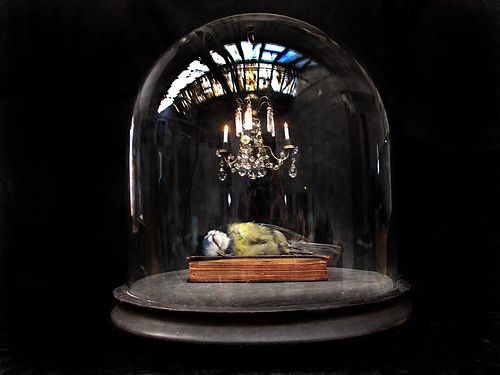
Polly Morgan – Taxidermy Artist

To Every Seed His Own Body


Detail from Carrion Call


Still Life After Death (Fox)


BIO– British artist Polly Morgan’s love for animals and desire to preserve them led her to learn taxidermy. Since then she has gravitated towards making still lives with the animals as subjects. Her intention has never been to mimic the natural habitats of animals, but to place them in less expected scenery. The scale and settings are often unnatural, but the animals are never anthropomorphized. Seeing the out of place encourages us to look at them as if for the first time and appreciate their beauty.

Check out more of her bizarre and thought provoking animal displays at http://www.pollymorgan.co.uk/