Consumers Find Ways to Spend Less and Find Happiness

NY TIMES– She had so much. A two-bedroom apartment. Two cars. Enough wedding china to serve two dozen people.

Yet Tammy Strobel wasn’t happy. Working as a project manager with an investment management firm in Davis, Calif., and making about $40,000 a year, she was, as she put it, caught in the “work-spend treadmill.”

So one day she stepped off.

Inspired by books and blog entries about living simply, Ms. Strobel and her husband, Logan Smith, both 31, began donating some of their belongings to charity. As the months passed, out went stacks of sweaters, shoes, books, pots and pans, even the television after a trial separation during which it was relegated to a closet. Eventually, they got rid of their cars, too. Emboldened by a Web site that challenges consumers to live with just 100 personal items, Ms. Strobel winnowed down her wardrobe and toiletries to precisely that number.

Her mother called her crazy.

Today, three years after Ms. Strobel and Mr. Smith began downsizing, they live in Portland, Ore., in a spare, 400-square-foot studio with a nice-sized kitchen. Mr. Smith is completing a doctorate in physiology; Ms. Strobel happily works from home as a Web designer and freelance writer. She owns four plates, three pairs of shoes and two pots. With Mr. Smith in his final weeks of school, Ms. Strobel’s income of about $24,000 a year covers their bills. They are still car-free but have bikes. One other thing they no longer have: $30,000 of debt.

Ms. Strobel’s mother is impressed. Now the couple have money to travel and to contribute to the education funds of nieces and nephews. And because their debt is paid off, Ms. Strobel works fewer hours, giving her time to be outdoors, and to volunteer, which she does about four hours a week for a nonprofit outreach program called Living Yoga.

“The idea that you need to go bigger to be happy is false,” she says. “I really believe that the acquisition of material goods doesn’t bring about happiness.”

While Ms. Strobel and her husband overhauled their spending habits before the recession, legions of other consumers have since had to reconsider their own lifestyles, bringing a major shift in the nation’s consumption patterns.

“We’re moving from a conspicuous consumption — which is ‘buy without regard’ — to a calculated consumption,” says Marshal Cohen, an analyst at the NPD Group, the retailing research and consulting firm.

Amid weak job and housing markets, consumers are saving more and spending less than they have in decades, and industry professionals expect that trend to continue. Consumers saved 6.4 percent of their after-tax income in June, according to a new government report. Before the recession, the rate was 1 to 2 percent for many years. In June, consumer spending and personal incomes were essentially flat compared with May, suggesting that the American economy, as dependent as it is on shoppers opening their wallets and purses, isn’t likely to rebound anytime soon.

On the bright side, the practices that consumers have adopted in response to the economic crisis ultimately could — as a raft of new research suggests — make them happier. New studies of consumption and happiness show, for instance, that people are happier when they spend money on experiences instead of material objects, when they relish what they plan to buy long before they buy it, and when they stop trying to outdo the Joneses.

If consumers end up sticking with their newfound spending habits, some tactics that retailers and marketers began deploying during the recession could become lasting business strategies. Among those strategies are proffering merchandise that makes being at home more entertaining and trying to make consumers feel special by giving them access to exclusive events and more personal customer service.

While the current round of stinginess may simply be a response to the economic downturn, some analysts say consumers may also be permanently adjusting their spending based on what they’ve discovered about what truly makes them happy or fulfilled.

Read full article about Consumers Finding Ways to Spend Less and Find Happiness.

© COPYRIGHT NY TIMES, 2010

Photo by flickr user epSos.de
US Supersizes Afghan Mega-Base as Withdrawal Date Looms

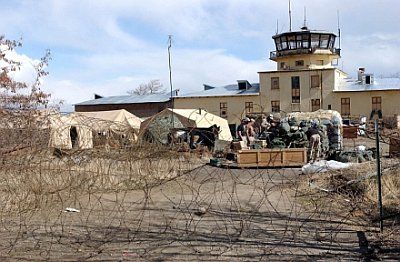
COMMON DREAMS– Anyone who thinks the United States is really going to withdraw from Afghanistan in July 2011 needs to come to this giant air base an hour away from Kabul. There’s construction everywhere. It’s exactly what you wouldn’t expect from a transient presence.

Step off a C-17 cargo plane, as I did very early Friday morning, and you see a flight line packed with planes. When I was last here two years ago, helicopters crowded the runways and fixed-wing aircraft were — well, if not rare, still a notable sight. Today you’ve got C-17s, Predators, F-16s, F-15s, MC-12 passenger planes … I didn’t see any of the C-130 cargo craft, but they’re here somewhere.

More notable than the overstuffed runways is the over-driven road. Disney Drive, the main thoroughfare that rings the eight-square-mile base, used to feature pedestrians with reflective sashes over their PT uniforms carrying Styrofoam boxes of leftovers out of the mess halls. And those guys are still there.

But now the western part of Disney is a two-lane parking lot of Humvees, flamboyant cargo big-rigs from Pakistan known as jingle trucks, yellow DHL shipping vans, contractor vehicles and mud-caked flatbeds. If the Navy could figure out a way to bring a littoral-combat ship to a landlocked country, it would idle on Disney.

Expect to wait an eternity if you want to pull out onto the road. Cross the street at your own risk.

Then there are all the new facilities. West Disney has a fresh coat of cement — something that’s easy to come by, now that the Turkish firm Yukcel manufactures cement right inside Bagram’s walls.

There on the flightline: the skeletons of new hangars. New towers with particleboard for terraces. A skyline of cranes. The omnipresent plastic banner on a girder-and-cement seedling advertising a new project built by cut-rate labor paid by Inglett and Stubbs International.

I haven’t been able to learn yet how much it all cost, but Bagram is starting to feel like a dynamic exurb before the housing bubble burst. There was actually a traffic jam this afternoon on the southern side of the base, owing to construction-imposed bottlenecks, something I didn’t think possible in late summer 2008.

Perhaps the most conspicuous change of all: fresh concrete T-walls fortifying the northern and southern faces of the base. Insurgents have launched a number of futile attacks on the base recently, mostly inaccurate small-arms fire and the odd rocket-propelled grenade. They’ve mostly irritated their targets instead of killing them.

But a definite legacy is the abundance of huge barriers at the most-obvious access points to Bagram. Much of the eastern wing remains surrounded by chicken fencing topped with barbed wire, but the more sensitive points of entry are now hardened.

So, apparently, are the sentiments of local Afghans nearby. Troops here told me of shepherd boys scowling their way around Bagram’s outskirts, slingshotting off the occasional rock in hopes of braining an American. Again, something else I wouldn’t have believed two years ago.

By next year, the detention facility that’s spirited away on a far corner of Bagram is supposed to revert to Afghan control. And maybe someday the Afghan National Army will inherit the entire base.

But two years ago there were about 18,000 troops and contractors living here. Now that figure is north of 30,000, all for a logistics hub and command post that the United States didn’t ever imagine possessing before 9/11.

In 2011, the U.S. military probably won’t be thinking about turning over the keys to a new, huge base. It’ll be thinking about how it can finish up the construction contracts it signed months ago — if not some it’s yet to ink.

Written by Spencer Ackerman for Wired Magazine

Photo by the US Army

© COPYRIGHT WIRED, 2010

Alarms Sound Over Trash Fires in War Zones

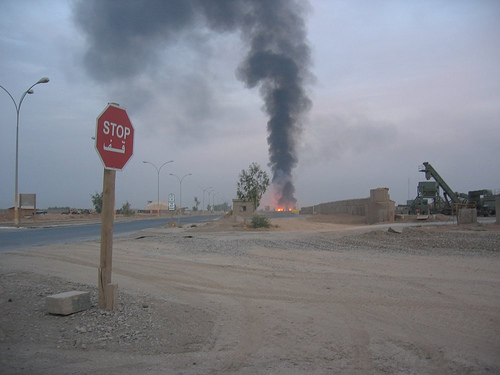
WASHINGTON POST– Hundreds of military service members and contractor employees have fallen ill with cancer or severe breathing problems after serving in Iraq and Afghanistan, and they say they were poisoned by thick, black smoke produced by the burning of tons of trash generated on U.S. bases.

In a lawsuit in federal court in Maryland, 241 people from 42 states are suing Houston-based contractor Kellogg Brown & Root, which has operated more than two dozen so-called burn pits in the two countries. The burn pits were used to dispose of plastic water bottles, Styrofoam food containers, mangled bits of metal, paint, solvent, medical waste, even dead animals. The garbage was tossed in, doused with fuel and set on fire.

The military personnel and civilian workers say they inhaled a toxic haze from the pits that caused severe illnesses. Six with leukemia have died, and five are being treated for the disease, a cancer of the blood and bone marrow. At night, more than a dozen rely on machines to help them breathe or to monitor their breathing; others use inhalers.

“You’d cough up black stuff, and you couldn’t seem to catch your breath. And your eyes were burning,” said Anthony Roles, 33, a father and Air Force retiree from Little Rock, who was told that he had a blood disorder shortly after returning from Iraq in 2004. “I can still smell it to this very day.”

Read full article HERE.

Photo by flckr user Octal

© COPYRIGHT WASHINGTON POST, 2010

Posted in Uncategorized | 1 Reply

Giant Mushroom Largest Living Organism Ever Found

mushroomABC NEWS– Walking through the Malheur National Forest in eastern Oregon you would be hard pressed to notice it. But a fungus spreading through the roots of trees now covers 2,200 acres, making it the largest living organism ever found.

Popularly known as the honey mushroom, the Armillaria ostoyae started from a single spore too small to see without a microscope and has been weaving its black shoestring filaments through the forest for an estimated 2,400 years, killing trees as it grows.

“When you’re on the ground, you don’t notice the pattern, you just see dead trees in clusters,” Tina Dreisbach, a botanist and mycologist with the U.S. Forest Service’s Pacific Northwest Research Station in Corvallis, Ore., said Friday.

The outline of the giant fungus, strikingly similar to a mushroom, stretches 3.5 miles across, and extends an average of three feet into the ground. It covers an area as big as 1,665 football fields. No one has estimated its weight.

“There hasn’t been anything measured with any scientific technique that has shown any plant or animal to be larger than this,” said Gregory Filip, associate professor of integrated forest protection at Oregon State University and an expert in Armillaria.

Dead Trees Reveal Fungus

Until now, the largest known organism was another Armillaria ostoyae found in 1992 in Washington State. It covered 1,500 acres near Mount Adams.

“We just decided to go out looking for one bigger than the last claim,” Filip said.

Continue reading about Giant Mushroom Largest Living Organism Ever Found.

© ABC, 2010

Photo by flickr user gabster10

UFO Files From National Archive Revisit ‘Welsh Roswell’

UFOGUARDIAN– UFO enthusiasts called it the “Welsh Roswell” and insisted that one evening in 1974 an alien craft crashed in north Wales and the government secretly removed dead extraterrestrial bodies, the latest files from the National Archives reveal today.

The documents describe how residents of Llandrillo in Merionethshire, near the Berwyn mountains, first reported strange lights streaking across the sky. Then as the night wore on the villagers heard a colossal explosion and felt a tremor ripple through their homes.

Later ufologists claimed roads were sealed off and people kept away from the site after the incident on 23 January 1974. Alien bodies were then taken to Porton Down biological warfare centre for analysis, it was claimed, prompting the comparisons with Roswell, the 1947 incident in which, conspiracy theorists claimed, the US military recovered an alien spacecraft in New Mexico – the story that gave birth to 60 years of ufology, movies and all.

The latest batch of UFO files show how experts at the Ministry of Defence (MoD) initially struggled to explain the Llandrillo incident. A search and rescue team from RAF Valley, on Anglesey, was scrambled in response to the reports of an explosion and a large fire on the mountainside. Some witnesses described seeing a “bright red light, like a coal-fire red. Large perfect circle. Like a big bonfire. Could see lights above and to the right and white lights moving to bottom.”

Continue reading about UFO Files From National Archive Revisit ‘Welsh Roswell’.

© Guardian, 2010

Photo by flickr user Jonas B