MR Original – Re-Creating Revolutionary Communities

MEDIA ROOTS- The revolution starts in your own backyard.

Cindy Sheehan, along with over 160 other leading peace advocates held a conference call on February 6th, 2011 to strategize for a new collaborative effort of localization called “Re-creating Revolutionary Communities”, or RevComs.

The plan is to put words into action. Cindy’s book, Myth America: the Twenty Greatest Myths of the Robber Class, breaks apart the societal and cultural myths that keep the oppressed dependent on their oppressors, and lays out the case for communities to revolutionize their environment, economy and society.

RevComs intends to overwhelm and permanently overcome the corporate controlled political and economic system that perpetuates exploitation and destruction by providing resources and guidance to local communities as they connect and build outside the grid. It is a truly grassroots effort that requires people to get active and to work collectively and creatively with their neighbors.

In the conference call, Cindy described the vision of how citizens can re-claim the resources in their environment and communities:

“We can do this by appropriating for ourselves what should already be under our control: community banking, community farming, supporting farmer’s markets, electing progressive revolutionaries to local school boards and city councils, having a barter/trade economy and creating cooperatives for every system we can…”

Cindy also emphasizes the necessity for people to look outside of the “use and throw away” paradigm of the current consumerist, capitalist institutions. Citizens who want to create a self-functioning community need to re-evaluate the way they consume and must focus on waste reduction: re-using what we already have and recycling that which we already use.

RevComs aims to be the umbrella organization that helps to guide and connect community initiatives happening across the nation and eventually the world. There are already hundreds of projects happening all over the country– the first step is to discover what they are, followed by getting involved and helping to strengthen them. If your community lacks this foundation, Cindy stresses the need to get creative with entrepreneurial endeavors and new collaborative projects in the community.

Re-creating Revolutionary Communities believe that the answer to globalization is localization. People need to see the fruits of their labor and the benefits of community involvement. Waiting for federal change every four years keeps people disempowered and disillusioned with actions that struggle to affect visible change. Undoubtedly, there will be people who dismiss the potential of RevComs to help emancipate citizens from the ties of multi-national corporations or corrupted policies, and still others who disregard the movement as ‘doomed to fail’. Cindy responds to the naysayers:

“With this we cannot fail, because we will be touching people’s lives in a positive way… when Yoko [Ono] was on my show she said we have to drop the pebble in the pond and the ripples will go to infinity… Everybody that went before us that tried to make positive change did make positive change. They did not fail. I shudder to think where our society would be today if we didn’t have people like Martin Luther King Jr… I know that many of those people… were thinking the same way that we thought. They were thinking that they failed, they were thinking that they didn’t change society. But they changed it in a very profound way. The only way we are guaranteed failure is if we don’t do anything. That is the beautiful, wonderful miraculous thing about this project: that we will have a 100% success rate.”

RevComs will begin putting this plan into action during the first round of community gatherings slated for the first week in March 2011. The meetings are going to start locally, with anticipation of then going regional, and eventually national.

The seeds of revolution are already being sewn, now it’s up to you to join in.

To learn information, gather resources or to get involved with Re-creating Revolutionary Communities, please visit their website at http://cindysheehanssoapbox.blogspot.com/2011/01/re-creating-revolutionary-communities.html or become a part of their facebook community here.

Writing and art by Abby Martin

Check out an exclusive Media Roots interview with Cindy Sheehan.


Posted in Uncategorized | 1 Reply

Salvia Eyed as Treatment for Alzheimer’s, Chronic Pain

Februray 17, 2011

AOL NEWS– Doctors hope further studies of salvia, a powerful hallucinogen that is sometimes smoked by recreational users, will unlock treatments for a variety of neurological disorders including Alzheimer’s disease and illnesses that cause chronic pain.

Researchers at Johns Hopkins Hospital recently completed a study that examined the effects of salvia or salvinorin A, on humans. “It is unlike anything that exists,” Dr. Matthew Johnson, lead study researcher, psychologist and assistant professor of psychiatry at John Hopkins University, told AOL Health.

Johnson believes that gaining information about how salvia affects the brain could lead to medical advances and the creation of new drugs to treat a variety of illnesses and conditions that affect the brain.

Salvia divinorum is the active ingredient in salvia, which resembles marijuana and, according to researchers, is the most powerful hallucinogen in nature. This study, which appears online in Drug and Alcohol Dependence, is the first controlled trial to be conducted on humans.

The study participants were two men and two women who had previous experience with hallucinogens. The volunteers smoked the drug in 20 sessions over the course of two or three months.

Continue reading about Powerful Hallucinogen Eyed as Treatment for Alzheimer’s, Chronic Pain.

© COPYRIGHT AOL NEWS, 2011

Photo by flickr user briweldon

MR Exclusive – Interview with Jeanmarie Simpson

MEDIA ROOTS-  In 2002, Jeanmarie Simpson co-adapted the book, Amigas: Letters of Friendship and Exile, a chronicle of correspondence between two Chilean friends separated during the Pinochet era. The theatre adaptation, Amigas, won a 2003 grant from the National Endowment for the Arts.

Later that year, Simpson stumbled across a reference to Jeannette Rankin, lifelong pacifist and the first and only US Congresswoman who voted against US entry into both world wars. Her discovery of Rankin led to the production of A Single Woman, a play that toured worldwide and was subsequently made into a a film featuring the talents of Martin Sheen, Patricia Arquette, Peter Coyote, Judd Nelson and Joni Mitchell.

In 2008 Simpson co-adapted another book called Powder: Writing by Women in the Ranks from Vietnam to Iraq into a solo piece called Coming in Hot. She has performed the show dozens of times in Arizona, California, Washington and Nevada and has garnered rave reviews on Huffington Post. A documentary film about the play is currently in production.

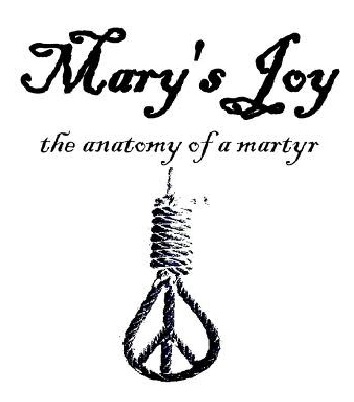
Simpson’s newest solo play, Mary’s Joy: The Anatomy of a Martyr, is ready to meet the public and has already been performed at a school at CU Boulder. I had the honor of sitting down with Jeanmarie Simpson and getting some insight on her work, art, and what it means to be a self proclaimed “artivist”.

***

Cynthia Schwartz: How do you choose your characters? How do you decide whose lives are expansive enough, or interesting enough that you could step inside them and actually become that person on stage?

Jeanmarie Simpson: I guess it’s my enthusiasm for clarity and justice and my feminist heart that leads me to the characters I want to write about and play. I love that these women speak for me, they’re a joy to make a case for, as an artist, because I am so moved by them and their lives.

CS: When you get something back from the audience, does that feed you not only as an actor, but do the characters respond differently during different performances?

JS: Absolutely. My work is deeply responsive to the energy in a room. When the audience is lively and engaged from the get-go, then so is the character. When an audience is more subdued, the performance will be sensitive to that and not seek to overwhelm them right off the bat. That’s the beauty of live performance. It’s an intimate communication. I feel so honored every time anyone is willing to sit and watch and/or listen to me for two hours.

CS: Tell us about Mary Dyer. She was hanged for being a Quaker?

JS: Yes. She was hanged on June 1, 1660, for being a Quaker in Boston, specifically. She had been banished and kept returning.

CS:  The play is subtitled “the anatomy of a martyr.” Can you dissect that for us?

JS: Sure. Whenever an event as dramatic as an execution happens, people become very interested in the “why” of it, and become really curious about the background of the person. We, as a species, seem to be fascinated by criminals who are killed by the state – I mean look at all the documentaries and TV shows that go over every little detail of their childhoods, etc. In Mary’s case, I was deeply intrigued by the notion of a colonial woman with six living children, one of them an infant, getting on a ship alone and going back to England for seven years. I knew she was one of the first Quakers and that she was hanged by the Puritans in Boston, but it’s her relationship with her husband and children that really hooked me- the trajectory of her life led to such a scary ending. She was incredibly determined to get through to the authorities, to turn their hearts, and that determination kept her moving forward. She believed that if she kept advancing in the struggle, something really beautiful would happen.

CS: Almost sounds like a suicide bomber.

JS: Hmmm. Yes. Maybe so, in terms of dying and believing in something beyond death, but she didn’t take anyone else with her. She wasn’t a killer.

CS: Many people view suicide as a selfish act. I can see how some might say that Mary Dyer is profoundly selfish, leaving a husband and all of those children behind to miss her and be left with such horrible images of her death.

JS: True. That’s a theme that is very true, no matter when it happens, today or 350 years ago. Without giving too much away, I think when people see the show and hear Mary’s story, they’ll maybe gain some understanding and a bit more compassion towards people who may be dealing with depression or suicidal thoughts. To label those people as selfish is really too easy. There is a community of complex human beings who suffer from mental diseases and they are really punished for it, by society in general. The stigma is much more powerful than is the the movement to make sure there’s plenty of help for troubled people. So many things can trigger chemical changes in the brain that can lead to all kinds of disorders. I think anyone who lived the life Mary Dyer lived would have been hard pressed not to become disturbed.

CS: Is it also a religious play? Will I walk away wanting to become a Quaker?

JS: (Laughs) I don’t know- I don’t think so. It’s much more about tolerance than it is any kind of missionary piece. Mary was always driven by a deep belief that love and grace are more appropriate expressions by clergy than totalitarianism marked by torture and execution. She had an intense moral compass and couldn’t accept the status quo. I hope that you’ll get a chance to see the show and meet her. She’s really something.

CS: At this point you’re doing a series of dramatic readings rather than a full-blown production, is that correct?

JS: Yes. We’re going to be doing readings, collecting donations and raising the money to stage the show in a theatre. We’re looking at several different spaces. Meanwhile, we can raise a bit of awareness about the Quakers and the Rocky Mountain Peace and Justice Center, here in Boulder. They have been doing such great work for so long and they’re always in need of support. Half of the proceeds will go to them, and the other half will go to Universal Arts Boulder, a new company that a group of us have started. This is a very exciting time of life for me, that’s for sure.

***

Written by Cynthia Schwartz

Playwright and actor Jeanmarie Simpson’s one-woman show is called Mary’s Joy: The Anatomy of a Martyr and it’s currently playing in Boulder, Colorado. For more information please visit universalartsboulder.wordpress.com or jeanmariesimpson.wordpress.com.

Jill Bolte Taylor’s Stroke of Insight

TED– One morning, a blood vessel in Jill Bolte Taylor’s brain exploded. As a brain scientist, she realized she had a ringside seat to her own stroke. She watched as her brain functions shut down one by one: motion, speech, memory, self-awareness…

Amazed to find herself alive, Taylor spent eight years recovering her ability to think, walk and talk. She has become a spokesperson for stroke recovery and for the possibility of coming back from brain injury stronger than before. In her case, although the stroke damaged the left side of her brain, her recovery unleashed a torrent of creative energy from her right. From her home base in Indiana, she now travels the country on behalf of the Harvard Brain Bank as the “Singin’ Scientist.”

© TED, 2008

Photo by flickr user brain_blogger

Economic Inequality In US Worse Than Egypt

NEWSVINE– According to the CIA World Fact Book, the U.S. is ranked as the 42nd most unequal country in the world, with a Gini Coefficient of 45.

In contrast:

Tunisia is ranked the 62nd most unequal country, with a Gini Coefficient of 40.
Yemen is ranked 76th most unequal, with a Gini Coefficient of 37.7.
And Egypt is ranked as the 90th most unequal country, with a Gini Coefficient of around 34.4.
And inequality in the U.S. has soared in the last couple of years, since the Gini Coefficient was last calculated, so it is undoubtedly currently much higher.
So why are Egyptians rioting, while the Americans are complacent?

Well, Americans – until recently – have been some of the wealthiest people in the world, with most having plenty of comforts (and/or entertainment) and more than enough to eat.

But another reason is that – as Dan Ariely of Duke University and Michael I. Norton of Harvard Business School demonstrate – Americans consistently underestimate the amount of inequality in our nation.

As William Alden wrote last September:

Americans vastly underestimate the degree of wealth inequality in America, and we believe that the distribution should be far more equitable than it actually is, according to a new study.

Or, as the study’s authors put it: “All demographic groups — even those not usually associated with wealth redistribution such as Republicans and the wealthy — desired a more equal distribution of wealth than the status quo.”

The report … “Building a Better America — One Wealth Quintile At A Time” by Dan Ariely of Duke University and Michael I. Norton of Harvard Business School … shows that across ideological, economic and gender groups, Americans thought the richest 20 percent of our society controlled about 59 percent of the wealth, while the real number is closer to 84 percent.

Written by John Russel

© COPYRIGHT NEWSVINE, 2011

Photo by flickr user SOS.de

Why are the rich getting richer while the poor are getting poorer in the United States?