 MEDIA ROOTS- Carly Ivan Garcia is a San Francisco based art curator and painter whose thriving,
neo-abstract style is expressed through bold strokes and colorful palettes. Garcia’s work has been shown
all over the country in both solo and group shows, and many of his paintings are featured in an
upcoming film called Touching Home, starring Ed Harris. Media Roots
recently caught up with Garcia to get the low down on his artistic perspective and creative
process.
MEDIA ROOTS- Carly Ivan Garcia is a San Francisco based art curator and painter whose thriving,
neo-abstract style is expressed through bold strokes and colorful palettes. Garcia’s work has been shown
all over the country in both solo and group shows, and many of his paintings are featured in an
upcoming film called Touching Home, starring Ed Harris. Media Roots
recently caught up with Garcia to get the low down on his artistic perspective and creative
process.
***
MR: Hey Carly, thanks so much for taking the time to share your thoughts with Media Roots. Your style caught me right away– it is an alive expression of self. Your imagery encompasses provocative themes that can be both childlike and dark. Have you been developing this style for a long time? How did you get into it?
CIG: Well, first of all I would like to take a
moment to thank everyone at Media Roots who helps to promote creative artists, like myself, and who helps to reclaim journalism through positive truth telling. So thank you, Media Roots.
I believe part of my creative
endeavors grew out of a passion I had for BMX biking. At 13,
I was a national champion in flatland freestlye. My experience with bike riding
fueled my kinetic energy and desire to express art. In high
school, I took a liking to painting and ended up spending most of my time in art class. I always felt like I had the ability to create and have always felt
confident that art was a discipline I could excel in.
MR: That’s awesome that your artistic expression stemmed from BMX enthusiasm! What mediums do you generally work with during the creative process?
CIG: I mostly work with oil and acrylics and find
myself going back to them more often than not. With oils, I prefer the saturation of
color they give. The acrylic efficiency in drying lets me paint layers on
top of layers quickly. This eventually presents a unique history from within the
painting that can be tracked visually. If I had to pick, I would say that oil is my top pick, but I also incorporate spray paint
and watercolors in some of my work too. I like to keep my neo-
modern style limitless by constantly pushing mediums and changing their conventional use. All of these mediums and ideas together creates my body of work.
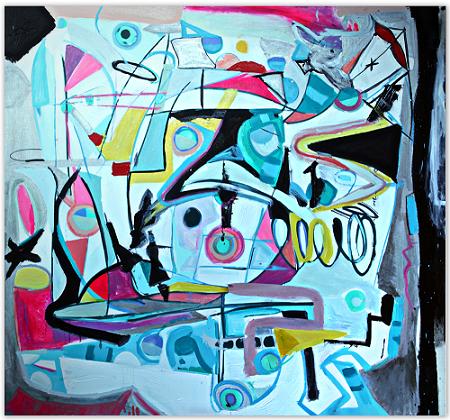
Daydream Free, 58″x60″, oil and mixed media, 2010
CIG: I created this large scale painting for solo exhibit presented by
TincaArt at the Miami Art Fair Foundation in 2010. This painting is from
my latest series that captures a neo- modern abstraction of an
industrialized world.
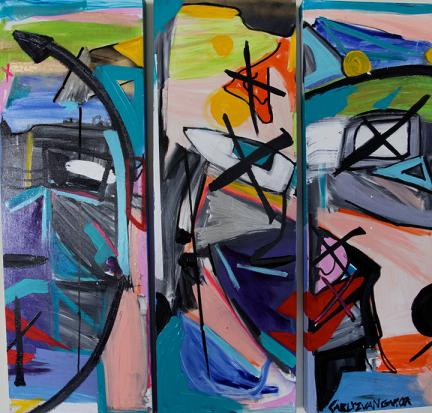
No Evil Triptych, 30″x12″, acrylic and wash, 2010
CIG: This is a painting out of a series of paintings I did on censorship for the NYCLU Just Art benefit.
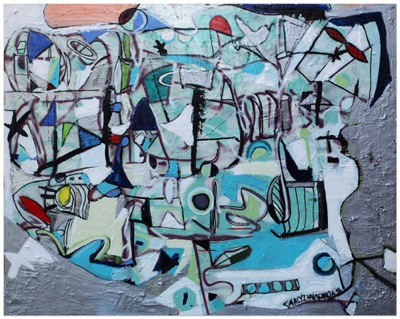
See Clear, 58″x60″, oil and mixed media, 2010
CIG: As the title suggests, I bring attention to society’s assumption in appearance. This painting was also part of a series called Neo Modern Abstractions of an industrialized world.
MR: It’s impressive that you are able to switch back and forth, I
tend to get stuck on one and shut myself out from exploring other
mediums. What is your favorite kind of art to create?
CIG: My favorite kind of art to make is the kind of work
that includes a ton of color that attracts the eye- first out of
instinct, but then the imagery takes you deeper into feeling or
significance that may not have been felt at first glance. The
beauty in my favorite kind of art work is all subjective. All art work
that I like or collect must have an
innate attraction- the more clever, the
better.
MR: Mo’ clever, mo’ better fo sho. Why do you
think it is so important to have independent media outlets working together to
highlight community art and activism?
CIG: Independent media outlets are essential in bringing attention to
artists’ social and political statements that either challenge the establishment or empower
communities.
MR: Do you think
artists and musicians have a responsibility to reflect societal and political
climates?
CIG: I strongly believe that the ultimate
responsibility of contemporary artists today is to reflect societal and political
climates. The most powerful artwork portrays a voice that creatively expresses
basic human rights. When given a space, art manifests positive interventions. Independent media outlets are crucial in bringing attention to
artists’ social and political statements that either challenge or empower
communities through art and activism.
MR: I agree. So how can people find you and your art in the
bay area?
CIG: I’m really excited at this moment because I
just had my first solo show in Hollywood CA at The FilmPunks
Gallery. I also have large scale paintings that reside at
The Uptown which is Oakland CA’s first apartment community to be certified by
the U.S. Green Building Council as ecologically-friendly. In Marin, my work can be seen
at Room Interior Gallery on Fourth street in San Rafael.
***
To learn more about Carly Ivan Garcia, or to check out his work go to www.carlyivangarcia.com or go to http://fountainexhibit.com/2010/index.php/media/tinca-art.
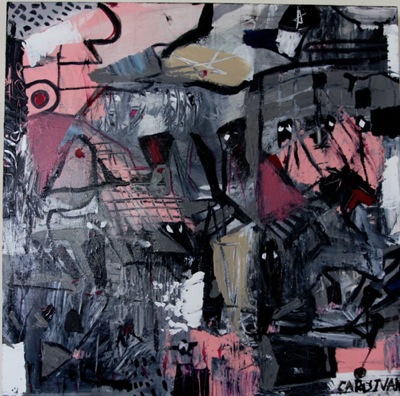
Main photo Starry Night, art by Carly Ivan Garcia
Written by Abby Martin



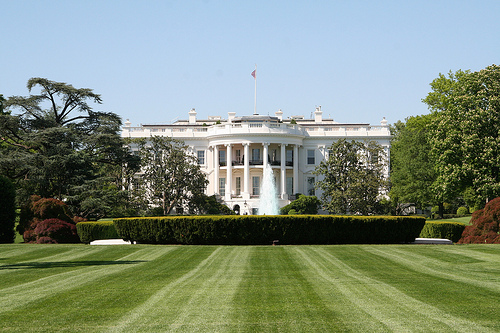 POLITICO– Caught between their boss’s anti-lobbyist rhetoric and the reality of
governing, President Barack Obama’s aides often steer meetings with
lobbyists to a complex just off the White House grounds – and several of
the lobbyists involved say they believe the choice of venue is no
accident.
POLITICO– Caught between their boss’s anti-lobbyist rhetoric and the reality of
governing, President Barack Obama’s aides often steer meetings with
lobbyists to a complex just off the White House grounds – and several of
the lobbyists involved say they believe the choice of venue is no
accident. SALON.COM
 MEDIA ROOTS- Carly Ivan Garcia is a San Francisco based art curator and painter whose thriving,
neo-abstract style is expressed through bold strokes and colorful palettes. Garcia’s work has been shown
all over the country in both solo and group shows, and many of his paintings are featured in an
upcoming film called Touching Home, starring Ed Harris. Media Roots
recently caught up with Garcia to get the low down on his artistic perspective and creative
process.
MEDIA ROOTS- Carly Ivan Garcia is a San Francisco based art curator and painter whose thriving,
neo-abstract style is expressed through bold strokes and colorful palettes. Garcia’s work has been shown
all over the country in both solo and group shows, and many of his paintings are featured in an
upcoming film called Touching Home, starring Ed Harris. Media Roots
recently caught up with Garcia to get the low down on his artistic perspective and creative
process.

 SALON.COM