More Black Men Now in Prison than Were Enslaved


LA PROGRESSIVE– “More African American men are in prison or jail, on probation or parole than were enslaved in 1850, before the Civil War began,” Michelle Alexander told a standing room only house at the Pasadena Main Library this past Wednesday, the first of many jarring points she made in a riveting presentation.

Alexander, currently a law professor at Ohio State, had been brought in to discuss her year-old bestseller, The New Jim Crow: Mass Incarceration in the Age of Colorblindness. Interest ran so high beforehand that the organizers had to move the event to a location that could accommodate the eager attendees. That evening, more than 200 people braved the pouring rain and inevitable traffic jams to crowd into the library’s main room, with dozens more shuffled into an overflow room, and even more latecomers turned away altogether. Alexander and her topic had struck a nerve.

Growing crime rates over the past 30 years don’t explain the skyrocketing numbers of black — and increasingly brown — men caught in America’s prison system, according to Alexander, who clerked for Supreme Court Justice Harry Blackmun after attending Stanford Law. “In fact, crime rates have fluctuated over the years and are now at historical lows.”“Most of that increase is due to the War on Drugs, a war waged almost exclusively in poor communities of color,” she said, even though studies have shown that whites use and sell illegal drugs at rates equal to or above blacks. In some black inner-city communities, four of five black youth can expect to be caught up in the criminal justice system during their lifetimes.

As a consequence, a great many black men are disenfranchised, said Alexander — prevented because of their felony convictions from voting and from living in public housing, discriminated in hiring, excluded from juries, and denied educational opportunities.

“What do we expect them to do?” she asked, who researched her ground-breaking book while serving as Director of the Racial Justice Project at the ACLU of Northern California. “Well, seventy percent return to prison within two years, that’s what they do.”

Organized by the Pasadena Public Library and the Flintridge Center, with a dozen or more cosponsors, including the ACLU Pasadena/Foothills Chapter and Neighborhood Church, and the LA Progressive as the sole media sponsor, the event drew a crowd of the converted, frankly — more than two-thirds from Pasadena’s well-established black community and others drawn from activists circles. Although Alexander is a polished speaker on a deeply researched topic, little she said stunned the crowd, which, after all, was the choir. So the question is what to do about this glaring injustice.

Married to a federal prosecutor, Alexander briefly touched on the differing opinion in the Alexander household. “You can imagine the arguments we have,” Alexander said in relating discussions she has with her husband. “He thinks there are changes we can make within the system,” she said, agreeing that there are good people working on the issues and that improvements can be made. “But I think there has to be a revolution of some kind.”

However change is to come, a big impediment will be the massive prison-industrial system.

“If we were to return prison populations to 1970 levels, before the War on Drugs began,” she said. “More than a million people working in the system would see their jobs disappear.”

So it’s like America’s current war addiction. We have built a massive war machine — one bigger than all the other countries in the world combined — with millions of well-paid defense industry and billions of dollars at stake. With a hammer that big, every foreign policy issue looks like a nail — another bomb to drop, another country to invade, another massive weapons development project to build.

Similarly, with such a well-entrenched prison-industrial complex in place — also with a million jobs and billions of dollars at stake — every criminal justice issue also looks like a nail — another prison sentence to pass down, another third strike to enforce, another prison to build in some job-starved small town, another chance at a better life to deny.

Alexander, who drew her early inspiration from Dr. Martin Luther King Jr., devotes the last part of “The New Jim Crow” to steps people can take to combat this gross injustice. In particular, she recommended supporting the Drug Policy Alliance. At the book signing afterwards, Dr. Anthony Samad recruited Michelle Alexander to appear this fall at one his Urban Issues Forums, typically at the California African American Museum next to USC.

Written by Dick Price

© Copyright Dick Price, 2011

Photo by flickr user mocvdleung

BP Doesn’t Want You to See Its Tarballs

MOTHER JONES– Lots has changed on Elmer’s Island. Nearly a year after the great oilpocalypse of 2010, this Louisiana wildlife refuge about 50 miles south of New Orleans isn’t crawling with teams of cleanup workers raking big black pools of crude off the sand; there’s no cleanup machinery or equipment; the only immediately visible remnants of the BP/Deepwater Horizon spill are the occasional tarballs, big as a kid’s head, that wash onto the shore.

Not that I can just waltz onto this public beach to see all that—not everything has changed. Like some lame iteration of Groundhog Day, the hundredth time I try to pull onto the Elmer’s Island access road from Highway 1 in southern Louisiana—some 200 days after the last time I tried it—I am, once again, stopped. Last year, it was cops blocking the road. Now it’s private security hired by BP.

“You have to get permission from central command to come on here, and then you’ll probably have to be escorted by an official,” the security guard tells me.

“How hard is it to get permission?”

“Usually pretty hard.” She says a local reporter couldn’t get through recently.

Read more on BP Doesn’t Want You to See Its Tarballs.

© 2011 Mother Jones

Photo by Flickr USFWS Southeast

Fukushima Beyond Point of No Return

NATURAL NEWS– The battle to save the Fukushima nuclear power plant now appears lost as the radioactive core from Reactor No. 2 has melted through the containment vessel and dropped into the concrete basement of the reactor structure. This is “raising fears of a major release of radiation at the site,” reports The Guardian, which broke the story. A former General Electric nuclear expert told The Guardian that Japan appears to have “lost the race” to save the reactor.

The only feasible interpretation from this analysis is that radiation emissions from Fukushima could suddenly become much greater. It is also now obvious that the radioactive fallout from Fukushima will last for decades, if not centuries.

Japan’s Prime Minister Naoto Kan last night admitted the situation at Fukushima remains “unpredictable.” Meanwhile, the presence of plutonium in soil samples is proof that the nuclear fuel rods have been compromised and are releasing material into the open atmosphere.

Read full article about Fukushima Beyond Point of No Return.

© Copyright Natural News, 2011

Photo by flickr user Abode of Chaos

Japan Earthquake and Pacific Tsunami


How to Design a Neighborhood for Happiness

SHAREABLE– Biology is destiny, declared Sigmund Freud.

But if Freud were around today, he might say “design is destiny”—especially after taking a stroll through most American cities.

The way we design our communities plays a huge role in how we experience our lives. Neighborhoods built without sidewalks, for instance, mean that people walk less and therefore experience fewer spontaneous encounters, which is what instills a spirit of community to a place. That’s a chief cause of the social isolation so rampant in the modern world that contributes to depression, distrust and other maladies.

You don’t have to be a therapist to realize all this creates lasting psychological effects. It thwarts the connections between people that encourage us to congregate, cooperate and work for the common good. We retreat into ever more privatized existences.

Of course, this is no startling revelation. Over the past 40 years, the shrinking sense of community across America has been widely discussed, and many proposals outlined about how to bring us back together. 

One of the notable solutions being put into practice to combat this problem is New Urbanism, an architectural movement to build new communities (and revitalize existing ones) by maximizing opportunities for social exchange: public plazas, front porches, corner stores, coffee shops, neighborhood schools, narrow streets and, yes, sidewalks. 

This line of thinking has transformed many communities, including my own World War I-era neighborhood in Minneapolis, which thankfully has sidewalks but was once bereft of the inviting public places that animate a community. Now I marvel at all the choices I have to mingle with the neighbors over a cappuccino, Pabst Blue Ribbon, juevos rancheros, artwork at a gallery opening or head of lettuce at the farmer’s market.

But while New Urbanism is making strides at the level of the neighborhood, we still spend most of our time at home, which today means seeing no one other than our nuclear family. How could we widen that circle just a bit?  Not a ‘60s commune (“pass the brown rice, comrade, and don’t forget your shift cleaning the toilet ”), but good neighbors with whom we share more than a property line.

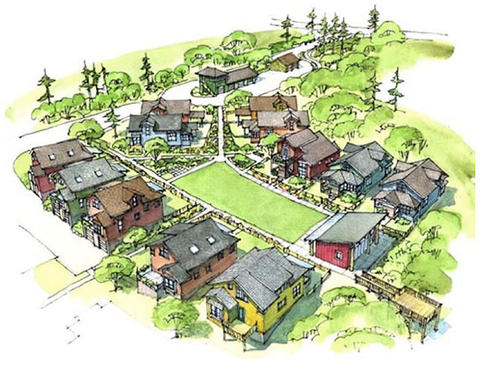
That’s an idea Seattle-area architect Ross Chapin has explored for many years, and now showcases in an inspiring and beautiful new book: Pocket Neighborhoods: Creating a Small-Scale Community in a Large-Scale World.

He believes that groupings of four to twelve households make an ideal community “where meaningful ‘neighborly’ relationships are fostered.” But even here, design shapes our destiny. Chapin explains that strong connections between neighbors develop most fully and organically when everyone shares some “common ground”. 

That can be a semi-private square, as in the pocket neighborhoods Chapin designed in the Seattle area. In the book’s bright photographs, they look like grassy patches of paradise, where kids scamper, flowers bloom, and neighbors stop to chat.

But Chapin points out these commons can take many different forms—an apartment building in Cambridge with a shared backyard, a group of neighbors in Oakland who tore down their backyard fences to create a commons, a block in Baltimore that turned their alley into a pubic commons, or the residential pedestrian streets found in Manhattan Beach, California, and all around Europe.

The benefits of a living in a pocket neighborhood go farther than you might imagine. I lived in one while in graduate school, a rundown 1886 rowhouse with its own courtyard near the University of Minnesota campus.  At no other time in my life have I become such close friends with my neighbors. We shared impromptu afternoon conversations at the picnic table and parties that went into the early hours of the morning under Italian lights we strung from the trees. 

When the property was sold to an ambitious young man who jacked up the rents to raise capital for the eventual demolition of the building to make way for an ugly new one, we organized a rent strike. And we won, which would never have happened if we had not already forged strong bonds with each other. Because the judged ruled that the landlord could not raise our rents until he fixed up the building, he abandoned plans to knock it down. It still stands today, and I remain friends with some of the old gang that partied in the courtyard.

by Jay Walljasper

This work is licensed under a Creative Commons License. Photo of Conover Commons in Redmond, Washington, designed by Ross Chapin, author of the book Pocket Neighborhoods: Creating Small-Scale Community in a Large-Scale World.

Posted in Uncategorized | 1 Reply

13% of All U.S. Homes are Vacant

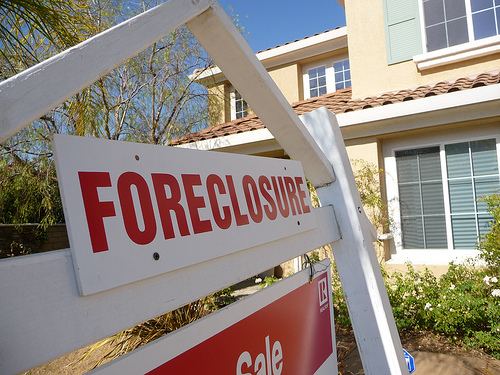
CNN– High residential vacancies are killing many housing markets, as foreclosed homes sit on the market and depress sale prices and property values.

And it’s only getting worse: The national vacancy rate crept up to just over 13% according to last week’s decennial census report. That’s up from 12.1% in 2007.

“More vacant homes equal more downward pressure on home prices,” said Brad Hunter, chief economist for Metrostudy, a real estate information provider.

Maine had the highest proportion of empty housing stock, at 22.8%. Other states with gluts of empty houses included Vermont (20.5%), Florida (17.5%), Arizona (16.3%) and Alaska (15.9%).

The way the census calculates the vacancy rates, however, is problematic. It includes properties such as ski lodges, beach houses and pied-à-terres that many real estate statisticians would not.

Read full article about 13% of All U.S. Homes are Vacant.

© Copyright CNN, 2011

Photo by flickr user Respres