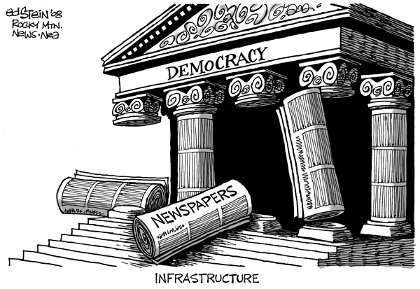
 PROJECT CENSORED– As we approach the prophetic and supposed media hyped end-of-times year
of 2012, hysterical speculation will abound. But the ubiquitous
corporate media don’t seem to notice that We the People of these United
States already stand at our own precipice– the potential end of what has
been deemed the Great American Experiment, the institutional embodiment
of human freedom protected by government of, by, and for the people.
PROJECT CENSORED– As we approach the prophetic and supposed media hyped end-of-times year
of 2012, hysterical speculation will abound. But the ubiquitous
corporate media don’t seem to notice that We the People of these United
States already stand at our own precipice– the potential end of what has
been deemed the Great American Experiment, the institutional embodiment
of human freedom protected by government of, by, and for the people.
Of course, for many, the promises of equality and democracy that lie
therein may never have existed in the history of the United States.
Certainly, racism, sexism, classism, and imperialism, have all played
the role of antagonist to said promises. However, America’s founding
documents were particularly rife with rhetorical flourishes that were
supportive of liberty, freedom of expression, the pursuit of happiness–
all of which actually sprouted many social and political movements that
changed American culture by striving toward those founding principles,
achieving them in varying degrees. In this regard, America has
succeeded in realizing the essence of some of its promises. But in
reality, the US, in historical terms, has fallen short in myriad ways
across the demographic spectrum and that trend is not abating. This is
in large part due to American’s reliance on reform over revolutionary
ideals and action as tools for change.
Arguably, the root of these
aforementioned problems within democracy, beyond exclusion or
manipulation of the franchise, chiefly resides in the controlling of
public information and education, and access to it. Thomas Jefferson
once offered a possible solution to these issues when he wrote, “The
functionaries of every government have propensities to command at will
the liberty and property of their constituents. There is no safe deposit
for these but with the people themselves, nor can they be safe with
them without information. Where the press is free, and every man able to
read, all is safe.”
The focus then is to achieve a truly free
press and a literate citizenry in maintenance of democratic government.
More timely, this was purportedly the focus of the organizers and
A-list participants of the National Conference on Media Reform this past
weekend in the historic (once revolutionary?) city of Boston. However,
these reformers have also fallen short of achieving this goal.
We
the people should go straight to the root of our problems with media,
which means taking a radical approach in dealing with the current
problems of our supposed free press to ensure that all are, as Jefferson
put it, safe. For starters, we should move well beyond reformist calls
for attenuating institutional dials, changing a few metaphorical
channels, or appointing new FCC commissioners. This has not worked.
The root of democracy is with the people, in education, in literacy, in
media awareness, and the path to change comes from the people, not the
president. That we move beyond a reform ethos concentrated on elite
media control must be agreed upon by all those aware of the problem in
order for real change to take place. And while moving beyond reform, we
cannot succumb to “hope and change we can believe in,” which was
promised, yet never delivered after the 2008 election where many
reformers focused great efforts to no avail. These eventual outcomes of
reform serve to create a subculture of acceptance in defeat, living to
fight again…in another four years. That is a long game. And we have
played it for a long time.
It is true that reforms play a role in
radical changes, though they are stepladders to paradigmatic changes.
The time to unite, face reality, and act to rebuild a new and relevant
democracy on the foundation of a truly free press is upon us as we are
in dire straights as a country, as a world.
Like falling empires
of old, the US today is mired in multi-front, unilateral wars and is
engaging in new ones ongoing while living well beyond its means at home;
ignoring domestic affairs when not outright waging internal wars
against those who actually expect elected and appointed officials to
live up to our founding Enlightenment principles.
These current
so-called “wars on terror” have cost over $3 trillion to date and occupy
a great deal of time of political leaders. All the while, the US
boasts record declines in middle and working class incomes and
opportunities; a jobless “recovery” in the wake of the economic collapse
of 2008 (caused in large part by the biggest banks on Wall Street which
subsequently were not held accountable and instead bailed out at
taxpayer expense); a crumbling infrastructure; failing schools
(including public and private charter); abysmal records on access and
quality of healthcare given the overall wealth and technological prowess
of the country; rising infant mortality rates; increasing homelessness;
skyrocketing foreclosures; collapse of community development and
non-profit support systems; faulty elections procedures; the use of
torture abroad and at home; the list goes on and on.
Last but not
least, we suffer a hyperreal condition as a society, spurred on by
fearful, factless, and feckless news programming by the nation’s
supposed leading journalistic outlets. This is why most people in
America do not seem to notice the inevitable descent. America is so
disconnected that even while individuals may suffer in large numbers
they lack a collective adhesive in a modern media landscape. They
erroneously believe they suffer alone, and thanks to corporate media
propaganda, are often afraid of the wrong things. Yet, a truly free
press should help build and protect democracy for the people, not
destroy it.
All this is taking place in what appears to be
absolute decline across the board for most Americans as the upper few
percent of the population control most of the nation’s wealth. A real
free press would tell us to forget the GDP and focus on community
building and works programs, not abstract market fluctuations. America
is a debtor nation and has not made much outside of weapons and related
technologies accompanied by military industrial media complex
propaganda/advertising for years– all masquerading as official foreign
policy and the “news.” The US government, along with this massive
military industrial complex, has now armed the world to the teeth to
justify a permanent warfare state.
America, its government of and
by corporations over the people, is now locked in a self-created,
last-ditch effort to occupy the nether regions of oil, industrial
capitalism’s dwindling lifeblood. The US forces the rest of the world
to trade on the dollar to maintain global hegemony, funding its
expansion of over a thousand military bases in over 130 countries.
Meanwhile, China, Russia, and several South American countries, are
already operating outside this monetary imposition, which as the late
scholar and author of the Blowback trilogy Chalmers Johnson argued, is
what would spell the end of American empire– fiscal bankruptcy. The
collapse of the dollar would hasten that. Indeed, that time draws nigh
as the cry for austerity from ostentatious leaders rings hollow across
the land.
But again, don’t expect the so-called mainstream media
to explain all this to the public. After all, according to the
mainstream media in the US (in actuality, it is the corporate media, but
the term “mainstream” is used so often people tend to forget it is not
so mainstream) there are teachers to blame and public workers to vilify,
and there is an ever ready supply of immigrant populations to enslave
or deport as well as exotic lands Americans can’t find on a map to
invade in efforts to rout evildoers that supposedly cause our current
calamities. And if that’s too much to handle, big media in the US can
intersperse a steady diet of junk food news where Americans can
vicariously feast on celebrity gossip and sport spectacles ranging from
Charlie Sheen and Dancing With the Stars to the Super Bowl and March
Madness in hopes that the problems we all face in the real world will
simply just go away.
These are the same issues many in the media
reform movement also decry, and rightfully so. Reform efforts have been
laudable. But the solutions reformers offer mostly seem to involve
“fixing the system” by focusing on influence of advertisers or
regulating ownership (which to date have not achieved reformer
objectives). Other reformers want the government to step in to “fix the
system” by creating a public media, without noting government has
played a big role in the current problem and even while public media is
under attack by Congress, PBS and NPR have hardly stood out in major
ways to challenge the plutocracy in the name of the people.
These
reform notions do not go to the root of the problem, they do not map out
a radical solution. And, despite reformers’ benevolent instincts and
intentions, don’t always expect reformers that criticize the big media
messengers’ behaviors to realize that the system they spend so much time
trying to repair is now defunct, if it ever existed in any
democratically functional means in the first place. This is why we, the
media literate citizens of this dying republic, must now move beyond
reform to create a new way.
We need to be the media in word and
deed, not lobby those in power to reform their own current establishment
megaphones for their own power elite agendas, as that will not happen,
and indeed, it has not in the past. In order to achieve real change, we
need not have elaborate conferences that rely on power elite voices,
their foundation monies, and their apologetic reformist rhetoric. In
the words of 19th century American activist Elizabeth Cady Stanton, we
need to embody the true change she channeled when she said, “Reformers
who are always compromising have not yet grasped the idea that truth is
the only safe ground to stand upon.” Indeed.
The time to speak
truth to power, to media power elites and their political allies, is
now. Media reform is an important movement, but it should not be seen
as the only path to create a more just and democratic media system.
More radical approaches are needed at this point. So just say no to
reform driven agendas delivered as so much managed news propaganda and
embrace the possibilities of a radical media democracy in action, of,
by, and for the people. Show it with actions through citizen journalism
and support of local and independent, non-corporate, community media.
Do it after the reform spectacle of vicarious deference to power and
celebrity is over in Boston this year, as the real change only begins
with true, radical action at home. That’s the only way a truly free
press can be created, preserved, and grown to be a tool of the people
and not the reformers with their unrequited overtures to the media power
elite. The time to act is now. We may not have time enough for the
next reform conference to save us.
Mickey Huff is Director of
Project Censored, on the board of directors for the Media Freedom
Foundation, and Associate Professor of History at Diablo Valley College
in the San Francisco Bay Area. Contact: Mickey [at] projectcensored.org
and Peter [at] projectcensored.org
See
“Truth Emergency Meets Media Reform” by Peter Phillips, Mickey Huff, et
al, in chapter 11 of Peter Phillips and Andrew Roth, eds, Censored
2009, NY, Seven Stories Press, 2008, pp. 281-295.



 PROJECT CENSORED
 MEDIA ROOTS- When it comes to foreign policy and trade, it’s common to see
  DAILY BEAST