KPFA– On this edition of Flashpoints, a nationally syndicated radio show,
Peter Phillips and
Mickey Huff from Project Censored and Abby Martin from Media
Roots report the latest news and coverage from the Fukushima
nuclear disaster.
On this edition of
Flashpoints, a nationally syndicated radio show, Peter Phillips and
Mickey Huff from Project Censored as well as Abby Martin from Media
Roots report the latest news and coverage from the Fukushima
nuclear disaster.
On this edition of
Flashpoints, a nationally syndicated radio show, Peter Phillips and
Mickey Huff from Project Censored as well as Abby Martin from Media
Roots report the latest news and coverage from the Fukushima
nuclear disaster.
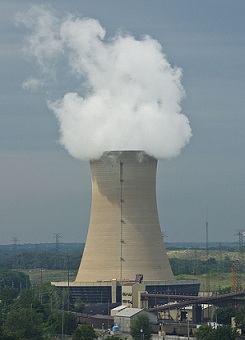
DEMOCRACY NOW– Three U.S. senators have called for a congressional probe on safety
issues at the nation’s aging nuclear plants following a pair of new
exposés. In a special series called “Aging Nukes,” the Associated Press
revealed that the U.S. Nuclear Regulatory Commission and the nuclear
power industry have been working in tandem to weaken safety standards to
keep aging reactors within the rules.
Just last year, the NRC
weakened the safety margin for acceptable radiation damage to reactor
vessels. The AP report also revealed radioactive tritium has leaked from
48 of the 65 U.S. commercial nuclear power sites, often into
groundwater from corroded, buried piping. Leaks from at least 37 of
those facilities contained concentrations exceeding the federal drinking
water standard—sometimes at hundreds of times the limit. We speak with
AP investigative journalist Jeff Donn. [includes rush transcript below]
***
JUANGONZALEZ:
Three U.S. senators called for a congressional probe on Thursday on
safety issues at the nation’s aging nuclear plants. The request from
Democratic senators Barbara Boxer of California, Sheldon Whitehouse of
Rhode Island, and independent Bernard Sanders of Vermont comes following
a pair of new exposés by the Associated Press. In a special series
called “Aging Nukes,” the AP revealed that the U.S. Nuclear Regulatory
Commission and the nuclear power industry have been working in tandem to
weaken safety standards to keep aging reactors within the rules. Just
last year, the Nuclear Regulatory Commission weakened the safety margin
for acceptable radiation damage to reactor vessels.
AMYGOODMAN:
The AP report also revealed radioactive tritium has leaked from 48 of
the 65 U.S. commercial nuclear power sites, often into groundwater from
corroded, buried piping. Leaks from at least 37 of those facilities
contained concentrations exceeding the federal drinking water standard,
sometimes hundreds of times the limit.
We’re joined now from Boston by Jeff Donn, who wrote the exposés for
the Associated Press, the national writer for the AP and member of the
AP investigative team.
Jeff, welcome to Democracy Now! Why don’t you lay out your
exposés one at a time, what you found in light of what happened in
Fukushima, what we’re dealing with here in this country?
JEFFDONN:
Well, there are two big ideas. One is that, as you summarized, the
nuclear industry and their government regulators have been working
together to lower safety standards as aging nuclear systems and parts
and plants come close to violating those standards and those rules. And
that’s been a pattern for decades now, and we’re seeing a lot of it as
these plants get older and older.
The other big idea here is that the plants have had piping buried
underneath, underground, covered underground for so long the piping
can’t be properly inspected. It’s rarely looked at carefully, visually.
It’s rarely dug up. And it’s been so long now that a lot of that is
corroding, and you have leaks, that we’ve documented, at three-quarters
of the sites. And in fact, a Government Accountability Office, the
congressional investigative arm, released—had a report released a day or
two ago after our series, and in that they say the Nuclear Regulatory
Commission, the federal regulators say, you know what? There have been
either leaks or spills—presumably many related to aging, some not, but
radioactive leaks or spills—of tritium and other radionuclides at all
the plants.
JUANGONZALEZ:
Well, Jeff, the picture that you paint here, especially when you
describe what’s happening at some of these plants, is really—it’s
amazing, the extent of, in essence, the cracks, the corrosion. How
exactly do they weaken the standards when they discover some of these
problems at particular plants?
JEFFDONN:
Well, what they do first is that the industry comes to government,
typically—this is the pattern you see—or sometimes government comes to
industry and says, “We’ve got all these parts or systems that are coming
close to the standard, even sometimes violating the standard. What do
we do about it?” And so, they set off on a round of research—and the
government does some of the research, the industry does some of the
research—and they find, again and again, that the standards can be
lowered. The operative phrase that you hear and you read again and again
is that “the standards were overly conservative.” So then they find
justification to lower those standards, and suddenly a group of parts or
systems that were coming close to violating rules, or do violate the
rules, are back within the rules. The other half of it is that the
regulators sometimes can’t get the systems and parts back within the
rules, so then they begin issuing waivers or amendments or special
exceptions that still allow the nuclear plants to keep running.
AMYGOODMAN:
I just want to go back to the tritium water. Explain the dangers of
this and how this is possible all over this country and what exactly it
means and what can be done to stem the leaks. I mean, you have Vermont.
They are poised to shut down their plant.
JEFFDONN:
Yeah, that’s a very good question, and it’s a little bit confusing to
people, I think. Tritium itself, at the levels that it’s been released,
is probably not a great health threat. It doesn’t penetrate the skin
very well. It’s not like the gamma radiation that people were talking
about in Japan. The main danger from tritium, the main health danger, is
if you were to drink it. The EPA sets a limit
for how much can be in drinking water. None of the leaks have entered
drinking water in amounts that would violate the EPA limit so far.
Part of the problem—and the GAO report I
was just talking about points this out—part of the problem is that the
industry and the regulators don’t really have a good handle on what’s
happening in those pipes and vaults and all that equipment under the
ground, that they don’t have technologies that really allow them to see
that very well. So, the GAO report says we
don’t really know about how bad the leaks are. That’s one part of the
problem. Another part—that’s a part that bears on public health.
Another part is that it raises questions about the integrity of the
plants, about the integrity of their cooling systems. Some, not all, but
some of this piping carries water that’s used to cool the reactors. And
in an emergency, as we saw in Japan, you desperately need that water to
cool the reactors, because the radiation produces a lot of heat, and
you’ve got to keep it cool. So, that’s the other half of the problem:
what do all these leaks say about the integrity of that piping and, even
in a broader sense, about the integrity of a lot of parts that can’t
easily be seen in nuclear power plants, like all those miles of
electrical cable underneath the power plants that are needed by the
operators to see what’s going on in the plant?
JUANGONZALEZ: And Jeff—
JEFFDONN: So it raises a lot of questions that trouble engineers.
JUANGONZALEZ:
Jeff, doesn’t the presence of tritium also indicate that probably other
radioactive materials like strontium or cesium might also be
getting—leaking from these plants?
JEFFDONN:
It does, because tritium—that’s a radioactive form of hydrogen, by the
way, and that’s why it gets into water, H20. It does. Tritium moves
through the soil more readily than some of those other radioactive
substances, so it’s often—you often see it first. And then, there are
lots of cases where you see other more powerful radioactive substances
that do more health harm, in equal amounts, after you see the tritium.
That’s—you’re right. That’s part of why the tritium is a concern.
AMYGOODMAN:
Can you name names of plants? For example, let’s talk New York. What’s
outside of New York City, of tens of millions of people, the plant and
where it stands today?
JEFFDONN:
Well, they’ve had—there are so many problems that it’s hard to
enumerate them all. But, for example, they’ve had radioactive leaks from
the spent fuel pools at Indian Point—the spent fuel pool. The spent
fuel pool is where they keep the radioactive fuel after they’ve used it
in the reactor, and that fuel remains thermally hot and radioactive for
years to come, so you have to keep it cool, just like the fuel in the
reactor. And they’ve had leakage from that spent fuel pool at Indian
Point, which is about 25 miles north of New York City. And we know how
important the spent fuel pools are in a different context in Japan, at
the Fukushima Daiichi plant, because a lot of the
radioactive—radioactivity that was released in the air there was from
the spent fuel pool. So, there’s been a lot of focus on the spent fuel
pools recently. And even the chairman of the Nuclear Regulatory
Commission, Gregory Jaczko, has hinted recently that maybe we do need to
look at the spent fuel pools in the United States and how securely
we’re keeping the spent fuel.
AMYGOODMAN: And what about evacuation plans, I mean, at places like Indian Point? And you can go around the country.
JEFFDONN:
Well, that’s something that we’ll be saying more about on Monday, in a
story that’s coming out on Monday. And I don’t want to get ahead of my
employer, but I can tell you that we’ll be—we’ll have a lot to say about
how much population growth there has been around the 65
nuclear—commercial nuclear power sites in the United States over last 30
years—we did a historical mapping analysis with mapping software—and
where the evacuation plans that communities must make for evacuation, if
it’s necessary around the plants, where they have weaknesses and where
they haven’t kept up to date with the population growth.
JUANGONZALEZ:
Jeff, your articles also talk about the problems with the reactor
vessels that enclose the reactors and that you found major problems, as
well, there, in the documents that you obtained, the monitoring
documents that you obtained from the government?
JEFFDONN:
Yeah, it’s real interesting. One of the biggest areas of aging
difficulties has been in so-called embrittlement of the steel around the
reactors. And what that means is that if you bombard something with
neutrons from a chain reaction, like the one that goes on inside these
reactors, if you bombard steel with neutrons for years and years, it
gets more brittle. And as it gets more brittle, like, say, a reed from
the beach that maybe you brought home and it gets brittle, when it
undergoes a force, it’s more likely to suddenly shatter, to break. And
the reactor vessels are like that. The vessels are these gigantic steel
tubs that surround the chain reaction, the radioactive fuel, and they
provide a shield from it, and they hold it. They keep the area around it
safe. And so, over the years, they’ve got increasingly brittle. There
was even one reactor in the early 1990s, the Yankee Rowe reactor in
western Massachusetts, that had to be closed largely because of concerns
about its vessel getting brittle.
And as—fairly early on, actually, in the industry’s history,
government and regulators started to notice that reactors were
approaching the embrittlement standard for the vessels, and in some
cases even violating that standard. And instead of saying, “OK, what can
we do to get the reactors back within the standard? Is it possible to
do a process called annealing, that would make them less brittle? Is it
possible to replace them?” what the industry and the government did is
they launched another round of research and decided, “You know what? We
can back off a little bit on the standard and allow the vessels to
become more brittle.” And that’s continued. There was a second round of
this, that’s taken years, that just culminated in the last year or two,
where they raised that safety standard again. Again, the same pattern,
saying, “We didn’t need to be so strict.” In other words, “We didn’t
need to be so safe. It’s safe enough.” Because the government and
industry argue that, for all the changes, the reactors still remain
safe—maybe not as safe as they were before, but plenty safe. That would
be their argument.
AMYGOODMAN:
Well, we’re going to leave it there, Jeff Donn, national writer for the
Associated Press, member of the AP investigative team, has done this
series, “Aging Nukes.” We will continue to report on what you’re doing.
Thanks so much, Jeff, for reporting to us from Boston.
TRUTHDIG– The most important moral and intellectual voices within a disintegrating society are slowly discredited when their nonviolent protests and calls for justice cannot alter intransigent and corrupt systems of power. The repeated acts of peaceful civil disobedience, efforts at electoral and political reform and the fight to protect the rule of law are dismissed as useless by an embittered, dispossessed and betrayed public. The demagogues and hatemongers, the purveyors of violence, easily seduce enraged and bewildered masses in the final stages of collapse with false promises of vengeance, new glory and moral renewal. And in the spiral downward the good among us are reviled as naive and ineffectual fools.
There is no shortage of courageous dissidents in America. They seek to thwart the imperial disasters, looming financial insolvency and suicidal addiction to fossil fuel. They have stood in small knots on street corners week after week, month after month, year after year, to denounce the wars in Iraq and Afghanistan. They have occupied banks, shut down coal-fired power plants, attempted to halt mountaintop removal, interfered with whaling ships and walked in blustery weather to the White House, where they were arrested. They are struggling to break the Israeli blockade of Gaza on a ship called the Audacity of Hope. But because the corporate state and the two major political parties are indifferent to principled calls for reform, and because the mass of the public still buys into the myths of globalization and the American dream, the plundering and destruction continue unimpeded.
When most Americans face the nightmare before us, when they realize the irreversible devastation unleashed on the ecosystem and the economic misery from which they cannot escape, violence will have a broad and terrifying appeal. Those of us who demand a return to the rule of law and remain steadfast to nonviolence will find ourselves cast aside—the useful idiots Lenin so despised. I watched this happen in the social and political implosions in El Salvador, Guatemala, the Palestinian territories, Algeria, Bosnia and Kosovo. I watched the same cocktail of despair, economic collapse and callousness from a corrupt power elite mix itself into potent brews of civil strife. I watched the same untiring efforts by those who detested the violence and cruelty of the state, and the nascent violence and intolerance of the radical opposition. I covered as a reporter the disintegration that tore these societies apart. Those who held fast to moral imperatives, including Archbishop Oscar Romero in El Salvador and Ibrahim Rugova in Kosovo, were thrust aside and replaced with killers on both sides of the divide who embraced violence.
MEDIA ROOTS- The following contains the full transcript of President Obama’s June 22 speech
regarding the troop pullout in Afghanistan. All additional commentary is italicized.
President Obama on June 22, 2011
***
BARACK OBAMA: Good evening. Nearly 10 years ago, America suffered
the worst attack on our shores since Pearl Harbor. This mass murder was
planned by Osama bin Laden and his alQaeda network in Afghanistan, and
signaled a new threat to our security– one in which the targets were
no longer soldiers on a battlefield, but innocent men, women and
children going about their daily lives.
We can’t actually go to trial to prove Al Qaeda’s involvement because Leon Panettasupposedly had OBL murdered by special operations trained killers. How do you like that for due process?
BO: In the days that followed, our nation was united as we struck at alQaeda
and routed the Taliban in Afghanistan.
Thanks to the dutiful stenographer-like
news-casters and cowardly political elites, the Bush administration was able to
amplify and carry the trauma onto millions of Americans. People whose lives would otherwise have been
unaffected were suddenly subjected to fear, paranoia, anxiety, PTSD, anger,
hate and manipulation.
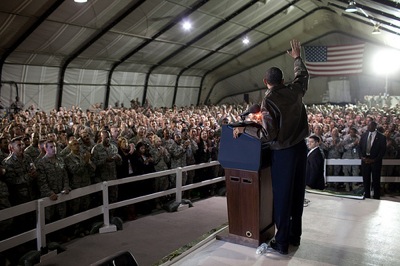
BO: Then, our focus shifted. A second war was launched in Iraq, and we spent
enormous blood and treasure to support a new government there. By the
time I took office, the war in Afghanistan had entered its seventh year.
Let me just gloss over the million or so
deaths in Iraq that were attributable to America’s
invasion and the trillions of
dollars pissed away to private contractors.
BO: But al Qaeda’s leaders had escaped into Pakistan
and were plotting new attacks, while the Taliban had regrouped and gone on the
offensive. Without
a new strategy and decisive action, our military commanders warned that we
could face a resurgent alQaeda, and a Taliban taking over large parts of
Afghanistan. For this reason, in one of the most difficult decisions that I’ve made as
President, I ordered an additional 30,000 American troops into Afghanistan.
When I announced this surge at West Point, we set clear objectives: to refocus
on alQaeda; reverse the Taliban’s momentum; and train Afghan Security Forces
to defend their own country.
Some might say that the
American and Coalition presence
in Afghanistan and Iraq are to strategically control the resources
there: oil, minerals, opium, etc. Well, everyone’s entitled to their
own opinion.
BO: I
also made it clear that our commitment would not be open-ended, and that we
would begin to drawdown our forces this July. [Nothing on the ground has really
changed, but hey, it’s an election year.
I can’t spin my December 2009 escalation of troops in Afghanistan as
having been effective if I don’t declare that we’ll be de-escalating now.] Tonight, I can tell you that we are fulfilling that commitment. Thanks to
our men and women in uniform [To whom you should all be grateful — man, it’s easy
to use the troops as props and political human shields — just tell your critics
that they’re not supporting the troops no one will dare disagree with you!] our civilian personnel, and our many coalition partners,
we are meeting our goals.
As a result, starting next month, we will be able to
remove 10,000 of our troops from Afghanistan by the end of this year, and we
will bring home a total of 33,000 troops by next summer, fully recovering the
surge I announced at West Point.
Notice how I cleverly don’t mention the amount of troops that would be left on the ground? Even after this fantasy withdrawal,
there will still be 70,000 troops and even more contractors in Afghanistan, just as there are in Iraq.
BO: After this initial reduction, our troops will
continue coming home at a steady pace as Afghan Security forces move into the
lead. Our mission will change from combat to support. By 2014, this process of transition will be complete, and
the Afghan people will be responsible for their own security. We are starting this drawdown from a position of strength. Al Qaeda is under
more pressure than at any time since 9/11. Together with the Pakistanis, we
have taken out more than half of al Qaeda’s leadership.
Nevermind that the global “War on Terror”— yes, the phrase which I retired rhetorically but in all
other ways supported— has created more terrorists worldwide, more threats to
US security, and has even caused the US government to turn on its own people.
BO: And
thanks to our intelligence professionals and Special Forces, we killed Osama
bin Laden, the only leader that alQaeda had ever known. This was a victory for
all who have served since 9/11.
The
killing of one man has been worth spending trillions on the illegal,
immoral US wars that have killed more than a million civilians?
BO: One soldier summed it up well.
“The message,” he said, “is we don’t forget. You will be held accountable, no
matter how long it takes.” [Isn’t that cute?
This anonymous soldier thinks there’s accountability in this world.]
The information that we recovered from bin Laden’s compound shows alQaeda
under enormous strain. Bin Laden expressed concern that
alQaeda has been unable to effectively replace senior terrorists that have
been killed, and that alQaeda has failed in its effort to portray America as a
nation at war with Islam – thereby draining more widespread support. [I’m
counting on you to not try and verify anything I’m saying by actually talking
with people who might be brown and from other countries.].
BO: Al Qaeda remains dangerous, and we must be
vigilant against attacks. But we have put alQaeda on a path to defeat, and we
will not relent until the job is done. [We will also keep killing, exploiting, torturing and waging war on
people all over the world, and then pretend to express shock and incompetence when these victims
retaliate.] In Afghanistan, we’ve inflicted serious losses on the Taliban [and in
Mcchyrstal’s words, an “amazing number of people” who were not threats] and taken a number of its strongholds.
Along with our surge, our allies also increased their commitments, which helped
[de-] stabilize more of the country. Afghan
Security Forces have grown by over 100,000 troops, and in some provinces and
municipalities we have already begun to transition responsibility for security
to the Afghan people.
In the face of violence and intimidation,
Afghans are fighting and dying for their country [and mainly to kick us out of
their country], establishing local police forces, opening markets and schools,
creating new opportunities for women and girls, and trying to turn the page on
decades of war. Of course, huge challenges remain. This is the beginning – but not the end –
of our effort to wind down this war. We will have to do the hard work of
keeping the gains that we have made[don’t ask for specifics about the “gains” I am referring to], while we
drawdown our forces and transition responsibility for security to the Afghan
government. And next May, in Chicago, we will host a summit with our NATO
allies and partners to shape the next phase of this transition.
We do know that peace cannot come to a land that has known so much war
without a political settlement. So as we strengthen the Afghan government and
Security Forces, America will join initiatives that reconcile the Afghan
people, including the Taliban. [Is that why we are paying members of the Taliban to “switch” to our side?] Our position on these talks is clear: they
must be led by the Afghan government, and those who want to be a part of a
peaceful Afghanistan must break from alQaeda, abandon violence, and abide by
the Afghan Constitution. But, in part because of our military effort, we have
reason to believe that progress can be made.
The goal that we seek is achievable, and can be expressed simply: no
safe-haven from which alQaeda or its affiliates can launch attacks against our
homeland, or our allies. We will not try to make Afghanistan a perfect place.
We will not police its streets or patrol its mountains indefinitely. That is
the responsibility of the Afghan government, which must step up its ability to
protect its people; and move from an economy shaped by war [a war that we’ve had a
huge hand in for decades] to one that can sustain a lasting peace. What we can do, and
will do, is build a partnership with the Afghan people that endures – one that
ensures that we will be able to continue targeting terrorists and supporting a
sovereign Afghan government [and as long as energy and mining companies can
extract resources from the soil and seas in and around the country].
Of course, our efforts must also address terrorist safe-havens in Pakistan.
No country is more endangered by the presence of violent extremists, which is
why we will continue to press Pakistan to expand its participation in securing
a more peaceful future for this war-torn region. [How do we know they’re
violent? We’ve got their calling cards
in our Rolodexes. And they’ve got
receipts from subsidized weapons sales from American dealers.] We will work
with the Pakistani government to root out the cancer of violent extremism, and
we will insist that it keep its commitments. For there should be no doubt that
so long as I am President, the United States will never tolerate a safe-haven
for those who aim to kill us: they cannot elude us, nor escape the justice they
deserve.
Don’t bother asking
about justice for American politicians. I believe in the double standards
afforded by American exceptionalism. We
are an empire– laws and
justice are for other people.
BO: My fellow Americans, this has been a difficult decade for our country. We
have learned anew the profound cost of war — a cost that has been paid by the
nearly 4500 Americans who have given their lives in Iraq, and the over 1500 who
have done so in Afghanistan – men and women who will not live to enjoy the
freedom that they defended. Thousands more have been wounded. Some have lost
limbs on the field of battle, and others still battle the demons that have
followed them home.
Yet tonight, we take comfort in knowing that the tide of war is receding. [Let
me frame that in a way that makes war a phenomena that is caused by the pull of
celestial bodies and gravity, rather than the design and greed of men.] Fewer of our sons and daughters are serving
in harm’s way. [Don’t ask who put them there.]
We have ended our combat mission in
Iraq, with 100,000 American troops already out of that country. [Don’t
ask how many tens of thousands of troops remain, and how many contractors are
still cashing nice checks in the name of freedom and democracy and liberation. Did I mention that June was the deadliest month for the US Army in Iraq since 2009?]
And even as there will be dark days ahead in Afghanistan, the light of a secure
peace can be seen in the distance. These long wars will come to a responsible
end.
As they do, we must learn their lessons. [Let me ignore the lessons of
Vietnam and from every other war in history. That
way, I can choose lessons that won’t preclude future military
interventions.] Already this decade of
war has caused many to question the nature of America’s engagement around the
world. Some would have America retreat from our responsibility as an anchor of
global security, and embrace an
isolation that ignores the very real threats that we face. Others would have
America over-extend ourselves, confronting every evil that can be found abroad.
That thing in Libya that I’ve done—yeah,
don’t think about that…
BO: We must chart a more centered course. Like generations before, we must
embrace America’s singular role in the course of human events. But we must be
as pragmatic as we are passionate; as strategic as we are resolute. When
threatened, we must respond with force – but when that force can be targeted,
we need not deploy large armies overseas. When innocents are being slaughtered
and global security endangered, we don’t have to choose between standing idly
by or acting on our own. Instead, we must rally international action, [by
pressuring the UN and then broadly interpreting UN resolutions, such as UNSCR
1970] which we are doing in Libya, where we do not have a single soldier on the
ground, but are supporting allies in protecting the Libyan people and giving
them the chance to determine their destiny.
When we’re attacked by Libyans in years to come, remember, act
surprised!
BO: In all that we do, we must remember that what sets America apart is not
solely our power – it is the principles upon which our union was founded. We
are a nation that brings our enemies to justice while adhering to the rule of
law [don’t mention torture, don’t mention torture], and respecting the rights
of all our citizens. [Never mind that privacy is completely eradicated in this country and that big brother is watching your every move.] We protect
our own freedom and prosperity by extending it to others.
That nut-grab at the
airport is just a friendly freedom
fondle!
BO: We stand not for empire, but
for self-determination. That is why we have a stake in the democratic
aspirations that are now washing across the Arab World. [Even though,
admittedly, we propped up and befriended those very dictators that are now
getting overthrown… see, it’s useful to American politicians to have an
American public so ignorant of history.]
We will support those revolutions with fidelity to our ideals, with the
power of our example, and with an unwavering belief that all human beings
deserve to live with freedom and dignity.
Actually, it’s not so much that we care about congruence of ideals—I
mean, look at China. Where it suits the
interests of the economic elites and warprofiteers, we’ll turn a blind eye to
human rights. Though sometimes I wish we could
censor the internet like China does, so we could prevent ugly reports pointing out American hypocrisy from being accessed.
BO: Above all, we are a nation whose strength abroad has been anchored in
opportunity for our citizens at home. Over the last decade, we have spent a
trillion dollars on war [actually close to three or five], at a time of rising
debt and hard economic times. Now, we must invest in America’s greatest
resource – our people. We must unleash innovation that creates new jobs and
industry, while living within our means. We must rebuild our infrastructure and
find new and clean sources of energy. And most of all, after a decade of
passionate debate, we must recapture the common purpose that we shared at the
beginning of this time of war. For our nation draws strength from our
differences, and when our union is strong no hill is too steep and no horizon
is beyond our reach.
Let’s not talk about 800 military bases, or the fact that US military spending costs more than 2
billion dollars a day. I hope no one
looks up the employment effects of military spending either.
BO: America, it is time to focus on nation building here at home. In this effort, we draw inspiration from our fellow Americans who have
sacrificed so much on our behalf. To our troops, our veterans and their
families, I speak for all Americans when I say that we will keep our sacred
trust with you, and provide you with the care, and benefits, and opportunity
that you deserve.
I met some of those patriotic Americans at Fort Campbell. A while back, I
spoke to the 101st Airborne that has fought to turn the tide in Afghanistan,
and to the team that took out Osama bin Laden. Standing in front of a model of
bin Laden’s compound, the Navy SEAL who led that effort paid tribute to those
who had been lost – brothers and sisters in arms whose names are now written on
bases where our troops stand guard overseas, and on headstones in quiet corners
of our country where their memory will never be forgotten. This officer – like
so many others I have met with on bases, in Baghdad and Bagram, at Walter Reed
and Bethesda Naval Hospital – spoke with humility about how his unit worked
together as one – depending on each other, and trusting one another, as a
family might do in a time of peril.
That’s a lesson worth remembering – that we are all a part of one American
family. Though we have known disagreement and division, we are bound together
by the creed that is written into our founding documents, and a conviction that
the United States of America is a country that can achieve whatever it sets out
to accomplish. Now, let us finish the work at hand. Let us responsibly end
these wars, and reclaim the American Dream that is at the center of our story.
With confidence in our cause; with faith in our fellow citizens; and with hope
in our hearts, let us go about the work of extending the promise of America –
for this generation, and the next. May God bless our troops. And may God bless
the United States of America.
Transcript of Obama’s Speech, Commentary written by Smedley Butler’s ghost
HAARETZ– The Greek government issued a statement on Friday, saying that the
departure of ships with Greek and foreign flags from Greek ports to the
maritime area of Gaza has been prohibited. The statement explained that
this is in a bid to prevent a breach of Israel’s naval blockade.
The Greek government stressed that local
Hellenic Coast Guard Authorities must take all appropriate measures to
implement the decision. It also warned that the broader maritime area of
the eastern Mediterranean Sea will be continuously monitored by
electronic means for tracking the movement of ships trying to
participate in the flotilla.
Naval authorities have already implemented the order, blocking both
an American and Canadian ship planning to participate in the
pro-Palestinian Gaza flotilla set to take place next week.
However, in light of Greece’s decision to block all ships heading to the strip, the flotilla has been delayed further.
American activists attempted to set sail
from Greece toward Gaza on Friday aboard a boat dubbed “The Audacity of
Hope”, defying calls from Israel to cancel and the ban by Athens.



 DEMOCRACY NOW
 TRUTHDIG
 BO: Then, our focus shifted. A second war was launched in Iraq, and we spent
enormous blood and treasure to support a new government there. By the
time I took office, the war in Afghanistan had entered its seventh year.
BO: Then, our focus shifted. A second war was launched in Iraq, and we spent
enormous blood and treasure to support a new government there. By the
time I took office, the war in Afghanistan had entered its seventh year.  HAARETZ