Fukushima Caesium Leaks ‘Equal 168 Hiroshimas’

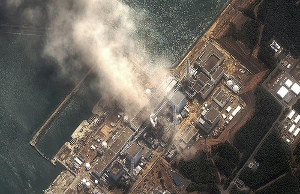
MEDIA ROOTS- An extremely harrowing aspect of the Fukushima meltdown is the amount of radiation that has been expelled and will continue to be released into the atmosphere as a result. A recent report from the Japanese government states that the amount of radioactive caesium-137 released by the disaster is so far equivalent to that of 168 Hiroshima nuclear bombs, and that 34 different locations around Fukushima already exceed the radiation standards of inhabitability used for the Chernobyl disaster. The Center for Disease Control (CDC) states the following about caesium-137:

“External exposure to large amounts of Cs-137 can cause burns, acute radiation sickness, and even death. Exposure to Cs-137 can increase the risk for cancer because of exposure to high-energy gamma radiation. Internal exposure to Cs-137, through ingestion or inhalation, allows the radioactive material to be distributed in the soft tissues, especially muscle tissue, exposing these tissues to the beta particles and gamma radiation and increasing cancer risk.”

As scary as this seems, it’s important to put it into perspective. There is nothing much we can do about what is going on in Japan right now, but there are things we can do to reduce the risk of over exposure to our bodies by continuing to be healthy and conscious consumers.

Abby

***

AFP– The amount of caesium-137 released since the three reactors were crippled by the March 11 quake and tsunami has been estimated at 15,000 tera becquerels, the Tokyo Shimbun reported, quoting a government calculation.

That compares with the 89 tera becquerels released by “Little Boy”, the uranium bomb the United States dropped on the western Japanese city in the final days of World War II, the report said.

The estimate was submitted by Prime Minister Naoto Kan’s cabinet to a lower house committee on promotion of technology and innovation, the daily said.

The government, however, argued that the comparison was not valid.

While the Hiroshima bomb claimed most of its victims in the intense heatwave of a mid-air nuclear explosion and the highly radioactive fallout from its mushroom cloud, no such nuclear explosions hit Fukushima.

There, the radiation has seeped from molten fuel inside reactors damaged by hydrogen explosions.

“An atomic bomb is designed to enable mass-killing and mass-destruction by causing blast waves and heat rays and releasing neutron radiation,” the Tokyo Shimbun daily quoted a government official as saying. “It is not rational to make a simple comparison only based on the amount of isotopes released.”

Read more about Fukushima Caesium Leaks ‘Equal 168 Hiroshimas’

© 2011 Agence France Presse

Photo by Flickr user RINKRATZ


Posted in Uncategorized | 1 Reply

In California, Much Is Officially Secret

MEDIA ROOTS- There are some things that are justifiably kept secret within the state bureaucracy, like personal data and information about residents. However, the expansion of secrecy in every avenue of California’s government has made it increasingly difficult to gauge its efficiency and affect change at the legislative level.

Surprisingly, lawmakers’ schedules are withheld from public record, widening the divide between the people and the government by limiting a constituency’ ability to shape policy or voice their opinions to representatives. The OC Register recently compiled a report detailing the era of secrecy that reveals how much is actually being kept secret, and why.

Abby

***

OC REGISTER– Secrecy has seeped into every corner of state government, making it difficult to gauge Sacramento’s effectiveness and discretion. An Orange County Register review of the Government Code found at least 500 provisions that exempt specific records or information from public disclosure while another 16 code sections prohibit the release of broad categories of documents, including every complaint filed with a licensing body or investigatory agency, all communications with members of the Legislature and any document whose release does not serve the public interest.

Official secrets are held in every office and department in state government, from food and agriculture, public health and the DMV to corrections, social services and the Legislature, where the Assembly recently made headlines (and drew a lawsuit) over its refusal to release documents related to members’ current budgets.

California’s deference to secrecy is often couched as a public service, and indeed much of the information held in confidence actually protects residents. Nobody wants the government giving out Social Security numbers or publicly releasing the results of AIDS tests. But the Government Code is also littered with exemptions that freedom of information advocate Terry Francke criticizes as “hard to justify.” Why are the names of asparagus producers, red light camera photos and the urine tests of race horses confidential?

CAPITOL’S BLACK BOX

Nothing is more valuable in Sacramento than access. If you can get a meeting with a lawmaker, you can influence votes and shape public policy. Among Capitol insiders, the personal meeting is thought to be among the most important parts of the legislative process.

How do you get a meeting with a lawmaker? Many legislators pride themselves on taking meetings with any constituent who asks, but it’s widely believed that most lawmakers reserve their time for campaign contributors. In fact, some insiders say lawmakers make no effort to hear both sides of an issue, that they only take meetings with the side that gave them money.

It’s difficult to see if that’s true, however, because both houses of the Legislature say that lawmakers’ schedules are secret – even if legislators want to release them. The Rules Committees of the Senate and the Assembly prevented lawmakers from disclosing their schedules when reporters asked for them earlier this year, saying that the committees, not the lawmakers themselves, actually have possession of the documents.

Secrecy has seeped into every corner of state government, making it difficult to gauge Sacramento’s effectiveness and discretion. An Orange County Register review of the Government Code found at least 500 provisions that exempt specific records or information from public disclosure while another 16 code sections prohibit the release of broad categories of documents, including every complaint filed with a licensing body or investigatory agency, all communications with members of the Legislature and any document whose release does not serve the public interest. Official secrets are held in every office and department in state government, from food and agriculture, public health and the DMV to corrections, social services and the Legislature, where the Assembly recently made headlines (and drew a lawsuit) over its refusal to release documents related to members’ current budgets.
California’s deference to secrecy is often couched as a public service, and indeed much of the information held in confidence actually protects residents. Nobody wants the government giving out Social Security numbers or publicly releasing the results of AIDS tests. But the Government Code is also littered with exemptions that freedom of information advocate Terry Francke criticizes as “hard to justify.” Why are the names of asparagus producers, red light camera photos and the urine tests of race horses confidential?
CAPITOL’S BLACK BOX
Nothing is more valuable in Sacramento than access. If you can get a meeting with a lawmaker, you can influence votes and shape public policy. Among Capitol insiders, the personal meeting is thought to be among the most important parts of the legislative process.
How do you get a meeting with a lawmaker? Many legislators pride themselves on taking meetings with any constituent who asks, but it’s widely believed that most lawmakers reserve their time for campaign contributors. In fact, some insiders say lawmakers make no effort to hear both sides of an issue, that they only take meetings with the side that gave them money.
It’s difficult to see if that’s true, however, because both houses of the Legislature say that lawmakers’ schedules are secret – even if legislators want to release them. The Rules Committees of the Senate and the Assembly prevented lawmakers from disclosing their schedules when reporters asked for them earlier this year, saying that the committees, not the lawmakers themselves, actually have possession of the documents.

Read more about In California, Much Is Officially Secret.

© 2011 The Orange Country Register

Photo by Flickr user Mark Luethi

America’s Rampant Inequality Impossible to Deny

MEDIA ROOTS- This segment from the Daily Show breaks down how class warfare is perpetrated by the rich to phase out the middle class in this country. Stewart explains that the government could raise $700 billion by either taking half of everything earned by the bottom 50% or by raising the marginal tax rate on the top two percent. The video is followed by a great article from In These Times that further details the war being waged on the poor.

Abby

***


IN THESE TIMES– For years, America’s super-rich and their allies in Congress and the media have tried to deny that a tiny elite was growing astronomically wealthy at the expense of the vast majority of Americans.

But the vast gaping canyon between the richest 1 percent and Corporate America, on the one hand, and the rest of us on the other, has become so large and well-documented that denial no longer works. The ideological combat gets especially intense when it turns to the relatively minimal taxes that corporations and the rich pay.

What defense can be offered when billionaire investor Warren Buffet admits that he pays a 15 percent capital-gains rate on most of his income, while everyone else in his office (including the secretary) pays a considerably higher rate?

Significantly, the plight of the broad American middle class has been closelylinked to the fate of the labor movement as it has come under siege in the last 35 years. While many middle-class people have long resented the gains made by blue-collar workers who often lacked higher education, the fact remains that as labor has lost ground in terms of real wages, so has the middle class.

Prof. Bruce Western of Harvard concluded in a study this month:

From 1973 to 2007, wage inequality in the private sector increased by more than 40 percent among men, and by about 50 percent among women. […] deunionization—the decline in the percentage of the labor force that is unionized—and educational stratification each explain about 33 percent of the rise in within-group wage inequality among men. Among women, deunionization explains about 20 percent…

Having invested in union-busting lawyers, private police, and anti-union politicians, America’s rich benefit immensely from such de-unionization. The most affluent Americans and big corporations have enjoyed a spectacular recovery from the deepest recession in 80 years.

While effects of the recession linger for working-class families in America—joblessness and insecure employment, loss of health coverage, exhausted unemployment benefits, falling home values, the threat of home foreclosure, to name a few—the prosperous and Corporate America have almost entirely avoided this pain. In fact, corporations saw their profits soar 243 percent in 2009 and another 61 percent in 2010. The wealthiest 10 percent nowaccount for 60 percent of all consumer spending.

For years, America’s super-rich and their allies in Congress and the media have tried to deny that a tiny elite was growing astronomically wealthy at the expense of the vast majority of Americans.
But the vast gaping canyon between the richest 1 percent and Corporate America, on the one hand, and the rest of us on the other, has become so large and well-documented that denial no longer works. The ideological combat gets especially intense when it turns to the relatively minimal taxes that corporations and the rich pay.
What defense can be offered when billionaire investor Warren Buffet admitsthat he pays a 15 percent capital-gains rate on most of his income, while everyone else in his office (including the secretary) pays a considerably higher rate?
Significantly, the plight of the broad American middle class has been closelylinked to the fate of the labor movement as it has come under siege in the last 35 years. While many middle-class people have long resented the gains made by blue-collar workers who often lacked higher education, the fact remains that as labor has lost ground in terms of real wages, so has the middle class.
Prof. Bruce Western of Harvard concluded in a study this month:
From 1973 to 2007, wage inequality in the private sector increased by more than 40 percent among men, and by about 50 percent among women. […] deunionization—the decline in the percentage of the labor force that is unionized—and educational stratification each explain about 33 percent of the rise in within-group wage inequality among men. Among women, deunionization explains about 20 percent…
Having invested in union-busting lawyers, private police, and anti-union politicians, America’s rich benefit immensely from such de-unionization. The most affluent Americans and big corporations have enjoyed a spectacular recovery from the deepest recession in 80 years.
While effects of the recession linger for working-class families in America—joblessness and insecure employment, loss of health coverage, exhausted unemployment benefits, falling home values, the threat of home foreclosure, to name a few—the prosperous and Corporate America have almost entirely avoided this pain. In fact, corporations saw their profits soar 243 percent in 2009 and another 61 percent in 2010. The wealthiest 10 percent nowaccount for 60 percent of all consumer spending.
With most U.S. consumers having little money to spend, American corporations see little reason to crank up production and hire new workers in America. Corporations are sitting on at least $2 trillion in savings (plus another $1 trillion or more stashed outside the country) but have no reason to invest in the U.S. The consumer demand simply doesn’t exist in America, and corporations can sell to the engorged elites of emerging nations like China, India, Brazil, and Mexico.
Perhaps that explains why major corporate leaders seem perfectly complacent with the obstructive hijinks of Congressional Republicans, in whom they invested so heavily with campaign contributions (out-spending labor in 2008 by a ratio of 15-1) and who are committed to crushing any and all programs that might serve as a badly-needed economic stimulus.

Read more about America’s Rampant Inequality Impossible to Deny

© 2011 In These Times

Photo by Flickr user daliphoto

President Obama’s Lack of Transparency

MEDIA ROOTS- What happened to all that talk about transparency, Mr. President? Oh right, it was all just empty rhetoric. One of the first things Obama did once he elected was promise an “unprecedented level of transparency” in government. He was even given a transparency award which was ironically delivered to him in a private Oval Office ceremony off the public record. However, his administration has exacerbated some of the most egregious policies regarding secrecy and censorship.

The Obama administration has not only prosecuted more whistleblowers than any other president combined. Officials in this administration are also responsible for classifying 77 million documents in 2010—a shocking one-year jump of 40 percent. Furthermore, this cabinet has misguidedly used the Espionage Act in five cases of news media disclosures, when previously there were no more than four in all of White House history.

Abby

***

NEW YORK TIMES– A former top official in charge of ensuring that real secrets are kept secret has delivered a stunning repudiation of the Obama administration’s decision to use the Espionage Act against a whistle-blower attempting to expose government waste and abuse.

J. William Leonard, who directed the Information Security Oversight Office during the George W. Bush administration, filed a formal complaint about the prosecution with the Justice Department and the National Security Agency, and urged punishment of officials who needlessly classify documents that contain no actual secrets.

In the case in question, Thomas Drake, an N.S.A. employee, faced 35 years in prison for espionage after he leaked information to a reporter about a potential billion-dollar computer boondoggle. The case collapsed last month with Mr. Drake walking away after a token misdemeanor plea to providing information to an unauthorized person. The government was deservedly berated by Judge Richard Bennett of Federal District Court in Maryland for an “unconscionable” pursuit of the accused across “four years of hell.”

Prosecutors dropped the felony charges at the 11th hour after Judge Bennett ordered them to show allegedly classified material to the jury. But Mr. Leonard said he was willing to testify for Mr. Drake that there were no secrets at issue and that he had never seen “a more deliberate and willful example of government officials improperly classifying a document.”

The Obama administration has misguidedly used the Espionage Act in five such cases of news media disclosures; previously there were no more than four in all of White House history. This comes as officials classified nearly 77 million documents last year — a one-year jump of 40 percent. The government claim that this was because of improved reporting is not reassuring.

Two years ago, President Obama ordered all agencies to review secret material by June 2012 with a goal of promoting more declassification. Unfortunately, the administration’s emphasis since then has all been in the opposite direction. Treating potentially embarrassing information as a state secret is the antithesis of healthy government.

A former top official in charge of ensuring that real secrets are kept secret has delivered a stunning repudiation of the Obama administration’s decision to use the Espionage Act against a whistle-blower attempting to expose government waste and abuse.
Related in News
J. William Leonard, who directed the Information Security Oversight Office during the George W. Bush administration, filed a formal complaint about the prosecution with the Justice Department and the National Security Agency, and urged punishment of officials who needlessly classify documents that contain no actual secrets.
In the case in question, Thomas Drake, an N.S.A. employee, faced 35 years in prison for espionage after he leaked information to a reporter about a potential billion-dollar computer boondoggle. The case collapsed last month with Mr. Drake walking away after a token misdemeanor plea to providing information to an unauthorized person. The government was deservedly berated by Judge Richard Bennett of Federal District Court in Maryland for an “unconscionable” pursuit of the accused across “four years of hell.”
Prosecutors dropped the felony charges at the 11th hour after Judge Bennett ordered them to show allegedly classified material to the jury. But Mr. Leonard said he was willing to testify for Mr. Drake that there were no secrets at issue and that he had never seen “a more deliberate and willful example of government officials improperly classifying a document.”
The Obama administration has misguidedly used the Espionage Act in five such cases of news media disclosures; previously there were no more than four in all of White House history. This comes as officials classified nearly 77 million documents last year — a one-year jump of 40 percent. The government claim that this was because of improved reporting is not reassuring.
Two years ago, President Obama ordered all agencies to review secret material by June 2012 with a goal of promoting more declassification. Unfortunately, the administration’s emphasis since then has all been in the opposite direction. Treating potentially embarrassing information as a state secret is the antithesis of healthy government.

Read more about Why Is That A Secret?

© 2011 The New York Times

Photo by Flickr user Animation Concept

Fabricating Pretext for NATO “Humanitarian Intervention”

MEDIA ROOTS- After using NATO’s Orwellian “humanitarian bombing” operation as the front for US intervention in Libya, the establishment is narrowing its sight on oil rich Syria next. Already the US and the EU have slapped economic sanctions on the country, citing President Bashar al-Assad’s human rights abuses during Syria’s recent protests. The corporate media is also beginning to ingrain propaganda about Syria’s stockpile of deadly weapons that is reminiscent of the propaganda surrounding the lead up to the Iraq war.

Earlier this month, Russia Today reported that the UN Security Council condemned “the widespread violation of human rights in Syria and the use of force against civilians by the country’s security forces,” while also urging the Damascus authorities to respect human rights and observe international law. “Those responsible for the violence should be held accountable,” the Council said in a presidential statement, the UN official website reports.

A great article by Global Research cuts through the misinformation regarding Syria and lays out some facts that don’t jive with what we are being told about their “democratic uprising”. Instead, reports suggest that the government and corporate press are fabricating a pretext for another NATO led humanitarian intervention in the region. Let’s not forgot that the United States pays the largest percentage of all NATO efforts, and wields the most influence on the shots being called on the grand chessboard.

Abby

***
GLOBAL RESEARCH– There is evidence of gross media manipulation and falsification from the outset of the protest movement in southern Syria on March 17th.

The Western media has presented the events in Syria as part of the broader Arab pro-democracy protest movement, spreading spontaneously from Tunisia, to Egypt, and from Libya to Syria. 

Media coverage has focussed on the Syrian police and armed forces, which are accused of indiscriminately shooting and killing unarmed “pro-democracy” demonstrators. While these police shootings did indeed occur, what the media failed to mention is that among the demonstrators there were armed gunmen as well as snipers who were shooting at both the security forces and the protesters.

The death figures presented in the reports are often unsubstantiated. Many of the reports are “according to witnesses”. The images and video footages aired on Al Jazeera and CNN do not always correspond to the events which are being covered by the news reports.

There is certainly cause for social unrest and mass protest in Syria: unemployment has increased in recent year, social conditions have deteriorated, particularly since the adoption in 2006 of sweeping economic reforms under IMF guidance. The IMF’s “economic medicine” includes austerity measures, a freeze on wages, the deregulation of the financial system, trade reform and privatization.

With a government dominated by the minority Alawite (an offshoot of Shia Islam), Syria is no “model society” with regard to civil rights and freedom of expression. It nonetheless constitutes the only (remaining) independent secular state in the Arab world. Its populist, anti-Imperialist and secular base is inherited from the dominant Baath party, which integrates Muslims, Christians and Druze.

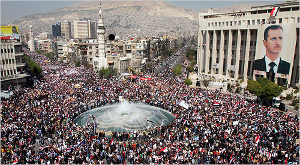
Moreover, in contrast to Egypt and Tunisia, in Syria there is considerable popular support for President Bashar Al Assad. The large rally in Damascus on March 29, “with tens of thousands of supporters” (Reuters) of President Al Assad is barely mentioned. Yet in an unusual twist, the images and video footage of several pro-government events were used by the Western media to convince international public opinion that the President was being confronted by mass anti-government rallies.

The “Epicenter” of the Protest Movement. Daraa: A Small Border Town in southern Syria 

What is the nature of the protest movement? From what sectors of Syrian society does it emanate? What triggered the violence?

What is the cause of the deaths?

The existence of an organized insurrection composed of armed gangs involved in acts of killing and arson has been dismissed by the Western media, despite evidence to the contrary.

The demonstrations did not start in Damascus, the nation’s capital. At the outset, the protests were not integrated by a mass movement of citizens in Syria’s capital.

The demonstrations started in Daraa, a small border town of 75,000 inhabitants, on the Syrian Jordanian border, rather than in Damascus or Aleppo, where the mainstay of organized political opposition and social movements are located. (Daraa is a small border town comparable e.g. to Plattsburgh, NY on the US-Canadian border).

The Associated Press report (quoting unnamed “witnesses” and “activists”) describes the early protests in Daraa as follows:

The violence in Daraa, a city of about 300,000 near the border with Jordan, was fast becoming a major challenge for President Bashar Assad, …. Syrian police launched a relentless assault Wednesday on a neighborhood sheltering anti-government protesters [Daraa], fatally shooting at least 15 in an operation that began before dawn, witnesses said.

At least six were killed in the early morning attack on the alOmari mosque in the southern agricultural city of Daraa, where protesters have taken to the streets in calls for reforms and political freedoms, witnesses said. An activist in contact with people in Daraa said police shot another three people protesting in its Roman-era city center after dusk. Six more bodies were found later in the day, the activist said.

As the casualties mounted, people from the nearby villages of Inkhil, Jasim, Khirbet Ghazaleh and alHarrah tried to march on Daraa Wednesday night but security forces opened fire as they approached, the activist said. It was not immediately clear if there were more deaths or injuries. (AP, March 23, 2011, emphasis added)

The AP report inflates the numbers: Daraa is presented as a city of 300,000 when in fact its population is 75,000; “protesters gathered by the thousands”, “casualties mounted”.

The report is silent on the death of policemen which in the West invariably makes the front page of the tabloids.

The deaths of the policemen are important in assessing what actually happened. When there are police casualties, this means that there is an exchange of gunfire between opposing sides, between policemen and “demonstrators”.

Who are these “demonstrators” including roof top snipers who were targeting the police.

Israeli and Lebanese news reports (which acknowledge the police deaths) provide a clearer picture of what happened in Daraa on March 17-18. The Israel National News Report (which cannot be accused of being biased in favor of Damascus) reviews these same events as follows:

Seven police officers and at least four demonstrators in Syria have been killed in continuing violent clashes that erupted in the southern town of Daraa last Thursday.

…. On Friday police opened fire on armed protesters killing four and injuring as many as 100 others. According to one witness, who spoke to the press on condition of anonymity, “They used live ammunition immediately — no tear gas or anything else.”

…. In an uncharacteristic gesture intended to ease tensions the government offered to release the detained students, but seven police officers were killed, and the Baath Party Headquarters and courthouse were torched, in renewed violence on Sunday. (Gavriel Queenann, Syria: Seven Police Killed, Buildings Torched in Protests, Israel National News, Arutz Sheva, March 21, 2011, emphasis added)

The Lebanese news report, quoting various sources, also acknowledges the killings of seven policemen in Daraa: They were killed “during clashes between the security forces and protesters… They got killed trying to drive away protesters during demonstration in Dara’a”

The Lebanese Ya Libnan report quoting Al Jazeera also acknowledged that protesters had “burned the headquarters of the Baath Party and the court house in Dara’a” (emphasis added)

These news reports of the events in Daraa confirm the following:

1. This was not a “peaceful protest” as claimed by the Western media. Several of the “demonstrators” had fire arms and were using them against the police: “The police opened fire on armed protesters killing four”.

2. From the initial casualty figures (Israel News), there were more policemen than demonstrators who were killed: 7 policemen killed versus 4 demonstrators. This is significant because it suggests that the police force might have been initially outnumbered by a well organized armed gang. According to Syrian media sources, there were also snipers on rooftops which were shooting at both the police and the protesters.

What is clear from these initial reports is that many of the demonstrators were not demonstrators but terrorists involved in premeditated acts of killing and arson. The title of the Israeli news report summarizes what happened: Syria: Seven Police Killed, Buildings Torched in Protests.

The Daraa “protest movement” on March 18 had all the appearances of a staged event involving, in all likelihood, covert support to Islamic terrorists by Mossad and/or Western intelligence. Government sources point to the role of radical Salafist groups (supported by Israel)

Other reports have pointed to the role of Saudi Arabia in financing the protest movement.

What has unfolded in Daraa in the weeks following the initial violent clashes on 17-18 March, is the confrontation between the police and the armed forces on the one hand and armed units of terrorists and snipers on the other which have infiltrated the protest movement.

Reports suggest that these terrorists are integrated by Islamists. There is no concrete evidence as to which Islamic organizations are behind the terrorists and the government has not released corroborating information as to who these groups are.

Both the Syrian Muslim Brotherhood (whose leadership is in exile in the UK) and the banned Hizb ut-Tahrir (the Party of Liberation), among others have paid lip service to the protest movement. Hizb ut Tahir (led in the 1980s by Syrian born Omar Bakri Muhammad) tends to “dominate the British Islamist scene” according to Foreign Affairs. Hizb ut Tahir is also considered to be of strategic importance to Britain’s Secret Service MI6. in the pursuit of Anglo-American interests in the Middle East and Central Asia. (Is Hizb-ut-Tahrir another project of British MI6? | State of Pakistan).

Syria is a secular Arab country, a society of religious tolerance, where Muslims and Christians have for several centuries lived in peace. Hizb utTahrir (the Party of Liberation) is a radical political movement committed to the creation of an Islamic caliphate. In Syria, its avowed objective is to destabilize the secular state.

Since the Soviet-Afghan war, Western intelligence agencies as well as Israel’s Mossad have consistently used various Islamic terrorist organizations as “intelligence assets”. Both Washington and its indefectible British ally have provided covert support to “Islamic terrorists” in Afghanistan, Bosnia, Kosovo and Libya, etc. as a means to triggering ethnic strife, sectarian violence and political instability.

The staged protest movement in Syria is modelled on Libya. The insurrection in Eastern Libya is integrated by the Libya Islamic Fighting Group (LIFG) which is supported by MI6 and the CIA. The ultimate objective of the Syria protest movement, through media lies and fabrications, is to create divisions within Syrian society as well as justify an eventual “humanitarian intervention”.

Read more about Who is Behind The Protest Movement? Fabricating a Pretext for a US-NATO “Humanitarian Intervention”

Written by Prof. Michel Chossudovsky

© 2011 Global Research

Photo by Flickr use gmsampaio