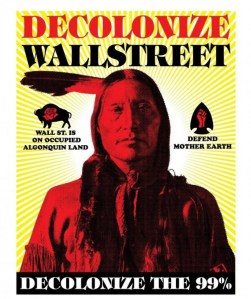
 MEDIA ROOTS — For some of us who either have indigenous roots in the Americas going back to pre-Columbian times or have strong consciousness of colonisation and occupation, we know the terms occupy and occupation are loaded terms. On one hand, we can understand contemporary Americans attempting to appropriate a term of oppression in defiance of the ruling-class, the 1%.
The fact that Occupy Wall Street caught on and evolved into the national then global Occupy Movement (OM) seems to reflect the popular desire of the U.S. working-class to do to their oppressors what has been done to them and to the proletariat the world over. Yet, as Nietzsche has noted in Beyond Good and Evil, “Whoever fights monsters should see to it that in the process he does not become a monster. And when you look into an abyss, the abyss also looks into you.”
This resonates with the importance of the OM to develop its consciousness beyond its dominant culture. Indeed, the OM has been as progressive as its participants. Yet, indigenous consciousness, class consciousness, consciousness of White privilege, consciousness of racism and imperialism, all these factors must be incorporated and studied by OM general assemblies, especially as it goes mobile following Obama’s federalised police state crackdowns and dismantling of encampment sit-ins. At this point, the die is cast. The OM is here. What’s in a name? As it’s always been, the strength and character of a movement, even one aspiring toward horizontalism, is dependent upon the level of consciousness of its rank and file.
Thus, blogger Colin Donoghue provides a synthesis of thought considering Indigenous consciousness and Native American participation within the Occupy Movement. Similarly, Morning Star Gali of the Achumawi band of the Pit River Nation and the Bay Area Native American Indian Network recently discussed efforts to decolonise Occupy Oakland. (See transcript below.)
Messina
***
COLIN DONOGHUE — What is now called the United States was founded on occupations of Native land, and in a sort of ironic way, the urban Occupy Wall St. campers being evicted from city parks across the country are getting a first-hand experience of what’s it’s like to be violently forced off the land, out of their small dwellings, dissolving their communities. Of course the Occupy camp evictions and the police-brutality that has come with it (and preceded it), though inexcusable, is still nothing compared to the indiscriminate killing of Native Americans that occurred on this continent not too long ago, yet it would be productive to consider where similarity between the two events does exist, and what that means as far as understanding what the root cause of social-injustice really is, and what the most effective strategy against it is.
Many of the Occupy activists today seek to “evolve” the same imperial powers that committed genocide against Native Peoples around the world and have since gone on to massacre millions of other innocent women, men and children in other acts of mass-violence. They believe the existence of these governments can still actually advance liberty & justice, they believe it is just a matter of somehow making these so-called democracies actually live up to that promise, like through more protest. However, if the Occupy activists look at their nation’s history more through the eyes of Indigenous women & men, they would get a better understanding of what they are really fighting against, and therefore what their focus and plan of action should be.
In America during the past two centuries, activists have tried to reform this institution of extreme violence over and over, without understanding that this government, like all governments, not only tends to be extremely violent and destructive, it was founded on violence and destruction, and in fact continues to be violent and destructive on a daily basis, just by its very existence. What do I mean by that? We are actually always experiencing the violence and destruction of an ongoing eviction, an eviction from the Earth, an eviction from a natural way of life that harmonizes with Nature and each other. These current Occupy camp evictions make partly visible once again how the 99% have all been prevented from living in harmony with Nature and each other, through the existence of social-systems, and the taxes and land costs that come with those systems of human farming. Two excellent documentaries that also visually show this root injustice repeating are “Broken Rainbow” (about the Navajo in the Southwest) & “The Garden” (about community gardeners in South Central Los Angeles); in both you see the state bulldozing the gardens of low-income people trying to live more self-sufficiently and naturally….
“We no longer see ourselves within the
webs and cycles of nature. The loss of a direct relationship to the
world terminates a once universal human understanding of our oneness
with the natural world. The principle of relatedness is at the heart of
indigenous wisdom: traditional intimacy with the world as the immanent
basis of spirituality. This understanding is an essential and
irreplaceable foundation of human health and meaningfulness.”
“Twilight of the Machines” by John Zerzan,” p.124
Indigenous wisdom is desperately needed by those who think of themselves as citizens rather than humans,
by those who are exploited and indoctrinated by social-systems, systems
that are supposedly run by representatives who “serve” the masses. The
truth is a rearranging of those letters; they don’t serve us, but sever
us, from the Earth and from each other, through taxation, land
control/cost, hierarchy and division of labor. Seeing through
the deceitful promises of government, modern technology and
industrialized society, we can reclaim our humanity and base our way of
life on principle, on non-violence, equality and true freedom.
So yes, Occupy, but not to petition false masters to treat their slaves better, Occupy to break away the chains to the lie of so-called “representative” democracy. Then we can unite and harmonize with the Earth, our true nurturing parent, and reject the false parental overlords who continue to deceive the masses into believing that they are better off with their “care.”
Read more about Native Americans & the Occupy Movement: Potentially a Powerful Partnership.
© 2011 Colin Donoghue
***
THE MORNING MIX WITH TARA
Tara Dorabji (c. 45:12): “You’re tuned in to The Morning Mix on KPFA. I’m Tara Dorabji. And those are the sounds of Los Guaraguao, some of our revolutionary freedom fighters, music makers, from El Salvador. And right now I have with us in the house, in-studio, Morning Star Gali. She’s a movement maker, human rights warrior, freedom fighter, mother, radio producer, friend, and compañera. Welcome to KPFA.
Morning Star Gali (c. 45:41): “Thank you so much for having me this morning.”
Tara Dorabji (c. 45:43): “Yeah. Thanks for being with us. And, you know, just breaking down what’s going on with the Movement to Decolonise Occupy Oakland. There was a big movement to actually have a name change. And that was shot down. So, break it down for us. What’s going on? How are folks working to decolonise the Occupy Movement?”
Morning Star Gali (c. 46:05): “Yeah, definitely. That’s a lot. So, I’ll start first with October 10th when Occupy Oakland was first set up. It was on Indigenous People’s Day. And there was an effort made; on that day we have the annual Sunrise Gathering that takes place on Alcatraz Island and we had organised a protest that day over at Nady Electronics, at the headquarters there. And so there was an effort made to insure that the timing would workout where we went to the Alcatraz Sunrise Gathering. We protested at Nady Headquarters over on Shellmound Street in Emeryville. And then later that afternoon was the kick-off for Occupy Oakland.
“And from day one, recognising that on Indigenous People’s Day, you know, having Corrina Gould, who is Chochenyo Ohlone, and other Ohlone representatives there, really, blessing the area and giving their blessing to the Occupy Movement and also recognising from day one that there is this effort being made to decolonise these movements and that we really have an issue with the word occupy. Our lands are occupied. And we want them unoccupied. And, so, there’s that effort being made to decolonise [Occupy] Oakland.
“On October 31st, there was a declaration of Solidarity with Indigenous Peoples that was passed with a vote of 97% by the General Assembly of Occupy Oakland. And some of the text of that stated that there was an effort being made to decolonise [Occupy] Oakland. So, the proposal that was submitted on December 4th was just the next step forward with it.
“We knew that it was going to be a contentious issue. We knew most likely that it wouldn’t pass. But it was really about bringing the conversation to light for people and to talk about why we weren’t comfortable with occupation and with the term occupy being used. And, really, that it was very nauseating to many of us to continually sit through the general assemblies and hear these claims made about, ‘we need to occupy everything’ and ‘we need to continue the occupation on lands that have been occupied for over 500 years.’ And, so, it didn’t pass just by a slight margin. It was 1 ½% that was needed to make the friendly amendments that would have changed it to Unoccupy Oakland or Liberate Oakland or Coexist. There were, really, a number of great suggestions.
“So, we do plan in the future to bring it up in the future again. And, at the time, there were also indigenous solidarity teach-ins that were taking place. And there’s a number of them that are coming up as well. So, we’re asking folks to get engaged and kind of plug in.
“There was a really successful action that was held this past weekend by a number of folks involved with the Decolonise Oakland efforts and also the efforts to protect Rattlesnake Island up in Elem Pomo territory. So, that was really beautiful ‘cos we really reached out to the Decolonise Occupy Oakland folks and really had the support of a lot of folks where we marched up to the territory of the one-percenters, up to [millionaire developer] John Nady’s home.”
Tara Dorabji (c. 49:40): “We’re talking with Morning Star Gali. She’s here with us in-studio about the efforts to, really, decolonise the Occupy Oakland Movement. The Occupy Movements across the Americas and, you know, one of the things, I mean, it struck me—Occupy. When I hear the word Occupy, I see the soldiers. There’s a sense of occupation. And, so, how do you see? I think that there’s a real difference, like, people who have never been occupied, people who have never lived in an occupied land, people who have had a certain privilege, perhaps, perspective like that word. It’s gonna resonate, perhaps, differently.
“And, so, how do you see within the Occupy Oakland Movement; how are you seeing a shift taking place within the organising? Is it happening? Are people becoming more aware of the intensity of that word and its impact on folks? How do you see that dialogue continuing to move forward?”
Morning Star Gali (c. 50:42): “I definitely think that it’s moving forward in a very positive way. We have seen even over the past weeks where people’s emotional attachment to the word occupy and what that looks like in terms of branding and people really felt like, ‘Oh, if we change the name then what does that look like in terms of us distancing ourselves from the movement? And people won’t recognise, you know, people are very familiar with Occupy Oakland.’
“But there have been name changes. Sedona, Arizona, they did change their name to Decolonise Sedona. Albuquerque, New Mexico changed to Unoccupy Albuquerque. And their initial proposal was to decolonise. Up in Seattle, they also had a proposal put forth to decolonise Occupy Seattle. And it also didn’t pass up there. But the QPOC Caucus up there decided that they were gonna go forth and call themselves. And that they didn’t need permission. They didn’t need anybody’s permission in what they wanted to name themselves. And, so, since then they’ve been Decolonise Occupy Seattle.”
Tara Dorabji (c. 51:57): “We’re talking with Morning Star Gali about the Movement to Decolonise. And, so, is the main thrust then in people’s resistance to changing the name, really, the branding? Is that, sort of, the central impetus for keeping the occupy word in there?”
Morning Star Gali (c. 52:15): “I feel like that’s definitely one of the stronger arguments that they have, which is interesting because it’s only here in the U.S. where the term Occupy is being used. And there was argument that over in Egypt and in Tahrir Square that the connection’s made with what’s going on. And we’re like, ‘No, wait a minute. They’re not calling themselves Occupy.’ You know? And what would that look like in Palestine, over Gaza, a huge banner that read Occupy Palestine? And the colonialism here is deep, that entrenched, that people don’t see that it’s problematic.
“But I do feel like we’re making those steps forward. I mean four to five years ago, even, if we were to put it out there. The first day of the Occupy Movement there were those big banners that said ‘Welcome to Oscar Grant Plaza on Ohlone Land.’ And, so, just even that recognition, that’s, really, a huge step forward. You know? And, really, calling that out and letting folks know that this isn’t something that’s in the past, that these cultures are no longer alive. We are here and we are very much present as California Indian people. There are struggles that are currently taking place, as far as the desecration of our sacred sites and the effort to protect them. So, I feel like we’ve really been able to bring those conversations into light and to talk about the fact that, as indigenous peoples, we are the original 99% resisters, that we are here and this is what we’ve been experiencing and, so, to really connect those struggles across the board.”
Tara Dorabji (c. 54:02): “We’re talking with Morning Star Gali about the shift, the need, the Movement to decolonise the occupiers. And in our last couple of minutes, you know, this is, sort of, a watershed, in a way, of activism and a different wave of resistance coming up right now in the U.S. And from your perspective as a mother, as an indigenous woman, as someone that has really come up and done a huge amount of organising on the ground in all the spots—I know I can always call on Morning Star, she’ll be there—what do you think is the most strategic thing for the movement to do right now? Where do you see the pulse? Where do you see the need to go? And where do you see the place to strike?”
Morning Star Gali (c. 54:44): “Well, it’s interesting because a lot of the kind of resistance with the name change was, ‘Why now? Why are you bringing this up now? It’s not the time. Why are we wasting our time focusing on this?’ And we were just like, ‘Wait a minute. Wait a minute. You need to hold up because if now is not the right time, when is it?’ You know? This is a conversation that’s long overdue. And, so, where is the movement going from here? If we’re talking about being inclusive of all the 99%, when recognising that indigenous peoples feel that they can’t participate and a number of people feel they can’t participate in this movement under the label of occupation, we need to have that conversation of what that looks like and how to be inclusive across the board, especially to the First Nations People, whose land that this is.
“And, so, as I mentioned this past weekend there was a really successful action that took place in marching on [millionaire developer] John Nady’s house in Piedmont. I feel like that’s a really great direction of where we’re going, whether with the Port Shutdowns, which I heard was like a 5% loss to Goldman Sachs, making those connections that with indigenous peoples that are on the front lines here, this is what we’re experiencing on an everyday basis. So, we need to make those connections and have those further dialogues and conversations. And that’s what Decolonisation Movement is about.”
Tara Dorabji (c. 56:19): “Great. Thank you so much for joining us and coming in the casa this morning.”
Morning Star Gali (c. 56:22): “Thank you.”
Tara Dorabji (c. 56:23): “And today’s Morning Mix was produced by, myself, Tara Dorabji with help from Anthony Fest. Just a heads up that next Monday, December 26th, we’ll be airing a special from the most densely militarised land on Earth, Kashmir. So, tune in for that next Monday on The Morning Mix.
“I just want to say happy solstice to you all out there. It’s been an honour being with you on the airwaves over this last year. If you have any feedback for me, you can hit me up at [email protected]. You are listening to KPFA, 94.1 FM, 89.3 KPFB in Berkeley, 88.1 KFCF in Fresno, online all the time, KPFA.org. Up next is Democracy Now!.”
Transcript by Felipe Messina
Point of information: Morning Star Gali says it’s only in the U.S. that the term Occupy is being used. Yet, we are mindful of Occupy Toronto, Occupy Montreal, Occupy Jamaica, Occupy Amsterdam, Occupy Bucharest, etc.
***



 MEDIA ROOTS — How does one determine when one’s society becomes unfree? A society loses its freedoms not in one fell swoop, but
in a slow and systematic erosion of successive legislation. Like Charles Sullivan’s proverbial frog brought to a slow boil in a pot, the loss of freedom can easily go unnoticed until it’s too late. Perhaps chattel slavery simply morphed into wage slavery and creeping fascism.
MEDIA ROOTS — How does one determine when one’s society becomes unfree? A society loses its freedoms not in one fell swoop, but
in a slow and systematic erosion of successive legislation. Like Charles Sullivan’s proverbial frog brought to a slow boil in a pot, the loss of freedom can easily go unnoticed until it’s too late. Perhaps chattel slavery simply morphed into wage slavery and creeping fascism.  MEDIA ROOTS – Paul Rockwood Jr. was a weather forecaster in King Salmon, Alaska who became highly critical of US foreign policy in a post-9/11 world. During his quest to understand the motive behind 9/11, he was drawn to the Islam religion and eventually converted.
  MEDIA ROOTS — For some of us who either have indigenous roots in the Americas going back to pre-Columbian times or have strong consciousness of colonisation and occupation, we know the terms occupy and occupation are loaded terms. On one hand, we can understand contemporary Americans attempting to appropriate a term of oppression in defiance of the ruling-class, the 1%.