
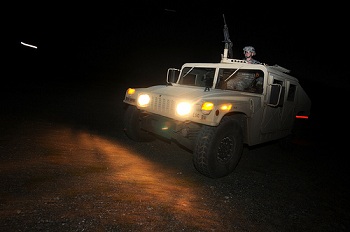
Enacting the NDAA: Limiting Protesters’ Rights

MEDIA ROOTS — The U.S. blindly took another giant step further into tyranny last week—no, really.

In most corporate and, even, many independent news outlets, the public was kept up-to-date with the deaths of singer Davy Jones and conservative blogger Andrew Breitbart.  However, relatively little attention was given to the annihilation of Constitutionally-protected civil liberties executed by the National Defense Authorization Act, which went into effect  Wednesday, March 1.  On the very same day two celebrities coincidentally died from unexpected heart-attacks in the U.S., a bipartisan Congress carefully dealt orchestrated attacks against the First Amendment.

Instead of the anti-democratic new law merely taking effect, the House resolved to further the scope of the NDAA by preventing assembly near public officials guarded by the Secret Service.  Not only is the U.S. tradition of protesting at the White House under siege—now those vying to replace the presidency are also exempt from the ‘nuisance’ of protesters.  499 Congressional Representatives voted in favor of HR 347—the Federal Restriction Buildings and Grounds Improvement Act—only three voted against: Paul Broun (R-GA), Justin Amash (R-MI), and Ron Paul (R-TX).

The President signed the NDAA into law on New Year’s Eve, but hardly did a media firestorm result from the fact that the military is now legally able to indefinitely detain U.S. citizens solely based on suspicion.  That’s right.  Despite Presidential Policy Directive 14, future protesters at the White House could be locked up indefinitely, without due process of the law.  Of course, Attorney General Eric Holder has begun engaging in Orwellian semantical double-speak regarding due process in cases of arbitrary targeted killings when he spoke before law school students today at Chicago’s Northwestern University:

“Due process and judicial process are not one and the same, particularly when it comes to national security.  The Constitution guarantees due process, not judicial process.”

It’s a terrible precedent Holder is working to set with regard to due process, which may easily spread to the First Amendment and other rights once the Fifth Amendment is undermined.  Although, no one may be “deprived of life” without due process of law under the Fifth Amendment, Holder claims that due process “doesn’t necessarily come from a court.”

Author Naomi Wolf reminded the world the day before NDAA Day 1 that U.S. citizens are “sleepwalking into becoming a police state.”  She explained further:

“Overstated?  Let’s be clear: the NDAA grants the president the power to kidnap any American anywhere in the United States and hold him or her in prison forever without trial.  The president’s own signing statement, incredibly, confirmed that he had that power.  As I have been warning since 2006: there is not a country on the planet that you can name that has ever set in place a system of torture, and of detention without trial, for an “other”, supposedly external threat that did not end up using it pretty quickly on its own citizens.”

The American Civil Liberties Union is now calling on all U.S. citizens to pressure the Senate to clean up the NDAA.  People must specifically demand that no president ever be given the power to use the military far from armed conflict to imprison civilians indefinitely, especially within U.S. borders.  Additionally, no President should be required to put civilians into military custody without charge.  Chris Anders from the ACLU explains:

“The United States itself should be off-limits for the military to impose indefinite detention without charge or trial.  It would be unconstitutional for the president to apply the NDAA provisions here at home, but the Senate rejected explicit protections to reinforce the Constitution’s and the Posse Comitatus Act’s protections.”

But without much leverage other than the power of the vote, which most voters perpetually award to the same politicians they protest, U.S. civilian demands are easily dismissed, as the Democrat and Republican parties know they have monopolized the political process.  Perhaps, it’s time to boycott both corporate political parties responsible for so much oppression.

Pulitzer Prize-winning journalist Chris Hedges is suing the President for signing the NDAA.  He, along with several other plaintiffs, such as Noam Chomsky and Daniel Ellsberg, blame both political parties for the passing of this totalitarian law.  They suspect that the corporate state ensured its passage because of potentially imminent uprisings in the United States.  In Hedges’ own words:

“This demented ‘war on terror’ is as undefined and vague as such a conflict is in any totalitarian state.  The NDAA expands our permanent war to every spot on the globe.  It erases fundamental constitutional liberties.  It means we can no longer use the word ‘democracy’ to describe our political system.”

Chris Hedges on Alex Jones’ Infowars discusses the lawsuit.

***

Oskar Mosquito is a regular contributor to Media Roots.

Photo provided by Flickr user DVIDSHUB.

***UPDATE

Obama recently came out to issue new guidelines for the NDAA provision, but the move is simply a PR stunt.  It does not strip his absolute power of indefinitely detaining U.S. citizens.

Abby
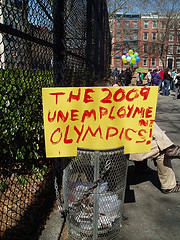
Economist Joseph Stiglitz and the Book of Jobs

joblessgamesMEDIA ROOTS  Although the corporate media touts an improving economy, U.S. citizens continue to suffer cruel economic punishment and austerity.  Millions of citizens still search for employment, and the typical income of a U.S. household is less now than it was in 1997.  Why is the economy not improving?  Wall Street makes an easy target for the ire of struggling workers, but is there a deeper, more complex reason why the economy creaks, tumbles and rolls like an outdated galleon laboring in rough seas?
Economist Joseph Stiglitz offers in-depth analysis of the weakening foundation of the U.S. economy.  In the years leading up to 2008, U.S.A. lived in an easy-credit, fast-money mania, fueled by wildly inflated home values, corrupt appraisers, and financial gimmicks.  However, the integrity of the economy was compromised even before the meltdown, explains Stiglitz.  Our collective economic livelihood had been dealt a slow acting, poisonous blow long ago, as other observers such as Catherine Austin Fitts and Dr. Michael Hudson have described. 

Stiglitz draws insight comparing today with the tumultuous Great Depression, which had been well underway for years before the banking sector crashed.  What brought about the economic paralysis?  The primary cause was a quiet, but massive, transition away from an agriculture-based economy.  As food production modernized and became more efficient, less farmers were required to grow the food necessary to feed the U.S.  Suddenly, a vast portion of the U.S. workforce became obsolete through automation. 

Stiglitz argues broad changes must be made in tandem with large, concentrated investment.  As once industrious manufacturing regions of U.S.A. wither and rust, elected officials neglect investment in education, research, and infrastructure, favoring austerity cuts.  Yet, these three areas provide opportunities for healthy economic growth and future employment, as the nation struggles to adapt to the 21st century.  Addressing these needs, perhaps, U.S.A. can fulfill its promise of greatness and prosperity.

MR

***

VANITY FAIR Even when we fully repair the banking system, we’ll still be in deep trouble—because we were already in deep trouble. That seeming golden age of 2007 was far from a paradise. Yes, America had many things about which it could be proud. Companies in the information-technology field were at the leading edge of a revolution. But incomes for most working Americans still hadn’t returned to their levels prior to the previous recession. The American standard of living was sustained only by rising debt—debt so large that the U.S. savings rate had dropped to near zero.

And “zero” doesn’t really tell the story. Because the rich have always been able to save a significant percentage of their income, putting them in the positive column, an average rate of close to zero means that everyone else must be in negative numbers. (Here’s the reality: in the years leading up to the recession, according to research done by my Columbia University colleague Bruce Greenwald, the bottom 80 percent of the American population had been spending around 110 percent of its income.) What made this level of indebtedness possible was the housing bubble, which Alan Greenspan and then Ben Bernanke, chairmen of the Federal Reserve Board, helped to engineer through low interest rates and nonregulation—not even using the regulatory tools they had. As we now know, this enabled banks to lend and households to borrow on the basis of assets whose value was determined in part by mass delusion.

The fact is the economy in the years before the current crisis was fundamentally weak, with the bubble, and the unsustainable consumption to which it gave rise, acting as life support. Without these, unemployment would have been high. It was absurd to think that fixing the banking system could by itself restore the economy to health. Bringing the economy back to “where it was” does nothing to address the underlying problems.

The trauma we’re experiencing right now resembles the trauma we experienced 80 years ago, during the Great Depression, and it has been brought on by an analogous set of circumstances. Then, as now, we faced a breakdown of the banking system. But then, as now, the breakdown of the banking system was in part a consequence of deeper problems. Even if we correctly respond to the trauma—the failures of the financial sector—it will take a decade or more to achieve full recovery. Under the best of conditions, we will endure a Long Slump. If we respond incorrectly, as we have been, the Long Slump will last even longer, and the parallel with the Depression will take on a tragic new dimension.

Until now, the Depression was the last time in American history that unemployment exceeded 8 percent four years after the onset of recession. And never in the last 60 years has economic output been barely greater, four years after a recession, than it was before the recession started. The percentage of the civilian population at work has fallen by twice as much as in any post-World War II downturn. Not surprisingly, economists have begun to reflect on the similarities and differences between our Long Slump and the Great Depression. Extracting the right lessons is not easy.

Read more about America’s 21st Century Job Engine.

© 2012 Vanity Fair

***

Photo by Flickr user clementine gallot

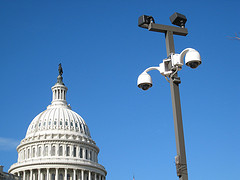
The U.S. Government’s Panopticon State

allseeingeyeMEDIA ROOTS — The U.S. Government’s raging paranoia regarding terrorism has now led to a high-octane obsession with perpetual and complete surveillance of its citizens in every manner conceivable

“The thought police would get him just the same. He had committed—would have committed, even if he had never set pen to paper—the essential crime that contained all others in itself.  Thoughtcrime, they called it.  Thoughtcrime was not a thing that could be concealed forever.  You might dodge successfully for a while, even for years, but sooner or later they were bound to get you.”  —George Orwell, 1984 (Book 1, Chapter 1)

Each day, we move closer to Orwell’s dystopic vision.  The latest addition to U.S. domestic surveillance is the National Security Agency’s (NSA) new data mining facility behemoth in San Antonio, Texas.  More worrisome, a Microsoft data centre is located just a few blocks away, so the NSA will be able to tap into the massive stores of data without a warrant being necessary, only a simple fibre optic cable.

The NSA’s hulking complex raises any number of serious questions, such as the large numbers of people arbitrarily placed on watch lists.  Does data mining even justify the ends?  Catherine Austin Fitts has long described the Data Beast, data mining apparatus, “the reality was you had Lockheed Martin and their subcontractors owning and controlling the data and you couldn’t get it.”

“And if you look at all the other databases that IBM and their subcontractors have access to government-wide, the question is if you integrate those databases what you’re talking about is a complete control system ‘cos you’ve got the mortgages, you’ve got the IRS payments, on and on and on and on and on.  So, if you watch the movie ‘Enemy of the State’ or you watch the movie ‘Listening,’ you’re talking about an intelligence capacity that can basically manage and manipulate the economy at a very detailed level, whether it’s manipulation of the stock in the financial markets or manipulation of households.” 

With so many lumbering and uncoordinated security agencies engaged in electronic surveillance, how can all this information be shared and correlated?  What risk does the U.S. run should it fall prey to a tyrannical despot with a fully functioning and devastatingly intrusive surveillance system already in place?  These questions and more must give U.S. citizens pause to reflect on the swiftness with which our privacy evaporates before our eyes.

The concept of the CIA project Total Information Awareness has now migrated over to the NSA, which is determined to turn that vision into reality.  The NSA wants to know every detail about our lives:  what we eat, where we travel, what books we read, what movies we watch, every iota of our lives.  But with very little progressive legislation emanating from the regressive two-party system to harness this rapid data grab for electronic omnipotence, is it too late for U.S. voters to pull their lives out from underneath the microscope of the state?

MR

***

SAN ANTONIO CURRENT “Eisenhower warned of the military-industrial complex, but now it’s mostly the security, industrial complex; it’s these people that build all the hardware and software for Homeland Security and Intelligence and all that,” says Bamford. “As far as I can see, nobody has a handle on how many contractors are out there, what they’re doing, how much money’s going to them, how much is useful, how much is wasted money.”

Cate says the NRC committee is not necessarily opposed to data-mining in principal, but is concerned about how it’s carried out. “The question is can you do it and make it work so that you don’t intrude unnecessarily into privacy and so that you reach reliable conclusions.”

Bamford writes in the Shadow Factory of how the NSA’s Georgia listening post has eavesdropped on Americans during the Iraq War, including journalists, without a warrant or any indication of terrorism. He also reports on NSA eavesdropping on undecided members of the United Nations Security Council in the run-up to the vote on the Iraq War resolution, with the Bush regime seeking information with which to twist the arms of voting countries. The spying was only revealed due to British Parliament whistleblower Claire Short, who admitted she’d read secret transcripts of UN Secretary-General Kofi Annan’s confidential conversations.

“The UN people have been aware of [NSA eavesdropping] for a long time, but there’s not much they can do about it,” says Bamford.

A common response to concerns about data surveillance is that those who keep their noses clean have nothing to worry about. But the reach of the NSA’s surveillance net combined with lack of oversight and the political paranoia escalated by the 9/11 attacks means that almost anyone could wind up on the terrorist watch list.

“The principal end product of all that data and all that processing is a list of names — the watch list — of people, both American and foreign, thought to pose a danger to the country,” writes Bamford. “Once containing just twenty names, today it is made up of an astonishing half a million — and it grows rapidly every day. Most on the list are neither terrorists nor a danger to the country, and many are there simply by mistake.”

Read more about the NSA’s long arm of surveillance

© 2012 San Antonio Current

***

Photo by Flickr user satanoid

WikiLeaks is Back – Corporate Spying

MEDIA ROOTS – Early Monday morning, the controversial website WikiLeaks released a stunning collection of Global Intelligence Files from the private intelligence corporation Stratfor.
According to WikiLeaks:

“The Global Intelligence Files exposes how Stratfor has recruited a global network of informants who are paid via Swiss banks accounts and pre-paid credit cards. Stratfor has a mix of covert and overt informants, which includes government employees, embassy staff and journalists around the world.

The material shows how a private intelligence agency works, and how they target individuals for their corporate and government clients. For example, Stratfor monitored and analysed the online activities of Bhopal activists, including the “Yes Men”, for the US chemical giant Dow Chemical. The activists seek redress for the 1984 Dow Chemical/Union Carbide gas disaster in Bhopal, India. The disaster led to thousands of deaths, injuries in more than half a million people, and lasting environmental damage.”

Most mainstream media reports aren’t covering several important issues that these files bring up, like how Stratfor has been gathering intelligence and spying on journalists and activists all over the world for not only the government, but for private corporations like Coca-Cola.

Comedy/activist duo the Yes-Men found out they were being spied on by Stratfor because of their activism surrounding the Bopal Chemical Disaster.  Other media outlets that had intelligence gathering done on them include Rolling Stone, Wikileaks itself (over 4,000 emails alone), Sunday Star Times, The Hindu, Russia Reporter, Publico and an unknown amount more.  Wikileaks says that more information about journalist spying is yet to be revealed.

Activist Cosmos found an intriguing tidbit of information within the e-mails that uncovered how “out of Wikileaks’ release of 5 million Stratfor emails is the comment from Fred Burton, Stratfor’s Vice President of Intelligence, that the Imam of the controversial so-called Ground Zero mosque is an “FBI operational asset.” Burton, who was formerly a special agent with the US State Department’s Diplomatic Security Service and the Deputy Chief of their counterterrorism division, made the comment on an email chain regarding a New York Observer article, Untangling the Bizarre CIA Links to the Ground Zero Mosque.  The controversy surrounding the “Ground Zero mosque” overwhelmingly dominated the news and discussion surrounding the ninth anniversary of the 9/11 attacks.”

At Media Roots, we recommend that you don’t rely on our or any other media outlet’s coverage of the recent leak.  Instead, you can watch the entire press conference with Julian Assange about the Stratfor leaks here:


Julian Assange Press Conference on Stratfor Leaks

***

Written by Robbie Martin for Media Roots

Photo by Flickr user Animantion Concept


Posted in Uncategorized | 1 Reply

MR Original – Bill Maher, Establishment Lackey

MEDIA ROOTS — I’m a huge Bill Maher fan.

I say that not as an empty platitude nor as a way to soften the eventual blow.  My dad introduced me to “Real Time with Bill Maher” several years ago and I’ve been hooked ever since.  For awhile, he recorded the show and we watched it together every week.  Eventually, I was able to afford HBO on my own, but we’d still call each other every week to talk about the episode.  As silly as it sounds, I am really grateful to Bill for his show because it gave my dad and I an opportunity to bond. 

In addition to being a huge comedy fan, I’ve also dabbled in stand up for several years.  Bill’s style and attention to politics and religion have always made him one of my favorite comedians.  So naturally, I was really excited when my dad got us tickets to the live taping of his new special, “CrazyStupidPolitics.”

Heading into the show, I thought I knew what to expect.  The crowd would be 99% liberal (or so they think) and Bill would spend his entire set trashing Republicans.  When you think about it, it’s a great formula for success because the Republican presidential candidates make it incredibly easy. “The jokes write themselves,” as the saying goes. 

Being a former card-carrying member of the Democratic Party, I sometimes enjoy reveling in the intellectual wasteland that is Republican ideology.  As expected, so did everyone else in the theatre.  The crowd was loud and energized because Bill gave us the Anti-Republican red meat that we all came to feast on.  In the end, he put on a great show.  He was thoughtful and poignant at times while juvenile and mean at others.  Nevertheless, he was always funny.  After all, it was a comedy show. 

Well…mostly.

After Bill finished his set and received his well-deserved standing ovation, he told us all that he had a surprise.  To be honest, I was hoping he would bring out the opening act (Amy Schumer) and let her go home with whatever audience member could cheer the loudest.  Yes, she has the bone structure of a Cabbage Patch doll but I would still totally take her down.  Instead, Maher took the opportunity to present a whopping $1,000,000 in the form of a giant game show check to President Obama’s Super PAC—Priorities USA Action.

For about ten more minutes, this is still a free country.  If Bill wants to “donate” his money in this way on HIS show then he should be allowed to do so.  The act of donating money to a Presidential candidate is not what concerns me—it was his accompanying message that was so disappointing.  Just before presenting the massive $1,000,000 check, he seriously addressed the crowd to convey his displeasure with Citizens United and the Super PACs it spawned. 

I was hoping Bill would follow those thoughts with a great plan or at the very least, a hilarious solution.  Instead, he took the path of least resistance.  Bill’s over-the-top donation was his way of saying, ‘if you can’t beat ’em, join ’em.’  What makes it worse is that Bill’s rationale for donating the money seemed to be due to fear of another Republican in the White House instead of a ringing endorsement of Obama and his policies.  He even went as far urging those of us in the audience as well as those watching at home to donate to Obama’s Super PAC because Obama “doesn’t have this in the bag.”  It’s that exact same type of fear-mongering, for which Bill often chastises Republicans on his show.

For many of you, this might seem like no big deal.  However, I remember a time when Bill Maher was fired from ABC for speaking out against the cowardice of U.S. foreign policy.  I remember a time when Bill Maher was a cynic, who once famously said you should “question everything.”  And I remember when Bill Maher was a patriot, who regularly criticized President Bush for gross violations of our Constitution and civil liberties.  Unfortunately, THAT Bill Maher, either, doesn’t exist anymore or his presence is only predicated on whom is currently sitting in the Oval Office.

As I walked out of the theatre, I realized this was nothing more than an Obama fundraiser, in the heart of Silicon Valley, disguised as a comedy show.

Written by Barrett Rodda for Media Roots

Photo by flickr user David_Shankbone