


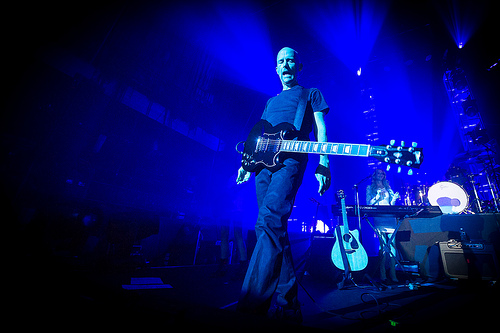
 It’s not often you find a Grammy Award-nominated musician on the front lines of political activism. One of those exceptions simply goes by the name Moby.
The L.A. based electronic musician spends every iota of his free time making it count. When he’s not making music, he’s promoting music therapy as a board member of the Institute for Music and Neurologic Function.
He’s also taken Washington to bat, by testifying on the Hill about Net Neutrality and standing up to the ever powerful Recording Industry Association of America or the RIAA.
Recently Moby sat down with Abby Martin on Breaking the Set to discuss the problems with making piracy illegal, and why the freedom of information is so important in today’s digital age.
MR
***
Moby Breaks the Set on the Freedom of Information
***
AM: What is the corporate music industry’s biggest failure?
MOBY: I think one of the biggest failings is that music business and record companies have treated listeners terribly for a long time. Overcharging for CDs in an era of CDs, and punishing people for downloading music, and basically trying to make people feel guilty for listening to music. I just think it’s created a very sort of strange and very unhealthy climate around the release of music.
AM: You’ve also stood up to the Recording Industry Association of America and called for the group to be disbanded in 2009 for its two million dollar lawsuit against a mother who illegally downloaded music. What prompted you to go after the RIAA?
MOBY: The whole reason I make music—and maybe I’m stating the obvious—is because I love making music and I love the idea of people listening to the music that I’ve made. The idea of punishing the audience, even if they’re downloading music illegally, I don’t think and audience should be punished, nor should the RIAA take litigious action against soccer moms who are just downloading music because they want to listen to it. It seems very self-evident to me that if you’re trying to generate goodwill, suing the people who are ultimately patronizing your business is not the best way to go about that.
AM: Let’s talk about your new album “Innocents”. Why did you choose that name and how is it different from your previous work?
Moby: I’m going to try and not give a long-winded self-involved grad student answer, ‘cause I’m really good at long-winded, self-involved grad student answers…but when I was in college, I was a philosophy major and I’d just been obsessed with the simple question of: What does it mean to be human in the Universe that’s 15 billion years old? What significance do our lives have? And when I look at our collective response to the human condition, I see a lot of confusion, a lot of fear, a lot of sadness, and–in a strange way–a lot of innocence, ‘cause the truth is none of us really know what we’re doing. You know, we might put on a brave face when we go out in public, but at the end of the day we all get old, we all die, we’re all confused, and I feel like, collectively, even though at times we’re not necessarily doing the best things, we still have a quality of innocence to us and that’s what the title of the album comes from.
AM: And you’re also—this is really fascinating–you’re a board member for the Institute for Music and Neurologic Function, which studies the effects of music on the brain. Talk about this. What have you learned as part of that organization, and how can music be used in therapeutic ways?
MOBY: Well, it’s funny ‘cause I’ve dedicated my life to making music, and I always thought music was something I loved and was really fun, but I never thought it actually had anything beyond a very sort of frivolous utility. Dr. Oliver Sacks and Dr. Connie Tomaino are two amazing brain neuroscientists and they started this institute for Music and Neurologic Function. What they’ve seen is that music is a remarkably powerful healing modality. When I talk about the sort of healing effects of music it almost sounds like I’m indulging in hyperbole, but it’s truly miraculous. People who are aphasiac, who’ve had strokes, when they listen to their favorite music from childhood, even if they’ve lost the ability to walk or speak, they can still dance and sing. I know that sounds like the most absurd claim, but Dr. Sacks and Dr. Tomaino have documented this and they’re going before Congress to try and get more money for music therapy because really it is phenomenal healing. The only problem is it’s hard to make money from it, so clearly the pharmaceutical companies aren’t too thrilled about a non-profit powerful healing modality.
AM: I know that you testified in front of Congress in 2006 about Net neutrality. When are you going to get out there and testify about the music therapy?
MOBY: Hopefully soon. The funny thing about talking about music therapy is you don’t have to convince anyone of its power. All you have to do is say ask anyone how they respond to their favorite song. If you even right now think of your favorite song you could almost feel like a physiological and neurochemical change, and the truth is, it’s a real change. It promotes healing and it decreases stress hormones like norepinephrine, and adrenaline and cortisol, so in the future I think people will look at music not just as something fun, but as a really, really powerful healing modality.
AM: It’s also a revolutionary tool, which is why it’s such a travesty that it’s the first thing cut from public education; music and arts. I mentioned that you did testify in front of Congress about net neutrality. Let’s talk about that. What did you tell them back then, and are you worried about the current circuit court lawsuit that could entirely abolish the concept?
MOBY: Yeah. I was a little bit confused, because in 2006, and now, the Internet seems to be working fine the way it is. I don’t understand the idea of—to an extent and very broad terms—privatizing the Internet, when it’s this fantastic, egalitarian, granted chaotic, but democratic institution that serves everybody equally. So when you have these big corporations who want to get involved and try to monetize it and privatize it; I just don’t understand why they would mess around with something that works so flawlessly the way it is.
AM: How much do you think the music industry is a part of that push? I mean, we know that SOPA was obviously trying to implement a lot of seizure on net neutrality as well.
MOBY: In some ways I’m the wrong person to ask, because I love what I referred to as, the democratic chaos of the Internet. I love the fact that it is strangely self-regulating; it kind of polices itself, and I’ve also been a life-long member of the ACLU, so, I’m just a huge proponent of the free and uninhibited dissemination of information.
AM: I love that about the militant egalitarian method that the Internet started out as, and unfortunately we are seeing that going by the wayside. It’s really important that we cement that notion quick. Let’s talk about another thing that the ACLU is really big on, Chelsea Manning. You are also part of the I Am Chelsea Manning Video a few months back. Why is this case so important to you?
MOBY: It’s a tricky thing to talk about, because I’m a musician, I live in L.A., so, if I worked for the NSA or had worked for the NSA, I might have a different perspective—but it seems like sometimes governments, including our own, are interested in restricting information, because it is actually sensitive and to disseminate it would be compromising. But other times governments almost restrict information either because it’s embarrassing or it’s just a knee jerk reaction. You know, this feeling like it’s their job to restrict access to information, and that’s why I thought the Chelsea Manning case was so important, because she was drawing attention to the seemingly arbitrary way in which the government was trying to restrict access to ostensibly classified information.
AM: It’s also a crime to over-classify. We see things just being classified just for the sake of classifying them. Of course, we know that no one was actually hurt by the release of those documents. What are your thoughts on other whistleblowers in the public spotlight right now, like, Edward Snowden?
MOBY: Again, it’s tricky because everything I say has to be qualified with the caveat that I am a college dropout, and I make music and I live in L.A., so, my opinions are vaguely informed at best. But I’m just a fan of openness and I can’t think of too many instances where airing on the side of openness has done harm. In fact, quite the opposite. We live in a culture where it’s becoming increasingly difficult for anyone to restrict access to information which, personally, I think is great. I’d much rather have a few instances where potentially sensitive information is released, but as a result you have so much information that the public benefit is released as well.
AM: You keep saying that your opinions are vaguely informed at best. You’d be shocked at how uninformed Americans are. I think it’s very important to voice your opinion because you wield a lot of influence in this industry, and it’s unfortunate that others don’t. Why do you think that not other musicians and entertainment people speak out about these issues?
MOBY: I think probably because they’re getting much better advice than I am, because what I’ve found is by being an opinionated loudmouth as I am, I do often times run the risk of alienating a lot of people. So, I think that a lot of musicians, actors, whomever, are getting good management-career advice, and their managers are saying, “Keep your opinions to yourself ‘cause you’ll sell more records.” I unfortunately never got that advice, and I was raised by progressive hippies who told me that if you have the ability to reach people and communicate, you might was well try and say something that has some value or some merit to it. Or at least try to do so.
AM: I agree with your parents, Moby. Let’s talk about veganism. You’re a vegan. You even released a book critiquing the modern meat industry. What lead you to the decision to practice veganism, and what are your biggest frustrations right now with factory farms?
MOBY: I’ve been a vegan now for 26 years, and an animal rights activist for about 30 years, and what informs my veganism and animal rights activism is pretty simple. I love animals and I don’t want to be involved in any process that contributes to their suffering. I guess looked at objectively death is inevitable, but suffering isn’t. I think that we have the ability to treat other creatures with respect and dignity and ameliorate their suffering, and I just wonder why we don’t make more of an effort to do so. Why collectively we’re comfortable to contributing to the suffering of—literally—tens of billions of creatures who are all incredibly sensitive. I think it was I think it was either Albert Schweitzer or Einstein said the questions isn’t ‘Do animals have an intellectual life?’, the question is ‘Do they have an emotional life?’, and anyone who’s ever been around animals knows full well animals have incredibly profound emotional lives, are incredibly sensitive, and I just feel like it’s incumbent upon me and hopefully the rest of us to sort of like decrease the amount of suffering we cause while we are alive.
AM: Right, and we’re so detached from the food that we eat and I think that if people really saw the suffering they would be absolutely horrified. The food industry has so much autonomy, so much political influence. I mean, just look at Monsanto alone. How could we ensure that the food we are eating is safe and not destructive to the environment and doesn’t contribute to the suffering of creatures?
MOBY: When we put out the movie “Gristle”, which is about factory farming, I was asked that question. What one thing could we do that would make factory farming either go away or become a lot better, and one thing would be end subsidies to meat production, ‘cause meat production—and I’m not even saying people shouldn’t eat meat–but I’m just saying the production of meat decimates the animals, it decimates the workers, it decimates the communities, and the end result is a product that causes diabetes, arteriosclerosis, heart disease, obesity, etcetera. So, just end all subsidies to it and let meat actually cost what it should cost. Truth is, without government subsidies, a pound of hamburger would cost around thirty dollars. And I have a feeling if you just let meat cost what it should cost, all of the sudden you see people eating a lot less meat.
AM: Very well put. Totally agree. Thank you so much for your input on that, and so much more. Moby, artist, activist; really appreciate you coming to the studio.
***
Transcript by Juan Martinez, Photo by Flickr User Justin Wise
 Even though present-day Afghanistan flies under the news radar, it remains to be the longest military quagmire in US history. Aside from troops still occupying the country, thousands of private contractors are on the ground that the Pentagon