Celebrations of Imperialist War Abound

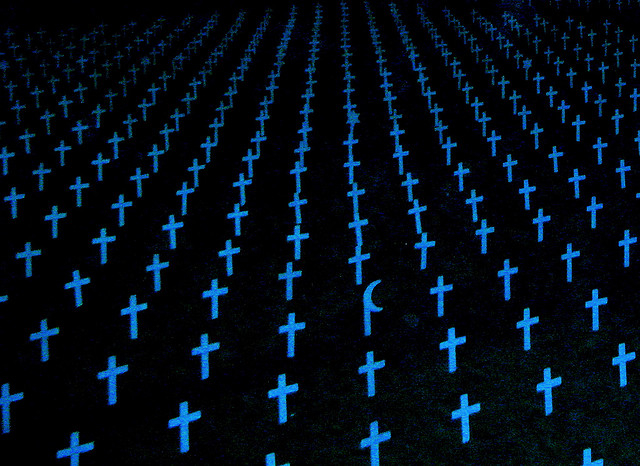
gravesPhotobyKevinDooleySummer is here and the stench of war is all around. Or, as Bob Marley put it, ‘everywhere is war’.

Start with the commemorations over a five-week span of Memorial Day, Flag Day and Independence Day, all presented varyingly as celebrations of our war dead, symbols of our greatness, the freedoms we love so dearly and seek to export to every corner of the world and, perhaps most important, the unquestioned rightness of our cause.

In reality, the celebrations are of imperialist war, with the talk about the hallowed dead just so much cover for the murderous nature of US foreign policy. Celebrating the dead – note that the dead celebrated are just the American dead, not any of the millions killed by US aggression or client states – is a no-lose proposition designed to render anyone who asks the wrong questions a traitor or a terrorist. The notion that the US regularly commits war crimes and that polished, well-educated men like Barack Obama are war criminals is unthinkable; war criminals look like Osama bin-Laden and Saddam Hussein and those other nasty people far away, over there.

It’s also the summer of the centennial of the start of what in its time was known as the Great War, the greatest blood-letting in history except for that of the Second Great War barely two decades later. One thing we can be sure is that the lessons drawn from mainstream discussions of World War I will be all the wrong ones. Worse, the spectacle of the intelligentsia waxing eloquent about the horrors of war while unflinchingly cheering on the warmakers in Washington will be accepted by one and all of their kind as perfectly reasonable – as beyond discussion, in fact.

In recent weeks, meanwhile, mainstream commentators have been shocked to discover that things in Iraq are not alright, in fact are worse than at any time since the second US blitzkrieg in 2003. Gee, who knew that an invasion predicated on a lie of weapons of mass destruction, designed to secure control of massive oil supplies, would go wrong? The political class and intelligentsia pretended they didn’t, but millions around the world who demonstrated against the invasion in the weeks before it was launched certainly did. And one of the points those demonstrators underscored was that a US invasion would fuel sectarian divisions and violence, precisely as has happened. Al-Qaeda, which did not exist in Iraq prior to the invasion, now flourishes while a new group, the Islamist State of Iraq and Syria (ISIS), rampages through the country.

The response of many elites in the US, naturally, is for more war. Calls from certain factions for a third US invasion are growing louder and Obama likely would have done so by now if not for grave ruling class concerns about how much more a war-weary populace can endure. Weary or not, people in the US came together in a remarkable groundswell of protest last summer that prevented Obama from attacking Syria. Given Obama’s penchant for resolving virtually any problem with violence, however, as in his determination to provoke war with Russia in Ukraine, his reluctance to invade Iraq may be temporary.

Also on the war front is the Veterans Affairs’ disgraceful neglect of ex-soldiers in need of medical care. For years, political elites have been slashing benefits for veterans while increasing spending on weapons and cutting taxes for the Super Rich. That the problem came to a head with a Democrat in the White House is simply an accident of timing, and it is especially outrageous that the most enthusiastic cheerleaders of the illegal Bush-Cheney invasions, as well as reductions to the VA’s budgets and the tax cuts for 1%, now pretend that they care about soldiers.

Equally farcical is the commencement of yet another round of hearings on the deaths of four Americans in Benghazi. Such hearings would certainly be valuable if everything related to US actions in Libya since the launch of the 2011 assault were up for review, but there is virtually no chance of that happening. The deaths of tens of thousands of Libyans in yet one more illegal military strike, as well as the resulting chaos and violence in that country, is of no concern to those who long for the good old days of Bush-Cheney interested only in scoring political points.

Last but not least is the saga of the much-vilified Bowe Bergdhal, a young man who came to see the criminal nature of the US invasion of Afghanistan. The refusal of working class youth to fight for Empire is the ruling class’s biggest nightmare and the attacks on Bergdahl, like the show trial that convicted Chelsea Manning, exemplify how far they will go to punish those in uniform who dare challenge their objectives. A hidden aspect of the movement that ended US carnage in Southeast Asia is that it was the widespread opposition of soldiers, both as embodied by organizations like Vietnam Veterans Against the War as well as active duty resisters, that decisively turned the tide.

This development was so alarming that two massive disinformation campaigns were immediately launched: the myth of the hostility of the anti-war movement for returning soldiers that sought to drive a wedge between active duty and homefront resistance (see Jerry Lembcke’s The Spitting Image: Myth, Memory and the Legacy of Vietnam); and the completely fraudulent MIA blitz (expertly exposed by Bruce Franklin in MIA, or Mythmaking in America) concocted by the Nixon Administration to shift attention away from the death and destruction wrought by the US to the plight of nonexistent prisoners of war.

Because preventing any similar resistance among soldiers is central to imperial objectives, discussion has largely avoided what Bergdahl actually said about his service in Afghanistan, including his telling declaration in a 2009 e-mail to his parents: “The future is too good to waste on lies and life is way too short to care for the damnation of others as well as to spend it helping fools with their ideas that are wrong. I’ve seen their ideas, I’m ashamed to even be American. The horror of the self righteous arrogance that they thrive in.” Rather than joining in the Bowe Bergdhal lynch mob, US soldiers everywhere, not to mention those with loved ones in the military, would do well to heed his words and experience.

Lastly, the same standard that applies to the war crimes of others applies to the US. As articulated by Robert H. Jackson, chief US prosecutor at Nuremberg, a war of aggression such as committed by the US against Afghanistan and Iraq “is not only an international crime; it is the supreme international crime, differing only from all other crimes in that it contains within itself the accumulated evil of the whole.” In such a circumstance, what Bergdahl did was proper and, it could be argued, obligatory for anyone party to war crimes.

So amidst the holiday flag waving and speeches that glorify imperialism, we should support prisoners of conscience like Chelsea Manning. We should demand that all services veterans require be provided, that US bases around the world be closed, that soldiers be returned home and that the US cease its campaign of endless aggression. And as enticing as the military may seem in such desperate economic times, we should counsel young people to stay away no matter how bleak the alternatives may be.

Written by Andy Piascik at [email protected]

Photo by flickr user Kevin Dooley
Oakland’s Anti-Spy Center Campaign Sets Template For US Cities

SpybyFlickrLeoReynoldsMINT PRESS NEWS – Less than a year ago, the city of Oakland, California, took what privacy activists considered to be a major step toward a surveillance state.

In July 2013, the Oakland City Council unanimously approved the implementation of the Domain Awareness Center (DAC), a surveillance hub that would combine public and private cameras and sensors from all over California’s eighth-largest city into one $11 million mass surveillance system.

The components of the program would include integration of closed-circuit feeds from 700 cameras at Oakland public schools and 135 cameras at the Oakland Coliseum complex, which is home to the NFL’s Raiders and Major League Baseball’s Athletics. The video and data flowing into the system would be analyzed with license plate recognition software, thermal imaging and body movement recognition software, possibly even with facial recognition software.

Supporters of the Domain Awareness Center claimed it would improve response times for emergency crews and reduce crime. While the American Civil Liberties Union and others voiced concerns about privacy, a relatively small number of people signed up to speak on the Domain Awareness Center item before the council’s July 30 vote.

But if the eight council members and Mayor Jean Quan thought it would be smooth sailing from there, they were very much mistaken.

Amid unprecedented public outcry, the council in March backed away from a full-fledged “fusion center,” approving an amended resolution limiting the center so it will only monitor feeds from the Port of Oakland and Oakland International Airport.

The original program “would have allowed warrantless mass surveillance of Oakland residents … who are engaged in no wrongdoing whatsoever,” Linda Lye, an attorney for the ACLU, told MintPress News in an interview. “The City Council took the courageous step of dialing it back significantly.”

Among those who mobilized against the center were such diverse groups as North Oakland’s Lighthouse Mosque, the Oakland Privacy Group and former Occupy Oakland activists. At the March 4 council meeting, 149 people signed up to speak, including a nine-year-old who suggested that DAC stands for “Destroy All Coolness.”

One argument that particularly resonated in Oakland was that law enforcement would use the DAC to target minorities. The death of Bobby Hutton, a 17-year-old Black Panther party member, in a shootout with Oakland officers in 1968 helped spark an antagonism toward the police in the black community that has lasted to the present day.

“The importance of the broad coalition of left, right and center groups coming together in less than two months cannot be understated,” Oakland Privacy spokesman Brian Hofer told MintPress. “It was amazing to watch groups previously slow to come to the table in January and February suddenly jump on board in March.”

With other communities around the country considering fusion centers, Hofer and others believe that what has happened in Oakland could serve as a template of how to protect privacy rights from “Big Brother” intrusions.

“Community input really does matter,” Lye said.

The Domain Awareness Center in Oakland was initially authorized in 2009 as part of a nationwide initiative to beef up port security by integrating sensors and cameras in and around port facilities into networks. The Port of Oakland is one of seven U.S. maritime facilities that the Department of Homeland Security considers to be at the highest risk of a terrorist attack.

The first phase of the project was completed in June 2013 at a cost of about $3.4 million in federal grants. By that time, the project had swollen well beyond its original port security parameters, extending to feeds from the Oakland school cameras, city traffic cameras and automated license plate readers, along with data from gunshot detectors and police records.

Renee Domingo, the city’s director of emergency services, told the Center for Investigative Reporting last year that Oakland’s public safety and logistical challenges — the Port of Oakland also operates Oakland International Airport — prompted officials to design an “all-hazards system” capable of aiding responses to crime, terrorism, earthquakes and other disasters.

But Lye, the ACLU attorney, says there was “enormous mission creep. It grew into something much larger … a very expansive project that would have allowed warrantless mass surveillance even though the justification was port security.”

The “aggregation” of data at one location had privacy activists particularly concerned. “A mosaic reveals more information than an individual tile,” Lye noted.

On July 16, 2013, a resolution to approve an additional $2 million in federal grants to fund Phase II of the project — the build-out of the surveillance center at Oakland’s Emergency Operations Center — went before the Oakland City Council. The item was on the council’s consent calendar, meaning the city’s Public Safety Committee regarded it as non-controversial and not requiring much, if any, public input.

According to Lye, the city, like many other local governments, had succumbed to the temptation of accepting federal grant money for technology without going through a rigorous and transparent decision-making process.

The federal government’s largesse, she said, “encourages people to spend money on a device rather than ask the question, ‘Do we need this device?’”

At the July 16 meeting, however, concerned residents did kick up enough of a fuss about privacy and policing to persuade the council to put off a vote. One speaker, Joshua Daniels, complained that the Oakland Police Department “doesn’t respect the rights” of residents.

“This city has a huge trust issue, and it’s not going to be solved by spying on your citizens,” he told the council.

Two weeks later, the council approved the resolution but said it wouldn’t “activate” the system completely until privacy guidelines and data-retention policies were developed and voted on by the council no later than March 2014. City staffers had stated that they planned to get the money first, then design privacy protocols and decide whether or not to store data and for how long.

A speaker at the July 30 meeting voiced his displeasure by singing, “Everybody must get droned.”

By the time the Oakland City Council met on March 4, the political landscape had changed dramatically. “It was a monumental momentum shift,” Hofer said, involving the mobilization of dozens of community groups and an extensive education effort, not only of the public, but elected officials.

“The council was not well-educated about the DAC when the voting process began in 2013,” Hofer explained. “It was clear when attending [council] hearings and in meeting with them privately that the administration had not fully informed the council of the true technical capabilities [of the system].”

Pressure groups, he said, “kept up a continuous education campaign … As each day went by and more citizens became informed, the opposition to this project grew.”

At a protest in February, activists held signs saying, “Welcome to the Domain Awareness Center. We Are Always Watching,” while a costumed “DAC official” put bags over their heads and ziptied their hands behind their backs.

Councilwoman Desley Brooks had introduced the amended resolution limiting the Domain Awareness Center to a “port-only” operation and requiring that any further expansion of the center come before the council. Ahead of the March 4 meeting, Hofer said, more than 40 groups submitted joint letters opposing city-wide mass surveillance.

When the amended resolution came up for debate, representatives of the Muslim community spoke of the detrimental impact of post-9/11 intelligence-gathering and surveillance. The proposed center would be used to “discriminate against minorities and perpetuate racial, religious and political profiling,” warned Maya Schweiky, who described herself as a Muslim.

“All I see is failure after failure after failure to ensure that the civil liberties of Oakland residents are protected,” said Nadia Kayyali of the Electronic Frontier Foundation.

At one point, the booing of city staff got so loud that Councilwoman Lynette Gibson McElhaney plugged her ears. Finally, in the early hours of March 5, the council voted 5-4 in favor of the resolution, with Mayor Quan casting the deciding vote.

“I wish I had paid attention to it a little earlier,” Quan said after the vote. “I really thought it was a no-brainer. I think it is just the time, because people are mad about the [National Security Agency] … It didn’t occur to us that a system that would help the existing cameras coordinate in an emergency would become so controversial.”

The mayor indicated she would push for the project’s scope to be expanded beyond the port in the near future. But activists said they would be vigilant about preventing any further “mission creep.”

“We are aware of [the mayor’s] intent,” Hofer told MintPress. “We will keep watching and keep educating.” Hofer is a member of an ad hoc committee now drafting a privacy and data retention policy, and he is “excited about the model we are creating. Hopefully, we can … use it as a model for other municipalities.”

Last month, Hofer and other activists from Oakland took part in a National Day of Action against fusion centers with residents of 10 other cities, including Boston; Charlotte, N.C.; Dallas; Los Angeles; San Francisco; and Washington.

“Folks are excited about the momentum Oakland has in defending civil liberties,” he said.

By Matthew Heller for Mint Press News, photo by flickr user Leo Reynolds

Dismantling Our Right-Wing World

(A quick note to US readers: left and right in this piece do not refer to the American liberal-conservative spectrum – both of which are considered neoliberal – but to the broader left-right spectrum as traditionally conceived, ranging from far-left communism/socialism to far-right fascism.)

zapatistas flickr aeneastudioIt’s been an eventful few weeks for the Zapatista Army of National Liberation (EZLN), also known as the Zapatistas, midway through their 20th anniversary year.

First, Jose Luis Solís López, also known as “Compañero Galeano”, was murdered by a paramilitary group with ties to the Mexican government, which also injured fifteen other Zapatistas and destroyed a school, clinic and water system in the same attack. The attack then prompted the Zapatistas to change strategies, with well-known spokesperson Subcomandante Marcos stepping down.

These developments serve to remind us of the EZLN’s status as, in the words of Chris Hedges, “the most important resistance movement of the last two decades” – important enough to warrant the rather violent attention of the Mexican government and its paramilitary associates.

The EZLN, a group based in the state of Chiapas in southern Mexico, launched an armed rebellion against the Mexican government on January 1, 1994 as an act of protest against the North American Free Trade Agreement (NAFTA), which entered into effect on the same day. However, instead of attacking the Mexican state and society and causing endless bloodshed, the Zapatistas set up a system of self-governance in the territory it controlled, creating autonomous communities each with its own health clinic and schools to fill the void that the Mexican government had actively sought to widen in the interests of US and Canadian multinational corporations.

What the Zapatistas demonstrate is a vision of the notion articulated in the motto of the World Social Forum: another world is possible. They provide evidence that contradicts the belief that the status quo under neoliberal capitalism, in which the haves have it all and the have-nots are left to fend for themselves, is not only the best system but indeed the only viable system. The Zapatistas represent a victory for the oppressed peoples of the world over the powerful political and economic interests that rule over them. But more importantly, they represent a victory for the values of egalitarianism, compassion and solidarity – what I call the left-wing ethos. A victory over the idea that those who rule have the divine right to further their own interests, regardless of the consequences for the rest of humanity – an attitude that epitomizes what it means to be “right-wing”.

Marko Attila Hoare boils down the left-right spectrum to a simple distinction: that “the left supports the redistribution of wealth from the rich to the poor while the right opposes it”. But we can remove the entire spectrum from politics entirely to expose the values that underlie them: lefties value social equality, whereas righties value social hierarchy. Why, though? The answer lies in our individual worldview. As a self-identified lefty, I consider it more than possible for all of us to peacefully coexist in the world and have all of our common needs met, if (and only if) that’s the goal that we all work together to try to achieve. In a left-wing worldview, it’s therefore neither necessary nor ethical for us to undermine others in order to benefit ourselves. In other words: compassion, not competition. Without claiming complete objectivity, a right-wing worldview revolves around the idea that we live in a dog-eat-dog world in which the best we can do is fend for ourselves and get our share before someone else takes it.

Human history has been almost entirely dominated by the right-wing worldview. It’s been an endless cycle in which privileged groups have taken turns dominating each other in a seemingly eternal battle between the powerful and the powerless. From the imperial conquests of the ancient world through European colonialism, the two World Wars and Soviet communism to modern neoliberal capitalism, it’s always been the same story, flowing through different chapters but reaching the same inevitable conclusion: Oligarchy. It’s a story familiar to the Zapatistas as well as countless other sites of confrontation between the haves and the have-nots in recent years. The hierarchical, conflict-ridden relationship today between those who rule the world and those who are ruled, between corporate bosses and workers, between autocrats and their citizens, between the rich and the poor, is a continuation of this cycle of domination.

The right-wingers among us will assert that history simply reflects human nature, that it is in our nature to be maliciously selfish rather than compassionate, that this is the best we can do, or even that there’s nothing wrong with the world we’ve created. But their argument fails to acknowledge that the dominant worldview of the past has created the world we know today. As an example, the domination of the indigenous populations of the Americas, Africa, Asia and Oceania by European invaders and colonizers was not an inevitable result of human nature, but rather a product of widespread extreme right-wing beliefs such as Manifest Destiny and the white man’s burden. Similarly, the dominant worldview of the present will determine the world of tomorrow. A child raised in a society that values getting ahead at all costs is encouraged is far more likely to act accordingly than one raised in a society that values empathy and compassion. The dominant worldview in a society is therefore not inherent in human nature but in fact reinforces itself.

Right-wing theorists have a crucial role to play in promoting their worldview, too. “Realist” international relations scholars, capitalist economists, or simply those at the top of the social hierarchy love to tell us how it’s in our nature to always act in self-interest. They tell us that “greed is good” and that we all collectively benefit from constantly undermining each other, as ludicrous as that may sound. Yet, for the most part, even despite their contempt for those below them in the social hierarchy, even right-wingers behave in an incredibly left-wing manner towards those closest to them. And that’s because humans organized themselves into what we nowadays call “societies” precisely so that we could all benefit from being interdependent. That interdependence required us to develop compassion to allow us to survive in a society. The “savage” who undermines and betrays everyone he or she comes into contact with doesn’t survive for very long and, sociopaths aside, doesn’t find much happiness either. Surely we as a species are capable of applying that same logic to our everyday actions in today’s world so that we can all thrive at the same time instead of striving to be the “last man standing”?

Roman Krznaric couldn’t have put it any better: we need an empathy revolution. We need to turn the right-wing world that we live in into a left-wing one in which we recognize our fellow human beings as worthy of a livelihood and worthy of happiness and, in return, receive the same recognition. As the economic crisis in Greece goes to show, humans are capable of compassion even in the most desperate of situations: rather than stealing from each other, many Greeks are stepping in to provide the services that their government has failed to deliver and those that some of their compatriots can no longer afford, from food to medical services to street lighting – all for free. Similar systems have been devised in Serbia as well as in Macedonia, where numerous bakeries have introduced “solidarity baskets” to allow customers to buy an extra bun or piece of bread to leave to those who can’t afford to eat. And many customers indeed comply.

But showing empathy on our part only does half the job. While it spares those around us from our own potential malice, what it doesn’t do is liberate ourselves from those who have their hands around our necks. That involves critically examining and rethinking the false ideologies and pseudo-theories invoked by the powerful for the sole purposes of justifying their own dominating behaviour. After all, ideologies are all too often used as pretenses to mask the hidden agendas of those who assert them rather than a reflection of the values that they truly believe – in other words, purposeful bullshit. We mustn’t forget how the left-wing idea of communism was employed by self-described revolutionaries to justify right-wing oligarchic tyranny. Similarly, we can’t afford to look away when libertarians cite the dogma of enriching big businesses at the cost of everyone else, or when rich countries proclaim free trade to justify infiltrating the economies of developing countries. We’ve been raised to regard Soviet-style communism as tyranny and Western capitalism as freedom, but we need to recognize both for what they are: systems of oppression backed up by pseudo-theories that have no empirical basis and only serve those who preach them.

The empathy revolution needs a theoretical and social component. Neither pacifism nor confrontation can do the job alone. We need to channel our discontent into action by adopting the autonomist ethos of the Zapatistas to build the society we want. We need to form cooperatives and make use of cryptocurrencies, local currencies, open source, open knowledge, peer-to-peer practices, the sharing economy and countless other methods of grassroots social and economic organization the mainstream media doesn’t want us to hear a word about. What these methods all have in common is that they’re all built on the basis of cooperation and collaboration rather than malice and treachery – exactly what society needs and what the oligarchs don’t want.

Modern society is diseased and needs treatment. It’s only when we renounce one-upmanship in favour of cooperation and collaboration that we’ll be able to construct a society not for the few at the top, but for all of us. After all, isn’t fulfilling our mutual needs the whole point of even living in a society? It’ll require a good deal of empathy and creativity, as well as plenty of critical thinking to distinguish truth from pseudo-theory and other purposeful bullshit. Left-wing and right-wing are no longer a question of politics, but a question of social values and social justice. The right-wing worldview has failed us, and as the Zapatistas have shown, another world is certainly possible. It’s time to recognize that, for the purposes of redeeming ourselves from perpetual oligarchy, left is right.

Written by Ming Chun Tang, photo by flickr user aeneastudio

http://clearingtherubble.wordpress.com/

**

Jacobin Magazine’s Bhaskar Sunkara on Breaking the Set

How the Zapatistas’ Success Threatens Global Status Quo

The Case for Vegetarianism You’ve Never Heard Before

CowbyFlickrb3dWhen I was in 5th grade, I was obsessed with animals. It was an age where most of my friends were going through the phase of wanting to be either a veterinarian or whale trainer at Sea World (yes, this was before Blackfish).

My love for animals may have been innocent and ill-informed early on, but it led me to become passionate about animal rights.

Over the years, vegetarianism has stuck with me despite the fact that most of my friends, family, and men I’ve dated eat meat. It certainly hasn’t been easy – but it’s been worth it. People might never stop asking me why I don’t eat meat, but my answer will remain simple and the same: I like animals too much to bring myself to eat them.

Yet Gary Francione, a self proclaimed animal abolitionist, has a much more sophisticated argument in favor of vegetarianism. Rather than focusing merely on the treatment of animals, Francione defines “animal abolitionism” as the inability to “justify using animals at all, no matter how humanely we treat them”. He’s structured a moral argument against the alleged necessary use of animal products, particularly with the advent of technology and alternative materials like hemp.

And whilst Francione acknowledges that animals are cognitively different than humans, he explains why it still doesn’t justify the consumption and use of animals for our benefit. Francione argues that the cognitive differences don’t matter morally, because animals are sentient.

He underscores this by posing a scenario comparing two different human beings: one who is brilliant and one who is mentally disabled. Whilst the two humans are “different” from one another, Francione points out that a cognitive difference would not justify, for example, subjecting the disabled individual to a harmful biomedical experiment.

So why would we do the same to animals?

Well, as Francione points out, animals are little more than helpless resources at the hands of exploitative human beings. But “how can you justify using a sentient being exclusively as a resource?” Francione asks.

The answer: you can’t.

Even back in 1884, Henry David Thoreau proposed “… that it is a part of the destiny of the human race, in its gradual improvement, to leave off eating animals…” just as “savage” humans “have left off eating each other”.

**

Professor Gary Francione on Breaking the Set

Gary Francione on Animal Abolition & Ethical Consumption

**

Written by Anya Parampil for Media Roots, Photo by flickr user b3d

Posted in Uncategorized | 1 Reply

American Drug War Creator on Addiction, Prohibition & the “Green Rush”

MarijuanaPhotobyKayVee.INC_.jpgAs costly as it is ineffective, America’s prohibition on illegal drugs is a contentious subject the corporate media keeps at arm’s length.

Documentarian Kevin Booth is the director of several films that scrutinise America’s dubious relationship with drugs and suggest that illegal trafficking is embedded in the US economy.

As arrests are hastily made for the possession of marijuana – which is proven to have countless medical benefits, people are bombarded with advertisements for alcohol and cigarettes. Booth’s films bring attention to the profit holding priority over public health with big pharma and private prisons reaping substantial benefits to the detriment of patients whose lives could be vastly improved by medical marijuana.


American Drug War: The Last White Hope

**

Booth has lost close friends and family members to legal drug addiction amongst whom include Bill Hicks, legendary comic whose outrage with the establishment’s hypocrisy on drugs paralleled Booth’s. Their shared worldview fueled them to create Sacred Cow Productions which has since produced a host of eye-opening documentaries including American Drug War 2: Cannabis Destiny and How Weed Won the West.

With Colorado recently legalising cannabis and Washington close to follow, it’s due time for the US to review its classification of marijuana. Filmmakers like Kevin Booth deserve worldwide recognition, and we were lucky to sit down with him for an interview with Media Roots.

**

MR: I recently saw a video where you and Bill Hicks are on site covering the Waco massacre in 1993. Is that where your filmmaking career kicked off?

KB: That was in 92. I started shooting in 84. I sold cocaine in order to buy my first video camera all the way back in 1984. In Austin, Texas, they a public access channel which would allow first time filmmakers or people that made videos to able to put videos out that they made up on Austin access which was channel ten on the regular cable vision. If you had basic cable in Austin you would actually get Austin access channel ten. I became a producer for that and that was all the way back in the mid-eighties. Around the same time my band got a record contract with Chrysalis records was actually out of England, they did Jethro Tull who was one of the first bands out of Chrysalis records. I helped do a music video that was on MTV and that’s what really kind got me pushed through into this more seriously. Up until then I thought I was going to be a musician and I just did video as a hobby, and then once I did this help on the music video for MTV I got the bug. I started getting more interested in cameras than I was into guitars. Bill and I did a karate movie called, Ninja Bachelor Party – we started that all the way back in 85. I did a lot of videos before the Waco thing.

My background was first in music then in comedy and then going into documentaries wasn’t until after Bill died. Alex Jones as a conspiracy guy was just getting started up at the Austin access channel up at the time and like you said I did that video with Bill up at Waco. Alex was just this young guy starting off and he was doing some stuff with Waco, in fact he was trying to raise money to help the Branch Davidians rebuild the church and so I started to travel to Waco with him and started filming him up at Waco. That kind of led me into working on my first real documentary with working together with Alex Jones. I worked on several documentaries with Alex for a while until we kind of had a clash of personalities. I wanted to kind of be able to do my own which what led me to do American Drug War besides other personal reasons.

MR: Talk about your reasons for setting out to make films.

KB: At the time I had lost Bill to legal drugs. There’s no proof but Bill was such a heavy, horrible smoker and abused his body horribly with alcohol and cigarettes then my brother died in 97 from having a seizure from pharmaceutical drugs. He was a schizophrenic and was actually court ordered to take anti schizophrenic medication which gave him a seizure. My mom and dad were both alcoholics, my dad he died of throat cancer from cigarettes that he had smoked when he was way younger and my mom died of liver complications so I kind of looked at it like I had lost all my friends and family to legal drugs of alcohol, tobacco and pharmaceutical. A close friend of mine by the name of Mambo Johnny he went to a prison camp for two years for just growing marijuana and then when he got out of this prison camp he died from complications or some disease he got while he was in this prison. Around the same time George Bush was on TV saying, ‘If you buy drugs then you support terrorism.’  All that together made me think decide to put everything I have together to make a documentary about the drug war.

MR: How has the reaction been to your work?

KB: It’s been really great. When the first one came out on Showtime in 2008 I got probably one hundred emails a week from people sharing their stories of drug addiction or their stories of being arrested and how much they appreciate me shedding light on the topic – pretty much all positive reactions. The very few people that have anything negative to say to me will usually just do it on comments, they don’t ever do it face to face. They’ll hide behind their computer if they have anything mean to say to me.

MR: There’s psychoactive properties of some drugs that would make them dangerous, if not life threatening for some people. Personally, I can understand why drugs like LSD are illegal.

KB: Yeah, Bill had a joke about that, how Art Linklater’s daughter took acid and jumped off a building. His joke was would be like, ‘Well, you don’t see ducks lined up to take elevators. If you thought you could fly take off from the ground first! Don’t blame acid on this fucking dumb ass!’  If you take drugs and run into a wall…No, I get it.

Some people watch these films and they don’t really totally get it. Their knee jerk reaction is to think that I’m just out there promoting drug use and it couldn’t be further from the truth. I’m actually kind of conservative!  When I go to some of these pro-legalisation rallies and I have to interact with a lot of these people, I run into a lot of them that say everything should be legal – crystal meth, PCP should be legal ,legal, legal..I have to be honest and say I have a hard time with that. There really does need to be a line.

The problem always comes in to what should be against the law and I think it should be your actions need to be against the law, not ingesting a chemical. If you’re selling drugs to children then that should be against the law. I wish there was a way for people who wanted to do cocaine responsibly in their home to be able to get legally controlled substances.  It’s like when you hear the thing about Phillip Seymour Hoffman dying, right? Most likely what killed him was that he probably got hold of something that was a lot stronger than what he was used to. I think that most of the deaths that are related to illegal drugs have to do with a lack of control. There are more deaths in this country right now from Tylenol than there are from heroin and meth and all these other illegal drugs combined. Of course there’s no deaths from marijuana but when you look at the deaths that happen from illegal drugs it does have to do with the lack of control.

I don’t believe that everybody should be able get everything but I think that if you’re a responsible adult and you want to work through certain channels say you want to be able to take a hit of ecstasy with your wife in the privacy of your own home, have a shared experience maybe you could go to a certain doctor or psychiatrist. They found that it’s really good as a marriage counseling drug. We worked with these people that were doing ecstasy when someone was going to die, like a wife was about to lose a partner they would take ecstasy together and have these amazing experiences before they die. There’s a lot of therapeutic benefits to it all but if someone wants to do it they have to go get it from some scummy person off the streets and that’s what really screws it up. I wish that I could try cocoa leaves for example. I think it would be amazing if I could try chewing on some cocoa leaves like god intended, I mean wouldn’t that be awesome? I’ll never get to do that, all I get to do is do this thing called cocaine that is a powerful chemical derivative that’s very dangerous because you have no idea what people are mixing it with in the jungle to get it across the border. It’s a very cloudy issue.

MR: Has your view on drugs changed since putting out the first film?

KB: My reaction from putting out these movies and the reaction I got is that I’ve probably actually gotten a little conservative with what I think is reasonable. Now that marijuana is legal in Colorado, case in point, I’ve been going to Denver since Colorado has been legalised and I have to be honest it’s a little over board. It’s fun, don’t get me wrong. It’s probably how Chicago was when prohibition ended and people were dancing and drinking in the streets. Now everybody’s ‘Dabbing’ – I don’t know if you know what dabbing is?  Everybody’s smoking these big pipes using blow torches and smoking this really powerful form of marijuana extract. Everywhere you go everybody’s is smoking this and when I see that in Denver I go, ‘Oh my god, when the rest of the country sees this it’s really going to hurt the legalisation!’

People always have to take things too far, you know what I mean? It’s kind of human nature, it’s the blow back from all the years of it being illegal too that people are always going to take things to the far extremes. I’m all for responsible use, I’m all for people being sober when they drive. Then again I believe that alcohol probably is one of the most horrific drugs out there when it comes to making people act like idiots and do really stupid things, acting violent, driving bad, doing dumb things. I think that alcohol is at the very top of the list as one of the most dangerous drugs out there. It’s just amazing to me that I can go to the grocery store and there are bottles of Jack Daniels and tequila right there! If I drunk that I would lose my mind! There’s just so much hypocrisy.

MR: What do you think would be the immediate effects of nationwide cannabis legalisation?

KB: You can look at what’s going on in Colorado right now. Colorado is having a real boom. I’m getting ready to go to a conference of billionaire investors who are all flocking around Colorado to see how they can get involved in the emerging legal cannabis business. Looking at what’s going on in Colorado around the cannabis industry right now is a little indicator of what could happen across the rest of the country. Now of course I’m not talking about legalising cocaine or any of those things, though wouldn’t it be cool if you could grow poppy plants in your back garden? Of course I’m not advocating that you have some big lab or something like that. Anytime you’ve got people mixing dangerous chemicals, that should be illegal. It should probably be illegal to set up a laboratory of flammable explosive things, you know? I don’t think it should be illegal to grow and consume anything. I guess where I draw the line is at nature.  If it grows out of the ground then you should be able to plant it and consume it. If it takes chemistry to do it then yeah, maybe the law should step in.

MR: One fascinating aspect of your films is how deeply embedded the drug market is in American economics, for example the CIA drug running.

KB: You can look at what’s going on right now. We could flash to Afghanistan and the reason why the military is still there. A lot of people believe we are still there basically protecting the opium and the heroin. Right now there’s huge resurgence. There’s stories on the news that are like, ‘Wow, heroin is really having a big resurgence in America!’ and they never connect the dots like, ‘Oh, yeah! That Afghanistan thing!’ They never connect those dots! Another fascinating thing that no one ever talks about is the banks and the money laundering taking place. Anyone can see for themselves if they go to Google maps – go to the Texas border and type in ‘banks’ and zoom in and look at the Mexican border – it’s fascinating to see all the banks. There are so many banks along the border in these border towns. Not only that, there are so many of these weird foreign banks with these names that you’ve never heard of and it’s all just money laundering. Then again other big mainstream banks get caught doing it being knowingly involved in money laundering for cartels and, you know, no one ever goes to jail. Nothing ever happens to the big guys it’s just all the little people that get sent to jail.

MR: What’s next for you?

KB: After doing Cancer in Kids I need to take a break from the seriousness. I’m moving off and getting back into my comedy roots a little bit. One of the documentary projects I’m working on is kind of showing some of the corruption in the marijuana industry – some of the more high end corruption. There are a lot of big companies that are now coming out of the industry and I don’t know if you realise this but a lot of them are actually being publicly traded. Although a lot of them are really great, some of them in my opinion are fraudulent. People when they think about marijuana they think of hippies, peace and love but some of the people in the marijuana industry are some of the most cutthroat people I’ve ever been around. It’s a whole another level. We’re not talking about just drug dealers any more, we’re talking about an industry that is not quite regulated by the government yet but it has been legitimised by the fact that they’ve legalised it in two states!

So you’ve got two out of fifty states that have legalised it, so in a way the government has said, ‘Okay, yeah so it’s illegal’, although people are being arrested in these forty eight states. Meanwhile you have not only the good people like rich investors from all over the world. Tokyo, Germany, Switzerland rushing to Colorado to figure out how they can invest in this thing to get in on it early, you also have a lot of scummy, fly by night, get-rich-quick schemer type people. They call it ‘the green rush’ and in my opinion it really is like a modern day gold rush, because so many people have this idea of easy money and dollar signs in their eyes. I’m working on a documentary that’s going to look at that and a lot of its humorous so it’s going to be more of a comical documentary, because in my mind, once you enter into the world of trying to get rich overnight then it’s all fair. I can’t feel sorry for you if get screwed when you’re trying to get rich overnight. It kind of all becomes comedy to me at a certain point with people scamming each other. I’m also working on a scripted show that’s going to based on the same thing. None of them are drop dead serious. It’s more in the vein of comedy.

Written and transcribed by Aaron Williams, photo by Kayvee Inc.

Page 4 of 16<<...23456...>>