
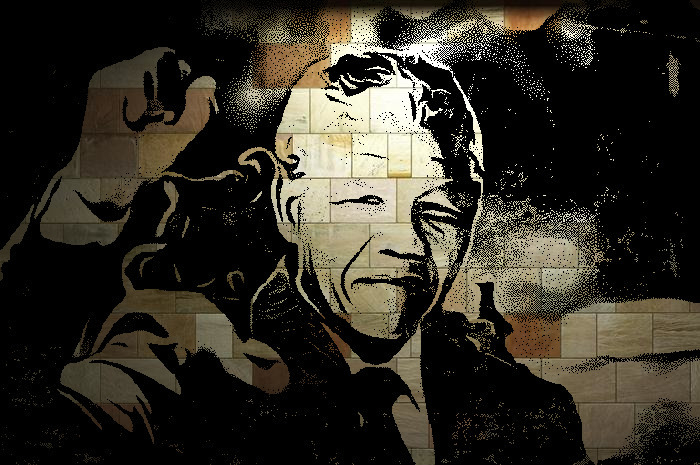
Understanding Nelson Mandela’s Complex Legacy Honors Him the Most

NelsonMandelaflickrEmanueleBertuccelliWhen Nelson Mandela died on December 5, 2013 at the age of 95, the outpouring of praise from the political elite and establishment media around the world was overwhelming. In larger-than-life terms, Mandela was lionized and romanticized as the world’s most admired human being.

In some ways, such praise is encouraging in our age when the wealthy and powerful, usually lacking any admirable values, are held up by their mass media as our success stories. In a world with such dehumanizing, violent, and unjust images and unworthy role models, the overwhelming praise for Mandela is hopeful. His was a life of dedicated struggle for freedom, self-sacrifice, suffering, courage, and admirable moral, economic, and political values.

In other ways, such praise is hollow, hypocritical, self-serving, and troubling, especially when uttered by many who condemned Mandela during his lifetime of struggles for freedom and who continue to uphold the most anti-Mandela priorities and values. The powerful, lavish in their praise for Mandela, conveniently fail to mention how our economic and political elite favored white apartheid South Africa and classified Mandela as a “terrorist.” During the Nixon Administration, the Kissinger Doctrine singled out white supremacist, apartheid South Africa as one of America’s pivotal allies. In the 1980s, President Ronald Reagan and Prime Minister Margaret Thatcher opposed the anti-apartheid divestment movement, despised the “terrorist” Mandela and opposed his release from prison. Dick Cheney, Secretary of Defense and later Vice President under George Bush, was extreme in expressing his contempt for Mandela, viciously labeling him a terrorist who should not be freed.

In general, those with corporate economic, political, and military power in the U.S. identified with the anti-Mandela white power elite in South Africa, who were pro-Western, anti-Communist, and provided access to South Africa’s diamonds and other vast economic resources and their exploited labor. Indeed, the elite professing current admiration for Mandela conveniently fail to note that he remained on the U.S. terrorist list until 2008, even while he served as President of South Africa’s first multiracial democratic government.

The establishment now praises Mandela by emphasizing his great humanity and his ability to forgive his enemies, even those who imprisoned him for 27 years. Yet it conveniently omits his radical critique of U.S. and other unjust relations of domination, corporate capitalism, imperialism, inequality and exploitation, militarism and war making, racism and other forms of oppression.

It is important to distinguish between celebrating Mandela, in which there is so much to celebrate in appropriating what we can learn and apply from his life and values, and packaging and commodifying him. In reducing Nelson Mandela to a celebrity, those with power define how we should honor him. They selectively soften a completely political person who repeatedly proclaimed “the struggle is my life.” In return, we get a fake and depoliticized icon, not a complex human being with strengths and weaknesses.

What exacerbates this problem is the global yearning of so many who suffer, including many oppressed and impoverished South Africans, to regard the very human leader as a kind of Messiah figure. In fairness, Mandela also contributed to this celebrity transformation, especially during the last two decades of his life. Partially based on very practical calculations, but enhanced by some personality weaknesses, Mandela, for all of his integrity, enjoyed rubbing shoulders with the rich and the powerful.

Therefore, in assessing the significance of Nelson Mandela for us today, we are confronted with many contradictory questions: Which Nelson Mandela? Do we accept the disempowering narrative in which Mandela is celebrated as a kind of Messianic leader who will save us and overcome widespread injustice? Or do we accept a Mandela narrative more consistent with how he actually viewed his struggles as a remarkable but flawed human being; a complex narrative we can selectively appropriate in ways that are contextually relevant to our social justice struggles?

Mandela was primarily a revolutionary, a freedom fighter for equality and justice. As he developed as a freedom fighter, he developed his remarkable capacity for self-control, controlling his emotions, self-discipline, strength of will, focus, and seeing the world with its injustices clearly so that one could respond intelligently and most effectively.

Mandela also emphasized the importance of core principles, of which one could then work out appropriate tactics and strategy. He was a radical egalitarian who believed in the core principle that everyone should have equal rights. During the 1980s while in prison and after his release on February 11, 1990, he focused on the core belief that South Africa should become a multiracial, democratic, constitutional, unified nation with a one-person, one-vote basis.

Although he experienced so much racism, classism, exploitation, humiliation, and inhumanity, Mandela believed that human beings are basically good, which was central to his remarkable focus on forgiveness. Not only are human beings basically good, but if you approach them as if they are, it will more likely bring out the best in them.

In contrast to our dominant Western view of the separate individual with one’s individualistic orientation, Mandela emphasized the basic interconnectedness and unity of life. This is often expressed through the African concept of Ubuntu: I am an integral part of a meaningful whole, and I am human only in relation to others. This belief system was part of the tribal decision-making process of Mandela’s youth in which group consensus was valued over conflict; in his view of his African National Congress as a collective, in which others were “comrades” and part of a unified community; and his emphasis on restorative justice, depersonalizing evil, and struggling for freedom and equality in which each one of us can realize our true interconnected unity.

Although Mandela should be seen as a freedom fighter in the tradition of Mahatma Gandhi, who spent 21 years in South Africa, and Martin Luther King, Jr., he did not fully endorse their views of nonviolence. Mandela personally disliked violence, but he disagreed with earlier African National Congress policies upholding nonviolence starting with its founding in 1912; the position of Chief Albert Luthuli, the proponent of nonviolence and head of the ANC, who had been awarded the Nobel Peace Prize in 1960, as was Mandela in 1993; and the philosophies of Gandhi and King, both of whom he greatly admired. For Mandela, nonviolence is not an absolute principle, philosophy, or way of life. In different contexts, where nonviolence is not possible or effective, the use of violence may be justified.

Nelson Mandela’s real legacy raises difficult questions about the contexts within which Mandela and we live, and how they reveal limitations of what we can achieve. These contextual power structures and relations are both limiting and enabling. From his youth and throughout his life, Mandela was willing to take big risks, defy authority, challenge or evade status quo limitations, and radically change his own positions. But there were always real economic, political, military, cultural, and historical limitations on his remarkable achievements. In other words, in dealing with the real world, and not some utopian world of his imagination, Mandela had many personal and political setbacks, and he was necessarily limited in the extent to which he and his comrades could reshape their South African world in ways that reflected his vision.

It is certainly open to debate as to how Nelson Mandela understood the changing limits throughout his life, and whether he redefined his positions in the most adequate ways. A small sample of such topics on contextual limits would include the following: Mandela’s earlier anti-white, Africanist view of the African National Conference as only open to blacks and his later formulations of a multiracial ANC and South Africa; his earlier anti-Communist views and exclusion of Communists from the ANC and his later embrace of important Communists as among his mentors and closest comrades in the ANC; his conclusion that policies of nonviolence had become ineffective and suicidal, with his launching of the Umkhonto we Sizwe (MK, the Spear of the Nation) in 1961 as the arm of the ANC dedicated to armed struggle directed at weakening the hold of the white apartheid regime; his conclusion while in prison that the liberation forces could not defeat the white racist regime through armed struggle; his subsequent decision, defying the ANC positions on negotiating and on collective leadership, that he would negotiate on his own with representatives of the white power structure; and most controversially, his secret meetings and negotiations with the most powerful white economic leaders after his release from prison that led to radical shifts in his own values and policies.

The ongoing debate often focuses on what limits necessitated changes in values, priorities, and policies and which changes were not necessary but reflected disastrous shifts, concessions, and even betrayals. This is significant in terms of Mandela’s ineffectiveness in realizing many of his major goals during his Presidency. It is especially significant when examining Mandela’s post-apartheid, independent South Africa with growing class inequality, incredible poverty and frustration and violence among the black masses, continuing white power and privilege, and the rapid emergence of a corrupt, wealthy, black elite.

Through his secret negotiations with the white power elite, Mandela accepted loan arrangements with the International Monetary Fund and its structural adjustment requirements, endorsed what has been labeled as “the U.S. Consensus Plan,” and adopted policies of neoliberalism promoted by globalized corporate capitalism. The results for the overwhelming majority of South Africa have been disastrous.

In fairness, the situation that confronted Mandela was very complex and daunting with South Africa’s large debt; the collapse of the Soviet Union and the aggression of triumphalist globalized capitalism; the fact that Mandela and the ANC were part of a freedom movement with limited knowledge of economics and of the politics of running a nation; and, most importantly, Mandela’s understandable immediate priority of avoiding a likely civil war, with an incredible bloodbath, and creating a unified, multiracial, democratic nation that would not repeat the patterns of extreme divisiveness, dictatorship, tribalism, religious hatred and violence, and genocide found throughout Africa.

It is easy to second guess and have a critical analysis in hindsight, recognizing what has happened to South Africa and the globalized world, but it is fair to ask whether Nelson Mandela was pressured, flattered, and seduced by those with dominant power in ways that greatly sabotaged and subverted his vision, core values, and priorities, often expressed upon his release from prison and to the end of his life. Mandela is often praised for adopting a more “mature” and realistic “pragmatism,” but questions remain as to whether he compromised too much and unwisely gave away concessions that were not pragmatically necessary. Did he give such a high priority to overcoming the fears of whites and winning over their trust that he deemphasized the needs of the disadvantaged masses and what was needed for radical changes in the unjust power relations?

“Apartheid” is a Dutch Afrikaans word in South Africa meaning “separateness.”  It was the name used for an economic, political, legal, and social system of the separation and control of black Africans and other nonwhites by the dominant white minority. It finally became the official system of apartheid or “separate development” of the Afrikaner National Party that ruled South Africa from 1948 until 1994.

Educating ourselves about the system of apartheid, showing solidarity with the liberation movement in South Africa and throughout the world, and exposing U.S. and University of Maine complicity in profiting from apartheid became major issues at UMaine, starting in the late 1970s and continuing for a decade. In 1982, the University of Maine (and the Maine System) agreed to divest all of their holdings in corporations and banks doing business in South Africa (one-third of the principle portfolio). We became one the first ten universities in the U.S. to divest completely. It took six more years of intense organizing and struggle before the semi-private University of Maine Foundation agreed to divest its large holdings in apartheid South Africa. We had the sense of a spectacular, rare, significant, and meaningful victory.

At this celebratory event, I read some of Mandela’s heroic and defiant speech at the Ravonia Trial in 1964 before his imprisonment. This included his words that had so inspired us, proclaiming that he was prepared to die for freedom: “I have fought against white domination, and I have fought against black domination.” Mandela continued: “I have cherished the ideal of a democratic and free society in which all persons live together in harmony and with equal opportunities. It is an ideal which I hope to live for and to achieve. But if needs be, it is an ideal for which I am prepared to die.”

In 1990, after his dramatic release from prison, Mandela went on a tour of the United States that included being honored at a huge evening gathering at Yankee Stadium in New York. A group of us, who had been anti-apartheid activities for many years, gathered during the day at a church for workshops and celebrations. Suddenly, to our great surprise, Nelson Mandela appeared, much to the overwhelming tearful and joyful responses of the activists. I’ll always remember his words. “Tonight, all of the famous influential politicians and dignitaries will praise me. However, I want you to know that I’ll never forget who my real friends are, those who struggled all those years against the apartheid system and for my freedom.” In the last years of his life, Mandela made similar kinds of statements.

While preparing several Nelson Mandela talks after his death and in writing this article, it struck me how most students and community members easily admire Mandela and his message and genuinely believe in equality, freedom, democracy, and the need to overcome the injustices and oppressions of economic exploitation, racism, sexism, and environmental destruction. But we feel powerless, are so easily discouraged, and are often cynical. When one begins to appreciate what Mandela went through, his suffering and sacrifice and long struggle, it really puts into perspective how easily we become discouraged, feel hopeless, and give up.

Mandela leaves us with a legacy of hope; that even in the darkest of times, we can live meaningful value-based lives of integrity and bring about dramatic, qualitative changes in the unjust status quo. Mandela shows us that we can live lives of admirable courage, even when we have deep fears and insecurities, as he often had. In an age when we are socialized to desire instant rewards and gratifications, Mandela teaches us the necessary value of disciplined will power and perseverance, as evidenced in the title of his autobiography, Long Walk to Freedom, and in his frequent declarations that we must view what we are doing in the long run. Mandela shows us the importance of having worthy principles, of clarifying what we really believe, and then, as he quoted Gandhi, “Be the change you seek.”

In an age when I am socialized to view myself as separate, isolated I-me, egotistic individual, who lives in an adversarial world of win-lose competitions and learns to calculate what is in my own narrow self-interest, Mandela teaches us that such aggressive self-interested individualism is false and destructive; that I am really an integral part of interconnected unified wholes in which others are a necessary part of who I am and how I can live a meaningful life.

It is now up to us to understand, appreciate, and selectively appropriate what is of lasting value in Mandela’s vision, values, and ideals and to contextualize his legacy in ways that inspire us, give us hope, and inform our lives as integral to an action-oriented interconnected movement working for a much better world.

Doug Allen is Professor of Philosophy at the University of Maine. He is Coordinator of the Marxist and Socialist Studies Program at UMaine, and he has lectured and published extensively on the philosophy of Mahatma Gandhi.

Photo by Flickr user Emanuele Bertuccelli
Posted in Uncategorized | 1 Reply

Clinton 2016: Endless War Guaranteed

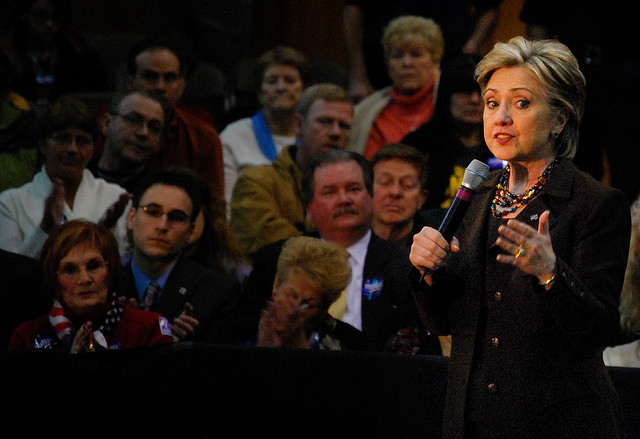
CLINTONFLICKRRONAPROUDFOOTVisits from high-profile public figures are somewhat of a rarity at Hamilton College in upstate New York, so it wasn’t a surprise many students snatched up tickets to see Hillary Clinton last October. And after a talk which may have cost the school up to $300,000 (at her “discounted” student rate), the presidential endorsements quickly echoed across campus.
Her speech at Hamilton was just one of many stops on her lucrative nationwide speaking tour, a relentless self-promoting campaign aimed at earning her a head start in the 2016 presidential race. Across small towns and college campuses, with an acquiescent media fawning over her new book, Clinton hailed the United States as “the greatest force for peace and progress the world has ever known”.

Inserting herself in the collegiate demographic conveniently allows Clinton to rewrite history, absolving her role in some of the nation’s most criminal foreign policy initiatives – from the invasion of Iraq to the overthrow of Gaddafi in Libya. In fact, Clinton is widely known to be even more of a war-hawk than Sen. John McCain within Obama’s national security circles.

Her war mongering has paid off with heavy backing of the military industrial complex, exemplified by her relationship with Boeing, the world’s second largest defense contractor. In one instance, she set aside ethics guidelines in order to secure a multi-billion dollar deal with the company.

A few of the venues on her tour are particularly revealing. Aside from the usual events open to the public, she’s been paid hefty sums of money to give private speeches to investors at Goldman Sachs and the Carlyle Group – the former of which has since been revealed as her second largest political donor. Modern-day presidential campaigns can’t be run on a shoestring – the 2012 race exceeded $1 billion in campaign spending and in 2008, Goldman Sachs exceeded every other corporation in spending for Obama.

Hillary Clinton’s list of donor buddies stretches far beyond the 1200 yards of Wall Street, and considering how banks and war are leading the pack, the damage wrought by them does too. If she wins the 2016 election, America is guaranteed four more disastrous years of neoliberalism and war.

Ming Chun Tang

**

Abby Martin talks about Clinton’s horrible track record on foreign policy and war mongering on Breaking the Set.


Hillary Clinton 2016: Recipe for Endless War

**

Follow @AbbyMartin

Photo by FLICKR user Rona Proudfoot

The Climate Change “Debate” and Marketization of Nature: Everyone Loses

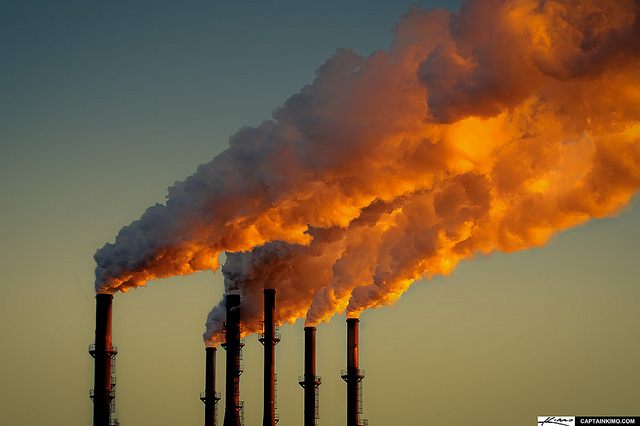
FactoryFlickruserKimSengDespite near-unanimous global scientific and governmental consensus that global warming is accelerating due to human activity, debating this fact is still a favorite political pastime in the United States.
Governments around the world acknowledge the science that connects industrialization, increased greenhouse gas emissions, and their detrimental impact on the climate, and are currently acting upon solutions. Yet the US, one of the largest greenhouse gas producers, has repeatedly refused to participate in global climate reform. To further confound this reality, the November midterm elections placed ardent climate-change deniers in line for senior legislative environmental policy positions.

Meanwhile, the evidence continues to mount. An abundance of reports show that not only does climate change exist, but that it’s human-induced and will cause severe and non-reversible negative consequences for the planet. Most recently, the Intergovernmental Panel on Climate Change (IPCC) released its 2014 Climate Change Report, which states the observed changes in the climate are “unequivocal” and that carbon dioxide, methane and other greenhouse gas emissions have increased exponentially in the past 60 years. The majority of carbon emissions are absorbed into the ocean, causing rapid acidification which has already caused mass die-offs.

Despite having presented overwhelming evidence from over 130 countries that support this conclusion, IPCC reports continue to be attacked by US media outlets. In 2007, minor errors in the Climate Change Report were widely exploited to justify a denial of its findings, forcing scientists in the US to respond in an open letter. Instead of acknowledging climate change science, the US media continues to distort reality by creating a false equivalency between the two sides.

Additionally, when extreme weather phenomenons are reported, climate change is rarely mentioned as a contributing factor. Project Censored found that out of 450 news segments about weather anomalies in 2013, only 16 of them mentioned climate change.

One may be inclined to believe that politicians who deny man-made climate change are innocuously naïve, but many times they are consciously furthering the neoliberal business agenda at the expense of the planet. Accepting the true human impact on the world would mean instilling regulations to curb pollution, which would cut into corporate profits. As Naomi Klein keenly elucidates, the destructive nature of neoliberalism does not lend itself to a sustainable environment, now or ever. Free-market advocates don’t look at earth resources beyond market shares, and their corporate mantra is to continuously maximize profits.

Fossil fuel companies know their time is running out, so they’ve launched a propaganda war to confuse the American public about climate change, raising serious questions about democracy and the right to information. Journalist George Monbiot has extensively researched the ties between oil companies and the reproduction of climate change disinformation. As Abby Martin on Breaking the Set revealed, those who want to protect oil interests fund think-tanks with the sole aim of derailing climate change evidence and environmental advocacy.

One example of intentionally manipulating public opinion is EPA Facts, whose single purpose is to debunk research by the Environmental Protection Agency. Sourcewatch describes it as a “front group operated by the PR firm Berman & Co.” which manages several similar groups that work to further market fundamentalism, including anti-minimum wage campaigns, food safety, and a host of other social policies. Another egregious example of this collusion is the American Enterprise Institute. This Exxon Mobil-funded think tank blatantly offered funding to scientists and academics that could produce research to dismiss human caused climate change.

Other industries that contribute significantly to greenhouse gas emissions, such as the beef industry, also have ties to climate change denial. A report by the 2006 UN Food and Agriculture Organization (FAO) found that livestock production is responsible for up to 18 percent of total emissions, more than all transportation combined. Coincidentally, Koch Industries, which oversees Matador Cattle Company, has consistently funded climate change denial.

These astroturf groups have subverted the dialogue, toxified the political process and halted environmental progress. Sociologist Robert J. Bruelle found just how prevalent they are too, with at least 140 organizations existing solely to poison the well and delay legislative action on climate change. Mega rich donors who also want to chip in are becoming more savvy in their funding techniques, using third-party agencies such as Donors Capital Fund to anonymously funnel money into neoliberal policies. As the Guardian revealed last year, anonymous billionaires donated up to $120 million to anti-climate groups to discredit the scientific consensus using Donors Trust.

As journalist Lee Fang discussed on Democracy Now, Republicans who deny man-made climate change and are largely backed by fossil fuel companies will soon be in key positions to block environmental policies. This includes Senator Jim Inhofe in the Environment Committee, Senator Ron Johnson in the Homeland Security and Government Reform Committee, and possibly Senator Ted Cruz in the Science Subcommittee, which controls federal scientific research. Beyond their proclaimed skepticism or outright denial of climate change, these leaders’ ties with oil giants will dismiss any chance of judicious policy decisions.

Because campaign funding is intimately tied to corporate interests, Americans must recognize the influence that corporations and politicians have on media, advertising, think-tank research, and other avenues of information. It’s also a critical time to recognize neoliberalism (or market-fundamentalism) as a toxic system that places corporate profit over any chance for democracy. Acknowledging climate change as a global reality is the first step to demanding sustainable environment policies and proper investment in renewable energy sources.

Other countries are quickly progressing on this front. Germany’s Energiewende project (energy transition plan) has successfully turned nearly one-third of their electricity production carbon-free over the past ten years, and are projected to be 100% renewable as early as 2050. The country’s renewable plan uses electricity through solar photovoltaic and onshore wind power energy.

The US could do this too. Dr. Mark Jacobson from Stanford University developed a plan for America to shift to 100 renewables by 2050, tailoring the proposals for each state based on regional resources available. California, for instance, would meet its energy needs by switching to 55% solar, 35% wind, 5% geothermal, and 4% hydroelectric power. Details of the intricate plan include land requirements, projected cost and savings, expected job creation, and how the proposed trade-off would significantly reduce pollution and global warming emissions.

Plans like this demonstrate the potential the US has in shifting its energy policies and being a leader in sustainable development. Rather than watching the fictitious ‘climate change’ debate unfold, the American public should be aggressively advocating for the development and implementation of green energy plans. It is now or never, and unfortunately, the planet cannot wait.

Written by Sabrina Nasir

Photo by flickr user Kim Seng

Posted in Uncategorized | 1 Reply

BP: Scandal, Lies and Another Massive Oil Spill Cover-Up

BP Thierry EhrmannForget Stephen King. If you want scary, read U.S. District Judge Carl Barbier’s 150-page Findings of Fact released recently in the Deepwater Horizon case.

Although the judge found BP liable for “gross negligence,” some U.S. media failed to mention that Barbier let BP off the hook on punitive damages. And that stuns me, given that the record seems to identify enough smoking guns to roast a sizable pig.

Every rig operator knows that, before a rig can unhook from a drill pipe, the operator has to run a “negative pressure test” to make sure the cement has properly sealed the drill pipe.

If the pipe is safely plugged, the pressure gauge will read zero. The amount of pressure BP measured at 5 p.m. on April 20, 2010, the day of the explosion? 1400 psi (see the findings, pages 62-65).

1400 psi is not zero. Stick a balloon in your mouth with zero pressure and nothing happens except that you look silly. Replace the balloon with a hose delivering a 1400 psi blast and it’ll blow your skull apart.

So, how could the company record zero? Answer: BP’s crew re-ran the test measuring the pressure in something called the “kill line,” which is definitely not the drill pipe.

By reporting that the pipe had no pressure and all was safe, BP could begin to unhook the Deepwater Horizon from the pipe—and sail away. Why would BP do that? In my view, there were three motives: money, money and money. It costs BP a good half million dollars each extra day the rig stays on top of the drill hole. It seems it wanted the rig gone, and quickly.

Instead of halting the disconnection process, BP appears to have lied and recorded the pressure reading as “zero.” The rig’s owner, Transocean of Switzerland, went along with BP’s actions.

So how did BP get away with mere “gross negligence” as opposed to the more serious claim of fraud? Because the court found that the blowout, explosion, fire and oil spill were caused by “misinterpretation of the negative pressure test.”

Misinterpretation? If a woman says “thanks” when you say she’s dressed nicely and you think she wants a kiss, that’s “misinterpretation.” But on the Deepwater Horizon, the drill pipe gauge read 1400 psi and BP picked a different pipe that gave the company the magic zero. That’s not, I contend, “misinterpretation.”

Maybe the judge thought he was pretty tough by calling out BP for “gross” negligence (rather than plain-vanilla negligence, the finding against Transocean and contractor Halliburton). But, in fact, it seems Barbier fell for the Three Stooges defense.

Throughout the 150-page decision, the judge cites one instance after another of bone-headed, buffoonish, slapstick decisions, and plenty of pratfalls and banana-peel slips by BP, Transocean and Halliburton. You have to wonder how these schmucks even found their drill hole. It was a corporate Larry-Moe-and-Curly-Joe routine that would provide a lot of belly laughs if 11 men hadn’t died as a result.

I’ve seen the Three Stooges defense before in federal court. In 1988, the corporate owner and the builder of the Shoreham nuclear plant were on trial on accusations they bilked their New York customers out of $1.8 billion. In court, they pleaded stupidity and incompetence as a defense against deliberate deception. As the government’s investigator, I didn’t buy it—billion-dollar corporations can’t be that stupid—and neither did the jury. (The racketeering charges were settled after trial for $400 million.)

And here is a new set of Stooges: BP plays Larry, Transocean puts on Moe’s wig and Halliburton makes “Nyuk! Nyuk! Nyuk!” sounds like Curly Joe. Halliburton, the judge found, failed to test the final cement mix and BP bitched about it—“[Halliburton engineer Jesse Gagliano] isn’t cutting it any more,” reads an email between two BP managers on the rig—but BP went ahead and used the bad cement anyway (Findings, paragraphs 227-228)

When the pressure in the drill pipe read 1400 psi, BP and Transocean managers should have stopped the rig departure immediately. They didn’t. Nevertheless, other systems should have prevented a blowout. According to Barbier, other safety systems were jacked with to save a penny here, a penny there (or, a million here, a million there). Example: BP used leftover cement (Findings, paragraphs 209-211) that contained chemicals that destroyed the integrity of the new cement, because using the old stuff saved some serious cash.

Barbier had the power to levy a fine big enough to make BP plc, BP America’s London-based parent corporation—a company with revenue of a quarter of a trillion dollars a year—go “ouch.” But to slam BP with a fine that would hurt, the judge needed to hear from the Justice Department about corporate-wide perfidy. He pointed out that the case would have to be made against BP plc, the international parent, if he were to level a fine that would punish the corporation.

Against BP there is evidence aplenty. For years BP plc has played fast and loose with safety—from Asia to Alaska.

Chasing BP across five continents, I’ve found that “gross negligence” could be BP’s corporate motto. In 2010, I was arrested in Azerbaijan hunting down evidence of another BP/Transocean offshore blowout that occurred 17 months before the Deepwater Horizon explosion. The cause of the Caspian blowout was the same as in the Gulf disaster: mishandling of “foamed” cement. Had BP not covered up the prior blowout off the coast of Azerbaijan, the deaths and destruction in the Gulf, I’m certain, would have been avoided.

More on the Caspian Sea blowout and BP ruling on Breaking the Set with Abby Martin:


What?! Another Massive BP Oil Spill Coverup?

**

The ugly truth is that the U.S. State Department knew of the Caspian disaster and kept its lips sealed. Furthermore, the U.S. government can’t tag BP as an endemically rogue, dangerous operator without casting doubt on the administration’s recent grant to the corporation of new deep tracts to drill in the Gulf of Mexico.

So maybe it was not the judge but the public that was blinded by the government and media crowing about a possible $18 billion fine for gross negligence. Eighteen billion dollars may sound like a lot to us mere mortals, but to a trillion-dollar behemoth like BP, it is not a punishment, but a reasonably priced permit for plunder.

Greg Palast is award winning author and journalist.

This article was originally published in Truthdig. Photo by flickr user Thierry Ehrmann

Watch Breaking the Set’s exclusive follow-up on the 2010 BP Oil Spill from the Gulf.

Walmart’s Predatory Profit Model: Low Prices With a Heavy Cost

Stop Walmart by Flickr Lone PrimateAs the saying goes, there’s no such thing as a free lunch. Nowhere does that ring more loudly true than in the aisles of every Walmart store. Always low prices, yes – but at what cost?

There are, unfortunately, two inconvenient truths about the dollars you’ve supposedly saving from having elected the world’s largest retailer over Joe’s little store just down the street. First off, what you don’t pay, someone else is paying for. And secondly, the actual price you pay is much higher than what your receipt tells you.

I’m aware that the slogan I mentioned earlier is outdated. The irony was not lost when, in 2007, the company swapped it for the rather idealistically sounding “Save Money, Live Better” – a far cry from the everyday reality facing the average Walmart employee in the United States. Making an average hourly wage of $8.81 an hour, or about $18,300 a year working full-time, is hardly the way to live better. It’s only slightly over a third of a living wage for an adult with one child. 

That’s why Walmart isn’t quite as cheap as you’d think – because much of what you’re not paying at the cashier ends up getting paid for through your taxes. It’s estimated that every Walmart store in America costs citizens $1.7 million in welfare benefits such as food stamps. Taxpayers are effectively subsidizing the retailer for its failure to pay employees a living wage.

Abby Martin outlines Walmart’s horrible treatment of employees and destruction of the planet on Breaking the Set:

Why Walmart is an Economic Death Star

**

Amazingly, Walmart could afford to give all of its employees a 50 percent raise without even touching its bottom line – but it chooses not to. And why does it choose to perpetrate the countless other assaults on its outsourced workforce, female employees and the environment? The answer’s simple: profit maximization.

We’ve all heard of corporate social responsibility. Be it sincere or mere corporate whitewashing, the “triple bottom line” of economic, social and environmental sustainability surely fares better than the single-minded focus on profit that prevails under the current global economic order.

The existing objective, profit maximization, is exactly what it sounds like: putting profits above all else, be it workers’ right to “live better”, the planet’s capacity to sustain human activity, worker and consumer health and safety, economic stability, or human lives. This reckless pursuit of profit is why taxpayers are propping up large corporations that make obscene profits in the meantime.

It’s why 1100 Bangladeshi workers, many of them making garments sold at Walmart, lost their lives when the Rana Plaza factory collapsed due to blatant disregard for building safety on the part of the companies it supplied (Walmart still refuses to sign an international agreement that would ensure worker safety in its sweatshops).

It’s why General Electric, Toshiba and Hitachi did nothing about the flaws in their nuclear reactors at Fukushima that caused them to melt down in 2011, despite knowing for decades that they were unsafe.

It’s why there is still no vaccine for ebola despite over 2000 deaths at the time of writing – because there’s no money to be made out of it. Or why corporate tax evasion through loopholes and tax havens costs the United States some $300 billion every year.

It’s why governments, on behalf of their grossly bloated financial sectors, are negotiating a secretive international financial treaty that further deregulates global finance known as the Trade in Services Agreement (TISA). 

And so on. What these failures of the capitalist system, or what neoliberal economists term “market failure”, share is a common root in the unwillingness on the part of businesses to fully account for their costs. Taxpayers pay the price for Walmart’s refusal to adequately pay its own workers. The manufacturers of the Fukushima nuclear plants, unwilling to dish out the money to fix their inherent design flaws, unleashed a public health disaster that threatens to get worse. Global finance triggered the Great Recession through their own risky but rewarding behaviour and want to do it all over again.

The very nature of business needs to change if humanity is to avoid yet more Rana Plazas, Fukushimas and Great Recessions, and if it is to ever overcome ebola, tax evasion and corporate welfare. We need to move away from the predatory capitalist “I want it all” ethos and towards new business models that account for all costs rather than leaving them for others to pay. This is not financially impossible, and there’s no reason why such a model can’t be financially self-sustaining. But it’s only when business owners and executives start to acknowledge their responsibility to really help the rest of society to “live better” rather than taking more and more for themselves will that model be possible.

**

Top Five Worst Corporations for US Workers

Abby Martin calls out the corporations that refuse to pay their workers a living wage, despite posting record profits and generously compensating their CEOs.

**

Written by Ming Chun Tang; image by Flickr user Jim

Page 2 of 1612345...>>