


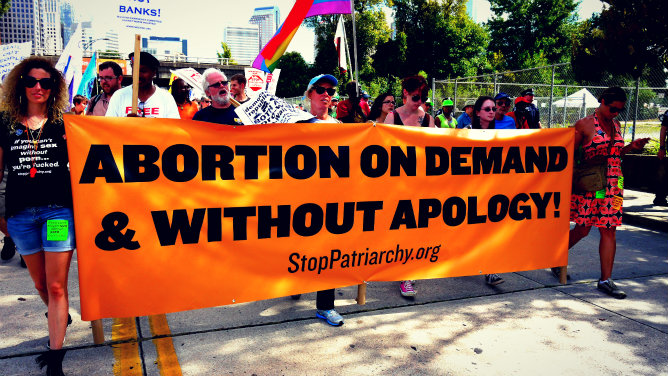
 On March 3, a clinic that provides abortions in Montana was so severely vandalized that it has been forced to close down indefinitely. This took place against a backdrop of the most relentless escalation of abortion restrictions and clinic closures since the Roe v. Wade Supreme Court decision legalized abortion 41 years ago. Across the country, this right hangs by a thread. Sunsara Taylor, writer for Revolution newspaper (revcom.us) and initiator of End Pornography and Patriarchy: The Enslavement and Degradation of Women (StopPatriarchy.org), spoke with Susan Cahill, the owner and advanced-level clinician who provided abortions and other services at the family clinic.
Cahill provides the larger picture of what it means to take on the responsibility of providing women with abortions: the threats, violence, legal attacks, gratitude and support; she reveals the depth of her own commitment to women and what it would mean if abortion was no longer available.
This interview first appeared in Revolution Newspaper, and the views expressed by Cahill are her own.
***
ST: When I first heard about the vandalism that happened at your clinic I was incensed. I’m outraged about this and a lot of people are, but a lot of people actually have no idea what happened at all. And even those who have heard about it, the headline said that your clinic was “vandalized” and that can conjure up the image of some kids playing a prank.
SC: Yes, and I’m actually going to go back just a little bit. All Families Healthcare is my business which I started at a different location 6½ years ago and I was very happy there. But I was renting and [not long ago] my landlord at the time said that he was running into some financial problems and he was going to sell the business. He asked me if I wanted to buy the building but it was an older home, which was great because I liked the cozy atmosphere of it, but I didn’t really want to take on that big a project at this time in my life as far as the building and it needed a lot of work so I said no. You know, I may be retiring in a couple of years. So I didn’t think it would sell right away because of all that and because of what he was asking for it, but it did. And when it did, I turned to my secretary/receptionist and said, “An anti-choice person bought this building, I bet you anything.” So I asked my landlord if I could stay there and they said no they were going to use the building and I had to get out.
So I had to turn inward and decide whether or not I was going to try to find another place ’cause it’s not easy for me, because I do abortions, to find a place to rent. But I did. So I got out of there and in minus 15 degrees with a huge amount of help from very dear friends who moved my office to this new location.
And after spending a lot of money and time fixing it up, new paint, cabinets, lots of stuff… I moved in on the weekend before the 11th of February, started seeing patients on the 11th of February.
There’s a lot of things to do when you move a medical office. Lots. So just getting everything organized, remembering where you put new stuff after 6½ years of being in a different place. We were just starting to feel like we were getting settled. It looked really nice. The sun was coming out again and it wasn’t minus 15 anymore and I had almost finished the security system. I had cameras in but this was a new system that was wireless and the person on Monday the 3rd of March said to me, “Tomorrow, I will finish it.” I said “great,” because the next day the 40 Days for Life [40 days of protest and prayers outside the doors of abortion clinics across the country] was going to start and I wanted it up for that.
So that was what happened on Monday. I remember actually walking around after everybody had left thinking, “We did a really good job with this new place.” I was really happy with it. The next morning I was getting ready to go to work and my secretary/receptionist comes in before me and she went in to go to the back door and saw that the glass had been broken and it was obviously broken into. She smartly did not walk in. She walked to where the landlord was, who’s a lawyer and said, “We’ve been broken into, we need to call the police.” Then she called me and by the time I got there the police would not allow us to go in. The FBI was there and actually—this was a Tuesday—we didn’t get to see the damage until Wednesday afternoon.
During that time they spent all day and all night there as well, and the police kept telling me, “This is really very destroyed. I need you to get prepared for this.” They asked me if I wanted to watch the videos of it first before we walked in, but that whole thing made me so anxious. I said, “No, I just want to get in there.”
So, by Wednesday afternoon they finally let me in after doing all their investigation and… it’s really hard to… in fact… every time I think about it I start crying because it’s really, it’s really very difficult to understand the devastation that was there. And everything kept running through my mind, I mean it was only three weeks ago that all of my dearest friends and colleagues helped me create this space and now it was completely vanda… completely destroyed.
And the energy of hate in that place was palpable because not only did this person take meticulous care to damage every possible [medical and structural thing] you can imagine, but on top of that broke… I mean, you know I have prints and paintings and things through the years that represent important things for me that I put up… They were totally destroyed. As well as my, you know, pictures of my family… where holes [were stabbed] in their faces… Everything.
And then every piece of medical equipment was destroyed in some manner or the other. He had put iodine and sprayed it all over everything… He took the fire extinguisher and sprayed the dust… I mean we’re still dealing with this in the little room that we have now, trying to get our charts in order, every time you pull a chart, you know [the] smell comes again… I go to sleep with that in my nose.
So it was complete devastation… They pulled my plants from their roots and besides that he went downstairs in the basement and completely destroyed the heating and plumbing as well. So it was not mere vandalism and it certainly wasn’t [random]. It was an attack on me, there was absolutely no doubt about that.
ST: I’m glad that you went back and told the story from earlier because that is more than I had realized. I read a quote I was going to ask you about later, but it just comes right to the fore of my mind as I’m hearing you describe this. In a letter that you sent to a newspaper, you said this is an attack on you but it is an attack on all women. I wonder if you could explain why you said that and how you mean that.
SC: Well, let me just connect another dot here before I respond to that. So, I wanted to find out who bought the building I was in for 6½ years and my landlord would not tell me. Finally, a lawyer found out from the county and it was a man and wife. The woman is the ex-director for a crisis pregnancy center, Hope Pregnancy Ministries. So they bought the building purely to get me out of business, knowing that it would be hard for me to find another place.
At the time, it was claimed that they were going to use the building. Well, the building is up for lease now. No one’s in it. Then because that didn’t work [to put me out of business] and I found another place, the son of the woman who started Hope Pregnancy Ministries is the one who completely destroyed my clinic and the painful thing for me is that the physician for this Hope Pregnancy Ministries… where you can get, you know, free ultrasounds from a place called Clear Choice which has “Pregnant Scared?” on their billboards… but over the course of the time Clear Choice has referred patients to me, women who—against all of the harassment trying to convince them otherwise—have said, “No I need to terminate this pregnancy.” And I’ve even heard a few patients say, “They said, ‘You will get good care with Susan.'”
So I have felt that we have had some understanding. You know, its respect for differences and hopefully respect for women’s choices. So that was my made-up belief system, apparently. And the physician who was connected to [Hope Pregnancy Ministries] over the course of the years has been very considerate of me. We exchange patients. When I had hip surgery, he came in to see how I was doing. So I felt like this is the belief system that I hold dear, which is that we respect each other’s differences in life. So when this happened, not only did I take it so personally because it was, but I looked at all the women in my community who we both had taken care of, and this was such an attack on them because, it’s like, “We’re telling you what you’re going to do. You are no longer an individual who needs and has to make choices in their life sometimes that are different from the ones that I think you should make… We are going to stop you from being able to do that. We don’t respect your decisions making.”
And this is not just women. It’s families. It’s people. I mean, life is hard. People need choices. I have to say, I was thinking about your organization name, Stop Patriarchy, and I thought, you know, I think it’s “stop misogyny” because, the women… it was the mother… it was the son of a mother who did this… and it was the woman whose executive director who got stuck… and they are also misogynistic. They have bought into this belief that women can’t make… that women are less than and are just whatever vessels or whatever… or when did it become that an embryo was more important than a breathing human being, you know?
ST: I really agree with you. Patriarchy encompasses an ideology as well as the structures… and I agree that women can enforce that, they can take up the ideology of male supremacy and misogyny, just as much as men can. On Democracy Now! you said a lot of people, because abortion is legal, they don’t understand that we are actively losing this right. Also, that you remember what it was like before Roe v. Wade. Could you talk some about that?
SC: You know, I was born in 1950, so I grew up when it was illegal. Interestingly, I actually was born on International Women’s Day, March 8, and I was delivered by an 82-year-old female physician who, in 1950 was a rarity to say the least! She was on a program a couple days after delivering me and it was entitled, “Life begins at 80,” so I think the stars were aligned in some respect, you know, for better or worse. But, just with this shadow of understanding that the rarity of having a female physician in the first place, and then growing up and my own sensitivities around the fact that I remember having male doctors. You know, I was hippie generation, so when I wanted to get birth control there was one physician at the university who would do that and he was a dirty old man.
I remember that when I got examined, quote unquote, so that I could get birth control pills, he asked me about how I liked sex. I remember this and it just stuck in my mind as I grew and had a broader understanding of what all this meant. So I went through that… and I went through the time when we believed and understood that we were sexual human beings… understanding the philosophy of that and understanding the responsibility. As I grew older and got interested in medicine and what that meant in order for us to feel that way, we needed to also take care of our reproduction in a healthy way.
So I went through all that and I remember when Roe was passed—because that was in ’73 and I went to PA [physician assistant] school in ’74 and from ’74 to ’76—the universities and the hospitals were teaching medical people how to do abortions, which doesn’t even happen anymore. You have to ask now, and it’s hard to find a place that will teach you. So I remember this whole time and to me it was an absolute given. I mean, it was like, “Of course we need this, there is no doubt.” But now, these generations have passed and it is legal… but there’s something missing in our brains around how important this is to stay safe and legal… and I think it’s like the old, “You have to remember your history otherwise you’ll repeat it,” and I think that’s what’s happening here.
ST: Several generations now have never heard anybody speak positively about abortion. Last summer, when we did the Abortion Rights Freedom Ride, we travelled the entire country and we had these bright bright beautiful orange signs that you cannot miss that say, “Abortion on demand and without apology.” And over and over again, some people were confused, “Wait a second, are you for it or against it?” I mean, the sign could not be more clear. But people have never heard the word “abortion” without it being condemned. They’ve heard “choice.” They’ve heard “privacy.” They’ve heard “safe, legal, rare.” But they’ve never heard somebody say look this is a very positive and liberating thing for women to be able to make conscious decisions about when and whether they will have children. So it underscored to me how much there has been a far too one-sided battle in the last 40 years against women’s right to abortion, legally, extra-legally, as well as in the in the realm of culture and morality. So, this is something that I think, in addition to people taking it for granted as something legal, there’s also a lot of defensiveness and shame that is misplaced around abortion.
SC: I totally agree with you about that. And I confront that every day when women call up and, because I’m a family practice office… That’s my way of saying this is just another medical procedure. I take care of sore throats, I take care of babies, I take care of the elderly, I take care of women’s reproductive needs, including when they get pregnant and find that they can’t keep the pregnancy, or if they get pregnant and want to keep the pregnancy. Then I am joyful for them, refer them because I don’t do obstetrics because I don’t have privileges at the hospital because I am a physician’s assistant.
To me, you fit this in. You know when I was working with Dr. Armstrong [the doctor who Susan Cahill worked with for many years at a family practice that provided abortions], you fit this in. You have vasectomies, you have whatever. I mean, it is part of life. I think marginalizing the whole abortion thing was the biggest mistake after it became legal… putting it in clinics where that’s all they did. I think that was mistake number one and if I was queen for a day I would, and I said this in my letter, I would have particularly physicians and other medical people whose concentration is on women’s health to learn first trimester abortions.
We have made it so safe since ’73 when it was legalized. And I’ve gone through that whole thing, so I know from the hard time to the easy time, it’s a five-minute procedure. It’s a very simple procedure. A shot of penicillin or a tonsillectomy is a heck of a lot more dangerous. And yet, because it’s been stigmatized, OBGYN doctors don’t want to have anything to do with [abortions]. I think women should go [to their physicians] and say, “How come you don’t you do this? What kind of a women’s doctor are you?” You know?
And, women should be able to say “abortion.” But, women will call up to me and they’ll say, “Um, um, um, well I want to make an appointment.” And I’d say, “OK, what kind of an appointment do you want?” “Well, um… um…” Well, we all know. They can’t say it so often. So, I say it. It’s like with anything, we can’t say “penis,” we can’t say “vagina.” I had a patient whose mother called me up when her daughter was 10 saying something was the matter with her “toe-toe,” which I knew right away. So she comes in and my medical assistant gets her ready by taking her shoes off and I went back to her and I said, “Why’s her shoes off?” She goes, “Because she said there’s something the matter with her toe.” I said, “No, there’s something the matter with her ‘toe-toe.'” And then, I said, “First of all, we’re going to talk about what this word really is.” So it is a problem, you’re right. And, I don’t know exactly what the answer is, except I do think part of the problem was marginalizing this whole thing in the beginning and if we could in anyway [reverse that]… And now there’s medication abortion, so it’s even easier if you wanted that…
Oh, I was going to tell you a story, which was… I had thought you were going to say that you met women who talked about their experiences having an abortion and that it was not all great. I also believe most of the time in my office, certainly sometimes this is a crisis for a woman, but sometimes it’s easier for them to decide. Sometimes it’s personally harder, but I try to make it not… I don’t want to make it a big ordeal because I believe that it’s disrespectful. I mean, I certainly do everything. I do the counseling. I have a master’s in social work on purpose. But, besides that I’m not going to question women a million times for her decision. I have too much respect for the fact they know what they’re doing. So that also has got to stop, frankly.
I mean, I think we’ve got to make it a little bit simpler for women to go in and say, “I’m pregnant and I don’t want to be.” You know? You certainly want to know, make sure they’re not being forced into something they don’t want to do, that’s very important, but it doesn’t take too long to figure that one out, frankly. You just do it and you say, “I’ll see ya in two weeks to make sure you’re OK,” you know, whatever.
So, this young woman came in. She’s 16 at the time and we had a parental notice hanging around which I think we’ve gotten rid of now… it said “15 and under” but she thought she needed her mother to come in, so her mother came in. Her mother was obviously chemically dependent and was screaming and cursing at the time. This young woman was much more mature than her mother and was very clear about her decision. Really, she allowed her mother to be who she was but after her mother left, she apologized for her mother.
We thought from the date that she was farther along than she actually was, and by the time I got dealt with her mother and her mother left and then I took care of the other patients it was after five… So, I said, “You’re not as far along and if you’re OK with just the two of us doing this now we will.” She said, “I would like that,” so we did it and then I took her home.
And I remember a couple of things about it because she was trying to get her GED. She was working. Her mother was down in the basement of this house, the boyfriend’s mother was in the center of the house and she and the boyfriend were living in the upstairs attic. That’s how it was and she had this little sweatshirt and it was pretty cold out and I had just got a new car with heated seats, which I never had before. I started the car before she got in because I noticed she didn’t have much on. And she’s sitting there yacking away at me and then she stops and she goes, “Oh, heated seats!” You know, it was so sweet. So I drove her home and she’s talking and she stops and she starts to open the door and she turns to me and she says, “Can I give you a hug? You did a really great thing for me today.” That’s the stuff that makes me, first of all it breaks my heart, but also it makes me proud. But it also makes me know how important this is. That’s what I was going to tell you, and for her this was a very good experience, and the right thing.
ST: You spoke before about reducing women to vessels and breeders. I think a lot of people don’t understand that when women don’t have access to abortion when they need it, their lives are foreclosed. That’s it for them, you’re 16, you end up with a kid, that’s your entire life. It has been forcibly changed in a way that is just unconscionable, and it’s society imposing that. And what you do, what the providers do across this country, is enable women to have their lives back. But also, reducing women to vessels is actually the aim[both laugh in recognition], that’s actually their aim, of this movement. It’s never been about babies, it’s never been about life, it’s always been about control over women, it’s pretty clear because they don’t support birth control either.
That was a great story. And I agree with you that other physicians should provide this service, but I also think that everybody in this country right now needs to get off the sidelines and be part of fighting to defend abortion rights and to defeat the war on women. So I think it’s important for people to understand the full dimension. This recent destruction of your clinic is not the first targeting, extreme violence that you’ve experienced. Your clinic was firebombed in the ’90s and you also experienced legal attacks. And, while there is a distinction between that kind of extra-legal attack and legal attacks, it’s not necessarily the most important distinction because both are completely illegitimate in terms of what they mean for women. So, I wonder if you could just paint a little bit of a picture of what it’s been like to be providing abortions in this climate for the last two decades.
SC: Well, after the legal attack was settled and the anti-choice group, you know, they’re always needling, needling… so they went to county trying to arrest Dr. Armstrong for doing second trimesters in the clinic, and me for doing first trimesters at all. And just, to go back again, when I went to school and I was looking to come to Montana, I was in New York, and I wrote, and I was looking for my final elective in Montana because I wanted to come here for romance reasons…
I didn’t know where Montana was on the map actually, but [laughs] Dr. Armstrong, who was also originally from New York, had vowed that when it became legal, if it became legal, that he would incorporate [abortions] into his family practice, because he saw women die every day in New York City of illegal abortions.
And so, by the time I wrote to see if I could come out there and I described all the things that I had learned, one of which was abortion, he grabbed me because he had so many requests for abortions that he didn’t have enough time for his regular family practice. He needed help, so I did my final elective with him and that’s how that started. So, I was doing them all that time and then physician assistants were just, you know, getting more and more known [in medicine in general] and there was a medical practice act that said that physicians could delegate authority to any professional they feel has been trained adequately to do that.
So, that’s how I was working doing first trimester abortions. Then, when I became licensed in ’83, I had worked already six or seven years doing abortions, and he told this moving story at the board of medical examiners, to make sure that they were ok with me doing them and it was passed without any question.
The anti-choice people then started looking at the fact that there was the Roe v. Wade thing, which says only physicians can do abortions. That was said because, first of all there were no advanced level clinicians doing anything in ’73, they were just staring to come out, nobody knew anything about them, so they weren’t going to say “medical professionals,” because they didn’t know anything other than physicians that could do physician-type of work, so that’s why Roe v. Wade was stated that way. But they, the anti-choice people, took that and said, “She’s not a physician, she can’t be doing them, so arrest her.” And the same goes with… there was a law in the books about physicians doing second trimesters in the hospital.
So we got legal advice and it turned into a two-year legal battle. And it would get… they would say I couldn’t do them and then I could do them and then I couldn’t do them and then I could do them, back and forth for two years, and finally won, I think it was in ’97 that I won. And then the Montana Supreme Court just basically said that medical professionals who are well trained can do this. It was a big deal. At one point patients would come and say, “But I want you to do it,” and I would have to say to them, “I can’t, I can’t do it.”
I went through the whole counseling, I explained the procedure, but Dr. Armstrong would have to come in and do it, you know, so that went back and forth for two years. So there was that, and of course, stuff in the paper, and you know, it was another one of those things that you just kind of slog through.
ST: You become medical professional because you want to serve your patients, and here you have to go through years of legal battle just to do your job. It’s a huge cost to pay, not everybody would persevere and fight that through.
SC: Right. Dr. Armstrong was the one who was instrumental in helping me do that. He was determined. He was a very determined person and very clear. And he’s another one of those people who knows exactly what it would mean if this wasn’t legal, because he’s seen it. You know, and that’s why I said the people who know about what it would be, what it was like when it was illegal, are disappearing, they’re dying, they’re retiring and they’re dying.
It’s a concern, and I feel right at the precipice of that right now, you know.
ST: And then your clinic was also, or I guess Dr. Armstrong’s clinic, you two were working together.
SC: Firebombed. It took us five months to rebuild. Well, that was early in the morning, three o’clock in the morning, you know, and interestingly, the man who lives next to me is the fire chief. I even heard his car leave, but that was not uncommon. They got there right away, but it destroyed the front office and it took us five months to rebuild and then we had to find another place and that was the first scary thing. Again, we persevered and we talked about the same things that I’m talking about now. The same things, and that’s very painful to me. We started something called the Safe Place Project and the community was behind it, about, “This can not happen in our community.”
And it didn’t for twenty years. Now it’s back again. It’s just non-stop and quite honestly it’s very shocking to me that we’re still fighting this. From my perspective growing up and seeing and saying, “Yes of course, of course we need this right.” I mean, yes, of course. And, “Oh we got it, oh good, that battle’s won.” You know? No. It hasn’t been won and it’s going backwards, it’s absolutely going backwards. You know, Texas has all these awful laws passed that were passed even against popular opinion.
ST: This is not acceptable this situation. We are, like you said, on a precipice, not just you personally at a precipice, but in this country access is being closed down, women’s lives right now are being foreclosed. There are women undergoing dangerous self-… attempts to self-induce abortion is very widespread, much more than people understand. People are going to have fight this. Go out on the streets and speak out about this, raise their voices, resist, and refuse to allow this to happen, really refuse to allow for this happen. And change the atmosphere and the climate, and that is something I feel very strongly is not, it is not the responsibility of those who already put their lives on the line for decades to do that alone. It’s unacceptable that people like yourself are—I know you described everybody who helped you open the new clinic, you mentioned that young woman who gave you a hug, I’m sure that is manifold—but it’s too much that providers are left by themselves to face the real consequences of this, it’s going to take the toll on all women if there’s not a change very soon. I want to ask you… Go ahead.
SC: I think the other thing that needs to change is that, and I don’t know how we’re going to do this, but the rhetoric of “murderer,” that an abortion provider is a “murderer” has absolutely got to not be allowed, because for me, the difference between the firebombing in the ’90s and now is that then the guy was from some other state and he did that to three abortion clinics before he was caught and in jail for seven years. But today, this was a fellow in my own community. And, done by people in my own community is scarier to me. And he had a semi-automatic rifle in his car. He was armed at the time. And I thought this morning just, the unfortunate part… it might not have been so unfortunate that my alarm system wasn’t totally set up because it’s possible that if he could not commit to destroying my clinic, that he would have then decided to destroy me. And that’s a scary, scary thought for me.
ST: Yeah, that’s a horrible thought, and I don’t think that’s an unreasonable thought. And I am reminded of something I read about the rise of the Nazis. How a lot of people were very alarmed by Kristallnacht and all the thuggish violence against Jews, but then when anti-Jewish laws were passed and S.S. were posted outside Jewish businesses, for example, and people accepted that more easily because it had the veneer of legality and so-called “legitimacy” in that sense. But, in reality, the anti-Jewish laws turned out to be much, much more deadly. And I think there’s an analogy with to abortion today, “Sure, there’s legal restrictions, but there’s not the same level of violence as say in the ’90s.” But, they… first of all, they don’t understand the level of violence that’s going still going on, and secondly, those restrictions are having a much greater effect shutting down abortion—and in a much more lasting, much harder-to-reverse kind of way. Plus, and this relates to your point on rhetoric, there’s a connection between the atmosphere that allows those legal restrictions… with major officials in the country talking about abortion as “murder,” as a “holocaust,” as blood on the providers’ hands, and you have Fox News, when they used to talk about “Dr. Tiller the Baby Killer”… all of this creates an atmosphere where unstable people or fanatical people, indoctrinated people feel that they’re justified in quote, unquote, “taking God’s work into their own hands,” or acting “on behalf of the unborn,” or however they understand it. You can’t separate the motivation of individuals to carry out this kind of violence from the overall atmosphere and legal framework that’s being hammered into place. And both are harmful, I realize that’s not really a question [both laugh], but I wanted to appreciate and kind of build on your point about the rhetoric, it’s very deadly.
SC: It’s extremely deadly… There is a woman who did a documentary on the Holocaust… She also was the woman who interviewed me because I got an award on Lifetime TV for being a “risk-taker”… and that thick glass award on my desk was also totally destroyed… But, this woman did a documentary talking about the Hungarians and it was so moving about how they kept watching the Nazis and doing all these little things, and saying, “Oh well, it’s just this isolated thing… Oh well, it’s not going to happen to us… Oh well… Oh well…” Until it did. And it’s just the palpable understanding of the deeper thing, how the people who want to do the destruction do it in a very systematic way that makes people have amnesia around what’s happening… or just not take it seriously. Not thinking it’s that important. And it is. All of these things. So, I don’t know what is going to happen in my community right now. It’s going to be an interesting thing. I just talked with a man yesterday who said, “Whatever you need, I will be there for you, I will protect you, I know martial arts… and, I don’t agree with what you are doing, but I know who you are and this is wrong, and it is wrong in our community and we can’t have it.” And a lot of people are saying that, so, we’ll see what happens.
I have a certain amount of faith, maybe it will happen here. Interestingly, the physician for the Crisis Pregnancy Center, I wrote him a letter and he called me last night. My letter basically said, I identified that your executive director bought my old clinic to get me out of work and when that didn’t work the woman who started that, her son totally destroyed my clinic and my livelihood and everything I have ever worked for. And you have irreparably damaged our relationship and blah, blah, blah… and on your website you have, “In the spirit of Jesus,” and I said, “This is not the spirit of Jesus.” I said, “I am a victim, but so is Zachary, because Zachary was born in innocence and love and he was taught to hate.” [Zachary is the son of the founder of Hope Pregnancy Ministries. He has been arrested and charged for vandalizing Susan Cahill’s clinic.] And I said, “This is not the spirit of Jesus, this is the spirit Jesus was preaching against.” He called me up and he said, “You’re right. I want you to be OK with me talking to my colleagues…” So, I don’t know what is going to happen with that. But part of me hopes something out of this will be good.
ST: Let me as you a final question, and then invite you for any final reflections you want to add. Can you talk about what now, the phones are operating at your office, but what are women in your region of Montana facing if they do need abortion care?
SC: For people in Kalispell, the closest place is Missoula, which is a two-and-a-half hour drive. Great clinic, but they right now are going to be inundated with women because there was a clinic in Livingston that was closed also, so they were already getting those women and now they will get my patients. They are a bigger clinic. They also cost more because they are a bigger clinic because they have to pay for all that. That’s another thing, with my office, I had me and two employees and I tried to keep things reasonable because I also think abortion needs to be reasonable financially for women. So, they are going to cost more, they have to go farther. They only do them a couple days a week. The other thing that I always offered intermixed with my other patients.
But besides all that, we also have the Blackfeet Reservation. These people don’t have a lot of money, very often. They had to drive an hour and a half to me. I often give them… they often come without gas money by the time they make it here, without gas money, without food money. So, I have donations that I give them. Now, these people are going to have to go to Missoula…. It’s pathetic! Frankly, it’s more than pathetic, but that is one of the things it is. It’s a disgrace! Just that alone, women should say, WHAT? WHAT!? Men can go anywhere he wants to get whatever the frick he wants, you know? [Both laugh.]
I want people to be angry, but I want their anger to come out in constructive ways. And I think it’s going to take a lot of different ways in order to do that. I’ve had this fund set up for me, which is fabulous, and the money has gotten much more than was originally asked for. And thinking about what I want to do with part of that money in the most constructive way I can to help the movement… I need to talk to the groups that are all working towards better access and think about where we can work most constructively with that. And I don’t know what that is yet. But I will continue to talk and think and work at it. And I think all of us who have come together thinking about it, we need to talk about what we can do here…
And one of the things we can do is get access to reproductive health in the schools again. This whole abstinence-only thing… is so ludicrous! No! No! Because we know, in all the other western countries that have comprehensive reproductive healthcare, they’re abortions and need for abortions are a lot less. We know that. I mean, that’s one way. But, these battles…
I really think that the younger generation, we need their help. We need their help.
***
Tune in for:
National Webcast: “Abortion Rights Emergency!”
Friday, April 11th 7pm, Eastern Daylight Time at StopPatriarchy.org.
Featured speakers include: Dr. Willie Parker (doctor at last abortion clinic in Mississippi), Rev. Donna Schaper (of Judson Memorial Church), Merle Hoffman (CEO of Choices Women’s Medical Center which has provided abortions for 42 years), Sunsara Taylor (writer for Revolution and initiator of StopPatriarchy.org), a video message from Marge Piercy (novelist, poet, activist), and more.
Learn about Emergency Protests to Stop the War On Women taking place nation-wide on April 12th at StopPatriarchy.org.
********************************************************************************************************
1. “Crisis pregnancy centers” are fake clinics run by people who are anti-abortion. They lure unsuspecting women in by providing pregnancy tests and in the guise of giving “medical advice,” they actually give women wrong and distorted information to scare or shame them into not having abortions. – ST [back]
2. November 9-10, 1938, Nazis led mobs to attack Jewish-owned businesses, homes, and synagogues throughout Germany and parts of Austria. Close to 100 Jews were killed that night, which came to be known as Kristallnacht, or the Night of Broken Glass, because of the shards of broken glass all over the streets in its aftermath. [back]
 With the controversy surrounding the recent Ukrainian coup and Crimean incursion, the wheels of war are turning once again, churning up an old foe. If you listen closely, you can hear the sound of the Red Menace prop being roused from the warmonger’s hall of archives, dusted off and wheeled down the plush carpet of the military-media complex.
 Failed ideas, infighting, and glimmers of hope.
 On March 20, the world celebrated International Day of Happiness, a day initiated by the Kingdom of Bhutan at the United Nations in 2012. The small Himalayan country of about 730,000 people became famous for introducing to the world Gross National Happiness (GNH), a holistic development index that goes beyond the solely economic focus of Gross Domestic Product (GDP) to measure the emotional and spiritual well being of Bhutan’s people. It was a revolutionary idea by the fourth Dragon King Jigme Singye Wangchuck that continues to resonate in the West.
 There are few things more harmful to the public discourse than the cloak of false respectability – especially on a nationally or globally disseminated news network. When corporate media broadcasts propaganda, a benighted public is duped into believing the twaddle of stark raving mad political ideologues as though they were the very words of Socrates by satellite. The mainstream’s reach and influence is staggering, and when unchallenged, fatal. Take, for instance, the estimable Republican Representative Mike Rogers of Michigan. Let’s consider for a moment the aura of respectability that enveloped, like a hot towel on a transatlantic flight, the mindless bluster Rogers so thoughtfully aired for the nation last month on
  Millions of viewers were exposed to this dialogue, and millions more will see it in syndication. As they watch, few will be aware of some damning omissions.