The Case for Vegetarianism You’ve Never Heard Before

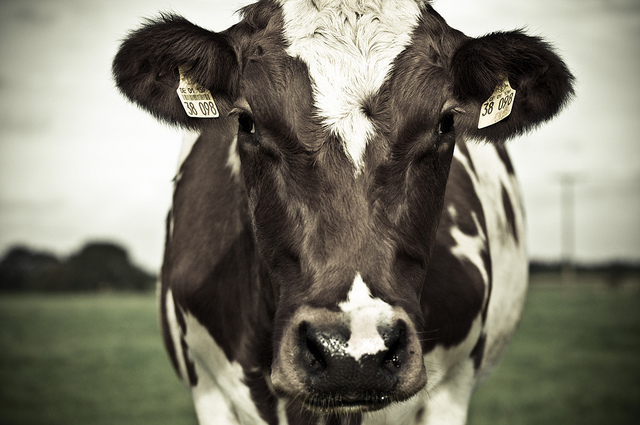
CowbyFlickrb3dWhen I was in 5th grade, I was obsessed with animals. It was an age where most of my friends were going through the phase of wanting to be either a veterinarian or whale trainer at Sea World (yes, this was before Blackfish).

My love for animals may have been innocent and ill-informed early on, but it led me to become passionate about animal rights.

Over the years, vegetarianism has stuck with me despite the fact that most of my friends, family, and men I’ve dated eat meat. It certainly hasn’t been easy – but it’s been worth it. People might never stop asking me why I don’t eat meat, but my answer will remain simple and the same: I like animals too much to bring myself to eat them.

Yet Gary Francione, a self proclaimed animal abolitionist, has a much more sophisticated argument in favor of vegetarianism. Rather than focusing merely on the treatment of animals, Francione defines “animal abolitionism” as the inability to “justify using animals at all, no matter how humanely we treat them”. He’s structured a moral argument against the alleged necessary use of animal products, particularly with the advent of technology and alternative materials like hemp.

And whilst Francione acknowledges that animals are cognitively different than humans, he explains why it still doesn’t justify the consumption and use of animals for our benefit. Francione argues that the cognitive differences don’t matter morally, because animals are sentient.

He underscores this by posing a scenario comparing two different human beings: one who is brilliant and one who is mentally disabled. Whilst the two humans are “different” from one another, Francione points out that a cognitive difference would not justify, for example, subjecting the disabled individual to a harmful biomedical experiment.

So why would we do the same to animals?

Well, as Francione points out, animals are little more than helpless resources at the hands of exploitative human beings. But “how can you justify using a sentient being exclusively as a resource?” Francione asks.

The answer: you can’t.

Even back in 1884, Henry David Thoreau proposed “… that it is a part of the destiny of the human race, in its gradual improvement, to leave off eating animals…” just as “savage” humans “have left off eating each other”.

**

Professor Gary Francione on Breaking the Set

Gary Francione on Animal Abolition & Ethical Consumption

**

Written by Anya Parampil for Media Roots, Photo by flickr user b3d
Posted in Uncategorized | 1 Reply

Monsanto Corn Plant Losing Bug Resistance

MEDIA ROOTS- If there is one thing that’s been constant over the course of this planet’s evolution, it’s nature’s resilience. Even if a pesticide is designed to eradicate a weed or insect species native to a particular area, nature will eventually bounce back and become resistant to the poison.
Similar to the heavy use of antibiotics leading to supergerms, a recent epidemic of super weeds have started to take over farmers’ lands that have been spraying crops with Monsanto’s Roundup Ready weedkiller. According to the president of the Arkansas Association of Conservation Districts, the built up resistance to these pesticides is “the single largest threat to production agriculture that we have ever seen.”

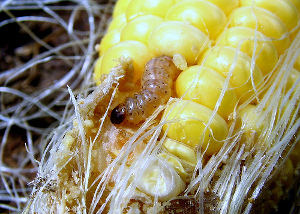
For the first time, Monsanto’s BT corn crops in Iowa are now falling prey to the very bug they’re engineered to resist: the rootworm.

This could be very bad news for Monsanto, a company that has monopolized both the pesticide and genetically modified food industry for more than a decade. Since Monsanto’s Roundup Ready GM seeds are engineered to withstand their Roundup Ready pesticide, American farmers have gotten accustomed to using both products hand in hand. However, if Monsanto’s seeds are deemed useless, what incentive will farmers have to spend the extra money for seeds that no longer kill weeds or bugs?

Monsanto is a monolithic and ruthless corporation that will do anything to meet their bottom line of profit maximization. Hopefully this is the beginning of Monsanto’s disintegration into irrelevancy. For more about Monsanto’s callous domination over the global food market read Media Roots Original – Monsanto’s Global Food Domination.

Abby Martin

***

WALL STREET JOURNAL– Iowa State University entomologist Aaron Gassmann’s discovery that western corn rootworms in four northeast Iowa fields have evolved to resist the natural pesticide made by Monsanto’s corn plant could encourage some farmers to switch to insect-proof seeds sold by competitors of the St. Louis crop biotechnology giant, and to return to spraying harsher synthetic insecticides on their fields.

“These are isolated cases, and it isn’t clear how widespread the problem will become,” said Dr. Gassmann in an interview. “But it is an early warning that management practices need to change.”

The finding adds fuel to the race among crop biotechnology rivals to locate the next generation of genes that can protect plants from insects. Scientists at Monsanto and Syngenta AG of Basel, Switzerland, are already researching how to use a medical breakthrough called RNA interference to, among other things, make crops deadly for insects to eat. If this works, a bug munching on such a plant could ingest genetic code that turns off one of its essential genes.

Monsanto said its rootworm-resistant corn seed lines are working as it expected “on more than 99% of the acres planted with this technology” and that it is too early to know what the Iowa State University study means for farmers.

Read more about Monsanto Corn Plant Losing Bug Resistance.

© 2011 Wall Street Journal

Photo by Flickr user Hadie

Europe Has Already Run Out Of Fish For The Year

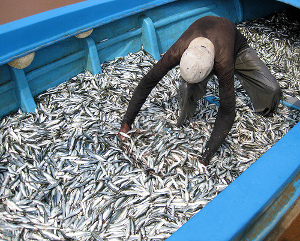
FAST COMPANY– Scientists have warned that without drastic changes “this century is the last century of wild seafood.” The world’s current trajectory of falling catches and rising consumption is projected to end in 2050 with the collapse of nearly 100% of exploited seafood populations. But those are just abstract numbers. Now a new report tells us the precise day each year when we have eaten more fish than the planet can sustain. In Europe, that day has already passed. Every fish consumed now by Europeans is one that couldn’t come from their own fisheries.

In 2011, according to the study by the New Economics Foundation this “fish dependence day,” fell on July 2, the day when–theortetically–at least, the EU pulled all the fish it could from its waters (NEF extrapolates from the most recent FAO data of 2008). This dependence date has crept forward for more than a decade and is now a full month ahead of where it  was in 2000. The reasons are well known. Since 1950, governments  have deployed policies, loans, and subsidies to build up big industrial fishing operations that feed the world’s growing appetite for seafood. Escalating competition for a dwindling pool of fisheries has had predictable consequences: the world’s catch peaked at 90 million tons in the late 1980s, and declined ever since to 79.5 million tons in 2008 (the most recent year statistics are available).  

The NEF’s study, while detailing which EU countries consume the most seafood (Portugal per capita), the most popular species (tuna, salmon, and cod primarily), and other trends, it also offers solutions it thinks can reverse the situation and prevent the collapse of marine species that, scientists say, may still be saved with proper management.

Read more about Europe Has Already Run Out Of Fish For The Year

© 2011 Fast Company

Photo by Flickr use oggywaffler

MR Reports on Fukushima for KPFA

Flashpoints – July 4, 2011 at 5:00pm

Click to listen (or download)


KPFA– On this edition of Flashpoints, a nationally syndicated radio show, Peter Phillips and Mickey Huff from Project Censored and Abby Martin from Media Roots report the latest news and coverage from the Fukushima nuclear disaster.

On this edition of Flashpoints, a nationally syndicated radio show, Peter Phillips and Mickey Huff from Project Censored as well as Abby Martin from Media Roots report the latest news and coverage from the Fukushima nuclear disaster.

Yellowstone River Oil Spill Spreads

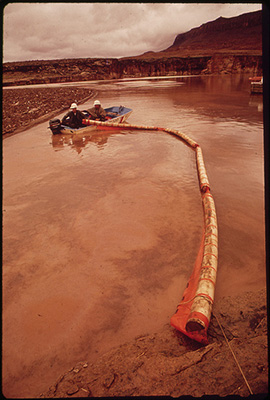
THE GUARDIAN– Oil from a ruptured ExxonMobil pipeline on the famed Yellowstone spread at least 15 miles beyond the initial leak – further than the oil company’s original estimates.

Clean-up crews have yet to reach the break in the 12-inch pipeline because of historic flooding on the river, which is projected to peak on Tuesday.

Montana’s governor, Brian Schweitzer, who was due to visit areas near the spill site on Tuesday, has called for a safety inspection of all pipelines crossing the state and a review of the company’s emergency response plans.

In its latest update, ExxonMobil said it was expanding its clean-up effort, deploying 280 people to help contain the damage. It was also conducting aerial searches for oil as far as 140 miles downstream.

But the firm said on its website that flooding, and swift river currents, meant it was still unsafe to send crews out in boats or to walk the banks in search of oil. It’s not clear whether the break was caused by heavy rains and extreme flooding.

“The river is well over its banks, very turbulent,” Gary Pruessing, head of ExxonMobil’s pipeline company, told a news conference on Monday. “I’ve never seen the river like this in my life.”

Read the full article about Yellowstone River Oil Spill Spreads.

© 2011 The Guardian

Photo by Flickr user usnationalarchives