Monsanto, America’s Monster

MONSANTO HYPNOSIS

Last month, the University of San Francisco made an alarming discovery, that 93% of Americans tested had traces of a chemical called glyphosate in their urine. Last year, the World Health Organization deemed glyphosate a “possible carcinogen”.

Glyphosate is the main ingredient in biotech giant Monsanto’s flagship product: Roundup, an herbicide sprayed all over almost every acre of food grown. Not only has Roundup been dumped around the world more than any other weed killer in history, but the US is its largest customer. According to the US Geological Survey, a record 280 million pounds were used in 2010 alone, nearly a pound of poison for every American.

Monsanto has already proven it cannot be trusted to care about anything but money, especially when lives are at stake. In this episode of The Empire Files, Abby Martin issues a scathing exposé on the corporate polluter, chronicling its rise to power, the collusion of its crimes with the US government, and the serious danger it poses today.


Monsanto, America’s Monster

***

FOLLOW // @EmpireFiles & @AbbyMartin

WATCH // YouTube.com/EmpireFiles


Used & Betrayed – 100 Years of US Troops as Lab Rats

Screen Shot 2016-05-17 at 11.49.07 AMOn Memorial Day, politicians will speak at ceremonies all over the country and repeat their favorite mantra: “Support the troops.”

This pledge is hammered into the American psyche at every turn. But there’s a hidden, dark history that shows that the politicians are in fact no friend to service members–but their greatest enemy.

An easy way to prove this is to look at how they so quickly betray and abandon their soldiers after purposely ruining their lives, and even after using them as literal lab rats. 

In this disturbing chapter of The Empire Files, Abby Martin documents decades of experimentation on unwitting US troops—from nuclear tests to psychotropic drugs—as well as knowingly exposing them to deadly poisons, from Agent Orange to sarin gas.

Most infuriating is that the hundreds of thousands of veterans seeking help from the government for the side-effects of these tests are always met with lies and denial. Be prepared to be armed with info and pissed off about how veterans are really treated in the US Empire.


Used & Betrayed: 100 Years of US Troops as Lab Rats

***

FOLLOW // @EmpireFiles & @AbbyMartin

WATCH // YouTube.com/EmpireFiles

Posted in Uncategorized | 1 Reply

Rewriting the Vietnam War

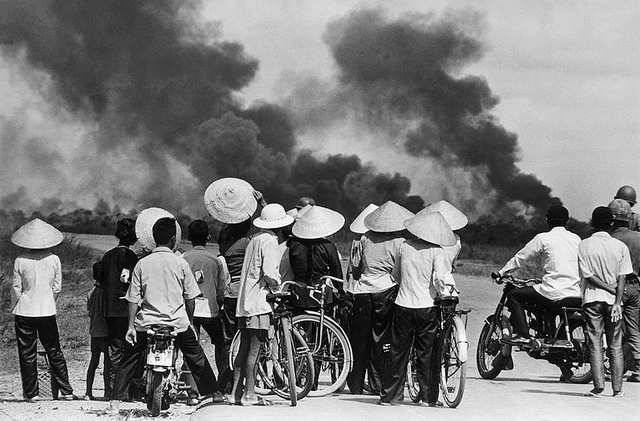
VietnamWarFlickrManhhaiArticles aplenty have appeared to mark the recent 50th anniversary of the first battle between US soldiers and the army of what was known in this country as North Vietnam. Come April, we can expect far more commentary on the 40th anniversary of the end of the fighting in what is still referred to as the “Fall of Saigon.”

This is especially significant considering the Pentagon recently posted a lengthy history of the Vietnam War (the Vietnamese, whose struggle for independence was waged against the Chinese, the French and the Japanese, in addition to the US, refer to this same period as the American War). Many sifting through its website might be confused as to why the stories differ dramatically from what one would hear from a war veteran or activist.

Pinpointing where US aggression in Vietnam began depends on how one determines when war starts. It’s silly to claim it began in February of 1965, as tens of thousands of Vietnamese were already dead at US hands by that point. Better to trace the origins to 1945, when the United States refused to recognize the new government established by Vietnamese independence forces.

See, Japan invaded Vietnam years earlier and French colonialists ceded the country to the Japanese. When French colonialists finished sipping cognac in Paris and decided to re-invade Vietnam, the US backed them to the hilt with weapons, financing and diplomatic cover. Unsurprisingly, the Vietnamese people resisted – just as they had resisted other occupiers for centuries.

As the French failed its attempt at re-conquest, the US bore more of the war’s burden until, in 1954, the Vietnamese were again on a path to independence. Yet the US undermined the elections Washington knew Ho Chi Minh would win in a landslide. As in dozens of cases over the past 100 years, the US opposed democracy in favor of aggression. Elections are praised when the right people win; machine guns raised if the wrong people win.

The US flew Ngo Dinh Diem in from New Jersey and installed him as dictator. Eventually, Kennedy had him whacked a mere three weeks before he himself was assassinated. This was not, however, before Kennedy began the saturation bombing of South Vietnam with napalm, while also calling for ground troops and organized strategic hamlets.

Lyndon Johnson’s fabrication of the Gulf of Tonkin incident in August 1964 was another turning point. Within six months, the Peace Candidate who had startled the world with a campaign ad attacking Barry Goldwater as a warmonger extended the invasion and bombing campaign in Vietnam. So it remained until the Super Rich grew antsy about the financial costs of the war, the US’s growing international embarrassment, unprecedented domestic upheaval, an army that increasingly wouldn’t fight, and the stark realization that there was no way the Vietnamese could lose militarily. I recall reading years ago something a Vietnamese elder who had probably seen as much death and destruction as anyone who ever lived said (I’m paraphrasing): We can settle this now or we can settle it a thousand years from now. It’s up to the Americans.                 

It’s impossible to calculate the Vietnamese death toll. Whatever Vietnam has said has been dismissed by the powerful, as anti-American propaganda and US elites have never bothered to summarize. Their attitude was captured perfectly by a general speaking of a more recent conflagration: “We don’t do body counts.” Not, anyway, when the dead bodies are victims of US violence.  

Three million Vietnamese deaths is a commonly cited figure but undoubtedly far too low. Also completely ignored is the Vietnamese experience of Agent Orange and Post Traumatic Stress Disorder, for example. Take the terrible suffering of US soldiers and multiply their numbers ten thousand fold or more and we get a sense of the damage to the Vietnamese. Additionally, Vietnam and the rest of Indochina (it’s often conveniently forgotten that the US also waged war against Laos and Cambodia) are full of unexploded ordinances that regularly cause death and injuries, to this day. There’s also the starvation deaths of hundreds of thousands throughout Indochina immediately after the war. A countryside ravaged by bombing, combined with the curtailment of airlifts, doomed those hundreds of thousands once the US imposed an ironclad embargo. That’s an unpleasant truth, though; so much easier to blame everything on the Vietnamese Communists and the despotic Khmer Rouge.

Discussions of Vietnam are hardly academic exercises; the US is on a global rampage and falsifying history has paved the way to the US-caused deaths of three million Iraqis since the first invasion in 1991, to cite just one of many recent examples. We remain in the grips of people who worship wealth and are in love with war, so any truth and reckoning about Vietnam and the destruction imperialism wreaks on the world will have to come from us.

Andy Piascik is a long-time activist and award-winning author | [email protected]

Photo by flickr user Manhhai

The Ongoing, Never-Ending JFK Mythology

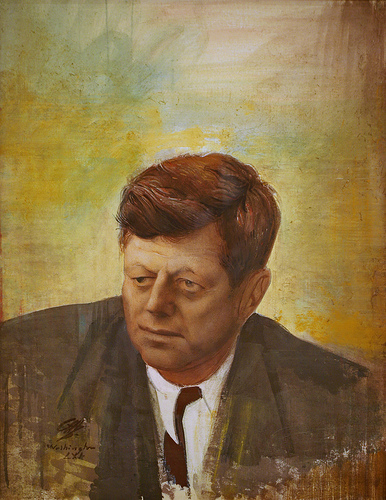
JFKCliff1066The latest eruption of John Kennedy hysteria, bordering on deification, seems safely behind us now that the 50th anniversary of his assassination has passed. Though there is much disinformation about JFK’s legacy that could and should be discussed, two areas stand out: his relationship to the Black Liberation Movement and his actions in Southeast Asia.

Despite all the evidence to the contrary, Kennedy has come to be seen as an ally of – even a hero of – the Black Liberation Movement. In fact, he opposed both the goals and actions of that movement from early in his term when terrorists were beating unarmed and vastly outnumbered Freedom Riders, to the final months of his life when four young girls were blown up in an Alabama church.

When black moderates announced plans for an action in Washington in 1963, Kennedy worked overtime to derail it, with significant success, mainly by strong arming black moderates eager to remain in good with the White House. As a result, the planned direct action protest with civil disobedience morphed into a march and the moderates went so far as to force the day’s most radical speaker, John Lewis of the Student Nonviolent Coordinating Committee, to drop portions of his speech critical of the administration.

As for Southeast Asia, many in the mainstream have argued that Kennedy was about to withdraw U.S. troops and leave the Indochinese to fight their own battles when he was assassinated. This fixation on what he might have done is understandable, for the historical record – what JFK actually did – is quite horrifying and laid the groundwork for the decade of slaughter that followed.

First was the escalation of U.S. aggression in Laos, accompanied by diplomatic shenanigans that undermined coalition governments that included the Pathet Lao revolutionaries despite their being the most popular force in the country. The goal, as always with empire, was all out victory and the annihilation of anyone who favored national liberation.

In Vietnam, a similar approach led to massive devastation. In the winter of 1961-62, Kennedy initiated the full-scale bombing of those parts of South Vietnam controlled by the National Liberation Front (all but Saigon and its immediate surroundings). The justification that bombing was needed to defeat the revolution masked the indiscriminate nature of the aerial assault, which resulted in casualties that were overwhelmingly civilian. And so the tone was set for the next eleven years of war.

It was also Kennedy who authorized the first use of Chemicals of Mass Destruction in Southeast Asia, with napalm the best-known and most deadly. Never had chemical warfare been used so extensively, though the U.S. had also used napalm in Korea in the early 1950’s. Again, the tone was established as massive amounts of phosphorous, Agent Orange and other chemicals were used for the rest of the war, chemicals the deadly affects of which are being felt to this day throughout Indochina.

And it was under Kennedy that the notorious strategic hamlets were set up throughout South Vietnam. “Strategic Hamlets” is a term worthy of Orwell at his best or Madison Avenue at its worst, designed to induce thoughts of happy, grateful peasants gathered around a campfire. The more accurate phrase would be Concentration Camps, as Vietnamese by the thousands were rounded up at gunpoint and forced to live behind barbed wire. Anyone who resisted was beaten or worse; anyone attempting to escape was shot. The aim was to separate the people from the NLF though the result, not surprisingly, as with the bombing and the chemical weapons, was the opposite, as ever larger segments of the population became supporters of the revolution.

As each of these moves failed and the NLF grew stronger, Kennedy ordered ground troops to Southeast Asia in the spring of 1962, the number of which he gradually increased until his death. There is no evidence to indicate any plan for withdrawal short of victory, the myth-making of Oliver Stone, Arthur Schlesinger, Jr. and so many others notwithstanding.

One way to get a handle on the JFK withdrawal myth is to recall another assassination in November of 1963, that of South Vietnamese dictator Ngo Dinh Diem. For much of 1963, Diem threatened to undermine empire’s goals by pushing for a negotiated peace with the NLF and a U.S. withdrawal. In response, Kennedy did what his kind frequently do in such circumstances: he authorized a hit on Diem and replaced him with generals willing to follow orders.

For all the wishful thinking about what Kennedy would have done in Indochina had he lived, the inescapable truth, as opposed to the fantasy, is that he escalated the war and initiated increasing levels of terror that eventually resulted in the deaths of millions. Significantly, there is no mention of withdrawal short of victory in the many Camelot memoirs, biographies and histories until after the tide had turned dramatically against U.S. aggression. Only then did the myth of “Kennedy the Peacemaker” emerge.

Perhaps the JFK cult can be explained by the odious legacies of his two immediate successors, Lyndon Johnson and Richard Nixon, both of whom massively escalated the carnage in Indochina and ultimately abdicated in disgrace. Odious their legacies may be but there’s no way around the fact that Kennedy’s legacy smells just as foul. Such an explanation also obscures the fact that it was Kennedy who established the terms for the domestic conflict that would rage throughout the 1960’s – outraged hostility on the part of the ruling class to the democracy movements that shook the empire to its foundations. It is those movements that will be remembered and celebrated long after the JFK cult hopefully, eventually, finally, finds its rightful resting place in the proverbial dustbin of history.

Andy Piascik is a long-time activist and writer for Z, Counterpunch and many other publications. He can be reached at [email protected].

Photo by Cliff1066

Posted in Uncategorized | 1 Reply

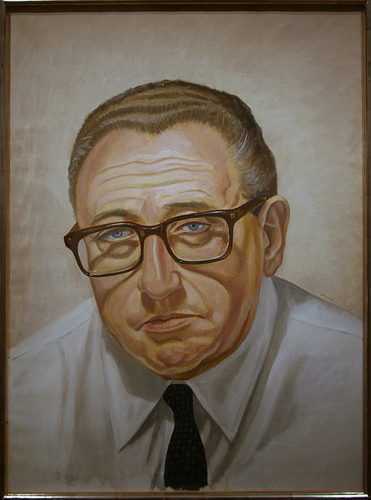
Why Henry Kissinger Should Be Tried at the Hague

KissingerCliff1066Two months ago, hundreds of thousands of Chileans somberly marked the 40th anniversary of their nation’s September 11th attack. It was on that date in 1973 that the Chilean military, armed with a generous supply of funds and weapons from the US, and assisted by the CIA and other operatives, overthrew the democratically-elected government of the moderate socialist Salvador Allende.

Sixteen years of repression, torture and death followed under the fascist Augusto Pinochet, while the flow of hefty profits to US multinationals – IT&T, Anaconda Copper and the like – resumed. Profits, along with concern that people in other nations might get ideas about independence, were the very reason for the coup and even the partial moves toward nationalization instituted by Allende could not be tolerated by the US business class.

Henry Kissinger was National Security Advisor and one of the principle architects of the coup in Chile. US-instigated coups were nothing new in 1973, especially those in Latin America. Kissinger and his boss Richard Nixon were carrying on a violent tradition that spanned the breadth of the 20th century and continues in the 21st – see, for example, Venezuela in 2002 (failed) and Honduras in 2009 (successful). Where possible, such as in Guatemala in 1954 and Brazil in 1964, coups have been the preferred method for dealing with popular insurgencies. In other instances, direct invasion by US forces such as happened on numerous occasions in Nicaragua, the Dominican Republic and many other places, has been the fallback option.

The coup in Santiago occurred as US aggression in Indochina was finally winding down after more than a decade. From 1969 through 1973, it was Kissinger again, along with Nixon, who oversaw the slaughter in Vietnam, Cambodia and Laos. It is impossible to know with precision how many were killed during those four years; all the victims were considered enemies, including the vast majority who were non-combatants, and the US has never been much interested in calculating the deaths of enemies. Estimates of Indochinese killed by the US for the war as a whole start at four million and are likely far more. It can thus be reasonably extrapolated that probably more than a million, and certainly hundreds of thousands, were killed while Kissinger and Nixon were in power.

In addition, countless thousands of Indochinese have died in the years since from the affects of the massive doses of Agent Orange and other Chemical Weapons of Mass Destruction unleashed by the US. Many of us here know soldiers who suffered from exposure to such chemicals; multiply their numbers by 1,000 or 10,000 or 50,000 – again, it’s impossible to know with accuracy – and we can begin to understand the impact on those who live in and on the land that was so thoroughly poisoned as a matter of US policy.

Studies by a variety of organizations including the United Nations also indicate that at least 25,000 people have died in Indochina since war’s end from unexploded US bombs that pocket the countryside, with an equivalent number maimed. As with Agent Orange, deaths and ruined lives from such explosions continue to this day. So 40 years on, the war quite literally goes on for the people of Indochina, and it is likely it will go on for decades more.

Near the end of his time in office, Kissinger and his new boss Gerald Ford pre-approved the Indonesian dictator Suharto’s invasion of East Timor in 1975, an illegal act of aggression again carried out with weapons made in and furnished by the US. Suharto had a long history as a bagman for US business interests; he ascended to power in a 1965 coup, also with decisive support and weapons from Washington, and undertook a year-long reign of terror in which security forces and the army killed more than a million people (Amnesty International, which rarely has much to say about the crimes of US imperialism, put the number at 1.5 million).

In addition to providing the essential on-the-ground support, Kissinger and Ford blocked efforts by the global community to stop the bloodshed when the terrible scale of Indonesian violence became known, something UN ambassador Daniel Patrick Moynihan openly bragged about. Again, the guiding principle of empire, one that Kissinger and his kind accept as naturally as breathing, is that independence cannot be allowed. That’s true even in a country as small as East Timor where investment opportunities are slight, for independence is contagious and can spread to places where far more is at stake, like resource-rich Indonesia. By the time the Indonesian occupation finally ended in 1999, 200,000 Timorese – 30 percent of the population – had been wiped out. Such is Kissinger’s legacy and it is a legacy well understood by residents of the global South no matter the denial, ignorance or obfuscation of the intelligentsia here.

If the United States is ever to become a democratic society, and if we are ever to enter the international community as a responsible party willing to wage peace instead of war, we will have to account for the crimes of those who claim to act in our names like Kissinger. Our outrage at the crimes of murderous thugs who are official enemies like Pol Pot is not enough. A cabal of American mis-leaders from Kennedy on caused for far more Indochinese deaths than the Khmer Rouge, after all, and those responsible should be judged and treated accordingly.

The urgency of the task is underscored as US aggression proliferates at an alarming rate. Millions of people around the world, most notably in an invigorated Latin America, are working to end the “might makes right” ethos the US has lived by since its inception. The 99 percent of us here who have no vested interest in empire would do well to join them.

There are recent encouraging signs along those lines, with the successful prevention of a US attack on Syria particularly noteworthy. In addition, individuals from various levels of empire have had their lives disrupted to varying degrees. David Petraeus, for example, has been hounded by demonstrators since being hired by CUNY earlier this year to teach an honors course; in 2010, Dick Cheney had to cancel a planned trip to Canada because the clamor for his arrest had grown quite loud; long after his reign ended, Pinochet was arrested by order of a Spanish magistrate for human right violations and held in England for 18 months before being released because of health problems; and earlier this year, Efrain Rios Montt, one of Washington’s past henchmen in Guatemala, was convicted of genocide, though accomplices of his still in power have since intervened on his behalf to obstruct justice.

More pressure is needed, and allies of the US engaged in war crimes like Paul Kagame should be dealt with as Pinochet was. More important perhaps for those of in the US is that we hound Rumsfeld, both Clintons, Rice, Albright and Powell, to name a few, for their crimes against humanity every time they show themselves in public just as Petraeus has been. That holds especially for our two most recent War-Criminals-in-Chief, Barack Bush and George W. Obama.

Written by Andy Piascik at [email protected].

Photo by flickr user Cliff1066

Posted in Uncategorized | 1 Reply