Alan Watts – Nothingness

ALAN WATTS– The idea of nothing has bugged people for centuries, especially in the Western world. We have a saying in Latin, Ex nihilo nuhil fit, which means “out of nothing comes nothing.” It has occurred to me that this is a fallacy of tremendous proportions. It lies at the root of all our common sense, not only in the West, but in many parts of the East as well. It manifests in a kind of terror of nothing, a put-down on nothing, and a put-down on everything associated with nothing, such as sleep, passivity, rest, and even the feminine principles.

But to me nothing — the negative, the empty — is exceedingly powerful. I would say, on the contrary, you can’t have something without nothing. Image nothing but space, going on and on, with nothing in it forever. But there you are imagining it, and you are something in it. The whole idea of there being only space, and nothing else at all is not only inconceivable but perfectly meaningless, because we always know what we mean by contrast.

Origin of the Species, From an Alien View

whereNEW YORK TIMES– Where did humankind come from?

If you’re going to ask Zecharia Sitchin, be ready for a “Planet of the Apes” scenario: spaceships and hieroglyphics, genetic mutations and mutinous space aliens in gold mines.

It sounds like science fiction, but Mr. Sitchin is sure this is how it all went down hundreds of thousands of years ago in Mesopotamia. Humans were genetically engineered by extraterrestrials, he said, pointing to ancient texts to prove it.

In Mr. Sitchin’s Upper West Side kitchen, evolution and creationism collide. He is an apparently sane, sharp, University of London-educated 89-year-old who has spent his life arguing that people evolved with a little genetic intervention from ancient astronauts who came to Earth and needed laborers to mine gold to bring back to Nibiru, a planet we have yet to recognize.

Outlandish, yes, but also somehow intriguing from this cute, distinguished old man whom you may have seen shuffling slowly down Broadway with his cane, and thought, “Is Art Carney still alive?”

So you bring your laptop to his kitchen table, as if to take dictation, and ask what to write about him. He pads slowly to the stove and puts on the kettle.

Continue reading about Origin of the Species, From an Alien View.

© New York Times, 2010

Photo by flickr user Marco Belluci

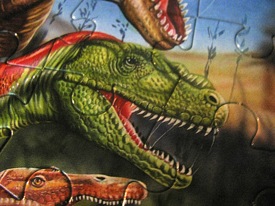
Dinsoaurs Died Within Hours After Asteroid Hit Earth

dinosSPACE DAILY– According to new research led by a University of Colorado at Boulder geophysicist, a giant asteroid that hit the coast of Mexico 65 million years ago probably incinerated all the large dinosaurs that were alive at the time in only a few hours, and only those organisms already sheltered in burrows or in water were left alive.

The six-mile-in-diameter asteroid is thought to have hit Chicxulub in the Yucatan, striking with the energy of 100 million megatons of TNT, said chief author and Researcher Doug Robertson of the department of geological sciences and the Cooperative Institute for Research in Environmental Sciences.

The “heat pulse” caused by re-entering ejected matter would have reached around the globe, igniting fires and burning up all terrestrial organisms not sheltered in burrows or in water, he said.

A paper on the subject was published by Robertson in the May-June issue of the Bulletin of the Geological Society of America. Co-authors include CU-Boulder Professor Owen Toon, University of Wyoming Professors Malcolm McKenna and Jason Lillegraven and California Academy of Sciences Researcher Sylvia Hope.

Continue reading about Dinosaurs Died Within Hours After Asteroid Hit Earth, Research Shows.

© Space Daily, 2004

Photo by flickr user edenpictures

Galaxy May Be Full of ‘Earths,’ Alien Life

galaxyCNN– As NASA prepares to hunt for Earth-like planets in our corner of the Milky Way galaxy, there’s new buzz that “Star Trek’s” vision of a universe full of life may not be that far-fetched.

Pointy-eared aliens traveling at light speed are staying firmly in science fiction, but scientists are offering fresh insights into the possible existence of inhabited worlds and intelligent civilizations in space.

There may be 100 billion Earth-like planets in the Milky Way, or one for every sun-type star in the galaxy, said Alan Boss, an astronomer with the Carnegie Institution and author of the new book “The Crowded Universe: The Search for Living Planets.”

He made the prediction based on the number of “super-Earths” — planets several times the mass of the Earth, but smaller than gas giants like Jupiter — discovered so far circling stars outside the solar system.

Boss said that if any of the billions of Earth-like worlds he believes exist in the Milky Way have liquid water, they are likely to be home to some type of life.

“Now that’s not saying that they’re all going to be crawling with intelligent human beings or even dinosaurs,” he said.

“But I would suspect that the great majority of them at least will have some sort of primitive life, like bacteria or some of the multicellular creatures that populated our Earth for the first 3 billion years of its existence.”

Continue reading about Galaxy May Be Full of ‘Earths,’ Alien Life

© Cable News Network, 2009

Photo by flickr user Patrick Hoesly

What Role Does DMT Play in a Psychedelic Renaissance?

SCIENTIFIC AMERICAN– You know that psychedelics are making a comeback when the New York Times says so on page 1. In “Hallucinogens Have Doctors Tuning In,” John Tierney reports on how doctors at schools like Harvard, Johns Hopkins, UCLA and NYU are testing the potential of psilocybin and other hallucinogens for treating depression, obsessive-compulsive disorder, post-traumatic stress disorder, alcoholism—and for inducing spiritual experiences. 

Tierney’s brisk overview neglects to mention the most mind-bending of all psychedelics: dimethyltryptamine, or DMT. It was first synthesized by a British chemist in the 1930s, and its psychotropic properties were discovered some 20 years later by the Hungarian-born chemist Stephen Szara, who later became a researcher for the National Institute on Drug Abuse.

Why is DMT so fascinating? For starters, DMT is the only psychedelic known to occur naturally in the human body. In 1972, the Nobel laureate Julius Axelrod of the National Institutes of Health discovered DMT in human brain tissue, leading to speculation that the compound plays a role in psychosis. Research into that possibility—and into psychedelics in general–was abandoned because of the growing backlash against these compounds.

Continue reading about What Role Does DMT Play in a Psychedelic Renaissance?

© Scientific American, 2010

Photo by flickr user Skye Horgan

Page 23 of 24<<...2021222324