NASA: Asteroids Might Have Brought Water to Earth

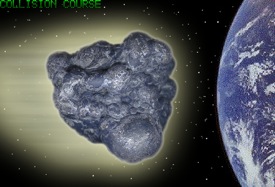
asteroidCOMPUTER WORLD– The discovery of water ice on the surface of an asteroid has NASA scientists conjecturing that asteroids and comets could have delivered enough water to a primordial Earth to fill its oceans.

A study of data compiled during six years of observing the asteroid 24 Themis through a NASA-funded telescope found evidence of water ice and carbon-based organic materials. The asteroid orbits the sun at a distance of 297 million miles, or between the planets of Jupiter and Mars.

The telescope, housed at NASA’s Infrared Telescope Facility on the summit of Mauna Kea in Hawaii, has constantly focused on 24 Themis asteroid.

“For a long time the thinking was that you couldn’t find a cup’s worth of water in the entire asteroid belt,” said Don Yeomans, manager of NASA’s Near-Earth Object Program Office, in a statement yesterday. “Today we know you not only could quench your thirst, but you just might be able to fill up every pool on Earth — and then some.”

According to NASA, this new research could help rewrite the book not just on the nature of asteroids but on how the solar system was formed as well.

Continue reading about NASA: Asteroids Might Have Brought Water to Earth.

© Computerworld, 2010 

Photo by flickr user andrewsrj
New Two Million Year Old Humanoid Species Found

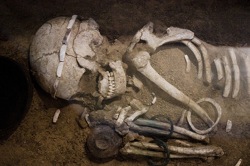
skeletonNEWS 24– Two partial skeletons unearthed in a South African cave belong to a previously unclassified species of pre-human dating back almost two million years and may shed new light on human evolution, scientists said on Thursday.

Fossils of the bones of a young male and an adult female suggest the newly documented species, called Australopithecus sediba, walked upright and shared many physical traits with the earliest known human Homo species.

The finding of the pre-human, or hominid, fossils – which scientists say are between 1.78 and 1.95 million years old – was published in the journal Science and may answer some key questions about where humans came from.

Lee Berger of the University of the Witwatersrand, Johannesburg, who led the team that found the fossils in August 2008, said the team were hoping to reveal a possible two further skeletons from the same site.

He was reluctant to define the new species as a “missing link” in human evolutionary history, but said it would “contribute enormously to our understanding of what was going on at that moment where the early members of the genus Homo emerged”.

Continue reading about New Two Million Year Old Humanoid Species Found.

© Reuters, 2010

Photo by flickr user vintagedept

Mediterranean Microfossils Offer Hope for Finding Life On Mars

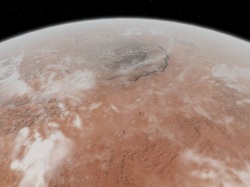
marsSCIENCE NEWS– Tiny fossils discovered on Earth in samples of sulfates, a class of minerals recently found to be common in some parts of Mars, bodes well for finding vestiges of life on the Red Planet, astrobiologists reported April 28 during a briefing held in conjunction with the Astrobiology Science Conference 2010 in League City, Texas.

Bill Schopf of the University of California, Los Angeles, and his colleagues discovered the fossils in deposits of gypsum, or calcium sulfate, that were deposited in the Mediterranean Sea 6 million years ago and then thrust up into the Alps.

The discovery, which included plankton and single-celled organisms such as cyanobacteria (pond scum), some filling areas tens of micrometers in diameter, was a surprise, he said. Schopf and other researchers had assumed that as sulfate crystals grow, they would crush and obliterate any microfossils that might have been trapped inside the minerals, “but that turned out not to be the case,” he said.

Continue reading about Mediterranean Microfossils Offer Hope for Finding Life On Mars.

© Science News, 2010

Photo by flickr user FlyingSinger

Life Discovered on Saturn’s Moon Titan

Jun 5, 2010

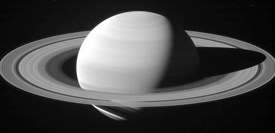
saturnTELEGRAPH– Evidence that life exists on Titan, one of Saturn’s biggest moons, appears to have been uncovered by Nasa scientists.

Researchers at the space agency believe they have discovered vital clues that appeared to indicate that primitive aliens could be living on the moon.

Data from Nasa’s Cassini probe has analysed the complex chemistry on the surface of Titan, which experts say is the only moon around the planet to have a dense atmosphere.

They suggest that life forms may have been breathing in the planet’s atmosphere and also feeding on its surface’s fuel.

Astronomers claim the moon is generally too cold to support even liquid water on its surface. The research has been detailed in two separate studies.

The first paper, in the journal Icarus, shows that hydrogen gas flowing throughout the planet’s atmosphere disappeared at the surface. This suggested that alien forms could in fact breathe.

The second paper, in the Journal of Geophysical Research, concluded that there was lack of the chemical on the surface.

Scientists were then led to believe it had been possibly consumed by life.

Continue reading about Life Discovered on Saturn’s Moon Titan.

© Telegraph, 2010

Photo by flickr user kokogiak

Zeitgeist: Addendum – Documentary

Zeitgeist: Addendum, sequel to Zeitgeist: The Movie, was created as a Not-for-Profit expressions to communicate what the author felt were highly important social understandings which most humans are generally not aware of. The movie attempts to locate the root causes of this pervasive social corruption, while offering a solution.

This solution is not based on politics, morality, laws, or any other “establishment” notions of human affairs, but rather on a modern, non-superstitious based understanding of what we are and how we align with nature, to which we are a part. The work advocates a new social system which is updated to present day knowledge, highly influenced by the life long work of Jacque Fresco and The Venus Project.

http://www.zeitgeistmovie.com/

http://thezeitgeistmovement.com/


Cover photo by flickr user Zeitgeist Granada

Page 20 of 24<<...1819202122...>>