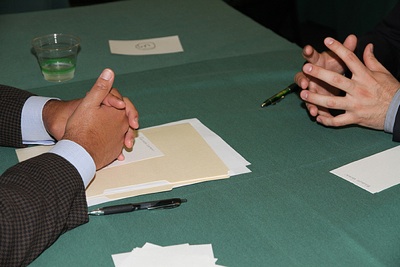
Glenn Greenwald vs. Bush Drug Czar

SALONGlenn Greenwald:  Last Thursday at Brown University, I debated former Bush drug czar John Walters on the virtues of drug legalization, and the video is below. The aspect of With Liberty and Justice for Some that has received the most attention is the shield of immunity for elite lawbreaking, but the other side of that rule-of-law evisceration — the incomparably harsh and sprawling penal state America has created for its ordinary citizens — is at least as important, and it is the Drug War that personifies the worst abuses of that punishment system and accounts for much of it.

Read more about Debating Bush’s drug czar on legalization.

***

Glenn Greenwald vs. John Waters on Drug Legalization


Posted in Uncategorized | 1 Reply

Employers Less Likely to Interview Openly Gay Men

MEDIA ROOTS- Several research studies have studied job discrimination by sending out resumes with different identifying features and tracking the response rates. For instance, one study conducted by researchers at MIT and University of Chicago sent out thousands of resumes that were identical except for the name of the applicant: in one version, the applicants name was stereotypically “Black” (e.g., Rasheed, Aisha) and another version had stereotypically “White” names (e.g., Greg, Emily). Even though the resumes were identical in terms of qualifications, those researchers found that the “White” resumes had a 30 percent greater chance of getting responses than the “Black” resumes.

A new study published this week in the American Journal of Sociology has used this method to test whether gay men face similar job discrimination. Identical resumes were sent out, with a key difference being membership in a college club: either the applicant reported membership in an LGBT organization, or a socialist organization. The results were striking: “gay” resumes were significantly less likely to lead to interview requests than “socialist” resumes. The socialist group was used as the comparison to rule out the possibility that any discrimination was due to an “anti-liberal” bias, and this makes the results even more striking: being openly gay is more of a liability on the job market than being openly socialist.

Perhaps even more concerning is that a huge scientific literature now shows that these types of discrimination are not necessarily due to overt, conscious prejudice – these differences tend to emerge from subtle, unconscious preferences that guide our judgments and decision making even when we’re not aware of it.

Steven Frenda for MR

***

EUREKALERT– A new study suggests that openly gay men face substantial job discrimination in certain parts of the U.S. The study, which is the largest of its kind to look at job discrimination against gay men, found that employers in the South and Midwest were much less likely to offer an interview if an applicant’s resume indicates that he is openly gay. Overall, the study found that gay applicants were 40 percent less likely to be granted an interview than their heterosexual counterparts.

“The results indicate that gay men encounter significant barriers in the hiring process because, at the initial point of contact, employers more readily disqualify openly gay applicants than equally qualified heterosexual applicants,” writes the study’s author, András Tilcsik of Harvard University.

For the study, Tilcsik sent two fictitious but realistic resumes to more than 1,700 entry-level, white collar job openings — positions such as managers, business and financial analysts, sales representatives, customer service representatives, and administrative assistants. The two resumes were very similar in terms of the applicant’s qualifications, but one resume for each opening mentioned that the applicant had been part of a gay organization in college.

“I chose an experience in a gay community organization that could not be easily dismissed as irrelevant to a job application,” Tilcsik writes. “Thus, instead of being just a member of a gay or lesbian campus organization, the applicant served as the elected treasurer for several semesters, managing the organization’s financial operations.”

The second resume Tilcsik sent listed experience in the “Progressive and Socialist Alliance” in place of the gay organization. Since employers are likely to associate both groups with left-leaning political views, Tilcsik could separate any “gay penalty” from the effects of political discrimination.

The results showed that applicants without the gay signal had an 11.5 percent chance of being called for an interview. However, gay applicants had only a 7.2 percent chance. That difference amounts to a 40 percent higher chance of the heterosexual applicant getting a call.

The callback gap varied widely according to the location of the job, Tilcsik found. In fact, most of the overall gap detected in the study was driven by the Southern and Midwestern states in the sample — Texas, Florida, and Ohio. The Western and Northeastern states in the sample (California, Nevada, Pennsylvania, and New York) had only small and statistically insignificant callback gaps.

“This doesn’t necessarily mean that there is no discrimination in those states, just that the callback gaps were small in the case of the jobs to which I sent applications,” Tilcsik explained. “I think it’s very plausible that, even in those states, there might be a large callback gap in some other jobs, industries, or counties. What this does show is that discrimination in white-collar employment is substantially stronger for the Southern and Midwestern states in the sample.”

The research also found that employers seeking stereotypically heterosexual male traits were more likely to discriminate gay men. Gay applicants had lower callback rates when the employer described the ideal candidate for the job as “assertive,” “aggressive,” or “decisive.

“It seems, therefore, that the discrimination documented in this study is partly rooted in specific stereotypes and cannot be completely reduced to a general antipathy against gay employees,” Tilcsik writes.

The technique Tilcsik used, known as audit study, has been used in the past to expose hiring prejudice based on race and on sex. This is the first major audit study to test the receptiveness of employers to gay male job applicants.

Understanding the ways in which these biases might operate at the interview stage of the employment process, or how they might apply to lesbian job seekers in the U.S., requires additional research, Tilcsik says.

###

András Tilcsik, “Pride and Prejudice: Employment Discrimination against Openly Gay Men in the United States.” American Journal of Sociology 117:2 (September 2011).

Established in 1895 as the first U.S. scholarly journal in its field, the American Journal of Sociology remains a leading voice for analysis and research in the social sciences.

Photo by Flickr user bpsusf

Space Junk At Tipping Point, Says Report

MEDIA ROOTS- This is a disturbing story that exemplifies the throw-away mentality propagated by so many institutions on the planet. It’s something that isn’t thought about often, but the garbage being produced by humans on the planet is also affecting space.

Aside from the fact that there are two swirling trash islands in both the Atlantic and Pacific Ocean, there is now a ring of trash consisting mostly of minute fragments and debris from exploded satellites surrounding the planet that is so dense, experts are saying it is already a detriment to space exploration. Unfortunately, because of the shortsightedness of many, there is no clear plan on how this debris will be cleared or prevented from causing fatal destruction in future space ventures.

Abby

***

BBC– A report by the National Research Council says the debris could cause fatal leaks in spaceships or destroy valuable satellites.

It calls for international regulations to limit the junk and more research into the possible use of launching large magnetic nets or giant umbrellas.

The debris includes clouds of minuscule fragments, old boosters and satellites.

Some computer models show the amount of orbital rubbish “has reached a tipping point, with enough currently in orbit to continually collide and create even more debris, raising the risk of spacecraft failures,” the research council said in a statement on Thursday.

Situation ‘critical’

Hopes of limiting the amount of space junk in orbit suffered two major setbacks in recent years.

In 2007, China conducted an anti-satellite weapon test which destroyed a decommissioned weather satellite, smashing the object into 150,000 pieces larger than 1cm.

Two years later, two satellites – one defunct and one active – crashed in orbit, creating even more debris.

“Those two single events doubled the amount of fragments in Earth orbit and completely wiped out what we had done in the last 25 years,” said Donald Kessler, who led the research.

The International Space Station must occasionally dodge some of the junk, which flies around the Earth at speeds of up to 17,500 mph (28,164 km/h).

In June, some debris narrowly missed the space station, forcing its six crew to go to their escape capsules and prepare for an emergency evacuation back to Earth.

The situation is critical, said Mr Kessler, a retired Nasa scientist, because colliding debris creates even more of the junk.

“We’ve lost control of the environment,” he said.

A report by the National Research Council says the debris could cause fatal leaks in spaceships or destroy valuable satellites.
It calls for international regulations to limit the junk and more research into the possible use of launching large magnetic nets or giant umbrellas.
The debris includes clouds of minuscule fragments, old boosters and satellites.
Some computer models show the amount of orbital rubbish “has reached a tipping point, with enough currently in orbit to continually collide and create even more debris, raising the risk of spacecraft failures,” the research council said in a statement on Thursday.
Situation ‘critical’
Hopes of limiting the amount of space junk in orbit suffered two major setbacks in recent years.
In 2007, China conducted an anti-satellite weapon test which destroyed a decommissioned weather satellite, smashing the object into 150,000 pieces larger than 1cm.
Two years later, two satellites – one defunct and one active – crashed in orbit, creating even more debris.
“Those two single events doubled the amount of fragments in Earth orbit and completely wiped out what we had done in the last 25 years,” said Donald Kessler, who led the research.
The International Space Station must occasionally dodge some of the junk, which flies around the Earth at speeds of up to 17,500 mph (28,164 km/h).
In June, some debris narrowly missed the space station, forcing its six crew to go to their escape capsules and prepare for an emergency evacuation back to Earth.
The situation is critical, said Mr Kessler, a retired Nasa scientist, because colliding debris creates even more of the junk.
“We’ve lost control of the environment,” he said.
The report makes no recommendations about how to clean up the field of debris.
But it refers to an earlier study for the Pentagon’s science think-tank, the Defence Advanced Research Projects Agency (Darpa).

Read more about Space Junk At Tipping Point, Says Report

© 2011 British Brodcasting Company

Photo by Flickr user inter-

Posted in Uncategorized | 1 Reply

Film: Fault Lines – The Top 1%

AL JAZEERA– The richest one per cent of Americans earn nearly a quarter of the country’s income and control an astonishing 40 per cent of its wealth.

Inequality in the US is more extreme than it has been in almost a century – and the gap between the super-rich and the poor and middle class people has widened drastically over the last 30 years.

Meanwhile, in Washington, a bitter partisan debate over how to cut deficit spending and reduce the US’ $14.3 trillion debt is underway. As low and middle class wages stagnate and unemployment remains above nine per cent, Republicans and Democrats are tussling over whether to slash funding for the medical and retirement programmes that are the backbone of the US’ social safety net, and whether to raise taxes – or to cut them further.

The budget debate and the economy are the battleground on which the 2012 presidential election race will be fought. And the US has never seemed so divided – both politically and economically.

How did the gap grow so wide, and so quickly? And how are the convictions, campaign contributions and charitable donations of the top one per cent impacting the other 99 per cent of Americans? Fault Lines investigates the gap between the rich and the rest.

Al Jazeera’s Fault Lines

Photo by flickr user J_D_R


Cell Phone Radiation Listed as Cancer Risk

RAW STORY– A new report from the World Health Organization (WHO) classifies cell phones as a possible carcinogen in the same category as lead, engine exhaust and chloroform.

A team of 31 scientists from 14 countries in the International Agency for Research on Cancer, the cancer arm of the World Health Organization, made the determination that cell phone exposure was “possibly carcinogenic to humans.” The team, which included scientists from the U.S., reached their conclusion after reviewing dozens of studies.

“The biggest problem we have is that we know most environmental factors take several decades of exposure before we really see the consequences,” Dr. Keith Black, chairman of neurology at Cedars-Sinai Medical Center in Los Angeles, told CNN.

“What microwave radiation does in most simplistic terms is similar to what happens to food in microwaves, essentially cooking the brain. So in addition to leading to a development of cancer and tumors, there could be a whole host of other effects like cognitive memory function, since the memory temporal lobes are where we hold our cell phones,” he added.

Read the full article about Cell Phone Radiation Officially Listed a Potential Cancer Risk.

© 2011 RAW STORY

Photo by Flickr user jonjon_2k8