MR Original – Sexual Assault Scandal in the US Air Force

MEDIA ROOTS – One in five women in the U.S. Armed Forces is sexually assaulted, but most do not report these despicable acts.  Two weeks ago, U.S. Air Force General Edward Rice held a press conference regarding allegations of sexual assault at Lackland Air Force Base, where all Air Force enlisted trainees undergo Basic Military Training (BMT).  After listening to General Rice adroitly muffle concern and dodge responsibility, it is important to clarify precisely how he fails to understanding the trainee mindset, refuses to investigate sexual assault comprehensively, and likely will not hold himself accountable.

General Rice, Commander of Air Education and Training Command (AETC), fails to understand the mindset of enlisted trainees.  When in BMT, one’s overarching priority is to complete training on schedule and with all due haste.  Most often, this requires maintaining a low profile, “blending in,” or avoiding the training instructors’ ire.  Trainees fear any circumstance leading to being “recycled” or “washed back,” which could add weeks to a trainee’s BMT experience.  This fear is one reason why trainees do not speak up.  As disturbing as it sounds, trainees weigh the costs and benefits: speaking up, seeking administrative attention, enduring even more time in BMT, and starting an Air Force career with clerical paperwork vs. bottling up, suppressing sexual incident(s), and perhaps seeking redress later on.  Addressing this reality may involve affording victims all psychological and physical help while simultaneously allowing them to progress in training at their own pace and comfort.

General Rice also needs to focus on another distressing aspect of the trainee mindset, the nuances of which a former Marine drill instructor explains:

“You cannot do anything without requesting permission from your drill instructor…  You are literally in many cases a robot waiting for permission to take a step.  And if you have that relationship which is based on fear and intimidation… if that’s the person you’re asking help from, it becomes a very bizarre scenario…  You are subject to every single order that comes out of that instructor’s mouth.”

While Marine and Air Force basic training environments differ in many respects, the underlying point is clear:  it is incredibly difficult to seek help as a trainee after a sexual assault, due in part to the very nature of the trainee-instructor relationship.  This relationship is vital for training purposes, but impedes justice and administrative recourse in certain circumstances.  General Rice believes an existing system of “comment sheets” and anonymous “comment boxes” provides each Air Force trainee with the outlet they need.  Unfortunately, fear of an extended duration in BMT often stifles trainee recourse to comment sheets.  Rice must examine how to alleviate such a destructive mentality without compromising the caliber of existing Air Force training.

Additionally, General Rice and his fellow senior officers fail to investigate sexual assault across AETC.  Observe Rice’s equivocation:

“I indicated we had 12 instructors that are under investigation…  Nine of those 12 were in one [squadron].  We have a total of nine squadrons, and nine of them came from one squadron.  So in my assessment to this point, it is not an issue of an endemic problem throughout basic military training.  It is more localized, and we are doing a very intensive investigation on that squadron to find out what exactly happened and why.”

General Rice, whose academic credentials boast multiple graduate degrees, could surely fathom a reality in which numerous victims of sexual assault exist across AETC and the operational Air Force.  For Rice, it’s far easier to blame a localized problem at the squadron level than engage in institutional introspection or examine the culture over which he reigns.

If recent history is any indication, General Rice and senior Air Force officers will not be held accountable.  After the Abu Ghraib torture scandal, a dozen lower-enlisted service members were punished but only one general was reprimanded.  After repeated Afghan civilian deaths under General Petraeus’ command, no U.S. general was disciplined.  These are dismal precedents.

In 2008, Defense Secretary Robert Gates fired the two most senior Air Force leaders for mismanagement of nuclear weapons.  Although their indiscretions led to no casualties, Gates recognized the imperative of holding senior Air Force officials accountable.  The standing lesson is clear: senior officials who endanger lives with nuclear weapons get fired, while those who oversee a ruinous culture of endemic sexual abuse survive without a scratch.  To right this wrong, Defense Secretary Leon Panetta must ask for General Rice’s resignation along with all relevant officers in the AETC chain of command.  All forms of punishment are available when reprimanding the abusers, their immediate superiors, and their entire chain of command, including reduction in rank, forfeiture of pay, confinement, and imprisonment.

General Rice has failed in his duty by misunderstanding the trainee mindset, avoiding a comprehensive investigation of sexual misconduct, and evading punishment.  Although administrative accountability doesn’t ease the pain of victimhood, it sends a firm message to every soldier, sailor, airman, and Marine: sexual assault will not be tolerated in the U.S. military, and every link in the chain of command is responsible for enforcing this.  The tragedy of sexual assault is deafening; a catastrophe which numerous military members endure through no fault of their own.  This is a defining time for Pentagon leadership to prove its mettle.

Written by Christian Sorensen for Media Roots. Christian went through BMT at Lackland’s 331 Training Squadron.

***

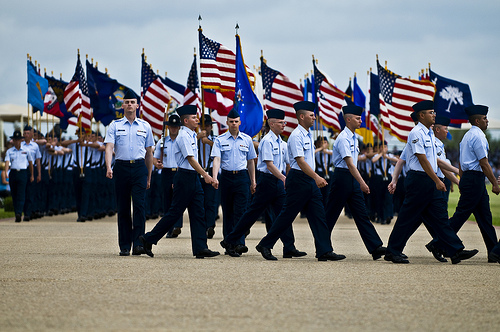
Photograph provided by Flickr user JSMoorman.

MR Original – Translating Subtle Zionism

IsraelFlagFlickrRonAlmogMEDIA ROOTS Suzanne Maloney is a mainstay within élite U.S. foreign policy circles.  A former employee of ExxonMobil and the U.S. State Department, Maloney now works for the Brookings Institution’s Saban Center for Middle East Policy.  She recently presented testimony to the United States Congress entitled Progress of the Obama Administration’s Policy toward Iran.  The Saban Center later provided an Arabic translation of her testimony on their website.  Maloney’s testimony and its Arabic translation afford valuable insight into the ideology, which directs U.S. foreign policy in the Middle East.

Ideology and the Saban Center 

Haim Saban, who holds dual citizenship between the USA and Israel, founded the Saban Center in 2002 with a multi-million dollar donation.  By his own admission, Saban boasts, “I’m a one-issue guy, and my issue is Israel.”  Saban, who has a personal net worth of roughly $3 billion, was also the second biggest private donor to U.S. Presidential and Congressional candidates.  He describes his formula for influencing U.S. politics thusly:  “make donations to political parties, establish think tanks, and control media outlets.”  According to The New Yorker, “he is most proud of his role as political power broker.  His greatest concern,” he says, “is to protect Israel by strengthening the United States-Israel relationship.”  In line with Saban’s words, the Saban Center attracts those who adhere to a rigid brand of Zionist ideology.  

Ideology is a constellation of ideas, which form the basis of a group’s political theory and actions.  Zionism is a political ideology, which supported the establishment of an occupying Jewish state in the historical land of Palestine.  Today, Zionism is dedicated to furthering Israel’s nationalist aspirations.  The most widespread form of Zionism in the U.S. foreign policy arena is Revisionist Zionism, which romanticizes Jewish nationalism, emphasizes a perceived necessity of military force against any Arab or Persian ‘threat,’ and condones Israel’s territorial expansion and aggression.  Adhering to this Zionist ideology, the Saban Center has employed Visiting Fellows whose ranks include numerous former IDF employees, the former head of Shin Bet, and a sprinkling of Arab nationals who turned their backs on the Palestinians and sought the prestige inanely associated with D.C. think tanks.  In this context, the Saban Center doesn’t just publish texts periodically, but rather is a constituent to extensive dynamics, which prescribe Revisionist Zionist policy and advance it throughout the U.S. foreign policy lobbying apparatus.

Maloney’s testimony highlights the fact that, although the majority of U.S. think tanks are diffused across the Democrat-Republican two-party system, even the most respected think tank doesn’t deviate from the Revisionist Zionist narrative with respect to U.S. foreign policy towards the Middle East.  Maloney testified in the autumn of 2011 during a time when Israeli Prime Minister Benjamin Netanyahu was mobilizing the American Israel Public Affairs Committee (AIPAC) and its propaganda apparatuses in Washington, D.C. to inflate the Iranian ‘threat.’  Netanyahu is no fool.  He targets Iran, which is Israel’s lone regional rival, because Iran supports groups, which resist Israeli aggression.  Maloney testifies within that context.  She critiques President Obama on behalf of the Saban Center, as part of the political ebb and flow, which ensures all Washington actors adhere to the precepts of Revisionist Zionism.

Numerous U.S. think tanks perpetuate Revisionist Zionist ideology with even greater aggression than others.  The Washington Institute for Near East Policy, the Center for Security Policy, the Heritage Foundation, and the American Enterprise Institute are the most prominent.  However, it is crucial to focus on the Saban Center for Middle East Policy precisely because it is not often considered a Zionist enterprise, unlike these other think tanks.  This low visibility allows the Saban Center to propagate a subtler, smoother mode of Revisionist Zionism throughout the U.S. foreign policy lobbying apparatus.  With deliberate concealment, the Saban Center professes to provide “Washington policymakers with balanced, objective, in-depth and timely research and policy analysis from experienced and knowledgeable scholars,” while claiming that its “central objective is to advance understanding of developments in the Middle East through policy-relevant scholarship and debate.”  This prevarication is even more dangerous when one considers its influential status as the 2011 “Top Think Tank in the World.”

The Saban Center’s subtle use of Revisionist Zionism is exemplified in the salient fact Maloney’s testimony doesn’t reference Israel once.  This intentional silence speaks volumes.  Omissions of Israel, its regional hegemony, or the USA’s history of interference in Iran’s internal affairs, are all part of a deliberate effort to de-historicize Iran and flush away any useful socioeconomic perspective.  Other relevant facts—Israel possesses nuclear weapons and didn’t sign the Nuclear Non-proliferation Treaty (NPT), while Iran has no nuclear weapons and has signed the NPT—are simply not allowed to penetrate the prevailing narrative.

Mark Dubowitz and Dr. Kenneth Pollack accompanied Maloney in testifying to Congress.  Mark Dubowitz is Executive Director of the Foundation for the Defense of Democracies.  That think tank describes itself as a “non-partisan policy institute” dedicated to “defending free nations against their enemies,” specifically against the “threat facing America, Israel, and the West.”  Kenneth Pollack is Director of the Saban Center for Middle East Policy.  In 2006, the U.S. Department of Justice alleged Pollack aided two AIPAC employees while they were under investigation on allegations of spying for the state of Israel.  After immense political pressure, all charges were eventually dropped.  These three, the only panel members to testify before that Congressional Subcommittee, were selected deliberately to provide policymakers with the narrowest possible viewpoints of the Iranian ‘threat‘ through the lens of Revisionist Zionism.

Ideology via Translation

Revisionist Zionism is present within Maloney’s original English language testimony and also underpins the Saban Center’s translation of this document into the Arabic.  (The Saban Center does not credit any individual(s) for translating Maloney’s text into Arabic).  Aside from examples to be discussed momentarily, the Arabic translation is outstanding and remains completely loyal to Maloney’s English text.  This faithful, direct translation is itself a strategy, stemming from the deliberate collocation of an ideology with persuasive, incisive writing (Lefevere: 51).  

When reading the Arabic translation in comparison to the English text, it is evident that the Saban Center’s translator spent a great deal of time selecting the appropriate words to convey Maloney’s challenging, academic vocabulary.  Therefore, one can reasonably conclude that any deviation from Maloney’s source text is entirely deliberate and may have ideological motives. As the Persian language, Farsi, is the national Iranian language, any changes, which took place during translation from the English into the Arabic, imply a sense U.S. power is omnipotent and unavoidable.  These changes can foment dissent among Arab populations who read that text, and provide an Iranian minority, which is literate in the Arabic, with a sense of ascending capability to confront the Iranian theocracy.

Although the Arabic languge translation of Maloney’s testimony is a direct, accurate, and faithful translation, the instances where the translator deviates from said fidelity are fantastic discussion points. These deviations are also valuable precisely because they’re rare and offer tremendous insight into the nature of Revisionist Zionism and the broader aims of Maloney’s text. For example, Maloney’s English testimony stated, “Iran has experienced very little of the upheaval that has beset its neighbors over the course of the past year.”  However, the translator opted for a stronger word in Arabic, which means “to storm through, to blow through, or to shake thoroughly.”  The Arabic translation reads:  “Iran had witnessed very little of the protests that stormed through its neighboring countries over the past year.”  Later on, the English language testimony states Iran’s “neighborhood has been engulfed in historic change,” while the translation expresses how “the historic change stormed through/blew through Iran’s neighboring countries.”  The Saban Center translated these passages in this manner in order to address the Arab audience, and emphasize Middle Easterners’ agency and ability to affect change in their region.  Perhaps the translator is also targeting the slice of Iranian Persians who can read Arabic or the many Arabs who fled to Iran after USA’s 2003 invasion of Iraq.  The translator deliberately selects words, which emphasize how populations in the Greater Middle East can positively affect their environments; the audience can engage in protests, which storm through regions, not passive, nameless upheaval, which besets regions.

The Saban Center often interfered with the Arabic language text during translation.  In multiple instances, the translator selected two different Arabic words to translate the English language word for “liabilities.”  The first context speaks of “the regime’s internal political liabilities,” which I would have translated as “political responsibilities.”  The second context broaches how “the regional environment has also created new liabilities for Tehran,” which I would have translated as “obligations.”  By telling the Arabic audience responsibilities are actually liabilities and obligations, the Saban Center advises the populace has a right to be upset if any regime reneges on its obligations.  This can be extrapolated to other regional, oppressive regimes.  This is a deliberate, indirect message to the Middle East, fitting perfectly with an Israeli propaganda apparatus, which prides itself on sewing strife within Arab and Persian lands.

Maloney’s testimony affirms “sanctions and export controls have played a subtle but significant role in slowing Iran’s capability to acquire” nuclear technology.  The Saban Center deliberately didn’t translate the word “subtle” into the Arabic, despite the fact that the Arabic language contains multiple words with which to convey subtlety well.  The Saban translator instead selects a word, which means “covert” or “hidden.”  This Arabic word meshes well with the U.S.-Israeli clandestine subversion of Iran’s sovereignty.  A covert program, supported by two hegemonic powers, is unlikely to be stopped; it can’t even be pinpointed.  Those who read the Arabic translation of Maloney’s testimony may retain a feeling of inevitability the hegemons will prevent Iran from obtaining nuclear technology and the reader must go along with such a foregone conclusion.

Maloney contends “Iran’s dogmatic theocrats perceive the Arab uprisings in triumphal terms.”  The Saban Center translates this into the Arabic as:  “Iran’s dogmatic zealots perceive the Arab uprisings in triumphal terms.”  There is no mention of a theocracy.  In theocracy’s stead, the Saban Center refers to dogmatic “zealots” or “hardliners.”  Zealotry, synonymous with fanaticism and intolerance of opposing views, is an amplification of mere theocracy.  Theocracy, by definition and Iranian tradition, is a system of government in which clerics lead the nation.  In practice, the Saban Center actualizes a cognitive distinction in the reader of its Arabic language text.  The Arabic reader, having no knowledge of the tamer wording in Maloney’s original testimony, understands the Iranian rulers as fanatics, not mere theocrats.

The Saban Center’s mutation of theocrat into zealot also confines the Persian Other within Western stereotypes.  “By employing certain modes of representing the other… translation reinforces hegemonic versions of the [neo]-colonized” (Niranjana: 3) and emphasizes damaging stereotypes.  The readers are fully cognizant of this distortion of identity, but are helpless to alter the source of these representations, located distally in Washington, D.C., where these images serve as a mobilizing force.

Early in her testimony, Maloney asserts the Iranian regime’s durability is “the product of a resourceful campaign” to hamper popular uprisings.  Notably, the Arabic translation of Maloney’s testimony indicates the regime’s durability results from a “sly” or “insidious” campaign to suppress dissent.  By portraying the Persian with great negativity, the reader of Maloney’s translated testimony is imbibed with a sense of antipathy towards the Other.  Perhaps this revulsion will contribute to existing Persian-Arab tensions around the Persian Gulf, or perhaps this revulsion will be internalized within the Arab or Iranian readership.  No matter its effect, portraying the Persian with great negativity benefits practitioners of Revisionist Zionism.

Near the end of her English language testimony, Maloney remarks “the impediments to American sanctions represent tactical challenges,” which the Saban Center translated as representing “large” or “considerable” challenges.  The Saban Center’s omission was deliberate, since the word “tactical” exists in Arabic and is used frequently.  Tactical challenges are related to military manoeuvres in support of immediate martial gain and are designed to contribute to strategic objectives.  By omitting any mention of the tactical nature of the challenges posed by U.S. sanctions, the Saban Center avoids military correlations and any concept Iran might possibly achieve military advantage.  Furthermore, by translating the utterance “tactical” into the adjective “large,” the Saban Center places an amorphic, conceptual obstacle of indeterminate volume in Iran’s path.  Once again, the Saban Center employs slight translation techniques to dramatically affect the Arabic reader’s perception.  The message to the Middle East is clear: Revisionist Zionism, and those who support it, whether willingly or otherwise, will win.

In addition to manipulating individual words, the Saban Center adds Arabic words during translation.  Maloney’s testimony asserts “disturbing new allegations [surround] Iran’s efforts to acquire nuclear weapons technology and its involvement with terrorism.”  The Saban Center’s Arabic translation deliberately adds to Maloney’s initial assertion through contending allegations exist about “Iran’s efforts to acquire nuclear weapons technology and its involvement in acts of terrorism.”  The insinuation is profound to the Arabic reader.  In diplomatic terms, general involvement with terrorism pales in comparison to direct complicity in acts of terrorism.  The Saban Center’s ideological additions frame Iran as an exporter of global terrorism and implicate it in finite acts of the worst kind, a contention Maloney’s counterparts at the Subcommittee hearing were eager to emphasize.

A similar narrative arises in Maloney’s testimony when she remarks “the resistance and persistence of the Islamic Republic presents a greater concern within the region than at any time in the past two decades.”  The Saban Center translates this seemingly bland introduction as: “the Islamic Republic’s resistance and persistence is a source of great worry within the region, more so than at any point in the past two decades.”  This addition incriminates Iran as the paramount source, insinuating boldly all fear will evaporate once Iran is dealt with. Interference through addition is a clever, measured action, calculated specifically to frame the Iranian regime in a negative light.

As expected, there are many instances where English language utterances do not exist in Arabic.  These cases provide the Saban Center translator with free range to convey the precise meaning of the English word by using whatever Arabic words the translator sees fit.  When discussing USA’s position relative to Iran, Maloney asserts “the threat of new measures has persuaded Tehran to take a number of steps over the years to mitigate its vulnerability to external economic leverage.”  That statement alone, like much of Maloney’s testimony, is loaded with ideological prejudices.  Despite all, the Saban Center chose to insert greater ideological force in the Arabic translation.  Since a single, complete, apropos utterance for “leverage” doesn’t exist in Arabic, the Saban Center could have conveyed its essence through multiple words or various other translation techniques.  Instead, it selects one word, whose meaning conveys influence, effectiveness, and even prestige.  None of these descriptions satisfy leverage’s definition, which conveys an exertion of force designed to achieve a particular outcome.  By deliberately avoiding explaining this in the Arabic, the Saban Center instead drops any connotation the U.S. achieves its goals through the application of force and implies the U.S. is enigmatically influential.  In sum, the Saban Center doesn’t attempt to explain the concept of “leverage” in Arabic, because that doesn’t suit its ideological goals; implications of the inexplicable influence of non-native entities aligns well with the ideology of Revisionist Zionism.

The heart of Zionism explains why the Saban Center would omit words during translation.  Zionism, by definition, is based on exclusion, both territorially and conceptually.  It emphasizes a state-building process, which rejects Palestinians, prioritizes land allotment for a chosen people, and deliberately propagates ethnic division (Gordon: 821).  By its very nature, Zionism demands the expulsion of aspects, which might disrupt its traditionally cohesive character (Ibid: 811).  Hence, ideology tends to trump linguistic considerations during the translation process (Lefevere: 39).

Caution is mandatory because some translators might not be conscious of how the Saban Center’s ideology affects their work.  Hence, deliberate intent might not be applicable to all instances where the Saban Center distorts Maloney’s text during translation into the Arabic.  Concordantly, critics of the Saban Center’s perpetuation of Revisionist Zionism must accept not all ideological acts are premeditated.  Nonetheless, dissecting Dr. Suzanne Maloney’s testimony and its Arabic translation illuminates how a subtle U.S. think tank adheres to a strict Zionist narrative when prescribing policy about the Greater Middle East.  This analysis is a small step towards understanding how the ideological undercurrents of a refined think tank intersect with the U.S. geopolitical process.

Written by Christian Sorensen for Media Roots

***

Photo by Flickr user Ron Almog

Additional labour by Messina

MR Original – A Community of Cowards


ArmySunsetflickrUSArmyMEDIA ROOTS — Five years ago, Lieutenant Colonel Paul Yingling courageously asserted USA’s military generals were failing in their duty to provide policymakers with candid appraisals of war.  Unfortunately, generalship has only deteriorated since then.  Today, Pentagon leaders lie directly through euphemism, omission, and talk of progress.

Euphemism

Generals euphemize in order to shape public discourse in their favor and to mislead their listeners.  By employing euphemisms precisely, Pentagon officials corral listeners’ thought processes into the confines of a perspective, which portrays the generals as benevolent protectors.  For example, USA’s generals conduct military operations, while the opposing force conducts ambushes and acts of war.  Any locals, which resist the generals’ plans are deemed insurgents and militants, while those who resist, the generals’ enemies, are termed rebels.  Perceive the distinction.  The terms, insurgents and militants invoke imagery of unjustified revolt against a benign authority, while rebels stand up for justice despite overwhelming odds.  Meanwhile, the Pentagon refers to random citizens who are swept up in the obscenity of night raids (a.k.a. village stability operations) as insurgent facilitators.  These citizens are then placed in administrative detention, instead of solitary confinement.  Administrative detention recalls a process of paperwork, regulated justice, and accountability.  When USA’s generals employ this phrase, they deliberately place the listeners’ thought processes within the compassionate confines of supervision and order, while actively obviating any potential questions of human rights or public liability.

Nomenclature cushions the listeners’ ears.  When taken off the streets, the enemy experiences extraordinary rendition instead of a kidnapping.  Generals ordain mercenaries and kidnappers as military contractors and glorified agents, respectively.  Once in custody, an insurgent might experience an isolated case of abuse or sanctioned enhanced interrogation, certainly not torture.  Meanwhile USA’s generals implement a policy of targeted killings, otherwise known as terrorist atrocities when the brown-skinned Arab implements the same policy (Chomsky: 24).  When civilian casualties inevitably occur, generals euphemize their deaths as collateral damage, a term which is not recognized anywhere in humanitarian international law (Johnson: 25). 

To imply a kinder, transient military presence, the Pentagon traditionally employs euphemisms of outpost, facility, or station when referring to overseas military bases.  After ramping up the so-called War on Terror, generals conjured up new euphemisms like forward operating location, defense staging post, and contingency operating site, while clinging to classics like camp, which invoke imagery of an ephemeral hiker.  Generals describe any setbacks as operational pauses or indications of a desperate enemy.  Generals term regulating documents like status of forces agreements as visiting forces agreements, again implying that the generals’ troops are merely spending the night in your resource-rich land, which the generals refer to as a theater instead of a warzone.  When the Pentagon overstays its welcome, it leaves behind a residual training force instead of a continuing military occupation

When generals are unable to negotiate judicial immunity for their troops, they redeploy and re-posture them, instead of withdrawing.  Even the Pentagon’s weaponry is named with compassion, as the LGM-118 missile is known as the Peacekeeper!  When reforming military healthcare and retirement packages, all while claiming to care for their people, generals embrace terminology like flexibility vice cost-cutting and reforming vice gutting.  When defusing concern over costly projects like the F-22 Raptor, Pentagon officials use the term additional contract requirement instead of honestly discussing the waste associated with overpriced, underperforming weapons platforms.  And the Wheel of Euphemisms goes ‘round.  Mendacity through euphemism is a sly way to manipulate public opinion and deceive policymakers, and is one way that USA’s generals fail to perform their duties.

Omission

When not lying through euphemism, generals simply omit truths about civilian casualties, women’s rights, and war funding.  General Stanley McChrystal (ret.), who in uniform was once incapable of distinguishing between the Taliban and Al-Qaeda, omitted discussion of USA’s role in creating civilian casualties from Senate testimony.  Although he once privately admitted the harm of civilian casualties, McChrystal insisted publicly that the Pentagon’s strategy was working.  Even after being dismissed for insubordination, McChrystal maintained ties to the Pentagon and continued to omit truths.  Nine months after getting fired, McChrystal proposed that in order to defeat a fluid network like the Taliban, USA’s forces should become a flexible network themselves. (This concept was later repeated by General Martin Dempsey).  While finding room for corporate lingo like “robust communications connectivity” and “shared purpose,” McChrystal omitted any mention of civilian casualties from his “win” formula.  For the record, the United Nations estimates over 10,000 civilian fatalities in Afghanistan from 2006 through 2011.  The truth, which generals like McChrystal omit, is that USA “lost” in Afghanistan a long time ago, due in large part to civilian casualties.  Today, approaching two years removed from military service, McChrystal still insists that the Afghan population wants USA’s military: “They would like an American base somewhere” with enough “people on that base — say 15,000 — to show the world [they’ve] got… American power… right over [their] shoulder,” echoing delusional Pentagon rhetoric, which “the Afghan people desire [USA’s presence].”

By avoiding qualitative discussions of women’s rights, generals perpetuate the perception that “women continue to make progress in Afghanistan.”  In contrast to Pentagon omissions, domestic violence against women has increased in Afghanistan since USA’s 2001 invasion.  Cosmetic fixes, like female representation in parliament, belie a reality where misogyny reigns supreme.  As of 2011, ten years into the war, Afghanistan was ranked the most dangerous country for women in the world.

To sustain their flush coffers and interminable wars, generals avoid placing budgetary figures in perspective.  For example, the annual United States’ military budget has increased from roughly $261 billion to roughly $700 billion in just eleven years.  The United States spent more on war in Afghanistan in one year, adjusted for inflation, than it spent on the War of 1812, the Mexican-American War, the Civil War, the Revolutionary War, and the Spanish-American War combined.  One will not hear generals discuss spending roughly $1 million taxpayer dollars per year to sustain each service-member that they deploy to Afghanistan.  Lastly, generals rarely acknowledge that they spend roughly $10 billion taxpayer dollars per month in Afghanistan.  For a full accounting of expenditures, generals must also factor in payments to the Pakistani military, the Frontier Corps, and disbursements for access to regional air bases, all of which they rarely disclose.  Generals lie to policymakers through omission, as the cases of Stanley McChrystal, Afghan women, and war funding illustrate.

Talk of Progress

Admiral James Stavridis once unintentionally alluded to the way in which USA’s generals lie.  Despite tremendous obstacles, Stavridis didn’t “see any challenge… that we can’t overcome by training the Afghan security forces, protecting the people of Afghanistan, working closely with our friends and allies… and doing exactly what I’m doing right now – strategic communication [and] telling the story – because it will be a story of success over time in Afghanistan.”  Lying repeatedly—what Stavridis calls strategic communication—involves frequently asserting that progress is occurring in Afghanistan.

Upon taking the leadership reins in Afghanistan in July 2011, General John Allen set the bar by affirming that “together, we will prevail.”  Allen insists that considerable progress has been made in Afghanistan and that “security in many places… is near normal.”  Allen maintains that progress in Afghanistan is tangible and viable, and that the insurgency is “severely degraded.”  He claims that “the insurgents are on the defensive. They are losing territory. They are losing support.”  In this spirit, Allen encourages Congress to “stay the course” in Afghanistan during this time of optimism.  Allen insists that “we have a sound campaign plan” and that “we can accomplish our objectives, without question.”  To overcome any remaining skepticism, General Allen points to the numbers as justification for “progress” and “momentum,” boasting that in the past year, the Afghan security forces grew from 276,000 to 330,000 individuals.  Allen claims that these security forces are “doing a good job” and “better than we thought.”  In operational terms, he alleges that “42 percent [of operations] were Afghan-led” and that Afghanistan’s national police force and army has “passed the 320,000-member mark.”  The United States’ top general in Afghanistan lies well and lies often.

Others point to quantity over quality.  Lieutenant General William Caldwell, commander of the NATO Training Mission Afghanistan, lets his deputy boast about “growing to a force of 352,000 – 195,000 in the [Afghan] army and 157,000 in the police” by October 2012.  General Caldwell hails these forces as having made “tremendous” progress.  His deputy continues, proclaiming that “we have over 3,100 Afghans assigned to training instructor positions with a very deliberate, proven program of certification that takes place.”  Others assert that the National Army and Police have grown by more than 100,000 members since President Obama’s 2009 strategy realignment, with another 50,000 slated to join by the end of the summer of 2012.  With enough repetition, generals use numbers to justify imaginary progress.

Defense Secretary Leon Panetta leads the charge in asserting that significant progress has been made combatting Afghanistan’s insurgency.  He vows that “we need to keep the momentum up and we need to keep the enemy on its heels… We have to continue the pressure [sic] on the enemy.”  He states that “we are making progress in Afghanistan… violence is down [and] the insurgents have lost momentum.”  So now, according to Panetta, not only does America have the momentum, but the “insurgents” have lost theirs.  Panetta is very consistent. 

On 12 January, he asserted that “we see continued progress in Afghanistan. It remains challenging, but we have begun to enable a transition to the Afghan government.”  On 1 February, Panetta repeated: “We have weakened the Taliban. We’ve made good progress in going after them. The level of violence is down. It continues to be down.”  On 11 March, Panetta responded to SSgt Robert Bales’ killing spree by stating: “This terrible incident does not reflect our shared values or the progress we have made together.”  On 12 March, Panetta claimed to have made progress in terms of Afghanistan’s ability to govern, “control and secure itself,” stating “the level of violence is… down significantly over these last five years.”  On 15 March, Panetta claimed, “we have made good progress here in Afghanistan… Levels of violence are down. We’ve weakened the Taliban.”  Overall, Secretary Panetta reaffirms that “we’ve made good progress… in terms of security, particularly in the south and southwest,” emphasizing a “consensus that we are on the right path. We’ve made good progress, [and although] there are hard times ahead… we remain unified in the goal of achieving a stable Afghanistan that can govern and secure itself for the future.”  Not to be outdone, Secretary of State Clinton hit all of the key talking points when testifying to the House Foreign Affairs Committee: tremendous progress, momentum, pressure on the enemy, peace process, and building capacity.

US Admiral James Stavridis, NATO’s Supreme Allied Commander, “can see the progress,” affirming that he’s “confident we’re going to succeed.”  Stavridis reminisces: “[Looking] back on three years in command… is where I have seen the most progress.”  Stavridis concedes that “despite a very challenging couple of weeks,” [read: massacres, civilian casualties, Quran burnings, and green-on-blue deaths], he is “quite confident that our fundamental strategy remains sound.” 

Lieutenant General David Rodriguez, commander of US Army Forces Command, concurs that USA is making headway: “Last year saw the implementation of a plan that demanded focus and synchronization, and we saw that where we do that, we make steady progress.”  Irresponsibly embracing corporate jargon, Rodriguez swears that progress is occurring “through synchronizing efforts in time and space.” 

Lieutenant General Scaparrotti, deputy commander of US Forces in Afghanistan, has “personally seen” progress across Afghanistan, remarking that “we certainly have the momentum, and we’ve got the resolve to succeed.”

Pentagon Press Secretary George Little summarizes his superiors’ assessments: “We’re making progress. We have put the enemy on its heels in many parts of the country. Doesn’t mean that there isn’t work to be done — there is — but let’s not let the events of the past week steer us away from the reality that we have made significant progress throughout the country.”

Sometimes the lies are quite detailed.  General James Amos, Commandant of the Marine Corps, points to “substantial progress” in Afghanistan’s Helmand River Valley.  Amos remarks bluntly that “the Taliban have been driven out… those that wanted to stay have been killed, and those who didn’t want to stay have squirted out.”  General James Mattis adds the Taliban are “losing leadership, ground, logistics, and public support.”  Major General Richard Mills elaborates, stating “our intent is to simply overwhelm [the Taliban] with an increased operational tempo that he’ll be unable to match.”  Major General James Terry takes off where Mills left off, discussing his own regional leadership: “A lot has changed during our ten months out there on the ground… we have made progress… Most notable is that insurgent momentum has been put in check and we are increasing security in key districts.”

Meanwhile, the Pentagon shirks severe obstacles as minor bumps in the road.  Desertions from the Afghan army and police units are euphemized as attrition and described as “less than what the figures reflect” because Afghan personnel “who are taken off the rolls later return to their units.”  Violence and bold assassinations are “expected,” while officials emphasize “the many successes we’ve enjoyed over the Taliban in the past year.”  The spectacular nature and frequency of recent assassinations are explained away as the result of the Taliban’s inability to “mount a big military campaign.”  Army Major General Allyn supports this claim when professing that “ruthless, desperate, and inexplicable acts of insurgents” against civilians are the predictable side effects of the Afghan-NATO partnership.  Or, as Defense Secretary Panetta puts it, “these kinds of attacks – sporadic attacks and assassination attempts – are more a reflection of the fact that they are losing their ability to attack our forces on a broader scale.”  Even attacks against the U.S. Embassy in Kabul, an area previously thought to be immune to Taliban penetration, are spun as the actions of a desperate few.

Above all, generals lie perniciously to Congress and the USA’s public when arguing that USA occupies Afghanistan to prevent it from becoming a planning area for future attacks on USA.  As the attacks of 7-7 and 11-M illustrate, terrorist plots can originate from any country, regardless of location, political orientation, or level of democracy.  Therefore, no matter how long USA’s forces stay in Central Asia, future plots could originate from Afghanistan, Laos, Bolivia, the United States, Lithuania, or any other country.  Operating against this logic, NATO Joint Command states their intent “to be here to [2014] any beyond… [They are] determined to work toward [their] goal of ridding Afghanistan of these terrorist sanctuaries.”

USA’s generals codify their lies in the Pentagon’s bi-annual Report on Progress toward Security and Stability in Afghanistan, which is known informally as the Pentagon’s “congressionally-mandated report card.”  Critical minds ponder why the Pentagon is allowed to rate its own performance.  As it stands, nothing stops generals from giving themselves good marks on every Report.  True to form, the Pentagon uses the word “progress” over 100 times within its Report on Progress.

Exemption

Exceptions to this tradition of lying are granted to officials who ignore the biggest problems associated with the so-called Global War on Terror while profiting from criticism aimed at US intelligence.  Criticism from Major General Michael Flynn, the former top US intelligence officer in Afghanistan, is a great example.  Flynn writes:

“The vast intelligence apparatus is unable to answer fundamental questions about the environment in which U.S. and allied forces operate and the people they seek to persuade. Ignorant of local economics and landowners, hazy about who the powerbrokers are and how they might be influenced, incurious about the correlations between various development projects and the levels of cooperation among villagers, and disengaged from people in the best position to find answers.”

Since he didn’t stray outside the Pentagon’s ideological boundaries, Flynn is recognized as a discerning leader, a man of temerity, and is promoted to Lieutenant General.  Others gain by framing their criticism as simply institutional challenges.  Former Commander of U.S. Special Operations Command, Admiral Eric Olson (ret.), once criticized US intelligence in this light:

“We generally don’t speak their languages, we don’t understand their histories, we don’t know their families, we don’t know how work is done, we don’t know how money is made, we don’t know all the nuances, we don’t know the effects, truly, of climate, of terrain, of religion, of culture, in these regions.”

Olson’s brief sparkle of candor occurred en route to retirement.  Immediately after retiring from military service, Olson profited from his critique by working for corporations—like Iridium Communications and Mission Essential Personnel—which rectify the very flaws Olson had highlighted while in uniform a few months earlier.

If General Flynn or Admiral Olson were truly honest, they’d assess the big picture.  Former CIA official Antonio Mendez’s analysis of Vietnam, a catastrophe from which we still haven’t learned, provides today’s high-ranking officers with a strong critical foundation:

“America’s costly involvement in Vietnam was a tragic defeat. From the perspective of an intelligence war, we had failed to understand the fundamental nature of the enemy. Successive administrations and CIA leadership could only perceive the North Vietnamese through the lens of the Cold War, as surrogates of their Communist masters in Moscow and Beijing (Mendez: 121).”

Any general could switch up some names and create the following accuracy:

“America’s costly involvement in Afghanistan was a tragic defeat. From the perspective of an intelligence war, we had failed to understand the fundamental nature of the enemy. Successive administrations and Pentagon leadership could only perceive the Taliban through the lens of the Global War on Terror, as alleged allies of al-Qaeda.”

For various reasons, some of which were explored above, USA’s generals avoid criticizing the big picture, choosing instead to lie continuously.  The generals’ subordinates then choose to tread water on the battlefield and pursue deeply flawed strategic designs while generals wriggle from one pretext to the next: eliminating al-Qaeda, to fighting the Taliban, to nation-building, to conducting a counterinsurgency campaign, to training police and army forces.  Any excuse will do, as long as the Pentagon maintains a military presence in Central Asia.

Lessons Never Learned

USA’s generalship was poor when Lieutenant Colonel Paul Yingling composed his groundbreaking exposé in 2007.  Since then, the caliber of US generalship has declined dramatically.  USA deserves honesty from her senior defense officials.  Any candid general would acknowledge that the Pentagon has deployed forces against “low-level troublemakers”—Abu Sayyaf, Boko Haram, the Taliban, Lord’s Resistance Army, Al-Shabbab, Lashkar-e-Taiba, Haqqani, and FARC—that posed no threat to the United States of America.  Contrary to duty and courage, Pentagon officials instead lie continuously through euphemism, omission, and reference to ambiguities like progress.  Harry Pendel rings in USA’s ears, reminding us: “If it wasn’t a con, you wouldn’t go on saying it, would you, General?”

Written by Christian Sorensen 

And edited by Felipe Messina for Media Roots

***

Posted in Uncategorized | 1 Reply

MR Original – War’s Other Bane: Waste & the US Military


usarmyflickrafghnisanMEDIA ROOTS — Earlier this month, Secretary of Defense Leon Panetta visited Manas Transit Center, located just outside of Bishkek.  Panetta’s coterie disclosed air-refueling operations, departing from Manas, had transferred 300 million pounds of jet fuel in 2011 alone.  This staggering figure provides a reflection point for any U.S. observer who follows the post-9/11 world closely. Above all, it begs the question: if one base in one year transferred that much fuel, then how much has U.S.A.’s military wasted since 2001?  In an era of great demand for increasingly scarce resources, the global citizenry must demand accountability for U.S.A.’s military waste and environmental damage.  Ultimately, a leadership failure and an apathetic U.S. citizenry contribute to the dismal status quo.

Locations
Recall our post-9/11 climate of fear, through which the Defense Department justified massive territorial and budgetary growth.  Since 2001, U.S.A.’s military expanded throughout Africa, Latin America, Central Asia, Australia, Southeast Asia, and the Middle East in an unprecedented manner.

USAFRICOM blankets the African continent, using embassies, the Combined Joint Task Force Horn of Africa (CJTF-HOA), the Trans-Sahara Counterterrorism Partnership (TSCTP), and humanitarian pretexts to roam freely.  Thousands of U.S. troops are stationed at Camp Lemonnier, Djibouti.  This number doesn’t include certain elements from the 3rd, 5th, and 10th, Special Forces Groups whose areas of responsibility cover Sub-Saharan Africa, the Horn of Africa, and Northern Africa, respectively.  Although CIA has been playing Cold War games throughout Africa for decades, an overt, sustained, U.S. military presence is a fairly new wrinkle.  

In contrast, U.S.A.’s military boasts a deep tradition of interference in the oil-rich Middle East.  Current imperial outposts include Camp Arifjan, Al-‘Udeid Air Base, Incirlik Air Base, and Juffairare.  Dozens of other bases are scattered across the region, altogether hosting thousands of U.S. personnel in and out of uniform.  

The so-called War on Terror has not spared Southeast Asia or Latin America, as U.S.A.’s military occupies these regions under various pretexts.  Far from clandestine, Joint Special Operations Task Force-Philippines (JSOTF-P) even has its own Twitter account.  Able to successfully imbricate ‘terror’ with the so-called War on Drugs, U.S.A.’s military has continued its tradition of interference throughout Central and South America.  Recent meddling, which is a drop in the bucket compared to U.S.A.’s overall military presence,  includes a Fused Response exercise with Guyana, increased DEA and CIA interference in Mexico, sustained Foreign Military Financing of Columbia, Honduras, and other nations across what many military officials refer to as America’s backyard.  And, of course, fuel is required to transfer U.S. citizens and materiel to, from, in, and around these locations.

Some statistics shed more light upon military waste.  The Air Force has flown over 663,000 sorties and counting in support of operations in Iraq and Afghanistan since 2001.  Transportation Command (USTRANSCOM), responsible for moving everything associated with U.S.A.’s military, “conducted more than 37,000 airlift missions, transported more than 2.3 million passengers by air and 29 million short tons of cargo” in 2010.  In the process, TRANSCOM supplied deployed units with “food, fuel and spare parts, moved troops into the combat zone, and evacuated the wounded.”  In 2011, the Air Force set a new annual record in Afghanistan, dropping 75,956,235 pounds of cargo.  One military public relations official remarked, “that is the equivalent of standing on a mountain top and watching… 11,868 Chevrolet Silverado trucks floating down from the sky with parachutes to a landing zone.”  The total amount of cargo delivered in Afghanistan by airdrop from 2006 to 2010 was over 121 million pounds.  U.S.A.’s military bombarded at least 1,314 tons of bombs (2,628,000 pounds) on Afghanistan in 2008 alone.  The Department of Defense, an institution fundamentally incapable of conducting a basic audit of its own financial records, probably doesn’t even know the total tonnage of bombs unleashed.

From 2003-2011, hundreds of thousands of uniformed U.S. military, contractors, mercenaries, and third-country nationals (TCN) flew or rode into Iraq on the back of wasted fuel.  After U.S.A.’s invasion, the Pentagon constructed bases across Iraqi soil, establishing roughly 505 bases by 2008.  In 2011, much to the horror of my military peers stationed there, the Pentagon initiated orders to tear down some of its post-invasion construction, including but not limited to housing units, gazebos, dormitories, and recreational areas.  Considering that these facilities cost U.S. taxpayers astounding amounts of money to construct, one must inquire why Pentagon leadership decided to demolish so many structures before handing them over to the Iraqis.  When my peers inquired, their leadership absurdly rationalized U.S.A.’s military must return all property in the same condition in which it found it.  If it makes no sense, it’s probably courtesy of Pentagon leadership.  When not demolishing viable structures, U.S.A.’s military withdrew almost two million pieces of equipment from Iraq over eleven months.  Try to fathom the amount of fuel spent since 2003 on constructing U.S. military bases in Iraq, transporting troops, fuel, and goods throughout the country, only to demolish portions of these bases during troop withdrawal.  What a blatantly wasteful exercise in arrogance.

Pentagon officials brag that since September 2001, the Air Force has flown more than “15,750 personnel recovery sorties, recording 2,900 saves and 6,200 assists,” as if life and limb are now perverted into the same casual patois with which an ice hockey fan follows Roberto Luongo’s goaltending career.  Disgraceful accounting procedures aside, the Air Force has transported “more than 85,000 patients and more than 15,400 casualties” from USCENTCOM alone.  The aforementioned Manas Air Base has evacuated an additional 3,500 casualties and assisted in the travel of 580,000 passengers into and out of Afghanistan.  All told, at least 6,404 U.S. personnel have died from operations in Iraq, Afghanistan, and elsewhere, not including military veterans who have died prematurely after returning home.  These examples highlight a portion of the time, fuel, resources, and lives wasted during U.S.A.’s global wars of imperialistic aggression.

We, U.S.A.’s citizenry, are to blame for not mobilizing swiftly against the military-industrial-media complex.  Considering the options available to the U.S. public outside of war in Iraq or a landlocked Asian nation, one must vomit at the funding, maintenance, individual opportunity cost, logistical support, fuel, death and pollution which were allocated to the elite’s wars.  Such profligate waste is profoundly frustrating.  Fossil fuels, as a finite resource, need to be preserved and exploited wisely for the betterment of society, with specific focus on producing the infrastructure necessary to convert U.S.A.’s economy towards renewable sources of energy.  Wasting fossil fuel needlessly during the prosecution of unnecessary wars is redundant lunacy.  Yet, lunacy is the norm set by Pentagon leadership.

Personal Touch
I witnessed waste every step of the way during my years in U.S.A.’s military.  During my deployment, a certain ISR platform regularly drew too much fuel during aerial refueling and routinely dumped excess fuel before landing.  The amount of tax-payer dollars wasted during this practice will never be known, nor will the amount of noxious jet fuel released into the environment unnecessarily.  After landing, our leadership then threw away much of the food we carried on board with us, even though the food products didn’t expire anytime soon.  I do not know if this practice also occurred on other airframes.  Waste pertains to all fossil fuel products.  Instead of refillable canteens or personal water bottles, leadership decided to purchase millions of 12-ounce plastic bottles from the local water company, Rayyan Water.  Leadership did not respond to calls from the enlisted corps to initiate a recycling program in coordination with the wealthy host nation, which would have led to proper disposal of these bottles.  Back in the States, attempts to recycle anything more than cardboard were consistently met with disdain from Air Force leadership.  Any comprehensive recycling programs had to be initiated and sustained entirely by low-ranking enlisted members with no support from higher leadership.  Excuses like ‘it’s too messy’ and ‘it’s too much work’ echoed throughout my military tenure.  Dr. Anne Marie Slaughter, former Director of Policy Planning at the U.S. State Department, explained it best when she wrote about how struggles with military bureaucracy are where the vast majority of U.S.A.’s troops have done their best, given extraordinary challenges (2007: XIII).

After my deployment, I witnessed the 97th Intelligence Squadron’s ribbon-cutting ceremony for their new building, which received the base’s award for Silver Level Leadership in Energy and Environmental Design.  The 97IS spent roughly $24 million for this new facility, and couldn’t help but toot its own horn.  The Squadron Commander, Lieutenant Colonel Smith, spoke to the crowd at the ceremony: “Oh, by the way, we’re still carrying out our combat mission… on pace to fly some 20,000 combat missions this year.  If you can’t be proud of that on a day like today, then your proud meter is busted.”  Eloquence aside, no one at the ceremony cared to point out the building’s major flaws, which included lack of any comprehensive recycling program and massive vampire energy consumption from the building’s computers running unnecessarily twenty-four hours a day.  (The squadron’s IT department confirmed that the computers didn’t need to run continuously.)  The fact that a mediocre building set the green standard speaks volumes about our bleak situation.  Upon my honorable discharge, U.S.A.’s military accounted for over 80% of its government’s total energy use.

Roll Call
The military’s highest ranking officers set the tone for irresponsibility, as exemplified by change of command and retirement ceremonies.  Dozens of so-called VIPs fly across the country for these events, wasting countless gallons of fuel and millions in taxpayer money.  If the Defense Secretary and his subordinates actually care about protecting U.S.A.’s taxpayers, they would stop such whimsical journeys.  Keep in mind dozens of these wasteful ceremonies have occurred during an economic recession.  Apparently ego and pomp provide an exemption for these so-called leaders.  Pick any change of command or retirement ceremony and witness taxpayer dollars ripped up in front of your eyes.  Among others, these extravagances occurred recently at ceremonies for General Petraeus, Transportation Command, and Pacific Command.  Waste and ceremony go hand-in-hand for a mere one hour of self-congratulatory conceit.

Ceremonies are indeed a valued military tradition.  Therefore, it’s time to start a new tradition in which ‘dignitaries’ compose a kind letter to be read at a small ceremony.  They can even embrace new technology, like Wistia professional video hosting, to convey their respects.  This method, saving gallons of fuel and millions of taxpayer dollars, is a solid step towards environmental stewardship, long absent from the military’s massive, polluting footprint.  If an egotistical general officer insists, despite all reason to the contrary, on personally attending a military ceremony, he or she can spend their own money to fly in coach with the rest of U.S.A.  After all, military officers work for the people as part of their public service.  Live among them and drop the ego.  With U.S.A.’s general officers using commercial air travel, the Pentagon can sell its Cessna, Gulfstream, and Boeing VIP transport planes.  The sale of these planes can set an important precedent, provide much-needed liquidity for the U.S. Treasury, and contribute greatly to a shift in consciousness within U.S.A.’s war-fighting community.  No one is exempt from responsibility, whether an E-3 or an O-10; and all should behave accordingly.

The military’s job is to protect U.S.A., yet it is the number one consumer of fossil fuels in the entire world, spending roughly $13 billion on fuel in 2010.  As of early 2011, the Air Force alone was burning through seven million gallons of oil per day.  Near their peak, forces in Iraq and Afghanistan burned through roughly 11 million barrels of fuel each month.  The Air Force alone uses “about 2.5 billion gallons of fuel every year” with an “energy bill [of] about $9 billion.”  The Navy, benefiting from the use of nuclear power in submarines and aircraft carriers, admits to an annual petroleum consumption of 1.26 billion gallons.  As the nation’s top polluter, the Pentagon cannot claim to look out for the welfare of the country when it pollutes so prolifically.  In both the long and short term, the Pentagon harms more than it helps.

U.S.A.’s military is in grave danger, since it’s almost entirely dependent on petroleum to shoot, move, and communicate.  Operational energy (OE), the energy required to train, move, and sustain U.S.A.’s military, accounts for 75% of Pentagon energy use.  Under the current paradigm, one airman pumped 422,271 gallons of petroleum fuel in one month alone and each battlefield soldier or Marine requires 22 gallons of fuel per day to sustain.  Supervising the most energy-inefficient fighting force in the history of the world, the Pentagon burdens the troops.  In Afghanistan, one U.S. service member is killed in every twenty-four fuel convoys, amounting to more than 3,000 U.S. lives lost thus far.  Furthermore, petroleum fuel can cost the taxpayer up to $400 per gallon, once all transportation expenses are factored in.  Generals and admirals have been remarkably slow to respond to these deaths, preferring the blissful ignorance of their air-conditioned conference rooms to the harsh reality facing U.S. fighters.  Even Senator Mark Udall (D – CO) acknowledges that the Pentagon’s annual fuel invoice of $20 billion is a strategic vulnerability.

Yet, leadership still fails us.  The 2011 Pentagon Operational Energy Strategy is a “major disappointment” according to retired Brigadier General Steven Anderson.  It doesn’t contain any novel energy approaches and is not issued from the Secretary of Defense’s office, which would have given it greater weight in implementation.  In its current form, this “Strategy” simply follows the Pentagon’s anemic tradition of bureaucratic business-as-usual.  This approach is unsustainable and costly in terms of man-hours, fuel, public treasury, pollution, and U.S. lives.  If these trends persist, nobody would want to be Secretary of Defense on the day U.S.A. runs out of oil imports.

Pentagon leadership fails U.S.A. through sloth and resistance to change, perpetuated by over-reliance on pretexts which frame reform as an impediment to ‘mission effectiveness.’  Content sitting back and allowing our overseas military presence to be focused disproportionally around the oil producing nations of the Middle East, generalship avoids a greener military.  When examining why leadership is so disgustingly lethargic in implementing reform, one must consider how much the Pentagon benefits from our dependency on oil imports:

“Imagine the impact just on the Pentagon were this country actually to achieve anything approaching energy independence. U.S. Central Command would go out of business. Dozens of bases in and around the Middle East would close. The navy’s Fifth Fleet would stand down. Weapons contracts worth tens of billions would risk being cancelled” (Bacevich 2008: 173).  

Many officers who occupy positions of power have the ability to positively affect U.S.A.’s energy independence, both militarily and domestically.  We can only hope that the individuals who hold these critical positions will lead through innovation and dedication to a greener planet, incorporating environmentally responsible behavior into the fundamentals of U.S.A.’s military.

Some military planners have considered converting all military bases into ‘net zero’ installations, which requires on-site production of all energy needs.  Others have tentatively proposed incorporating movement of energy supplies into war game scenarios.  This step would benefit greatly from a partnership with the National Renewable Energy Laboratory, initiated in order to share and incorporate best practices into tactical and strategic military operations.  Other important first steps can emulate the Army’s contract with Clark Energy Group, which is constructing a solar farm at Fort Irwin, CA.  Removing some military installations from the polluting civilian electric grid and placing them on solar, wind, and geothermal power, has another added bonus: security.  Domestically, U.S.A.’s military is nearly completely dependent on a commercial electric grid that is highly vulnerable to disruption.  The more installations that are converted to ‘net zero’ status, the more secure U.S.A.’s military becomes.  Everybody wins, except for the victims of U.S. foreign policy.

With a focus on humility and technology, a coterie of green generals can use their clout to implement a range of novel concepts.  Cardiovascular exercise equipment can be modified to produce energy, not consume it.  Motion sensor lights can be installed in military barracks, offices, and facilities.  Recycling can be mandated in military communities.  Military families can use websites like Streetbank to reuse and share belongings.  Domestic military bases can explore the feasibility of on-site geothermal energy production.  U.S.A.’s overseas bases can coordinate recycling programs with the host country as another means of engaging the local public.  The Pentagon can follow Thule Air Base’s lead and recycle its inventory of scrap metal.  Plastic bags can be banned from all Base Exchanges.  Tax exemptions can be provided to individuals who purchase windmills, solar panels, join renewable energy cooperatives, or construct greenhouses.  The Navy can use tidal and wave power.  Biomass can be used for heating barracks, costing roughly half as much as conventional oil.  Green generals can implement shuttle systems to and from military housing communities, allowing military personnel to embrace the joy and asceticism of public transportation.  The associated reduction in traffic flow improves Force Protection measures, which military leadership must applaud.  Green generals can set up local dispensaries where cellulosic ethanol can be produced from families’ garden and lawn scraps.  Regenerative braking can be mandated in all new military vehicles.  Instead of running on JP-8 and other jet fuels, deployed forces can legally purchase electricity from native sources, supplemented by solar, wind, and geothermal power.  If Combatant Commanders are concerned about the reliability of local energy sources, perhaps a greater ‘nation-building’ focus on symbiosis is required to help the locals they occupy to refine their own energy capacities.  Crucially, a greater downrange reliance on HUMINT tradecraft, instead of computer-intensive SIGINT, will likewise reduce the military’s overseas energy demand.  These are examples of the military leadership that U.S.A. deserves.  Imagine if these ideas were pursued with the same vim with which the Defense Department pursues weapons development.

Extraordinary efforts across the military can achieve the change in culture necessary to reduce waste.  This requires implementing energy awareness curriculums in enlisted basic training, Officer Training Schools, Officer Candidate Schools, ROTC, every service academy, professional war colleges and senior NCO academies.  Greener curriculums can emphasize the value of individual initiative and emphasize teamwork.  Individual initiative inspires energy conservation’s inclusion among the military’s portfolio of PowerPoint presentations.  Teamwork inspires a posse of command pilots to promote alternative power sources for jet aircraft and insist that the next generation of aircraft will be oil-free.  Semper Fidelis, Integrity First, Non sibi sed patriae, and This We’ll Defend all apply to environmental responsibility.  Paramount among curriculum change is recognizing that a successful military fights in harmony with the environment, not against it.  As it stands, Sun Tzu laughs at U.S.A.’s military.

Given every dollar increase in the price of petroleum costs the military an additional $31 million, Mabus has U.S.A.’s best interests in mind when wanting to use the military’s fiscal weight to kick-start the alternative fuels market, ultimately benefiting all of humankind.  Yes, Mabus’ stance neglects the darker side of capitalistic greed and ignores moral imperatives, but the Pentagon’s exorbitant operational energy requirement can nonetheless create robust demand for green energy supplies.  Green companies can exploit the military’s obese coffers, at taxpayer expense, in order to produce viable alternative energy sources at competitive prices while boosting production of unconventional energy sources.  Nascent, proven technologies, like bacteria-fuelled, self-powered cells that produce an infinite supply of hydrogen, or a silicon strip capable of using sunlight to make power, need this type of financial support to get off the ground.  That, in a nut-shell, is the Pentagon’s green role.

Do not misunderstand.  The amount of financial sway that the Defense Department wields is a national tragedy.  U.S. citizens should not have to look towards the war machine to kick-start any domestic industry.  However, at this point we have little stomach for alternatives.  Citizens can still work hard, advocate strongly, and participate in non-violent direct action against the Pentagon.  Such mobilization is not mutually exclusive with orienting the military towards greener policies.

We have come full circle, after analyzing the fuel wasted transporting material and troops to, from, and around deployed locations, construction and destruction of warzone facilities, and leadership failure.  U.S.A. waits with bated breath for the Pentagon, ignominiously known as the world’s worst bureaucracy, to kick its efforts into high gear.  True change will only arise from an informed and engaged public dedicated to resisting the war industry’s unseen externalities and to giving new meaning to the motto This We’ll Defend.  All hope lies with U.S.A.’s citizenry.  

So, as Secretary Panetta travels throughout Central Asia imposing the Pentagon’s so-called War on Terror, we must remain mindful of the following:  Above all other methods, the easiest way to curb military pollution and stop the waste of fuel is to cease wars of aggression.  Instead of wasting finite resources in support of imperialistic wars, they need to be utilized prudently, focusing specifically on converting U.S.A.’s infrastructure into a capable, green economy.

Written by Christian Sorensen for Media Roots

Additional References:
Bacevich, Andrew. The Limits of Power, New York: Metropolitan Books, 2008.
Slaughter, Anne Marie. The Idea That Is America, New York: Basic Books, 2007.
Turse, Nick. The Complex, New York: Metropolitan Books, 2008.

***

Photos by Flickr user Afghanisan (feature) and Troops Iraq (synopsis)

Posted in Uncategorized | 1 Reply

MR Original – Media Black-Out Vets for Ron Paul Event

MEDIA ROOTS — Yesterday, 500 fellow veterans and I marched in Washington, D.C. in support of Republican Congressman Ron Paul’s bid for Presidency.  The Veterans for Ron Paul President’s Day event began with two hours of speakers and musical performances at the Washington Monument and was followed by a well-organized march and military procession down 15th Street.

Upon reaching the White House, we promptly did an about-face to symbolically turn our back on the Commander-in-Chief and held a salute while organizer Adam Kokesh, of Adam vs. The Man, presented a folded U.S. flag to represent the death of a soldier.  We held the salute for over eight minutes—one second for every soldier that has committed suicide while President Obama has been in office.  For an additional ten minutes, our diverse company of men and women then stood at parade-rest to pray for each soldier who has died while serving Obama’s so-called ‘War on Terror.’

The successful event pulled over a thousand supporters along with many in-town tourists who were able to witness the historic spectacle.  After the rally and march, there was a sold out after-party and concert with performances by Golden State and Aimee Allen.

RT was one of the few outlets to report on the Veterans for Ron Paul Event

Although the monumental event was a great success for all those in attendance, one glaring failure did occur yesterday, a failure of coverage from the corporate media.

Most news outlets simply didn’t cover the event; and the outlets that did cover it marginalized its significance or omitted important information.  For example, ABC initially downplayed the number of attendees from hundreds who were actually in attendance to only “dozens.”  There was also no mention of event organizer Adam Kokesh in ABC’s report.  Kokesh is a former Marine, Russia Today anchor and New Mexico Congressional candidate, yet he was simply referred to as one “organizer.”  Kokesh hosts the online news show “Adam vs. The Man,” which garners thousands of viewers.

Fortunately, Ben Swann of WXIX is expecting to cover the event in his weekly “Reality Check” segment, in which Kokesh is scheduled to appear.  Swann has previously produced segments critical of the corporate media’s failure to cover Dr. Paul’s consistently strong anti-war campaign.

Oskar Mosco, who participated in yesterday’s event, is a veteran of the U.S. Army and a producer at truth-march.

Photo provided by Danny Panzella.

Page 2 of 41234