

Independent Media and the Cultural Revolution at Zeitgeist Day

SLIDE 18 CONNECTIVITY NASAOne human family living on one organism. Yet man is embroiled in a war against himself.

Unfortunately this blatant truth hasn’t yet been realized by the vast majority of humans living on earth.

The wars against ISIS, Russia, and now laughably Venezuela are dominating headlines in the latest front of the information war, but a far more deadly battle is being carried out against the organism we all share.

We face the most severe environmental crises in history with deforestation at a rate of 36 football fields per minute, floating trash islands the size of Texas in the Pacific, and half the world’s species being wiped out in the last 40 years as a result of habitat loss and pollution. In just the last 30 years, climate change has already caused a tripling of natural disasters, with scientists predicting an irreparable tipping point around year 2020, the same year Obama pledged to cut US carbon emissions by 17%.

But how can climate change solutions be taken seriously without a massive overhaul of the agricultural industry and complete termination of the military industrial complex? The Pentagon is the largest polluting institution in the world and is exempt from all international climate treaties.

The climate change disinformation campaign has gotten to the point of such absurdity, that Florida’s State Environmental Protection Department has banned the use of the terms climate change and sustainability in all emails and reports. It’s an issue that should supersede politics. But a corporate controlled press run by oil and gas won’t dare undermine its sponsors.

Of course the establishment showcases an alternate reality. Media hysteria abounds about missing planes and Iran’s non existent nukes, yet there’s an eerie calm about the issues that most impact us, and what we can do to fix them. The population remains dumbed down, complacent and willfully blind.

Maybe the CEOs, lobbyists and politicians are shortsighted because they’re building their own elysium and don’t give a fuck if we all die, but the majority of them are inevitably just changing deck chairs on the Titanic – and they know it.

Deep down everyone knows the truth. Every last vestige of this precious planet is being pillaged without consequence. Endless consumption and unfettered capitalism cannot and will not last. And every empire falls. That’s just a matter of time.

The system blatantly protects the bottom line and resists all substantial change with military force and police aggression to keep the old guard. The elites at the helm will never capitulate their security for the good of humanity.

Once a system doesn’t work for 99.9% of the people, it might be time for a new one.


Abby Martin at Zeitgeist Day 2015 in Berlin


I’m more than happy to be a part of an annual event that showcases a different future than the dark path humanity is bulldozing down. So thank fuck for Peter Joseph’s not only incredible three part Zeitgeist documentary series, but also for his follow up work with Culture in Decline – all of which dismantle the toxic conventional wisdom that strangles our mental development.

Seeing the power of video to shatter religious, political and economic dogma inspired the hell out of me. But I was also moved by the trajectory of the series, which first deconstructed systems of control and then presented an entirely new realm of possibilities.

I used to be an anti-war organizer. But once I saw the media selling the Iraq war I realized something was very systemically wrong, and it crossed all party lines. Media became my number one battle, because if you don’t have a platform to tell your story then no one will hear it.

I started Media Roots as a hub for censored information and it grew into a multimedia citizen journalism project, which eventually brought me to RT and Breaking the Set. It was a dream job to attack power on an international platform, but I decided I want to be meeting the people behind the stories and telling them independent from any state or corporate entity.

I don’t just want to react to the mainstream media’s circle jerk of fuckery.

Bush lackey Karl Rove once brazenly told New York Times reporter Ron Suskind in 2004 “We’re an empire now, and when we act, we create our own reality. And while you’re studying that reality… judiciously as you will… we’ll act again, creating other new realities, which you can study too, and that’s how things will sort out. We’re history’s actors… and you – all of you – will be left to just study what we do.”

Unfortunately, Rove’s right. Reality is dictated by an out-of-touch war mongering elite that doesn’t apply to the reality we live every day. But it’s only able to sustain on fear and war. And there’s nothing that terrifies the establishment more than a populace not living in fear.

People are rightly disillusioned after being called crazy for wanting more than two parties or questioning ludicrous paradoxical foreign policy. They also want sustainable energy.

Clearly I don’t have all the answers, and I don’t think anyone here claims to. But a resource based economy is one of the most thought provoking and groundbreaking solutions I’ve seen to the crisis of civilization we face.

We don’t have to wait for anyone but ourselves to start implementing the ideals either, because we are all agents of change and vessels of truth that can push our communities towards seismic sustainable shifts in the way we live right now.

Other countries already have a different approach. I recently had the chance to visit Cuba, and not only does the country have an organics renaissance, but there aren’t commercials telling you what a worthless piece of shit you are, or corporate chains eviscerating local culture.

But most spectacularly is Cuba’s medical internationalism. Cuba sent the world’s largest contingent of medical professionals to Liberia, Sierra Leone, and Guinea to fight the ebola epidemic, and has healthcare workers operating in 66 countries. The country also has a medical school that trains international students to become doctors for free.

Of course, this wasn’t out of pure altruism, the long imposed embargo on Cuba forced it to become self sufficient and fiercely community oriented. The country is far from perfect, but the obvious takeaway remains the tremendous amount of good that can be done with such little resources. If that’s what an economically crippled nation can achieve, what can the richest one in the world do?

If people came first.

Every government that has tried to incorporate different economic models gets systematically undermined with regime change attempts. USAID is still spending $20 million dollars a year in Cuba to undermine the government despite the normalization process. 56 years after the Cold War, and the US government still can’t let a small socialist nation live in peace.

In socialist Venezuela, Obama just announced the country poses and quote “extraordinary threat” to national security and that he has quote “deep concerns” about its human rights abuses. Meanwhile America’s biggest ally Saudi Arabia summarily carries out beheadings and public floggings to bloggers who criticize the king.

Clearly these issues are deep rooted and deeply interconnected. This is about hegemony, and the clutches of capitalism won’t give up easily. The system can’t afford alternatives, and we’ve seen how far it will go, with no remorse. It’s a machine that runs on death and destruction, having institutionalized structural violence that kills millions of our brothers and sisters every day.

No one has to go without water in the streets of Detroit, or freeze to death in bombed out Gaza, because we have the resources to provide everyone. Would you let your mother or brother starve on the streets? No, because we belong to the commons and the commons belongs to us.

The revolution of values is the extension of empathy, understanding, compassion and humility – globally. Which means shattering the illusion of me as separate from you or us as separate from the dirt underneath our concrete jungle. It comes with expanding consciousness and media literacy. And most importantly, it’s about building alternatives ourselves. That’s why I believe that this movement is unstoppable and the ideas it’s spawned will create our reality of a sustainable future.

Because if we don’t, we’ll just become casualties in the war being waged against us and every living thing on this planet.

On this pale blue dot.

As Carl Sagan said, “In our obscurity, in all this vastness, there is no hint that help will come from elsewhere to save us from ourselves.”

Written by Abby Martin | @AbbyMartin

Photo by NASA
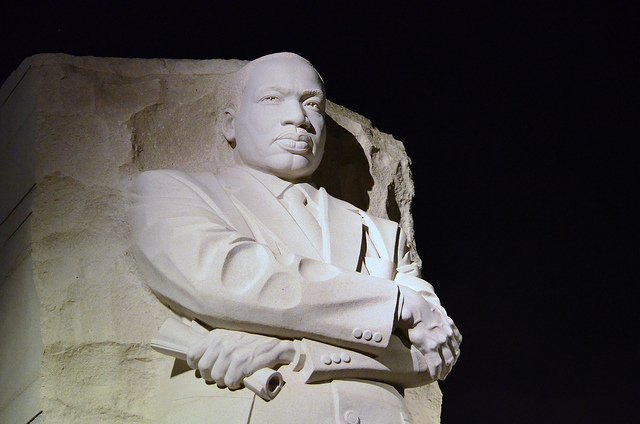
MLK Jr. – The Uncomfortable Truths History Books Won’t Touch

MLKflickruserangelanFor many, the words “I have a dream” are the only thing they associate with Dr. Martin Luther King, Jr.

Dr. King’s legacy is mostly depicted in the context of civil rights, with history books lauding his noble achievements of the Civil and Voting Rights Acts being passed.

But Dr. King gave hundreds of unpopular and controversial speeches ranging from the dangers of the Vietnam War to mass commercialization. During his life, he was attacked and marginalized from the white and black community alike.

The US government coined Dr. King the most “dangerous Negro leader in the country”, routinely spied on him and even went as far as writing him a letter in 1964 urging him to commit suicide.

In fact, MLK Jr.’s surviving family filed a civil suit in Memphis, TN, in which the jury found elements of the US government complicit in his assassination.

Having been arrested thirty times, Dr. King routinely threw his body upon the gears of the machine to show that change doesn’t roll in on the wheels of inevitability, but through continuous struggle against institutionalized injustice.

Focusing on America as the greatest purveyor of violence in the world, Dr. King spent the last year of his life fighting what he called the triple evils of the word: racism, militarism, and economic exploitation.

In fact, when MLK was assassinated he was planning the “Poor People’s Campaign” – a mass march and occupation of DC until the US government granted poor people an “Economic Bill of Rights”.

Listen to his profound speech “Beyond Vietnam”, given exactly one year before Dr. King’s assassination.

Rev. Dr. Martin Luther King Jr. “Beyond Vietnam”

It’s a topic Tavis Smiley explores in amazing depth and clarity in his new book, Death of a King: The Real Story of Dr. Martin Luther King Jr.s’ Final Year in which he talks about the unvarnished truth about Dr. King’s life, and last sermon entitled “Why America May Go to Hell”.

Breaking the Set speaks with Smiley about Dr. King and Mahatma Gandhi’s grandson, Arun Gandhi, about why structural and passive violence are the most inhibiting factors for peace.


Breaking the Set with Tavis Smiley and Arun Gandhi

**

 Abby Martin | @Abby Martin 

Photo by flickr user Angela N.

How Words Absolve Pillaging and Mass Murder

WordsFlickrKool_SkatkatObama’s election marked a new dawn for hundreds of millions of people, who were looking to an eloquent, constitutional lawyer for “Hope” and “Change” in America. However, it quickly became apparent that Obama had little substance beyond the slogans branded by his campaign.

With a little more than a year left in his presidency, his milquetoast legacy has been embodied by his greatest skill: wordcraft. Obama’s team has continued, if not exacerbated, most Bush era policies, simply rebranding them in order to appease and confuse the public into compliance.

One of the first things his administration did was declare an end to the “War on Terror” that the Bush sociopaths launched worldwide. Turns out, all they wanted to do was stop calling it a “War on Terror,” making clear that any further military involvement abroad would simply be called “Overseas Contingency Operations.”

Six years later, and the Nobel Peace Prize winning president has bombing campaigns in seven different countries under his belt. And the casualties of the empire’s plunders? Collateral damage.

There are also new terms for war. When US and NATO bombed the hell out of Libya resulting in the failed state we see today, it wasn’t a war. No, it was merely a “Kinetic Military Action,” according to government officials.

Torture is now “enhanced interrogation techniques”, and the act of kidnapping and exporting torture is simply called “extraordinary rendition”.

Whenever the administration sends predator drones to bomb people around the world, they’re just “surgical strikes” targeting “militants”. However, simply being military aged male constitutes someone as a militant, and according to the Bureau of Investigative Journalism, less than four percent of drone victims in Pakistan are officially listed as al Qaeda.

When Obama’s cabinet dropped the term “enemy combatant”, it was a purely symbolic move to distance itself away from the Bush Guantanamo era. Unfortunately, over 140 men still remain rotting away in the notorious prison despite what they’re now called on paper. And when these prisoners go on a hunger strike, it’s now called a “long term non-religious fast”.

As journalist Glenn Greenwald reminds us, altering the names of policies doesn’t change the fact that they’re still happening:

“The Obama administration…makes only the most cosmetic and inconsequential changes – designed to generate headlines misleadingly depicting a significant reversal – while, in fact, retaining the crux of Bush’s extremist detention theory.”

Obviously this rebranding tactic wasn’t invented by Obama’s PR team. 

Propaganda was propelled with the advent of PR genius Edward Bernays and later Nazi mastermind Joseph Goebbels, whose powerful techniques have been perfected and employed for decades by governments worldwide. Disturbing Newspeak phrases that absolve their pillaging and mass murder have permeated society and warped our interpretation of reality.


How Words Absolve Mass Murder

The term “Mowing the Lawn” is what governments say to allude to the literal mowing down of civilians. Shockingly, the callous term has been used not only by Israeli military commanders in reference to the recent bloodbath of Palestinians, but it’s also been used by Obama’s counter-terrorism adviser Bruce Riedel who said this about drone strikes:

“You’ve got to mow the lawn all the time. The minute you stop mowing, the grass is going to grow back.”

If you think that’s bad, officials also use the cute phrase “Shake ‘n Bake” to refer to using banned white phosphorus before blowing up people with high grade explosives. Administrators also think so lowly of the people they’re killing with flying robots that they brutishly call them “bug splats”.

Beyond war, in today’s cut throat capitalist world overrun by neoliberal doctrine, there’s a language of dehumanization employed towards everything, spoken among the elite class and policy heads in order to keep things running efficiently.

As the Guardian points out, the term “cleansing the stock” is actually used to describe excess human beings by parliamentarians. After all, you can’t afford to actually feel emotion, empathy or sorrow for the paupers at the bottom of the totem pole.

Unsurprisingly, when it comes to the natural world, the language is even more crude.

According to journalist George Monbiot,

“Nature is “natural capital”. Ecological processes are ecosystem services, because their only purpose is to serve us. Hills, forests and rivers are described in government reports as green infrastructure. Wildlife and habitats are asset classes in an ecosystems market. Fish populations are invariably described as stocks, as if they exist only as moveable assets from which wealth can be extracted – like disabled recipients of social security.”

All of these devaluing terms have seeped into mainstream consciousness, dutifully repeated by media figures and then, by us.

Words hold tremendous power, and if we don’t reclaim our language and start seeing people instead of “militants”, drone victims instead of “bug splats”, or natural splendor instead of “green infrastructure”, then the voiceless are destined to be silenced forever.

Follow me at @AbbyMartin

Journalist Amber Lyon: The War on Drugs is a Human Rights Crisis

JournalistAmberLyonWikimedia CommonsHave you ever found it odd that a side effect of Cymbalta, a leading anti-depressant, is suicide? It seems counterintuitive, but in a country where medicine is dictated by Big Pharma, such a paradox is hardly surprising.

That’s because, as former CNN correspondent Amber Lyon points out, Western medicine treatments are not intended to get to the root of the sickness.

The result of prolonged medical treatment is a country with 70% of its citizens on prescription drugs. And perhaps more shocking, where at least one fifth of its population is taking five or more prescription pills.

The US remains one of only two countries in the world with direct-to-consumer advertising, and the sheer amount of pills flooding the market is having deadly results. According to the book Our Daily Meds, nearly 100,000 Americans die each year from prescription drugs, roughly 270 people every day.

The non-profit organization Trust For America’s Health also found last year that deaths involving prescription drugs quadrupled between 1999 and 2010. Nearly 6.1 million people abuse prescription pills and overdose deaths have doubled in 29 states, exceeding vehicle related deaths.

With the innate perils of these drugs becoming more evident, Lyon dedicated her journalism to finding another way to treat psychological illnesses. Her personal experience curing Post Traumatic Stress Disorder (PTSD) with psilocybin mushrooms led her into a world of research establishing that what we’ve been told by the establishment about psychedelics is wrong.

Lyon travelled around the world to legally take psychedelics with foreign cultures that have used them medicinally for thousands of years. She explains that when done in a safe setting, these psychedelic therapies allow people to confront, process and purge their darkest memories, instead of numbing them with pharmaceuticals.

How Psychedelics Are Saving Lives

**

Amber Lyon joined Abby Martin on Breaking the Set to debunk the myths surrounding psychedelics and explain their proven benefits.

Amber Lyon Trips All Over the World to Discover the Power of Hallucinogens

**

Lyon launched the website Reset.Me in order to change the narrative and spread awareness about the benefits of psychedelics.

Written by Abby Martin and Anya Parampil, photo by Wikimedia Commons

The Case for Vegetarianism You’ve Never Heard Before

CowbyFlickrb3dWhen I was in 5th grade, I was obsessed with animals. It was an age where most of my friends were going through the phase of wanting to be either a veterinarian or whale trainer at Sea World (yes, this was before Blackfish).

My love for animals may have been innocent and ill-informed early on, but it led me to become passionate about animal rights.

Over the years, vegetarianism has stuck with me despite the fact that most of my friends, family, and men I’ve dated eat meat. It certainly hasn’t been easy – but it’s been worth it. People might never stop asking me why I don’t eat meat, but my answer will remain simple and the same: I like animals too much to bring myself to eat them.

Yet Gary Francione, a self proclaimed animal abolitionist, has a much more sophisticated argument in favor of vegetarianism. Rather than focusing merely on the treatment of animals, Francione defines “animal abolitionism” as the inability to “justify using animals at all, no matter how humanely we treat them”. He’s structured a moral argument against the alleged necessary use of animal products, particularly with the advent of technology and alternative materials like hemp.

And whilst Francione acknowledges that animals are cognitively different than humans, he explains why it still doesn’t justify the consumption and use of animals for our benefit. Francione argues that the cognitive differences don’t matter morally, because animals are sentient.

He underscores this by posing a scenario comparing two different human beings: one who is brilliant and one who is mentally disabled. Whilst the two humans are “different” from one another, Francione points out that a cognitive difference would not justify, for example, subjecting the disabled individual to a harmful biomedical experiment.

So why would we do the same to animals?

Well, as Francione points out, animals are little more than helpless resources at the hands of exploitative human beings. But “how can you justify using a sentient being exclusively as a resource?” Francione asks.

The answer: you can’t.

Even back in 1884, Henry David Thoreau proposed “… that it is a part of the destiny of the human race, in its gradual improvement, to leave off eating animals…” just as “savage” humans “have left off eating each other”.

**

Professor Gary Francione on Breaking the Set

Gary Francione on Animal Abolition & Ethical Consumption

**

Written by Anya Parampil for Media Roots, Photo by flickr user b3d

Posted in Uncategorized | 1 Reply
Page 2 of 2412345...>>