
Drone Wars Can’t Exist Without Decades-Long Genocide in Congo

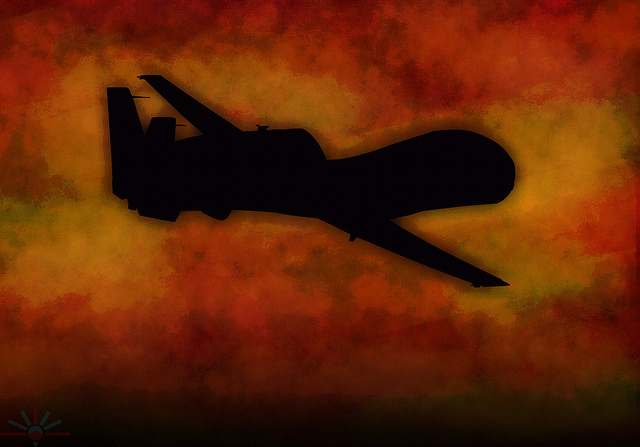
DronebyFLICKRAKROCKEFELLERIn January of 2014, a UN surveillance drone crashed in Eastern Congo.

According to the UN, the drone was part of a surveillance operation to keep tabs on warring militias that have been fighting in the country since 1996.

Ironic, considering the manufacture of drones is entirely dependent on the bloody conflict taking place on the ground below. That’s because the source of cobalt, a vital mineral in defense technologies like drones, is one of the many resources rebel groups in the Congo are fighting to control. In fact, every death by way of drone can be traced back to the embattled history of this region.

For several decades beginning in 1908, the Congo was a Belgian colony. In 1960,  a nationalist movement led by young postal clerk Patrice Lumumba was successful in gaining the country’s independence. Lumumba was then chosen as the first democratically elected Prime Minister of the Congo that year.

However his popularity, driven by a commitment to the economic and political liberation of the country, dissatisfied former colonists in Belgium and their American allies. Only months after his election, Lumumba was deposed by Western-backed forces. Within a year, he was captured by those forces and subsequently executed by firing squad on January 17, 1961.

After several years of jockeying for power, in 1965 military strongman Mobutu Sese Seko came to power in a US/Belgium backed coup. A staunch anti communist, Mobutu used much of the Congo’s resources to his personal gain, amassing a multi-billion dollar personal fortune throughout his years of cooperation with western governments and corporations.

It was during Mobutu’s rule in 1982 that the Congressional Budget Office released a report entitled “Cobalt: Policy Options for a Strategic Mineral”. In it, the CBO outlines how cobalt is an essential mineral used in American aerospace and defense technologies. Because of its necessity, the CBO declares that if cobalt supplies were to shortfall, it would be of great concern for the US government and national security.

The CBO also points out that the greatest producer of cobalt is the Congo, at the time known as Zaire. The report determines that the greatest threat to cobalt production in the Congo would be political unrest and quote “guerrilla insurrection” against Mobutu’s hardline rule.

Fifteen years later, the threat of Mobutu’s overthrow became a reality.

When Mobutu was ousted in 1997, Congo fell into chaos from which it never recovered, culminating with the takeover of yet another pro-western dictator Joseph Kabila in 2001 – but the violence never stopped. Despite enjoying a cozy relationship with US leaders, it is estimated that somewhere between 5.4 to 6 million people have died under Kabila’s watch in the deadliest conflict since World War II. According to Friends of the Congo spokesperson Kambale Musavuli, the conflict can all be traced back to the “War on Terror”.

“The battle in the Congo has really been about who’s going to control Congo’s resources and for whose benefit,” he says. “Cobalt [is] a mineral very essential to modern technologies…found in aerospace, in drones, in airplanes, in nuclear reactors, and it is a strategic mineral to the so called war on terror.”

In 2011, Kabila gave approval for American Mining Company Freeport-McMoRan to expand its ownership of the Tenke Fungureme mine – the largest cobalt reserve in the world – to 56 percent, making him quite popular in Washington.

However, not everyone in the US government has turned a blind eye to the fact that minerals like cobalt come with a heavy human cost. That’s why a few members of Congress made an effort to classify some resources as “conflict minerals,” which would require companies to disclose the sources of their products.

In fact, hidden within the 2010 Dodd-Frank Wall Street Reform Bill, “Section 1502” promises to “monitor and stop commercial activities involving the natural resources of the Democratic Republic of Congo that contribute to the armed activities of armed groups and human rights violations”.

Yet cobalt was not named among the four “conflict minerals” classified in the report, despite the fact that it’s the most strategic and abundant resource in the Congo.

Perhaps that’s no surprise, considering that the VP of International Affairs at Freeport (formally VP of Africa), Melissa Sanderson, was a Political Counselor to the State Department for over two decades before joining the company. Specifically, she was the Charge d’Affairs at the US Embassy in the Congo.

With the conflict of interest so entrenched and drone strikes replacing conventional warfare, it’s hard to imagine how any top-down policy could foster real change. Ultimately, Musavuli says that rather than count on governments and corporations to put peace before profits, the solution lies in the people.

“They need the people in Pakistan [and] Afghanistan who are being bombed day and night by drones to know that those drones would be able to be sending those missiles [into their] community if the western powers did not have access to minerals in the Congo,” he says. “[Minerals] such as uranium, such as cobalt…creating those alliances with people who believe in peace and freedom and human dignity will be a change maker as we continue to support those who are fighting on the ground [in the Congo].”

Indeed, while the struggle begins with democratizing the source of cobalt in the Congo, it won’t prevail without global solidarity. Yet until people realize the interconnectedness of these conflicts, such unity may prove to be its greatest obstacle.

Written by Anya Parampil, Follow me @anyaparampil

Photo by flickr user AK ROCKEFELLER
Posted in Uncategorized | 1 Reply

BP: Scandal, Lies and Another Massive Oil Spill Cover-Up

BP Thierry EhrmannForget Stephen King. If you want scary, read U.S. District Judge Carl Barbier’s 150-page Findings of Fact released recently in the Deepwater Horizon case.
Although the judge found BP liable for “gross negligence,” some U.S. media failed to mention that Barbier let BP off the hook on punitive damages. And that stuns me, given that the record seems to identify enough smoking guns to roast a sizable pig.

Every rig operator knows that, before a rig can unhook from a drill pipe, the operator has to run a “negative pressure test” to make sure the cement has properly sealed the drill pipe.

If the pipe is safely plugged, the pressure gauge will read zero. The amount of pressure BP measured at 5 p.m. on April 20, 2010, the day of the explosion? 1400 psi (see the findings, pages 62-65).

1400 psi is not zero. Stick a balloon in your mouth with zero pressure and nothing happens except that you look silly. Replace the balloon with a hose delivering a 1400 psi blast and it’ll blow your skull apart.

So, how could the company record zero? Answer: BP’s crew re-ran the test measuring the pressure in something called the “kill line,” which is definitely not the drill pipe.

By reporting that the pipe had no pressure and all was safe, BP could begin to unhook the Deepwater Horizon from the pipe—and sail away. Why would BP do that? In my view, there were three motives: money, money and money. It costs BP a good half million dollars each extra day the rig stays on top of the drill hole. It seems it wanted the rig gone, and quickly.

Instead of halting the disconnection process, BP appears to have lied and recorded the pressure reading as “zero.” The rig’s owner, Transocean of Switzerland, went along with BP’s actions.

So how did BP get away with mere “gross negligence” as opposed to the more serious claim of fraud? Because the court found that the blowout, explosion, fire and oil spill were caused by “misinterpretation of the negative pressure test.”

Misinterpretation? If a woman says “thanks” when you say she’s dressed nicely and you think she wants a kiss, that’s “misinterpretation.” But on the Deepwater Horizon, the drill pipe gauge read 1400 psi and BP picked a different pipe that gave the company the magic zero. That’s not, I contend, “misinterpretation.”

Maybe the judge thought he was pretty tough by calling out BP for “gross” negligence (rather than plain-vanilla negligence, the finding against Transocean and contractor Halliburton). But, in fact, it seems Barbier fell for the Three Stooges defense.

Throughout the 150-page decision, the judge cites one instance after another of bone-headed, buffoonish, slapstick decisions, and plenty of pratfalls and banana-peel slips by BP, Transocean and Halliburton. You have to wonder how these schmucks even found their drill hole. It was a corporate Larry-Moe-and-Curly-Joe routine that would provide a lot of belly laughs if 11 men hadn’t died as a result.

I’ve seen the Three Stooges defense before in federal court. In 1988, the corporate owner and the builder of the Shoreham nuclear plant were on trial on accusations they bilked their New York customers out of $1.8 billion. In court, they pleaded stupidity and incompetence as a defense against deliberate deception. As the government’s investigator, I didn’t buy it—billion-dollar corporations can’t be that stupid—and neither did the jury. (The racketeering charges were settled after trial for $400 million.)

And here is a new set of Stooges: BP plays Larry, Transocean puts on Moe’s wig and Halliburton makes “Nyuk! Nyuk! Nyuk!” sounds like Curly Joe. Halliburton, the judge found, failed to test the final cement mix and BP bitched about it—“[Halliburton engineer Jesse Gagliano] isn’t cutting it any more,” reads an email between two BP managers on the rig—but BP went ahead and used the bad cement anyway (Findings, paragraphs 227-228)

When the pressure in the drill pipe read 1400 psi, BP and Transocean managers should have stopped the rig departure immediately. They didn’t. Nevertheless, other systems should have prevented a blowout. According to Barbier, other safety systems were jacked with to save a penny here, a penny there (or, a million here, a million there). Example: BP used leftover cement (Findings, paragraphs 209-211) that contained chemicals that destroyed the integrity of the new cement, because using the old stuff saved some serious cash.

Barbier had the power to levy a fine big enough to make BP plc, BP America’s London-based parent corporation—a company with revenue of a quarter of a trillion dollars a year—go “ouch.” But to slam BP with a fine that would hurt, the judge needed to hear from the Justice Department about corporate-wide perfidy. He pointed out that the case would have to be made against BP plc, the international parent, if he were to level a fine that would punish the corporation.

Against BP there is evidence aplenty. For years BP plc has played fast and loose with safety—from Asia to Alaska.

Chasing BP across five continents, I’ve found that “gross negligence” could be BP’s corporate motto. In 2010, I was arrested in Azerbaijan hunting down evidence of another BP/Transocean offshore blowout that occurred 17 months before the Deepwater Horizon explosion. The cause of the Caspian blowout was the same as in the Gulf disaster: mishandling of “foamed” cement. Had BP not covered up the prior blowout off the coast of Azerbaijan, the deaths and destruction in the Gulf, I’m certain, would have been avoided.

More on the Caspian Sea blowout and BP ruling on Breaking the Set with Abby Martin:


What?! Another Massive BP Oil Spill Coverup?

**

The ugly truth is that the U.S. State Department knew of the Caspian disaster and kept its lips sealed. Furthermore, the U.S. government can’t tag BP as an endemically rogue, dangerous operator without casting doubt on the administration’s recent grant to the corporation of new deep tracts to drill in the Gulf of Mexico.

So maybe it was not the judge but the public that was blinded by the government and media crowing about a possible $18 billion fine for gross negligence. Eighteen billion dollars may sound like a lot to us mere mortals, but to a trillion-dollar behemoth like BP, it is not a punishment, but a reasonably priced permit for plunder.

Greg Palast is award winning author and journalist.

This article was originally published in Truthdig. Photo by flickr user Thierry Ehrmann

Watch Breaking the Set’s exclusive follow-up on the 2010 BP Oil Spill from the Gulf.

Walmart’s Predatory Profit Model: Low Prices With a Heavy Cost

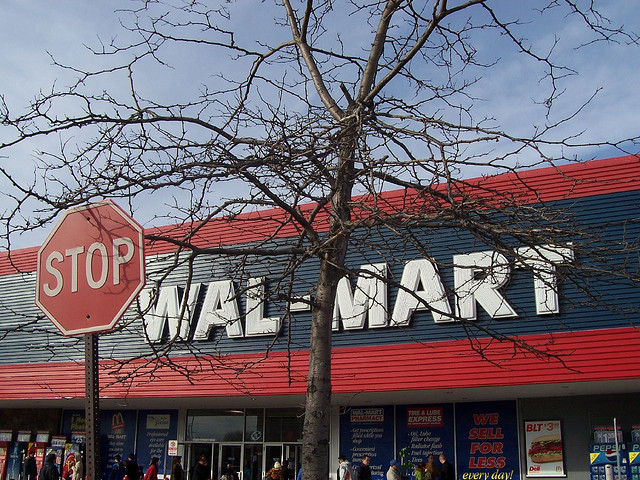
Stop Walmart by Flickr Lone PrimateAs the saying goes, there’s no such thing as a free lunch. Nowhere does that ring more loudly true than in the aisles of every Walmart store. Always low prices, yes – but at what cost?
There are, unfortunately, two inconvenient truths about the dollars you’ve supposedly saving from having elected the world’s largest retailer over Joe’s little store just down the street. First off, what you don’t pay, someone else is paying for. And secondly, the actual price you pay is much higher than what your receipt tells you.

I’m aware that the slogan I mentioned earlier is outdated. The irony was not lost when, in 2007, the company swapped it for the rather idealistically sounding “Save Money, Live Better” – a far cry from the everyday reality facing the average Walmart employee in the United States. Making an average hourly wage of $8.81 an hour, or about $18,300 a year working full-time, is hardly the way to live better. It’s only slightly over a third of a living wage for an adult with one child. 

That’s why Walmart isn’t quite as cheap as you’d think – because much of what you’re not paying at the cashier ends up getting paid for through your taxes. It’s estimated that every Walmart store in America costs citizens $1.7 million in welfare benefits such as food stamps. Taxpayers are effectively subsidizing the retailer for its failure to pay employees a living wage.

Abby Martin outlines Walmart’s horrible treatment of employees and destruction of the planet on Breaking the Set:

Why Walmart is an Economic Death Star

**

Amazingly, Walmart could afford to give all of its employees a 50 percent raise without even touching its bottom line – but it chooses not to. And why does it choose to perpetrate the countless other assaults on its outsourced workforce, female employees and the environment? The answer’s simple: profit maximization.

We’ve all heard of corporate social responsibility. Be it sincere or mere corporate whitewashing, the “triple bottom line” of economic, social and environmental sustainability surely fares better than the single-minded focus on profit that prevails under the current global economic order.

The existing objective, profit maximization, is exactly what it sounds like: putting profits above all else, be it workers’ right to “live better”, the planet’s capacity to sustain human activity, worker and consumer health and safety, economic stability, or human lives. This reckless pursuit of profit is why taxpayers are propping up large corporations that make obscene profits in the meantime.

It’s why 1100 Bangladeshi workers, many of them making garments sold at Walmart, lost their lives when the Rana Plaza factory collapsed due to blatant disregard for building safety on the part of the companies it supplied (Walmart still refuses to sign an international agreement that would ensure worker safety in its sweatshops).

It’s why General Electric, Toshiba and Hitachi did nothing about the flaws in their nuclear reactors at Fukushima that caused them to melt down in 2011, despite knowing for decades that they were unsafe.

It’s why there is still no vaccine for ebola despite over 2000 deaths at the time of writing – because there’s no money to be made out of it. Or why corporate tax evasion through loopholes and tax havens costs the United States some $300 billion every year.

It’s why governments, on behalf of their grossly bloated financial sectors, are negotiating a secretive international financial treaty that further deregulates global finance known as the Trade in Services Agreement (TISA). 

And so on. What these failures of the capitalist system, or what neoliberal economists term “market failure”, share is a common root in the unwillingness on the part of businesses to fully account for their costs. Taxpayers pay the price for Walmart’s refusal to adequately pay its own workers. The manufacturers of the Fukushima nuclear plants, unwilling to dish out the money to fix their inherent design flaws, unleashed a public health disaster that threatens to get worse. Global finance triggered the Great Recession through their own risky but rewarding behaviour and want to do it all over again.

The very nature of business needs to change if humanity is to avoid yet more Rana Plazas, Fukushimas and Great Recessions, and if it is to ever overcome ebola, tax evasion and corporate welfare. We need to move away from the predatory capitalist “I want it all” ethos and towards new business models that account for all costs rather than leaving them for others to pay. This is not financially impossible, and there’s no reason why such a model can’t be financially self-sustaining. But it’s only when business owners and executives start to acknowledge their responsibility to really help the rest of society to “live better” rather than taking more and more for themselves will that model be possible.

**

Top Five Worst Corporations for US Workers

Abby Martin calls out the corporations that refuse to pay their workers a living wage, despite posting record profits and generously compensating their CEOs.

**

Written by Ming Chun Tang; image by Flickr user Jim

BP’s Oil Spill: Criminal Negligence, Thousands Still Sick & A Gulf Graveyard Left Behind

BP dead flickr user thierry ehrmannAfter BP agreed to pay $4.5 billion to the government, and another $9.2 billion in penalties since its catastrophic oil spill, a new ruling has put the corporation under fire again.

A US District Judge has found BP grossly negligent and it’s subcontractors, Halliburton and TransOcean, negligent for their roles in the 2010 Deepwater Horizon explosion and subsequent dumping of more than 210 million gallons of toxic sludge into the Gulf of Mexico, killing 11 people and countless marine creatures in the process. Under the Clean Water Act, the new ruling could effectively quadruple the penalty per barrel spilled that BP will have to pay.

BP’s criminal negligence shouldn’t come as a surprise. After nine years at sea, company management acknowledged that the Deepwater drilling rig was in decline and presented a quote “intolerable risk” to safety, yet chose to do nothing. Halliburton also plead guilty to the destruction of key evidence related to the company’s shady cost-cutting practices like failing to inspect the well’s cement mixture, and using only six of the recommended 21 centralizers to secure the site.

Besides the massive damage that’s been done to the environment as a result of the BP disaster, the health impact on humans continues – largely because of the decision by BP and the EPA to spray nearly two million gallons of a dispersant called Corexit onto the water, making the oil 52 times more toxic, according to the Environmental Pollution Journal.

All this aside, BP’s contracts with the Defense Department have more than doubled in the years since the disaster.

Even though the media is fatigued with its coverage of this disaster, Breaking the Set went down to the Louisiana Gulf Coast to see how the region is faring nearly five years later and to investigate the spill’s lasting damagesWe learned that hundreds of thousands of people are still sick, and that the oil industry has turned the once vibrant shore into a graveyard.

Abby

**

BP’s Oil Spill: Criminal Negligence, Thousands Sick & Gulf Graveyard Left Behind

**

Exclusive coverage includes interviews with Jorey Danos, a sick clean-up worker who was exposed to a toxic chemical dispersant known as Corexit, award winning toxicologist Wilma Subra, Gulf Restoration Network’s Jonathan Henderson and Clint Guidry, President of the Louisiana Shrimpers Association.

We also reached out to BP, which provided the following statements:

Q: Why were cleanup workers refused respirators and even threatened with termination if they requested them, according to multiple interviews with clean-up workers and the Louisiana Environmental Action Network?

A: We certainly do not and would not retaliate against workers. BP worked closely with OSHA, the US National Institute for Occupational Safety and Health (NIOSH) and other US government agencies to take extraordinary measures to safeguard the health and safety of responders.

Workers were provided safety training and appropriate personal protective equipment (PPE), and were monitored by federal agencies and BP to measure potential exposure levels and to help ensure compliance with established safety procedures.

Response workers applying dispersants received training on work procedures and PPE usage designed to minimize exposures, and were provided respirators and other PPE.

Workers who were not exposed to dispersants may have asked for a respirator, possibly in the mistaken belief that it would provide an extra level of protection and safety. This is not true. Perhaps the most important consideration in voluntary respirator usage is the potential physiological burden placed on the user. That was particularly true given the hot working conditions encountered during the response.

Due to the extensive controls in place, there was little potential for worker or public exposure to dispersants. More than 30,000 air monitoring samples were collected by the Coast Guard, OSHA, NIOSH, and BP as part of a comprehensive air monitoring program to evaluate the potential for human exposure to dispersant and oil compounds. The results showed that response worker and public exposures to dispersants were well below levels that could pose a health or safety concern.

Additional Background: OSHA advises that, “in workplaces with no hazardous exposures, but where workers choose to use respirators voluntarily, certain written program elements may be necessary to prevent potential hazards associated with respirator use. Employers must evaluate whether respirator use itself may actually harm employees. If so, employers must medically evaluate employees and, if necessary, restrict respirator use…”

For these reasons, respirators typically are not provided to people who do not need them, and who have not passed the required tests for fitness to wear the equipment. In consultation with NIOSH and OSHA, BP developed guidelines to help determine when PPE, including respirators, was to be used. Known as the “PPE Matrix,” this guideline was made available on several websites, including websites for BP and OSHA. Under the PPE Matrix, respirators were to be used in specifically- identified situations, including during the application of dispersants. There were times, however, when the potential risks associated with using a respirator outweighed the benefits since air monitoring data indicated that worker exposures to chemicals of concern generally were well below occupational exposure limits, and respirator use could place physiological stress on the body. In those cases, protection was provided by work practices and procedures and the use of other PPE.

A paper reviewing OSHA and NIOSH’s response to the accident can be found here.

Q: Why was the public told that Corexit was as harmless as Dawn, when five of the ingredients in it are linked to cancer, 33 are linked to skin irritation and 11 are respiratory toxins, according to expert toxicologists, Wilma Subra and Dr. Susan Shaw?

A: The Material Safety Data Sheet (MSDS) for Corexit, where human exposure characterization is addressed notes, “Based on our recommended product application and personal protective equipment, the potential human exposure is: Low.” Also, Section 16 of the MSDS characterized Corexit’s general product risk- “The human risk is: Low. The environmental risk is: Low.”

The same ingredients contained in Corexit are also found in common consumer products such as household cleaners, food packaging, hand lotion and cosmetics. The product ingredients alone do not determine if a compound has created a public health concern; there must also be exposure to a compound at levels and for sufficient duration that could cause harm.

The results of extensive monitoring conducted by federal agencies and BP show that response workers and the public simply were not exposed to dispersant compounds at levels that might pose a health risk.

Due to the controls in place during dispersant application operations, there was little potential for public or worker exposure when dispersants were applied to the oil offshore. This was confirmed by the government findings as previously mentioned.

Q: Why has the active cleanup of Louisiana’s coast officially ended when thousands of tar balls continue to wash on shore?

A: The Coast Guard ended active cleanup after an extensive four-year effort. Even so, we remain committed and prepared to respond at the Coast Guard’s direction if potential residual Macondo material is identified through the National Response Center reporting process and requires removal. We have teams and equipment at staging areas in Grand Isle, LA and Gulf Shores, AL ready to rapidly respond as necessary.

Additionally numerous studies and reports have documented the presence of tar balls along the Gulf coast in the decades before the Deepwater Horizon accident, and during our cleanup efforts we continued to find tarballs that did not contain residual Macondo oil.

Q: Why have only 148 people received any medical claim whatsoever well over four years after the disaster and why is the average benefit only $1,600 dollars, when doctors such as Michael Robichaux has studied hundreds of patients and observed long term and possibly lifelong health effects in the process?

A: BP and the PSC consulted with medical experts to determine compensation amounts and formulate a list of the conditions that, according to scientific evidence, could be caused by exposure to oil or to the dispersants used in the cleanup. Compensation for these listed conditions is subject to the clear terms of the MSA. As is common in class action settlements, the settlement program did not begin processing and paying out claims until all appeals were exhausted, which occurred earlier this year. As to Dr. Robichaux, his allegations were considered and rejected over a year ago by a New Orleans federal court, which found that the doctor “wholly failed to provide any competent evidence in support of the assertions he makes.”

**

Follow me @AbbyMartin

Art by flickr user Hierry Ehrmann

Posted in Uncategorized | 1 Reply

Terms and Conditions May Apply: Dangers of Corporate Surveillance

Robbie Martin talks to Cullen Hoback, privacy advocate and creator of Terms and Conditions May Apply, a must-watch documentary about digital privacy rights, corporate/government spying collusion and the data mining economy of corporate surveillance.

Terms and Conditions May Apply premiered a few months before the world learned Edward Snowden’s name. Following the leaks, Cullen’s thesis was emboldened, so he added an addendum contextualizing them.

Watch the trailer:


Terms and Conditions May Apply

**

Be sure to listen to our previous Media Roots Radio episode ‘Occupy Silicon Valley‘ for more information on the history of Silicon Valley and why there is so much missing outrage over private sector spying.

If you would like to directly download the podcast click the down arrow icon on the right of the Soundcloud display. To hide the comments to enable easier rewind and fast forward, click on the icon on the very bottom right.

This Media Roots podcast is the product of many long hours of hard work and love. If you want to encourage our voice, please consider supporting us as we continue to speak from outside party lines. Even the smallest donations help us with operating costs.

Listen to all previous episodes of Media Roots Radio here.

Follow Robbie @fluorescentgrey

Page 5 of 29<<...34567...>>