
Dismantling Our Right-Wing World

(A quick note to US readers: left and right in this piece do not refer to the American liberal-conservative spectrum – both of which are considered neoliberal – but to the broader left-right spectrum as traditionally conceived, ranging from far-left communism/socialism to far-right fascism.)
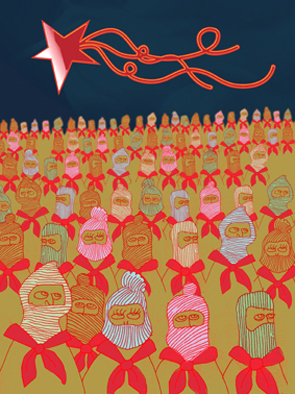
zapatistas flickr aeneastudioIt’s been an eventful few weeks for the Zapatista Army of National Liberation (EZLN), also known as the Zapatistas, midway through their 20th anniversary year.

First, Jose Luis Solís López, also known as “Compañero Galeano”, was murdered by a paramilitary group with ties to the Mexican government, which also injured fifteen other Zapatistas and destroyed a school, clinic and water system in the same attack. The attack then prompted the Zapatistas to change strategies, with well-known spokesperson Subcomandante Marcos stepping down.

These developments serve to remind us of the EZLN’s status as, in the words of Chris Hedges, “the most important resistance movement of the last two decades” – important enough to warrant the rather violent attention of the Mexican government and its paramilitary associates.

The EZLN, a group based in the state of Chiapas in southern Mexico, launched an armed rebellion against the Mexican government on January 1, 1994 as an act of protest against the North American Free Trade Agreement (NAFTA), which entered into effect on the same day. However, instead of attacking the Mexican state and society and causing endless bloodshed, the Zapatistas set up a system of self-governance in the territory it controlled, creating autonomous communities each with its own health clinic and schools to fill the void that the Mexican government had actively sought to widen in the interests of US and Canadian multinational corporations.

What the Zapatistas demonstrate is a vision of the notion articulated in the motto of the World Social Forum: another world is possible. They provide evidence that contradicts the belief that the status quo under neoliberal capitalism, in which the haves have it all and the have-nots are left to fend for themselves, is not only the best system but indeed the only viable system. The Zapatistas represent a victory for the oppressed peoples of the world over the powerful political and economic interests that rule over them. But more importantly, they represent a victory for the values of egalitarianism, compassion and solidarity – what I call the left-wing ethos. A victory over the idea that those who rule have the divine right to further their own interests, regardless of the consequences for the rest of humanity – an attitude that epitomizes what it means to be “right-wing”.

Marko Attila Hoare boils down the left-right spectrum to a simple distinction: that “the left supports the redistribution of wealth from the rich to the poor while the right opposes it”. But we can remove the entire spectrum from politics entirely to expose the values that underlie them: lefties value social equality, whereas righties value social hierarchy. Why, though? The answer lies in our individual worldview. As a self-identified lefty, I consider it more than possible for all of us to peacefully coexist in the world and have all of our common needs met, if (and only if) that’s the goal that we all work together to try to achieve. In a left-wing worldview, it’s therefore neither necessary nor ethical for us to undermine others in order to benefit ourselves. In other words: compassion, not competition. Without claiming complete objectivity, a right-wing worldview revolves around the idea that we live in a dog-eat-dog world in which the best we can do is fend for ourselves and get our share before someone else takes it.

Human history has been almost entirely dominated by the right-wing worldview. It’s been an endless cycle in which privileged groups have taken turns dominating each other in a seemingly eternal battle between the powerful and the powerless. From the imperial conquests of the ancient world through European colonialism, the two World Wars and Soviet communism to modern neoliberal capitalism, it’s always been the same story, flowing through different chapters but reaching the same inevitable conclusion: Oligarchy. It’s a story familiar to the Zapatistas as well as countless other sites of confrontation between the haves and the have-nots in recent years. The hierarchical, conflict-ridden relationship today between those who rule the world and those who are ruled, between corporate bosses and workers, between autocrats and their citizens, between the rich and the poor, is a continuation of this cycle of domination.

The right-wingers among us will assert that history simply reflects human nature, that it is in our nature to be maliciously selfish rather than compassionate, that this is the best we can do, or even that there’s nothing wrong with the world we’ve created. But their argument fails to acknowledge that the dominant worldview of the past has created the world we know today. As an example, the domination of the indigenous populations of the Americas, Africa, Asia and Oceania by European invaders and colonizers was not an inevitable result of human nature, but rather a product of widespread extreme right-wing beliefs such as Manifest Destiny and the white man’s burden. Similarly, the dominant worldview of the present will determine the world of tomorrow. A child raised in a society that values getting ahead at all costs is encouraged is far more likely to act accordingly than one raised in a society that values empathy and compassion. The dominant worldview in a society is therefore not inherent in human nature but in fact reinforces itself.

Right-wing theorists have a crucial role to play in promoting their worldview, too. “Realist” international relations scholars, capitalist economists, or simply those at the top of the social hierarchy love to tell us how it’s in our nature to always act in self-interest. They tell us that “greed is good” and that we all collectively benefit from constantly undermining each other, as ludicrous as that may sound. Yet, for the most part, even despite their contempt for those below them in the social hierarchy, even right-wingers behave in an incredibly left-wing manner towards those closest to them. And that’s because humans organized themselves into what we nowadays call “societies” precisely so that we could all benefit from being interdependent. That interdependence required us to develop compassion to allow us to survive in a society. The “savage” who undermines and betrays everyone he or she comes into contact with doesn’t survive for very long and, sociopaths aside, doesn’t find much happiness either. Surely we as a species are capable of applying that same logic to our everyday actions in today’s world so that we can all thrive at the same time instead of striving to be the “last man standing”?

Roman Krznaric couldn’t have put it any better: we need an empathy revolution. We need to turn the right-wing world that we live in into a left-wing one in which we recognize our fellow human beings as worthy of a livelihood and worthy of happiness and, in return, receive the same recognition. As the economic crisis in Greece goes to show, humans are capable of compassion even in the most desperate of situations: rather than stealing from each other, many Greeks are stepping in to provide the services that their government has failed to deliver and those that some of their compatriots can no longer afford, from food to medical services to street lighting – all for free. Similar systems have been devised in Serbia as well as in Macedonia, where numerous bakeries have introduced “solidarity baskets” to allow customers to buy an extra bun or piece of bread to leave to those who can’t afford to eat. And many customers indeed comply.

But showing empathy on our part only does half the job. While it spares those around us from our own potential malice, what it doesn’t do is liberate ourselves from those who have their hands around our necks. That involves critically examining and rethinking the false ideologies and pseudo-theories invoked by the powerful for the sole purposes of justifying their own dominating behaviour. After all, ideologies are all too often used as pretenses to mask the hidden agendas of those who assert them rather than a reflection of the values that they truly believe – in other words, purposeful bullshit. We mustn’t forget how the left-wing idea of communism was employed by self-described revolutionaries to justify right-wing oligarchic tyranny. Similarly, we can’t afford to look away when libertarians cite the dogma of enriching big businesses at the cost of everyone else, or when rich countries proclaim free trade to justify infiltrating the economies of developing countries. We’ve been raised to regard Soviet-style communism as tyranny and Western capitalism as freedom, but we need to recognize both for what they are: systems of oppression backed up by pseudo-theories that have no empirical basis and only serve those who preach them.

The empathy revolution needs a theoretical and social component. Neither pacifism nor confrontation can do the job alone. We need to channel our discontent into action by adopting the autonomist ethos of the Zapatistas to build the society we want. We need to form cooperatives and make use of cryptocurrencies, local currencies, open source, open knowledge, peer-to-peer practices, the sharing economy and countless other methods of grassroots social and economic organization the mainstream media doesn’t want us to hear a word about. What these methods all have in common is that they’re all built on the basis of cooperation and collaboration rather than malice and treachery – exactly what society needs and what the oligarchs don’t want.

Modern society is diseased and needs treatment. It’s only when we renounce one-upmanship in favour of cooperation and collaboration that we’ll be able to construct a society not for the few at the top, but for all of us. After all, isn’t fulfilling our mutual needs the whole point of even living in a society? It’ll require a good deal of empathy and creativity, as well as plenty of critical thinking to distinguish truth from pseudo-theory and other purposeful bullshit. Left-wing and right-wing are no longer a question of politics, but a question of social values and social justice. The right-wing worldview has failed us, and as the Zapatistas have shown, another world is certainly possible. It’s time to recognize that, for the purposes of redeeming ourselves from perpetual oligarchy, left is right.

Written by Ming Chun Tang, photo by flickr user aeneastudio

http://clearingtherubble.wordpress.com/

**

Jacobin Magazine’s Bhaskar Sunkara on Breaking the Set

How the Zapatistas’ Success Threatens Global Status Quo
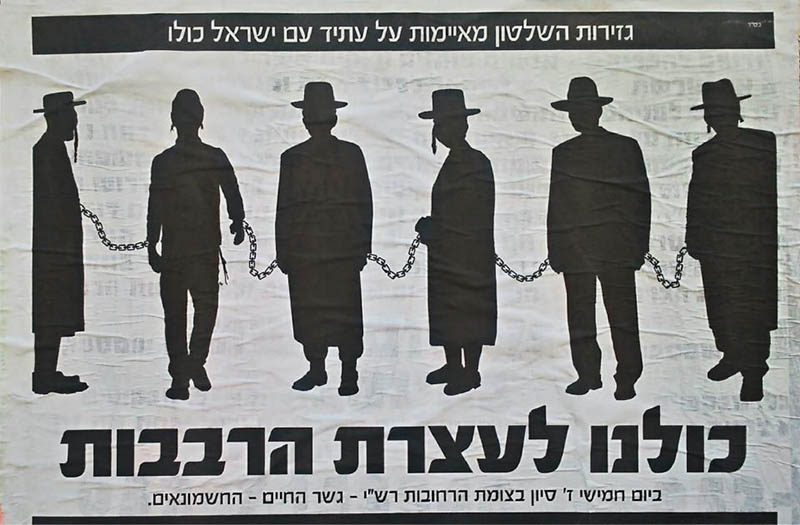
Ultra-Orthodox Jews in Israel Draw the Line

thursdaydemoPrime Minister David Cameron got more than he expected at the Israeli Knesset in his recent visit, receiving a cold shoulder from ultra-Orthodox and Palestinian legislators who share common interests, being the state’s most oppressed communities. Cameron’s visit to the Knesset took place on the same day that two controversial laws, the Conscription Law and the Governability Law, were finally approved following a prolonged legislative battle. As Prime Minister Netanyahu welcomed the guest of honour the ultra-Orthodox parliamentarians left the plenary session in protest while their colleagues, Palestinian Members of the Knesset, refused to attend the event altogether. This was the culmination point of several months of heated protest over the Conscription Law which brought to the surface contradictions between Zionism and Judaism.
Hundreds of thousands of ultra-Orthodox Jews (Haredim) of all denominations took to the streets of Jerusalem to oppose the draft law several days before its legislation. In a mass prayer, the worshippers-protesters declared their faithfulness to Torah study rather than to the military. United under the banner declaring that “the State of Israel is fighting against the Kingdom of Heaven” they held signs stating that military draft is a spiritual suicide. The event was not merely an opposition to the law but nothing short of a battle cry against the very legitimacy of a state that encroaches upon their spiritual autonomy and poses a danger to their religious liberty.

Under the slogan “Equality in the Burden” both religious-Zionist Naftali Bennett and secular-Zionist Yair Lapid were elected and became the two largest coalition partners of a Haredi-free government. The campaign called for the forced conscription of the ultra-Orthodox and garnered wide support from the Israeli public. Unlike the purist Edah HaHaredit group which prohibits its members from partaking in, voting and receiving funds from the Zionist state, the Haredi rabbinical councils which called for the mass protest have their elected representatives at the Knesset. They all walked out of the plenum stating that Netanyahu is an enemy to their religion, yet this did not stop the Prime Minister from addressing Cameron in his welcoming speech by saying “David, welcome to the City of David and to the Jewish Knesset”.

The law enforces an incrementally growing annual quota of ultra-Orthodox students to be drafted, reaching 5,200 by 2017. Religious schools that would send their students to the military will receive financial incentives but in case the goal is not met, a draft for all the ultra-Orthodox would be imposed and financial sanctions implemented. The ultra-Orthodox argue that sanctioning and criminalizing students of the Torah proves that the State of Israel cannot possibly be regarded as being Jewish. The Law’s initiators, Lapid and Bennett, along with Prime Minister Netanyahu, were subsequently depicted in an animated film as they physically abuse a Haredi Jew and place him behind bars.

People of the book, not people of the rifle

The forced conscription of the ultra-Orthodox into an army that is foreign to their culture is deemed by the Haredim as a Zionist attempt to destroy their millennia-old tradition of Jewish learning. The draft law has therefore achieved the rare feat of uniting all non-Zionist religious streams of the Sephardic, Ashkenazi, Hassidic and Lithuanian communities who are currently working together in an emergency action committee.

ZionismIsraelFollowing the massive Jerusalem demonstration, an immense protest of over 150,000 people took place in the United States, which united all major ultra-Orthodox Jewish denominations. Yet, the law achieved more than simply uniting the Haredi groups but has also allowed for the more radical voices, like the Mahara Satmar Rabbi, to gain dominance. While the initial call for protest referenced the word “Israel,” the Satmar Rabbi conditioned his support on omitting it and managed to convince all other Rabbis to re-sign an amended declaration that will not give an ounce of legitimacy to the Zionist state.
While the religious Zionists see serving in the IDF as a holy obligation, the ultra-Orthodox believe that living according to the Torah and serving God is the ultimate goal of Jewish life. Recent days have displayed a clear divide between the latter and the religious Zionists as the Haredi paper Hamodia referred to religious Zionists in terms unused before, such as “collaborators with Satan,” “deeply messianic” and “worshippers of the state.”

Religious nationalism, a contradiction in terms

Appalled by the statement of the revered Haredi rabbinical councils, claiming that the State of Israel is an enemy to the religion of Israel, Rabbi Haim Druckman, spiritual leader of Bennett’s nationalist Jewish Home party, instructed his students not to attend the massive gathering. For the ultra-Orthodox, such a rabbi objecting to a gathering for prayer exposes the inherent flaw in religious Zionism whereby, to put it bluntly, the state is worshipped rather than the Almighty.

In response, an op-ed in the Haredi newspaper Yated Ne’eman took the harsh and unusual step of publishing Rabbi Druckman’s name while omitting the title “Rabbi”. Ultra-Orthodox Knesset member Aryeh Deri referred to Jewish Home member Ayelet Shaked, chairwoman of the draft law committee, as a “traitor of Judaism,” “the Jewish Home and Ayelet Shaked did not [only] betray the Haredim, they have betrayed the Torah.”

This unholy union of Zionism and religion is what mainstream Israeli society perceives as the Jewish identity. Yet, the ultra-Orthodox perspective is that Zionism is nothing short of an aberration of Judaism, insisting that Zionism goes against Judaism while claiming to speak on its behalf. The late Prof. Leibowitz, an Orthodox scholar, philosopher and a proponent of separation between state and religion, explained that: “Religious nationalism is to religion what National Socialism is to socialism. National Socialism is not socialism but its opposite and likewise religious nationalism is not religion but its opposite.”

Boycotting the state, saving Judaism

Opposition to Zionism is not new to the ultra-Orthodox. From its very first days, the Zionist movement was strongly condemned by almost all traditional Rabbis in Palestine and throughout the world, who prohibited any Jew from embracing Zionism. As a result, Zionist ideology took hold almost exclusively among secular Jews, i.e. those of a Jewish ethnicity rather than religion.

While talks were underway concerning the future of Jerusalem, Rabbi Dushinsky, the leader of the 60,000 people strong Haredi community in the city, expressed his definite opposition to the Zionist movement and its attempt to expropriate the holy city of Jerusalem. He claimed that religious Jews have not the slightest intention of subjugating the local Arab population. Even earlier, in the years following the Balfour Declaration, Dr. Jacob Israel de Haan who acted on behalf of Rabbi Sonnenfeld, saw the Arabs as natural allies against the Zionist project and met Arab leaders accompanied by the Rabbi, in order to protect their religious autonomy under Arab rule rather than accepting an alien Zionist governance.

Merely a day before embarking for Britain to address the British government, with a delegation expressing its staunch opposition to the Balfour Declaration, de Haan was assassinated outside the Sha’are Zedek synagogue where he attended the afternoon prayer. The assassins confessed to receiving orders from the top Zionist leadership at the time, including Yitzhak Ben-Tzvi who later became the second president of the State of Israel. It is speculated that David Ben-Gurion was also involved in the decisionmaking. According to Avraham Tehomi, one of the assassins, de Haan was marked for execution due to his meeting with King Hussein and Emir Abdullah. In January 1924, the Jewish Telegraphic Agency reported: “The Hejas King stated that all of the Arab countries are prepared to receive the Jews on terms of equality, but he loathes political Zionism.” A signed royal letter to the same effect is also believed to have been given to de Haan and later stolen by the culprits. Following the murder, it was the Zionist Jewish Agency which in turn limited Jewish immigration into Palestine by choosing to provide ‘certificates’ only for Zionist Jews, even during the Holocaust.

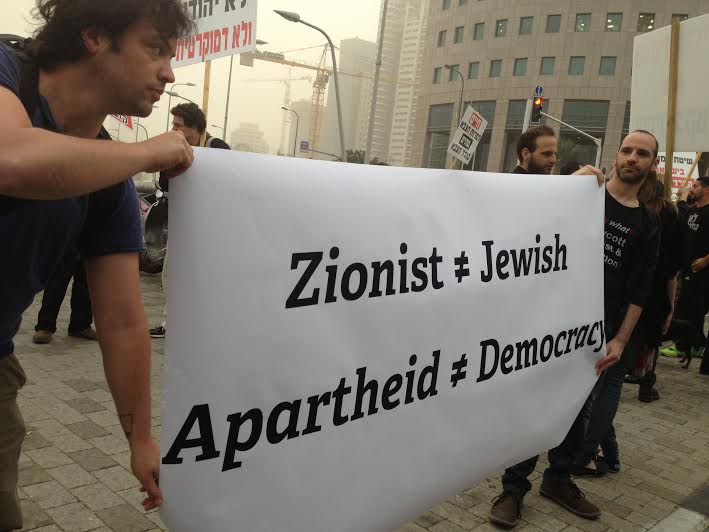
While most secular Israelis detest the Haredim, rare stems of solidarity have recently appeared from the almost negligible number of progressive Israelis. The group Democracy or Rebellion claims that a state that denies civil equality and minority rights has no democratic virtue. In its activities it also reaches out to the ultra-Orthodox community and had posted its message of solidarity on the walls of Me’ah She’arim in Jerusalem as well as demonstrating their support in Tel-Aviv.

A whole new discourse is now emerging within the Haredi community. Some call for a political re-alignment with progressive parties and even with elements on the radical left. Others call to boycott the settlements and their produce, while a growing number of rabbis call on Jews abroad to boycott and divest from Israel at large. One Hassidic group went as far as making plans to migrate en masse to the US, seeking political refuge there with the assistance of American senators.

Neither Jewish nor democratic

During Cameron’s visit at the Knesset, Prime Minister Netanyahu’s speech focused on four points. He declared that the boycott is racist, that Jews have religious-nationalist rights to the land and that indigenous Palestinians hardly existed before the Zionist colonization of the land. Aside of the fact that these claims are patently false, a more rational and humane approach would be to propose an end to the criminal policies leading to boycotts, insisting on equality between Jews and non-Jews and acknowledging the rights of all indigenous people.

Finally, Netanyahu argued that the Balfour Declaration validates Zionist exclusive rights over the land and that this is the will of Jews worldwide. The declaration states, however, that “nothing shall be done which may prejudice the civil and religious rights of existing non-Jewish communities in Palestine” and the political assassination of de Haan by the Zionists can hardly be regarded as a form of agreement between Jews and Zionists. Therefore, it would have been appropriate for the British Prime Minister to correct his colleague and explain that the Balfour Declaration, as unfair as it is, has never recognized the right to dispossess, expel or subjugate.

The so-called “Jewish and democratic” state is neither Jewish nor democratic. Religiously speaking, Zionism is a secular movement that went as far as dehumanizing and mocking the religious Jews of Europe. Israel’s majority is secular rather than religious, while it can hardly be argued that the state’s oppressive policies are in agreement with Jewish values. As religion has been “nationalized”, hardships also exist for those practicing Jews who choose a different path from the state sanctioned form of Judaism.

Ethnically, the majority of world Jewry prefers to live abroad rather than in Israel. At the same time, Israeli figures show that ethnic Jews are no longer a majority between the river and the sea, while not even counting the many Palestinians living in exile.

Paramount to the Zionist project in Palestine is the claim that the land is exclusively Jewish and that all others, even its indigenous people, are alien and unwanted. It is therefore no coincidence that Israel refuses to have a constitution or to acknowledge an Israeli nationality since this would mean, at least on paper, that its citizens are to be treated as equals. Instead, the privileged group is defined as having a “Jewish” nationality while the others may be “Arab,” “Druze” or “Circassian,” none of which are nationalities. On this basis, discrimination has been codified into law.

The Israeli regime can therefore best be characterized as an ethnocracy which practices the Crime of Apartheid as defined by international law. Israel is only “Jewish” in the ethnic-supremacist sense, in the same way that South Africa was white. Consequently, the demand to recognize its Jewish character is just as questionable as legitimizing white supremacy in South Africa at the time.

After many decades, new bonds between anti-Zionists – ultra-Orthodox, Palestinians, and progressives – are now being forged. While dispelling the myth of Zionism, a new path is being paved in the Holy Land.

Let us walk that path.

By Ronnie Barkan and Joshua Tartakovsky, photo by Tamar Aviyah
Earlier versions of this article appeared on AlterNet and Tikkun Daily

***

Ronnie Barkan is an Israeli human rights activist, conscientious objector and co-founder of Boycott from Within, a group of Israeli citizens and residents that supports the Palestinian call for Boycott, Divestment and Sanctions (BDS).
Follow at: @ronnie_barkan

Joshua Tartakovsky comes from an ultra-Orthodox family in Jerusalem, went to a Zionist-Haredi army unit and is a graduate of Brown University and the LSE. He is an independent researcher and filmmaker.

Bhutan’s Missing Pillar of Happiness: The Truth

Bhutan by Anja DisseldorpOn March 20, the world celebrated International Day of Happiness, a day initiated by the Kingdom of Bhutan at the United Nations in 2012. The small Himalayan country of about 730,000 people became famous for introducing to the world Gross National Happiness (GNH), a holistic development index that goes beyond the solely economic focus of Gross Domestic Product (GDP) to measure the emotional and spiritual well being of Bhutan’s people. It was a revolutionary idea by the fourth Dragon King Jigme Singye Wangchuck that continues to resonate in the West.
March 24 is the United Nations International Day for the Right to the Truth Concerning Gross Human Rights Violations and for the Dignity of Victims. This day honors the important work of Archbishop Oscar Arnulfo Romero, who was assassinated on March 24, 1980 after years of denouncing violations of human rights in El Salvador. More broadly, the purpose of the day is “to promote the importance of the right to truth and justice” for victims of gross and systematic human rights violations.

I live in the contradiction between these two United Nations observances. I am a victim of gross human rights violations and I am from Bhutan, land of Gross National Happiness.

It may be the West’s long-standing tendency to romanticize the East as Shangri-La, the cloud-shrouded utopic counterpart to its own well-lit capitalistic world, that has made it so easy for otherwise critically-minded skeptics to accept Bhutan’s GNH campaign without much question. However, behind this government-proclaimed happiness lurks a reality of ethnic purging, property confiscation and redistribution, and a systematic erasing of history, all in the name of the government’s “One Nation, One People” policy. In fact, the last three decades have brought little happiness to my Nepali-speaking people, known as Lhotsampas, who have inhabited Bhutan’s southern foothills since the times of British India.

Beginning in the late eighties, the Bhutanese government’s “One Nation, One People” campaign led to a violent ethnic cleansing of its southern population. According to the Global Post:

“By the end of 1990, the ‘Bhutanization’ campaign had escalated to harassment, arrests and the burning of ethnic Nepali homes. Many fled, but the army also expelled tens of thousands, forcing them to sign forms renouncing any claims to their homes and homeland.”

All of this happened to my people. My 60-year-old father and several brothers were beaten publicly, one imprisoned and tortured for five years. In total, the Royal Government’s harsh campaign created an estimated 108,000 Lhotsampa refugees, evicting a staggering one-sixth of Bhutan’s total population. Lhotsampas who remain in Bhutan today continue to endure treatment as second-class citizens, while their history is being erased before their eyes. For example, after the redistribution and resettlement of northern Bhutanese in the lands of Bhutanese refugees, the names of the villages, towns and landmarks are changed. Thus, my little village known as “Surey” since the first settlement of Lhotsampas is now rechristened as “Jigmecholing” like thousands of others.

While many, like myself, have found refuge in other countries, thousands more still languish in refugee camps, and none have been allowed to return to their homes. Even those who have settled into new lives in the United States and elsewhere are rankled by what they perceive as the government’s concerted effort to erase the facts from the world’s collective memory and to rewrite history in such a way as to frame Lhotsampas as recent immigrants to a country that had been their homeland for generations.

The other tactic used by the government to discredit Lhotsampas is to frame them all as terrorists. Indeed, in response to the government’s brutal and relentless policies of ethnic purging, groups associated with Lhotsampas youths have carried out violent activities along Bhutan’s border with India. Extremists have staged protests, burnt the national dress, tried to destroy bridges, and have even killed people. However, the overwhelming majority of Lhotsampas, who hold up Gandhi as a hero of nonviolence, condemn these activities. Such violent behavior does not represent the Southern Bhutanese community, and the government has a duty to decipher right from wrong. Instead, it branded all of its southern citizens as anti-nationals, distributing images of violence carried out by fringe groups to foreign visitors in order to portray a democratic uprising as a terrorist movement. But where are the pictures of the police killing Lhotsampas on the streets?

We are calling for the international community to urge a Truth and Reconciliation Commission in order to reveal the human rights abuses of the Bhutanese government against the Lhotsampa people. The world has a right to know our stories as Bhutan refugees and to keep our true history in Bhutan even if they cast a shadow on Bhutan’s well-loved policy of “Gross National Happiness.”

Sign the petition for a Congressional Hearing about Bhutan: Ethnic Cleansing vs Gross National Happiness.

Written by Dick Chhetri, who can be reached at [email protected]

Photo by Flickr User Anja Disseldorp

How Neoliberalism and NGOs Stunt Civil Society: Reflections on Palestine

PalestineFlagFlickrFreeTextureDesignsThe act of giving to charities has become synonymous with creating a better world. Yet charities have also infiltrated our society, soliciting donations with constant advertisements.


Of course, the act of giving, purportedly for selfless reasons, results in good feelings and perhaps does help build schools or hospitals in some communities. But what are the larger consequences of the charity industrial complex, particularly of international charities that operate in the developing world?

It is oftentimes Non-Governmental Organizations [NGOs] such as Save the Children or Ducere Foundation that serve as charities. The number of NGOs has risen drastically over the past few decades, and now span across various categories – BINGOs [Business-friendly or Big International NGOs], DONGO [Donor Organized NGO], QUANGO [Quasi-Autonomous NGO], INGO [International NGO], and so on. First coined in 1945 by the United Nations, NGO is defined as a “not-for-profit group, principally independent from government, which is organized on a local, national or international level to address issues in support of the public good.”

There are polarizing views about the NGO industry – some regard it as groups of ‘do gooders’ that promote liberal democracy, while others see it as imperial spreaders of Eurocentric hegemony. NGOs have always been a continuation of imperial power, being created and staffed with colonial administrators in the wake of countries winning their independence. Today’s neoliberal economic modality ensures the global elite to safeguard their capital, and therefore, it’s pertinent to understand the role of the NGO industry within this terrain of power.

Neoliberalism is rooted in the perverse notion that the market and monetization are neutral and natural indicators of social needs, which has resulted in mass privatization of previously state-operated services such as health, education, and military intelligence, in addition to the deregulation of trade barriers in order to enhance the mobility of capital. This toxic ideology usurped the previous ideological hegemon of state-led economics after a series of events equated the ‘free market’ with ‘freedom’ – the 1973 oil crisis, the 1979 Volcker shock and the decline of the Soviet Union. It has since been egregiously applied as a ‘one recipe fits all’ economic model, oftentimes being imposed on developing countries in exchange for debt relief by international financial institutions, such as the International Monetary Fund (IMF).

One component of neoliberalism is the restructuring of the state – deemed to be inherently corrupt – into a neoliberal one. The state’s previous role under the Keynesian (state-led) economic model was to serve as a developmental actor in providing social services. It was expected to provide electricity, healthcare, education, telecommunications, and other basic services. Neoliberalism’s assault on the state has shrunk its role into simply a managerial one, in order to ensure deregulation and advance privatization.

NGOs fit into the narrative by becoming the primary providers of social services like education and healthcare. Although it appears to be the solution to governments not sufficiently providing for their people, it’s a short-term remedy that doesn’t address long-term needs and how constituents ultimately need to advocate for themselves.

While it’s unfair to umbrella all NGOs with the same depiction, most international NGOs encompass a Jekyll and Hyde dichotomy. They are subjected to neoliberal-dictated confines which marginalize the poor, yet (innocently or not) seek to provide much needed services to the poor. The result is a de-radicalized populous, less likely to advocate for state solutions to long-standing geopolitical issues due to the ideological restructuring of the market, the naturalization of NGO services, and the normalization of geopolitical issues as being terminal and requiring the aid-industry to continue its band-aid solutions. This very complex construction of the NGO industry as a ‘Jekyll and Hyde’ apolitical third sector ultimately serves to negate any space for local alternatives to neoliberalism to grow.

In 1949, the United Nations Relief and Works Agency for Palestinian Refugees [UNRWA] was established by the United Nations General Assembly resolution 302 (IV) to provide relief and work programs for Palestinian refugees. The organization was set up as a temporary solution to serve the Palestinians until UN Resolution 194, which facilitates the right to return, takes effect. Because Resolution 194 continues to fail to be implemented, the UNRWA is continuously rewarded, and now provides a variety of social services, including health and education.

NGOs have been ordained as ‘bottom up’ development actors and representatives of the people. Yet the UNRWA’s existence as a temporary provider for over fifty years serves to naturalize its own services while normalizing the geopolitical issue surrounding the occupied territories. Its assertion to be apolitical is contradictory, because the existence of an apolitical actor in a political sphere is ultimately politically influential. The perpetual renewal of the UNRWA’s mandate depoliticizes the necessity to legitimize Resolution 194, that is, the right to return.

Additionally, Israel continues to be exempt from international law as an occupying authority, as denoted by the 1907 Hague Regulations and the Fourth Geneva Convention. Nearly all of the responsibility that the occupier has to its occupied population are negated by Israel, including: the confiscation of private property, the condition to ensure public order and safely, and the the responsibility to ensure public health and food to the population under occupation. Palestinians remain disenfranchised in regards to land access and resources.

The UNRWA does provide services that help a lot of Palestinians, but the larger long-term notions of its presence is difficult to ignore. Additionally, the UNRWA provides services to Palestinians outside of the occupied territories, which only complicates the problem. The provision of these services may (temporarily or not) subdue the desire for the right to return, thereby disintegrating the ‘Palestine question.’ The depoliticization of the Palestine occupation serves as a way for Western parties to detach from the issue and fund relief organizations rather than reconsider the policy actions their governments undertake in continuing the brutal occupation.

This is just one example of how NGOs are often embedded with a contradictory, short-term framework in providing needs but ultimately being detrimental for the interests of local populations. Of course, there are many NGOs that are local and independently funded, with an ability to provide short-term needs while addressing long-term issues. These should not be discounted; however, neither should the imperial construct in which all NGOs ultimately exercise their bargaining power. As neoliberalism continues to undo the victories in social service gains over the past several decades, the material and ideological role of NGOs should be assessed within a changing power terrain that upholds the free market and dismantles the welfare state. Organic, and local alternatives to neoliberalism are desperately needed now, or seemingly benign NGOs’ Jekyll and Hyde nature will inevitably disintegrate the space in which these alternatives can ever be developed.

Written by Sabrina Nasir for Media Roots

Photo by Flickr user Free Grunge Textures

Jeremy Scahill Talks About “Dirty Wars”

ApacheUSArmy-Flickr.jpgAbby Martin talks to Jeremy Scahill, investigative journalist and author of the new book and upcoming film Dirty Wars, an exposé on the expansion of American covert wars fought by US intelligence agencies and the Joint Special Operations Command (JSOC).

They talk about covert operations happening in countries like Somalia, Yemen, and Pakistan, where drone strikes and targeted assassinations are creating resentment of the US, and how the decline of journalism has prevented the American public from seeing the full story. Scahill also discusses instances of extra-judicial killings of American citizens, and the importance of understanding the roots of radicalization and the motives behind the concept of blowback against the US’ ‘Dirty Wars’.

***

***

Page 21 of 62<<...1920212223...>>